EVALUATION OF COPPER RESISTANT BACTERIA FROM VINEYARD SOILS AND MINING WASTE FOR COPPER BIOSORPTION
1,2
Andreazza, R.; 3Pieniz, S.; 2Okeke, B.C.; 1Camargo, F.A.O*
1
Departamento de Ciência do Solo, Universidade Federal do Rio Grande do Sul, Porto Alegre, RS, Brasil; 2Department of Biology, Auburn University at Montgomery, P.O. Box 244023, Montgomery, AL, USA; 3Departamento de Ciências dos
Alimentos, Universidade Federal do Rio Grande do Sul, Porto Alegre, RS, Brasil.
Submitted: February 19, 2010; Returned to authors for corrections: March 04, 2010; Approved: June 21, 2010.
ABSTRACT
Vineyard soils are frequently polluted with high concentrations of copper due application of copper sulfate in order to control fungal diseases. Bioremediation is an efficient process for the treatment of contaminated sites. Efficient copper sorption bacteria can be used for bioremoval of copper from contaminated sites. In this study, a total of 106 copper resistant bacteria were examined for resistance to copper toxicity and biosorption of copper. Eighty isolates (45 from vineyard Mollisol, 35 from Inceptisol) were obtained from EMBRAPA (Empresa Brasileira de Pesquisa Agropecuária) experimental station, Bento Gonçalves, RS, Brazil (29º09'53.92''S and 51º31'39.40''W) and 26 were obtained from copper mining waste from Caçapava do Sul, RS, Brazil (30º29'43.48''S and 53'32'37.87W). Based on resistance to copper toxicity and biosorption, 15 isolates were identified by 16S rRNA gene sequencing. Maximal copper resistance and biosorption at high copper concentration were observed with isolate N2 which removed 80 mg L-1 in 24 h. Contrarily isolate N11 (Bacillus pumilus) displayed the highest specific copper biosorption (121.82 mg/L/OD unit in 24 h). GenBank MEGABLAST analysis revealed that isolate N2 is 99% similar to
Staphylococcus pasteuri. Results indicate that several of our isolates have potential use for bioremediation treatment of vineyards soils and mining waste contaminated with high copper concentration.
Key words: Copper contamination, vineyard soil; mining waste, copper biosorption; bioremediation.
INTRODUCTION
Copper is a very important element. Living organisms require copper as an essential micronutrient. Prior to the recognition of the existence of microorganisms on Earth, the Egyptians, Greeks, Romans, and Aztecs used copper compounds for hygiene and for the treatment of diseases (21). Many fungicides, paints, antimicrobial medicines, oral hygiene products, hygienic medical devices, antiseptics and other
products contain copper as an antimicrobial agent (21). However, at high copper concentrations, it is very toxic to most forms of life in addition to microorganisms (5).
Mining activities of modern societies, extensive industrial use of copper and its widespread use as a pesticide in crop production are major sources of copper pollution of soils and water. Toxic heavy metals pose a serious threat to human health, biodiversity and the ecosystem (3). In vineyards, copper pollution negatively impact grape production. Consequently,
the development of methods to remove toxic heavy metals such as copper from water and soils is currently an area of intensive research (1, 6, 7, 8, 12, 14, 20, 22, 23, 25, 26, 27).
Treatment technologies such as ion exchange adsorption, electrodialyses, precipitation and chemical reduction can be used to remove heavy metals (17). These methods are conversely expensive compared to bioremediation processes. Biological removal of pollutants is attractive in this technology, and it is considered cost-effective and eco-friendly (4, 7, 8, 13, 14, 25). Contaminated environments select resistant microorganisms over pollutants (3). Microorganisms that are resistant to toxic and recalcitrant chemicals can be isolated from polluted sites as well as natural soils and used for bioremediation of environments contaminated with specific chemicals to which they are resistant (6, 7, 15, 27, 28). Biosorption is an important bioremediation process for removal of copper and other toxic heavy metals from the environments. In this study, in search for efficient strains for copper bioremoval, we examined a total of 106 copper resistant bacteria isolated from two copper contaminated vineyard soils and copper mining waste for copper biosorption at high concentration. We employed DNA-based methods to identify promising copper resistant isolates with potential for copper bioremoval from contaminated environments.
MATERIALS AND METHODS
Soil sample
Soil samples were collected from three contaminated soils
from South of Brazil. Two of them were collected from copper contaminated vineyards areas of EMBRAPA experimental station, Bento Gonçalves, RS, Brazil (29º09'53.92''S and 51º31'39.40''W). These two soils were classified as Inceptisol and Mollisol. The copper mining waste sample was obtained from the copper mining area of Caçapava do Sul, RS, Brazil (30º29'43.48''S and 53'32'37.87W). Soil samples and copper mining waste were characterized. Table 1 presents the physico-chemical parameters analyzed in the Laboratory of Soil Analysis from Federal University of Rio Grande do Sul.
Enrichment and Isolation of Copper-Resistant Bacteria Enrichment of copper resistant bacteria was in 100 mL of nutrient broth (NB) (5 g of Peptone and 3 g of Beef extract) in 250 mL Erlenmeyer flasks to which 300 mg L-1 of Cu(II) as copper sulfate (CuSO4.5H2O) was added and pH was adjusted to 7.0. NB was sterilized by autoclaving at 121ºC for 20 min. The soil samples were independently used to inoculate (1%, w/v) sterile medium amended with Cu(II) and incubated for 24 h, with shaking (150 rpm) at 30ºC. Subsequently, 1 mL of enrichment culture was used to inoculate 99 mL of sterile medium amended with Cu(II) and incubated for 24 h, with shaking (150 rpm, 30ºC). This procedure was repeated two times. Cu(II)-resistant bacterial were thereafter purified by repeated streaking on nutrient agar (NA) plates containing Cu(II) (300 mg L-1). The isolates were coded with letter C for Mollisol isolates, letter N for Inceptisol isolates and letter R for waste from copper mining area.
Table 1. Chemical and physical properties of vineyard soils contaminated with copper (Inceptisol and Mollisol) and copper mining wastes (Waste).
Tratamento pH CEC* OM** Clay Cu Zn Mn
1:1 cmolc dm -3
g dm-3 % --- mg dm-3 ---
Inceptisol 6.3 17.2 2.6 19 207 19 55
Mollisol 6.0 13.9 2.5 29 142 18 35
Waste 7.9 - 0.9 2 576 0.8 2
Ca Al Mg H + Al S P K
---cmolc dm-3--- --- mg dm-3 ---
Inceptisol 10.9 0.0 3.1 2.8 6.1 28 142
Mollisol 7.8 0.0 2.1 3.5 5.9 27 167
Waste 24.2 0.0 1.7 - 12.3 32 32
Analysis of isolates for Cu(II)-resistance profile and biosorption
Monoculture isolates were evaluated for Cu(II)-resistance and biosorption as follows: Inoculants were prepared by transferring three loops of each isolate to NB medium amended with 300 mg L-1 of copper and incubated at 30ºC for 24 h with shaking (150 rpm). After, each inoculum was adjusted with sterile saline solution (0.85%) to optical density of 0.85 (OD600) and 0.1 mL of each inoculum was added into 20 mL of NB medium containing 300 mg L-1 of Cu(II) in 50 mL Erlenmeyer and incubated (150 rpm, 24 h, 30ºC). Biomass (cell density) was determined by measuring absorbance at OD600 of appropriately diluted cultures. Copper biosorption was determined by measuring copper remaining in the cell-free supernatant, using an atomic absorption spectrophotometer. Briefly, 5 mL of replicate cultures were subjected to centrifugation (10,000 rpm, 10 min). Total copper was analyzed using atomic absorption spectrometer (Perkin-Elmer 2380). Aliquots of culture supernatant (1000 µL aliquots) were diluted 20 times and injected into the atomic absorption spectrometer. Copper biosorption was calculated as the difference in total copper added to the medium and total copper remaining in the medium after different microbial treatments. (CuBiosor = CuTotal added – CuTotal after growth).
DNA based identification of isolates
Isolates were identified by 16S ribosomal RNA gene sequencing as follows. The isolates were grown by streaking on nutrient agar with incubation at 30ºC for 24 h. DNA of each isolate was extracted from colonies forming units pooled from the nutrient agar plate using Promega Wizard Genomic DNA Purification Kit (Promega, Madison, WI) with slight modification. Briefly, cells were re-suspended in 300 L of nucleic acid lyses solution, incubated at 80ºC for 15 min and allowed to cool at room temperature. RNase solution (1.5 L) was added and incubated at 37ºC for 60 min. Protein precipitation solution (100 L) was added and incubated on ice for 5 min. Following centrifugation, the supernatant was transferred to an ice cold tube with 95% ethanol. The
precipitate was recovered by centrifugation. The pellet was washed with 70% ethanol at room temperature and re-suspended in sterile nuclease free distilled water. Two primers corresponding to E. coli positions 27F (5’-AGATTTGATCMTGGCTCAG-3’) and 1492R (5’-TACGGYTACCTTGTTACGAC TT-3’) were used for PCR amplification of the 16S ribosomal RNA (18). The PCR reaction mixture consisted of 12.5 L of PCR master mix (Promega, Madison, WI), genomic DNA template (0.5 L), primer 27F (2.5 L=12.5 pmol), primer 1492R (2.5 l=12.5pmol) and made up to 25 l final volume with nuclease-free water. The 16S rRNA gene was amplified using a 35-cycle PCR (initial denaturation, 95ºC for 5 min; subsequent denaturation, 95ºC for 0.5 min; annealing temperature, 50ºC for 1 min; extension temperature, 72ºC for 1 min and final extension, 72ºC for 5 min). The PCR amplification products were analyzed by electrophoresis on a 1% agarose gel. Millipore Montage PCR filter units (Millipore, Billerica, MA) were used to remove primers, salts, and unincorporated dNTPs according to the manufacturer’s instructions. DNA cycle sequencing was performed using BigDye terminator kit (Applied Biosystems, Foster City, CA) with sequencing primer 519r (5’-GWATTACCGCGGCKGCTG-3’) in independent reactions at the Institute of Integrative Genome Biology (IIGB) of UCR, Riverside, CA.
DNA Sequence Similarity and Phylogenetic Analysis GenBank BLAST (N) was used for homology searches. Phylogenetic and molecular evolutionary analyses were conducted using MEGA version 4.1 (30). Nucleotide sequence similarity searches were conducted by Genbank BLAST (N). The ribosomal RNA gene sequences were submitted to the GenBank database under accession numbers ranging from FJ577657 to FJ577671.
RESULTS
Biosorption of Cu(II) by isolates
from Mollisol collected from vineyard soil polluted with copper. Maximum biomass development at high copper concentration (300 mg L-1) was observed with isolate C28, C40, C41 and C44. Cu(II) biosorption was maximal in cultures
of isolates C12 (62.21 mg L-1 in 24 h) and C14 (61.77 mg L-1 in 24 h). Isolate C34 displayed the lowest Cu(II) biosorption (6.48 mg L-1 in 24 h) although it grew luxuriantly (1.55 OD600) units at high concentration of Cu(II) (300 mg L-1).
Table 2. Biomass levels and Cu(II) bioremoval in cultures of isolates from vineyard Mollisol incubated in NB medium contaminated with 300 mg L-1 of Cu(II) and incubated at 30ºC for 24 h with orbital shaking.
Isolates Biomass Cu(II) bioremoval Specific Cu(II) bioremoval ---- OD600 ---- ---- mg L
-1
---- --- mg L-1/OD units ---
C1 1.16±0.0643* 12.53±0.6330 11.73±0.096
C2 1.53±0.0464 20.14±1.0338 13.25±0.848
C3 1.71±0.0122 34.91±3.1758 20.41±1.890
C4 1.14±0.0343 18.57±0.3165 15.76±0.712
C6 1.57±0.0328 31.78±2.2971 20.24±1.301
C7 1.16±0.0475 35.36±3.1652 32.10±1.762
C8 1.45±0.0101 15.88±1.5826 11.12±1.146
C9 1.22±0.0250 13.20±0.9496 10.88±0.494
C11 1.31±0.0227 36.03±1.5826 26.66±1.208
C12 1.19±0.0219 62.21±2.5322 53.71±1.773
C14 1.16±0.0250 61.77±2.0675 53.72±2.900
C15 0.83±0.0435 29.09±2.9805 36.83±6.043
C16 0.85±0.0125 16.56±0.6330 19.82±0.490
C17 0.80±0.0195 13.87±1.2661 17.00±1.020
C18 0.64±0.0709 20.14±1.5826 33.07±2.614
C20 0.93±0.0128 27.30±3.7983 28.83±4.064
C21 1.58±0.0554 34.69±1.5826 21.75±0.068
C22 0.89±0.0424 18.79±1.8091 21.13±1.781
C24 1.01±0.0478 29.99±5.4273 29.09±5.062
C28 1.92±0.0080 25.96±0.6330 13.59±0.371
C30 0.84±0.0265 41.40±7.9131 51.04±8.672
C31 1.75±0.0301 17.90±2.5322 10.59±1.560
C34 1.55±0.0242 6.48±0.9496 4.07±0.534
C35 1.59±0.0092 10.74±2.8429 6.71±1.746
C36 1.67±0.0457 19.24±1.3675 11.01±0.139
C37 1.60±0.0168 31.33±1.1265 19.81±0.194
C38 1.03±0.0319 10.29±1.3675 9.91±1.303
C39 1.52±0.1418 8.95±1.1265 5.79±0.223
C40 1.91±0.0269 24.61±2.3260 12.99±1.365
C41 1.89±0.0289 20.59±1.9512 10.90±1.057
C42 1.65±0.1697 17.45±3.6458 10.12±2.210
C43 1.52±0.1072 24.61±6.3305 15.68±2.827
C44 1.91±0.0347 41.40±2.2157 22.13±1.710
C45 1.16±0.0470 15.21±1.8991 12.20±1.367
C46 1.00±0.0246 17.45±3.6458 17.75±3.899
C47 1.24±0.0962 12.98±2.1154 9.27±0.596
C48 1.63±0.0248 15.88±1.5826 9.67±0.454
C49 1.56±0.0204 12.98±2.1154 8.30±1.341
C50 1.39±0.0205 15.21±3.9787 11.32±0.902
C52 1.45±0.1317 18.79±0.2584 13.85±1.607
C53 1.45±0.0654 15.21±3.9787 11.05±3.050
C54 1.63±0.0335 26.40±2.0675 16.12±1.155
C55 1.72±0.0829 33.12±1.5720 19.79±1.941
Forty copper resistant bacteria were isolated from Inceptisol collected from copper contaminated vineyard area (Table 3). Growth of the isolates in media amended with 300 mg L-1 was not directly related to copper biosorption. Cell density was highest in cultures of isolate N18 (1.98 OD600 units). The highest biosorption of copper was recorded in culture of isolate N2 (80.22 mg L-1 in 24 h) while the lowest Cu(II) biosorption (5.85 mg L-1 in 24 h) was observed for the isolate N20 although cell density was high (1.41 OD600 units in 24 h).
Copper biosorption and biomass levels in cultures of 30 bacterial isolates from copper mining waste are presented in Table 4. In general, no direct relationship was observed between amount of biomass in culture and biosorption of Cu(II) by the isolates. Bacterial cell density was highest in cultures of isolates R27 (1.20 OD600 units in 24 h), R17 (1.15 OD600 units in 24 h) and R8 (1.09 OD600 units in 24 h). Maximal Cu(II) biosorption occurred in cultures of isolates R17 (70.47 mg L-1 in 24 h) and R4 (68.34 mg L-1 in 24 h).
Table 3. Biomass levels, Cu(II) bioremoval, and specific copper bioremoval in cultures of isolates from vineyard Inceptisol incubated in NB medium contaminated with 300 mg L-1 of Cu(II) and incubated at 30ºC for 24 h with orbital shaking.
Isolates Biomass Cu(II) bioremoval Specific Cu(II) bioremoval ---- OD600 ---- --- mg L-1 --- --- mg L-1/OD units ---
N1 1.46±0.0195* 32.79±1.4768 22.01±0.957
N2 1.45±0.0426 80.22±2.5696 53.40±2.950
N3 1.36±0.0046 32.16±2.3257 23.75±1.776
N4 1.43±0.0231 51.38±1.3427 36.02±1.280
N5 1.13±0.0424 27.15±2.9239 23.65±1.838
N6 1.20±0.0861 30.91±4.1770 27.84±5.232
N7 1.41±0.0288 35.92±3.0121 25.31±1.773
N8 1.38±0.0202 32.16±0.8861 23.14±0.030
N9 1.33±0.0290 22.56±2.4116 16.97±1.805
N10 1.40±0.0150 30.91±0.8980 22.11±0.234
N11 0.67±0.1021 67.25±1.0070 121.83±0.900
N12 1.44±0.0358 29.66±6.4979 21.20±4.386
N13 1.50±0.2895 43.86±4.3875 33.68±2.649
N14 1.61±0.0315 38.01±3.5030 23.53±2.093
N16 1.61±0.0718 44.69±0.5907 27.22±1.822
N17 1.46±0.0396 36.34±4.2869 24.97±2.920
N18 1.98±0.3887 52.21±4.7257 26.10±1.003
N20 1.41±0.0268 5.85±0.5000 4.17±0.112
N22 1.43±0.0478 31.54±2.0675 22.54±2.503
N23 1.40±0.2701 37.80±0.2954 26.96±0.419
N24 1.38±0.2681 37.17±5.3165 26.44±2.927
N25 1.38±0.2647 32.16±7.0886 23.27±5.036
N26 1.33±0.0146 32.16±4.3609 23.96±3.019
N27 1.30±0.0100 19.21±5.5151 14.64±4.152
N28 1.31±0.0070 29.66±6.0242 22.75±4.735
N29 1.36±0.0166 38.01±2.9338 28.10±2.380
N30 1.41±0.0031 16.50±5.0211 11.72±3.553
N32 1.68±0.0959 32.58±5.2559 18.68±2.279
N33 1.44±0.0201 35.30±2.0675 25.07±1.261
N34 1.39±0.0210 7.10±0.5907 4.98±0.366
N35 1.31±0.0177 21.72±5.0356 16.28±3.634
N36 1.29±0.0122 30.91±1.5060 23.92±1.201
N38 1.26±0.0187 35.09±4.6576 27.56±3.245
N39 1.39±0.0181 41.77±1.7390 30.03±1.059
N40 1.18±0.0657 38.84±2.8432 33.48±2.701
Specific copper removal capacity was generally high in isolates from mining waste. Isolate N11 from vineyard Inceptisol contaminated with copper, however, displayed the highest specific copper bioremoval (121.82 mg/L/OD unit) in 24 h (Table 3). This was followed by isolates R4, R5, R17 and R3 with specific copper bioremoval capacities of 79.70, 67.21,
61.46 and 64.61 mg/L/OD unit in 24 h respectively (Table 4). Statistical evaluation of copper removed by each isolate based on remaining copper in culture supernatant, however, showed that isolate N2 from copper contaminated vineyard Inceptisol was significantly higher than others isolates. Isolates N11, R4 and R17 removed similar levels of copper from the culture.
Table 4. Biomass levels and Cu(II) bioremoval in cultures of isolates from copper mining waste incubated in NB medium contaminated with 300 mg L-1 of Cu(II) and incubated at 30ºC for 24 h with orbital shaking.
Isolates Biomass Cu(II) bioremoval Specific Cu(II) bioremoval ---- OD600 ---- --- mg L-1 --- --- mg L-1/OD units ---
R1 0.81±0.0009* 35.06±1.1920 43.45±1.528
R2 0.92±0.0106 34.22±0.6438 37.48±1.236
R3 0.94±0.0705 56.55±7.7480 36.84±0.900
R4 0.80±0.0151 68.35±4.6992 79.70±5.918
R5 0.84±0.0012 53.60±5.2693 67.21±6.448
R6 0.94±0.0045 44.33±1.3547 53.06±3.562
R7 0.82±0.0002 44.75±3.1631 49.54±1.826
R8 1.09±0.0403 40.75±1.4900 28.98±0.993
R9 0.89±0.0042 31.27±0.4214 35.46±2.351
R10 0.89±0.0024 31.69±2.0789 53.35±3.408
R11 0.84±0.0092 47.28±2.7094 62.70±3.122
R12 0.85±0.0219 52.34±2.4331 52.10±1.854
R17 1.15±0.0422 70.46±0.7299 76.49±3.448
R18 0.84±0.0226 36.74±3.8007 44.77±5.862
R19 0.73±0.0012 29.58±0.9733 40.79±1.439
R20 0.86±0.0415 34.64±1.3547 41.18±3.019
R21 0.82±0.0019 31.69±1.4800 38.70±1.845
R22 0.86±0.0099 39.69±1.2875 45.96±1.089
R23 0.67±0.1426 40.54±1.7032 44.00±1.299
R24 0.90±0.0250 27.89±0.8773 31.30±0.851
R25 0.85±0.0257 37.17±2.1212 44.01±3.490
R26 0.80±0.0073 30.42±1.7546 38.03±2.596
R27 1.20±0.0193 36.32±0.8429 30.26±0.718
R28 0.78±0.0061 30.84±1.9003 39.43±2.634
R29 0.79±0.0125 27.89±0.9733 36.38±0.935
R30 0.85±0.0047 23.68±1.1150 27.96±1.447
*Values are means ± standard error of the mean.
Identity of selected isolates based on 16S rRNA gene sequence
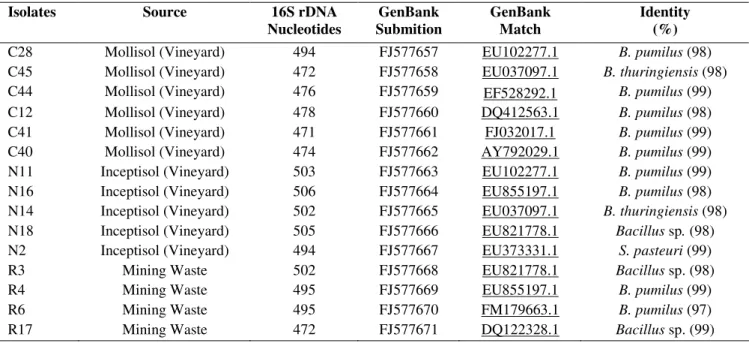
Fifteen bacterial isolates selected on the basis of copper biosorption and resistances to high copper concentration were identified by 16S rRNA gene sequence analysis. Nucleotide sequences in the range of 471-506 nucleic acid bases (Table 5) were used for Genbank blast analysis and construction of phylogenetic tree. Most of the isolates were identified as
Bacillus species in the phylum Firmicutes. Nine isolates (C28; C44; C12; C40; C41; N11; N16; R4 and R6) were identified as
Bacillus pumilus. Two isolates (C45 and N14) were identified as Bacillus thuringiensis and three (N18; R3 and R16) as
Bacillus sp. One isolate was identified as Staphylococcus
98% similar to the Genbank match and 97% similarity was observed for isolate R6. Figure 1 presents the phylogenetic
relationship among selected isolates from three different copper contaminated areas in study.
Table 5. DNA-based identification of isolates from different contaminated soils vineyard Mollisol (C), vineyard Inceptisol (N) and copper mining waste (R).
Bacillus pumilus; FJ577657; C28
Bacillus pumilus; FJ577662; C40
Bacillus sp.; FJ577671; R17
Bacillus pumilus; FJ577660; C12
Bacillus pumilus; FJ577664; N16
Bacillus sp.; FJ577666; N18
Staphylococcus pasteuri; FJ577667; N2
Bacillus pumilus; FJ577669; R4
Bacillus pumilus; FJ577661; C41
Bacillus pumilus; FJ577659; C44
Bacillus sp.; FJ577668; R3
Bacillus pumilus; FJ577663; N11
Bacillus pumilus; FJ577670; R6
Bacillus thuringiensis; FJ577665; N14
Bacillus thuringiensis; FJ577658; C45 100
100 100
99 100
100
98 50
29
30 38
0.0 0.1
0.2 0.3
Figure 1. Phylogenetic tree showing evolutionary distance among selected isolates from three copper contaminated areas based on 16S rRNA gene sequence. The number at each node is the bootstrap from 100 replicates. The scale is the evolutionary distance value.
Isolates Source 16S rDNA
Nucleotides
GenBank Submition
GenBank Match
Identity (%) C28 Mollisol (Vineyard) 494 FJ577657 EU102277.1 B. pumilus (98) C45 Mollisol (Vineyard) 472 FJ577658 EU037097.1 B.thuringiensis (98)
C44 Mollisol (Vineyard) 476 FJ577659 EF528292.1 B. pumilus (99) C12 Mollisol (Vineyard) 478 FJ577660 DQ412563.1 B. pumilus (98) C41 Mollisol (Vineyard) 471 FJ577661 FJ032017.1 B. pumilus (99) C40 Mollisol (Vineyard) 474 FJ577662 AY792029.1 B. pumilus (99)
N11 Inceptisol (Vineyard) 503 FJ577663 EU102277.1 B. pumilus (99) N16 Inceptisol (Vineyard) 506 FJ577664 EU855197.1 B. pumilus (98) N14 Inceptisol (Vineyard) 502 FJ577665 EU037097.1 B.thuringiensis (98) N18 Inceptisol (Vineyard) 505 FJ577666 EU821778.1 Bacillus sp. (98)
N2 Inceptisol (Vineyard) 494 FJ577667 EU373331.1 S. pasteuri (99)
R3 Mining Waste 502 FJ577668 EU821778.1 Bacillus sp. (98)
R4 Mining Waste 495 FJ577669 EU855197.1 B. pumilus (99)
R6 Mining Waste 495 FJ577670 FM179663.1 B. pumilus (97)
DISCUSSION
Copper is one of the toxic heavy metals of concern in the environment. Toxicity of heavy metals is largely due to their presence in aqueous systems in ionic forms, which are easily absorbed by living organisms (2, 3). There is increasing interest in the use of microbial biomass for biosorption of heavy metals from the environment. Biosorption of heavy metals involve accumulation of the metals in microbial biomass with subsequent recovery and remediation through bioremediation or chemical technologies. Copper resistant microorganisms with the capacity to adsorb copper on biomass can be used as bioremediation tools to remove copper from contaminated terrestrial and aquatic environments (1).
Several bacteria isolated in this study demonstrated tolerance to extremely high copper concentration. An
Agrobacterium tumefaciens, strain CCNWRS33-2 grew in 2.0 mM or 127 mg L-1 of copper in TY liquid medium (5 g tryptone, 3 g yeast extract, and 0.7 g CaCl2·2H2O per liter), (YMA) (29) but our isolates resisted up to 300 mg L-1 of Cu(II) in nutrient broth medium, in which they have almost the same composition. The isolate A. tumefaciens CCNWRS33-2 removed 6.35 mg L-1 of Cu(II) after 36 h (29), and our best isolate (N2) removed 80 mg L-1 after 24 h, being much more efficient on copper bioremoval. One isolate was identified as
Staphylococcus pasteuri. There is little or no published
information on copper biosorption by the genus
Staphylococcus. However, Staphylococcus warneri was isolated from sediment slurry contaminated with Se (24). Microbial communities are affected by environmental pressures which decrease natural populations and select microbes resistant to contaminants (3). Selenate reducing
Bacillus species were abundant in sediment slurries from an
evaporation pond heavily polluted with Se and salt (24).
Bacillus is an important bacterial genus for bioremediation of heavy metals in different heavy metal contaminated areas (13, 16).
In general, the isolates from the copper mining area showed stronger capacity for copper biosorption. Isolates from
copper mining waste area, R4, R17, R3 and R6 removed as much as 70 mg L-1 from liquid medium in 24 h. A
P. putida
CZ1 (6) and Pseudomonas sp. NA (1) removed from liquid medium 20 to 25 mg L-1 in 24 h. Staphylococcus pasteuri N2 isolated in our work from vineyard soil polluted with Cu(II) displayed the highest copper biosorption capacity and removed as high as 80 mg L-1 of Cu(II) in 24 h. On the contrary, isolate N11 (B. pumilus) showed the highest specific rate of copper biosorption calculated relative to cell density. This parity in copper removal capacity of the two isolates indicates that copper biosorption can be directly related to biomass as observed with S. pasteuri N2.
High sorptive capacity of prokaryotic (29) and eukaryotic (19) microorganisms are due to components of cell walls that offer an array of functional groups with metal binding capacity. Metals can also be accumulated in the cell cytoplasm (3), but some studies show that higher copper concentrations are linked to the cell wall than the cytoplasm in one prokaryote specie (29). Copper is one of the metals with great potential for bioremoval from contaminated environments through biosorption. In a comparative study (11) on selective binding of different metals to the cell wall of Pseudomonas sp., Cu(II) had much more affinity than other heavy metals like Ni(II), Co(II) and Cd(II) when evaluated together.
In summary, we evaluated copper biosorption by several environmental isolates of copper resistant bacteria. DNA-based methods were employed to characterize selected highly copper resistant isolates. Our results showed that several of the isolates have good potential for copper bioremoval from complex environments contaminated with copper.
ACKNOWLEDGEMENTS
REFERENCES
1. Andreazza, R.; Pieniz, S.; Wolf, L.; Lee, M.; Camargo, F.A.O.; Okeke, B.C. (2010). Characterization of copper biosorption and bioreduction by a highly copper resistant bacterium isolated from copper-contaminated vineyard soil. Sci. Total Environ., 408:7:1501-1507.
2. Arica, M.Y.; Bayramoglu, G. (2005). Cr(VI) biosorption from aqueous solutions using free and immobilized biomass of Lentinus sajor-caju: preparation and kinetic characterization. Physicochem. Eng. A, 253:203-211.
3. Atlas, R.M.; Bartha, R. (1997). Microbial Ecology: Fundamentals and Applications. 4th edn. Benjamin/Cummings Science Publishing, USA, 656 pp.
4. Camargo, F.A.O.; Bento, F.M.; Jacques, R.J.S.; Roesch, L.F.W.; Frankenberger, W.T. (2007). Uso de microrganismos para a remediação de metais. Tópicos Especiais em Ciência do Solo, 5:467-496.
5. Cervantes, C.; Gutierrez-Corona, F. (1994). Copper resistance mechanisms in bacteria and fungi. Microbiol. Rev., 14:121-138. 6. Chen, X.C.; Wang, Y.P.; Lin, Q.; Shi, J.Y.; Wu, W.X.; Chen, Y.X.
(2005). Biosorption of copper (II) and zinc (II) from aqueous solution by Pseudomonas putida CZ1. Colloid. Surface B., 46:101-107.
7. Chen, H.; Yang, B.; Chen, X. (2007). Identification and characterization of four strains of Acidithiobacillus ferrooxidans isolated from different sites in China. Microbiol. Res., doi:10.1016/j.micres.2007.09.002. 8. Chen, X.C.; Wu, W.X.; Shi, J.Y.; Xu, X.H.; Wang, H.; Chen, Y.X.
(2007). Adsorption of copper and zinc on Pseudomonas putida CZ1: Particle concentration effect and adsorption reversibility. Colloid. Surface B., 54:46-52.
9. Chen, Y.Q.; Ren, G.J.; An, S.Q.; Sun, Q.Y.; Liu, C.H.; Ahuang, J.L. (2008). Changes of bacterial community structure in copper mine tailings after colonization of reed (Phragmites communis). Pedosphere, 6:731-740.
10. Chen, X.C.; Hu, S.P.; Shen, C.F.; Dou, C.M.; Shi, J.Y.; Chen, Y.X. (2009). Interaction of Pseudomonas putida CZ1 with clays and ability of the composite to immobilize copper and zinc from solution. Bioresource Technol., 100:330-337.
11. Choudhary, S.; Sar, P. (2009). Characterization of a metal resistant Pseudomonas sp. isolated from uranium mine for its potential in heavy metal (Ni2+, Co2+, Cu2+, and Cd2+) sequestration. Bioresource Technol., 100:2482-2492.
12. Cojocaru, C.; Diaconu, M.; Cretescu, I.; Savic, J.; Vasic, V. (2009). Biosorption of copper(II) ions from aqua solutions using dried yeast biomass. Colloid. Surface A., 335:181-188.
13. Desai, C.; Jain, K.; Madamwar, D. (2008). Evaluation of In vitro Cr(VI) reduction potential in cytosolic extracts of three indigenous Bacillus sp. isolated from Cr(VI) polluted industrial landfill. Bioresource Technol., 99:6059-6069.
14. Freitas, O.; Delerue-Matos, C.; Boaventura, R. (2009). Optimization of Cu(II) biosorption onto Ascophyllum nodosum by factorial design
methodology. J. Hazard. Mater., 167:1:449-454.
15. He, Z.; Gao, F.; Sha, T.; Hu, Y.; He, C. (2009). Isolation and characterization of a Cr(VI)-reduction Ochrobactrum sp. strain CSCr-3 from chromium landfill. J. Hazard. Mater., 163:869-873.
16. Jiang, C.; Sun, H.; Sun, T.; Zhang, Q.; Zhang, Y. (2009). Immobilization of cadmium in soils by UV-mutated Bacillus subtilis 38 bioaugmentation and NovoGro amendment. J. Hazard. Mater., 167:1170-1177.
17. Krishna, K.R.; Philip, L. (2005). Bioremediation of Cr(VI) in contaminated soils. J. Hazard. Mater., 121:109-117.
18. Lane, D. (1991). 16S/23S sequencing. In: Stackebrandt E, Goodfellow M (eds) Nucleic acid techniques in bacterial sistematics. John Wiley and Sons, New York, USA, 171-244 p.
19. Macfie, S.M.; Welbourn, P.M. (2000). The cell wall as a barrier to uptake of metal ions in the unicellular green alga Chlamydomonas reinhardtii (Chlorophyceae). Arch. Environ. Contam. Toxicol., 39:413-419. 20. Melgar, M.J.; Alonso, J.; García, M.A. (2007). Removal of toxic metals
from aqueous solutions by fungal biomass of Agaricus macrosporus. Sci. Total Environ.; 385:12-19.
21. Michels, H.T. (2006). Anti-microbial characteristics of copper. Accessed in July 29th of 2009, <http://www.astm.org/SNEWS/OCTOBER_2006/ michels_oct06.html>.
22. Özer, A.; Gürbüz, G.; Çalimli, A.; Körbahti, B.K. (2009). Biosorption of copper(II) ions on Enteromorpha prolifera: Application of response surface methodology (RSM). Chem. Eng. J., 146:377-387.
23. Sari, A.; Mendil, D.; Tuzen, M.; Soylak, M. (2009). Biosorption of palladium(II) from aqueous solution by moss (Racomitrium lanuginosum) biomass: Equilibrium, kinetic and thermodynamic studies. J. Hazard. Mater., 162:874-879.
24. Siddique, T.; Zhang, Y.; Okeke, B.C.; Frankenberger, W.T. (2006). Characterization of sediment bacteria involved in selenium reduction. Bioresource Technol., 97:1041-1049.
25. Uzel, A.; Ozdemir, G. (2009) Metal biosorption capacity of the organic solvent tolerant Pseudomonas fluorescens TEM08. Bioresour. Technol., 100:542-548.
26. Vilar, V.J.P.; Martins, R.J.E.; Botelho, C.M.S.; Boaventura, R.A.R. (2009). Removal of Cu and Cr from an industrial effluent using a packed-bed column with algae Gelidium-derived material. Hydrometallurgy, 96:42-46.
27. Umrania, V.V. (2006). Bioremediation of toxic heavy metals using acidothermophilic autotroph. Bioresour. Technol., 97:1237-1242. 28. Voss, M.; Thomas, R.W.S.P. (2001). Sorção de cobre e manganês por
bactérias rizosféricas do trigo. Ciência Rural, 31:947-951.
29. Wei, G.; Fan, L.; Zhu, W.; Fu, Y.; Yu, J.; Tang, M. (2009). Isolation and characterization of the heavy metal resistant bacteria CCNWRS33-2 isolated from root nodule of Lespedeza cuneata in gold mine tailings in China. J. Hazard. Mater., 162:50-56.