Automatic Control of a Dual-SMA Actuator System
Ion-Cornel Mituletu, Dorian Anghel
The present paper describes research results considering the automatic control of a prehension module using a dual shape memory alloy (SMA) actuator. The offspring targeted a high-speed prehension appliance by means of adjusting constants of a PID controller. Furthermore, SMA springs are individually driven according each one’s particularities, aim-ing at prolongaim-ing life of dual SMA actuator, with respect to parametric values given by manufacturer. Problem of process control is ap-proached from few perspectives: automatic control, software imple-mentation and electronic performance, the first being the one sub-jected to following discussion.
Keywords: Dual-SMA actuator, error prediction, heat control, PID con-troller, prehension appliance
1. Introduction
Over the past years it has been shown the great importance and significance of memory shape alloy in a wide domain of applications from different industrial branches, most of them concerning our comfort, moreover our needs.
The research in discussion shows a possible solution that can be used in driv-ing a prehension module, the main target bedriv-ing implementation of an automatic control of the module by means of a hardware platform. Prehension module is driven by a dual SMA actuator, controlled by heat obtained using electric power. The automatic control is achieved by means of a PID controller. PID controllers are widely used in the process-control industry, mainly because of their effectiveness and simple structure.
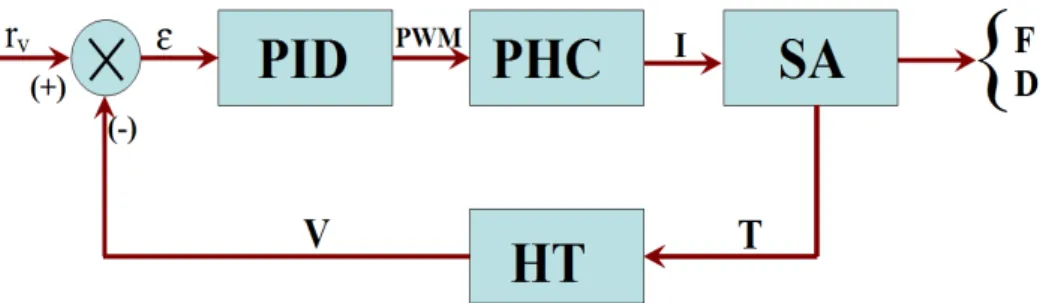
Diagram from Figure 1 shows functional blocks of automation process where rv- reference voltage, ε - error, PID - controller, PWM - controlling signal, PHC -
power module for heat control, I - current intensity, SA - springs actuator, T - temperature, HT - heat transducer, V - voltage, F - force and D - displacement.
ANALELE UNIVERSITĂŢII
Figure 1. Automation block diagram
The prospects for hardware platform are:
- prolonging life of SMA springs from dual actuator configuration, considering springs features and the fact that are individually driven;
- achieving a high speed module of prehension with respect to parametrical values given by manufacturer;
- controlling module of prehension by adjusting and correcting PID constants.
2. Problem Formulation
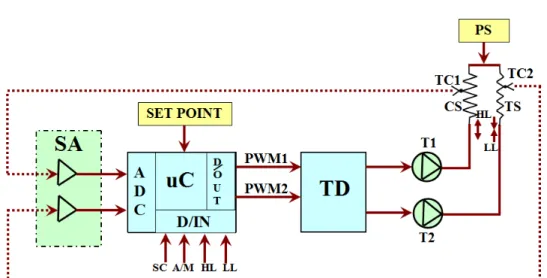
Hardware system designed for automatic control of a given prehension mod-ule driven by a dual-SMA actuator consists of two thermocouples, dual micropower Bi-CMOS operational amplifier, microcontroller (µC) C8051F005, SC1302D dual low-side MOSFET driver, two MOSFET transistors and dual-SMA actuator.
Thermocouples are used for proportionally conversion of heat to voltage. Elec-trical signals obtained are magnified with dual micropower Bi-CMOS operational amplifier. Output voltages are converted by ADC module of uC, values needed for determining the error. Using error values, PID algorithm performs a reference for generating PWM (pulse width modulation) in PCA module. SC1302D drives transis-tors with the PWM. The loop is completed by achieving heat control through cur-rent intensity modulation.
Functional blocks diagram is browsed in Figure 2, where: - PS is a 5 Vcc / 5 A power supply;
- TC1 fixed on CS (compression sprigs) having a high limit of 65 °C; - TC2 fixed on TS (tension sprigs) having a high limit of 55 °C; - SA block consisting of micropower Bi-CMOS operational amplifier;
- uC C8051F005 containing ADC, processing core, input (SC-sense-changing switch, A/M - commutator, HL, LL - limiters for displacement) and output (PWM1, PWM2) ports;
- TD is transistors driver;
Figure 2. Detailed functional blocks diagram
2.1. Automatic process feedback
For feedback design two K-type thermocouples, a dual micropower Bi-CMOS operational amplifier and the ADC module of C8051F005 were used.
Heat to voltage conversion was made by two standard Nickel-Chromium K - ther-mocouples having following features: limits of error 2.2°C or 0.75% above 0 °C, 2.2 °C or 2.0% below 0 °C, special 1.1 °C or 0.4%.
In this application were used highest temperature values to speed up operat-ing process: 55 °C for Nitinol tension sproperat-ings and 65 °C for Nitinol compression springs. Electric values associated with above mentioned temperature values are 2.23 mV and 2.644 mV. Considering low voltage given by thermocouples, a special amplifier is required.
The operational amplifier is capable of precision, low-power, single-supply op-eration. It is unity-gain stable, has low input offset voltage maximum ±150 µV, rail-to-rail output swing and low input offset current 0.3 nA. As packing marking was used MCP617-I/P meaning 14-lead PDIP.
Analog to digital conversion of voltage value from MCP617 output, is per-formed by ADC module of C8051F005.
2.2. Setting up Microcontroller C8051F005
Implementing a PID algorithm is required for generating PWM signal used to control automatically SMA springs.
⋅ + ⋅ + ⋅ =
∫
dt t d T dt t T 1 t K t R D t 0 I P ) ( ) ( ) ( )( ε ε ε , (1)
PID algorithm is considered in order to asymptotically achieve a steady-state for optimal controlling of heating process. Error is determined by subtracting proc-ess value from reference value.
Proportionally with value resulted from PID algorithm, module PCA generates an 8-bit PWM signal.
2.3. Power module for heating control
Basically, the advantage of SMA springs is that they can recover their original induced shape when exceeding a transition temperature between a low-temperature point and a high-low-temperature point, being able to convert their shape.
Taking into account SMA features, actuator was configured as follows: two compression springs in a serial connection, which can be pressed down to 16 mm and when heated using 3 A current can push outward to 30 mm with 4 N force, linked to two tension spring in a parallel connection, which can be stretched to 60 mm and when heated using 2 A current can shorten to 30 mm with 3.5 N force.
Respecting the imposed energy restriction, SMA control systems can be achieved by implementing circuits in PWM. SMA behavior is parametrically de-scribed by temperature, current intensity, electrical resistance, generated force and displacement. Springs temperature is adjusted using two power transistors in MOSFET technology that varies current from power supply.
SC1302D dual MOSFET driver controls transistors in PWM mode.
3. Problem solution
Proportional control is used to fix the error produced by heating process com-pared to reference value which represents the expected temperature value, error calculated with:
ε = Treference-Tprocess , (2)
Proportional control works similar to the gain control, called KP (proportional)
factor in PID, the control response resulting as a product of proportional constant, KP and error, ε. Using just the proportional control alone will result an irregular
heating behavior, therefore, we have to combine it with integral or derivative con-trol, or both of them, in order to obtain desired actuator response.
Integral control, KI, helps reducing the accumulated error produced by
Derivative control, KD, serves at speeding up proportional control error
re-sponse, thus, reducing irregular heating behavior. Therefore, the faster process produces an error, the higher derivative control response output value.
In order to establish PID factors (see Table 1), KP, KI, KD, certain steps must
be followed:
-turn off integral and derivative control by setting KI and KD to zero;
-slowly increase KD by factor of 10 and if the heating process tends to oscillate
de-crease it;
-slowly increase KI by factor of one close to oscillation;
-slowly increase KD by factor of one until it becomes stable;
Table1. PID factor values for two spring types
TC TT
C1 C2 C3 C1 C2 C3
KP 2.5 1.87 1 2.65 2.16 1
KI 1 0.156 0.038 1 0.23 0.046
KD 0 0.028 0.2 0 0.026 0.29
In Figure 3 a and b, families of temperature characteristics (C1, C2, C3) are
presented. Results are obtained for tension (TC), as well as for compression springs
(TT), considering PID parameters established in Table 1.
a) b)
Figure 3. Temperature characteristics for a) tension springs and b)compression springs
It can be observed that in both situations (Figure 3 a and b) temperature characteristic C1 exceeds maximum temperature limit, showing an overshooting,
undesired result. On the other hand, characteristic C3, for both spring types, never
reaches upper temperature limit, needed for an optimal actuator behavior. Best response is received in case of C2, where steady-state is reached after 4s to 5s. For
this state it important to be noted as a significant result that tension spring reach-es lower limit of 30 mm in 11.3 s and comprreach-ession spring reachreach-es upper limit of 30 mm in 12.5 s.
C3 C1
C2
C1
C2
4. Conclusion
Using µC C8051F005 along with the earlier presented components of hard-ware platform, in a closed-loop configuration, can improve the control of some electro-thermal actuators such as prehension modules and can increase the per-formance of some processes with slow dynamic behavior.
Considering PID constant values, given temperature and current intensity limits, the shortest operating time period for compression/tension of SMA springs was reached. Measured compression time was 12.5 s and measured tension time was 11.3 s.
References
[1] *****
SC1302A/B/C/D/E/F Dual High Speed Low-Side MOSFET DriverPID, Semitech Power Management, 2009, pp. 1-13.
[2] Ampuero S., Bosset J.O., The electronic nose applied to dairy products, Sensors and Actuators B: Chem., v. 94, 2003, pp. 1-12.
[3] Berna A.Z., Clifford D., Boss P., Trowell S., Selection of optimal sen-sor/temperature conditions for wine grape analysis using generalized ad-ditive modeling of thermally cycled metal oxide sensors, Sensors IEEE, 2009, pp. 1117-1120.
[4] Binxin H., Buyin L., Ming L., Integrated current–time characteristic measurement system for multichannel positive temperature coefficient thermistors, Measurement Science and Technology, Volume 22, Number 4, 2011.
[5] Charais J., Lourens R., Software PID Control of an Inverted Pendulum Using the PIC16F684, Microchip AN964, 2004, pp. 1-14.
[6] Iskandarani M., Shilbayeh N., Design and Analysis of a Smart Multi Purpose Electronic Nose System, Journal of Computer Science 1, 2005, pp 63-71.
[7] Jivkov I.C. & All, Computer Controlled Setup for Temperature Meas-urements for Thin Film Deposition, Electronics, 2008, pp. 79-84
.
Addresses:
• Lect. Dr. Eng. Ion-Cornel Mituleţu, “Eftimie Murgu” University of Reşiţa, Piaţa Traian Vuia, nr. 1-4, 320085, Reşiţa, [email protected]