VOLUME
2/1
CUSTOMARY LAWS FOR ACCESS TO AND MANAGEMENT OF
DRINKING WATER IN TANZANIA
This document can be cited as
‘Customary Laws for Access to and Management of Drinking Water in Tanzania’,
2/1 Law, Environment and Development Journal (2006), p. 50, available at http://www.lead-journal.org/content/06050.pdf
Leticia K. Nkonya*
Leticia K. Nkonya, PhD Candidate, Department of Sociology, Anthropology and Social Work, Kansas State University, 2740 Hartland Road, Apt T-1, Vienna, VA 22180, USA, Email: [email protected]
Published under a Creative Commons Attribution-NonCommercial-NoDerivs 2.0 License
IV.
Statutory Water Management Laws in Tanzania
55
V.
Customary Water Management Laws in Bariadi District
56
VI.
Customary Institutions for Water Management
57
VII. Categories of Water Management Laws
58
A. Equitable Water Access Laws
58
B.
Prevention of Water Pollution and Abuse Laws
60
C. Development of Water Source Laws
62
1
INTRODUCTION
For several decades before 1990, management of water resources in most Sub-Sahara African (SSA) countries was the responsibility of central governments. Unfortunately, many large water and other developmental projects that were established and managed by most SSA central governments failed; mainly due to lack of community participation in planning and implementing such projects.1 In the 1990’s,
SSA governments sought to decentralise and devolve administrative and legislative powers to local governments in order to increase the efficiency and participation of local communities in natural resource management.
Although the theoretical advantages of community management have been convincing and the need for devolution policies strong, the actual outcomes of devolution programs in different sectors and countries have been mixed.2 Experience has shown that decentralisation is faced with major challenges, including interest capture by local elites, over-exploitation of natural resources driven by the need to create local revenues, inadequate financing (taxation), arbitrarily imposed fees and levies, and lack of human resource capacity at the local level to plan, manage and implement developmental activities and policies.3 These weaknesses
of decentralisation have prompted an inevitable question of how they could be improved. One of the approaches is to strengthen alternative institutions such as customary institutions which are unwritten living interpretation of customs and norms observed by local communities.
Customary institutions may be defined as humanly devised constraints or complexes of norms and behaviours that are accepted by the community and persist over time by serving collectively valued purposes.4
The laws developed by customary institutions are based on society’s implicit understanding. They include community’s perceptions about the world, the accumulated wisdom of the past, and a current set of values. Thus, customary laws are part of a community’s heritage or culture.5 They are unwritten laws that are maintained from one generation to another through various transmission mechanisms such as imitation, oral tradition, and teaching.6 Examples of customary laws include sanctions, taboos, traditions, cultural norms, beliefs, values, social networks, kinship ties and codes of conduct.7
In many SSA countries, government programs for water management tend to rely on statutory arrangement and ignore the customary laws and institutions.8 However, national and local governments rarely possess enough personnel or money to enforce their laws adequately. Additionally, local communities both filter and
[1] D. Olowu, ‘Local Institutes and Development: The African Experience’, 23(2) Canadian Journal of African Studies 201, 202 (1989).
[2] R. Meinzen-Dick, K.V. Raju and A. Gulati, ‘What Affects Organisation and Collective Action for Managing Resources? Evidence from Canal Irrigation System in India’, 30(4) World Development 649, 651 (2002) and R. Meinzen-Dick, A. Knox, and M. Di Gregorio eds., Property Rights and Devolution of Natural Resource Management: Exchange of Knowledge and Implications for Policy 45 (German: Deutsche Stiftung für Internationale Entwicklung/ Zentralstelle für Ernährung und Landwirtschaft, 1999). [3] R. Prud’homme, ‘The Dangers of Decentralisation’, 10(2) World Bank Research Observer201, 204 and211 (1995), Meinzen-Dick et al., note 2 above at p. 44 and E. Nkonya et al., Who Knows, Who Cares? Determinants of Enactment, Awareness and Compliance with Community Natural Resource Management Bylaws in Uganda 11 (Washington DC: International Food Policy Research Institute, CAPRi Working Paper No 41, 2005).
[4] N. Uphoff, Local Institutional Development: An Analytical Sourcebook with Cases 8-10 (West Hartford, CT: Kumarian Press, 1986) and D.C. North,
Institutions, Institutional Change, and Economic Performance 4 (United Kingdom: Cambridge University Press, 1990).
[5] S. Pejovich, ‘The Effects of the Interaction of Formal and Informal Institutions on Social Stability and Economic Development’, 2(2) Journal of Market and Morality 164, 166 (1999).
[6] C. M. N. White, ‘African Customary Law: The Problem of Concept and Definition’, 9(2) Journal of African Law
86, 87 (1965).
[7] N. Nemarundwe, Negotiating Resource Access 4 (Doctoral dissertation, Department of Rural Development Studies, Sweden: Swedish University of Agricultural Sciences, 2003).
ignore the statutory laws and institutions and use their customary laws and institutions to manage their water resources.
Recent studies have shown that customary laws and institutions are the most influential in land and water allocation and settling land and water use disputes.9 Moreover, customary laws and institutions are viewed to be more successful in managing rural water resources than imposing formal laws.10 This is because most State-centred policies for managing natural resources have failed due to faulty designs for resource management programs, inefficient implementations, and corruption.11
The purpose of this study is to analyse the impact of customary (informal) laws on water management in Tanzania and show how they might be used to complement the statutory (formal) laws. I use Tanzania as a case study since the country has a long history of decentralisation. A recent study done by the World Bank ranked Tanzania as the 12th most politically,
administratively, and fiscally decentralised country in Sub-Sahara Africa.12 Since there are about 120 ethnic
groups in Tanzania, this study will focus on the customary laws and institutions of the Sukuma people of Northern Tanzania. With a population of about 4.5 million people, Sukuma is the largest ethnic group in Tanzania,13 constituting about thirteen percent of the total population in Tanzania.14
As is the case in many Sub-Sahara African countries, Tanzania is legally pluralistic where management of
natural resources is regulated by a multiple legal framework including customary and statutory laws.15
Statutory laws refer to laws that are formally written and changed in legislation and court judgments, and are enforced by the central government.16 Ordinances and bylaws are regulations that are enacted by different levels of local governments. Governmental authorities enforce formal rules by means of sanctions such as fines, imprisonment, and execution.
The enforcement of customary laws takes place through the use of sanctions such as expulsion from the community, ostracism by friends and neighbours, or loss of reputation.17 These methods of customary law
enforcement contrast starkly with the methods used to enforce statutory laws. This difference has a strong bearing on the degree of compliance with both sets of laws. Hence, it will be interesting to analyse the compliance with these laws in this paper. Moreover, the understanding of the relationship and impact of both types of laws is very crucial for the assessment of whether statutory laws support or undermine the contribution of customary laws for water management.
This paper focuses on management of drinking water sources in rural Tanzania. Most sociological studies on rural water management in SSA have addressed water management issues without adequately analysing and depicting customary institutions and how they affect rural water management. Further, most studies in river basin management focus on water for irrigation.18 Few studies have examined how customary and statutory
[9] P. Woodhouse, ‘African Enclosures: A Default Mode of Development’, 31(10) World Development 1705, 1711(2003). [10] E. Schlager , ‘Getting the Relationship Right in Water Property Rights’, in B.R Bruns, C. Ringler and R. Meinzen-Dick eds, Water Rights Reform: Lessons for Institutional Designs
27,43 (Washington DC: International Food Policy Research Institute, 2005).
[11] A. Agrawal and C. Gibson, ‘Enchantment and Disenchantment: The Role of Community in Natural Resource Conservation’, 27(4) World Development 629, 632 (1999).
[12] S. Ndegwa, ‘Decentralisation in Africa: A Stocktaking Survey Africa’, 6 (Washington DC: The World Bank, 2002) available at http://www.worldbank.org/afr/wps/wp40.pdf. [13] P. F. M. McLoughlin, ‘Recent Research in Sukumaland,
Tanzania’, 4(2) The Journal of Modern African Studies 242, 242 (1966).
[14] R. Yasir, The Safari Land, (2003) available at http:// khs.sandi.net/galaxy/galaxy2002_2003/june_13_2003/ article_pages/tanzania.htm.
[15] Maganga, note 8 above at 996 and C.S. Sokile, J.J. Kashaigili and R.M.J. Kadigi, ‘Towards an Integrated Water Resource Management in Tanzania: The Role of Appropriate Institutional Framework in Rufiji Basin’, 28(20-27) Physics and Chemistry of the Earth 1015, 1017 (2003).
[16] R. Meinzen-Dick and R. Pradhan, Legal Pluralism and Dynamic Property Rights3 (Washington DC: International Food Policy Research Institute, CAPRi Working Paper No. 22, 2002).
[17] Pejovich, note 5 above at 166.
institutions influence management of drinking water. Hence, this research will contribute to literature by analysing customary laws and their relation to management of drinking water in rural areas.
2
METHODOLOGY: DATA COLLECTION
Data used in this study was collected from primary and secondary sources. The secondary data collected includes the laws and regulations related to water management at the national and local government levels. The primary data was collected from focus groups discussions, key informants, household surveys, and participant observation. A total of sixteen villages from Bariadi district were sampled for household survey. At the village level, households were randomly selected from a list of household heads. The village household heads sampling frame was obtained from village executive officers (VEO). Population in each village was used as a sampling weight. A total of 223 household heads were sampled and interviewed. The focus groups were assembled from the sixteen villages that were sampled for household survey. To increase the number of focus groups, four additional villages were sampled. Two focus groups from each sampled village participated in the study making a total of 40 focus groups. The key informants who participated in the study comprised of the community elders who had better knowledge of customary laws, local government officials who provided information on local government bylaws and regulations, and the Ministry of Water officials who provided information on central government water laws and policy. Data analysis is mainly qualitative and quantitative.
3
THE STATE OF DRINKING WATER
IN BARIADI DISTRICT
Since the Sukuma people cover a large area, this study is done in Bariadi district. Drinking water sources
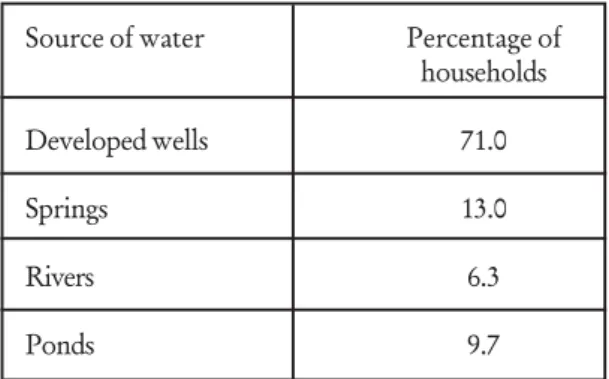
in Bariadi district can be grouped into: community and private water sources. Community water sources include deep wells, springs, rivers, and ponds. Private water sources include sources developed by individuals and water user groups. Shallow wells are the only major private water source in Bariadi district. Drinking water has to be transported from the source to homesteads, mainly by women and children. Table one shows that over a third of the sampled households abstracted drinking water from developed sources which are mainly shallow wells.
Table One: Sources of Domestic Water Supply in Bariadi District
Source of water Percentage of households
Developed wells 71.0
Springs 13.0
Rivers 6.3
Ponds 9.7
Table two shows that mote than 50 percent of rural populations in Tanzania have to walk more than one kilometre to get drinking water in dry season. In Bariadi district, about nineteen percent of households live within one kilometre of drinking water sources in the dry season compared to 48 percent of other rural areas, suggesting that the district is among the water deficit areas of Tanzania.
Table Two: Distance to Drinking Water Sources in the dry Season in Tanzania19
4
STATUTORY WATER MANAGEMENT
LAWS IN TANZANIA
Management of water resources in Tanzania is regulated by Water Utilisation (Control and Regulation) Act No. 42 of 1974 and its subsequent amendments. This is the major legislation on water in Tanzania. The Act declares all the water in the country to be the property of the Republic of Tanzania and it upholds the right of everyone to use water.20 The Republic of Tanzania recognises that water is a scarce resource and therefore a public good with a high value and needs to be available for everyone.21 The Act established a control and regulatory mechanism to administer water rights and to meet its objective of making
water available to everyone. Water right is a legal right that entails a bundle of authorised actions, including the right to use and obtain benefit from water, the right to determine who will have/ not have access to water (exclusion right), the right to regulate water use patterns, and the right to sell or lease water resources.22
According to Water Utilisation Act, people cannot have private ownership of water sources. They can obtain rights to use water by acquiring a water permit, which gives them a legal license to use but not own water. Water permits are issued in consideration of the needs of the applicant and the expected benefits of the proposed water use. The Act requires the applicant to state the use of water, amount required, and period of use, among other needs. The water use right is classified in order of priority whereby water for domestic purposes is given the highest priority, followed by livestock use, irrigation, industry, power generation and mining.23 Percentage of Population
Distance to drinking Tanzania Mainland Rural Tanzania Bariadi District
water sources (km) sample
Less than 1 kilometre 54.9 48.9 18.5
1-1.9 18.8 22.8 23.2
2-2.9 8.5 9.4 36.6
3-3.9 7.8 8.8 9.7
4-5.9 3.2 3.6 11.1
6+ 6.9 8.2 0.93
[19] United Republic of Tanzania, Household Budget Survey 2000/ 2001 49 (National Bureau of Statistics, Tanzania: Ministry of Economic Affairs and Development Planning, 2002) and Household Survey conducted in Bariadi district by the author.
[20] E. Carlsson, To Have and to Hold: Continuity and Change in Property Rights Institutions Governing Water Resources Among the Meru of Tanzania and the BaKgatla in Botswana: 1925-2000
(Sweden: Almqvist & Wiksell International, 2003) and United Republic of Tanzania, National Water Policy, 2002 at 48.
[21] United republic of Tanzania, note 19 above at 48.
[22] E. Schlager and E. Ostrom, ‘Property-rights Regimes and Natural Resources: A Conceptual Analysis’, 68(3) Land Economics 249, 250-251 (1992) and A. Scott, ‘Property Rights and Property Wrongs’, 16(4) The Canadian Journal of Economics 555, 558 (1983).
interrelationship between statutory and customary institutions. This analysis will shed more light on the complementarities or competition of the two sets of institutions and how they could be used to complement each other.
5
CUSTOMARY WATER MANAGEMENT
LAWS IN BARIADI DISTRICT
There is a major difference between property rights vested by the statutory laws and those by customary laws. Discussion with Sukuma elders revealed that water is a gift from God; hence water is regarded as a common pool resource and should be free for everyone. No one can be denied access to a water source for domestic use regardless of the water source. It does not matter whether the water is from natural or developed source, or whether the water source is situated on private or public land. Due to this custom, water vending among the Sukuma is not a common practice unless it is for cattle.27 It is the custom of Sukuma people to share water with their neighbours, friends and relatives (hereafter referred to as social networks). However, respondents reported that free water access to private sources by this social network is normally limited to water for human consumption. If members of a social network need additional water for animals, building, irrigation or other uses they are expected to pay for the water or go to public sources. In the case where a person owns land that is located by the water source, he will have private rights to the land but not to the water that is found on the land. If a person develops a private water source, he or she is expected to share the water with members of social networks. Thus, it is the custom of the Sukuma that no one can restrain anybody from using a water source for human consumption regardless of whether the water source is private or public.28 Although most of the time,
Once a water right is acquired, an individual is supposed to pay water taxes which are water user fees billed to him or her depending on how much abstraction is allowed.24 Thus, statutory laws for water management described above tend to obviate the customary rights since they do not stipulate categorically the role of customary institutions in water management. However, as noted above, enforcement of statutory laws in rural areas is ineffective because of the weaknesses of local formal institutions. Lack of participation by the local communities has further alienated statutory institutions for water management. In case of water user rights in rural areas, respondents reported that an individual is required to obtain land rights to be able to construct a well in a particular piece of land. After construction of a well, an individual holds all the rights to both the land and water.
The majority of people in Tanzania live in rural areas, with strong allegiance to customary institutions. Hence for the majority of rural people, customary institutions are the de facto institutions for access to and use of water resources. The customary laws stipulates that membership in a community ensures the right to access and use the communal water resources because all natural water resources are owned in common by all members of the tribe or community.25 This is contrary to the statutory laws which vests ownership of water on the central government.
According to customary law, surface water is accessible to everyone and people do not need to acquire specific water rights if they are using the water for domestic purposes or for watering livestock. However, the statutory laws stipulate that people have to obtain water rights for irrigation or commercial purposes. Statutory law is greatly impacting the customary arrangements especially when powerful outsiders try to claim local resources. This can happen when private individuals, groups of people and enterprises try to override customary rights by getting formal land titles and formal water rights.26 It will be interesting to analyse the
[24] Sokile and Van Koppen, note 18 above at 1349. [25] H. Cory, Sukuma Law and Customs 132-133 (Connecticut:
Negro Universities Press, 1970) and Carlsson, note 19 above at 101.
[26] Meinzen-Dick and Pradhan, note 16 above.
[27] Cory, note 25 above at 132 and J. Drangert, Who Cares About Water: A Study of Household Water Development in Sukumaland, Tanzania 169 (Pennsylvania: Coronet Books Inc, 1993).
members of social networks are granted access to water, they are nevertheless required to abide by customary laws regarding access to private water sources. They ought to seek permission from the owner before they can draw water. Some private well owners will grant access to water for ‘essential’ domestic needs like cooking, drinking, and washing. Respondents reported that water owners may require compensation if water is procured for non-domestic water use or for domestic use that is not ‘essential’. As far as possible, water for non-domestic use is drawn from public sources. Villagers who are neither neighbours nor relatives may be asked to pay for water. Occasionally, they may be allowed to draw free water if they ask and explain that they do not have money on that day and they are in need of water.
The rule of hospitality is an important one among the Sukuma. Any deviation from community norms is met with a negative social sanction. For example, private water owners who fail to render water assistance to their social networks are regarded as ‘selfish’ and will be ‘disowned’ by the community. It is also believed that the ancestral spirits will punish ‘selfish’ well owners who deny others access to water. Punishment may be in form of a series of ‘bad luck’ (mikosi) such as diseases, sickness, infertility, death, reduction of water flow, or collapse of the walls of the well.
Contrary to expectations, discussion with key informants showed that private well owners use customary laws to govern access and management of water sources. These rules are embedded in the customary laws of the Sukuma. The following customary laws are used to access water on a private well:
1. No one is allowed to have access to private water without permission of the owner/owners.
2. Members of social networks can get free water only if the water is for drinking, cooking and washing. If water is needed for other uses, the people need to pay for it. During scarcity, free water is limited to not more than five buckets (each bucket is about twenty litres).
3. No dirty containers are allowed at the water source.
4. No washing clothes, face, hands, or watering animals at the drinking water sources.
5. Those who belong to Seventh Day Adventist Church (SDA) religion do not work on Sabbath (from Friday when the sun is down to Saturday at sun down). During the Sabbath, no one is allowed to draw water from a well owned by SDA believers.
Private well owners in the study area have a reciprocal obligation to share their water with others. By sharing their water, private well owners expect in return to receive some benefits from water users. Although the well owner may not ask for these benefits, water users understand that they have a reciprocal obligation ‘to pay back’ for the favours they receive from well owners. These benefits include assurance of clean water since it is believed that if well owners share water, there will be no motive for anyone to come and poison the water or bewitch him or her. The principle of reciprocity and the fear of being harmed through poison or witchcraft forces private well owners to share their water. This ensures equitable access to water, but may discourage development of private water since it assures access to private water to those in a social network. Moreover, a private well owner who shares his/her water is assured of help in times of need. They may be assisted by those who draw water in their wells in times of harvest, funerals and wedding ceremonies. People drawing water from private wells may also donate free labour to well owners.
6
CUSTOMARY INSTITUTIONS FOR
WATER MANAGEMENT
discuss important village affairs. Everyone is allowed to speak and gives his views and finally the elders give a final decision based on the views of the majority.
During the time of water scarcity, communities reinforce rules that regulate the amount of water drawn in public and private water sources. For example, in dry seasons, when water is scarce, the norm is that the little water is shared by everyone. At this time, the communities practice rationing for each household. The village elders make the decision regarding water management rules and then the villagers or the owners of private wells are in charge of monitoring the water source and making sure that the rules are followed.
Most people in the community cooperate with their elders to monitor those who break the rules. Failure of offenders to comply with their ruling leads to beating in public or fine for minor offences. For serious or repeated offences ostracism is used. Moreover, the Dagashida plays a crucial role in organising communal work for water development and management. Those who don’t take part are fined. Rules for managing private water sources are made by Dagashida and private water owners. Rules made by private water owners are always inline with the existing customs.
7
C AT E G O R I E S O F W AT E R
MANAGEMENT LAWS
Laws for managing water resources whether enacted by customary institutions, water user groups or local government can be divided into three main categories: equitable water access laws, prevention of water pollution and abuse laws, and water development laws.
A. Equit a ble Wa t e r Ac c e ss La w s
The only local government bylaw related to equitable access and distribution of water requires members of water user groups to grant access to
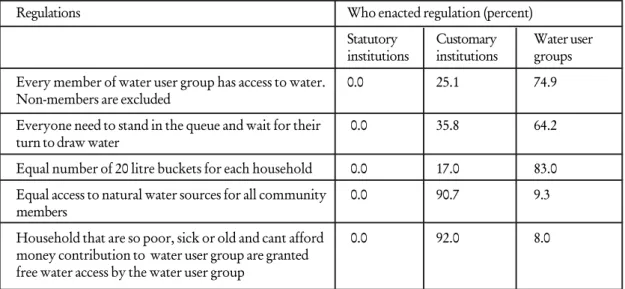
water for marginalised individuals who live close to the well. Many water user groups are reported to have complied with this law by granting free access to the poorest and disabled households, and to the elderly who can neither afford membership fee nor provide the water user groups with other financial and non- financial contributions. During the dry season when water is scarce, each household belonging to water user groups receives equal number of twenty litre buckets regardless of the household size, status or income. The water guard on duty is in charge to ensure that every household gets water. Those who have a bigger household size are advised to join more than one water user group. The number of buckets depends on the amount of water a well can produce per day, and the number of households in that water user group. The average number of buckets entitled to each household in dry season ranges from two to five buckets per household, equivalent to 40 to 100 litres per day. Moreover, everyone is required to stand in the queue and wait for their turn to draw water. Standing in queue creates order at the water source, prevents scrambling for water and spilling and makes for distribution of water easier during water scarcity. In the case of natural water sources like rivers, springs and ponds, every community member has equal access to them.
Table Three: Equitable Water Access Laws
Thus, table three shows that customary laws related to equitable water access are mainly for natural and undeveloped sources of water. This was expected since development of water sources came after natural water sources and human and livestock population pressure stressed natural water sources. In Bariadi district, the establishment of water user groups and the development of shallow wells by water user groups started in 1990‘s. As observed earlier, the water user groups use customary laws to institute equitable access to water. About 25 percent of households reported the law requiring water user group members to have equal access, and 36 percent reported to queue when drawing water was allowed by customary institutions. However, about 75 percent of the households reported that the equitable access to water law was enacted by water user group members. The results imply that water user groups are keen on ensuring equitable access to water from developed sources while customary laws are strong in laws related to access to water from natural sources. The result also shows that statutory laws are weak on laws related to equitable access to water in rural areas.
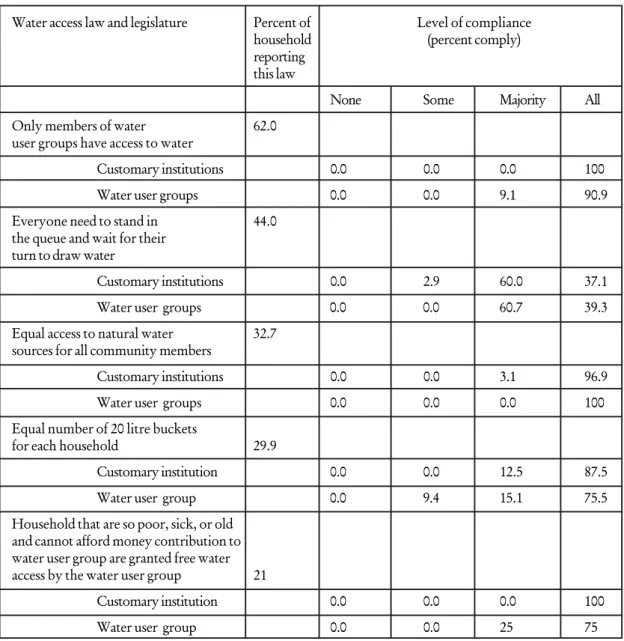
Table four reports the compliance with laws to equitable water access. Compliance with customary and water user group laws is high since the majority
or all members of the community complied with these laws. This suggests that compliance with laws which community members participated to enact is likely to be high as observed by Elinor Ostrom.29 The difference in the level of compliance between customary laws and those enacted by water user groups also does not appear significant. The results imply the effectiveness of water user groups and customary laws. These results also have a strong implication on access to water and water management in general.
[29] E. Ostrom, Governing the Commons: The Evolution of Institutions for Collective Action 91 (New York: Cambridge University Press, 1990).
Regulations Who enacted regulation (percent)
Statutory Customary Water user institutions institutions groups
Every member of water user group has access to water. 0.0 25.1 74.9 Non-members are excluded
Everyone need to stand in the queue and wait for their 0.0 35.8 64.2 turn to draw water
Equal number of 20 litre buckets for each household 0.0 17.0 83.0
Equal access to natural water sources for all community 0.0 90.7 9.3 members
Household that are so poor, sick or old and cant afford 0.0 92.0 8.0 money contribution to water user group are granted
Table Four: Compliance with Equitable Water Access Laws
B . Pr e ve nt ion of Wa t e r Pollut ion
a nd Abuse La w s
To prevent water pollution, each person is required to remove their shoes at the entrance of the water
source, which is always confined in a fence (linala) with an entrance. Shoes are believed to be dirty because people may step on things that may contain contaminants. Although there are a few people in Bariadi who do not have shoes, many believe that
Water access law and legislature Percent of Level of compliance household (percent comply) reporting
this law
None Some Majority All
Only members of water 62.0 user groups have access to water
Customary institutions 0.0 0.0 0.0 100
Water user groups 0.0 0.0 9.1 90.9
Everyone need to stand in 44.0
the queue and wait for their turn to draw water
Customary institutions 0.0 2.9 60.0 37.1
Water user groups 0.0 0.0 60.7 39.3
Equal access to natural water 32.7
sources for all community members
Customary institutions 0.0 0.0 3.1 96.9
Water user groups 0.0 0.0 0.0 100
Equal number of 20 litre buckets
for each household 29.9
Customary institution 0.0 0.0 12.5 87.5
Water user group 0.0 9.4 15.1 75.5
Household that are so poor, sick, or old and cannot afford money contribution to water user group are granted free water access by the water user group 21
Customary institution 0.0 0.0 0.0 100
these laws were enacted predominantly by water user groups who manage group developed water sources. Customary institutions have also enacted laws prohibiting washing, bathing and watering animals at wells for drinking.
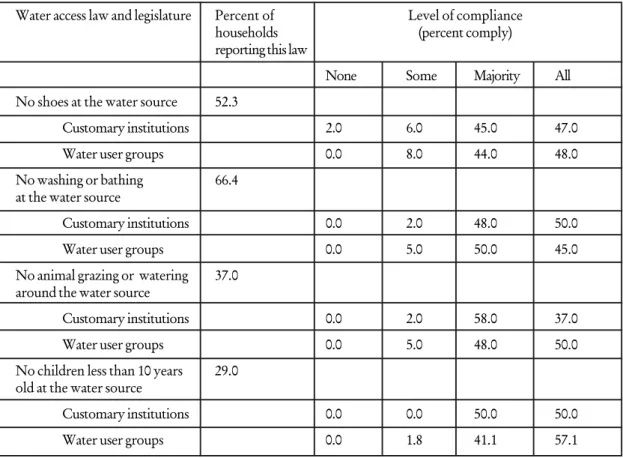
Table six reports the compliance related to prevention of water pollution and abuse laws. Compliance with customary and water user groups laws is high since the majority or all members of the community complied with these laws.
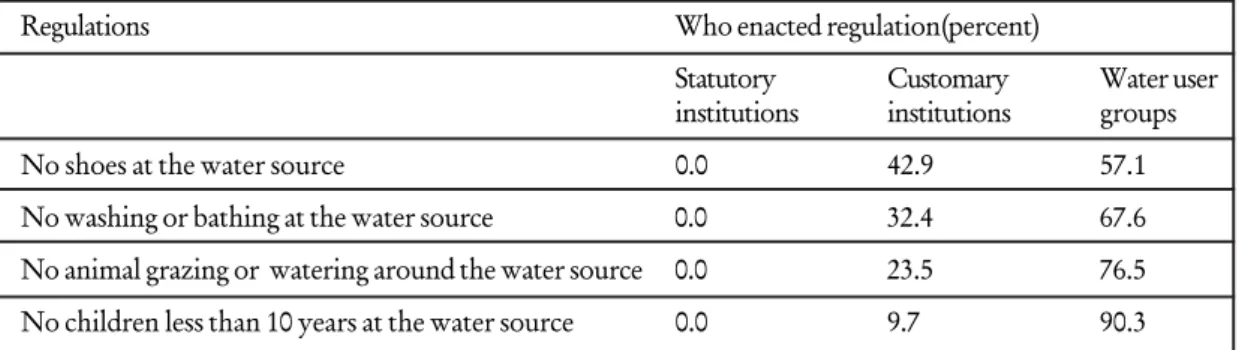
bare feet are cleaner than shoes because people who walk bare footed clean their feet if they happen to step on dirty substances. Table five shows that about 57 percent of households reported this law was enacted by water user groups and 42 percent reported the law was enacted by customary institutions. No household reported that the law was enacted by local governments even though this is one of the local government bylaws. This further shows the limited effectiveness of the statutory institutions as their bylaws are not well known among rural people. It is the same for the other laws related to prevention of water pollution and abuse as reported in table five.
To avoid pump damage and pollution at the water source, no children under ten years of age are allowed at the water source unless accompanied by adults. About a third of respondents reported the existence of this law and the majority (90 percent) reported that the law was enacted by water user group members and only ten percent reported that the law was enacted by customary institutions.
Table Five: Prevention of Water Pollution and Abuse Laws
Animal watering, washing, or bathing at the water source is also not allowed. Animal watering is supposed to be done at rivers, ponds, dams, or private wells. This law aims at prevention of pollution by faeces of livestock and the potential to damage water pumps and live fences. In addition to polluting water, livestock can knock and damage the water pump and the live fence. Likewise, washing and bathing at the water source causes bad smell, flies and soapy water that could kill the live fence surrounding the water source. As in the case for other laws related to pollution and abuse of water,
Regulations Who enacted regulation(percent)
Statutory Customary Water user institutions institutions groups
No shoes at the water source 0.0 42.9 57.1
No washing or bathing at the water source 0.0 32.4 67.6
No animal grazing or watering around the water source 0.0 23.5 76.5
The level of compliance with laws related to water pollution and abuse is similar with those for equitable water access. As argued above, the high level of compliance may be due to the participation of the local communities in enacting and enforcing customary laws.
C
C
C
C
C ... De
De
De v
De
De
v
v
v
ve lopm e nt of
e lopm e nt of
e lopm e nt of
e lopm e nt of
e lopm e nt of W
Wa
W
W
W
a
a
a
a t e r Sour
t e r Sour
t e r Sour
t e r Sour
t e r Sour c e
c e
c e
c e
c e
La w s
La w s
La w s
La w s
La w s
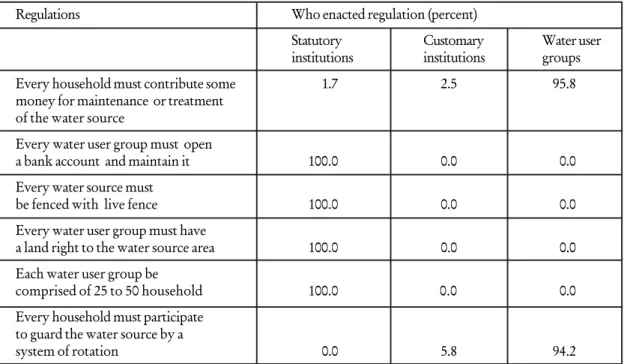
Table seven reports the laws related to water source development. To ensure that the water user groups always have money for maintenance, each water user group was required by the local government to open a bank account with an initial deposit of not less than Tanzania shillings 60,000 ( about US$ 60), and
maintain the bank account by depositing money each month. It is upon the water user group to decide how much money to deposit in the bank account every month. Most water user groups reported to contribute one hundred to two hundred Tanzanian shillings (about US$ 0.1 to 0.2) per month per household. In addition to monthly contribution, members of water user groups are required to contribute some money whenever a major repair or water treatment is needed and the money in the bank is not enough, the water user group will decide how much money each household need to contribute depending on the cost of water treatment or maintenance. Table seven indicates that all the respondents reported that the requirement to open a bank account came from the local government, but the law that requires water users to contribute money for maintenance or
Water access law and legislature Percent of Level of compliance households (percent comply) reporting this law
None Some Majority All
No shoes at the water source 52.3
Customary institutions 2.0 6.0 45.0 47.0
Water user groups 0.0 8.0 44.0 48.0
No washing or bathing 66.4 at the water source
Customary institutions 0.0 2.0 48.0 50.0
Water user groups 0.0 5.0 50.0 45.0
No animal grazing or watering 37.0 around the water source
Customary institutions 0.0 2.0 58.0 37.0
Water user groups 0.0 5.0 48.0 50.0
No children less than 10 years 29.0 old at the water source
Customary institutions 0.0 0.0 50.0 50.0
Water user groups 0.0 1.8 41.1 57.1
treatment of the water source was predominantly enacted by water user groups (96 percent). This reveals that the water user groups are committed to maintain and develop their water sources by their monthly contribution to maintain their bank account.
Other water development laws were reported to be enacted only by the local governments. Firstly, each water user group is required to plant a live fence around the water source. The live fence protects the water source from strong winds and animals that may destroy the pump, creates a boundary and a land tenure mark for the area owned by water user group. Secondly, every water user group is required to obtain a land right to the area around the water source. Once the water user group obtains formal land rights to the water source, they become legal owners of the water source and the area surrounding the water source from six to ten meters from the water source. Land right provides formal ownership and security of tenure to water users groups. Finally, at the time of establishing water user groups, households were asked to organise themselves into a group of 25 to 50 households per water user group. The aim was to avoid overworking the water pump and to ensure every household gets water especially in the dry seasons when water is scarce. Table six indicates the strength of local government bylaws in water development and signifies the importance of statutory institutions in development of drinking water sources.
Each household member is supposed to participate in rotational guarding of the water source. The major responsibility of the guard is to make sure that non-members do not get access to water, the water source is clean, the water pump is used properly, water is not abused, and all the rules are followed. In times of water shortage, the guard is responsible to make sure that each household gets equal number of buckets by counting the number of buckets each household draws. The guard reports any offender to the water committee.
Table seven indicates that ninety four percent of respondents reported this law to be enacted by water user groups and six percent said it was enacted by customary institutions. This shows the strength of water user groups in protecting and developing their water
Table Seven:Development of Water Source Laws
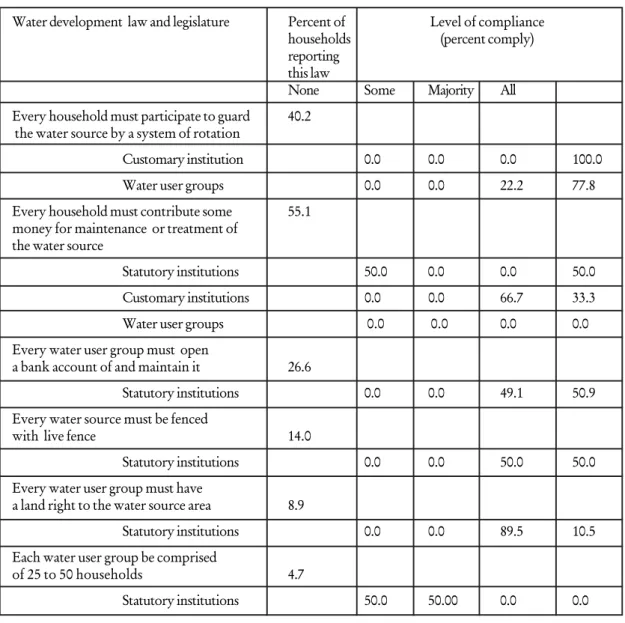
Table eight reports level of compliance with development of water source laws. As is the case with other laws, compliance with this law is generally high because most respondents reported that majority or all people comply with the laws, except for the local government enacted law that requires water user groups to comprise 25 to 50 where compliance is generally low. This is because the development of water source is expensive if only few households are involved. Moreover due to water scarcity, respondents reported that it is difficult to have fewer households per water source. Additionally, fewer respondents (ranging from five to twenty seven percent) are aware of water development laws enacted by statutory institutions.
Regulations Who enacted regulation (percent)
Statutory Customary Water user
institutions institutions groups
Every household must contribute some 1.7 2.5 95.8 money for maintenance or treatment
of the water source
Every water user group must open
a bank account and maintain it 100.0 0.0 0.0
Every water source must
be fenced with live fence 100.0 0.0 0.0
Every water user group must have
a land right to the water source area 100.0 0.0 0.0
Each water user group be
comprised of 25 to 50 household 100.0 0.0 0.0
Every household must participate to guard the water source by a
Table Eight: Compliance with Development of Water Source Laws
Water development law and legislature Percent of Level of compliance households (percent comply) reporting
this law
None Some Majority All
Every household must participate to guard 40.2 the water source by a system of rotation
Customary institution 0.0 0.0 0.0 100.0
Water user groups 0.0 0.0 22.2 77.8
Every household must contribute some 55.1 money for maintenance or treatment of
the water source
Statutory institutions 50.0 0.0 0.0 50.0
Customary institutions 0.0 0.0 66.7 33.3
Water user groups 0.0 0.0 0.0 0.0
Every water user group must open
a bank account of and maintain it 26.6
Statutory institutions 0.0 0.0 49.1 50.9
Every water source must be fenced
with live fence 14.0
Statutory institutions 0.0 0.0 50.0 50.0
Every water user group must have
a land right to the water source area 8.9
Statutory institutions 0.0 0.0 89.5 10.5
Each water user group be comprised
of 25 to 50 households 4.7
8
CONCLUSION AND
RECOM-MENDATIONS
It is clear that most rural people are not aware of statutory laws for water management. Rural communities have enacted their own laws to effectively manage their water resources. Respondents reported a lack of human resources at the local level to plan, manage and implement water management activities and policies as one of the major challenges of decentralisation in Tanzania. Hence recognising and formalising customary laws can help address the problem of a lack of human resources. This study found out that customary laws and institutions are most influential in water access, allocation and settling water use disputes. For example, most laws enacted by water user groups were consistent with the customary laws and were focused on prevention of water pollution and abuse, and equitable water access. The awareness of the customary and water user group laws was also generally high perhaps due to the participatory nature of those institutions. Customary laws are widely used and accepted in most rural areas in solving local water conflicts. Respondents reported that most disputes are settled by water user groups and customary institutions. Thus, local institutions for water management may be empowered and motivated to increase their participation and cooperation in achieving equity for access to water and prevention of water pollution as a way to reduce the cost of water management using statutory institutions. The use of customary law is cost effective because the regulation of customary law does not need enforcement by external resources which may be costly.30 Furthermore, local people are knowledgeable about available water resources, their water needs, and importance of managing their water.31 In rural areas, local water users know each
other so they can easily monitor each other to make sure everyone abides by local customs. They can easily and quickly identify violators of water laws than statutory institutions.
The results of this research also underline the complementarities of the plural legal instruments. While the local government appears to have a strong institution related to development of water, customary laws have strong institutions related to equitable water access of natural water sources. These laws have been adopted by water user groups for equitable access to water from developed sources. The same applies to laws for prevention of pollution and abuse of drinking water sources.
Thus, there is a need for the government to consider a participatory approach to water management that involves users, planners and policy makers at all levels. Local community participation in rural water management will provide important values, ideas, and experiences that will lead to a practical, relevant, achievable and acceptable water management approach.32 This is because managing rural water resources means intervening in power relations and cultural laws. Policy makers need to consider the cultural and political principles that underlie water management in rural areas. Therefore, the water policy in Tanzania needs to recognise and consider the plural legal system that exists. Relying on a single system to manage water resources is not enough. Suitable combination of different institutions and laws may be more efficient and practical in managing rural water sources.
[30] Sokile and Van Koppen, note 18 above at 1354. [31] Meinzen-Dick, Knox and Di Gregorio, note 2 above at 44.
[32] E.W. Dungumaro and N. F. Madulu, ‘Public