Chen, Z.-H., et al.: Transport and Deposition of Spherical Microparticles with …
THERMAL SCIENCE, Year 2015, Vol. 19, No. 4, pp. 1245-1248 1245
TRANSPORT AND DEPOSITION OF SPHERICAL MICROPARTICLES
WITH SINGLE-SHELL IN A 90 DEGREE BEND
by
Zhen-Hua CHENa, Kai ZHANGb*, Xiao-Fei LVc, Yan-Hua XINGb, and Hong JIANGb a
Zhejiang-California International NanoSystems Institute, Zhejiang University, Hangzhou, China
b
Department of Mechanics, China Jiliang University, Hangzhou, China
c
China REACH Solution Center, Hangzhou CIRS Co. Ltd., Hangzhou, China
Original scientific paper DOI: 10.2298/TSCI1504245C
Theoretical investigation on particle transport in a 90 degree bend was carried out. The finite volume method was used to simulate the flow field in the bend pipe, and one-way coupled Lagrangian method was used to calculate the trajec-tory and deposition efficiency of microparticles. The unique relationship between the irreversible deposition efficiency and radius ratio of single-shell microparticle was given finally.
Key words: single-shell model, radius ratio, cm factor, deposition efficiency, dielectrophoresis
Introduction
Large number of microparticles used in various industries always exists with one shell. For example, some kinds of particles which are used in dry electrophotographic mark-ing are specially dealt with different compounds to improve flow ability, and many microparticles used in granular bed filters are covered with the material that they are filtered to show their changes of electric and dielectric properties [1]. In other cases, bioparticles al-ways have mutiple structures [2], for example, cell consists of outer cell wall, membrane, and cytoplasm layer, etc. Therefore, single-shell model based on the effective moment method was proposed to solve those problems, which can be easily adapted to computational model-ing comparmodel-ing to effective moment method [3]. In a microchannel, when particles are trans-ported by electrokinetic flow, under the effect of both the hydrodynamic and electric forces, a large number of microparticles will deposit in the bend and separated [4]. Microparticle’s deposition efficiency (DE) is a crucial factor for its relevance to sample handling [5], such as separation of particles and surface fouling. Unlike the classic dipole moment method, the sin-gle-shell model is more suitable for the study of transport and deposition of particles with multiple layers.
Computational model
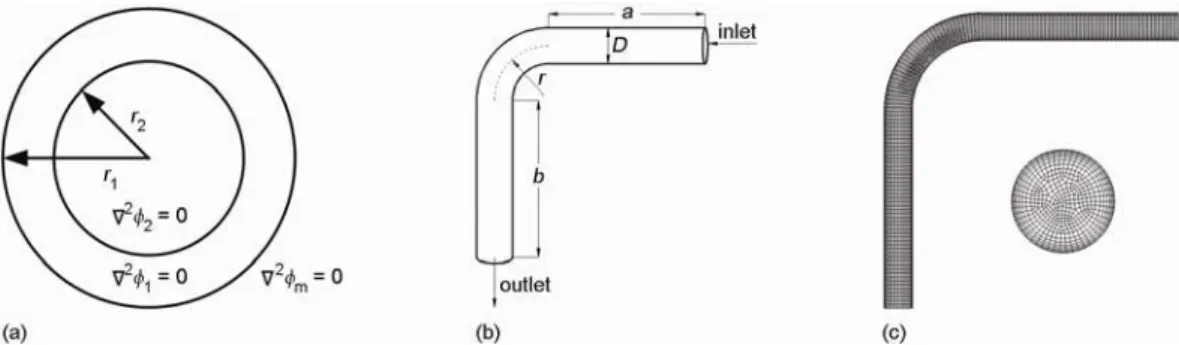
Microparticle with single-shell is shown in figure 1(a) in a 90 degree bend, which is filled with aqueous solution as shown in fig 1(b). The effective moment method is usually
––––––––––––––
Chen, Z.-H., et al.: Transport and Deposition of Spherical Microparticles with …
1246 THERMAL SCIENCE, Year 2015, Vol. 19, No. 4, pp. 1245-1248 used for transport of spherical particles without shell in the dielectrophoresis (DEP). Howev-er, for microparticles with shells the DEP model should be modified.
As shown in fig. 1(a), r1 and r2 are the radius of the outer and inner layers of the microparticle, respectively, and single-shell microparticle’s radius ratio β = r1/r2. σ1and σ2 are the outer and inner conductivity of the microparticle, and σmis the conductivity of the electrolyte solution.
Figure 1. (a) Schematic of the single-shell model, (b) geometry, (c) mesh of the 90 degree bend pipe
The density of the microparticle ρp =1550 kg/m3, particle zeta potential ζp =0.032V. In addition, it is assumed that specified water is used as the electrolyte solution, and its physi-cal properties are given by relative permittivity ε = 80, permittivity of the vacuum ε0=8.85·10–12 CV–1m–1, viscosity of the solution µ = 1.003·10–3 kgm–1s–1, wall zeta potential ζw =–0.02 V, density of the electrolyte solution ρ = 998.2 kg/m3.
For steady and incompressible flow, those dimensional governing equations are [6]:
2
(V )V V 2 sinh
b
ze
p n ze
k T ϕ
ρ G∇ G = −∇ + ∇µ G + ∞ ∇φ (1)
2 2
0
/ , 0, 2 sinh
e e
b
ze n ze
k T ϕ
ϕ ρ εε φ ρ ∞
∇ = − ∇ = = − (2)
Particle transport equation can be written as:
p
DEP EP w D g
du
F F F F F
dt = + + + +
G G G G G G
The formula described here involves electrokinetic and hydrodynamic forces. The DEP force FGDEP that exerted on a spherical for homogeneous body suspended in a local elec-tric field is expressed as:
3 2
p m
DEP
p
2π [ ( )] E
F = r Re K w
m
ε ∇G
G
(3)
Chen, Z.-H., et al.: Transport and Deposition of Spherical Microparticles with …
THERMAL SCIENCE, Year 2015, Vol. 19, No. 4, pp. 1245-1248 1247
3
3
(1 ) (2 )
( 0)
(1+2 ) 2 (1 )
K w χ β α χ
χ β α χ
− + +
= =
+ − (4)
whereα=(σ2−σ1)/(σ2+2σ1),χ σ σ= m/ 1. Other expressions for electrophoretic force FGEP, drag force F ,GD gravity force F ,Gg and repulsive force FGw have been listed in our group’s previ-ous research paper [6]. In addition, to ensure statistical independence, the mesh convergence and particle number independence tests are performed, fig. 1(c). The number of mesh used in numerical simulation shows that the discrepancy in velocity profiles is less than 1% when the mesh was further refined. The particle number of 20,000 could produce particle number inde-pendent simulation results.
Results and discussion
The CM factor K(w)has relation with radius ratio of the microparticle, then the elec-tric properties and the magnitude of DEP force depend on radius ratio of the microparticle. As shown in fig. 2, for a direct current electric
field, the CM factor K(w) varies from 0.7 to –0.4, as radius ratio β ranges from 1.01 to 1.64. When radius ratio β is less than 1.13, positive DEP (pDEP) makes the particle move towards the higher electric field because of
K(w) > 0; When radius ratio β is more than 1.13, negative DEP (nDEP) makes the particle move towards the region with lower electric field because of K(w) < 0.
In order to understand the regional parti-cle deposition, DE in the bend is defined as
DE=Nd/No, here N0 is the number of particles entering and depositing in the 90 degree bend region, and Nd is the number of particles re-leased from the inlet. As shown in fig. 3, the tendency of all DE–β curves seems similar. When β approaches 1.0, both K(w) and DE
have their maximum values, which causes a high pDEP force to make a large number of particles deposit in the inner of bend. Because the DEP force of the inner particle and DEP force of the outer particle have the same direc-tion, the total DEP force reaches its maximum
value and performs a maximum pDEP. After experiencing the maximum value, the DE–β
curve decreases rapidly and reaches the minimum value. When β approaches 1.1 K(w) de-creases to zero, that causes the DEP force to become weak rapidly until it almost disappeared, and only few particles deposited in the bend. At the same time, the DEP force of the inner particle almost completely offsets the outer one, and then it shows a weak DEP force which causes a lower DE in the microchannel. However, as the radius ratio β grows continuously, the DEP force shows up again and increases until the curve develops to a middle value, be-cause one of the DEP force of one particle only cancels part of another’s. In addition, after β
Figure 2. Schematic of the K(w)-β curves
Chen, Z.-H., et al.: Transport and Deposition of Spherical Microparticles with …
1248 THERMAL SCIENCE, Year 2015, Vol. 19, No. 4, pp. 1245-1248 gets its minimum value K(w) becomes negative, and microparticles are repelled to deposit in the outer of the bend forced by the nDEP force.
As shown in fig. 3, DE ranges from 0.6% to 87.32% with the growth of the parti-cle’s diameter. In the microchannel flow, microparticles are usually forced to change its direc-tion in the bend, for particles with same radius ratio but different diameters, it’s difficult for larger microparticle to follow fluid and easier to deposit in the bend due to larger inertia. Fur-thermore, the electrokinetic forces can also change the particle’s trajectory and enhance the
DE, therefore, microparticles with the same radius ratio but different diameters perform dif-ferent DE.
Conclusions
Modified single-shell model based theoretical and numerical investigation of elec-trokinetic transport and deposition of single-shell microparticles in a 90 degree bend were car-ried out. The finite volume method was used to simulate the flow field in the bend pipe and one-way coupled Lagrangian method was used to calculate the trajectory, and DE of microparticles. For specified radius ratio of microparticles, it was found that microparticles with larger diameters have higher DE in the microchannel due to its larger DEP force and hy-drodynamic force; the DEP force ranges from positive to negative which causes the DE–β curve experience a high-low-high process as the radius ratio of single-shell particle changes.
Acknowledgment
The work was supported by National Natural Science Foundation of China with Grant No 11472260, 11202203, and 11202201.
References
[1] Thomas, B. J., Electromechanics of Particles, Cambridge University Press, New York, USA, 1995, pp. 34-35
[2] Song, Y. X., et al., DC Dielectrophoresis Separation of Marine Algae and Particles in a Microfluidic Chip, Science China, 55 (2012), 4, pp. 524-530
[3] Hughes, M. P., Nanoelectromechanics in Engineering and Biology, CRC Press, Boca Raton, Fla., USA, 2002, pp. 279-296
[4] Lin, J. Z., Research on the Transport and Deposition of Nanoparticles in a Rotating Curved Pipe, Physics of Fluids, 21 (2009), 12, 122001
[5] Ros, A. D. R., et al., Bioanalysis in Structured Microfluidic Systems, Electrophoresis, 27 (2006), 13, pp. 2651-2658
[6] Zhang, K., et .al., Microparticle Transport and Deposition from Electrokinetic Microflow in a 90 Degree Bend, Journal of Hydrodynamics, 25 (2013), 4, pp. 535-644