Changes resulting from the publishing process, namely editing, corrections, final formatting for printed or online publication, and other modifications resulting from quality control procedures, may have been subsequently added.
The published version can be found in: Lima, C. F., & Castro, S. L. (2011). Emotion recognition in music changes across the adult life span. Cognition & Emotion, 25(4), 585-598. doi: 10.1080/ 02699931.2010.502449
Running Title: EMOTION RECOGNITION IN MUSIC AND AGING
Emotion recognition in music changes across the adult life span
César F. Lima and São Luís Castro
University of Porto, Faculty of Psychology and Education, Portugal
Word Count: 6833 (text including footnotes)
Address for correspondence: São Luís Castro
Faculty of Psychology and Education University of Porto
Rua Doutor Manuel Pereira da Silva P 4200 - 392 Porto, Portugal
Telephone: +351 22 607 9756 Fax: +351 22 607 9725 E-mail: [email protected]
Abstract
In comparison with other modalities, the recognition of emotion in music has received little attention. An unexplored question is whether and how emotion recognition in music changes as a function of aging. In the present study, healthy adults aged between 17 and 84 years (N = 114) judged the magnitude to which a set of musical excerpts (Vieillard et al., 2008) expressed happiness, peacefulness, sadness and fear/threat. The results revealed emotion specific age-related changes: advancing age was associated with a gradual decrease in responsiveness to sad and scary music from middle age onwards, whereas the recognition of happiness and peacefulness, both positive
emotional qualities, remained stable from young adulthood to older age. Additionally, the number of years of music training was associated with more accurate categorization of the musical emotions examined here. We argue that these findings are consistent with two accounts on how aging might influence the recognition of emotions: motivational changes towards positivity and, to a lesser extent, selective neuropsychological decline.
Acknowledgements
This work was supported by grants from the Portuguese Foundation for Science and Technology and the Bial Foundation. We thank Cristina Queirós, Manuela Cameirão, Maria Luís Almeida, Teresa Limpo and Susana Silva for their help in recruiting participants. We also thank two anonymous reviewers for their valuable comments on earlier versions of the manuscript. The musical stimuli were downloaded from the Isabelle Peretz Research Laboratory website (copyright © Bernard Bouchard, 1998), that we gratefully acknowledge.
Emotion recognition in music changes across the adult life span
Music is a powerful means to express emotions. Like in facial expressions and in speech prosody, basic emotions can be universally recognized in music (Balkwill & Thompson, 1999; Fritz et al., 2009) and recognition can occur within less than a second (Peretz, Gagnon, & Bouchard, 1998). The identification of emotions in music is highly consistent across subjects (Bigand, Vieillard, Madurell, Marozeau, & Dacquet, 2005; Thompson, 2009) and it has been shown to correlate with emotional intelligence
(Resnicow, Salovey, & Repp, 2004). It is thus not surprising that understanding how the mind/brain system responds to emotions in music has recently entered the agenda of cognitive neuroscience (e.g., Juslin & Västfjäll, 2008; Patel, 2008). In this study, we focus on the recognition of emotions in music and on how it changes across the adult life span. Most research on aging and emotion recognition has been conducted on facial expressions (Ruffman, Henry, Livingstone, & Phillips, 2008) leaving the auditory modality much less explored, and it has typically compared adults aged seventies or so with young adults, without including the intermediate middle age years (e.g., Gunning-Dixon et al., 2003). Here we investigate how aging may affect the recognition of emotions in music from young adulthood to older age, including the middle years.
What do we know on how aging affects the recognition of emotions? Studies of facial expressions, the main source of evidence so far, have revealed that advancing age is associated with a decline in the recognition of some emotions, but not of others. In a study with adults from 17 to 75 years of age, increasing age was associated with a decline in the recognition of fear and anger, whereas no change was observed for
disgust, sadness, surprise and happiness (Calder et al., 2003). The decline in the recognition of fear started early, at around 40 years, and increased linearly with advancing age. More recently, Isaacowitz et al. (2007) have also found age-related decline for fearful and angry expressions, and no decline for sad, surprised and neutral expressions. Consistent with Calder et al.’s results, the recognition of fear declined linearly with age. However, in this study an age-related decline was also observed for disgust and happiness. Furthermore, middle-aged and older adults had similar
performance in all emotions except fear, and the age-related decline was observed between the younger adults and the middle-aged ones. In a meta-analysis based on 17 studies on facial expressions, Ruffman et al. (2008) have confirmed that older adults (around 71 years) consistently recognize less well than younger ones (around 24 years) the emotions of fear, anger, sadness and, to a lesser extent, happiness and surprise; for disgust, older adults had slightly better performance than younger ones.
With respect to communicative channels other than faces, research is scarce. For emotions in voice, the meta-analysis by Ruffman et al’s (ibd.) showed stability for fear, surprise and disgust, and an age-related decline for anger, sadness and happiness, but it was based on five studies only. A recent study by Paulmann, Pell and Kotz (2008) with young and middle-aged adults, however, revealed a different pattern. The recognition of emotions was tested in speech prosody expressing fear, anger, sadness, disgust,
happiness, pleasant surprise and neutrality, and an age-related decline was observed for all expressions except pleasant surprise. Concerning music, the first systematic study on the effects of aging was conducted by Laukka and Juslin (2007) who compared younger adults, of around 24 years, with older adults, with at least 65 years, in the recognition of emotions in music and also in speech prosody. Emotions in music were manipulated by
expressive changes in performance; the same musical excerpt was played such that it expressed fear, anger, sadness, happiness and neutrality through modulations in loudness, articulation, vibrato and phrasing. Older adults had more difficulty in
recognizing fear and sadness in both music and speech prosody, whereas no differences were observed for anger, happiness and neutrality. These results indicate that the recognition of emotions in music changes with age, and that the pattern of age-related changes is similar for music and speech prosody (generality within the auditory modality).
Altogether, the above reviewed studies show evidence of age-related changes in how emotions are recognized in faces, voice and music. For faces and voice, there is an age-related decline for some emotions that might start in middle-age instead of in later years. However, it is not established which emotions are affected by age and which are not, and it is also not clear whether age-related changes depend on modality (visual, auditory) or on expressive channel (faces, voice, music). In order to clarify these issues, it is useful to briefly consider the mechanisms that have been proposed to explain age-related changes in emotion recognition: neuropsychological decline in specific brain structures, positivity bias and general cognitive decline. There is relative agreement that different emotions are subserved by at least partially distinct neural systems and that some of these undergo structural changes with advancing age (e.g., Raz et al., 2005; Yankner, Lu, & Loerch, 2008). Different rates of atrophy in specific brain regions might be a factor in explaining why the age-related decline is behaviorally more pronounced for some emotions rather than others. For instance, the decline in the recognition of fear and sadness might be associated with volume reduction in the amygdala and cingulate cortex, brain structures that are known to be implicated in processing these emotions,
whereas the stability for disgust might be associated with the relative preservation of the basal ganglia (Ruffman et al., 2008). In a different vein, socio-cognitive research has highlighted an age-related motivational bias towards positivity (for reviews, see
Carstensen & Mikels, 2005; Charles & Carstensen, 2007; Mather & Carstensen, 2005). According to this view, advancing age is associated with a motivational shift towards emotional goals and with better ability to regulate emotions; as a consequence, older adults allocate their cognitive resources towards positive information and away from negative one. Converging evidence supports the link between this motivational shift and age-related changes in how we recognize and process emotional stimuli (Gunning-Dixon et al., 2003; Iidaka et al., 2002; Jacques, Dolcos, & Cabeza, 2008; Kisley, Wood, & Burrows, 2007; Mather et al., 2004; Williams et al., 2006). For instance, Williams and colleagues (2006) analyzed the recognition of fearful, happy and neutral facial expressions from 12 to 79 years of age using behavioral, neurophysiological and neuroimaging methods. Behavioral measures revealed an age-related progressive decline for fear, but not for happiness. Brain activation in the medial prefrontal cortex increased linearly with advancing age for fearful faces, and decreased for happy ones. The decreased activation for positive faces was interpreted as reflecting uninhibited processing of positive input; conversely, increased activation for negative faces would reflect greater inhibition in processing negative input. General cognitive decline would be yet another mechanism for age-related effects in emotion recognition, but it is one that has received little support (e.g., Mitchell, 2007; Orbelo, Grim, Talbott, & Ross, 2005). It predicts a more pronounced decline for more difficult stimuli, but no decline has been found for supposedly difficult emotions such as disgust, and there is evidence of decline for easily recognized emotions such as sadness (e.g., Calder et al., 2003;
Paulmann et al., 2008; Ruffman et al., 2008). For our purposes, it is relevant to keep in mind that these accounts are based almost exclusively on evidence from visual stimuli (facial expressions and pictures). Research on other modalities and expressive channels is needed in order to test the generality of age-related effects and to clarify the
underlying mechanisms.
The goal of the present study is to examine how emotion recognition in music changes from young adulthood into middle age and older years, focusing on the pattern of change for positive emotions as compared to negative ones. The study by Laukka and Juslin (2007) mentioned earlier has already brought evidence that older adults have more difficulty than younger adults in recognizing the negative emotions of fear and sadness. However, several questions remain open. First, it is unknown whether these changes start around middle-age, as it is the case for faces and speech prosody (Paulmann et al., 2008; Isaacowitz et al., 2007). Second, it is also unknown whether these changes occur in response to stimuli where emotions are portrayed mainly through structural features, such as tempo or harmony in different musical excerpts, instead of the expressiveness proper of the same excerpt interpreted in different moods. Last but not least, since most studies only include happiness as a positive emotion (e.g., Calder et al., 2003; Laukka & Juslin, 2007; Williams et al., 2006), it is impossible to ascertain whether the consistently reported stability for happiness is specific to this emotional quality or rather extends to other positive emotions. Here we examine the recognition of emotional expressions in music over the adult life span (17 – 84 years) with a set of stimuli that use structural features as a means to portray two positive emotions, happiness and peacefulness, and two negative ones, sadness and fear/threat (Vieillard, Peretz, Gosselin, Khalfa, Gagnon, & Bouchard, 2008). Therefore, we have an equal
number of positive and negative emotions. Also, these emotions are expressed through variation in mode, tempo, dissonance and pitch range, and it is known that structural properties of music can determine the recognition of emotions (e.g., Dalla Bella, Peretz, Rousseau, & Gosselin, 2001; Hunter, Schellenberg, & Schimmack, 2008). The task presented to the participants requires them to perform graded ratings on the perceived intensity of the four possible emotions, for each musical excerpt. In comparison with forced-choice single categorization, this task is less prone to responses biases
(Isaacowitz et al., 2007). It has been used in studies on the recognition of facial
expressions and speech prosody (Adolphs, Damasio, & Tranel, 2002; Adolphs, Tranel, & Damasio, 2001) and musical emotions (Gosselin et al., 2005; Gosselin et al., 2007). Even though this task taps the recognition of emotions through behavioral measures, and not internal states proper (has the listener felt the emotions that were rated?), there is evidence that it engages neural systems of emotion, namely the amygdala (ibd.). Based on previous findings by Laukka and Juslin (2007), Paulmann et al. (2008) and Williams et al. (2006), we hypothesized that advancing age would be associated with emotion-specific changes in recognition, specifically an age-related decrease in
responsiveness to the negative emotions of sadness and fear/threat, and stability for the positive emotions of happiness and peacefulness. Based on the finding that musicians perform better than non-musicians in emotion recognition tasks (Thompson,
Schellenberg, & Husain, 2004), we also investigated the correlation between years of music training of the participants (controlled a posteriori) with accuracy on a derived measure of accuracy.
Method Participants
A total of 114 healthy adults (67 female) volunteered to take part in this study. They were aged between 17 and 84 years, and were categorized into three groups with 38 participants each: younger (mean age = 21.8 years), middle-aged (mean age = 44.5 years) and older adults (mean age = 67.2 years). The younger adults were undergraduate and graduate students from the University of Porto; the others came from several local communities including senior universities. Table 1 presents the demographic and background characteristics of the participants in each age group. Education level, assessed by the number of years of formal education, was similar across groups (F < 1). Older participants were screened for cognitive decline using the Mini-Mental State Examination (MMSE; Folstein, Folstein, & McHugh, 1975; Portuguese version from Guerreiro, Silva, Botelho, Castro-Caldas, & Garcia, 2003), and they all performed near ceiling (mean score = 29.3, maximum possible of 30). At the end of the experimental session, all participants were asked about formal training in music. Thirty-three reported having had some kind of formal training, including learning how to play an instrument (mean years of training = 5.1, range = 1 to 14; mean age when training began = 11 years).
______________
Please insert Table 1 around here ______________
All participants had normal or corrected-to-normal vision. In a brief preliminary questionnaire, none reported head trauma, substance abuse, nor major psychiatric or neurological illnesses. Younger and middle-aged participants had normal hearing according to self report. Older volunteers underwent a pure-tone audiometric screening
and only those with hearing thresholds of at least 30 dB HL for frequencies of 500 Hz, 1000 Hz, 2000 Hz and 4000 Hz at left and right ears took part in the experiment.
Materials
The stimuli were 56 short musical excerpts validated by Vieillard et al. (2008) for research on emotions. These excerpts were composed to express happiness, sadness, fear/threat and peacefulness, 14 stimuli per category, whilst also varying on valence (pleasant vs. unpleasant) and arousal (relaxing vs. stimulating). They consist of a melody with accompaniment produced in piano timbre, and follow the rules of the Western tonal system. Emotions are expressed mainly through structural features such as mode, dissonance, pitch range, tone density, rhythmic regularity and tempo1. The
mean duration of the excerpts is 12.4 seconds (see Vieillard et al., ibd., for a more detailed description of the stimuli and validation procedure).
The excerpts were pseudo-randomized and divided into two blocks of 28 trials each. The presentation order of the blocks was counterbalanced across participants. Two additional excerpts were used to familiarize the participants with the task: 15 seconds from Debussy’s Golliwog’s Cakewalk, for happiness, and 18 seconds from
Rachmaninoff’s 18th Variation from the Rhapsody on a Theme by Paganini, for peacefulness.
Procedure
The experimental session lasted approximately 30 minutes. Participants were tested individually, with the exception of some younger ones who were tested in groups of two or three. Stimuli were presented via high-quality loudspeakers with a fixed
inter-stimulus interval, ISI, of 6 seconds in the case of the younger and middle-aged persons, and with a variable ISI, contingent upon response, in the case of the older ones.
SuperLab V4.0 software (Abboud, Schultz, & Zeitlin, 2006) running on an Apple Macintosh computer was used to control the presentation of the stimuli. Participants were told that they would hear short musical excerpts that were intended to express different emotional tones, namely happy (“alegre”), sad (“triste”), scary (“assustador”) and peaceful (“sereno”). Their task was to evaluate how much each excerpt portrayed each of the four emotional tones on a 10-point scale, from absent (0, “ausente”) to present (9, “presente”). It was stressed that they were required, for each excerpt, to give a rating in each of the four emotional tones. Even if a stimulus sounded clearly happy, for example, it should be rated not only with respect to happiness, but also with respect to the possible presence of some sadness, threat or fear, and peacefulness.
Participants listened to each stimulus only once and no feedback was given. The task started with the practice excerpts, then the two blocks of stimuli followed. In the case of the older participants, the audiometric screening and the MMSE were
administered before the experimental task.
Results
Two different types of data were analyzed: the raw ratings that were given to each of the four emotion categories, and a derived measure of accuracy based on the emotion category that received the highest rating. In the rating analyses we considered the mean rating that was given to the intended emotion and also to the non-intended ones. E.g., for happy excerpts we analyzed the average rating on happiness, the intended emotion, and also the average ratings on peacefulness, sadness, and fear/threat, the
non-intended emotions. The mean rating on the non-intended emotion is an index of sensitivity to that emotion category, and the mean ratings on the unintended emotions give an indication of confusability. For accuracy analyses, we classified each individual response as a correct identification if the highest rating matched the intended emotion for the corresponding excerpt, as a misclassification if it did not, and/or as an
ambivalent response if the highest rating was bimodal (see below). The conversion of raw ratings into this accuracy measure is a procedure adopted by Peretz and colleagues for this type of experimental design (Vieillard et al., 2008; Gosselin et al., 2005; Gosselin et al., 2007), that makes it possible to analyze the data as forced choice responses. We started by determining which label or labels received the highest rating. If the highest rating was given to the intended emotion, the response was considered a correct identification of the corresponding emotion. If more than one emotion received the highest rating (e.g., giving a 8 for sadness and also for peacefulness, and lower ratings for the other two categories), the response was classified as ambivalent.
Ambivalent responses indicate that the excerpt was perceived as expressing more than one emotion with the same magnitude. If the highest rating, irrespective of absolute value, did not match the intended emotion, the response was considered a
misclassification. Finally, in all the analyses looking for age-related effects, music training in number of years was included as a covariate because the distribution of participants with music training was unequal across the three age groups (cf. Table 1). All the post-hoc comparisons were calculated with Tukey tests.
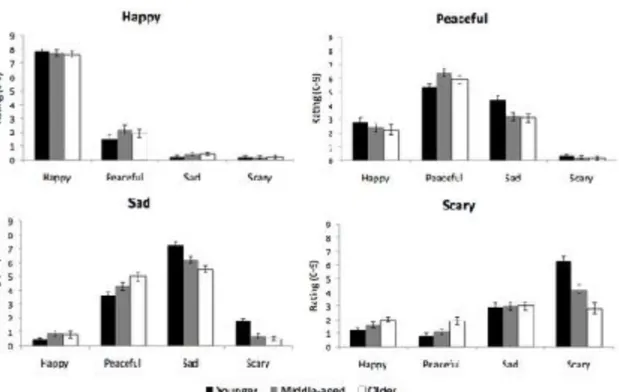
Figure 1 shows the mean ratings attributed to each emotion category for the excerpts intended for happiness, peacefulness, sadness and fear/threat (first to fourth panels, respectively), by age group. As expected, for all excerpt types, the highest ratings were given to the intended emotions. Let us first consider these ratings, that is, those that were attributed to the matching intended emotions (the first set of bars in the panel for happy, the second one in the panel for peaceful, and so forth).
______________
Please insert Figure 1 around here ______________
An ANCOVA with intended emotion (happy, peaceful, sad and scary) as repeated-measures factor, age (younger, middle-aged and older) as between-subjects factor, and music training as a covariate, was computed on these ratings. This analysis revealed that the main effect of emotion was significant, F(3,330) = 79.09, p < .0001, ηp2 = .42. The magnitude of the ratings attributed to happiness was higher (7.7,
maximum of 9) than that for peacefulness (5.9) and sadness (6.3), that were similar to each other (p > .05); fear/threat was rated the lowest (4.5; p < .0001). The magnitude of the ratings also varied with age [main effect of age: F(2,110) = 10.91, p < .0001, ηp2 = .
17], but this variation depended on emotion [age X emotion interaction, F(6,330) = 15.28, p < .0001, ηp2 = .22]. No age-related differences were observed for happy (ps > .
9) nor for peaceful (ps > .1) excerpts, as is clear from inspecting Figure 1. However, increasing age was associated with a decrease in the magnitude attributed to sadness (-1.7 decrease) and fear/threat (-3.5 decrease). In the case of sadness, the age difference was significant between the older and younger participants (p < .001), and did not reach statistical significance between these and middle-aged participants (p = .1; also no
difference between middle-aged and older, p > .8). In the case of fear/threat, the age-related decrease was significant between the younger and middle-aged participants (p < .0001) and between these and the older ones (p < .0001). In order to gain a different view on the interaction between age and emotion, we calculated partial correlations between years of age and the magnitude of the ratings assigned to each emotion, controlling for musical training. Consistently, while ratings for sadness and fear/threat were negatively correlated with age (r = -.38 and r = -.56, respectively, both p < .001), ratings for happiness and peacefulness were not (r = -.01 and r = .18, both ns). These results are clear evidence that the perceived magnitude of sadness and fear/threat in music decreased linearly with advancing age, whereas it remained stable for happiness and peacefulness.
An additional point is whether these age-related effects can be better understood by taking into account how emotions other than the intended ones were rated. For this purpose, let us now consider not only the ratings attributed to the intended emotions, but also the ratings attributed to the non-intended ones. Four separate ANCOVAs, one for each excerpt type, were computed with emotion response category (happy, peaceful, sad and scary) as a repeated-measures factor, age as between-subjects factor, and music training as covariate. These analyses confirmed that the intended emotion category indeed received the highest mean ratings [in the ANCOVA on responses to happy excerpts, main effect of emotion, F(3,330) = 886.38, p < .0001, ηp2 = .89, and similarly
for peaceful, F(3,330) = 221.1, p < .0001, ηp2 = .67, sad, F(3,330) = 290.98, p < .0001,
ηp2 = .73, and scary excerpts, F(3,330) = 68, p < .0001, ηp2 = .38; post-hoc
comparisons, ps < .0001]. The main goal of these analyses, however, was to examine the dominant non-intended responses and whether they vary depending on age. In the
case of happy excerpts, some peacefulness was also perceived (mean rating of 1.9; cf. the second set of bars in the first panel of Figure 1) and this was constant across ages (no interaction between emotion response and age, F < 1). In peaceful excerpts,
happiness was also rated as present with a similar magnitude across the groups (mean of 2.5; see Figure 1); sadness, however, received higher ratings from younger adults than from middle-aged and older adults (p < .05). In the case of sad excerpts, peacefulness was rated as present with a higher magnitude by older adults than younger ones (p < . 001; ns between younger and middle-aged participants), whereas fear/threat was more highly rated by younger adults than by middle-aged and older ones (ps < .0001; ns between middle-aged and older ones). In scary excerpts, sadness (3), happiness (1.6) and peacefulness (1.3) were also rated as present, with no differences across age groups (ps > .05); the ratings of older adults were not higher for fear/threat, the intended emotion, than for the other ones (ps > .3, cf. Figure 1, fourth panel). This later finding indicates low specificity in the recognition of fear/threat by the older adults.
Accuracy
The analysis of accuracy will follow analogous steps as the analysis of ratings: we will first focus on correct identifications and then will consider misclassifications and ambivalent responses. The percentage of correct identifications in each emotion category for the younger, middle-aged and older participants can be observed in the diagonal lines of Table 2.
______________
Please insert Table 2 around here ______________
An ANCOVA with emotion (repeated-measures) and age (between-subjects) factors, and music training as a covariate, showed significant effects of emotion
[F(3,330) = 72.06, p < .0001, ηp2 = .4], age [F(2,110) = 12.54, p < .0001, ηp2 = .10] and
the interaction between both [F(6,330) = 13.98, p < .0001, ηp2 = .20]. Happiness
reached the best accuracy of all (93%, ps < .0001). Sadness (61%) and peacefulness (55%) followed (difference ns), and fear/threat (52%) was the least well recognized. Sadness was better recognized than fear/threat (p < .001). Concerning the interaction with age, there was an age-related decline in accuracy for sadness (-34%) and fear/ threat (-43%; cf. Table 2), but not for happiness nor for peacefulness (ps > .8). The decline in both negative emotions was significant between younger and middle-aged participants (ps < .01) and between younger and older participants (ps < .01), but it did not reach significance between middle and older age (ps > .3). In the two positive emotions no other age-related effects were found, other than that for peacefulness middle-aged participants achieved better accuracy than the younger ones (p < .01). This pattern of emotion-specific age-related differences was replicated when the analyses were recalculated using accuracy rates corrected for possible response bias2
. Finally, in partial correlation analyses, years of age correlated negatively with accuracy for sad (r = -.44, p < .01) and scary music (r = -.55, p < .01), but not for happy (r = -.2, ns) nor peaceful music (r = .2, ns).
The overall distribution of responses, both accurate and inaccurate, was
examined by computing separate ANCOVAs for each excerpt type, with age (between-subjects) and response category (happy, peaceful, sad, scary, and ambivalent; within-subjects) as factors, and music training as covariate. For each excerpt type, the highest
percentage of responses was given to the intended emotion [main effects of response category: for happiness, F(4,440) = 1950, p < .0001, ηp2 = .95; peacefulness, F(4,440)
= 97, p < .0001, ηp2 = .47; sadness, F(4,440) = 136, p < .0001, ηp2 = .55; fear/threat,
F(4,440) = 75.7, p < .0001, ηp2 = .4; post-hoc comparisons, ps < .0001]. Happy music
elicited very few misclassications, similarly across groups (ps > .08). Peacefulness elicited 13% ambivalent responses, and was also misclassified as happiness similarly across groups (11%; ps > .05); however, misclassifications of peacefulness as sadness were more frequent among the younger participants than the older ones (p < .05; between middle-aged and the other groups, ns; see Table 2). Sadness elicited 13% ambivalent responses, and misclassifications as peacefulness (22% overall) were more frequent among younger participants than middle-aged and older ones (p < .001; between middle-aged and older participants, ns). Regarding scary music, ambivalent responses (13%) and misclassifications as happiness (13%) were similar across groups (ps > .05); misclassifications as sadness, however, were more common among middle-aged and older participants than among younger ones (p < .01). A closer examination of ambivalent responses in a separate ANCOVA confirmed that they were less frequent for happiness (4%) than for the other emotions, where they reached a similar rate of about 13% [main effect of emotion, F(3,330) = 21.44, p < .0001, ηp2 = .18]. It also revealed
that ambivalent responses were more frequent among the older (13%) than the younger participants (8%, p < .05; main effect of age, F(2,110) = 2.23, p < .05, ηp2 = .04; no
significant interaction]; differences between the middle-aged group (12%) and the other two groups were not significant.
Finally, we tested whether music training might have had an impact of on accuracy. We calculated a partial correlation between years of music training and mean
accuracy controlling for age (in years). This revealed a positive correlation between music training and accuracy, r = .33, p < .05: participants with more years of music training were better able to identify the musical emotions studied here, regardless of their age.
Discussion and conclusions
The present study investigated how the recognition of emotions in music changes with aging. Unlike most previous research, we considered the full adult life span and had an equal number of positive and negative emotions. The task used was based on graded judgments given to each of the emotion categories tested, intended and non-intended, instead of forced-choice identification of a single emotion category. As predicted, we observed age-related changes which were emotion-specific: advancing age was associated with a progressive decline in responsiveness to sad and scary music, whereas responsiveness to happy and peaceful music remained stable from young adulthood to older age. This pattern of age-related differences was observed in the analyses of both ratings and the derived accuracy measure, and was replicated after correcting accuracy for possible response biases. Furthermore, it was not due to between-group differences in the number of musically trained participants, because years of music traning were included as a covariate in all the relevant analyses and the age-related differences were robust. There were also age-related differences in the pattern of misclassifications and ambivalent responses for sad and peaceful excerpts, and an increase in the proportion of ambivalent responses with age. In addition, a
positive association was found between music training and the categorization of musical emotions. These findings are discussed next.
Emotion recognition in music and aging
The pattern of the observed changes in emotion recognition is consistent with previous findings (e.g., Calder et al., 2003; Isaacowitz et al., 2007). The decline in responsiveness to sad and scared music replicates Laukka and Juslin’s (2007) findings with older adults, and extends them by showing that this decline (a) occurs for music portraying emotions through structural features and not through expressiveness, and (b) is manifest at middle-age (ca. 45 years) and proceeds gradually with advancing age. This latter finding is converging evidence for the early onset of age-related changes in emotion recognition, as has been shown to occur for speech prosody (Paulmann et al., 2008) and for the facial expression of fear (but not sadness; e.g., Calder et al., 2003; Isaacowitz et al., 2007).
The stability across the adult life span to the positive emotions of happiness and peacefulness is the counterpart of the decline for sadness and fear/threat. Stability for happiness has been reported for music and speech prosody (Laukka & Juslin, 2007), as well as facial expressions (e.g., Calder et al., 2003; Williams et al., 2006; but see Ruffman et al., 2008). The stability for peacefulness has, to our knowledge, not been reported previously. It suggests that the stability of emotion recognition across age is not specific to happiness and might be generalized to positive emotions. Music may be an especially suited means to better explore the responsiveness to positive emotions, because listening to music is mostly pleasurable and evokes positive moods or feelings rather than negative ones (Juslin & Västfjäll, 2008). It can be argued that the stability for happiness could reflect a ceiling effect because the three age groups reached high accuracy (mean of 93% correct). However, the similarity of the ratings, about 8 in the
three groups, and the available evidence of preservation of this emotion (Laukka & Juslin, 2007), argue for a true stability instead of a mere methodological artifact.
Differences between age groups were also observed in the pattern of
misclassifications for sad and peaceful music: while the younger participants perceived more sadness in peaceful music than did the older groups, older participants perceived more peacefulness and less fear/threat in sad music than did younger ones. Future studies manipulating systematically the structural features of music might contribute to explain these findings (e.g., Dalla Bella et al., 2001; Hunter et al., 2008). For now, we can only speculate that the emotional cues conveyed by music might be differently weighted by participants of different ages. Slow tempo, a common feature of sad and peaceful excerpts, may have been taken as a cue for peacefulness by the older
participants, and as a cue for sadness by the younger ones. There was also an age-related increase in the proportion of ambivalent responses, i.e., excerpts in which more than one emotion was rated with the same magnitude. This may indicate that for older adults the boundaries between emotion categories are less discrete and more
overlapping, or that their classification of emotions is more multidimensional (rather than unidimensional).
Explanatory hypotheses
Different mechanisms might account for the age-related changes observed here. Decline in general abilities, such as working memory or attention, would be one of them. Increasing age is associated with decline in basic cognitive mechanisms, a decline that tends to be small between 20 and 60 years and accelerates after 60 (e.g., Hedden & Gabrieli, 2004). However, it has consistently been shown that the decrease in emotion
recognition by older adults is independent of general cognitive decline (e.g., Mitchell, 2007; Orbelo et al., 2005; Ruffman et al., 2008). It is also unlikely that our results can be explained by this factor. Firstly, changes in emotion recognition were significant already at middle-age, well before the general cognitive decline becomes clear; also, all of the older participants had good scores on the MMSE (23 out of 38 attained the maximum). Secondly, if general decline was the basis of the observed changes, these should have been more marked in the more difficult emotions. This was not the case: there was decline for relatively easy emotions like sadness, and stability for a relatively difficult one, peacefulness. Still, future studies should use additional
neuro-psychological measures, including tests of music perception, in order to rule out subtle cognitive or perceptual difficulties as factors contributing to age-related changes in emotion recognition.
Two other accounts are more plausible candidates. One is the age-related neuropsychological decline in brain regions that are involved in emotion recognition and processing. Although the amygdala, in comparison with other brain regions like the frontal lobes, is relatively preserved through advancing age, its volume has been shown to decrease linearly as people get older (Grieve, Clark, Williams, Peduto, & Gordon, 2005; Zimmerman et al., 2006). According to Ruffman et al. (2008), the age-related volume reduction in the amygdala and cingulate cortex would mediate the decline in the perception of sad and scared/fearful expressions that has been observed in behavioural measures. In fact, neuropsychological studies using the same stimuli and task as the present study have confirmed the engagement of the amygdala in the perception of sad and scary music (Gosselin et al., 2005; Gosselin et al., 2007). It is thus possible that the decline that we observed for these emotions is associated with structural age-related
brain changes. On the other hand, the stability for happiness might be related with the relative preservation of the basal ganglia with increasing age. The basal ganglia are known to subserve the processing of happiness and it is also known that they undergo little decline with age (e.g., for musical stimuli, see Mitterschiffthaler, Fu, Dalton, Andrew, & Williams, 2007; for other modalities: Calder et al., 2003; Pell & Leonard, 2003; Phan et al., 2002; Williams et al., 2006). Regarding the stability for peacefulness, given that it is usually not considered as a target emotion in the literature, it is
unwarranted to relate it with changes in brain structure.
Age-related shifts in motivation and in the regulation of emotion might also explain the present results. The age-related positivity bias (Carstensen & Mikels, 2005; Charles & Carstensen, 2007; Mather & Carstensen, 2005; cf. Introduction) has been argued to explain findings on emotion recognition (e.g., Williams et al., 2006; Laukka & Juslin, 2007), and it nicely fits our results of an age-related decline that selectively affected the recognition of negative emotions, and a concomitant stability for positive emotions. It is possible that with advancing age participants attended “more to positive information than negative information” (Mather & Carstensen, 2005, p. 498) in the music excerpts, as predicted by this account. Converging evidence for this motivational/ attentional bias comes from studies that have shown a link between the behavioral pattern of decline for negative emotions and selective functional changes in brain responses to emotional stimuli (e.g., Kisley et al., 2007; Williams et al., 2006). As mentioned in the Introduction, Williams et al. (2006) have shown that the age-related decline in the recognition of fearful facial expressions was associated with greater inhibitory control over negative input, and that the stability for happy expressions was associated with more automatic processing (less inhibition) of positive input. Kisley et
al. (2007) have shown that brain reactivity to negative emotional input decreased linearly with age, while it remained stable for positive input. Finally, an age-related reduced reactivity of the amygdala has been described for negative facial expressions and pictures, but not for positive ones (e.g., Gunning-Dixon et al., 2003; Iidaka et al., 2002; Mather et al., 2004). It is therefore possible that the age-related changes in motivation towards positive input and the bias to positivity, which appear to be linked with changes in brain function, underlie the pattern of results reported here.
However, only studies combining behavioral with structural and functional neuroimaging methods are able to directly address the question of whether motivational bias, changes in brain function, structural brain decline, or possibly a complex
interaction of these, determines age-related diferences of emotion recognition in music. Such neurocognitive studies could also shed light on the question of whether the
behavioral ratings of emotions in music are associated with the induction and feeling of the corresponding affective state, or if participants base their ratings on a “cold”
analysis of the stimulus features. We know from neuropsychological studies that the task we used recruits the neural systems of emotion (Gosselin et al., 2005; Gosselin et al., 2007) and indeed many of our participants commented, upon debriefing, that they had responded on the basis of how the excerpts made them feel. Nevertheless, because ours are behavioral data from healthy subjects, they are inadequate to test the emotional engagement involved in this task. As stated by Fritz et al. (2009, supplemental data, p. 9) new methodologies have to be developed in order to “gain experimental evidence of internal emotional states”.
An additional finding of this study was the positive partial correlation between years of music training and accuracy. After controlling for age, participants with more years of music training were more accurate in how they categorized the emotions expressed in the excerpts. This is hardly surprising because an important component in music training is dealing with emotional meaning and expressiveness, which is likely to enhance the recognition of subtle emotional qualities in music. The advantage of music training is also consistent with the available evidence on the benefits of music training (e.g., Moreno et al., 2008; Schellenberg, 2004) and especially with studies reporting an improvement in the recognition of emotions (Thompson et al., 2004). However, there is also research that failed to find effects of musical expertise on the implicit emotional assessment of musical excerpts (Bigand et al., 2005), and our study was not designed to test the role of this factor (years of musical training were controlled a posteriori). It is therefore important to examine more systematically the effects of music training in different tasks that tap the recognition of emotions in music.
In conclusion, the present study establishes that the recognition of emotions in music changes across the adult life span from middle-age onwards. The age-related changes occur selectively for negative emotions: advancing age was associated with decreased responsiveness to sad and scary music. By contrast, the responsiveness to the positive emotions of happiness and peacefulness in music remained stable from around 17 to 75 years of age. Future neucocognitive studies will help specify the brain
mechanisms that underlie this pattern of age-related changes. Importantly, and
that significant aspects of emotional functioning – the recognition of positive expressions in emotional stimuli – might be stable across the adult life span.
References
Abboud, H., Schultz, W., & Zeitlin V. (2006). SuperLab (Version 4.0) [Computer software]. San Pedro, Califórnia: Cedrus Corporation.
Adolphs, R., Damasio, H., & Tranel, D. (2002). Neural systems for recognition of emotional prosody: A 3-D lesion study. Emotion, 2(1), 23-51.
Adolphs, R., Tranel, D., & Damasio, H. (2001). Emotion recognition from faces and prosody following temporal lobectomy. Neuropsychology, 15(3), 396-404. Balkwill, L., & Thompson, W. F. (1999). A cross-cultural investigation of the perception
of emotion in music: Psychophysical and cultural cues. Music Perception, 17(1), 43-64.
Bigand, E., Vieillard, S., Madurell, F., Marozeau, J., & Dacquet, A. (2005). Multi-dimensional scaling of emotional responses to music: The effect of musical expertise and of the duration of the excerpts. Cognition and Emotion, 19, 1113-1139.
Blood, A. J., & Zatorre, R. J. (2001). Intensely pleasurable responses to music correlate with activity in brain regions implicated in reward and emotion. Proceedings of the National Academy of Sciences, 25, 11818-11823.
Calder, A. J., Keane, J., Manly, T., Sprengelmeyer, R., Scott, S., Nimmo-Smith, I., & Young, A. W. (2003). Facial expression recognition across the adult life span. Neuropsychologia, 41, 195-202.
Carstensen, L. L., & Mikels, J. A. (2005). At the intersection of emotion and cognition. Current Directions in Psychological Science, 14, 117-121.
Charles, S. T., & Carstensen, L. L. (2007). Emotion regulation and aging. In J. J. Gross (Ed), Handbook of Emotion Regulation (pp. 307-327). New York: Guildford Press.
Dalla Bella, S., Peretz, I., Rousseau, L., & Gosselin, N. (2001). A developmental study of the affective value of tempo and mode in music. Cognition, 80, B1-B10. Folstein, M. F., Folstein, S. E., & McHugh, P. R. (1975). Mini-Mental State: A practical
method for grading the cognitive state of patients for the clinician. Journal of Psychiatric Research, 12, 189–198.
Fritz, T., Jentschke, S., Gosselin, N., Sammler, D., Peretz, I., Turner, R., Friederici, A., & Koelsch, S. (2009). Universal recognition of three basic emotions in music. Current Biology, 19(7), 573-576.
Gosselin, N., Peretz, I., Johnsen, E., & Adophs, R. (2007). Amygdala damage impairs emotion recognition from music. Neuropsychologia, 45, 236-244.
Gosselin, N., Peretz, I., Noulhiane, M., Hasboun, D., Beckett, C., Baulac, M., & Samson, S. (2005). Impaired recognition of scary music following unilateral temporal lobe excision. Brain, 128, 628-640.
Grieve, S. M., Clark, C. R., Williams, L. M., Peduto, A. J., & Gordon, E. (2005).
Preservation of limbic and paralimbic structures in aging. Human Brain Mapping, 25, 391-401.
Guerreiro, M., Silva, A. P., Botelho, M. A., Castro-Caldas, A., & Garcia, C. (2003). Avaliação Breve do Estado Mental [Brief assessment of mental state]. In A. Mendonça, C. Garcia, & M. Guerreiro (Eds.), Grupo de Estudos de
Envelhecimento Cerebral e Demência: Escalas e Testes na Demência (pp. 27-32). Unpublished report.
Gunning-Dixon, F. M., Gur, R. C., Perkins, A. C., Schroeder, L., Turner, T., Turetsky, B. I., Chan, R. M., Loughead, J. W., Alsop, D. C., Maldjian, J., & Gur, R. E. (2003). Age-related differences in brain activation during emotional face processing. Neurobiology of Aging, 24, 285-295.
Hedden, T., & Gabrieli, J. (2004). Insights into the ageing mind: A view from cognitive neuroscience. Nature Reviews Neuroscience, 5, 87-97.
Hunter, P., Schellenberg, G., & Schimmack, U. (2008). Mixed affective responses to music with conflicting cues. Cognition and Emotion, 22, 327-352.
Iidaka T., Okada, T., Murata, T., Omori, M., Kosaka, H., Sadato, N., & Yonekura, Y. (2002). Age-related differences in the medial temporal lobe responses to emotional faces as revealed by fMRI. Hippocampus, 12, 352-362.
Isaacowitz, D. M., Lockenhoff, C. E., Lane, R. D., Wright, R., Sechrest, L., Riedel, R., & Costa, P. T. (2007). Age differences in recognition of emotion in lexical stimuli and facial expressions. Psychology and Aging, 22, 147-159.
Jacques, P., Dolcos, F., & Cabeza, R. (2008). Effects of aging on functional connectivity of the amygdala during negative evaluation: A network analysis of fMRI data. Neurobiology of aging, doi:10.1016/j.neurobiolaging.2008.03.012
Juslin, P. N., & Västfjäll, D. (2008). Emotional responses to music: The need to consider underlying mechanisms. Behavioral and Brain Sciences, 31, 559-575. Kisley, M., Wood, S., & Burrows, C. (2007). Looking at the sunny side of life:
Age-related change in an event-Age-related potential measure of the negativity bias. Psychological Science, 18(9), 838-843.
Laukka, P., & Juslin, P. (2007). Similar patterns of age-related differences in emotion recognition from speech and music. Motivation and Emotion, 31, 182-191. Mather, M., Canli, T., English, T., Whitfield, S., Wais, P., Ochsner, K., Gabrieli, J., &
Carstensen, L. (2004). Amygdala responses to emotionally valenced stimuli in older and younger adults. Psychological Science, 15, 259-263.
Mather, M., & Carstensen, L. (2005). Aging and motivated cognition: The positivity effect in attention and memory. Trends in Cognitive Sciences, 9, 496-502. Mitchell, R. (2007). Age-related decline in the ability to decode emotional prosody:
Primary or secondary phenomenon? Cognition and Emotion, 21(7), 1435-1454. Mitterschiffthaler, M., Fu, C., Dalton, J., Andrew, C., & Williams, S. (2007). A
functional MRI study of happy and sad affective states induced by classical music. Human Brain Mapping, 28, 1150-1162.
Moreno, S., Marques, C., Santos, A., Santos, M., Castro, S. L., & Besson, M. (2009). Musical training influences linguistic abilities in 8-year-old children: More evidence for brain plasticity. Cerebral Cortex, 19, 712-723.
Orbelo, D., Grim, M., Talbott, R., & Ross, E. (2005). Impaired comprehension of affective prosody in elderly subjects is not predicted by age-related hearing loss or age-related cognitive decline. Journal of Geriatric Psychiatry and Neurology, 18, 25-32.
Patel, A. (2008). Music, language, and the brain. New York: Oxford University Press. Paulmann, S., Pell, M. D., & Kotz, S. A. (2008). How aging affects the recognition of
Pell, M., & Leonard, C. (2003). Processing emotional tone from speech in Parkinson’s disease: A role for the basal ganglia. Cognitive, Affective, & Behavioral
Neuroscience, 3, 275-288.
Peretz, I., Gagnon, L., & Bouchard, B. (1998). Music and emotion: perceptual determinants, immediacy, and isolation after brain damage. Cognition, 68, 111-141.
Phan, K., Wager, T., Taylor, S., & Liberzon, I. (2002). Functional neuroanatomy of emotion: A meta-analysis of emotion activation studies in PET and fMRI. NeuroImage, 16, 331-348.
Raz, N., Lindenberger, U., Rodrigue, K. M., Kennedy, K. M., Head, D., Williamson, A., Dahle, C., Gerstorf, D., & Acker, J. D. (2005). Regional brain changes in aging healthy adults: General trends, individual differences and modifiers. Cerebral Cortex, 15, 1676-1689.
Resnicow, J., Salovey, P., & Repp, B. (2004). Is recognition of emotion in music performance an aspect of emotional intelligence? Music Perception, 22(1), 145-158.
Ruffman, T., Henry, J. D., Livingstone, V., & Phillips, L. H. (2008). A meta-analytics review of emotion recognition and aging: Implications for neuropsychological models of aging. Neuroscience and Biobehavioral Reviews, 32, 863-881. Schellenberg, E. G. (2004). Music lessons enhance IQ. Psychological Science, 15,
511-514.
Thompson, W. F. (2009). Music, thought, and feeling: Understanding the Psychology of Music. New York: Oxford University Press.
Thompson, W. F., Schellenberg, E., & Husain, G. (2004). Decoding speech prosody: Do music lessons help? Emotion, 4, 46-64.
Vieillard, S., Peretz, I., Gosselin, N., Khalfa, S., Gagnon, L., & Bouchard, B. (2008). Happy, sad, scary and peaceful musical excerpts for research on emotions. Cognition and Emotion, 22, 720-752.
Wagner, H. (1993). On measuring performance in category judgment studies of nonverbal behavior. Journal of Nonverbal Behavior, 17, 3-28.
Williams, L. M., Brown, K. J., Palmer, D., Liddell, B. J., Kemp, A. H., Olivieri, G., Peduto, A., & Gordon, E. (2006). The mellow years?: Neural basis of improving emotional stability over age. The Journal of Neuroscience, 26, 6422-6430. Yankner, B. A., Lu, T., & Loerch, P. (2008). The aging brain. Annual Review of
Pathology: Mechanisms of Disease, 3, 41-66.
Zimmerman, M., Brickman, A., Paul, R., Grieve, S., Tate, D., Gunstad, J., Cohen, R., Aloia, M., Williams, L., Clark, C., Whitford, T., & Gordon, E. (2006). The relationship between frontal gray matter volume and cognition varies across the healthy adult lifespan. American Journal of Geriatric Psychiatry, 14, 823-833.
Footnotes 1
The distinction between structural/compositional vs. expressive cues in music is not absolute. Tempo, loudness and articulation, for instance, can be used expressively by the interpreter as well as by the composer. Maybe the most straightforward example is tempo, that can be modulated by the performer in his/her own interpretation, while it can also be predetermined by the composer in musical notation. In the stimuli by Vieillard et al. (2008), tempo was set compositionally, and the other emotional cues were indeed structural, such as mode, dissonance, and pitch range. More importantly, there was only one particular musical excerpt for a given emotion category; no expressive variations of the same musical excerpts were used as stimuli.
2
A methodological issue in forced-choice paradigms is that between-group differences in accuracy might not reflect true differences in recognition but rather response bias, i.e., differences in the likelihood of using some labels more than others (for a review, see Isaacowitz et al., 2007). Although our data are not based on a forced-choice paradigm, as a precautionary control we reanalyzed the data using the unbiased hit rate Hu (Wagner, 1993). Hu is an estimate of the joint probability that a stimulus category is correctly recognized when it has been presented, and that a response is correct given that it has been used. Hu was calculated for each emotion and participant using the formula Hu = A2 / (B x C), where A corresponds to the number of correctly identified
number of responses in that category (i.e., including misclassifications). An ANCOVA computed on the arcsine transformed Hu rates replicated the pattern of results obtained in the analysis of the uncorrected accuracy rates: the interaction between age and emotion [F(6,333) = 10.45, p < .0001, ηp2 = .16] was significant; there was no
age-related decline for happy and peaceful excerpts (ps > .05), only for sad and scary ones (ps < .01).
Table 1
Demographic and background characteristics of the participants in each age group
Age group
Younger Middle-aged Older
Mean age (years) 21.8 ± 3.5 44.5 ± 6.2 67.2 ± 6.2
Age range (years) 17 - 29 35 - 56 60 - 84
Gender 17F / 21M 21F / 17M 29F / 9M Education (years) 15.5 ± 2.2 17.0 ± 3.7 15.6 ± 3.1 Mini-Mental State Examination - - 29.3 ± 1.0 Music training (n) 18 10 5
Table 2
Confusion matrix with the percentage of responses for each category as function of excerpt type (intended emotion), separately for younger, middle-aged and older participants. Diagonal cells in bold show correct identifications (standard error in parentheses)
Excerpt type Response
Happy Peaceful Sad Scary Ambivalent
Younger Happy 97 (2.2) 1 0 0 2 Peaceful 12 44 (4.4) 33 0 11 Sad 1 9 79 (4.3) 3 8 Scary 6 1 8 76 (4.3) 8 Middle-aged Happy 94 (2.2) 2 1 0 4 Peaceful 9 65 (4.4) 11 0 14 Sad 2 24 58 (4.3) 2 14 Scary 13 5 22 45 (4.3) 14 Older Happy 88 (2.2) 5 1 0 5 Peaceful 13 57 (4.4) 15 0 15 Sad 2 33 45 (4.3) 2 18 Scary 18 10 23 33 (4.3) 15
Figure Captions Figure 1
Mean ratings for the intended and non-intended emotions by type of excerpt, for younger, middle-aged and older participants. Standard errors are shown in bars.