Overcoming Organisational Tensions:
Strategic Actions Taken by Social Enterprises
Nuno Miguel Coimbra Teixeira Pegado 152116260
Dissertation submitted in partial fulfillment of the requirements for the degree of MSc in Business Administration at Católica-Lisbon School of Business & Economics
Title: Overcoming Organisational Tensions: Strategic Actions Taken by Social Enterprises
Author: Nuno Miguel Coimbra Teixeira Pegado (152116260)
Abstract
This dissertation looks to explain the response of social enterprise in the face of
organisational tensions from the implemented of strategic actions, mainly through company culture, organisational structure, and hiring process. Organisational tensions emerge through an organisation’s commitment to contradictory structures, cultures, practices and processes. The aim of this paper is to evaluate the strategic decisions taken by social enterprises
operating in Portugal and explain how they allow them to deal with the internal tensions. To that purpose, a qualitative study was conducted based on semi-structured, face-to-face interviews to managers of social enterprise, and support through analysis of secondary data. The research concluded that the strategic actions helped the enterprises by ensuring a
consistent level of internal communication, through the construction of a holographic company culture, and a hiring process that identified potential employees with a
commitment to social causes. However, the findings proved that research into the field of social enterprises is still required to further support these finds. This dissertation was only able to explain the influence of these actions on a surface level, with more research needed to be able to justify the true implications. Nonetheless, this dissertation has made
contributions to the field of social enterprises that can serve as a reference point for further research.
Keywords: Hybrid organisations, social enterprises, organisational tensions, company culture, hiring process, organisational structures
Abstrato
Esta dissertação procura explicar a resposta da empresa social face às tensões
organizacionais geradas a partir da implementação de ações estratégicas, principalmente por meio da cultura da empresa, estrutura organizacional e processo de contratação. As tensões
práticas e processos contraditórios. O objetivo deste artigo é avaliar as decisões estratégicas tomadas pelas empresas sociais que operam em Portugal e explicar como elas permitem lidar com as tensões internas. Para tal, foi realizado um estudo qualitativo, baseado em entrevistas semiestruturadas, presenciais, com gestores de empresas sociais. Para suporte, foram também executadas análises de dados secundários ao tema.
A pesquisa concluiu que as ações estratégicas ajudaram as empresas sociais, garantindo um nível consistente de comunicação interna, por meio da construção de uma cultura de
empresa homogénea e um processo de contratação que identificou o compromisso com as causas sociais dos potenciais trabalhadores. No entanto, este estudo provou também que pesquisa adicional no campo das empresas sociais é necessária para apoiar ainda mais estes resultados. Esta dissertação só foi capaz de explicar a influência das ações num nível superficial, sendo necessárias mais pesquisas para justificar e relacionar outras implicações. No entanto, esta dissertação contribui para a área do empreendedorismo social e poderá servir como ponto de referência para futuros estudos.
Palavras-chaves: Organizações hibridas, empresa social, tensões organizacionais, cultura da empresa, estrutura organizacional, processo de contratação
Acknowledgement
First, and foremost, I would like to thank my supervisor, Marta Bicho, whose guidance and patience supported me all the way until submission. Thank you to the participants who took gave up their valuable time to drive this research forward. Finally, thank you to my friends and family for the constant motivation.
Table of Contents
1. INTRODUCTION...6
1.1. ACADEMIC AND MANAGERIAL RELEVANCE ... 7
1.2. RESEARCH QUESTION ... 8 1.3. THESIS STRUCTURE ... 8 2. LITERATURE REVIEW ... 9 2.1. HYBRID ORGANISATIONS ... 9 2.2. HYBRIDISATION PROCESS ... 10 2.3. SOCIAL ENTERPRISES ... 11
2.4. THE INTERNAL CHALLENGES FACED BY SES ... 12
2.4.1. PERFORMANCE TENSIONS ... 12
2.4.2. BELONGING TENSIONS ... 13
2.4.3. LEARNING TENSIONS ... 13
2.4.4. ORGANISATIONAL TENSIONS ... 14
2.5. STRATEGIC ACTIONS TAKEN BY SOCIAL ENTERPRISES ... 15
2.5.1. BALANCING LOGIC DEMANDS ... 15
2.5.2. COMPANY CULTURE... 16 2.5.3. WORKFORCE COMPOSITION ... 17 2.6. ORGANISATIONAL STRUCTURES ... 18 2.6.1. VERTICAL STRUCTURES ... 19 2.6.2. HORIZONTAL STRUCTURE ... 20 3. METHODOLOGY ... 21 3.1. RESEARCH DEVELOPMENT ... 21 3.1.1. INTERVIEWS ... 22 3.1.2. CONTENT ANALYSIS ... 22 3.2. INTERVIEW PROTOCOL ... 23 3.3. SAMPLING STRATEGY ... 23 3.4. THEMATIC ANALYSIS ... 24 3.4.1. BUILDING A FRAMEWORK ... 24 4. DATA COLLECTION ... 25 4.1. PRIMARY DATA ... 25 4.2. SECONDARY DATA ... 26
5. ANALYSIS AND FINDINGS ... 26
5.1. DATA ANALYSIS ... 26
5.2. ORGANISATIONAL STRUCTURE ... 27
5.2.1. LEVEL OF INTERNAL COMMUNICATION ... 27
5.2.2. COMMONLY USED STRUCTURE ... 29
5.3. COMPANY CULTURE... 30
5.3.1. CONSTRUCTING MEANING ... 30
5.3.2. DETERMINING THE EFFECTIVENESS OF COMPANY CULTURE ON THE ORGANISATION ... 31
5.4. HIRING PROCESS ... 32
5.4.1. METHODS OF RECRUITMENT ... 32
5.4.2. INTEGRATION PROCESS ... 33
5.5. BALANCING LOGIC ... 35
5.5.1. LEVEL OF INTEGRATION BETWEEN LOGICS ... 36
6. CONCLUSION ... 36
6.1. CONCLUSION ... 36
6.2. LIMITATIONS ... 38
6.3. FUTURE RESEARCH ... 39
7. APPENDIX ... 40
7.1. APPENDIX A–PARTICIPANTS AND THEIR ENTERPRISES ... 40
7.2. APPENDIX B-INTERVIEW PROTOCOL ... 42
7.3. APPENDIX C-INTERVIEW PROTOCOL IN A TABLE WITH THE PURPOSE OF EACH QUESTION ... 46
1. Introduction
“Social entrepreneurs are the essential corrective force. They are system-changing entrepreneurs. And from deep within they, and therefore their work, are committed to the good of all.” – Bill Drayton, founder of Ashoka
The impact of the global recession in 2008, the persistent problems of poverty, inequality, and environmental concerns, have led to an increased focused on hybrid organisations, particularly social enterprises, as viable businesses providing solutions to societal issues and market failures (Doherty et al., 2014). This attitude is reflected as early as Adam Smith, who in his book, The Theory of Moral Sentiment, believed that duty and sympathy are part of human nature, and because of this inherent nature, society can be built to be collectively just and harmonious (Buffet & Eimicke, 2018). Economist Peter Drucker echoed a similar sentiment in The Age of Discontinuity by highlighting that all sectors of society are affected by public interest in one form of another.
Over the course of 30 years, there has been a significant increase in social enterprises (Battilana et al., 2015). These are organisations that operate at the intersection between for-profit business and social value generation (Battilana et al., 2015). However, organisation theorists have long argued that such organisations are unable to find balance between their two logics: the social logic, the pursuit of generating social value; and business logics, the maximisation of profits (Battilana & Dorada, 2010). This leads them to face organisational tensions within their enterprise. Organisational tensions are pressures that arise within an organisation due to the combination of contradictory structures, cultures, practices, and process (Smith & Lewis, 2011). Faced with these tensions while serving multiple logics, social enterprises are more susceptible to fulfilling the demands of those whom they depend on for key resources (Battilana et al., 2015; Pache & Santos, 2013; Jay, 2013; Doherty, 2014), such a financing or licensing. Therefore, social enterprises are likely to experience internal tensions when trying to satisfy both their social and business logics. These internal tensions refer to the challenges that SEs would face from within their enterprises in the form of balancing demands (Doherty et al., 2014; Battilana & Lee, 2014; Nielsen, 1986; Pache & Santos, 2013), workforce compositions (Battilana & Dorado, 2010; Battilana & Lee, 2014), and company culture (Battilana & Lee, 2014; Fiol et al., 2009; Zheng, Yang & McLean,
In view of the tensions that SEs face, some strategic actions have been explored in understanding their ability to facilitate organisational tensions. These actions include the formulation of a company culture that befits its multi-logic nature (Ebrahim, Battilana, & Lee, 2013; Schein, 2006; Battilana & Lee, 2014: Doherty, Haugh & Lyon, 2014), and a hiring process that identifies the ideal candidate for its workforce (Battilana & Dorado, 2010; Doherty, Haugh, & Lyon, 2014; Haugh, 2007). A third aspect to be considered is the organisational structures, as it is a way of ensuring the SEs performance and mission. Therefore, this dissertation aims to explain the easing of organisational tensions, and the role these three actions play in aid this.
1.1. Academic and Managerial Relevance
The aim of this thesis is to provide a theoretical contribution to the field of social enterprises by evaluating the organisational tensions, and how the strategic actions can facilitate the management of these tensions. Primarily, this study will look to identify the structure, either between vertical or horizontal, that is most commonly implemented by the social enterprise. This will be followed by an explanation as to how these strategic actions are able to assist the SE in overcoming internal organisational tensions. In order to do so, this dissertation will look to explore and explain this phenomenon by conducting qualitative research on social enterprise from different fields within the context of Portugal.
The primary objective of this study is to develop further the understanding of the internal tensions commonly face by social enterprise and the implementation of strategic processes. Accordingly, this dissertation will contribute further to the field of social enterprises through the perspective of balancing logics. Additionally, the findings can hopefully be useful for managers working for SEs by providing a theoretical framework that can be translated into their own decision-making process.
Previous studies on the internal organisation of SEs have been conducted before, however, little has been done to apply these findings within a general context. Key indicators have been identified in determining strategies of overcoming organisational tensions. For example,
company culture has been acknowledged as an effective strategy in relaying the ultimate mission to the internal members (Battilana & Dorado, 2010; Battilana & Lee, 2014; Doherty, et al., 2014). This study looks to take onboard the previous findings made in this field, apply them within a new context, and look to identify new contributing factor in overcoming internal organisational tensions. This will be done by determining the levels of internal communication and assess the notion of a ‘negotiation space’ as an additional strategy in facilitating tensions. Negotiation spaces are areas of interaction were differentiated groups within an organisation are able to come together and discuss and come to agreements (Battilana & Lee, 2014).
1.2. Research Question
The following research question will be addressed:
“How do the implemented strategic actions of social enterprises help in overcoming internal organisational tensions?”
To address this question, the focus of analysis will be on the internal organisational
structure that best serves SEs, the importance of a company culture in ensuring the mission is shared between members, and the hiring process which identifying ideal candidates. The purpose of this is to explain how each contributes to the easing of tensions. Additionally, a section will look at the ability of the SEs in balancing its logics. Previous studies have identified that in order to be able to generate social value while at the same time being financial sustainable, a strong company culture needs to be put in place that accurately reflects the purpose of the social enterprise (Zheng, Yang & McLean, 2010), while having a workforce that embodies those beliefs (Schein, 2006; Albert & Whetten, 1985; Battilana & Dorado, 2010). Additionally, assessing the level of internal interaction eases tenses as knowledge is transferred between the social and commercial logic (Battilana & Lee, 2014).
1.3. Thesis Structure
This dissertation is structured as follows: The first chapter is an introduction in to the purpose of the research, identifying the research question and structure of the essay. The
following chapter will be a review of the existing literature in the field of hybrid organisations, hybridisation process, social enterprises, social enterprises in Portugal, internal challenges faced by SEs, strategic actions taken by SEs, and organisational structures. This is followed by the methodology and data collection section that will highlight how information was gather. After that, analysis and findings will explain the data, before ending with a conclusion and a description of the limitation and future research proposals.
2. Literature Review
This section of the thesis will review and analyse previous studies conducted in the field of hybrid organisations and related areas. To begin with, a detailed introduction to the concept of hybrid organisation will be given. This will be followed by a definition of social enterprises and the challenges they face.
2.1. Hybrid Organisations
Hybrid organisations have gained significant importance in today’s modern society, and this growth in importance can be explained by the rising dominance of pluralistic
institutional environments (Pache & Santos, 2013). The concept was not something that developed independent of the external environment, but rather a product of prevailing social forces (Battilana & Lee, 2014). The term hybrid, by definition, refers to a mixed character composing of different existing elements (Arnold, 1997). Therefore, the hybrid nature of these organisations implies the combination of different legitimate organisational practises. Additionally, the hybridity of these organisations requires for the combined elements to remain persistent within the core of the organisation (Battilana & Lee, 2014; Jay, 2013; Pache & Santos, 2013). For example, Royal Dutch Shell may practise corporate social responsibility, however it is not a persistent, or clearly evident, element within its
organisation, and thus are not considered hybrid organisations. In this example, Shell has adapted its organisational practises to incorporate a new element of sustainability it follows. Hybrid organisations have identified and combined different elements from the beginning of its operations. Belgium organisation, Mobile School, is an example of a fairly hybrid
organisation. In achieving its social mission of providing educational material to street children, the organisation finances itself through consulting activities.
2.2. Hybridisation Process
Generally, when identifying a hybrid organisation, it is characterised by the overlapping between for-profit business methods and the pursuit of social value generation (Battilana et al., 2015). This is one type of hybrid organisation as other combinations may be brought together to form different types of hybrids. For example, a biotech company combining academic research organisation and business organisation (Murray, 2010), or government and business combinations (Arellano-Gault et al., 2013). Nonetheless, organisations undergo a hybridisation process that allow for these combinations to occur.
Although previous literatures have made theoretical contributions to the hybridisation of multiple elements either through the organisational logics, form and identity, it is instead a process that encompasses all three (Battilana & Lee, 2014; Nicholls, 2010; Gulbrandsen, 2011). Logics are the beliefs and practises that guide actors’ behaviour in a specific field (Thornton et al., 2012). It provides the cultural material with which organisational forms are constructed and reproduced (Greenwood & Hinings, 1988). These forms, which are a cluster of features shared amongst organisations (Hannan & Freeman, 1986), and over time institutionalised within that organisation or industry (Hannan & Freeman, 1977). Following a well-established form ensures a greater chance of survival (Aldrich & Fiol, 1994).
Having the logic and form established provides an organisation with the opportunity to construct its identity (Glynn, 2008), the central, distinctive, and enduring feature of an organisation (Albert & Whetten, 1985). It is what allows internal actors to understand the organisations aims, while setting itself apart from all other actors. An identity that attests to the trustworthiness of the organisation is an interpretation of its legitimacy. Gaining
legitimacy for a hybrid organisation is important as it provides a linkage between the
organisational and societal level of consideration (Dowling & Pfeffer, 1975), without which can jeopardise its survival. This is for hybrid organisations not an easy achievement, as they are required to find approval from actors on each side of the form (Guston, 2001). Herein lies the problem for hybrid organisations seeking legitimacy. Dowling and Pfeffer (1975)
referred to legitimacy as the “congruence between social values associated with or implied by their activities and the norms of acceptable behaviour in the larger social system of which that are a part”. If disparities exist between the norms and values, the legitimacy of an organisation is questioned (Gulbrandsen, 2011). The problem for hybrid organisations is that the value systems are dynamic and need to pay attention the changing systems.
2.3. Social Enterprises
There are several definitions to characterise ‘social enterprises’, which vary between geographic locations (Kerlin, 2010). In the US, SEs focus mainly on commercial
approaches to then achieve the social mission (Defourny & Nyssens, 2010), while in Europe they are located in cooperative traditional of collective social action (Defourny & Nyssens, 2010). The UK government defines a SE as, “a business with primarily social objectives” whose profits are reinvested instead of being “driven by need to maximise profits for shareholders and owners” (DTI, 2002, p.13). What can be drawn from these different definitions is that there is no definitive consensus about the actual meaning of the term (Nicholls, 2010). However, they all hold two defining features: engaging in commercial activities to revenue generations; and the pursuit of a social mission (Doherty, 2014). Therefore, social enterprises can be best understood as enterprises that pursue a dual mission of financial sustainability and social value generation. This dual mission pursuit at its core means that SEs do not fit within the traditional categories of private, public or non-profit organisations (Doherty, 2014; Pache & Santos, 2013; Battilana & Dorada, 2010).
The growth of interest of social enterprises can be attributed to four factors in social, economic, and political trends (Doherty, 2014). First, the change in the nature of philanthropy has pushed donor dependent organisations to incorporate methods of generating revenue (Dees, 1998). Changing their financial revenue model has led to the second factor, in that new models of public service delivery has created new market
opportunities for new entrants (Perrini et al., 2010). Thirdly, these new players who bring in new alternative business models draw attention and resources towards market potentials of SEs (Wilson & Post, 2013). Lastly, the new entrants with innovative business models are providing relief to social issues, such as inequalities, and therefore are seen as solutions to market failures by policy-makers (VanSandt et al., 2009).
Social enterprises are just one form of a hybrid organisation, and there are several organisations that are classified as hybrid (Pache & Santos, 2013). For example, private-public partnerships incorporate elements of state, market, and civil societies (Jay, 2013), and medical schools with both health care and academic logics at its core (Dunn & Jones, 2010). However, social enterprises can be viewed as an extreme as it combines two forms on opposite ends of the spectrum. Having these two forms within a core can lead to tensions that hinder the progress and development of social enterprises.
2.4. The Internal Challenges Faced by SEs
Types of social enterprises vary from function to industry, but the commonality between them all is the conflict in demand that tends to arise when pursuing a social and financial mission. Previous studies have acknowledged SEs to walk a fine line between institutional spheres of business and charity sector (Battilana & Lee, 2014), thus being caught between competing demands of the market logic and social welfare logic (Pache & Santos, 2013). Additionally, majority of the studies conducted in this area have focused solely on these challenges as the core of SEs problems and how to overcome them, however, little has been done in addressing how these internal challenges manifest themselves to begin with (Smith, Gonin & Besharov, 2013).
2.4.1. Performance Tensions
Performance tensions surface as the organisations incorporate conflicting goals of attempt to satisfy conflicting demands made by stakeholders (Smith & Lewis, 2011). Goals usually associated with a social mission engage in methods of evaluation that are based on qualitative, ambiguous, and non-standardised metrics (Ebrahim & Rangan, 2010). For example, WISEs attempt to measure the more complex matter of well-being as apposed to just the calculable figures of employment. Goals associated with business ventures are the opposite as performance can be measures with specific, qualitative, and standardised metrics, while the number of stakeholders is narrower (Smith, Gonin & Besharov, 2013). Divergence creates several conflicting demands and performing tensions in SEs. An
SEs are more likely to comply to the demands of those they depend on for access to key resources (Wry, Cobb & Aldrich, 2014), which in most cases are financial providers. This is a common managerial problem referred to as the principal-agent problem. The principle-agent relationship occurs when one party (principle-agent) is hired by another (principal) to take actions or make decisions that affect the payoff to the principal. The difficulty in this
relationship can arise when two conditions are met: objectives between two parties differ; or the actions taken by agent, or information possessed by agent, are hard to observe. This problem is further exacerbated when the definition of success across contradictory goals is not clear (Smith, Gonin & Besharov, 2013). The Cambridge Energy Alliance shows how outcomes, which are considered success in one aspect, are deemed failures in another (Jay, 2013). Ultimately, metrics that are more quantifiable and clearer in the short-term are preferred over those that are more qualitative and unclear over the long-term (Levinthal & March, 2013)
2.4.2. Belonging Tensions
Belonging tensions surface when the identity of the organisation is called into question (Smith & Lewis, 2011). Tending to the dual missions of an organisation raises the subject of “who we are” and “what we do” both individually and collectively. Battilana and Dorada (2010) highlighted this tension when creating a common sense of identity amongst organisational members when combining business and charity within the core. Individual organisational members are more aligned to a specific identity and are more encouraged to pursuit the demands and requirements of that said identity. The difficulty for the internal organisation of a SE is that the pursuit of each individual’s identity affiliation comes into conflict with those who hold opposite beliefs (Battilana & Lee, 2014).
2.4.3. Learning Tensions
Learning tensions surface from the contrast of multiple time horizons, as
organisations strive for growth over the long term, but desire stability and certainty in the short term (Smith & Lewis, 2011). An organisation that, struggles to determine its own purpose will face internal struggles in allocating efficiently its resources (Moizer & Tracey, 2010). Majority of SEs are small and restricted by the limited resources accessible to them.
An efficient distribution of resources is challenged by the demands of prevailing identities whose performances are determined either in the long or short term. WISE face this
particular challenge as their short-term goals of producing quality work comes into conflict with long term goals of generating skills for sustainable and stable employment (Smith et al., 2007). This tension in distribution resources could be stemmed from the allocation of ‘attentional’ resources (Battilana & Lee, 2014). While business and charities compete for the attention of senior managers, achieving the social mission is compromised as the business develops and grows over time.
2.4.4. Organisational Tensions
Organisational tensions emerge through commitments to contradictory
organisational structures, cultures, practices, and processes (Smith & Lewis, 2011). As mentioned above, SEs are limited by their size. Given the limited capacity of these
organisations, the challenge of attracting capable workforce becomes a potential stumbling block to their operations. It has been documented that SEs do not have the sufficient financial resources to pay market rate to employees (Bridgstock et al., 2010), therefore are required to rely on non-financial incentives to motivate staff (Austin et al., 2006). More recent studies have found that the social component is instrumental in facilitating the recruitment process for manager in social enterprises (Battilana & Dorada, 2010). The combination of enterprise and social mission holds intrinsic value for job satisfaction for potential employees. Typical within these organisations, the workforce is composed of people from various different backgrounds (Battilana & Dorada, 2010). However, while employees motivated mainly by the social impact identity, those aligned with the business form may be more difficult to attract.
Additionally, organisations may face challenges around the question of structure. Should they create separate or integrated structures, practises, and roles for pursuing social and business ventures? Some overcome said challenges by creating two distinct legal entities: a for-profit organisation for the commercial endeavours; and a non-profit for the social mission. Others, however, adopt hybrid legal forms that formally acknowledge organisations multiple logics (Battilana et. al., 2012).
2.5. Strategic Actions Taken by Social Enterprises
The problems of social enterprises face within internal organisations have been identified and well documented. The three main problems being: balancing demand between logics; common identity; and the composition of the workforce (Doherty et al., 2014; Battilana & Lee, 2014). In order to be able to overcome the internal challenges, it is important to analyse the internal organisation of SEs as processes mediate the external and internal demands faced by these organisations (Jay, 2013)
2.5.1. Balancing Logic Demands
Battilana and Lee (2014) examined the process of alleviating internal tensions by further developing the concept of hybrid organising, which are the “activities, structures, processes, and meanings by which organisations make sense of and combine aspects of multiple organisational forms”. Focusing on how SEs can balance demand between logics, we look to the core organisational activities of the enterprise. As previously stated,
incorporating multiple logics require social enterprises to craft a stability between acquiring resources to build and maintain competitive advantage and engage the demands of key stakeholders (Doherty et al., 2014). The tensions that social enterprises encounter stem largely from the combinations of activities that they engage in. Therefore, the level of integration between logics is likely to affect the degree of tensions between the two forms (Battilana & Lee, 2014). Revenue-generating activities that share costs with social mission are strategically beneficial, as they create a revenue stream without creating a competing demand for resources (Nielsen, 1986). Consider the case of WISEs and microfinance SEs.
Work integration social enterprises have a primary social mission of re-integrating long term unemployed individuals back into the labour market by offering different forms of training schemes. WISEs, however, face a trade-off in determining the correct allocation of their resources (Battilana et al., 2015). WISEs have to determine an allocation that satisfies the dependencies of their beneficiaries, which help achieve their social mission, while providing the customers with good quality products and services to ensure the continuous flow of financial resources. The success of a WISEs social mission is measured by
employment figures, and financial obligations by their commercial performance, cause there to be little to no synergy between their activities.
Microfinance organisations offer loans and other financial services to those who would otherwise not be serviced traditional financial institutions on a scale small enough to not justify the management of these transactions (Canales, 2014). The business activities of calculating risk, loans approvals and collection, are all integrated within the social mission. As long as microfinance institutions are providing loans to disadvantaged individuals, their social mission of poverty alleviation to those without access to financial services is still being fulfilled. These two examples illustrate that activities that are integrated together other the organisation a way of circumventing the potential paradoxes in the allocation of resources, thereby avoiding any internal tensions SEs may face.
If the organisation is committed to a level of activity integration that does not promote synergy, there are other methods to overcome internal imbalances. Battilana (2015) identified the benefits of incorporating a ‘negotiation arena’ to facilitate coordination between structurally differentiated groups of organisational members. Research has shown that compromise can be a viable strategy for organisations facing competing logic demands (Pache & Santos, 2013). Organisations that make time for ‘mandatory’ meetings to ensure the coordination of social and commercial activities were able to manage tensions as it enabled sustained coordination across all groups (Battilana et al., 2015).
2.5.2. Company Culture
An organisations culture is a potential source of their competitive advantage (Zheng, Yang, Mclean, 2010), as a culture that fosters the collective harmony eases an
organisation’s endeavours, and knowledge management. Previous empirical research has shown that it is a key factor to their organisational effectiveness (Zheng, Yang, McLean, 2010; Deal and Kennedy, 1982; Denison, 1990; Gordon and Di Tomaso, 1992; Ouchi and Jaeger, 1978; Peters and Waterman, 1982; Wilkins & Ouchi, 1983). Highlighting the works of Denison and colleagues (Denison, 1990; Denison and Mishra, 1995;), determining the effectiveness of company culture on the organisation can be validated along four
dimensions: adaptability; consistency; involvement; and mission, existence of a shared definition of purpose. Adaptability reflects the degree an organisation is able to alter
behaviour, structures, and systems in a changing. Consistency highlights the extent to which organisational members hold beliefs and values. Involvement shows the level of
level of shared definition of organisation’s purpose Considering each dimension individually, existing research have suggested a positive relationship between an organisations culture and knowledge management (Brockman & Morgan, 2003), the “systematic and integrative process of coordinating organisation-wide in pursuit of major organisational goals (Rastogi, 2000, p.40). However, it is important to note that company culture does not impact organisations effectiveness, or its ability to overcome challenges; rather, these impacts are experienced though shaping the behaviour of organisational members (Zheng, Yang, Mclean, 2010).
As mentioned earlier a negotiation space may be useful in aligning the company mission between groups, however, it merely provides a realist expectation of the ideals, and is not enough to instil the company culture within its members. An organisation with a common identity places an ideal within the enterprises that individual members are able to strive towards in the pursuit of its goals and mission. In the process of enacting these goals and missions, members develop a pattern of shared value that constitutes the organisations culture (Schein, 2006). SE managers face the challenge of construction meaning from multiple concepts of organisational values, begging the question whether company culture is to be holographic, where the multiple identities are shared amongst its members, or ideographic, where the multiple identities are carried by subgroups and not shared by the whole organisation (Albert & Whetten, 1985). Crafting a company culture that is prevalent throughout the company can be achieved through the governance and socialisation process. Governance of social enterprises face a unique challenge of ensuring joint accountability to both social and economic objectives (Battilana & Lee, 2014), and are required to promote both logics while at the same time resisting the urges to give in to pressures from either side (Ebrahim, Battilana, & Mair, 2013)
2.5.3. Workforce Composition
The last key area worth considering in organisational hybridity is the composition of the workforce itself. Social enterprises do not have a ‘ready-to-use- model that helps
facilitates operations unlike any other for-profit or non-profit business, therefore, individuals develop a disposition that reflects the legitimate organisational forms, as previous work experiences mould them according to those practises (Bourdieu, 1977). By following an identity approach through a socialisation process, members are able to better
understand the belief systems within the organisation. As an example, BancoSol aimed to “convert social workers into bankers and bankers into social workers” by enrolling their workforce into adapted training programs to round off their skill sets not only in the technical aspect of banking, but also cultural training in an attempt to instil commitment to the companies’ social mission (Battilana & Dorado, 2010). The distinction between the business and charity logic would enable a better understanding of when such separations are necessary over time.
Social enterprise, like any other hybrid organisation, deal with the challenge of gaining legitimacy from their new organisational forms. The previous exposure new employees faced make it harder for SEs to populate their workforce with ‘hybrid individuals’
(Battilana & Lee, 2014). Similar in developing company identity through socialisation, this process can be taken a step further down to an individual level. Consider the case of the microfinance organisations examined by Battilana and Dorado (2010). Both LosAndes and BancoSol had their own methods of solving this issue, with the former hiring recently graduated university students with no previous work experience, while the latter hired bankers with little previous work experience. The aim of these organisations in their hires was through practising a tabula rasa approach, allowing them to shape the thinking of their new individual employees. Additionally, both organisations hired a range of social workers in order to not lose sight of the social mission. The pool of potential employees is not the widest or the deepest, and that is not the only concern faced by SEs.
2.6. Organisational Structures
Similar to any for-profit or non-profit, social enterprises still set themselves up accordingly to a pre-determined organisational structure. Organisational structures are information networks that determine the methods by which tasks and activities are executed. The key phrase here is “information networks” and it is important for social enterprises dealing with conflicting logic demands. Mentioned earlier was the concept of a ‘negotiation space’, a method by which social enterprises can solve internal conflict through increased interactions and negotiation. Observing the organisational structure most
commonly deployed by SEs can determine whether an increased transfer of knowledge between the social logic and commercial logic can reduce internal tensions. This study will
focus on two types of structures: Vertical (Centralized) and Horizontal (Decentralized). Although a small minority of studies illustrate the positive impact of a centralized structure on organisations performance (Ruekert et al., 1985), majority of studies believe a
decentralised organisational structure to be conducive to organisational effectiveness (Rapert and Wren, 1998; Schminke et al., 2000).
2.6.1. Vertical Structures
A vertical organisational structure, also known as tall organisation, is characterised by its top-to-bottom hierarchical organisation, with strategic decisions made by top
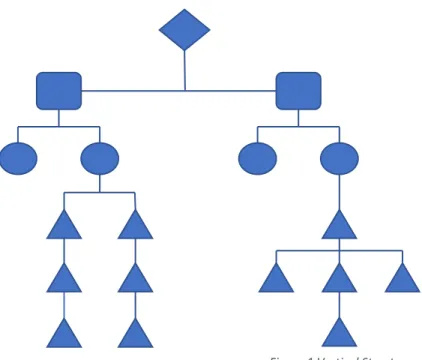
managers before being translated down to middle managers. In this sense, a vertical structure implies a centralised concentration of power in the organisation. Hage and Aiken (1967) identified two components of a centralised organisation: participation in decision-making and hierarchy of authority. Participation in decision-decision-making refers to the extent decision-making activities are relatively concentrated during the policy making process. Hierarchy of authority refers to the relative concentration of decision-making power in task completion. Consider the case of a marketing firm with various employees. Each employee is specialised in a given task, but all report to a marketing vice president who coordinates the activities (Walker, 1985). In a vertical structure, what is commonly found is an
organisation with low-levels of decision-making participation and high levels of hierarchy of authority (Schminke, Cropanzano, Ambrose, 2000). The graph below serves as a visual representation of a centralised structure. With strategic decisions coming from the top, each unit below is responsible for a single business function. In this form, the division of labour allows for the specialisation of basic business tasks. As the company grows, new tasks can be added to existing departments, or subdivided. While departments depend on direction from the top, cross-department coordination is made difficult.
2.6.2. Horizontal Structure
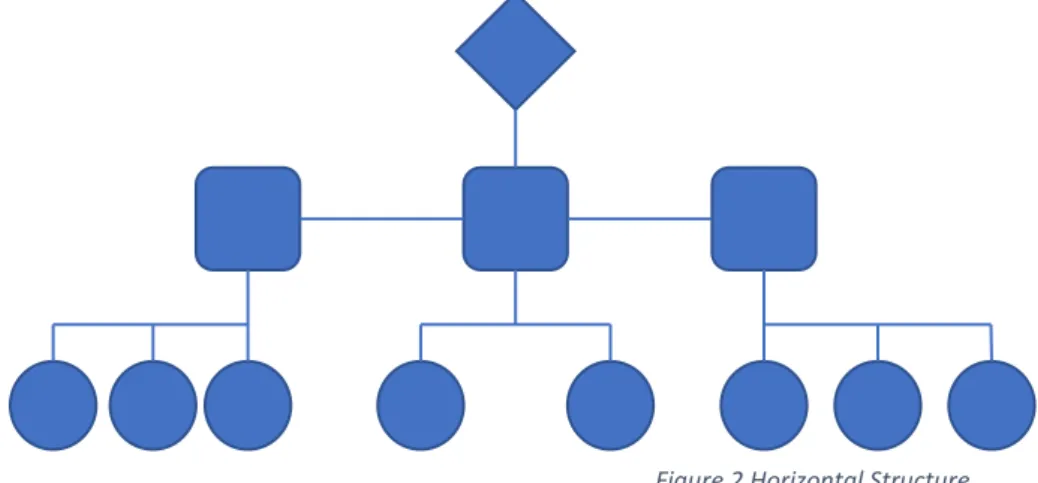
A horizontal structure, also known as a flat organization, has fewer management layers and many lateral channels that are actively involved in the decision-making process (G. Lo Nigro, M. Bruccoleri, and G. Perrone, 2006, “Negotiation in distributed production planning environment”, International Journal of Production Research, 44(18):3743-3758). Unlike what is true for a vertical structure, a horizontal organization is characterized by decentralization, as the reduced amount of management position implies greater
independence for individual workers in the organization. From the graph below, it becomes clear as to why a horizontal structure is viewed as flat. With fewer chains in the vertical chain of command, decision-making is reduced to where information is held (Qi, Tang, Zhang, 2014). The speed and quality of information sharing, interpretation, and application improves. Structures influence knowledge process through shaping patterns and frequencies of communication among organizational members (Zheng, Yang, McLean, 2010). With a reduced hierarchy of authority, organizational members are empowered to interact and coordinate along horizontal channels on their own level (Qi, Tang, Zhang, 2014). For social enterprises struggling with the competing demands of two logics, a flat organization may
favor them as increased cooperation between the two camps mat facilitate any internal tension as more information is passed between them.
3. Methodology
Although there have been significant contributions to the field of hybrid organisations and their internal challenges, there is still a lot that can be discovered in this field of research. Therefore, this thesis will follow a qualitative method of research, as the exploratory nature of the approach allows me to uncover the further underlying reasons behind a social enterprise’s decision to enact a strategic option available to them. By determining the characteristics of a qualitative research, it highlights why this method is most appropriate (Cresswell, 2013). Firstly, the research is holistic in nature through the collection of primary and secondary data, since it tries to develop a complex picture of the problem being studied by reporting on multiple perspectives and identifying different factors. Second, the information gathered through multiple sources of data will have to be collected, reviewed, interpreted, and complied into their corresponding categories in order to comprehend the phenomenon being evaluated.
3.1. Research Development
Given the novelty around this subject (Battilana et al., 2015; Battilana & Lee, 2014; Ramus & Vaccaro, 2017), the research question will be approach as an inductive approach. This research is not aimed to confirm any hypothesis regarding the strategic action taken by
social enterprises, but rather to gain a better understanding of how the identified social enterprises implement certain strategies to mitigate organisational tensions. In order to do so, two research techniques were chosen: interviews, and archival data. These two methods are most suitable because it allows us to “discover and understand what is behind this phenomenon” (Stauss & Corbin, 1990, p.19).
3.1.1. Interviews
Regarding techniques, conducting in-depth interviews is the method of choice in collecting primary data. Bailey (1987) highlighted the reasons as to why interviews are beneficial for a qualitative research. Firstly, ensures that that all questions are answered (Bailey, 1987). Secondly, it guarantees that answers reflect interviewee perception rather than that of an external source (Bailey, 1987). And lastly, it helps uncover any underlying opinions, motives or beliefs the interviewee may hold (Bailey, 1987). Interviews also benefit the researcher in that it allows for controlling the line of questioning when
participants cannot be observed directly (Cresswell, 2014), and allows for the exploration of the person’s thoughts and behaviours (Boyce & Neale, 2006).
The interviews will be semi-structure and face-to-face. Semi-structured because it helps to create an understanding between the research and participants and reduces the bias towards focusing on socially desired answers (Patton, 1990). Also, the semi-structured nature of the interviews allows for clarification when required (Skodol-Wilson, 1992). Additionally, being face-to-face, empathy is fostered between the interviewers and participants, while at the same time encouraging greater interest in the topic of discussion (While, 1994).
3.1.2. Content Analysis
Content analysis is “any methodological measurement applied to text (or other symbolic materials) for social science purpose” (Shapiro & Markoff, 1997, p.14). This method assumes groups of words reveal underlying themes through co-occurrences of keywords that can be used to interpret and reflect associations between concepts (Huff, 1990; Weber, 1990).
Content analysis holds several advantages when conducting a qualitative research. For managerial research, it is a methodology that provides deeper access to the individual or collective structures such as values, intentions, attitudes, and cognitions (Carey, 1997; Huff, 1990; Kabanoff, 1996). It allows degree of flexibility as analysis can be conducted on two levels (Erdener & Dunn, 1990; Holsti, 1969; Woodrun, 1984). On one level, text can capture and revealed in a number of text statistics, on another, research interested in the latent content and deeper meaning in text can explore it further (Duriau, Reger, Pfarrer, 2007). Lastly, it can be nonintrusive, as the text under analysis does not suffer from researcher demand bias (Woodrum, 1984).
3.2. Interview Protocol
Considering the type of research question serves as a guide in defining a starting point for the interview protocol. A defined research question allows for a better
understanding of the aims of the research. Key to understanding the research question is to view it to have both substance and form (Yin, 2013). “How do the applied strategic actions of SEs help in overcoming internal organisational tensions?” The substance (aim) is to understand the influence of the strategic actions on organisational tensions. The form (type) is the application of “how”, which implies the strategy of choice is explanatory (Yin, 2013) in order to clarify how these influences manifested themselves.
The interview protocol consists of five different sections, with each section serving a particular purpose in producing findings. Background, to gain a general impression of the interviewees’ motivations and role. Company culture, hiring process, and organisational structure all serve the purpose of highlighting how important each strategic method is to the social enterprise. Lastly, balancing logic section looks to understanding whether these methods have helped these social enterprises overcome their organisational tensions, as well as answering the research question. The interview protocol can be found in Appendix.
3.3. Sampling Strategy
This research will only focus on social enterprises operating within Portugal. The reason for this is ensure that the policy climate does not differ for social enterprises and they all
operate under the same conditions. In choosing the enterprise, primary condition for the social enterprises being analysed is that they need to have a dual mission, performing both commercial and social activities. Therefore, the customers and the beneficiaries must be clearly identified. A minimum of three operational years will also be considered as they have the operational experience that can be tracked, and their development as an
organisation can be better illustrated. Lastly, the people I will mainly interview will be participants operating in managerial roles within their enterprise. This is because their position offers a better overview of the SE and their experience provides a deeper insight that can be used to answer the research question.
3.4. Thematic Analysis
As highlighted earlier, the exploratory nature of the qualitative method will allow me to uncover underlying reasonings behind a social enterprise’s decision to enact its strategic options. In order to identify these reasons, this research will follow a thematic analysis method when analysing the data collected. As described by Braun and Clarke (2006), thematic analysis is a “method of identifying, analysing, and reporting patterns within data”. Given the amount of data that has been collected though out the research stage, this method will allow me to bring order, structure and interpret the gathered information (Marshall & Rossman, 1999, p. 150). In order to conduct a successful thematic analysis, a framework for analysis was required to be formulate.
3.4.1. Building a Framework
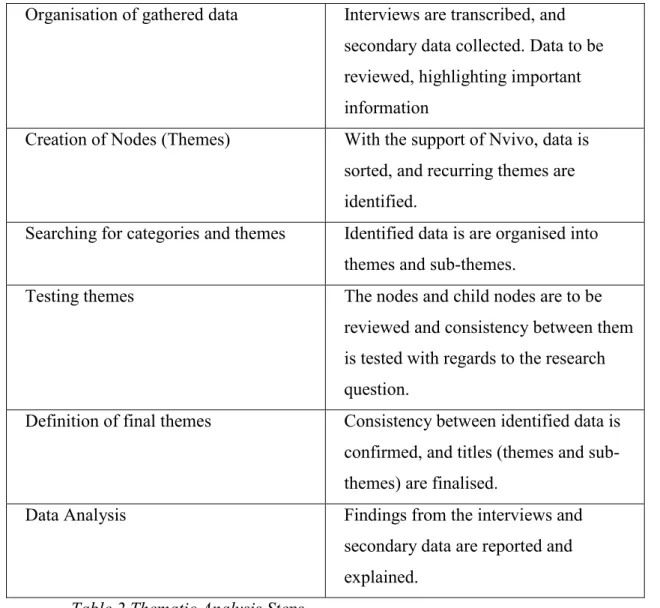
First and foremost, the purpose of conducting thematic analysis is to analyse “the data by principal concepts or themes while reducing it to main ideas to be extracted forward” (Woodruff, 2013). The data analysis in this research was supported by Nvivo, a qualitative software which aids the organisation and analysis of qualitative data. Building the framework for analysis required for the process to be broken down in to several stages, highlighted below:
Organisation of gathered data Interviews are transcribed, and secondary data collected. Data to be reviewed, highlighting important information
Creation of Nodes (Themes) With the support of Nvivo, data is sorted, and recurring themes are identified.
Searching for categories and themes Identified data is are organised into themes and sub-themes.
Testing themes The nodes and child nodes are to be
reviewed and consistency between them is tested with regards to the research question.
Definition of final themes Consistency between identified data is confirmed, and titles (themes and sub-themes) are finalised.
Data Analysis Findings from the interviews and
secondary data are reported and explained.
Table 2 Thematic Analysis Steps
4. Data Collection 4.1. Primary Data
Primary data is data gathered by the investigator on a first-hand basis (Rabianski, 2003), and is most commonly attained through interviews, focus groups, or participation
observation (Fossey et al., 2002). For this thesis, I conducted 10 interviews of participants in managerial roles for their respective social enterprises. Interviews were gathered during the months of July and August of 2018. The interviews, which lasted between 30 to 50 minutes, were conducted in a semi-structure way. All the interviews, which were either conducted in person, Skype, or via Hangout, were audio recorded, then transcribed.
A table highlights each participants position, as well as the characteristics of the enterprise can be found in the Appendix. In order to protect the identity of the participants, each participant was assigned with a letter from the NATO alphabet.
4.2. Secondary Data
Throughout the data gathering stage, secondary data, which refer to information
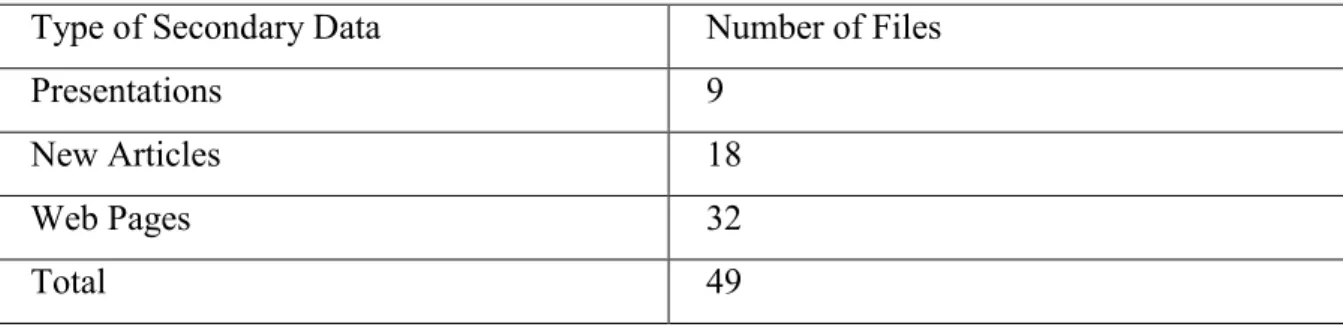
complied by third parties (Rabianski, 2003), was also collected. The purpose of this was to reflect and support the answers previously obtained from the interviews. The material gathered was obtained from publicly accessible means (i.e. social organisations webpage, news articles, videos, partners) or from the participants themselves (i.e. presentations, welcome packs).
Type of Secondary Data Number of Files
Presentations 9
New Articles 18
Web Pages 32
Total 49
Table 3 Secondary Data Collected
5. Analysis and Findings
Having gathered all the primary and secondary data necessary, this section of the thesis will serve to analyse and answer the aforementioned research question.
5.1. Data Analysis
When conducting the interviews, participants were asked to express their opinions over a series of question relating to the company culture, organisational structure, and hiring process of their social enterprise. Additionally, more questions were asked which reflected the organisations ability to balance the two logics incorporated within their core. The questions aimed to highlight aspects of the enterprise, such as:
Interaction between members of the organisation Identifying potential employees
Managing demand conflicts
Following the framework, the analysis has identified divided data into themes and sub-themes, which ultimately aim to answer the research question. The findings show that for majority of the themes that interviewees were questioned about there were general
agreements, while other themes had more contrasting attitudes.
The table below shows the themes and sub-themes identified when building the framework for analysis:
Themes Sub-themes
Organisational Structure Level of internal communication Commonly used structure
Company Culture Determining the effectiveness of of company culture of the organisation Construction of ‘meaning’
Hiring Process Methods of recruitment
Integration process
Balancing Logics Compromising on Logics
Level of integration between logics Table 4 Themes and Sub-themes
5.2. Organisational Structure
5.2.1. Level of internal communication
The level of internal communication within an enterprise can reflect the ability of the organisation in overcoming tensions by facilitating coordination between differentiated groups or departments. To better understand the how often teams and members are
communicating, participants were questioned how often the departments come together for team meetings, since “organisations that make time for ‘mandatory’ meetings to ensure
coordination of social and commercial activities were able to manage tensions as it enabled sustained coordination across all groups” (Battilana et al., 2015). This point is best
exemplified by Foxtrot:
“Even in the meetings we try to understand how we can manage our task, our goals, how to monitor our process of reaching those goals. We are always trying to optimise, especially in this start-up phase”.
Two participants, on the other hand, stated that they meet less than once a week. However, it was mentioned that the reason for this is because at each enterprise, members work remotely at times:
“Everyone as their own part, we work on our own task, then come together and report what has been done. Then we are off again.” – Hotel
“I can tell that part of the team is in Porto, the other is here in Lisbon. Myself, I am away a lot of the time.” – Bravo
Nonetheless, the benefits, and importance, of having mandatory meeting to facilitate coordination and ease tensions are known:
“We also do a lot of dynamic, so we don’t want to just meet around the table, but also make people thinking outside the box. We want them to keep an eye on what is happening in other areas.” – Charlie
Even Bravo, who doesn’t meet as regularly as the other enterprises identified this: “[…] they always have the purpose of realigning the vision and making sure that we understand that we are pushing in the same direction, which is something that you really need to pay attention to.”- Bravo
However, it should be mentioned that a common characteristic between the enterprises under analysis is that they are all small in size, and usually spend a lot of time together. Therefore, outside of the formal meetings, organisation members are constantly interacting with each other in other situations.
5.2.2. Commonly Used Structure
Understanding the way enterprises structure themselves internally provides us with further insight into how social enterprises dealing with organisational tensions manage their ‘information networks’. In understanding how they do so, after allowing participants to reflect on internal communication, formal and informal, they were asked whether they believed themselves to be organised vertically or horizontally. The majority identified themselves to being organised horizontally, with many believing that it was the most logical way to structure themselves in order to facilitate the development of the enterprise, a point best described by the following citation:
Horizontal. And not just because we are small. But our growth plan is to always have a horizontal structure, and I will tell you why. Our growth plan looks to hire more people for sales and support. But we believe that the founders can never leave sales and support so that everyone can understand reasoning behind decision-making. As long as it is possible, we will maintain a horizontal structure. – Alpha
The others who responded otherwise, believe themselves to be vertical for different reasons. Echo stated that the “lines of reporting is quite clear” to them since they would mainly report to one other manager. Although Hotel did not explicitly state that they were vertically structure, definitely implied it to be the case:
I know what my intentions are, and I know what I want these projects to do […] I considered everyone’s opinion, but at the end of the day, I am the one who decides This response reflects the two components of a centralised structure: participation in decision-making and hierarchy of authority (Hage & Aiken, 1967). Nonetheless, by referring to the idea of ‘information networks’, we can see that the choice of deploying a ‘flat’ organization is based significantly in the belief of promoting interaction amongst all members of the organisation:
Everything is changing for networks, even inside the company. You have different kind of elements, and they’re all connected somehow – Foxtrot
Reducing the hierarchy of authority, members are encouraged to interact and coordinate amongst each other on their own horizontal channels (Qi, Tang & Zhang, 2014).
5.3. Company Culture
5.3.1. Constructing Meaning
The purpose of understanding this theme is to understand how a company culture is formulated to incorporate the multiple logics. As mentioned in the literature, manager faces the challenge of constructing meaning from the multiple logics. What this theme aims to answer is whether the company culture is holographic or ideographic. The findings suggest the meaning is constructed holographically, with the managers and the employees agreeing what the company stood for. The following citations support this analysis:
“To democratize the access for citizens to invest in these specific area of sustainability” – Golf
“[…] put together the three axis (people, environment, and profits) through design and design processes.” – Bravo
When asked the same question both Delta and Echo had the same response, “social
inclusion of migrants”. Additionally, this holographic nature of the SE’s under observation is reiterated through the secondary data explored:
“We believe each project needs to find its balance between society, environment and economy” – Bravo’s mission statement
“We promote easy access to good investment opportunities and the outcomes are shared and benefit everyone.” – Golf’s mission statement
“It connects newcomers and locals living and makes integration easy to the ones moving to new cities.” – ‘Welcome Pack’ for Delta’s SE
What this result has showed us is that there is agreement within all the enterprise in their purpose, and therefore an understanding of the objectives their enterprises are trying to attain. It is therefore necessary to determine the purpose of the enterprise by determining the effectiveness of the culture on the internal organization.
5.3.2. Determining the Effectiveness of Company Culture on the Organisation
As the findings above suggest, meaning is something that members of the social
enterprise agree on. In order to further the determine the implications of company culture of organisational tensions it is worth understanding its effectiveness. Understanding its
effectiveness can be validated along four dimensions: adaptability, consistency, and mission. This theme aims to identify the dimension most present., and in order to do so, participants were asked to explain how their mission is maintained amongst individual members. From the data analysed, the effectiveness of the company culture was determined by the consistency of the culture. Consistency refers to the extent organisational members hold the enterprise’s beliefs, values, and expectations. This is reflected in the passion the employees already have for the objectives of their respective enterprise:
“I don’t think the mission exists because we say it does, but because we embody it. The people that joined are people with the same values, and so, it’s quite simple to maintain” – Bravo
“Every person has a SMART GOAL that is connected to the ultimate KPIs. Which is connected to our mission. That is how we validate, and that everyone knows their personal contribution to the vision and the mission.” – Echo
Having shared values as a characteristic of its members was a dimension that was consistent with all the participants, in that all of them believed it to be of upmost importance for the success of their respective enterprise. However, it should be noted that the company culture does not guarantee the organisation’s effectiveness itself, but rather the effectiveness is experience internally by its ability to shape the behaviour of an organisation’s members (Zheng, Yang & McLean, 2010), which can influence internal tensions.
5.4. Hiring Process
5.4.1. Methods of Recruitment
We know from the analysis above; the holographic nature of the company culture suggests that SEs look for individuals who ascribe to their shared values. However, for an enterprise that incorporates two sets of activities it can be challenging in finding the right candidate. When asked about any unique steps undertaken in their recruitment process, only two enterprises acknowledged their rigorous hiring process. Charlie, who was the developed SE in relation to the others, have experience a growth in applications. They have a very
rigorous hiring process:
“We have a strategic HR committee, that helps us define a hiring process that makes sense to each function.”
This is followed by a review of the CV and interviews before shortlisting the candidate who will be invited to take part in an experience day:
“One of the things we like to do is have an experience day […] we believe it is really important to conduct a transparent process […] they can ask anything they want” Echo provided a different explanation for having a rigorous hiring process:
“it’s a very important step because we don’t have a lot of money […] we really pay a lot of attention to recruit to make sure we find the right people and the right culture fit because there is a culture here which is a lot like ‘learn are you go’ […] Not all kinds of people can take this kind of environment” – Echo
Delta further supported the need for a rigorous hiring process with the following citation: “It is very difficult to hire good people. In interviews, some people are very good at doing interviews and some people are not so good. But it doesn’t mean that they are not good at their job. It’s tough anyway.”
The remain SEs did not have a hiring process as detailed as the previous two, however, it was suggested that belief in social causes or genuine support for the mission was a vital requirement:
“We need to have alignment. With our values, with our purpose, with our mission. That is the number one reason to hire someone.” – Bravo
“Their backgrounds reflect their concern for sustainability and environmental issues, so they understand perfectly the core belief.” – Golf
“They need to really have passion and be devoted to social causes. I don’t care about their experience.” – Hotel
These findings imply that although so may face a limited ability in identifying the ideal candidate that can navigate between the two logics, it does facilitate the enterprises in finding candidates with a genuine belief in their mission:
“We were very transparent. We told a lot of people who came towards us that we didn’t have money to pay them […] Everyone who is here today came to me first. We were always straight forward with them, on every aspect of the business.” – Foxtrot
The social component therefore becomes a fundamental tool in facilitating the recruitment process for managers of social enterprises (Battilana & Dorada, 2010).
5.4.2. Integration Process
The combination of commercial and social activities holds intrinsic value for the job satisfaction of employees. Explaining the integration process served to better illustrate how SEs deal with aligning individuals to their enterprise’s ethos. Once participants reflected on their hiring process, they were asked whether new employees undergo any training. Out of the ten participants, only Charlie had stated that new employees would immediately start an integration process:
“One of things is to ensure that everyone has a great perspective of all the areas in the enterprise. The first week, the objective is to pass through each area and meet everyone.” The other nine participants stated that the only form of training new recruits would receive was on-the-job training:
“I think the training, because we work so closely together […] but always working on different projects makes us grow with the project. We are always learning with different people [clients, partners, external hires]so there is always a learning process in all of it. – Bravo
“Besides the one-on-one training for tasks that I would perform on a daily basis, I didn’t undergo any specific training.” – Echo
A similar view was shared by another participant:
“When they start working, of course we make a briefing of what we are doing, the strategy, the process, the message. But it’s just a few hours. At the beginning, they sit next to me, so I can guide them through.”
Another point worth noting that may explain the reasons behind a lack of integration process is specifically the type of candidate that is hired. Some of the participants echoed the findings of Battilana and Dorado (2010) and mentioned they apply a tabula rasa approach by hiring mainly for entry level positions:
“First, we hire a lot of entry level.” - Delta
“[…] we are talking about young people. Straight out of university, so traditionally, they do not have a lot of experience.” – Golf
Reflecting back on the construct of meaning, the literature suggests that a ‘socialisation’ process would benefit social enterprises in overcoming organisational tensions by allowing
that the need for an integration process was not view as essential. Nonetheless, it is worth mentioning that majority of the respective SEs of the participants have not undergone a large hiring process just yet but look to do so in the future.
5.5. Balancing Logic
Previous studies have mentioned the need for crafting stability between activities (Doherty et al., 2014). This theme aims to provide a general perception of the participating SEs ability in overcoming internal organisational tensions. When ask whether there was a time they felt a need to compromise on one of their activities, the overwhelming response was that there was no need to compromise. Many of the changes made were changes that were deemed necessary at the beginning of their operations:
“No, not really. We went through four acceleration programs, and in all of them we made small changes.” – Alpha
“Yes, but it never influenced the impact side of the business […] Little changes you make because of feedback. The best way to have a really good product on the market is to listen to the market and try to adapt.” – Foxtrot
The closest example that suggested a need for compromise, in the favour of financial demands, was given by Hotel:
“We did have to compromise on one thing, but it was very small, which was our sustainability issue. At the start we wanted to only take 5% commission, but it was not enough for us to carry on operations over the last two years.”
Nonetheless, the justification for this decision was mirrored by other participants:
“There is no social mission if you don’t have money. If you put it this way, it’s not really compromising if you are making sure that you have a social mission.” – Juliet
“It is important the enterprises don’t forget to focus on the commercial activities for one simple reason: it’s the only way to ensure you can carry on with your mission” – Bravo While the literature suggests that SEs walk a fine line between the two logics (Battilana & Lee, 2014), the results imply that they gladly skip between both sides of that line. This echoes the findings of Pache and Santos (2013), who highlighted that compromise can be a viable strategy for organisations facing competing demands.
5.5.1. Level of Integration Between Logics
Considering the findings from above, this theme here aims to explain the justification behind participating SEs ability to accept this form of ‘compromise’. The literature highlighted that revenue-generating activities that share cost with the social mission a strategically beneficial as the demands are not competing for resources (Nielsen, 1986). This is highlighted by the following citation:
“What is needed is for you to formulate a strategy that aligns the two to go in a similar direction.” - Alpha
By reconsidering the core organisational activities of the SEs that participated in this study, it is clear that all of them displayed high levels of integration between their logics.
Therefore, the organisational tensions that have been identified in previous studies do not fully apply to the sample taken for this study.
6. Conclusion
The final chapter of this study will exhibit the conclusion. Furthermore, the limitations of the study with be presented, as well as recommendation for further research will be highlighted.