Resilient Supply Chains
Helena Carvalho* and V. Cruz Machado ** UNIDEMI
Universidade Nova de Lisboa Campus de Caparica – Caparica
Telf: +351 212 948 567; fax: +351 212 948 531; e-mail: [email protected], [email protected] Abstract — This paper explores the designing principles
to create resilient Supply Chains (SC’s) with the ability to return, rapidly, to the initial stage or to an improved one after a disturbance occurrence. SC disturbances and failure modes are identified and discussed. The concept of SC resilience is defined and explored; a conceptual SC Resilience Index and a SC Resilience Indicator are proposed. A framework for the design of resilient SC’s is introduced, identifying main SC characteristic that can be modified to increase SC resilience and to mitigate its vulnerability.
1. Introduction
In nowadays organizations need to answer to the increasing market volatility: product and technology’s life cycle time are getting shorter; competitive pressures force fast changes in the design of products/services; customers’ demand compel to bigger differentiation. There is an increasing awareness that businesses cannot compete as isolated entities, yet can do so, as networks [1].
The Supply Chain (SC) can be defined as a set of interdependent organizations that act together to control, manage and improve the flow of materials, products, services and information, from the origin point to the delivery point (the end customer) in order to satisfy the customer needs, at the lowest possible cost to all members [2].
One of the major problems in managing and controlling SC’s is the uncertainty associated with the SC events [3]. Some of the previous research developed by UNIDEMI (Unidade de Investigação e Desenvolvimento em Engenharia Mecânica e Industrial host in Faculdade de Ciências e Tecnologia da Universidade Nova de Lisboa) had been focus on “predictable” uncertainty, in the day-to-day fluctuations that affect the production systems [4]-[7]. But there is another type of uncertainty related to the events that can not be predictable. In a global economy, with SC’s crossing several countries and continents numerous times, from raw material to final product, those events can create large-scale disruptions. These disruptions are propagated through the SC, affecting the ability of the organizations to meet previously made commitments.
In order to study how to manage the negative effects of SC disturbances, a research project named “Supply chain management: design for resilient systems” is actually in progress at UNIDEMI. The main objective of this project is to develop a Management Support System (MSS) prototype to help managers to react quickly and
efficiently to the effects of disruptions that can occur in SC, sustaining a high service level to customers and to merge the necessary information to develop mitigation plans if the disruption became repetitive. This paper presents the preliminary findings of the research project. The rest of the paper is organized as follows. The Section 2 is dedicated to SC disturbances and they effect in SC’s; here the SC failure modes are identified. In Section 3 the concept of resilience is applied to SC, is proposed a conceptual SC Resilience Index and a SC Resilience Indicator. The Section 4 is dedicated to the principles for designing resilient SC. Finally, Section 5 concludes the paper with a summary of the research done.
2. Supply Chain Disturbances
A. Supply Chain Disturbances
The SC is an inherent complex system with a net of linked activities going through multiple suppliers, producers and retailers, which can be involved with several other chains. The SC dynamic behaviour adds complexity, with several uncertainty parameters that are spread along the chain: consumer’s requirements, resource capacity, transportation time, production time, costs, quality, priorities, and lack of information, among others. The SC uncertainty is expressed in questions such as: How much the customers will order? Which amount of products must they have in stock? The supplier will deliver the order in the established term and specifications?
According to Mason-Jones and Towill [8] the uncertainty reduction could be obtained through the analysis of the inherent uncertainty sources and their interactions. Towill et al. [9] classifies the SC uncertainty sources in the in four groups:
− Process uncertainty: affects the internal capacity of
the organization to reach the planned production;
− Supply uncertainty: the supplier can’t carry out with
the requirements of the organization (in time, right amount and correct specifications - quality or price);
− Demand uncertainty: it concerns the predictability of
the demand amount and the variety of product;
− Control uncertainty: it concerns to the information
flow in the organization and to the way as the organization transforms the orders into goals of production and material requests.
To Van der Vorst and Beulens [3] the SC uncertainty is associated to decision-making situations in which the decision maker does not know what to decide because: the goals are indistinct; it does not exist a complete information (or understanding) of the SC; it does not exist capacity of information processing; it is incapable to foresee the impact of possible control actions in the behaviour of the chain; or there are no actions of effective control. These authors classify the SC uncertainty sources in three categories:
− Inherent characteristics of SC that cause more or less
predictable fluctuations;
− Chain characteristic features that result in potential
loss of performance;
− Exogenous phenomena that disturb the system such
as changes in markets, products, technology, governmental regulations.
However, the available press articles reveal several examples of other type of SC uncertainty:
− September 11, 2001: terrorist attacks destroyed New
York’s World Trade Center Towers. Not only were some 3000 lives lost, but also companies such as American Express experienced significant losses in terms of their information databases [10];
− August 14, 2003: electrical power distribution in the
American Midwest and Ontario was disrupted, with power outages lasting up to several days. The effects of this disruption were felt as far away as California, where Apple Computer was preparing to launch its much anticipated G5 computer. This launch was affected by the fact that IBM in New York manufactured the microprocessor chips required by Apple. The power disruption resulted in large-scale losses of chip production [11];
− In 2003: a number of companies suffered serious
disruption because of severe acute respiratory syndrome. 8000 people were infected, with one in ten dying; it still costs an estimated US$60 billion in lost output in South and East Asia [12].
We identify these events as SC disturbances. It is proposed the following definition for SC disturbance: exogenous events that the decision maker cannot control or avoid; suddenly, they affect the SC, generating important uncertainties (a decision-making situation in which the decision maker does not know what to decide). In this definition, the concept of unexpected is implicit in the sense that some events are unpredictable or enable to foresee. Other events can be predictable but, if their impact is not correctly assessed, they will generate a SC uncertainty.
B. Supply Chain Disturbances Classification
As previously examples demonstrate, the disturbances are the outcome of numerous events. In an attempt to classify those ones, the following classification for SC disturbances is suggested: natural events; accidents; and man made events.
The first category, natural events, encloses all the events related to the natural environment (which comprises all living and non-living things that occur naturally) in which the SC is incorporated. It includes hurricanes, earthquakes, storms, extreme weather conditions,
tsunamis, diseases, volcanoes, among others. In this category, a pertinent aspect is that all environments are directly or indirectly influenced by humans. In this way, some events are inflated by consequences of the human action, e.g., markets environments that facilitate spread of the bird flu virus to others humans or animals. So, nevertheless the event occurrence can be predictable with some accuracy, the real consequences for the SC’s are difficult to assess. The Hurricane Katrina is a good example: despite the annunciate catastrophe, most organizations were not prepared to the devastating effects of the hurricane.
In the second category are include all accidents that can affect the SC’s: human errors, mechanical breakdowns, fires, among others. The frequency of the events occurrence can be minimized by promoting best practices to increase safety. However, it is impossible to control all risk factors and accidents eventually will happen, e.g., as the Chernobyl disaster.
The third category is related with all the disruptive acts performed on a deliberated basis by man: terrorism, political instability, vandalism, theft, computer virus, labour strikes, among others. Some events, like strikes, can be previously anticipated; but if their consequences are disregarded, SC uncertainty will be generated. Other events like terrorism or vandalism acts cannot be foreseen.
In this list, Technological, Economics, Governmental and Legal issues were not considered. Usually these events can be foreseen with some antecedence, and do not affect suddenly the SC. But unexpected changes in these categories can lead to SC disruptions, e.g., some responses to the attacks on September 11, 2001 had bigger impact on commerce and SC’s than the attacks themselves [13].
With this classification of SC disturbances decision makers can be aware of the several possible events that can affect their SC.
C. Supply Chain Failure Modes
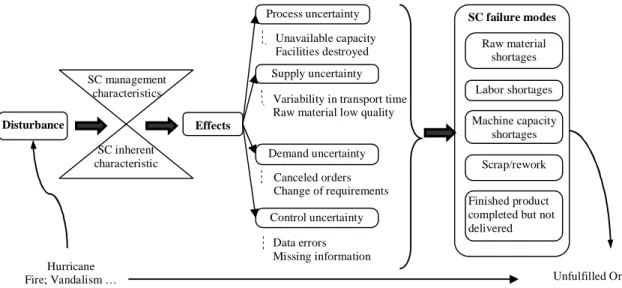
All SC disturbances, whatever they category, create an SC uncertainty that appears in the form of control, process, supply and demand uncertainty (see Figure 1). These uncertainties can derive from multiple causes depending on the disturbance characteristic, e.g., facilities can be destroyed by a fire causing a process uncertainty; extra orders of a particular medicine during an epidemic provokes a demand uncertainty. If there isn’t an appropriated response, these uncertainties, will cause a failure in SC: the previously made commitments could not be accomplish, i.e., delivers the right product, in the right quantity, in the right condition, to the right place, at the right time, for the right cost.
In their essence, disruptions in supply, demand spikes or capacity losses produce the same effect: an unfulfilled order; being this the final consequence of SC disturbances.
Kohn and Saad [14] established the underlying causes of finished product delivered late in organizations. Since the SC is a network of interdependent organizations, we can extrapolate the same causes for unfulfilled order in SC.
Figure 1. Effect of disturbances in the SC decision-making process
The following categories are identified:
− Raw material shortages: in this failure mode, we only
consider the situations related to the first supplier level, although several material (components, spare parts) shortages can occur at different SC levels (these situations can be related to the following failure modes);
− Machine capacity shortages: the capacity installed is
not enough to satisfy the next SC level demand;
− Labour shortages: since labour is a SC resource,
when a deficit occurs, the SC operations are affected.
− Scrap/rework: occur when the quality of materials is
defective; process variability causes quality defects in manufactured goods; customer requirements are soundly altered; among others;
− Finished product completed but not delivered: the
product is finalized, but is not delivered to the next SC stage.
So, although there are numerous SC disturbances, the number of failure modes is finite. These failure modes represent the real consequences of SC disturbances, that will be amplified or weaken by the SC characteristics. Therefore, managers should not be worried with disturbances that could occur, but with the failure modes that can occur and how to protect their SC against them. The magnitude of the disturbance impact is function of the relative importance of the entity that suffers the hit and her degree of integration in the SC. In this way, a problem that appears localized could ripple across a particular SC, an industry sector or even a national or multinational economy. From the previous examples, it is evident that disturbances can have a considerable impact on the SC short-term performance. Long-term negative effects also are observed: companies suffering from SC disruptions experienced 33-40% lower stock returns relative to their industry benchmarks [15]. Although this recognition, there is a lack of action from SC managers in order to minimize the impacts of SC disturbances [16]. According to Tang [16], the most probable reason for this fact is the difficulty to perform cost/benefit or return on investment analysis to justify certain risk reduction programs or contingency plans “nobody gets credit for fixing problems that never happen”.
3. Resilient Supply Chain
In order to minimize the negative impact of SC disturbances it is necessary to identify the system characteristics that can be used to manage the SC behaviour when disturbance occurs.
Traditional production systems practices try to anticipate and resist to perturbations. Fiksel [17] had defined three system types according with their reaction to perturbations:
− Resistant system: is an engineered system highly
controlled. It operates within a narrow band of possible states and is designed to resist perturbations from its equilibrium state. It recovers rapidly from small perturbations, but it may not survive a large perturbation;
− Resilient system: is typical of social and ecological
systems. It can operate across a broad spectrum of possible states and gradually tends to return to its equilibrium state. It is capable of surviving large perturbations;
− Larger perturbations tolerating system: this category
of systems under certain conditions may shift to a
different equilibrium state, representing a
fundamental change in its structure and/or function. Asbjørnslett and Rausand [18] defined the systems ability to resist to disruptions as resilience. Peck [19] defines resilience as the ability of a system to return to its original state or move to a new one, more desirable, after being disturbed. Carpenter et al. [20] specify some resilience properties: (i) amount of change the system can undergo (implicitly, the magnitude of disturbance the system can sustain) and still retain the same controls on function and structure; (ii) degree to which the system is capable of self-organization; (iii) ability to build and increase the capacity for learning and adaptations.
The goal of SC resilience analysis and management is to prevent the shifting to undesirable states when significant disruptions occur. In this sense SC resilience can be a strong source of competitive advantage.
SC inherent characteristic s SC management characteristics Disturbance Effects Process uncertainty Supply uncertainty Demand uncertainty Control uncertainty Unavailable capacity Facilities destroyed
Variability in transport time Raw material low quality
Canceled orders Change of requirements Data errors Missing information SC failure modes Raw material shortages Labor shortages Machine capacity shortages Scrap/rework Finished product completed but not delivered
Unfulfilled Orders Hurricane
According to Fiksel [17] the system characteristics that contribute to resilience are:
− Diversity of control actions: existence of multiple
forms and behaviours;
− Adaptability to switch to new states: flexibility to
change in response to new pressures;
− Cohesion: existence of unifying forces or linkages;
− Process efficiency: performance with modest
resource consumption.
The notion of flexibility and adaptability are imbedded in these characteristics (in the sense that the desired final state can be different from the original). In this case, SC resilience can be a strong source of competitive advantage. However, resilience is not always desirable; for example, systems states that reduce SC service level or profitability can be highly resilient. In fact, several organizations have trouble in recovering from undesirable states, although reengineering programs have been implemented.
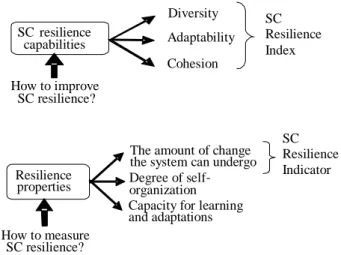
In order to increase SC resilience, some SC characteristics should be enhanced through the creation of competences to react quickly and properly, according to the disruption. Diversity, adaptability and cohesion can be considered main capabilities of the SC resilience (see Figure 2). Efficiency, as well, should be considered as an important characteristic of resilient SC, but all SC systems (resilient and non-resilient) should have this characteristic in order to sustain their competitive advantage. We propose a conceptual SC Resilience Index as a function of the SC resilience capabilities; the generic expression (1) can be build.
SC Resilience Index = f (diversity,adaptability,cohesion) (1) The SC Resilience Index will allow the evaluation of SC ability to preventing the system to shift to undesirable states, when significant disruptions occur. It should increase with higher levels of SC diversity, adaptability and cohesion. With this index, it would be possible to identify the SC resilience capabilities to develop, in order to improve SC resilience.
It is expected that high values of the SC Resilience Index will correspond to resilient SC’s; however, it is not a measure of SC resilience. The SC resilience only can be measured after a disturbance occurrence and consequent SC failure. The question on how to measure the SC resilience still has no answer. Carpenter et. al. [20] state that to understand the resilience of a system, it must be clearly defined the resilience in terms of “what to what”. It is necessary to define what system state is being considered (“resilience of what”) and what failure modes are of interest (“resilience to what”).
We proposed the use of the resilience properties to draw a SC Resilience Indicator; in particular, the amount of change the system can undergo and retain the same controls on function and structure. Doing so is possible to assess the SC resilience: the SC Resilience Index will allow evaluating the SC resilience capabilities and the SC Resilience Indicator will allow measuring the system reaction to disturbances.
Figure 2. How to asses SC resilience
4. Designing Principles for Resilient Supply
Chains
It is expected that SC characteristics will amplify or weak the effects of SC disturbances. On the other hand, SC resilience should increase if SC characteristics that are related with the resilience capabilities (diversity, adaptability and cohesion) are enhanced. In order to design resilient SC, it is necessary to identify the relations between SC characteristics and SC resilience. An insight on this research problem could be obtained in a seminal work in the Economic area done by Briguglio et al. [21]. They proposed a framework with two elements to analyze and measure the economic resilience: the first is associated with the inherent conditions of a country and the second associated with the conditions that have been developed to absorb, cope with or bounce back from external shocks.
In SC systems, some inherent characteristics are responsible for the SC vulnerability. In this perspective, Peck [19] used the term “risk” in the sense that something – a product, process, organization etc. – is “at risk” i.e. “vulnerable, likely to be lost or damaged”. This author had proposed an integrated model were the sources and drivers of SC risk/vulnerability operated at several different levels: Level 1 – value stream/product or process; Level 2 – assets and infrastructure dependencies; Level 3 – organizations and inter-organizational networks; Level 4 – the environment. Together these levels cover several elements of a SC and environment within they are embedded.
In other hand, some prescriptions to increase SC resilience are founded in the literature [16]. This suggests that there are some controllable SC characteristics that can be modified in order to make the SC more resilient. We denominated these characteristics as SC management characteristics.
In this work, is proposed the following design principles: SC vulnerability is due to the SC inherent characteristics that cannot be modified (or are hardly altered) and SC resilience is related to the management characteristics.
SC Resilience Indicator SC resilience capabilities Diversity Adaptability Cohesion How to improve SC resilience? SC Resilience Index
Capacity for learning and adaptations Resilience
properties
The amount of change the system can undergo Degree of self -
organization
How to measure SC resilience?
The SC inherent characteristics are related to the SC specificity: product, process, demand and supply characteristics.
For example, a fresh food SC has specific characteristics related to the product refrigeration during transport and storage; which is critical to ensure the delivery of a safe and high quality product. This SC is vulnerable to energy cut-offs, which could prevent appropriate refrigeration. If a disturbance affect the product distribution, it would be difficult to shift the transport mode because it is necessary to guaranty adequate product refrigeration conditions. Another example is the automotive SC, where numerous first-tier suppliers must be coordinated. In case of disturbance occurrence that affects the distribution of the several components, it is also necessary to guaranty the deliveries in time; in this case re-routing the transport mode would be easier than in fresh food SC.
A list of the inherent SC characteristics that must be considered in the assessment of SC vulnerability is proposed in Table I. This list is not intended to be a finished work, but an initial referential for future works.
Table I
Inherent SC characteristics
Product characteristics
Life cycle stage; Storage requirements; Quality requirements;
Degree of customization; Uniqueness of parts; Number of different parts;
Process/ technology characteristics
Number of different production steps; Production requirements; Special resources or facilities requirements;
Demand
High vs. Low volume; Seasonal patterns; Irregular demand patterns; Demand variability; Global vs. Regional localization;
In h er en t S C c h a ra ct er is ti cs Supply
Number of available suppliers; Capacity of response for extra orders; Global vs. Regional localization; Particular transport mode;
Several related cases show that changes in chain features allow the SC to return to its equilibrium state, after a disturbance occurrence. In the Nokia example [12], thunderstorms caused a small fire in the Phillips Semiconductor plant. A team quickly ascertained the availability of alternative suppliers. Agreements with Japanese and American suppliers lead to shipments with only five days of lead time. The Nokia team insisted on re-routing the capacity of all Phillips factories to obtain the parts that came from Phillips only. Through these actions, Nokia was able to avoid disrupting any shipments to its customers. Ericsson who also sourcing from Phillips, had ignored the impact of the disruption, and came up millions of chips short of what it needed for a key new generation of cell phone product. At the end of the first disruption-impacted quarter, Ericsson reported losses of US$340 and 450 million before taxes, which led to a nine-month recovery time. This is a good example how changes in chain configuration (new
alternative suppliers) and in control structure (re-routing the capacity of all Phillips factories) allow the mitigation of the negative effects in Nokia SC. However, the principal difference between Nokia and Erickson has at the organization structure; Erickson managers had ignored the impact of the disruption.
Another case is given by Chrysler, after the September 11 they responded to the air-traffic disruption caused of by temporarily switching to ground transportation to move components from a U.S. supplier to the Dodge Ram assembly plant in Mexico [22]. In this example the chain configuration has been changed using an alternative transport mode.
These cases demonstrates that SC management characteristics as configuration chain, control structure, information system and chain organization structure can be altered or readjusted in order to make the SC more resilient. These modifications in chain features are named as mitigations and contingency actions [22]:
− Mitigation tactics are those in which the organization
takes some action in advance of a disruption (and so incurs the cost of the action regardless of whether a disruption occurs);
− Contingency tactics are those in which an
organization takes an action only if the disruption occurs.
An organization is not limited to choosing a single tactic, and in many circumstances a combination of tactics might be the appropriate strategy for managing disruption risk. It is necessary to take in considering that the mitigation and contingency actions are constrained by the inherent SC characteristics, e.g., the re-routing of the suppliers capacity is only possible if suppliers have the ability to temporarily increase their processing capacity.
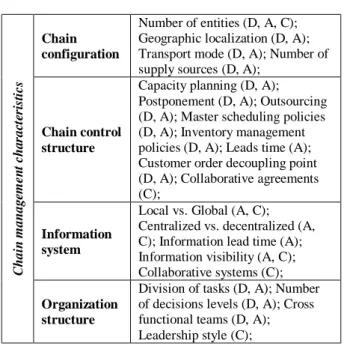
Table II proposes a list of SC management characteristics that can be modified in order to increase SC resilience and therefore to overcome the SC inherent vulnerability. Table II SC management characteristics Chain configuration Number of entities (D, A, C); Geographic localization (D, A); Transport mode (D, A); Number of supply sources (D, A);
Chain control structure
Capacity planning (D, A); Postponement (D, A); Outsourcing (D, A); Master scheduling policies (D, A); Inventory management policies (D, A); Leads time (A); Customer order decoupling point (D, A); Collaborative agreements (C);
Information system
Local vs. Global (A, C); Centralized vs. decentralized (A, C); Information lead time (A); Information visibility (A, C); Collaborative systems (C); C h a in m a n a g em en t ch a ra ct er is ti cs Organization structure
Division of tasks (D, A); Number of decisions levels (D, A); Cross functional teams (D, A); Leadership style (C);
Table II also indicates how those features can be related to the SC resilience capabilities (D - diversity; A - adaptability; C - cohesion). For example, the number of entities is related to the three SC resilience capabilities: diversity, adaptability and cohesion; but some features are only related to one capability, e.g., collaborative agreements only contribute to the SC cohesion. Similar to Table I, this one isn’t a conclude work, but an initial referential for future works.
5. Conclusions
There are numerous SC disturbances (exogenous events that the decision maker cannot control or avoid, and that affect suddenly the SC) but the number of failure modes is finite. So is possible to prevent SC system to shifting to undesirable states when significant disruptions occurs employing SC resilience analysis and management. To assess the SC resilience is proposed a conceptual SC Resilience Index (to evaluate SC resilience capabilities) and a SC Resilience Indicator (to measure system reaction to disturbances). This is a major contribution that we hope to become a step forward in SC resilience research in order to concretize resilience measurements. Other contribution is related with the designing of resilient SC: vulnerability is due to SC inherent characteristics that cannot be modified, and; resilience is related with SC management characteristics that can be modified. It is expected that changes in these characteristics would increase SC resilience.
These findings suggest the need for additional research to identify and establish relationships between SC resilient capabilities and SC modifiable characteristics.
Acknowledgments
This research is funded by Fundação para a Ciência e Tecnologia (Project PTDC/EME-GIN/68400/2006).
References
[1] H. Min and G. Zhou, “Supply chain modeling: past,
present and future”, Computers and Industrial
Engineering, Vol. 43, No. 1-2, pp. 231-249, 2002. [2] D. M. Lambert, J. R., Stock, and L. M. Ellram,
Fundamentals of Logistics Management, Irwin/McGraw-Hill, London (1998).
[3] J. Van der Vorst and A. Beulens, “Identifying sources of uncertainty to generate supply chain strategies”, International Journal of Physics Distribution & Logistics Management, Vol. 32, No. 6, pp. 409- 430, 2002.
[4] H. Carvalho and V. C. Machado, “Fuzzy set theory to establish resilient production systems”, IIE Annual Conference, 2006.
[5] G. Daria and V. C. Machado, “Using Fuzzy Logic to Model MRP Systems under Uncertainty”, IIE Annual Conference, 2006.
[6] H. Carvalho and V. Cruz Machado, “Management decision making under uncertainty in the Supply Chain”, IIE Annual Conference, 2005.
[7] A. P. Barroso, V. Helena Machado and V. Cruz Machado, “Incerteza no planeamento da produção: caracterização e
estado da arte”, in VII Congresso Ibero-americano de Engenharia Mecânica CIBIM7, pp. 220-226, 2005. [8] Mason-Jones and D. R. Towill, , “Shrinking the supply
chain circle”, IOM Control Magazine, Vol. 24, No. 7, pp. 17-23, 1998.
[9] D. R Towill, P. Childerhouse and S. M. Disney, “Speeding up the progress curve towards effective supply chain management”, Supply Chain Management: An International Journal, Vol. 5, No. 3, pp. 122-130, 2000. [10] G. A. Zsidisin, G. L. Ragatz and S. A. Melnyk, , “The
Dark Side of Supply Chain Management”, Supply Chain Management Review, available at: http://www.scmr.com /scm/article/CA528698.html, March 2005.
[11] eWEEK, “IBM Fab Idled by Blackout”, eWEEK,
available at: http://www.eweek.com/article2/
0,1895,1759793,00.asp, August 2003.
[12] The Economist, “When the chain breaks”, The Economist, available at: http://resiliententerprise.mit.edu/public/0617 06_Economist_Sheffi_Chainbreaks.pdf, June 2006. [13] J. B. Rice and F. Caniato, “Supply chain response to
terrorism: creating resilient and secure supply chains. Interim Report of Progress and Learning”, MIT, available at: http://web.mit.edu/scresponse/repository/SC_Resp_ Report_Interim_Final_8803.pdf, 2003.
[14] S. C. L. Koh and S. M. Saad, “Development of a business model for diagnosing uncertainty in ERP environments”, International Journal of Production Research, Vol. 40, No. 13, pp. 3015-3039, 2002.
[15] K. Hendricks and V. Singhal, “An empirical analysis of the effect of supply chain disruptions on long-run stock price performance and equity risk of the rm”, Production and Operations Management, Vol. 14, No. 1, pp. 35-52, 2005.
[16] C. S. Tang, “Robust Strategies for Mitigating Supply Chain Disruptions”, International Journal of Logistics: Research and Applications, Vol. 9, No. 1, pp. 33- 45, 2006.
[17] J. Fiksel, “Designing Resilient, Sustainable Systems”, Environmental Science and Technology, Vol. 37, No. 23, pp. 5330-5339, 2003.
[18] B. E. Asbjørnslett and M. Rausand, “Assess the vulnerability of your production system”, Production Planning & Control, Vol. 10, No. 3, pp. 219-229, 1999. [19] H. Peck, “Drivers of supply chain vulnerability: an
integrated framework”, International Journal of Physical Distribution & Logistics Management, Vol. 35, No. 4, pp. 210-232, 2005.
[20] S. Carpenter, B. Walker, J. M. Anderies and N. Abel, “From metaphor to measurement: Resilience of what to what?”, Ecosystems, Vol. 4, No. 8, pp. 765-781, 2001. [21] B. Briguglio, G. Cordina, S. Bugeja, and N. Farrugia,
“Conceptualizing and Measuring Economic Resilience”, Research Paper, Economics Department, University of Malta, available at: http://home.um.edu.mt/islands/resi ience_index.pdf, 2005.
[22] B. Tomlin, “On the Value of Mitigation and Contingency Strategies for Managing Supply-Chain Disruption Risks”, Management Science, Vol. 52, No. 5, pp. 639-657, 2006.