Airpower and the concept of centers of gravity:
The Battle of Britain as a case study
ISSN 1900-6586 (print), 2500-7645 (online)
Journal homepage: https://www.revistacientificaesmic.com
Miles Doctus Ingrid Yuliana Arango-Calderón https://orcid.org/0000-0002-5995-9262 [email protected]
Escuela Militar de Cadetes “General José María Córdova”, Bogotá D.C., Colombia Carolina Pedraza-Mariño
https://orcid.org/0000-0001-5055-3154 [email protected]
Escuela de Aviación del Ejército, Bogotá D.C., Colombia
How to cite: Arango-Calderón, I.Y. & Pedraza-Mariño, C. (2020). Airpower and the concept of centers of gravity: The Battle of Britain as a case study. Revista Científica General José María Córdova, 18(31), 483-494. http://dx.doi. org/10.21830/19006586.637
Published online: July 1, 2020
The articles published by Revista Científica General José María Córdova are Open Access under a Creative Commons license: Attribution - Non Commercial - No Derivatives.
Submit your article to this journal:
http://dx.doi.org/10.21830/19006586.637
Airpower and the concept of centers of gravity: The battle
of Britain as a case study
Poder aéreo y el concepto de centros de gravedad: La Batalla de Inglaterra
como estudio de caso
AbstrAct.The Battle of Britain is one of the most important military events of the Second World
War. Different approaches have been used to study it and understand the rationale behind Britain’s and Nazi Germany’s strategy. However, the use of warfare concepts, such as centers of gravity and its contemporary meaning, to scrutinize the planning and prosecution of the battle have not been as prolific. This article aims to contribute to the debate by maintaining that the concept of Centers of Gravity provides an advantageous framework that facilitates the understanding of the mindset and development of the battle in terms of critical capabilities, requirements, and vulnerabilities required to win.
Keywords:Battle of Britain; centers of gravity; critical capabilities; critical requirements; critical
vulnerabilities; military doctrine
resumen.La Batalla de Inglaterra es uno de los eventos militares más importantes de la Segunda
Guerra Mundial. Se han utilizado diferentes enfoques para estudiarla y comprender el fundamento de la estrategia de Gran Bretaña y la Alemania nazi. Sin embargo, el uso de conceptos de gue-rra, como los centros de gravedad y su definición contemporánea, para escrutar la planificación y el desarrollo de la batalla no han sido tan prolíficos. Este artículo pretende contribuir al debate, manteniendo que el concepto de centros de gravedad proporciona un marco ventajoso que facilita entender la postura y el desarrollo de la batalla en términos de las capacidades, los requisitos y las vulnerabilidades críticas necesarias para ganar.
PAlAbrAsclAve:batalla de Inglaterra; capacidades críticas; centros de gravedad; doctrina militar;
requisitos críticos; vulnerabilidades críticas
Ingrid Yuliana Arango-Calderón
Escuela Militar de Cadetes “General José María Córdova”, Bogotá D.C., Colombia Carolina Pedraza-Mariño
Escuela de Aviación del Ejército, Bogotá D.C., Colombia
contAct: Ingrid Yuliana Arango-Calderón [email protected]
Section: Education and Doctrine • Scientific and technological research article Received: March 14, 2020 • Accepted: June 10, 2020
Introduction
The Battle of Britain (BoB) is one of the most important military events of the Second World War. Its relevance is not only based on having defeated Hitler’s intentions of in-vading Britain in 1940 or strengthening Nazi Germany’s perspectives on establishing an everlasting regime in Europe but on demonstrating to the rest of the world that courage and persistence may imply a heavy toll for aggressors. This battle, fought between the 10th July and the 31st October 1940,1 between the Royal Air Force (RAF) and Nazi
Germany’s air force (the Luftwaffe) protected the United Kingdom (UK) against several large-scale air attacks aimed to destroy the UK’s strategic assets and main military and decision-making facilities.
By May 1940, the UK’s War Cabinet, a five-person council formed to deal with Second World War-related sensitive decisions and led by Winston Churchill as Prime Minister, identified “three ways in which Germany might break down the resistance of the United Kingdom: (1) unrestricted air attack aimed at breaking public morale, (2) starvation of the country by the attack on shipping and ports, and (3) occupation by in-vasion” (Cox, 2015, p. 16). This conclusion vastly influenced strategic decisions on how to command war to meet desired ends, and employ available means and ways.
A large and developing body of literature has focused on the design and develop-ment of the BoB, providing useful insights into the rationale behind some of the critical decisions of both Britain and Nazi Germany. Authors such as Mason (1990), Holland (2011), Robinson (2005), Bungay (2010), Gelb (2018), and Korda (2009), among many others, have offered a valuable recollection of historical data, as well as significant analysis of strategic and operational decisions during this part of the war. However, the usage of warfare concepts, such as centers of gravity (CoG) and its contemporary meaning to scru-tinize the planning and prosecution of the battle, have not been as prolific.
This article contributes to remedy this gap of knowledge by analyzing to what ex-tent the concept of CoG contributed to the planning and prosecution of the BoB. It maintains that the idea of CoG provided a useful framework to understand the mindset and development of the BoB concerning the critical capabilities, requirements, and vul-nerabilities required to win. It also suggests that identifying the CoG is complex and may vary depending on the perspective of the observer. Hence, the concept of CoG must be used mindfully before making general assumptions. To that end, this article will assess the concept of CoG based on different military doctrines. It will examine key BoB-related concepts, such as critical capabilities, critical requirements, and critical vulnerabilities, and ultimately provide some conclusions.
1 Although there has been disagreement on the exact dates when the BoB took place, the United Kingdom considers the dates provided official (Royal Air Force Museum, 2019).
The concept of centers of gravity
As suggested by various military practitioners and scholars, such as Marich (1995), Strange (1996), Echevarria (2003), Anderson (2004), or Sele (2004), CoG are difficult to outline or recognize for several reasons. Among the most prominent is the lack of a unified definition between different branches of the armed forces around the world, and the prevalence of theoretical CoG teaching without a practical framework.
Given the complexity of war, it is common that irrelevant factors be misunderstood for CoG. Eikmeier (2004, p. 5), for instance, provides a list of the elements that may be understood as CoG, “Joint forces, Nuclear forces, Land power, Sea power, Air power, Special operations forces, Unconventional forces, including terrorists, State security forc-es, and Specific units.” Furthermore, he suggests several factors that are usually misinter-preted as CoG, “The will of the people, Leadership/key personality, Airports or seaports of debarkation, Strategic mobility, Lines of communication, Resources, Time, The media and Coalition/allies.” The UK Air and Space Power has a different viewpoint of CoG and its usage when defining strategic attacks as:
The operations aimed at an adversary’s fundamental ability to wage war, by attacking their structures or organizations. Targets may include centres of gravity, such as leader-ship and command elements, critical war production resources or key supporting in-frastructure. In this context, ‘strategic’ describes the effect, not the location or distance to the target, or type of weapon system or delivery platform. It is most effective when a wide array of targets are attacked simultaneously, causing maximum shock effect, placing significant stress on an adversary’s processes and limiting their ability to adapt and react. (UK Ministry of Defence, 2017, p. 33)
Certainly, CoG, as a critical warfare concept that implies the core of the deci-sion-making process and pollical/military power, has evolved progressively during the past two centuries. The traditional definition of CoG as “the hub of all power and movement” (1976, p. 720), credited to Clausewitz in the 1830s, has several critics and originated dif-ferent variations through the years. For instance, Iron (2001) and Strange & Iron (2004) argue that Clausewitz meant a “centre of power and movement” (Iron, 2001, p. 109) that involves a high understanding of the enemy’s strengths and weaknesses in the form of critical capabilities, requirements, and vulnerabilities (UK Ministry of Defence, 2013, pp. 3–33). The United States Department of Defense defines CoG as “the source of power that provides moral or physical strength, freedom of action, or will to act” (2019, p. 33), which implies a connection with the concept of Decisive Point. That is, “a geographic place, specific key event, critical factor, or function that, when acted upon, allows com-manders to gain a marked advantage over an enemy or contribute materially to achieving success.” (2019, p. 63)
Despite the multiple concepts and characterizations of CoG, in this article, we will use the traditional definition of CoG used by the United Kingdom Ministry of Defense (UK MoD), and, since 2013 agreed upon with NATO, in terms of the “Characteristics, capabilities or localities from which a nation, an alliance, a military force or other group-ing derives its freedom of action, physical strength or will to fight” (2013, pp. L–6). This definition is included in the 2013 AJP-5 publication named Allied Joint Doctrine for Operational-level planning. As advised by the UK MoD, this publication was replaced by the AJP-5, Allied Joint Doctrine for the Planning of Operations (Edition A), published by the NATO Standardization Office in February 2019 (UK Ministry of Defence, 2019). Because the new publication still has limited public access, in this article, we will employ the 2013 AJP-5 definition.
Identifying the strategic and operational CoG of both Nazi Germany and Britain is challenging. Different opinions may arise given that the will to act (and to fight) is directly related to the political and military situation of these countries at that time. On the one hand, in 1940, Nazi Germany had secured several of the objectives that Hitler and the High Command of the Wehrmacht (Armed Forces), or OKW, envisioned in Directive No.1, justifying a force solution to solve the “unbearable situation on Germany’s east-ern border” (Fuhrer and Supreme Commander of Armed Forces, 1939). Moreover, the Wehrmacht had proved its capabilities by invading Poland without significant difficulties, and Hitler had signed a nonaggression pact with the Soviet Union that provided some confidence that an Eastern war front would not be necessary for the short term.
By June 1940, unable to stop the Nazi invasion, France had surrendered to Hitler’s intentions without major ambitions or strengths to pose a significant threat to Germany (Horne, 2012; Ousby, 1999). Nazi Germany had secured an alliance with Fascist Italy and its dictator Benito Mussolini, creating the Rome-Berlin axis that boosted Hitler’s military intentions in Europe. Based on these aspects, this article will focus on Hitler and the OKW as Germany’s strategic CoG (the will to act) and the Wehrmacht, and for the Battle of Britain, on the Luftwaffe, as Germany’s operational CoG.
On the other hand, Britain decided to go to war with Nazi Germany when Poland was invaded. Hitler began his expansion across Europe; however, its preparation was not ideal. By 1940, only the Royal Navy had similar strength in comparison to Germany (Maiolo, 1998). The Royal Air Force (RAF) was still developing a rapid improvement in its capabilities. The British Army had escaped from Dunkirk, leaving behind signifi-cant equipment and was trying to “reorganize, reequip and prepare defensive positions” (McCanne et al., 2002, p. 6). However, Britain had a more evident strategic thought on the future of the Second World War than Nazi Germany, and Winton Churchill acted as a counterbalance to Hitter’s vision. Hence, this article will use Winston Churchill as Britain’s strategic CoG, as he fueled the will to resist, as well as the British Armed Forces. For the Battle of Britain, the RAF will be used as the operational CoG.
Critical capabilities
Critical capabilities are defined as “those aspects of the CoG that are of decisive importance to the significance of that CoG” (UK Ministry of Defence, 2013, pp. 3–33). They have different exploitations depending on grand strategy. For instance, the UK MoD describes special forces air operations as:
(…) air operations conducted by specialist aircraft and personnel which enable the insertion, sustainment and extraction of UK Special Forces. Special forces are specia-lly organised, trained and equipped personnel who support strategic or operational objectives by unconventional military means, often in hostile, denied or politically sensitive areas. Although all four air power roles could be used to support special forces operations, having the ability to rapidly move high-value personnel in support of high priority political objectives is a critical capability. (UK Ministry of Defence, 2017, p. 39)
In the case of the Battle of Britain, it is possible to recognize some of these capa-bilities that were essential for affecting the balance of the war. For both Nazi Germany and Britain, they were vital to achieving air supremacy (not only air superiority), protect military/industrial hubs, and ensure supply chain routes for their plans and vision.
On the one hand, Hitler, the OKW, and some leading party members identified necessary conditions for Operation Sea lion’s2 success. Among them, defeating the RAF,
creating mine-free routes, protecting the straits of Dover and the western entrance of the English Channel with mines, consolidating the British coast by heavy coastal artillery, and blocking the Royal Navy in the North Sea and the Mediterranean were part of Nazis’ preparations for the invasion to Britain (Fuhrer and Supreme Commander of Armed Forces, 1940a, p. 3).
The Nazi Germany assessment may suggest a sound understanding of the concept of CoG. However, the lack of clear political direction and determination to continue with the attack on Britain shows that Nazi Germany had flaws in their threat assessment and de-cision-making.3 More than the CoG concept, Germany’s planning and prosecution of the
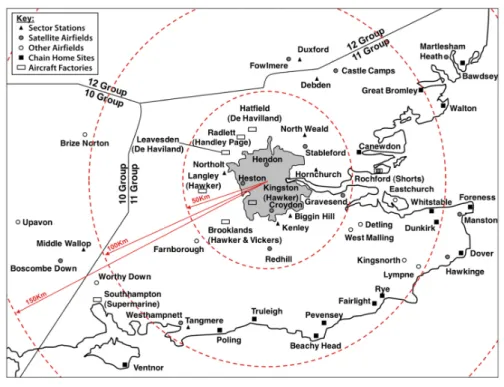
Battle of Britain involved the employment of the concept of Decisive Points as “point(s) from which a hostile or friendly center of gravity can be threatened. Th(ese) point(s) may exist in time, space or the information environment” (UK Ministry of Defence, 2013, pp. L–9). Therefore, the Nazi initiative seen may reflect a series of disconnected military attacks (Decisive Points) that did not add up to the common goal of defeating Britain’s will to fight (Figure 1).
2 German codename for the invasion of Britain. 3 See, for instance, Bishop (2013) or Overy (2010).
Figure 1: Air power-related targets during the BoB, as depicted by Shields (2015, p. 189)
Hitler’s hesitations on using other options, such as an amphibious landing, placed numerous principal responsibilities on the Luftwaffe (Nazi Air Force) regarding the entire invasion. The Heer (Nazi Army) and Kriegsmarine (Nazi Navy) provided late and pessi-mistic (or realistic) estimates on their capabilities for the invasion, implying delays up to 1941 (Taylor, 1967). Had Hitler understood the importance of critical capabilities for the invasion to Britain entirely, he would have focused on making timely decisions that would have prevented Nazi Germany from losing valuable aerial assets and aircrews. As highlighted by Goulter (2006), although the RAF experienced appalling losses during the period considered the duration of the Battle of Britain (10 July – 31 October 1940) –a total of 1,535 aircrews– the Luftwaffe’s losses were higher (2,662 men). The fact that the Germans had little time to plan and execute an invasion of Britain before the condi-tions in the English Channel made it impossible, may provide some insight into why the Germans may have made some mistakes in identifying the CoG and critical capabilities. However, Britain’s understanding of Nazi Germany’s CoG seems to be better. Britain recognized that having limited support from other nations demanded the protection of critical capabilities, such as its military, industrial production zones, and population. As such, the RAF issued orders to their aircrews defending Britain not to act fearlessly to keep the necessary aircraft and aircrews focused on protecting vital infrastructure. In other
words, to restrain from pursuing German aircraft over the Channel, which increased the chances of losing RAF aircraft. Additionally, they launched attacks on German soil to weaken Nazi Germany’s capabilities.
Critical requirements
CoG’s Critical requirements, understood as “those conditions, resources or means which are essential to the realization of critical capabilities” (UK Ministry of Defence, 2013, pp. 3–33), help to further comprehend the planning and prosecution of the Battle of Britain. Nazi Germany knew its desired final goal, the defeat of Britain. However, it overlooked some critical requirements to achieve this.
For example, the Nazi German air strategy had fatal errors in their understanding of Britain’s CoG. The lack of effective strategies to destroy Britain’s Fighter Command, its command and control (C2) structure, as well as air radar and air defense capabilities, represented the loss of valuable initiative and momentum for Nazi Germany (McCanne et al., 2002, p. 8). Gropman supports this idea (Gropman, 1971, p. 144) when suggest-ing that the Battle of Britain was a “textbook case of how not to fight an air war.” Nazi Germany did not use all its power to attack directly and conquer England effectively. On the contrary, air attacks were not enough and presented a dysfunctional and disjointed effort to destroy.
Furthermore, flaws in the Luftwaffe’s long and medium-range capabilities emerged during the prosecution of the Battle of Britain, reducing the feasibility of Nazi Germany’s plan. As Lorenz (1988) suggested, Nazi Germany had an “excellent air-ground coordi-nation but lacked a strategic bomber” (pp. 19–20), which proved necessary during the attacks against Britain. Moreover, the Luftwaffe did not have enough air-asset reserves be-cause Nazi Germany production rates were decreasing, and the aircraft had technological development deficiencies.
A significant issue here is what went wrong on the Nazi side to force them to change attack plans. Nazi Germany attacked the Fighter Command vigorously, then, shifted their effort to attack London. Some historians, such as Dixon (2008), Holland (2015), or Bergström (2015), contend that the RAF came close to losing control of the airspace over the South coast of England. These actions may suggest that the Germans understood the importance of the Fighter Command, thus, the concept of CoG.
Weakened by the Luftwaffe, Britain and its Fighter Command were able to resist enough Nazi Germany attacks to alter Hitler’s perceptions of the feasibility of the in-vasion of Britain. Hitler ordered the Luftwaffe to redirect its attacks away from Fighter Command’s sector stations in the southeast of England and assault the cities, especially London, in the hope of delivering a finishing blow to British morale. Nazi Germany did not reach the critical requirement of defeating the RAF.
Critical vulnerabilities
Critical vulnerabilities, defined as “those critical requirements, or components of these, that are deficient or have weaknesses in a way that means that they are vulnerable to effects that can be created using modest resources, which can thus have major effect” (UK Ministry of Defence, 2013, pp. 3–34), also contributed to the understanding of the CoG concept during the Battle of Britain.
Nazi Germany did not fully understand the British vulnerabilities that needed to be exploited to break its will to fight. Instead, Britain used Nazi Germany’s critical vulnera-bilities to deviate it from its initial goal. For instance, Luftwaffe doctrine, heavily based on offensive action, prevented Nazi Germany from creating an adequate air-defense system to protect vital industrial areas (Barley, 2004, p. 408). Hitler paid minimum attention to protect Nazi Germany airspace and even canceled the production of the ME-262 jet fighter, an aircraft “that may have prevented the Allies from gaining air superiority over Germany” (Pape, 1996, p. 311). By the time Hitler decided to have the ME-262 pro-duced as a bomber rather than cancel its production altogether, the United States Army Air Corps (USAAC) and the RAF Bomber Command attacked Germany both in the day and at night, and the importance of defending Germany was evident. As Shields (2015) suggested, when assessing Luftwaffe’s strategic failure,
In order to deliver a short and effective campaign, the identification and successful prosecution of the enemy’s centre of gravity is required. However, despite German doctrine embracing Clausewitz’s concepts, they failed to identify and target the British Centre of Gravity. The Luftwaffe instead chose to employ kinetic effect across the full spectrum of targets rather than against the enemy’s critical vulnerabilities. Put sim-ply, the German leadership demonstrated their lack of understanding of the potential strategic effect of air power by failing to take advantage of their numerical supremacy. Furthermore, in breach of one of the principle tenets of warfare, they failed to con-centrate their force on the enemy’s operational centre of gravity – Fighter Command” (p. 188).
Similarly, lessons learned, such as the ineffectiveness of terror bombings (Fuhrer and Supreme Commander of Armed Forces, 1940b), the effectiveness of striking airfields, which the Germans did for much of August 1940, causing the No. 11 Group and Fighter Command serious difficulties, and the error of ignoring the contributions of other ser-vices and assessments for joint decision-making were disregarded and reused during the Battle of Britain (Barley, 2004, p. 408). Nazi Germany relied heavily on the overconfi-dence of previous military campaigns lead by high-ranking officers and overlooked the importance and differences in defeating Britain. Nazi Germany also showed a lack of attention to the importance of joint action. This error was later exploited by the allies after the Battle of Britain when four strategies using the CoG concept were created to defeat the Nazi’s intentions over Europe.
The first was the industrial web strategy, which would use precision attacks on key economic bottlenecks to cripple the German economy as a whole, fatally weakening the social and political cohesion needed for resistance. The second, strategic air inter-diction, would also use precision bombing but would focus on industries critical to war production rather than seek a general economic collapse. The third was a Douhet strategy using area incendiary bombing of population centres. All three approached aimed to break German resistance through air power alone, so that a cross-channel invasion would be either unnecessary or simply a coup de grace to an already beaten opponent. The fourth strategy, by contrast, aimed to destroy the German Army throu-gh the combined weithrou-ght of Soviet and Western ground offensives. Strategic air power would support this strategy through operational interdiction attacks to have a direct and immediate impact on ground operations. (Pape, 1996, p. 258)
The industrial web theory predated the Second World War and was articulated by the USAAC Tactical School. The RAF also adopted a similar approach. There is a case for saying that Pape seemingly questions the adoption of the Douhet strategy, as it was arguably intended to ensure that targets in the first category –key economic and industrial areas– were burned or heavily damaged. These locations were in population centers. Area bombing meant that it was inevitable that homes would be razed along with the industry that was targeted. Although never openly stated, the allies accepted the loss of German homes and civilian casualties in the air raids as collateral damage in the context of a total war (although they avoided talking about this as much as possible).
Britain, on the other hand, exploited Nazi Germany’s critical vulnerabilities. During the Nazi Germany Operation Eagle Attack, in August 1940, the RAF successfully coun-teracted the main three tasks of the Luftwaffe. First, despite heavy losses, the RAF man-aged to gain the advantage in loss ratios, mainly because of an “effective early warning and C2 system that often gave Fighter Command the initiative when engaging the enemy” (McCanne et al., 2002, p. 9). Second, operating from Scandinavia, the RAF successfully intercepted Nazi Germany bombers preventing daylight flight raids over England. Third, because daylight attacks implied heavy losses to Nazi Germany, a greater emphasis was placed on night raids against English industrial centers. However, “the poor level of accura-cy of the night bombing generally hampered the effectiveness of such attacks” (McCanne et al., 2002, p. 9). Moreover, the Luftwaffe’s accuracy shortfalls affected English civilian assets, which encouraged Britain’s counterattack on German soil. The RAF’s bombing campaign over Germany affected vital infrastructure and produced a general psychologi-cal impact and affected civilian morale (Jones et al., 2004).
Final discussion
This article presented a brief analysis of the adequacy of the CoG concept to understand the planning and prosecution of the Battle of Britain. It covered the origin and variations
of the concept of CoG and examined Nazi Germany and British critical capabilities, re-quirements, and vulnerabilities required to win.
The article showed how complex it may be to identify strategic and operational CoG and how thoughtful scholars and practitioners should be when using this framework to make general assumptions. For instance, although Nazi Germany correctly identified the necessary conditions to defeat Britain during the planning phase of the Battle of Britain, it was Churchill, the Armed Forces, and the RAF that better exploited the Nazi’s CoG during the prosecution of the campaign. Nazi Germany managed to destroy vital infra-structure in England; however, Britain, through courage and persistence, forced Hitler to change his plans, providing an example for the rest of the world.
Acknowledgments
The authors wish to thank the Escuela de Aviación del Ejército (ESAVE) and the Escuela Militar de Cadetes “General José María Córdova” (ESMIC) for the support given to this article.
Disclaimer
This article is part of the research project “Civil-military relations in Colombia: an approach to the roles of the Military Forces” backed by the Escuela de Aviación del Ejército’s (ESAVE) Military Aviation research group and the Escuela Militar de Cadetes “General José María Córdova’s” (ESMIC) Military Sciences research group. The views expressed are the authors’ and do not reflect the views of the ESAVE, ESMIC, or the National Army of Colombia. The authors declare that there is no potential conflict of interest related to the article.
Funding
The authors do not report sources of funding for this article.
About the authors
Ingrid Yuliana Arango-Calderónis a Captain in the National Army of Colombia. A specialist in military sciences for planning, Centro de Educación Militar, Colombia; BSc in military sciences and BA in logistics management, Escuela Militar de Cadetes “General José María Córdova,” Colombia. A research fellow at the Escuela Militar de Cadetes “General José María Córdova,” research group in Military Sciences.
https://orcid.org/0000-0002-5995-9262 - Contact: [email protected] Carolina Pedraza-Mariñois a Captain in the National Army of Colombia. A spe-cialist in military sciences for planning, Centro de Educación Militar, Colombia; BSc in
military sciences and BA in logistics management, Escuela Militar de Cadetes “General José María Córdova,” Colombia. Research fellow at the Escuela de Aviación del Ejército (ESAVE) research group in Military Aviation.
https://orcid.org/0000-0001-5055-3154 - Contact: [email protected]
References
Anderson Jr, W. (2004). Where You Sit and Centers of Gravity: Bridging the Gap Between Army and Air Force
Perspectives. U.S. Naval War College.
Barley, P. (2004). Defence Studies Contributing to its Own Defeat: The Luftwaffe and the Battle of Britain.
Defence Studies, 4(3), 387–411. https://doi.org/10.1080/1470243042000344812
Bergström, C. (2015). The Battle of Britain: An Epic Conflict Revisited. Casemate.
Bishop, P. (2013). Battle of Britain : a day-by-day chronicle, 10 July 1940 to 31 October 1940. Quercus Editions Ltd. Bungay, S. (2010). The most dangerous enemy : a history of the Battle of Britain. Aurum Press Ltd.
Clausewitz, C. von. (1976). On War (M. Howard & P. Paret (eds.)). Oxford University Press. Cox, S. (2015). British strategy in a certain eventuality. Air Power Review, Summer, 12–39.
Dixon, J. (2008). Dowding and Churchill: The Dark Side of the Battle of Britain. Pen & Sword Books Ltd. Echevarria, A. J. (2003). Clausewitz’s center of gravity: It’s not what we thought. Naval War College Review,
56(1), 108–123.
Eikmeier, D. C. (2004). Center of Gravity Analysis. Military Review, July-August, 2–5.
Fuhrer and Supreme Commander of Armed Forces. (1939). Directive No.1. High Command of the Wehrmacht. Fuhrer and Supreme Commander of Armed Forces. (1940a). Directive No.16. High Command of the Wehrmacht. Fuhrer and Supreme Commander of Armed Forces. (1940b). Directive No.17. High Command of the
Wehrmacht.
Gelb, N. (2018). Scramble: A Narrative History of the Battle of Britain. Sharpe Books.
Goulter, C. (2006). The Battle of Britain: The Air Perspective. RUSI. https://rusi.org/commentary/battle-brit-tain-air-perspective
Gropman, A. (1971). The Battle of Britain and the principles of war. Aerospace Historian, 18(3), 138–144. Holland, J. (2011). The Battle of Britain : five months that changed history, May-October 1940. St. Martin’s Press. Holland, J. (2015). It’s time to shatter the myths of the Battle of Britain. The Telegraph. https://www.telegraph. co.uk/history/battle-of-britain/11866425/Its-time-to-shatter-the-myths-of-the-Battle-of-Britain.html Horne, A. (2012). To lose a battle : France 1940. Macmillan.
Iron, R. (2001). What Clausewitz (Really) Meant by ’Centre of Gravity. Defence Studies, 1(3), 109–112. ht)-tps://doi.org/10.1080/714000041
Jones, E., Woolven, R., Durodié, B., & Wessely, S. (2004). Civilian Morale During the Second World War: Responses to Air Raids Re-examined. Social History of Medicine, 17(3), 463–479. https://doi. org/10.1093/shm/17.3.463
Korda, M. (2009). With wings like eagles : a history of the Battle of Britain. Harper.
Lorenz, O. (1988). The Battle of Britain: An Analysis in Terms of Center of Gravity, Culminating Point, Fog,
Friction and the Stronger Form of War [United States Army Command and General Staff College]. http://
spitfirevsbf109.com/files/a215722.pdf
Maiolo, J. (1998). The Royal Navy and Nazi Germany, 1933-39 : a study in appeasement and the origins of the
Marich, L. (1995). Centers of Gravity in OOTW: A Useful Tool or Just a Black Hole? U.S. Army Command and General Staff College.
Mason, F. K. (1990). Battle over Britain : a history of German air assaults on Great Britain, 1917-18 and and
July-December 1940, and of the development of Britain’s air defences between the World Wars. Aston.
McCanne, R., Olson, G., & Teicher, D. (2002). Operation Sea Lion: a joint critical analysis [Joint Forces Staff College]. https://apps.dtic.mil/dtic/tr/fulltext/u2/a421637.pdf
Ousby, I. (1999). Occupation : the ordeal of France, 1940-1944. Pimlico. Overy, R. (2010). The Battle of Britain : myth and reality. Penguin.
Pape, R. A. (1996). Bombing to win : air power and coercion in war. Cornell University Press.
Robinson, D. (2005). Invasion, 1940 : the truth about the Battle of Britain and what stopped Hitler. Carroll & Graf. Royal Air Force Museum. (2019). Introduction to the phases of the Battle of Britain. The Battle of Britain. https:// www.rafmuseum.org.uk/research/online-exhibitions/history-of-the-battle-of-britain/introduction-to-the-phases-of-the-battle-of-britain.aspx
Sele, R. K. (2004). Engaging Civil Centers of Gravity and Vulnerabilities. Military Review, 84(5), 32–40. Shields, J. (2015). The Battle of Britain: A not so narrow margin. Air Power Review, Summer, 182–196. Strange, J. (1996). Centers of Gravity & Critical Vulnerabilities: Building on the Clausewitzian Foundation So
That We Can All Speak the Same Language. U.S. Marine Corps War College.
Strange, J. L., & Iron, R. (2004). Center of Gravity: What Clausewitz Really Meant. Joint Force Quarterly, 35, 20–27. https://apps.dtic.mil/docs/citations/ADA520980
Taylor, T. (1967). The Breaking Wave: The German Defeat in the Summer of 1940. Weidenfeld & Nicolson. U.S. Department of Defense. (2019). DOD Dictionary of Military and Associated Terms. https://jdeis.js.mil/jdeis/ UK Ministry of Defence. (2013). AJP-5 Allied Joint Doctrine for Operational-Level Planning. UK MoD. UK Ministry of Defence. (2017). Joint Doctrine Publication 0-30: UK Air and Space Power. UK MoD. UK Ministry of Defence. (2019). Allied joint doctrine for operational level planning (AJP-5). UK MoD.