Exploring the Other Side of
Favela Tourism.
An Insight into the Residents’ View
RITA DUARTE * [ [email protected] ]
KARIN PETERS ** [ [email protected] ]
Abstract | Favela tourism in Rio de Janeiro is becoming increasingly popular, especially among international travellers. However, academic debates often condemn this type of tourism as a form of exploitative voyeurism. This article intends to clarify this phenomenon and explore the potential contribution of tourism for social transformation. Supporting the idea that tourism can be seen as a platform for dialogue and social change (Ateljevic, 2009). Residents can benefit from tourism in terms of intercultural understanding and increase of self-esteem (Smith and Robinson, 2006). This study is based on qualitative research done in two favelas: Rocinha and Pereira da Silva. Insights into the residents’ perception upon tourism development were obtained through participant observation and interviews. Results showed that under certain circumstances, favela tourism can indeed support processes of transformation in favelas. It can lead to a more realistic perception of favela residents and can stimulate socio-economic opportunities. Although acknowledging the complexity of tourism in vulnerable areas, this study shows that it can also make a positive contribution. The outcomes of this research bring a new light on the topic of favela tourism and to a better understanding of the complexity of favelas as an object of study. Keywords | favela tourism; community perspective; tourism development; social change. Resumo | O turismo nas favelas está em expansão no Rio de Janeiro, atraindo especialmente viajantes estrangeiros. Contudo, no meio académico, esta questão, gera muita polémica e é vista por alguns como uma forma de exploração e voyeurismo. Este artigo pretende contribuir para uma melhor compreensão sobre este fenómeno e a sua possível contribuição para uma potencial transformação a nível social. Defendendo a ideia de que o turismo pode ser visto como uma plataforma para diálogo e mudança social (Ateljevic, 2009), os residentes podem beneficiar do contacto com outras culturas e de um aumento de auto estima (Smith & Robinson, 2006).
Este estudo é fruto de uma investigação qualitativa em duas favelas: Rocinha e Pereira da Silva. A percepção dos residentes em relação ao desenvolvimento turístico foi obtida através de observação participante e entrevistas.
Os resultados revelaram que sob determinadas circunstâncias, a presença do turismo pode estimular processos de
* Mestre em Lazer, Turismo e Ambiente com especialização em Desenvolvimento Internacional pela Universidade de Wageningen.
** Doutorada em Turismo pela Universidade de Wageningen, Professora Assistente no Departamento de Geografia Cultural na Universidade de Wageningen.
transformação nas favelas, podendo levar a uma percepção mais realista dos residentes e criando novas oportunidades socioeconómicas. Apesar de reconhecer a complexidade do turismo em áreas vulneráveis, este estudo demonstra que, também, pode trazer benefícios para as comunidades. Os resultados desta pesquisa trazem uma nova luz sobre o tema, permitindo, igualmente, uma melhor compreensão da pluralidade das favelas como objecto de estudo. Palavras-chave | turismo em favelas, perspectiva da comunidade, desenvolvimento turístico, mudança social. 1. Introduction
Rio de Janeiro is one of the main tourism attractions of Brazil. Since 1992, favelas are part of the tourism landscape of Rio and have become a growing destination (Kuiphuis, 2010). This is not exclusively a Brazilian phenomenon. It is also present in other countries, such as India and South Africa.
Despite its growing popularity this type of tourism raises many ethical dilemmas and criticism (Freire-Medeiros, 2009). Favela tourism, also known as slum tourism, consists of turning poor neighbourhoods and their inhabitants into a commodity to be consumed by the rich. In this process the “periphery” is incorporated in the global tourism industry as the exotic other (Cejas, 2006). Scheyvens (2001) defends favela tourism by stating that not including poor areas like slums in the tourist circuit of a city is reinforcing the social and economic isolation of such areas. In fact, if one aims to achieve a more integrated society tourism should be also promoted in the most vulnerable areas (Goudie et al., 1999).In general those who are in favour of slum tourism use the following arguments to underline their position: slum tourism will contribute to the economic development of poorer regions, it will improve community’s self-esteem and finally it will enhance the tourist’s awareness about the reality of vulnerable communities (Schevyens, 2001).
This new form of tourism is perceived as controversial because linking leisure and poverty touches on the sensitivity and moral values of the public opinion (Freire-Medeiros, 2009). Leisure and
poverty are often seen as two opposite concepts and connecting them is considered incoherent and inappropriate. Besides, it is stated that the motivation to undertake this kind of experience is only related to the voyeuristic consumption of poverty (Mowforth and Munt, 2003). Visits to poor areas are motivated by a desire to consume real poverty leading to the commoditization and aestheticization of poverty which can, in fact, disempower the residents.
In the Brazilian society the commodification of favelas is also a very controversial topic. A recent survey made by the newspaper “O Estado de São Paulo” showed that 80% of the Brazilian respond-ents were against the development of favela tourism (Menezes, 2007).
According to Freire Medeiros (2009), one of the pioneers in researching this topic, there are many critiques around favela tourism. Dehumanization of the poor, voyeurism and an asymmetric interaction between favela dwellers and tourists are some examples. Analogies with safaris are also frequent mentioned in order to illustrate how poor are exposed for tourists’ pleasure.
In order to critically analyse favela tourism the same author states that one needs to be free from extreme views. On the one hand, one should not believe that tourism in poor areas is the ideal solution for the socio economic problems that a community faces. On the other hand, one should not assume that commodifying poverty for tourism purpose is an immoral activity per definition. Freire – Medeiros (2009) suggests that when evaluating favela tourism, the specifics of each locality has to
be taken into account as well as understanding how tourism is being promoted. At the moment there are many extreme critiques, generalizations and pre conceived ideas around this controversial practice. This is partly due to the fact that favela tourism has only recently become an object of academic research (Medeiros, 2009).
This article will make a contribution in under-standing this new form of tourism. We will examine how tourism is being developed in two different fave-las and by doing so, taking into account the context of each one. The aim is to gain a better understanding of how favela tourism is perceived by the residents and to explore its potential for a social change. We will go beyond the above polarized views and reveal another perspective of favela tourism. Based on an inner view of two communities we intend to explore the social dimension of favela tourism. 2. Methodology The empirical results presented here are based on qualitative research conducted in two favelas in Rio de Janeiro: Rocinha and Pereira da Silva. The research was carried out between January and April 2010. Data was collected through semi-structured interviews and participant observations. The respondents for the interviews were recruited via key persons, a personal network, and by using the snowball method. In total, ten interviews were made in Rocinha and nine in Pereira da Silva. Each one lasted between 15 to 30 minutes and was held in Portuguese. The questions were related with community participation, socio-economic benefits, perceptions of tourism, negative and positive impacts and the level of satisfaction. In order to get a realistic insight in how tourism is perceived by the residents, two groups were distin-guished. The first group consists of residents that are directly connected to tourism activities (e.g. guides, art craft artists, community leaders and relevant local
organizations). The second group consists of resi-dents whose livelihood is not connected to tourism; they mainly have jobs outside the favela.
Next to the interviews, participant observation was used as a method of data collection. During three months of fieldwork every week several informal visits were made to both favelas. In order to understand how Rocinha is presented as a tourism destination, two tours were made, one organized by an external agency Favela Tour and one held by a local guide, Zezinho. In Pereira da Silva, many observations were taken in the position of volunteer in the NGO Morrinho. The fact that one of the authors volunteered highly contributed to gain an insight perspective into the favela´s environment. Before describing the results, first we will contextualise the development of favela tourism in Rio de Janeiro.
3. Mystifying, Representing and Commodifying Favelas
Although favelas have always been part of Rio de Janeiro´s reality they have gone a long way until the point of being transformed into a tourism commodity. Since its historical roots, back in the 19th century, favela´s image is marked by a duality
feeling. Considered the birthplace of some of the main elements of the Brazilian culture (samba and carnival), but at the same time associated with criminality, violence and lack of hygiene (Carter, 2005). As a consequence, a negative image was disseminated in the Brazilian society. As a result the majority of the residents in Rio want to keep a physical and mental distance from their slums. This distance crossed decades and is still dominant today (Valladares, 2005).
It is important to mention that this scenario became more dramatic in the late eighties, with the introduction of the drug trafficking in the favelas. This was a turning point for the favelas residents who became controlled by gangs. They started to be perceived as even more dangerous than before
(Zalzuar, 2004).The media, often controlled by politi-cians and influential business people, was the main vehicle to diffuse this image (Valladares, 2005). According to the author Freire-Medeiros (2006) the image of favelas became internationally popular by the movie “Cidade de Deus” (City of God) which supposedly portrays a ‘true story’ of everyday life in the Rio’s slum. Travel agencies that work in favela tourism state that this movie was responsible for an increase in demand (Freire-Medeiros, 2006). But also other elements played a role. European nightclubs like Favela Chic, art exhibitions and video clips made by famous artists such as Michael Jackson also contributed (Freire-Medeiros, 2007).
As a consequence the global image of favelas is linked both to a multi-cultural environment, samba, funk, warm people, tropical landscapes and, at the same time, to danger, violence, traffic and poverty. This binary and almost bipolar image is the main ingredient that turns favelas into a destination for tourists in Rio de Janeiro (Freire-Medeiros, 2006). Despite being internationally perceived as glamor-ous, due to the historical background it is very hard for the Brazilian society to accept this transforma-tion. It is contradictory that an area that is related to negative connotations represents Brazil internation-ally and becomes a tourist attraction. Thus, although favela eradication is no longer a policy, the stereo-types and the social constructions about favelas and their inhabitants remain until today (Carter, 2005). It is precisely because of this duality that exploring the social dimension of favela tourism is important. Investigating the possible benefits of tourism can be a contribution for integrating these communities in the Brazilian society. In the next section, the two case studies will be discussed. 4. Rocinha Rocinha is located on a steep hill in the southern part of the city, more precisely between the luxurious
neighbourhoods of São Corrado and Gávea. It is hard to precise the amount of inhabitants due to the quantity of houses without official addresses, but it is estimated that Rocinha has around 200.000 inhabitants. Rocinha is known for being the biggest favela in Latin America.
Tourism development started in 1992, opening the way for other favelas in Brazil. In 2000 Rocinha became part of the official city guide by Riotour, the organization responsible for promoting and developing tourism in Rio de Janeiro.
Tourism in Rocinha was initiated by external agencies. Nowadays there are seven tour operators who offer the same product in different styles. Tourists can make a tour in a van, by motorbike, open jeeps, walking or just watching sitting in a vehicle. Within Rocinha, there are very few residents connected to tourism activities. More precisely, there are six local guides doing their own tours and a small group of art craft artists that spontaneously decided to expose their stalls in one of the main streets, hoping that tourists will stop by.
Having in mind that local participation might be a key factor in improving the positive effects of favela tourism; we contacted the União Pró- Melhoramentos dos Moradores da Rocinha, the residents’ association, which represents the community rights outside the favela. Its president, Leonardo Rodrigues, explained that there is no collaboration between the travel agencies and the community. He argued that the agencies never approached them. Both parties also never discussed what should be included in the tours or what could be the role of the community. Leonardo Rodrigues stated that travel agencies don´t support the local economy or any social project. Except from the art craft, tourists hardly have a chance to purchase anything during the tour. Leonardo Rodrigues concludes that the agencies are disconnected from Rocinha needs and reality.
Residents, no matter if they are connected to tourism, had several critiques concerning the role of the agencies. The lack of direct benefits was mentioned and they stated that the current
activities do not give a chance for tourists to get to know Rocinha. Motivated by this dissatisfaction, several residents decided to organize themselves and created a local tourism association aiming at planning tourist activities that are more community oriented. Their ideal vision is to show outsiders the real Rocinha. They believe that tourism gives an opportunity for interaction, cultural exchange and, most important, a chance to show their side of the story. As Hélio Almeida (member of the local tourism association and responsible for the communication affairs), highlighted, interaction with tourists promotes ”demystification from the outside about what is a favela. Through tourism we have the possibility to create an image from the inside to the outside”.
The use of external guides was also criticized, because due to the lack of context and connection with the place, they could potentially damage the image of Rocinha. This point of view was clearly explained by Eduardo Casais (local journalist): “I think it is very inappropriate to have an external agency coming inside and showing a reality that they don’t know. For instance the guide will show that there is a large accumulation of garbage. But why there is so much garbage? It’s because the municipality can’t manage it. Plus because it is a favela the trash collector passes less often. Furthermore residents also do not have the consciousness not to add more garbage in an area that is already full”. If the encounters between tourists and locals are not well balanced by the guide, the consequences for the favela residents can be negative. As Daniel, director of a local NGO, claimed: “I have heard many lies about Rocinha from external guides. Then the tourists look at Rocinha according to what they hear.”
Local guides also share the same awareness and design their tours to promote an experience close to Rocinha´s reality. They are very engaged in showing that the majority of the people living in Rocinha are honest and hard workers. As Zezinho, a local guide said: “I want to show that the reality here is the opposite of what the media shows. That it is possible to walk peacefully, without problems. The majority of the residents are honest people, but because a minority is connected with trafficking the whole community gets a bad reputation. I try, on my tour, to show to the tourists how different the reality is from what is being said.”
Furthermore, the same interviewee mentioned that because of movies like “The City of God” tourists want to see people carrying guns, the opposite of what he aims to show. So, the fascination for favelas can actually work in two directions: it attracts tourists but can also perpetuate a negative image. Some local guides expressed that they see the interaction with tourists as the opportunity to promote Rocinha´s singularity. As Carlos Souza (local guide) explained: “Before starting my tour I like to explain what a favela is and the different types that you can find in Rio. I think this helps them to understand what they are going to see and to acknowledge that each favela is unique”.
Although there is some dissatisfaction about the way tourists encounters are being promoted, the interactions and presence of tourists is generally seen as positive. As Rodrigo Carvalho, a local guide assistant expressed, the continuous presence of tourists opens a path for residents to come into contact with different cultures and to develop a new social network. The presence of tourism led to the rise of a niche market: renting houses or rooms to foreigners. The possibility of communicating with people from a different cultural background in a less formal way can have a positive impact on a resident, as mentioned by Rodrigo:”Tourism changed my life a lot. It gave me the opportunity to meet people from different countries, motivation to learn new languages and helped me to change the way I was thinking. Before I was thinking about the wrong stuff... I could only see until a certain point. Now I can see beyond.” He continuous and stated that:” Now people from the favela have friends outside the favela, like the tourists. They come to Brazil but want to live in Rocinha”.
Another important opinion that is shared among residents is the interpretation of tourism as a sign of peace and evolution. As António Paiva, who works outside Rocinha in the construction field, explained there were people with shotguns controlling who was coming in and out of the favela. Now seeing tourists circulating, gives him a peaceful feeling. Rogério Pinto, member of a local NGO, confirms that tourism gives a higher sense of security.
In some informal conversations, it was possible to find evidences of the impact of tourism on the community´s self esteem. As Fernando Ermir (the secretary of the local tourism organization) said: “Just the fact that you came so far to visit my place is already quite good for me”. He continued to expose his argument by explaining that in general, residents appreciate the fact that there are people willing to visit their neighbourhood. It gives them a sense of pride, as if living in a favela would not be so bad after all. Helio Almeida reinforces this vision by mentioning that it is not just the outsider that has a negative image of a favela. Often residents also cheer a negative view of the place they live in. The fact that there are people willing to visit and appreciate Rocinha helps to smooth those feelings.
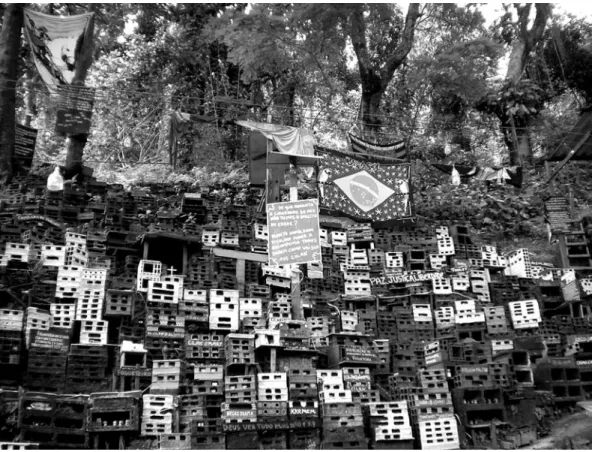
In conclusion, the case of Rocinha showed that the way tourism is being developed does not always match with the aspirations and vision of the residents. Generally, we can conclude that tourism is well accepted. The dissatisfaction found was focused on the hegemony of the external travel agencies and the danger of being misinterpreted. No critiques were found regarding tourists or the presence of tourism. 5. Pereira da Silva The favela Pereira da Silva is located on a steep hill between two neighbourhoods: Laranjeiras and Santa Teresa. Residents claim that it has a population of around 5000 inhabitants. Pereira da Silva is very different from Rocinha: It´s quite small, with much less infrastructure and a local economy that is practically nonexistent. Tourism in Pereira da Silva is locally initiated and controlled by residents. The tourism landscape con-sists of a hostel named Favelinha and art production known as Morrinho which is a reproduction of exist-ing favelas, made of brinks and recycled material (see also figure 1). The artists of Morrinho created an NGO with the same name and started informal tours in 2003. In 2005 it became official due to the partnership with Cama e Café, an external tourism organization that supports this project as part of the company’s social responsibility. Therefore, they don´t request any payment for their services and do not have access to Morrinho profits. Pousada Favelinha was the first hostel in Rio de Janeiro located in a favela and is open since 2005. Customers are mainly Europeans and Americans. This project is so exceptional that even the Brazilian and international media have covered this initiative (http://www. favelinha.com). So far, the presence of tourism in this favela is very minimal and the economic benefits are very low even for those that are directly involved. Only a small number of residents profit. Some work for the hostel and the lady that runs the only supermarket (located between the NGO and the hostel) sporadically has some foreigner customers. The community perceives the presence of tourists as positive, no criticisms were found concerning how tourism is being developed or how it can reproduce a negative image. The fact that tourism is locally run, organized in a less formal and intensive way can explain this result. Since the tours are not frequent and groups are small, it is unlikely that tourists interfere with the residents´ daily routines.
Pereira da Silva possesses a more familiar envi- ronment compared to Rocinha, allowing informal en-counters between tourists and residents. As Jorgete, a 54 years old resident (unemployed) explained, the interaction with tourists is easy and spontaneous. She mentioned the fact that often she helps them with luggage, give directions and have a few drinks
together. Encounters are perceived as positive which can also be understood due to the moral commit-ment that residents, engaged with tourism, have towards the community. Andreia is aware that the presence of tourists can expose her community. Her main concern is the excess of pictures, especially taken without permission, and sex tourism. Prosti-tutes cannot enter and single men are more carefully controlled. In case of disrespect Andreia does not hesitate to send them away.
Also in Pereira da Silva there are evidences of positive impacts on the community´s self esteem and the possibly of spreading a different image to the outside. This awareness was common among the residents that were interviewed. Evaneide, who runs a bar stated that: “Tourism gives a good image of the community. Those who visit spread the words to others.” Francisco (member of the NGO Morrinho) believes that tourism can be a possibility
of transforming favelas into social places, reducing the prejudice from outsiders about favelas: ”tourism can be an opportunity to show that there are good citizens living here, that is not exclusively a place where gangsters live like many people think”. The idea that tourism can break barriers and integrate favelas in the Brazilian society is quite important for the residents. In general, it can be concluded that the residents found the social benefits far more important than the economic profits.
In Pereira we also find evidences that tourism was perceived as something that brings freedom and progress. As Jorgete explained: “I think tourism is good for us. It is a sign of evolution, an improvement. Here we have freedom and that is very nice”. Nowadays Pereira da Silva possesses a quite peaceful environment but in the past the community was highly controlled and outsiders were not allowed to enter. Having the past in mind, it is understandable
that today´s reality is quite an achievement and a sign of progress for many residents.
In Pereira da Silva tourism was implemented by locals. Their motivation of developing tourist activities reflects their vision of the position of favelas in today’s society. In several informal conversations with Andreia (the hostel owner) and Cilan (member of NGO Morrinho) they revealed being aware of how their world as slum dwellers, is shaped by media at a national and international level. As was explained previously, media was a key element in creating strong negative public opinions. Nowadays in a highly interconnected society, they face similar judgments at an international level. This awareness was part of Andreia´s motivation to open her business: “I wanted to show that not everybody that lives in a favela is a thief. Here you can find good people, normal human beings. I wanted to show to my American and European tourists that it is different from what you can find in newspapers and on television. When international media wants to criticize Rio they only show blood and guns. I wanted to show that it can be different from what they think”. Following this reflection concerning the role of tourism and the gap that exists between the favela and the rest of society, Cilan invokes a change in mindset. He aspires a more united society, where people from different cultural and social backgrounds could interact and learn from each other. His biggest accomplishment is the fact that his NGO tries to break this barrier by creating a space for such interaction: “here you can find people from the favela, people from outside and from other countries. Everybody in the same place. Society as a whole.” This interconnection is the biggest pride of Cilan and it is a rare achievement in a society with such a strong class division.
This awareness is a fundamental ingredient of their commitment for trying to change the negative perception of favelas. In Pereira da Silva, although tourism development is still on a basic level, one can find a harmonious relationship between the community and the present reality.
6. Discussion and Conclusion
The aim of this study was to explore the potential of favela tourism as a vehicle for social change. Although it can be seen as a very idealistic goal, we found evidences that tourism in poor areas, can be a starting point for a social transformation. In both favelas the social dimension of tourism development is very important. Residents perceived tourism as the opportunity to be detached from the negative image portrayed by the media, to interact with different cultures, to broaden their horizons and to open space for new opportunities. Besides the positive effect on their self-esteem, progress, evolution and even freedom were mentioned in the two cases as benefits from tourism. Residents see the presence of tourists as a sign of peace, of security. It helps them to feel less excluded and more integrated in the city. This shows the importance of the social dimension of favela tourism and how tourism can bring positive effects in repressed areas.
Based on the results, we conclude that the debates concerning the introduction of tourism in favelas should be focus on the way it is implemented. Not the presence of tourism itself, but rather how it is developed that reflects the potential that tour-ism can have. Looking at how activities are offered shows how residents are affected and to what extent favela tourism is benefiting the community. Our results show that the positive potential of favela tourism relies on the presence of local participation. Following this line of thought, the concept of local participation is a crucial element to be incorporated in the debates of favela tourism and, more general, in discussions concerning tourism in disadvantage areas.
According to Mowforth and Munt (2003) the only form of local participation that can break existing patterns of power and unequal access of tourism development is the ones originated within the community, which was the case in Pereira da Silva. The fact that residents were responsible for tourism activities, appeared to be a very important
factor for development and impact of tourism on that community. There were no feelings of exploitation and invasion in Pereira da Silva, but they were present in Rocinha where tourism development was initiated by external agencies. Despite the positive perception of residents towards tourism development, we need to take into account the obstacles that are also present in excluded areas (Toscun, 2005). Due to the socioeconomic reality of favelas, make the community completely responsible for the tourism development can also be a risk. It is needed to give control to the residents, but the development should be supported by an external organization that contributes with its tourism/managerial knowledge. The case of the NGO Morrinho illustrates this. It was their initiative to turn the scale model into a tourism commodity but it was the partnership with an external tourism company that helped to transform their vision into reality. In conclusion, several indicators were found that stimulate the development of favela tourism as an agent for social change. The first two were already mentioned: local involvement and partnerships with external organizations that are purpose and not profit driven. In doing so, favelas can more easily be integrated in the tourism market and residents can better deal with dominant external actors. The third indicator concerns the mindset of the residents. Many perceive tourism as a way to promote understanding and reduce stereotypes. They prioritize social benefits over economic profits. Following this line, we have shown favela tourism, and in particular Pereira da Silva, has the potential to be a platform for social change and mind shift towards favelas. Tourism can be used as a vehicle to show another side of the favela and its people.
However, the results presented in this article do not deny that tourism in favelas could also reinforce a negative image and by doing so potentially can
disempower the residents. But in any case, it is crucial to give voice to the hosting communities as one of the most important actors in this complex scenario.
Reference list
Ateljevic, I., 2009, Transmodernity: Remaking Our (Tourism) World? in J. Tribe (Ed.), Philosophical issues of tourism: beauty, truth. Virtue, Channel View Publications, Clevedon, pp. 278-296. Carter, J., 2005, An Outsider’s view of the favela Rocinha and its
people, unpublished thesis, University of Texas, Austin, U.S.A. Cejas, M. I., 2006, Tourism in Shantytowns and Slums: A New “Contact Zone” in the Era of Globalization, Intercultural Communication Studies, Vol. 15(2), pp. 224-230.
Favelinha, [ http://www.favelinha. com], (Site accessed 5 November 2011).
Freire-Medeiros, B., 2006, A favela que se ve e que se vende: Reflexões e polémicas em torno de um destino turístico, RBCS, Vol. 22(65), pp. 61-72.
Freire-Medeiros, B., 2007, The Favela and its touristic transits, Geoforum, Vol.40, pp.580-588.
Freire-Medeiros, B., 2009, Tem Gringo na Laje: Produção, circulação e consumo da favela turística, Fundação Getulio Vargas, Rio de Janeiro, Brasil.
Goudie, S. C., Khan, F., Killian D., 1999, Transforming tourism: Black empowerment, heritage and identity beyond apartheid, South African Geographical Journal, Vol. 81(1), pp 22-31. Kuiphuis, I., 2010, The Involvement of Favela Residents in Favela
Tourism: A focus on Vila Canoas, Master thesis, Wagenigen University, Wagenigen, Holland.
Menezes, P., 2007, Gringos e Camaras na favela da Rocinha, Bachelor thesis, Rio de Janeiro University Rio de Janeiro, Brasil. Mowforth, M., Munt, I., 2003, Tourism and Sustainability:
Development and the New Tourism in the Third World, Routledge, London.
Scheyvens, R., 2001, Poverty Tourism, Development Bulletin, Vol. 55, pp. 18-21.
Smith, M., Robinson, M., 2006, Cultural tourism in a changing world: politics, participation and (re)presentation, Channel View Publications, UK.
Toscun, C., 2005, Stages in the emergence of a participatory tourism development approach in the Developing World, Geoforum, Vol. 36(3), pp.333-352.
Valladares, L., 2005, A Invenção da favela: do mito de origem a favela.com, Fundação Getulio Vargas, Rio de Janeiro, Brasil. Zalzuar, A., 2004, Um século de Favela, Fundação Getulio Vargas,