AR
TICLE
1 Faculdade de Odontologia, Universidade Federal de Minas Gerais. Av. Antônio Carlos 6627, Pampulha. 31270-901 Belo Horizonte MG Brasil.
[email protected] 2 Departamento de Odontologia, Faculdade de Odontologia, Universidade Federal dos Vales do Jequitinhonha e Mucuri. Diamantina MG Brasil.
Religiosity as a possible protective factor against “binge
drinking” among 12-year-old students: a population-based study
Abstract Associated with positive impacts on health, religiosity has presented itself as a possible protection factor against alcohol consumption by teenagers. This study evaluated the prevalence of binge drinking and its association with religiosity among 12-year-old students, from Diamantina, State of Minas Gerais. Statistical analyses involved chi-square Pearson (p < 0,05) and Poisson regres-sion with robust variance. The sample included a census of 588 students. Participation in religious activities was associated with no binge drinking (PR = 0,823; 95% CI: 0,717 – 0,945); and con-sumption of alcoholic beverages by the best friend was associated with binge drinking (PR = 1.554; 95% CI: 1,411- 1,711). It was concluded that re-ligiosity was associated with no consumption of alcoholic beverages in binge drinking sessions.
Key words Binge drinking, Religiosity,
Adoles-cents
Mariana Oliveira Guimarães 1
Paula Cristina Pelli Paiva 2
Haroldo Neves Paiva 2
Joel Alves Lamounier 1
Efigênia Ferreira e Ferreira 1
G
uimarães MO Introduction
Over the centuries in different cultures, alcohol has been a psychoactive substance that could lead addiction1,2. In 2012, its consumption was
responsible for approximately 3.3 million deaths worldwide. In addition to deaths, the Disabil-ity-Adjusted Life Years (DALYs) arrived at 139 million, or 5% of the total attributed to all dis-eases3.
The consumption of five doses of alcohol-ic beverages on a single occasion is defined as “binge drinking”4. High rates of binge drinking
in late adolescence and the early onset during this period of life may confer greater vulnerability to intoxication, leading to decreased motor coordi-nation, awareness and cognition, as well as other consequences such as dependence, depression and eating disorders5-7.
Alcohol has been the main substance con-sumed abusively among adolescents1,2,8,9. While
consumption of such beverages in Brazil is le-gally permitted only after the age of 18 (Law no. 9294, July 15, 1996)10, approximately 41.3% of
Brazilian adolescents aged 13-15 reported alco-hol consumption, according to the Housealco-hold Survey on the Use of Psychotropic Drugs carried out in 201011.
The average age at which Brazilian adoles-cents start to drink is 10 years12,13. The very early
habit has been pointed out in several studies as an important predictor for abusive consumption and dependence in adulthood14-17. Hingson et al.18
reported that adolescents who had started drink-ing at the age of 14 were 1.78 times more likely to develop dependence compared to those who had started drinking at 21. Thirteen-year-olds who reported having consumed alcoholic beverages until the stage of intoxication were three times more likely to develop addiction when compared to those who were intoxicated at the age of 19 or over, according to the same authors. Alcohol consumption by parents and friends, as well as sociodemographic factors related to maternal schooling and sociodemographic status would also be positively associated with adolescent binge drinking19-22.
In view of this situation, some research has been developed with a view to identifying factors that may be associated with the protection of the individual against the consumption of alcohol and other drugs23-26. Among these, religiosity has
been indicated as one of the main factors26-28.
Epi-demiological studies have shown that a high level of religiosity is associated with a lower prevalence
of binge drinking23,29. However, these studies are
still incipient and require further studies to seek a better sedimentation and elucidation of these associations. Therefore, this study seeks to inves-tigate the prevalence of binge drinking among 12-year-olds in the city of Diamantina (MG) and their association with religiosity, as well as socio-demographic factors and alcohol consumption by parents and best friends.
Methods
This cross-sectional epidemiological study was carried out between February and April 2013, in Diamantina, a municipality with approximately 46,372 inhabitants located in the north of the state of Minas Gerais, southeastern Brazil. The study was a census of 633 12-year-olds enrolled in eleven public and two private schools. A list of the names, school addresses and the total num-ber of students elected for the research was ob-tained from the Municipal Education Secretari-at. Data was collected in schools on a previously scheduled day.
Ethical considerations
This study was submitted for analysis and ap-proval by the Human Research Ethics Committee of the Federal University of Minas Gerais (Bra-zil), according to recommendations of the Dec-laration of Helsinki. After school management’s consent, participants and their parents/guardians signed an informed consent form, assuring con-fidentiality and anonymity of their answers.
Pilot Study
The pilot study was conducted in a region near the city of Diamantina to test the method-ology of the research. Schools were selected by convenience. One hundred and one 12-year-olds from two public and one private school partici-pated in the study. The pilot was conducted one year prior to the main study, so students who participated in it were not part of the main study. No changes in methodology were required after the results of the pilot study.
Variables
Assessment of binge drinking
aúd
e C
ole
tiv
a,
23(4):1067-1076,
2018
to identify alcohol use-related problems (AU-DIT-C). The AUDIT-C test was validated in Bra-zil30 in order to identify the frequency of alcohol
consumption and “binge” consumption31. The
AUDIT-C applied consisted of three questions about alcohol “binge” frequency and consump-tion: 1- How often did you drink alcohol in the last year? (response options: never, once a month or less, 2-4 times a month, 2-3 times a week, 4 or more times a week); 2- How many doses of alco-hol do you consume on a normal day? (response options: 1, 2 or 3, 4 or 5, 6 or 7, 8 or more times) and 3- How often do you consume five or more doses on a single occasion? (response options: Never, less than once a month, once a month, once a week, daily or almost every day). Alcohol consumption was obtained from Question 1 and dichotomized as 0 (never) or 1 (for monthly to 4 or more times per week). Binge drinking was obtained from question 3 and defined as con-sumption of five doses on a single occasion32. To
identify the onset of alcohol consumption, the following question was added: How old were you when you first tried alcoholic beverages?33 The
frequency of alcohol consumption by parents and friends was also included in the study from the questions: 1-Does your father drink alcoholic beverages? (answer options: 0-No or 1-yes) Does your mother drink alcoholic beverages? (answer options: 0-no or 1-yes); Does your best friend drink alcoholic beverages? (answer options: 0-no or 1-yes)34,35.
Religiosity and socioeconomic condition
The main independent variable analyzed was religiosity. Thus, the following questions used in the literature were asked: Did you partici-pate in religious activities in the last six months? (response options: never, less than once, once a month, once a week, daily or almost every day); Did you pray in the last six months? (response options: never, less than once a month, once a week, daily or almost every day); and How im-portant is religion in your life? (response options: not important, a little, neither little nor very important or very important)36-38. The
socio-economic condition was evaluated through the following variables: household income (number of minimum wages), school type (public or pri-vate) and maternal schooling (years of study)20-22.
Household income was determined based on the sum of all salaries received by the economically active residents of the household and classified based on the minimum wage in force in Brazil;
the threshold was the mean response. Maternal schooling was defined as the number of years of study, and seven years of study was used as the cutoff point; the threshold was the mean re-sponse. The family’s monthly income and ma-ternal schooling were considered as indicators of the individual’s socioeconomic status due to their association with binge drinking by adolescents, reported in several studies11,20,39. The
socioeco-nomic variables were collected through a form completed by parents/guardians, along with the informed consent form. The type of school was also used as a socioeconomic indicator, although this variable only allows a superficial evaluation; most Brazilian public schools are known to have smaller educational resources when compared to private schools. Thus, the richest adolescents in Brazil are enrolled in private schools40. The
students completed the questionnaire in the classroom, with teacher’s prior consent. In each classroom, all questions were read aloud, which was justified by the age of subjects who, while literate, could evidence difficulties of interpre-tation or understanding. The advantage of all filling out the questionnaire simultaneously, pre-venting responses from being influenced and, at the end of the reading, all students completing the questionnaire together was also associated. Privacy and confidentiality were assured to the participants41.
Statistical analysis
Data was analyzed with Statistical Package for Social Sciences (SPSS) version 19.0, for Win-dows, which included frequency distribution and association tests. The statistical significance for the association between binge drinking and independent variables (gender, household in-come, maternal schooling, school type, alcohol consumption by parents and best friends, im-portance of religion, participation in religious activities and prayers in the last 6 months) in the bivariate analysis was determined using the chi-square test with p < 0.05.
G
uimarães MO Results
Among the 633 invited students, 588 (92.9%) participated. The loss of 4.6% (28) was due to the refusal to participate by parents/guardians or the students themselves and 2.5% (n = 17) due to incomplete or incoherent data.
Among all students, we found that 51.4% (302) were female. Most (92.2%) were enrolled in public schools; 75.2% (n = 442) had a monthly family income of up to three times the nation-al minimum wage; and most mothers had more than seven years of schooling (n = 376, 63.9%).
The prevalence rates of alcohol consumption in the last year and binge drinking were 45.6% (n = 268) and 23.1% (n = 136), respectively. The mean age at which students reported having con-sumed their first alcoholic beverage was 10.76 years, whereas for other 12-year-old students (n = 31; 7.6%) the first consumption of alcoholic beverages occurred between the age of 8 and 9.
When questioned about participation in re-ligious activities in the last 6 months, the study showed that 90 (15.3%) students had not par-ticipated in such activities, while 498 (88.7%) reported having participated. When considering the importance of religion in life, 68 (11.6%) stu-dents reported that religion was not important, while 520 (88.4%) said it was little important to very important. Regarding prayer frequency in the last 6 months, 173 (29.4%) students said they had not prayed, while another 415 (70.6%) prayed once a month or daily.
Bivariate analysis showed that binge drinking was associated with males (p = 0.012) and those with mothers with higher education (p = 0.017). Students who reported not engaging in binge drinking were associated with reports of greater participation in religious activities (p < 0.001) as well as praying in the last 6 months (p = 0.002). When considering the use of drinks by parents and friends, it was verified that best friend drink-ing was associated with consumption and bdrink-inge drinking by students (p < 0.001) (Table 1)
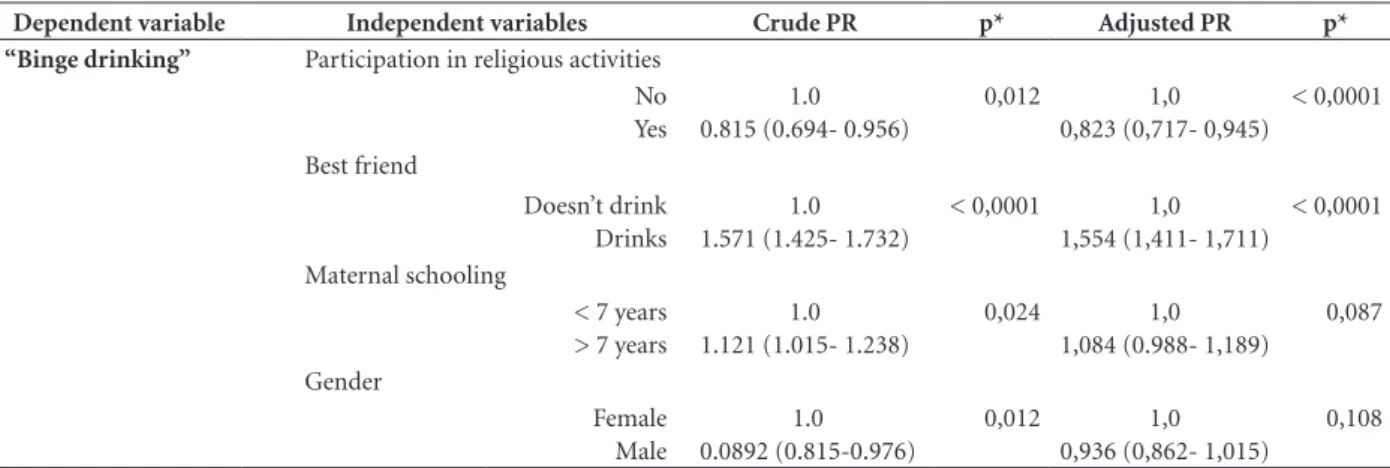
In the Poisson regression model with robust variance, participation in religious activities was associated with students’ binge drinking (PR = 0,823; 95% CI: 0,717 – 0,945); and best friend alcohol consumption was associated with the binge drinking by these students (PR = 1.554; 95% CI: 1,411-1,711) (Table 2).
Discussion
Alcoholic beverages are the psychotropic sub-stances most commonly used by adolescents42.
Adolescent drinking is an important ritual of so-ciability, as well as a pleasant moment, so that this period is usually one in which one drinks more in quantity and frequency43. In this study, the
prevalence rate of alcohol consumption (45.6%) was similar to that found in multicenter studies conducted in Brazil in 2001 (48.5%)44. When we
analyzed binge drinking (23.1%), we observed a lower prevalence when compared to studies in Belo Horizonte, Minas Gerais (36.0%)20 and
in Brazil (35.0%)25.However, these studies had
broader age groups. In Brazil, while selling alco-holic beverages to individuals under 18 years of age is forbidden by law (Law No. 9.294, 15 July 1996)10, their consumption seems somewhat
trivialized in society and is culturally associated with leisure. However, several studies show that binge drinking is a risk behavior not only due to the possibility of intoxication and death, but also because of its association with higher rates of traffic accidents45, poor school performance and
greater possibility of dependence46.
The early use of alcohol has been pointed out as an important predictor for problematic con-sumption in adulthood14,16,17. In their
longitudi-nal study in the U.S., Dawson et al.15 found that
adolescents who started drinking before the age of 15 were significantly more likely to become addicted in adult life, compared to those who had a late first consumption at the age of 18 (PR = 1.38, p = 0.047). In this sample, 7.6% of students reported first consumption between 8 and 9 years of age. In addition, 29.7% of those who reported binge drinking said it was done at the age of 10. The earlier the contact with alcohol, the more vulnerable individuals become to dependence, which can alter the normal development of the brain and hamper the ability to perform specific tasks for their age36.
In this study, binge drinking by participat-ing adolescents was not statistically associated with gender. Studies indicate that drunkenness8,
increased risk of alcohol consumption19 and
regular consumption of beverages47 are more
frequent among boys. However, several studies have shown a corresponding consumption for both genders or higher in females8,13,48. Currently,
aúd
e C
ole
tiv
a,
23(4):1067-1076,
2018
a group of equals, and may lead adolescents to adopt modes concerning that group48.
Histor-ically, it has been known that, since the end of
the eighteenth century, equal rights and oppor-tunities claimed by women have revolutionized society49. Believing that the use of beverages is
Table 2. Results of the Poisson regression analysis with robust variance of the dependent variable (“binge drinking”) and independent
variables among adolescents (n = 588), Diamantina/MG, Brazil, 2015.
Dependent variable Independent variables Crude PR p* Adjusted PR p*
“Binge drinking” Participation in religious activities
No Yes
1.0 0.815 (0.694- 0.956)
0,012 1,0
0,823 (0,717- 0,945)
< 0,0001
Best friend
Doesn’t drink Drinks
1.0 1.571 (1.425- 1.732)
< 0,0001 1,0
1,554 (1,411- 1,711)
< 0,0001
Maternal schooling
< 7 years > 7 years
1.0 1.121 (1.015- 1.238)
0,024 1,0
1,084 (0.988- 1,189)
0,087
Gender
Female Male
1.0 0.0892 (0.815-0.976)
0,012 1,0
0,936 (0,862- 1,015)
0,108
PR: Prevalence ratio CI: Confidence interval *Adjusted for gender.
Table 1. Distribution of the sample according to the dependent variable (“binge drinking”) and independent
variables; Diamantina, Minas Gerais, Brazil, 2015 (n = 588).
Independent variables “Binge drinking”
Absent Present p*
(n) % (n) %
Sociodemographic and economic condition
Gender
Female 245 81.1 57 18.9 0.012
Male 207 72.4 79 27.6
Maternal schooling
8 years and over of study 301 80.1 75 19.9 0.017
0-7 years of study 150 71.4 60 28.6
Religiosity Prayers in the last 6 months
Yes 402 79.0 107 21.0 0.002
No 50 63.3 29 36.7
Religious Activities
Participates 394 79.1 104 20.9 < 0.0001
Does not participate 58 64.4 32 35.6
Importance of religion
Little important 413 79.4 107 20.6 < 0.0001
Very important 39 57.4 29 42.6
Consumption by relatives and friends
Father
Never 135 87.1 20 12.9 < 0.0001
Yes 317 73.2 116 26.8
Mother
Never 297 73.2 109 28.6 < 0.001
Yes 155 85.2 27 14.8
Best friend
Never 274 94.2 17 5.8 < 0.0001
Yes 178 59.9 119 40.1
G
uimarães MO affected by cultural definitions
50, it is observed
that the contemporary female conduct of equat-ing men even in the act of drinkequat-ing has reflected a currently experienced cultural change between genders51,52. Although this consumption is not a
“typically male” behavior according to the results obtained in this study, we can note that society believes that alcohol abuse by men causes physi-cal and moral deterioration of self-care and fam-ily care, while for women this consumption re-veals women that “dishonestly” fail to fulfill their role of wives, workers and mothers who take care of their children and watch over home order, showing the demarcation of genders53.
The literature shows conflicting results while considering binge drinking and family socioeco-nomic status. Some researchers point out that binge drinking is positively associated with high-er socioeconomic status54,55, while others point
out a higher prevalence of consumption when the status is lower11,56. Our results indicate that
there was no statistically significant association between maternal schooling and binge drinking by her children. Factors such as culture and reli-giosity may be associated with variables income and schooling, influencing in a complex way the profile of alcohol consumption in a population. The evaluation of the influence of these socioeco-nomic factors on behaviors in developing coun-tries such as Brazil becomes more complex, since increased years of schooling can have a minimal effect on increased income57. The association
be-tween binge drinking and socioeconomic status is still contradictory, and it is important to point out the existence of studies that do not indicate such association58,59.
Although adolescence is the period associat-ed with the onset of alcohol consumption8,
sev-eral so-called “protective factors” may contribute to the non-involvement of individuals. Accord-ing to a survey by Hanson24, the main protective
factors are: family, due to the construction of af-fective bonds and monitoring of friendships and activities, strong involvement with school and/ or religious activities and availability of informa-tion. Religiosity has become an object of increas-ing interest to research. Studies investigatincreas-ing the relationship between religious involvement and binge drinking indicate a positive association between greater involvement in religious activi-ties and lower consumption23,29,60. In addition, it
is associated with a lower risk of depression and suicide, reduced mortality rate and a better qual-ity of life61. Participation in religious activities is
strongly connected with health care. In our study,
we observed that this action was negatively asso-ciated to binge drinking. Adolescents involved in religious activities fill in their time and begin to receive teachings about conduct and moral con-cepts that discourage the use of alcoholic bever-ages and increase faith25. Some authors suggest
that religious teachings work as a protective fac-tor by exerting a direct influence on the family, individual personality or bringing values related to life sanctity28,62,63. The perceived personal
re-sponsibility for the physical and mental care that religiosity brings cooperates so that practitioners implement self-control regarding the use of alco-hol and other drugs23,64.
When we analyze the fundamental role that friends play in individual behavior, it is known that these are great influencers for consump-tion65. Living with friends who consume alcohol
is a predisposing factor. Through multiple anal-ysis, we observed that alcohol consumption by the best friend was statistically associated with binge drinking among students. Often, the first alcoholic consumption occurs at parties, where drinks ingested are offered by friends and used as a socializing means48. In this perspective, studies
by Sanchez et al.25 and Zarzar et al.20 have shown
that friendships developed in religious environ-ments with people who habitually do not engage in binge drinking favor a lower risk lifestyle. Through networks of friends healthy behaviors can be shared. In schools, the environment of common rules, goals and values that aims life, can also reduce the risk of high alcohol con-sumption65. However, Zarzar et al.20 emphasize
that the best friendships, when developed within the church, works as a protective factor against binge drinking.
The limitations of this study include its cross-sectional design, which does not allow the establishment of a cause-and-effect direction, but facilitates the identification of associations between the analyzed variables. The use of ques-tionnaires enables the omission of information, but since they are anonymous, they leave the par-ticipant with more freedom to answer personal questions. Students who were in the classroom and who agreed to participate in the study were evaluated. Thus, the results may not reflect what happens to those who missed or evaded school and those not enrolled.
aúd
e C
ole
tiv
a,
23(4):1067-1076,
2018
Conclusion
There was a high prevalence of binge drinking among 12-year-olds participating in this study. The participation of adolescents of this study in religious activities appeared as a possible pro-tective factor for binge drinking. The consump-tion of alcoholic beverages by the best friend was identified as a possible risk factor for binge drinking by adolescents.
Collaborations
PCP Paiva, EF Ferreira and PMPA Zarzar con-tributed to the work’s design. PCP Paiva and HN Paiva contributed to data acquisition. PMPA Zarzar, PCP Paiva and HN Paiva were involved in data analysis and interpretation. MO Guimarães, PCP Paiva and PMPA Zarzar were responsible for the elaboration of the paper. MO Guimarães, PCP Paiva, JA Lamounier and PMPA Zarzar were responsible for the critical review and approval of the final version. All authors had full access to data and assume responsibility for the integrity and precision of the analyses.
Acknowledgments
G
uimarães MO References
1. Galduróz JCF, Sanchez ZVM, Opaleye ES, Noto AR, Fonseca AM, Gomes PLS. Fatores associados ao uso pesado de álcool entre estudantes das capitais brasilei-ras. Rev Saude Publica 2010; 44(2):267-273.
2. Galduróz JFC, Noto AR, Fonseca AM, Carlini EA. Le-vantamento nacional sobre o consumo de drogas psi-cotrópicas entre estudantes do ensino fundamental e médio da rede pública de ensino nas 27 capitais brasi-leiras. Unifesp 2004; 17(1):1-503.
3. World Health Organization (WHO). Global status re-port on alcohol and health-2014. Geneva: WHO; 2004. 4. Carlini EA, Galduróz JC, Noto AR, Carlini CM, Olivei-ra LG, Nappo SA. I Levantamento domiciliar sobre o uso de drogas psicotrópicas no Brasil: estudo envolvendo as 107 maiores cidades do país. São Paulo: Cebrid/Unifesp; 2002.
5. Silveira CM, Silveira CC, Silva JG, Silveira LM, Andrade AG, Andrade LHSG. Epidemiologia do beber pesado e beber pesado episódico no Brasil: uma revisão sistemá-tica da literatura. Rev Psiq Clin2008; 35(1):31-38. 6. Pitkänen T, Lyyara AL, Pulkkinen L. Age of onset of
drinking and the use of alcohol in adulthood: a follow up study from age 8-42 for females and males. Addic-tion 2005; 100(5):652-661.
7. Spear LP. Adolescent alcohol exposure: are there sepa-rable vulnesepa-rable periods within adolescence? Physiolo-gy e behavior 2015; 148:122-130.
8. Malta DC, Mascarenhas MDM, Porto DL, Duarte EA, Sardinha LM, Barreto SM. Prevalência do consumo de álcool e drogas entre adolescentes: análise dos dados da Pesquisa Nacional de Saúde Escolar. Rev Bras Epidemio
2011;14(1):136-146.
9. Madruga CS, Laranjeira R, Caetano R, Pinsky I, Zaleski M, Ferri CP. Use of licit and illicit substances among adolescents in Brazil — A national survey. Addictive Behaviors 2012; 37(10):1171-1175.
10. Brasil. Lei 9.294, de 15 de julho de 1996. Dispõe sobre as restrições ao uso e propaganda de produtos fumí-geros, bebidas alcoólicas, medicamentos, terapias e defensivos agrícolas, nos termos do Par. 4º do Art. 220 da Constituição Federal. Diário Oficial da União 1996; 16 jul.
11. Pinsky I, Sanchez M, Zaleski M, Laranjeira R, Caetano R. Patterns of alcohol use among Brazilian adolescents.
Rev Bras Psiquiatria 2010; 32(3):242-249.
12. Paiva PC, Paiva HN, Oliveira Filho PM, Lamounier JA, Ferreira RC, Ferreira EF, Zarzar PM. Prevalence of traumatic dental injuries and its association with binge drinking among 12-year-olds: a population-based study. Int J Paediatr Dent 2015; 25(4):239-247. 13. Reis TG, Oliveira LCM. Padrão de consumo de álcool e
fatores associados entre adolescentes estudantes de es-colas públicas em município do interior brasileiro.Rev. bras. Epidemiol 2015;18(1):13-24.
14. Ehlers CL, Slutske WS, Gilder DA, Lau P, Wilhelmsen KC. Age at first intoxication and alcohol use disorders in Southwest California Indians. Alcohol Clin Exp Res
2006; 30(11):1856-1865.
15. Dawson DA, Goldstein RB, Patricia CS, June RW, Grant BF. Age at first drink and the first incidence of adult-onset DSM-IV alcohol use disorders. Alcohol Clin Exp Res 2008;32(12):2149-2160.
16. Helms CM, Rau A, Shaw J, Stull C, Gonzales SW, Grant KA. The effects of age at the onset of drinking to in-toxication and chronic ethanol self-administration in male rhesus macaques. Psychopharmacology 2014; 231(8):1853-1861.
17. Morean ME, Kong G, Camenga DR, Cavallo DA, Con-nell C, Krishnan-arin S. First drink to first drunk: age of onset and delay to intoxication are associated with adolescent alcohol use and binge drinking. Alcohol Clin Exp Res 2014;38(10):2615-2621.
18. Hingson RW, Heeren T, Winter MR. Age at drinking onset and alcohol dependence: age at onset, dura-tion, and severity. Arch Pediatr Adolesc Med 2006; 160(7):739-746.
19. Campos JADB, Almeida JC, Garcia PPNS, Faria JB. Consumo de álcool entre estudantes do ensino médio do município de Passos - MG. Cien Saude Colet 2011; 16(12):4745-4754.
20. Zarzar PM, Jorge KO, Oksanen T, Vale MP, Ferreira EF, Kawachi I. Association between binge drinking, type of friends and gender: a cross-sectional study among Bra-zilian adolescents. BMC Public Health2012; 12(1):257-268.
21. Sanchez ZM, Santos MG, Pereira AP, Nappo SA, Carli-ni EA, CarliCarli-ni CM, Martins SS. Childhood alcohol use may predict adolescent binge drinking: A multivariate analysis among adolescents in Brazil. J Pediatr 2013; 163(2):363-368.
22. Sanchez ZM, Locatelli DP, Noto AR, Martins SS. Binge drinking among brazilian students: A gradient of as-sociation with socioeconomic status in five geo-eco-nomic regions. Drug and Alcohol Dependence 2014; 127(3):87-93.
23. Foster DW, Quist MC, Young CM, Bryan JL, Nguyen ML, Neighbors C. Benefit finding as a moderator of the relationship between spirituality/religiosity and drink-ing. Addictive behaviors 2013; 38(11):2647-2652. 24. Hanson GR. New vistas in Drug Abuse Prevention.
Nida Notes 2002, 16(6):3-7.
25. Sanchez ZM, Opaleye ES, Chaves TV, Noto AR, Nappo SA. God forbids or mom disapproves? Religious beliefs that prevent drug use among youth. Journal of Adoles-cent Research 2011; 26(5):591-616.
26. Wallace JMJR, Delva J, O’malley PM, Bachman JG, Schulenberg JE, Johnston LD, Stewart C. Race/eth-nicity, religiosity and adolescent alcohol, cigarette and marijuana use. Soc work in public health 2007; 23(2-3):193-213.
27. Wray-Lake L, Maggs JL, Johnston LD, Bachman JG, O’Malley PM, Schulenberg JE. Associations be-tween community attachments and adolescent sub-stance use in nationally representative samples. Journal of Adolescent Health 2012; 51(4):325-331.
28. Sanchez ZM, De Oliveira LG, Nappo SA. Religiosity as a protective factor against the use of drugs. Subst Use Misuse 2008; 43(10):1476-1486.
aúd
e C
ole
tiv
a,
23(4):1067-1076,
2018
30. Meneses-Gaya C1, Zuardi AW, Loureiro SR, Hallak JE, Trzesniak C, de Azevedo Marques JM, Machado-de-Sousa JP, Chagas MH, Souza RM, Crippa JA. Is the full version of the AUDIT really necessary? Study of the va-lidity and internal construct of its abbreviated versions.
Alcohol Clin Exp Res 2010; 34(8):1417-1424.
31. Martins M, Santos MA, Pillon SC. Low-income fam-ilies’ perceptions on the use of drugs by one of their members. Rev Latino-Am Enfermagem 2008; 16(2):293-298.
32. Wechsler H, Nelson TF. Binge drinking and the Amer-ican college student: what’s five drinks? Psychol Addict Behav 2001; 15(4):287-291.
33. Sanchez ZM, Martins SS, Opaleye ES, Moura YG, Lo-catelli DP, Noto AR. Social factors associated to binge drinking: a cross-sectional survey among Brazilian stu-dents in private high schools. BMC Public Health 2011; 11(1):201-211.
34. Chung T, Colby SM, Barnett NP, Monti PM. Alcohol Use Disorders Identification Test: Factor structure in an adolescent emergency department sample. Alcohol Clin Exp Res 2002; 26(2):223-231.
35. Reinert DF, Allen JP. The Alcohol Use Disorders Iden-tification Test: An update of research findings. Alcohol Clin Exp Res 2007;31(2):185-189.
36. Spears GV. Latent growth trajectories of substance use among pregnant and parenting adolescents. Psychol Addict Behav 2010;24(2):322-332.
37. Arria AM, Vincent KMA, Caldeira K. Measuring liabil-ity for substance use disorder among college students: Implications for screening and early intervention. J. Drug Alcohol Abuse 2009; 35(4):233-241.
38. Parsai MKS, Marsiglia FF. Parental monitoring, re-ligious involvement and drug use among latino and non-latino youth in the southwestern United States. Br J Soc Work 2010;40(1):100-114.
39. Pratta EMM, Santos MA. Levantamento dos motivos e dos responsáveis pelo primeiro contato dos adolescen-tes do ensino médio com substâncias psicoativas. Rev Eletrônica Álcool e drogas 2006; 2(2):0.
40. Bendo CB, Scarpelli AC, Vale MP, Araújo ZPM. Cor-relation between socioeconomic indicators and trau-matic dental injuries: a qualitative critical literature review. Dent Traumatol 2009; 25(4):420-425.
41. Oliveira FPM, Jorge KO, Ferreira EF, Ramos-Jorge ML, Tataounoff J, Zarzar PM. Association between dental trauma and alcohol use among adolescents. Dent Trau-matol 2013; 29(5):372-377.
42. Galduróz JFC, Noto AR, Fonseca AM, Carlini EA. Le-vantamento Nacional sobre o Consumo de Drogas Psicotrópicas entre estudantes do ensino fundamental e médio da rede pública de ensino nas 27 capitais bra-sileiras.Unifesp 2004; 17(1):1-503.
43. Franch M. Um brinde à vida: reflexões sobre violência, juventude e redução de danos no Brasil. Álcool e redu-ção de danos: uma abordagem inovadora para países em transição. Brasília: Ministério da Saúde;2004.
44. Galduróz JCF, Noto AR, Fonseca AM, Carlini CM, Oliveira LG. II Levantamento domiciliar sobre o uso de drogas psicotrópicas no Brasil: estudo envolvendo as 108 maiores cidades do País- 2005. São Paulo: Página e Le-tras Unifesp; 2007; p. 1-472.
45. Zhao G, Wu C, Houston RJ, Creager W. The effects of binge drinking and socio-economic status on sober driving behavior. Traffic Inj. Prev 2010;11(4):342-352. 46. Pitkänen T, Lyyra A, Pulkkinen L. Age of onset of
drinking and the use of alcohol in adulthood: a fol-low-up study from age 8-42 for females and males. Ad-diction 2005; 100(5):652-666.
47. Fraga S, Sousa S, Ramos E, Dias S, Barros H. Alcohol use among 13-year-old adolescents: associated factors and perceptions. Public Health 2011; 125(7):448-456. 48. Vieira PC, De Castro ADRG, Freddo SL, Bittencourt A,
Monteiro L. Uso de álcool, tabaco e outras drogas por adolescentes escolares em município do Sul do Brasil.
Cad Saude Publica 2008; 4(11):2487-2498.
49. Bezerra TCE. Mulheres e Políticas Públicas: uma análi-se sob a ótica das lutas pela construção da cidadania. O público e o privado 2012; (8):149-161.
50. Neves DP. Alcoholism: indictment or diagnosis? Cad Saude Publica 2004; 20(1):7-14.
51. Moreno RS, Ventura RN, Bretas JRS. O uso de Álcool e Tabaco por Adolescentes do Município de Embu, São Paulo, Brasil. Revista da Escola de Enfermagem da USP
2010;44(4):969-977.
52. Strauch ES, Pinheiro RT, Silva RA, Horta BL. Uso de álcool por adolescentes: estudo de base populacional.
Rev Saude Publica 2009; 43(4):647-655.
53. Campos EA, Reis JG. Representations on the use of alcohol among women undergoing treatment at a ref-erence center in the city of São Paulo, Brazil. Interface (Botucatu) 2010; 14(34):539-550.
54. Almeida-filho N, Lessa I, Magalhães L, Araújo M, Aqui-no E, Kawachi I, James S. Alcohol drinking patterns by gender, ethnicity, and social class in Bahia, Brazil. Rev Saude Publica 2004; 38(1):45-54.
55. Humensky JL. Are adolescents with high socioeconom-ic status more likely to engage in alcohol and illsocioeconom-icit drug use in early adulthood? Substance abuse treatment, pre-vention, and policy 2010; 5(19):5-19.
56. Mendoza-Sassi RA, Béria JU. Prevalence of alcohol use disorders and associated factors: a population-based study using AUDIT in southern Brazil. Addiction 2003; 98(6):799-804.
57. Ferreira LN, Sales ZN, Casotti CA, Júnior JPB, Júnior ACRB. Perfil do consumo de bebidas alcoólicas e fato-res associados em um município do nordeste do Brasil.
Cad Saude Publica 2011; 27(8):1473-1486.
58. Lundborg P. Social capital and substance use among swedish adolescents-an explorative study. Social Sci Med 2005; 61(6):1151-1158.
59. Barros M, Botega N, Dalgalarrondo P, Marín-Léon L, Oliveira H.Prevalence of alcohol abuse and associated factors in a population-based study. Rev Saude Publica
2007; 41(4):502-509.
60. Lucchetti G, Koenig HG, Pinsky I, Laranjeira R, Vallada H. Religious beliefs and alcohol control policies: a Bra-zilian nationwide study. Revista Brasileira de Psiquia-tria 2014; 36(1):4-10.
G
uimarães MO
62. King MB, Koenig HG. Conceptualising spirituality for medical research and health service provision. BMC Health Services Research 2009; 13(9):1-7.
63. Geppert C, Bogenschutz MP, Miller WR. Development of a bibliography on religion, spirituality and addic-tions.Drug Alcohol Rev 2007; 26(4):389-395.
64. Stylianou S. The role of religiosity in the opposition to drug use. Int J Offender Ther Comp Criminol 2004; 48(4):429-448.
65. Valente T, Ritt-Olson A, Stacy A, Unger J, Okamoto J, Sussman S. Peer acceleration: effects of a social network tailored substance abuse prevention program among high-risk adolescents.Addiction 2007; 102(11):1804-1815.
Article submitted 25/03/2016 Approved 22/06/2016
Final version submitted 24/06/2016
This is an Open Access article distributed under the terms of the Creative Commons Attribution License BY