AR
TICLE
Lactose in processed foods: evaluating the availability
of information regarding its amount
Abstract Patients with lactose intolerance, a high prevalence disease, should control the intake of food with lactose to avoid gastrointestinal symp-toms. Since tolerance depends on the amount of lactose ingested, it is essential to discuss the avail-ability of the amount of lactose information in processed foods, which is currently not mandato-ry. The study measured the availability of infor-mation on the amount of lactose on the labels of processed food that contained milk or lactose in the ingredient list. Then, we contacted the food industry to request this information. We evalu-ated 1,209 processed foods, of which 1,092 were traditional and 117 were diet/light/zero. Only 3,1% of the analyzed foods provided information on the amount of lactose in the labeled nutrition table. This information was more available in the diet/light/zero food group. Furthermore, of the 156 contacted companies, only 14 reported the amount of lactose contained in foods, 93 answered the request, but have not provided the amounts and 49 did not answer the request. We conclud-ed that there is a low availability of information about the amount of lactose in processed foods. Key words Lactose, Lactose intolerance, Con-sumer rights, Nutrition labeling
Raíssa Aparecida Borges Batista 1
Dyessa Cardoso Bernardes Assunção 1
Fernanda Rodrigues de Oliveira Penaforte 2
Camila Cremonezi Japur 3
1 Curso de Nutrição,
Faculdade de Medicina, Universidade Federal de Uberlândia. Av. Pará 1720/ bl. 2U/sl. 12, Umuarama. 38400-902 Uberlândia MG Brasil. raissaborges26@ hotmail.com 2 Curso de Nutrição,
Instituto de Ciências da Saúde, Universidade Federal do Triângulo Mineiro. Uberaba MG Brasil. 3 Curso de Nutrição
e Metabolismo,
B
at
ista R
Introduction
Lactose is the primary carbohydrate found in milk. It consists of two monosaccharides, glucose and galactose, characterizing a disaccharide. Lac-tose intolerance consists of poor digestion and absorption of lactose from the reduced activity of the β-galactosidase enzyme, also known as lac-tase, which can hydrolyze lactose to glucose and
galactose1. Individuals with lactose intolerance
are unable to digest lactose, which will not conse-quently be absorbed into the small bowel. When reaching the colon, lactose is fermented, produc-ing short-chain fatty acids and the formation of gases (carbon dioxide, hydrogen and methane)
by the intestinal microbiota2, which can cause
gastrointestinal problems, discomfort and symp-toms, such as nausea, colic, flatulence, diarrhea,
bloating, abdominal pain, among others3.
Usual-ly, these symptoms start around 30 minutes to 2 hours after consumption of some food
contain-ing lactose4.
Lactose intolerance can be classified into three types: congenital, primary and secondary. The congenital is caused by the complete absence of jejunal lactase throughout the life of an individu-al and is detected at childbirth. The primary type can develop at any age and is caused by the declin-ing concentration of lactase in the human body, genetically programmed (non-persistent lactase), from infancy to adulthood, leading to difficulties in the hydrolysis of lactose. The secondary type occurs due to the presence of intestinal lesions or
diseases and is transient and reversible5.
The persistence of lactase (or lactose toler-ance) in different populations seems to be asso-ciated with the domestication of dairy cattle and
with the habit of consuming milk after weaning6
and, therefore, the prevalence of lactose intoler-ance varies according to the geographic region and habits of the population.
A study points that non-persistence of lac-tose, or lactose intolerance, is found in 65% of
the world’s population7, affecting around 2% to
15% of people of North European descent, 60 to 80% of blacks and Latinos, and 80% to 100% of
Native Americans and Asians5. In Brazil, a study
showed that the prevalence of primary lactose in-tolerance in adults in a sample of 567 subjects was 57% for whites and mulattos, 80% for blacks and
100% for Japanese8. Other studies indicate a high
prevalence in the Brazilian population: 44.1% in
1,088 individuals in Southern Brazil9 and 60.8%
in 115 individuals in Southeast Brazil, of which
53.2% in whites and 91.3% in nonwhites10.
A reduction of at least 50% of enzyme activ-ity is required to trigger the symptoms resulting from the primary deficiency of lactase, which ex-plains part of the variation in tolerance to small doses of lactose by individuals with lactose intol-erance. Another possible explanation is the
adap-tation of the intestinal microbiota11.
Studies show a variation in the amount
tol-erated between 7 and 15g of lactose per day11-13.
A study conducted by Vesa et al.14, showed that
individuals with lactose poor digestion did not evidence gastrointestinal symptoms induced by the ingestion of low amounts of lactose (0.5 to 7.0 g/day).
Therefore, concerning nutritional treatment, it is recommended to avoid the consumption of products containing a high amount of lactose or to perform the ingestion of the enzyme lactase with dairy products. It is also possible to consume dairy products in which the amount of lactose has been reduced by fermentation, such as yo-gurt or curds, or excluded by industrial processes,
such as processed foods without lactose15,16. The
inadequate nutritional planning or replacement of milk and dairy products with their respective lactose-free products may lead to a lower intake
of calcium, phosphorus and vitamins15.
There is evidence of a high consumption
of processed foods in contemporary society17,
and a stimulus to the intake of diet/light/zero
foods18. Thus, because of the tolerance of a
cer-tain amount of lactose by individuals with lac-tose intolerance, information on the presence and amount of lactose in processed food labels should be mandatory in Brazilian legislation on nutritional labeling of packaged foods. However, such legislation does not require the provision of
such information19.
According to the National Health Surveil-lance Agency (ANVISA), lactose-free or low-lac-tose products should be labeled according to the
specific regulations for special-purpose foods20.
However, even if classified as such, the ordinance does not provide for the possibility of using a notice on the front label, clearly informing the consumer that the product is lactose-free or that
it contains a low amount of lactose1, with the
ex-ception of processed soy-based food that,
accord-ing to RDC 91/200021, must state the following
information: “Contains lactose”, “Contains milk proteins” or “Contains lactose and milk proteins”.
aúd
e C
ole
tiv
a,
23(12):4119-4128,
2018
foods to control the symptoms and often exclude them without necessity, which may compromise their health-related quality of life, which refers to the impact of the intervention, i.e., food
restric-tion on the perceprestric-tion of well-being22, and its
nu-tritional status. Also, failure to report the amount of lactose hampers the nutritionist’s calculation of diets and nutritional orientation of lactose-in-tolerant patients. Thus, the aim is to evaluate the availability of information on the amount of lac-tose in processed food labels and by the Custom-er SCustom-ervice Department (SAC).
Methods
This is a cross-sectional and quantitative obser-vational study evaluating the availability of infor-mation for the population of the amount of lac-tose in traditional processed and diet/light/zero foods marketed in a hypermarket in the city of Uberlândia, Minas Gerais. The hypermarket was intentionally selected because it has an abundant supply of processed foods and is considered the second largest supermarket company in
Bra-zil23 by the Brazilian Supermarket Association
(ABRAS).
The evaluation was carried out in two stages. In the first, a diagnosis was made concerning the presence of information on the amount of lac-tose in the labels of processed foods. In the sec-ond, food industries were contacted, when this was free, over the telephone, by e-mail or through company websites to request information on the amount of lactose in their products, clarifying that this information would be used for scientific research.
Data was collected in 2015, following a writ-ten authorization by the hypermarket’s manage-ment. Information included processed foods that contained milk or lactose in different positions in the list of ingredients, of different brands and fla-vors. Foods with the above characteristics, with the same composition, but with different pack-aging sizes, were excluded. It is worth noting that the position in the list of ingredients indicates, in decreasing order, the amount of the ingredient in the final product of the processed food, that is,
the ingredients with higher amounts24 appear in
the first positions.
The information was collected in this study by an instrument pre-tested by the researchers, with a sample of 20 foods to define the following items: technical name; trading name; brand; tele-phone or e-mail of the customer service (SAC);
position of lactose or milk in the list of ingredi-ents; portion in grams and nutritional composi-tion.
The foods were divided into two groups: tra-ditional and diet/light/zero. In the latter, only diet foods were included, for nutrient-restrict-ed diets or for controllnutrient-restrict-ed ingestion of nutrients
(considered special purpose foods)20 or with
sup-plementary nutritional information (light, which is one with reduction of some nutrient compared to traditional and zero, which does not contain a
particular nutrient)25. Each group was
subdivid-ed into 17 and 11 categories, respectively,
accord-ing to the Brazilian Food Classification System26.
Following data collection and entry, a view of the information entered by two other re-searchers was carried out and descriptive statis-tical analysis was performed on the number and percentage of the results obtained. The compar-ison of the percentages of the declaration of the amount of lactose between traditional and diet/ light/zero foods was performed using the chi-square test, with a significance level of 5%. The GraphPad Instat software version 3.05 was used for statistical analysis.
Results
The total sample of processed foods was 1,209, of which 1,092 (90.3%) were traditional foods and 117 (9.7%) corresponded to diet/light/zero foods. Foods properly classified and included in the analysis are described in Chart 1.
The total percentage of the declaration of the amount of lactose in the nutritional table of processed food labels was 3.1%. The declaration was more frequent (p < 0.0001) in the diet/light/ zero food group (30%) than in the traditional food group (0.2%) (Table 1). Among the prod-ucts that reported the amount of lactose (n = 38), 36 (95.0%) were diet/light/zero, of which 30.6% stated that the amount of lactose was equal to zero, and the remaining 2 (5.0%) were tradition-al foods.
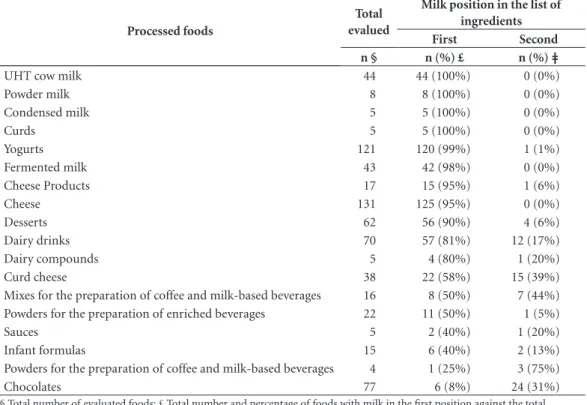
Table 2 described foods that contained the milk in the first two positions of the list of ingre-dients and that probably are foods with a more considerable amount of lactose. Processed foods with the highest frequency of milk/lactose in the last positions in the list of ingredients and those that did not have a significant number of foods within the same category were not shown.
B
at
ista R
important are the infant formulas, in which 50% contained lactose in the first position (n=8) and 19% in the second position (n = 3).
Of the 257 food industries responsible for the production of food evaluated, 156 (60.7%) provide access to the free SAC and were contact-ed. Among them, only 14 (9.0%) reported the amount of lactose contained in the requested foods. Ninety-three companies (59.6%) respond-ed to the request but did not report the amounts. Of these, 61 (65.6%) replied that such informa-tion is a secret formulainforma-tion and cannot be pro-vided due to internal policy, and 32 (34.4%)
re-ported that they could not make this information available, since they do not perform the analysis of sugars separately as the declaration on the food label is not mandatory, and 49 companies (31.4%) did not respond to the request.
Discussion
The main contribution of the study was to show the low availability of information on the amount of lactose in processed foods, either on labels or through the Customer Service
Depart-Chart 1. Description of food by food category.
Food categories Food included
Milk UHT cow milk (whole, skimmed, semi-skimmed); cow’s milk powder (whole, skimmed, semi-skimmed); goat milk (whole, skimmed, semi-skimmed); and pasteurized whole cow's milk.
Oils and fats Margarine; and butter and margarine-derived foods. Edible iced
products
Ice cream and powders for ice cream preparation.
Candy, confectionery, bonbons, chocolates and the like
Confectionery (almonds, cashew nuts, chips, sticks, among others); bonbons (with milk chocolate, stuffed with coconut, chocolate with peanuts, and others); hazelnut creams (hazelnut with cocoa, chocolate and hazelnut with wafer); condensed milk; toppings; nougats; chocolates (white, half bitter, aerated with milk, milk, among others); and candies (caramel of milk with cappuccino, caramel of milk stuffed with coconut, among others). Cereals and cereal
or cereal-based products
Cereal bars; morning cereals; milk flours and pasta.
Bakery products and biscuits
Toast; cheese breads; cookies; breads; cakes; bagels; corn-bread; mixes for the preparation of bakery products; pies; cookies and crackers.
Meat and meat products
Sausages; breaded chicken breast; Spanish sirloin and lamb meat.
Sugar and honey Dietetic sweeteners.
Soups and broths Corn cream; mixes for the preparation of soups; polenta and bean soup with pasta. Sauces and
seasonings
Sauces (cheese and tomato with ricotta) and pates (pork, turkey breast and ham).
Protein products yeasts
Dairy drinks; curds; milk creams; cheese creams; cheese products; cheeses; curd cheeses; yogurts; infant formulas; dairy compounds and food with isolated soy protein and milk. Beverages Liquors; mixes and powders for the preparation of cappuccino or instant milk and
coffee-based beverages. Snacks Salty and sweet snacks. Desserts and
powders for desserts
Sweets and mixes for the preparation of desserts such as flans, puddings, mousses, among others.
Processed cookery preparations
Lasagna; shepherd’s pies; rice; balls; chicken dumplings; vol-au-vents; purees; sandwiches; baby food; pizzas; pancakes; salted cakes; stroganoffs; pies; among others.
Nutrition supplements
Food supplements; protein bars; nutritional supplement and powders for the preparation of beverages for weight loss diet and powders for the preparation of enriched drinks. Preparations to
add to milk
aúd
e C
ole
tiv
a,
23(12):4119-4128,
2018
Table 1. Percentage of processed foods containing the declaration of the amount of lactose in the nutritional table of
traditional and diet/light / zero food labels.
Food group Total food
evaluated
Traditional food Diet/light/zero food
Total evaluated
§
Total declared
n (%) £
Total evaluated
§
Total declared
n (%) £
Milk 56 50 0 (0.0%) 6 3 (50.0%)*
Oils and fats 12 10 0 (0.0%) 2 0 (0.0%)
Edible iced products 74 72 0 (0.0%) 2 0 (0.0%)
Candy, confectionery, bonbons, chocolates and the like 123 114 0 (0.0%) 9 5 (56.0%)*
Cereals and cereal or cereal-based products 49 41 0 (0.0%) 8 0 (0.0%)
Bakery products and biscuits 165 160 0 (0.0%) 5 0 (0.0%)
Meat and meat products 12 12 0 (0.0%) 0 0 (0.0%)
Sugar and honey 8 8 0 (0.0%) 0 0 (0.0%)
Soups and broths 8 8 0 (0.0%) 0 0 (0.0%)
Sauces and seasonings 10 10 0 (0.0%) 0 0 (0.0%)
Protein products yeasts 461 396 2 (0.5%) 65 18 (28.0%)*
Beverages 23 19 0 (0.0%) 4 2 (50.0%)**
Snacks 13 13 0 (0.0%) 0 0 (0.0%)
Desserts and powders for desserts 74 65 0 (0.0%) 9 8 (89.0%)*
Processed cookery preparations 82 82 0 (0.0%) 0 0 (0.0%)
Nutrition supplements 14 8 0 (0.0%) 6 0 (0.0%)
Preparations to add to milk 25 24 0 (0.0%) 1 0 (0.0%)
Total 1209 1092 2 (0.2%) 117 36 (30.0%)*
* P-value < 0.0001; ** P-value <0.05; § Total evaluated: total number of traditional processed and diet / light / zero foods evaluated in this study; £ Total declared: total number of traditional processed and diet / light / zero foods declaring the amount of lactose in the nutritional table of food labels.
Table 2. Processed foods with milk in the first or second positions.
Processed foods
Total evalued
Milk position in the list of ingredients
First Second
n § n (%) £ n (%) ǂ
UHT cow milk 44 44 (100%) 0 (0%)
Powder milk 8 8 (100%) 0 (0%)
Condensed milk 5 5 (100%) 0 (0%)
Curds 5 5 (100%) 0 (0%)
Yogurts 121 120 (99%) 1 (1%)
Fermented milk 43 42 (98%) 0 (0%)
Cheese Products 17 15 (95%) 1 (6%)
Cheese 131 125 (95%) 0 (0%)
Desserts 62 56 (90%) 4 (6%)
Dairy drinks 70 57 (81%) 12 (17%)
Dairy compounds 5 4 (80%) 1 (20%)
Curd cheese 38 22 (58%) 15 (39%)
Mixes for the preparation of coffee and milk-based beverages 16 8 (50%) 7 (44%) Powders for the preparation of enriched beverages 22 11 (50%) 1 (5%)
Sauces 5 2 (40%) 1 (20%)
Infant formulas 15 6 (40%) 2 (13%)
Powders for the preparation of coffee and milk-based beverages 4 1 (25%) 3 (75%)
Chocolates 77 6 (8%) 24 (31%)
B
at
ista R
ment (SAC). Only 3.0% of the processed foods analyzed showed lactose content on the nutri-tional table of their label, and only 9.0% of the industries contacted provided such information. Traditional foods had a lower percentage of dec-laration of lactose content in nutritional tables when compared to diet/light/zero foods.
It is worth mentioning that most of the diet/ light/zero foods that reported the amount of lac-tose were foods with controlled intake of sugar, lactose-free or lactose-restricted. These data in-deed show the compliance by the industries with the specific legislation, such as Ordinance Nº
29/199820 and RDC Nº 54/201225, which provide,
respectively, foods with controlled intake of sug-ars and those with complementary nutritional information concerning sugars, which in turn, require the declaration of the amount of sugars in the nutritional information table when a Sup-plementary Nutrition Information is performed. However, not all diet/light/zero foods contained a declaration of the amount of lactose.
The lack of access to information on the amount of lactose in the label of processed foods violates consumers’ fundamental right to information, which consequently impairs their autonomy through the nutritional orientation received and freedom of choice concerning the
food consumption16. On the other hand, it
hin-ders the nutritionist’s work in the calculation and advice on lactose controlled amounts to ensure tolerance, since some people tolerate around 11g (corresponding to 240 ml of milk per day), while
others evidence intolerance symptoms12 with the
ingestion of small amounts (2 to 3 g of lactose, corresponding to a small chocolate tablet). The appearance of symptoms depends on the amount of lactose ingested, the type of food in which the lactose was consumed and the degree of lactase
deficiency27.
Lack of knowledge of the amount of lactose in food may trigger symptoms in the individual, and is a source of distress for the family (espe-cially for mothers of children with this clinical
condition)28. Therefore, this theme transcends
the nutritionist professional practice core and includes a broader field, in which health pro-fessionals will have to address the physical and emotional care of the individual and the family, and promote health education, acting in a
com-plementary way29.
Other diseases whose fundamental part of the treatment is the total exclusion of some nu-trients to avoid the emergence of symptoms and more severe health consequences, such as
phe-nylketonuria and celiac disease, already have spe-cific regulations for the declaration of presence on the label, which in these specific cases are for
phenylalanine and gluten, respectively30-34.
How-ever, there are still gaps in the legislation to reg-ulate nutritional labeling for the declaration of essential nutrients for the dietary treatment of some diseases, such as galactosemia and fructose intolerance, inborn metabolism errors that im-ply the restriction of the substrate (galactose and
fructose, respectively) for disease control35.
Concerning lactose, Law Nº 13.305 of July 4, 2016 was recently approved and mandates the declaration of the presence of lactose on the la-bels of food containing lactose and the remain-ing lactose content in foods whose original
lac-tose content has changed36. However, it does not
require the declaration of the amount of lactose in foods that have not undergone any change, essential information for patients with lactose intolerance, since lactose must not necessarily be excluded but restricted according to tolerance.
Currently, RDC Nº 26/201537 was approved
and establishes the requirements for mandatory labeling of the main foods that cause food aller-gies, including milk, and will also assist individu-als with lactose intolerance in the choice of food, but will still not provide the amount of lactose for the appropriate adjustment to individual tolerance. It is worth mentioning that allergy to milk protein and lactose intolerance are differ-ent clinical situations. In the former, the indi-vidual evidences an immunological response to the presence of milk protein (caseins and whey proteins), whereas poor digestion of milk
car-bohydrate, namely, lactose16, is found in lactose
intolerance.
Another critical factor is that even foods that are recommended and more tolerated by patients with lactose intolerance, such as yogurts, may ev-idence varying amounts (2.1 to 6.4 g of lactose per 100g of yogurt) depending on their form
(liquid, flavored or with pieces)38, which can
cause symptoms in those who consume them. It is worth mentioning that yogurts are recom-mended because they theoretically have low lac-tose concentration, because of their hydrolysis in the fermentation process due to the participation of microorganisms, which reduces the amount of
lactose in the final product39.
Some industrial food processing may require the addition of milk or lactose because of its in-fluence on the viscosity, texture and role played by proteins that contribute to softness, lower
aúd
e C
ole
tiv
a,
23(12):4119-4128,
2018
Besides, lactose has a low sweetening power when compared to sucrose. However, its hydroly-sis is an alternative for the acquisition of a sweet-er syrup containing glucose and galactose, which is a useful process to the food industry, since it allows the production of fermented products (yogurt), it facilitates its use in the formulation of foods without harming the natural flavor of other components and provides technological advantages insofar as it reduces crystallization risks in dairy products and increases sweetening
power42-44. Another useful and promising feature
for the industry, especially in the case of infant formulas, is that lactose can promote the
absorp-tion of calcium and phosphorus44.
As the food industry widely uses them due to the properties mentioned above, these foods can be consumed by people with lactose intol-erance, without being aware of the presence and quantity of milk or lactose, which can lead to the appearance of symptoms, since this information is currently not stated on food labels. Thus, it is necessary to alert consumers, especially the lac-tose intolerant, concerning the consumption of these products.
This study filled a gap in the discussion on lactose labeling in processed foods, as no pre-vious scientific studies were found to verify the availability of information to consumers,
es-pecially those with lactose intolerance, on the amount of food lactose.
However, it has been considered that the dec-laration of milk or lactose in the list of ingredi-ents necessarily implies the presence of lactose in the final product, which is a limitation, since the processing of milk and dairy products and the animal race influence nutritional composition,
and especially lactose concentration45,46.
Conclusion
There is low availability of information on the amount of lactose in processed foods. This was evidenced in this study by the low percentage of traditional and diet/light/zero foods that directly inform the amount of lactose in food labels and the high proportion of companies that do not provide such data when required.
B
at
ista R
Collaborations
RAB Batista performed the bibliographic review, data collection and analysis, interpretation of the results and drafting of the paper. DCB Assunção participated in data collection, and critically re-viewed and approved the final version of the paper. FRO Penaforte performed data statistical analysis, and critically reviewed and approved the final version of the paper. CC Japur idealized and guided the writing and development of the paper (conception, design, analysis and interpretation of data), critically reviewed the writing and ap-proved the final version of the paper.
Acknowledgments
aúd e C ole tiv a, 23(12):4119-4128, 2018 References
1. Pereira MCS, Brumano LP, Kamiyama CM, Pereira JPF, Rodarte MP, Pinto MAO. Lácteos com baixo teor de lactose: uma necessidade para portadores de má digestão da lactose e um nicho de mercado. Rev. Inst. Latic.“Cândido Tostes” 2012; 67(389):57-65.
2. Mattar R, Mazo DFdeC. Intolerância à lactose: mudan-ça de paradigmas com a biologia molecular. Rev Assoc Med Bras 2010; 56(2):230-236.
3. Frye RE. Lactose intolerance. Clínica Fellow, Departa-mento de Neurologia, Hospital de Crianças de Boston, Escola Médica Harvard. 2002.
4. Baudin B. Les intolerances héréditaires aux disacchari-des ou aux oses simples. Revue Francophone des Labo-ratoires.2010; 425:31-38.
5. Swagerty DL, Walling AD, Klein RM. Lactose Intoler-ance. Am Fam Physician 2002; 65(9):1845-1851. 6. Deng Y, Misselwitz B, Dai N, Fox M. Lactose
Intoler-ance in Adults: Biological Mechanism and Dietary Management. Nutrients 2015; 7(9):8020-8035. 7. Ingram CJE, Mulcare CA, Itan Y, Thomas MG, Swallow
DM. Lactose digestion and the evolutionary genetics of lactase persistence. Hum Genet 2009; 124(6):579-591. 8. Mattar R, Monteiro MS, Villares CA, Santos AF, Silva
JMK, Carrilho FJ. Frequency of LCT -13910C>T single nucleotide polymorphism associated with adult-type hypolactasia/lactase persistence among Brazilians of different ethnic groups. Nutrition Journal 2009; 8:46. 9. Pereira Filho D, Furlan SA. Prevalência de intolerância
à lactose em função da faixa etária e do sexo: experi-ência do laboratório Dona Francisca, Joinville (SC). Revista Saúde e Ambiente 2004; 1(5):24-30.
10. Escoboza PML, Fernandes MIM, Peres LC, Einerhand AWC, Galvão LC. Adult-type Hypolactasia: Clinical, Morphologic and Functional Characteristics in Brazil-ian Patients at a University Hospital. J Pediatr Gastro-enterol Nutr 2004; 39(4):361-365.
11. Shaukat A, Levitt MD, Taylor BC, MacDonald R, Sham-liyan TA, Kane RL, Wilt TJ. Systematic review: effective management strategies for lactose intolerance. Ann In-tern Med 2010; 152(12):797-803.
12. Hayder H, Mueller U, Bartholomaeus A. Examen de reactions d’intolerance aux aliments et aux additifs ali-mentaires. Int Food Risk Anal 2011; 1(2):25-36. 13. Hertzler SR, Huynh BL, Savaiano DA. How Much
Lac-tose is Low LacLac-tose? J Am Diet Assoc 1996; 96(3):243-246.
14. Vesa TH, Korpela RA, Sahi T. Tolerance to small amounts of lactose in lactose maldigesters. Am J Clin Nutr 1996; 64(2):197-201.
15. Barbosa CR, Andreazzi MA. Intolerância à lactose e suas consequências no metabolismo do cálcio. Revista Saúde e Pesquisa. 2011; 4(1):81-86.
16. Palomo KGS. Vulnerabilidade do consumidor brasileiro com distúrbio metabólico decorrente de alergia a proteí-na de leite de vaca e intolerância à lactose [monografia]. Brasília: Centro Universitário de Brasília; 2011. 17. Martins APB, Levy RB, Claro RM, Moubarac JC,
Mon-teiro CA. Participação crescente de produtos ultrapro-cessados na dieta brasileira (1987-2009). Rev Saude Publica 2013; 47(4):656-665.
18. Marins BR, Araujo IS, Jacob SC. A propaganda de ali-mentos: orientação, ou apenas estímulo ao consumo? Cien Saude Colet 2011; 16(9):3873-3882.
19. Brasil. Secretaria de Vigilância Sanitária (Anvisa). Re-gulamento técnico sobre rotulagem de alimentos em-balados. Resolução RDC n° 360, de 23 de dezembro de 2003 [Internet]. Brasília, DF; 2003. [acessado 2014 Dez 16]. Disponível em: http://portal.anvisa.gov.br/ wps/wcm/connect/ec3966804ac02cf1962abfa337aba-e9d/Resolucao_RDC_n_360de_23_de_dezembro_ de_2003.pdf?MOD=AJPERES.
20. Brasil. Secretaria de Vigilância Sanitária (Anvisa). Re-gulamento técnico para fixação de identidade e qua-lidade de alimentos para fins especiais. Portaria n° 29, de 13 de janeiro de 1998 [Internet]. Brasília, DF; 1998. [acessado 2014 Dez 16]. Disponível em: http://portal. anvisa.gov.br/wps/wcm/connect/2a1d950047458eca- 97dbd73fbc4c6735/PORTARIA_29_1998.pdf?MO-D=AJPERES.
21. Brasil. Secretaria de Vigilância Sanitária (Anvisa). Re-gulamento técnico para fixação de identidade e quali-dade de alimento com soja. Resolução RDC nº 91, de 18 de outubro de 2000 [Internet]. Brasília, DF; 2000. [acessado 2015 Jan 7]. Disponível em: http://portal. anvisa.gov.br/wps/wcm/connect/c2e95a80474588a- 39265d63fbc4c6735/RDC_91_2000.pdf?MOD=AJPE-RES.
22. Seild EMF, Zannon CMLC. Qualidade de vida e saúde: aspectos conceituais e metodológicos. Cad Saude Pu-blica 2004; 20(2):580-588.
23. Associação Brasileira de Supermercados (ABRAS). Ranking ABRAS/SuperHiper 2014 apresenta as 20 maiores supermercadista do país [Internet]. Brasil: Su-perHiper; 26 março 2014. [acessado 2015 Jan 7]. Dis-ponível em: http://www.abras.com.br/clipping.php?a-rea=20&clipping=44032.
24. Brasil. Secretaria de Vigilância Sanitária (Anvisa). Re-gulamento técnico para rotulagem de alimentos em-balados. Portaria nº 42 de 14 de janeiro de 1998 [In-ternet]. Brasília, DF; 1998. [acessado 2015 Jan 7]. Dis-ponível em: http://barretos.sp.gov.br/procon/imagens/ legislacao/geral/alimentos/Portaria%20n%2042.pdf. 25. Brasil. Secretaria de Vigilância Sanitária (Anvisa).
Re-gulamento técnico sobre informação nutricional com-plementar. Resolução RDC nº 54 de 12 de novembro de 2012 [Internet]. Brasília, DF; 2012. [acessado 2016 Abr 19]. Disponível em: http://portal.anvisa.gov.br/wps/ wcm/connect/630a98804d7065b981f1e1c116238c3b/ Resolucao+RDC+n.+54_2012.pdf?MOD=AJPERES. 26. Brasil. Secretária de Vigilância Sanitária (Anvisa). Guia
de procedimentos para pedidos de inclusão e extensão de uso de aditivos alimentares e coadjuvantes de tecnologia de fabricação na legislação brasileira. Brasília: Anvisa; 2009.
27. Heyman MB. Lactose intolerance in infants, children and adolescents. Pediatrics 2006; 118(3):1279-1286. 28. Porto CPC, Thofehrn MB, Sousa AS, Cecagno D.
Expe-riência vivenciada por mães de crianças com intolerân-cia à lactose. Fam. Saúde Desenv. 2000; 7(3):250-256. 29. Campos GWS. Saúde pública e saúde coletiva: campo
e núcleo de saberes e práticas. Cien Saude Colet 2000; 5(2):219-230.
B
at
ista R
31. Ciacci C, Ciclitira P, Hadjivassiliou M, Kaukinen K, Ludvigsson JF, McGough N, Sanders DS, Woodward J, Leonard JN, Swift GL. The gluten-free diet and its current application in coeliac disease and dermatitis herpetiformis. United European Gastroenterol J 2015; 3(2):121-135.
32. Mira NVM, Marquez UML. Importância do diagnós-tico e tratamento da fenilcetonúria. Rev Saude Publica 2000; 34(1):86-96.
33. Brasil. Secretária de Vigilância Sanitária (Anvisa). Re-solução RDC nº 19, de 5 de maio de 2010. Dispõe sobre a obrigatoriedade das empresas informarem à Anvisa a quantidade de fenilalanina, proteína e umidade de alimentos, para elaboração de tabela do conteúdo de fenilalanina em alimentos, assim como disponibilizar as informações nos sítios eletrônicos das empresas ou serviço de atendimento ao consumidor (SAC). Diário Oficial da União 2010; 6 maio.
34. Brasil. Secretária de Vigilância Sanitária (Anvisa). Re-gulamento Técnico para rotulagem de alimentos e bebidas embalados que contenham glúten. Resolução - RDC nº 40, de 8 de fevereiro de 2002 [Internet]. Bra-sília, DF; 2002. [acesso em 14 de julho de 2016]. Dis-ponível em: http://www.ivegetal.com.br/Anvisa/Reso-lu%C3%A7%C3%A3o%20RDC%20N%C2%BA%20 40%20de%2008%20de%20fevereiro%20de%202002. pdf.
35. Husny ASE, Fernandes-Caldato MC. Erros inatos do metabolismo: revisão de literatura. Revista Paraense de Medicina 2006; 20(2):41-45.
36. Brasil. Lei nº 13.305, de 4 de julho de 2016. Dispõe so-bre a rotulagem de alimentos que contenham lactose. [Internet]. Brasília, DF; 2016. [acesso 31 julho 2016]. Disponível em: http://www.planalto.gov.br/ccivil_03/_ Ato2015-2018/2016/Lei/L13305.htm
37. Brasil. Secretaria de Vigilância Sanitária (Anvisa). Re-gulamento técnico sobre rotulagem de alimentos em-balados. Resolução RDC nº 26 de 02 de julho de 2015 [Internet]. Brasília, DF; 2015. [acessado 2016 Abr 19]. Disponível em: http://portal.anvisa.gov.br/wps/wcm/ connect/9f73ec80490b18caa3e6bb05df47c43c/RD-C+26_2015+Rotulagem+de+alimentos+alergenicos. pdf?MOD=AJPERES.
38. Borges T, Ferreira I, Pinho O, Trindade E, Pissarra S, Amil J. Quanta lactose há no meu iogurte? Acta Pediá-trica Portuguesa 2010; 41(2):75-78.
39. Montalto M, Curigliano V, Santoro L, Vastola M, Cammarota G, Manna R, Gasbarrini A, Gasbarrini G. Management and treatment of lactose malabsorption. World J Gastroenterol 2006; 12(2):187-191.
40. Pereira J, Ciacco CF, Vilela ER, Pereira RGFA. Função dos ingredientes na consistência da massa e nas carac-terísticas do pão de queijo. Ciênc. Tecnol. Aliment. 2004; 24(4):494-500.
41. Richter M, Lannes SCdaS. Ingredientes usados na in-dústria de chocolates. Rev. Bras. Cienc. Farm. 2007; 43(3):357-369.
42. Ladero M, Santos A, Garcia-Ochoa F. Kinetic modeling of lactose hydrolysis by a β-galactosidase from Kluy-veromices fragilis. Enzyme and Microbial Technology 2000; 27(8):558-567.
43. Obón JM, Castellar MR, Iborra JL, Manjón A. β-Ga-lactosidase immobilization for milk lactose hydrolysis: a simple experimental and modeling study of batch and continuous reactors. Biochemical Education 2000; 28(1):64-168.
44. Kirkpatrick KJ, Fenwick RM. Manufacture and general properties of dairy ingredients. Food Technology 1987; 41(10):58-65.
45. Braga LPM, Palhares DB. Efeito da evaporação e pas-teurização na composição bioquímica e imunológica do leite humano. J Pediatr 2007; 83(1):59-63.
46. Brito MAVP, Brito JRF. Qualidade do leite. In: Madale-na FE, Matos LL, Holanda Júniot EV. Produção de leite e sociedade: uma análise crítica da cadeia do leite no Bra-sil. Belo Horizonte: Fundação de Estudo e Pesquisa em Medicina Veterinária e Zootecnia; 2001. p.61-74.
Article submitted 04/08/2016 Approved 23/11/2016
Final version submitted 25/11/2016
This is an Open Access article distributed under the terms of the Creative Commons Attribution License BY