Effects of immersion system and gibberellic acid on the growth and
acclimatization of micropropagated pineapple
Ramon Felipe Scherer1, Daniel Ferreira Holderbaum1, Antônio Corrrêa Garcia1, Dorival Almeida da Silva1, Douglas André Steinmacher1 and Miguel Pedro Guerra1*
Received 26 February 2014 Accepted 12 November 2014
Abstract – Micropropagation based techniques enable the mass production of pest- and disease-free stock plants. Aiming at optimizing pineapple [Ananas comosus (L.) Merril] micropropagation, a complete randomized experiment with three factors was established: immersion system (2 L twin flasks temporary immersion and permanent immersion); culture medium (supplemented or not with GA3); and shoot height class. The effects on regeneration rate (number of new shoots per 1 g fresh mass (FM) of inoculated microshoots), FM per shoot, and shoot survival were evaluated. Significant interactions (p<0.05) were observed in the regeneration rate, and simple effects (p<0.05) were detected for FM per shoot. All treatments resulted in a survival rate higher than 95%. Altogether, it was found that 2 L twin flasks temporary immersion and MS culture medium free of GA3 allowed the optimization of the protocol used. This treatment was tested with positive response in a biofactory system that uses sterile plastic bottles (5 L).
Keywords:Micropropagation, regeneration rate, biofactory.
Crop Breeding and Applied Biotechnology 15: 66-71, 2015 Brazilian Society of Plant Breeding. Printed in Brazil
ARTICLE
http://dx.doi.org/10.1590/1984-70332015v15n2a13
1 Universidade Federal de Santa Catarina (UFSC), Rod. Admar Gonzaga, km 3, 88.034-001, Florianópolis, SC, Brazil. *E-mail: [email protected]
INTRODUCTION
Pineapple (Ananas comosus var. comosus) was domes-ticated in northern South America from the wild species
A. comosus var. ananassoides (Clement et al. 2010), and currently it is one of the major tropical fruits on the global market (FAOSTAT 2011). It is estimated that 2/3 of the global pineapple production is consumed as fresh fruit and 1/3 as processed fruit (Reinhardt and Rodriguez 2009). The use of low quality propagules, which transmit pests and diseases, is one of the major constraints of its cultivation (Be and Debergh 2006). Micropropagation protocols for pineapples based on conventional organogenesis have been employed for the large-scale production of clonal seedlings with high genetic and sanitary standards (Dal Vesco et al. 2001). However, micropropagated plantlets are more expensive as compared to those produced by the conven-tional method based on the use of tops, slips and suckers (Teixeira et al. 2001, Be and Debergh 2006). Recently, new micropropagation protocols based on nodular cluster cultures (NC) demonstrated high regenerative efficiency in Bromeliaceae species (Guerra and Dal Vesco 2010), such as Vrisea reitzii (Dal Vesco and Guerra 2010), Billbergia zebrina (Dal Vesco et al. 2011), and pineapple (Scherer et
al. 2013). Nodular cluster cultures are globular organo-genic nodule groups composed of meristematic clusters of yellow-greenish to translucent coloration, with friable to slightly compact texture (Dal Vesco and Guerra 2010). Based on such approaches, Scherer et al. (2013) developed a new protocol for pineapple micropropagation based on NC, where temporary immersion systems (TIS) were used for the NC multiplication, and further NC differentiation into microshoots, defined as shoots smaller than 0.5 cm. However, it should be noted that only a permanent immer-sion system (PIS), in combination with different levels of gibberellic acid (GA3), was used during the shoot growth phase in the work of Scherer et al. (2013).
rate of somaclonal variation for pineapples, as compared to the permanent immersion system (Feuser et al. 2003).
Gibberellins (GA) are a large group of plant hormone produced by tetracyclic diterpenoid carboxylic acids, with more than a hundred representatives. Three of them, GA1, GA3 and GA4,are the most abundant in higher plants. They are involved in different plant biological processes, such as germination, reproduction, and cell elongation, among others (Hedden and Thomas 2012, Girek et al. 2013, Rastogi et al. 2013). Bromeliad micropropagation protocols based on organogenesis usually employ GA3 to promote shoot elon-gation (Escalona et al. 1999, Dal Vesco and Guerra 2010, Dal Vesco et al. 2011, Scherer et al. 2013). However, only a few reports have described the effects of this compound on pineapple micropropagation.
Therefore, the present work aimed to optimize the pineapple micropropagation protocol based on NC cultures developed by Scherer et al. (2013), by evaluating the effects of TIS, combined or not with GA3, and further evaluating such effects on the acclimatization phase.
MATERIAL AND METHODS
In vitro phase
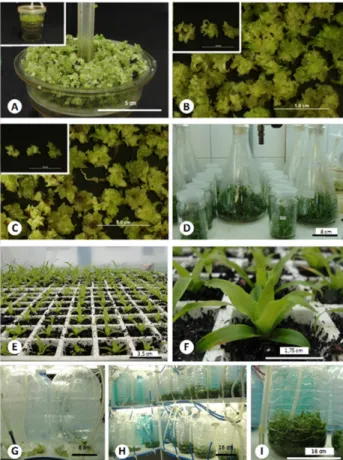
The experiments were carried out at the Plant Develop-mental Physiology and Genetics Laboratory of the Federal University of Santa Catarina, Brazil. Microshoots cultured in RITA® temporary immersion system, as described by Scherer et al. (2013), were used as starting cultures (Figure 1A). Basal culture medium was based on the MS saline formulation (Murashige and Skoog 1962) supplemented with 30 g L-1 sucrose and Morel vitamins (Morel and Wetmore 1951) (hereinafter termed MSB). The pH of the culture medium was adjusted to 5.5 before autoclaving at 1.1 atm and 121 °C for 20 min. The experiment had a completely randomized block design, with three factors: 1) immersion system (2 L twin flasks temporary immer -sion (TIS-TF) and permanent immer-sion in glass flasks (69 mm x 121.7 mm/350 mL) (PIS)); 2) culture medium (MSB only and MSB supplemented with GA3 at 10 µM); and 3) shoot height class (2-3 cm, 3-4 cm, 4-5 cm, 5-6 cm, 6-7 cm, and higher than 7 cm). The experiment had four replicates. The ratio of 30 mL of culture medium for each 0.5 g fresh mass (FM) of microshoots was used in all experimental units. The experimental unit of treatments in TIS-TF consisted of twin flasks inoculated with 5 g FM of microshoots. For treatments in PIS, the experimental unit consisted of 5 glass flasks, each one inoculated with 0.5 g FM of microshoots. For inoculation, microshoots were
sectioned to form clusters with approximately 0.5 cm in diameter (Figure 1B and 1C, respectively). In the TIS-TF culture, the immersion cycle consisted of 3 min every 3 h. After 8 weeks, the regeneration rate (number of new shoots per 1 g FM of microshoots) and FM per shoot were evaluated, and data were analyzed by ANOVA. Normal distribution of residuals and homoscedasticity were checked by graphical exploratory analysis (QQ-Plots, scatter plots and plots of residuals by treatments). The regeneration rate showed the appropriateness of the linear model assumptions. The Box-Cox transformation (Box and Box-Cox 1964) was employed to normalize the distribution of residuals of data from FM per shoot, and in this case the estimated means were reported after back-transformation. When significant effects were found, treatment means were compared by the SNK test, considering 95% confidence.
Acclimatization phase
Figure 1.In vitro development of pineapple shoots and acclimatization. A - Microshoots developed in RITA® temporary immersion system; B
In the acclimatization phase, shoots were placed in trays of 128 cells containing a mixture (1:1) of carbonized rice hull and the commercial substrate Tropstrato® forestry. Shoots longer than 2 cm were used, derived from the four treatments: MSB medium in TIS-TF (n = 96 shoots); MSB + GA3 (10 µM) in TIS-TF (n = 160 shoots); MSB in PIS (n = 176 shoots), and MSB + GA3 (10 µM) in PIS (n = 64 shoots). Plantlet survival was assessed 60 days after transfer to the acclimatization greenhouse using the χ2 test for a 4x2 contingency table.
RESULTS AND DISCUSSION
In vitro phase: shoot regeneration
For the regeneration rate, all double interactions were significant (p<0.05) (immersion system vs. culture medium; immersion system vs. shoot height class; culture medium vs. shoot height class), and no triple interaction was observed (p>0.05). The regeneration rate obtained on the two im-mersion systems was dependent on the shoot height class (Figure 2). In the smaller shoot height classes (2-3 cm and 3-4 cm), the highest number of shoots was found in PIS. In the intermediate class (4-5 cm), the two immersion systems produced no significant difference in regeneration rate. However, in the classes with longest shoots (5-6 cm, 6-7 cm, and higher than 7 cm), a higher regeneration was observed in TIS-TF. Similar results indicating the superior-ity of TIS for the production of shoots and plantlets with larger size were observed in peach palm (Steinmacher et al. 2011), eucalyptus (McAlister et al. 2005, Oliveira et al.
2011), strawberry (Hanhineva et al. 2005), Spanish red cedar (Peña-Ramíres et al. 2010), lemon grass (Quiala et al. 2006), sugarcane (Lorenzo et al. 1998) and rubber tree (Etienne et al. 1997). It was also observed that TIS-TF resulted in greater stability in the regeneration rate between different classes of shoot height. In TIS-TF, no significant differences were noted between five of the classes of shoot height, as all of them maintained a high level of shoot production. In PIS, a marked concentration of shoots with smaller size and a significantly lower production of larger shoots were observed. These results are similar to those reported in peach palm (Steinmacher et al. 2011) and Spanish red cedar (Peña-Ramíres et al. 2010).
It has been suggested that TIS-TF provides enhanced and homogeneous responses in in vitro regeneration as a consequence of 1) shorter time of contact between culture medium and the cultures and more uniform distribution of nutrients and 2) air renovation. Such features enhance culture development by decreased hypoxia, less accumulation of harmful compounds, as observed by Steimacher et al. (2011) and Scherer et al. (2013), and better cell nutrition. It has also been suggested that TIS-TF provides an environment which allows higher shoot density and, consequently, higher vertical growth of shoots.
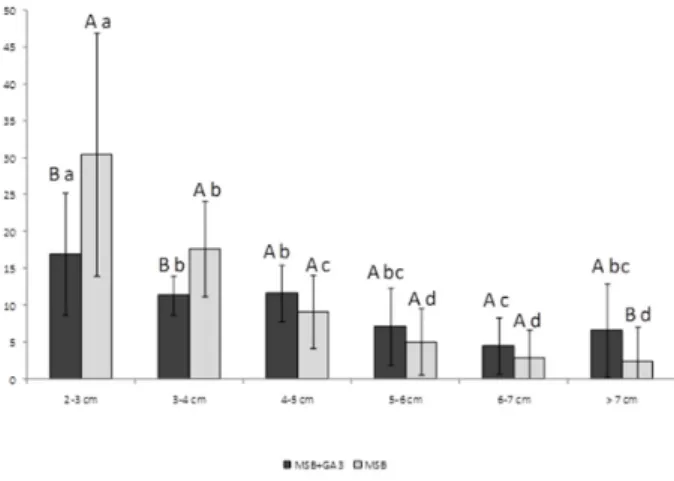
The regeneration rate was also affected by the combi-nation of the culture medium composition and the shoot height class (Figure 3). MSB medium free of GA3 resulted in a higher regeneration rate of small shoots (2-3 cm and 3-4 cm) while no differences in the regeneration rate were
Figure 2. Effect of permanent and temporary immersion systems on the regeneration rate (mean ± standard deviation) of pineapple shoots in differ-ent classes of shoot height. Means followed by differdiffer-ent letters, uppercase between immersion systems and lowercase inside each immersion system,
are different according to SNK test at 95% confidence. PIS: Permanent
immersion system; TIS: Temporary immersion system.
Figure 3. Effect of culture medium (MSB only or MSB supplemented with GA3 (10 µM)) on the regeneration rate (mean ± standard deviation) of pineapple shoots in different classes of shoot height. Means followed by different letters, uppercase between culture media and lowercase inside each culture medium, are different according to SNK test at 95%
found between culture media in classes of shoot height ranging from 4-5 cm, 5-6 cm and 6-7 cm. However, in class of shoots higher than 7 cm MSB supplemented with GA3 (10 µM) showed the highest regeneration rate. The supplementation of GA3 to MSB also provided more sta-bility in the number of shoots among the classes of shoot height, resulting in more synchronous shoot development. In cultures of bromeliad species based on NC, both shoot regeneration and synchronism in shoot development were positively affected by the presence of GA3 in the culture medium (Dal Vesco and Guerra 2010, Dal Vesco et al. 2011, Scherer et al. 2013), and the same was reported in other cultures (Dronne et al. 1999, Peña-Ramírez et al. 2010).
The interaction between immersion system and culture medium (Table 1) showed that the addition of GA3 to MSB was detrimental to the regeneration rate in PIS, while in TIS-TF no difference related to GA3 supplementation was observed. Interestingly, in PIS, the standard deviation of the regeneration rate was much higher than in TIS-TF, attesting to the more homogeneous regenerative performance in TIS. Finally, in MSB supplemented with GA3, the use of TIS-TF resulted in the highest regeneration rate, while in MSB free of GA3 the use of PIS showed the highest regeneration rate. It should be emphasized, however, that TIS-TF showed an overall higher synchrony of shoot production.
In vitro phase: fresh mass per shoot
In evaluating FM per shoot, simple effects were detected for the three factors (p < 0.05), but no significant interac -tions were detected among them. Shoots developed in PIS had higher FM than shoots in TIS-TF (0.175 and 0.112 g, respectively). Moreover, shoots produced in MSB free of GA3 were heavier than those obtained in MSB supplemented with GA3 (0.178 and 0.111 g, respectively), and a steady increase in the FM per shoot resulted from the increase in height of shoots (Table 2).
Escalona et al. (1999) reported a positive correlation between acclimatization survival and shoot size in pine-apple. Increased fresh mass per shoot reduces losses in the acclimatization phase, which is considered the most critical
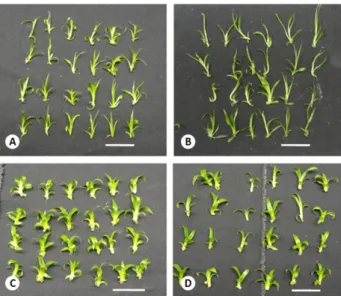
phase of the micropropagation process (Steinmacher et al. 2007). In the present work, MSB free of GA3 produced heavier shoots, while the shoots produced in MSB supple-mented with GA3 were higher, but showed thinner stems, longer internodes and more elongated and thin leaves (Figure 4). It was also observed that shoots developed in PIS were more compact than those developed in TIS-TF, but this morphological difference was less marked than that observed in response to GA3.
Acclimatization phase
In the acclimatization phase, shoot survival showed no significant difference in response to the tested treatments (p>0.05), and all treatments resulted in a survival rate higher than 95%. Similar survival rates for pineapple acclimatization were previously reported by Guerra et al. (1999), Sripaoraya et al. (2003), Amin et al. (2005), and Scherer et al. (2013).
Figure 4. Pineapple shoots (3 to 4 cm) micropropagated in temporary
immersion system based on twin-flasks (TIS-TF) and in permanent immer -sion system (PIS) containing MSB culture medium supplemented, or not, with GA3 at 10 µM. Bar = 4 cm.A - Shoots developed in PIS containing MSB and GA3. B - Shoots developed in TIS-TF containing MSB and GA3. C – Shoots developed in PIS containing MSB without GA3. D – Shoots developed in TIS-TF containing MSB without GA3.
Table 1. Effect of culture medium (MSB only or MSB supplemented with GA3 (10 µM)) on the regeneration rate (mean ± standard deviation) of pineapple shoots in different immersion systems (temporary or permanent)
Culture medium Culture system
PIS TIS
MSB + GA3 (10 µM) 8.5 ± 8.6 B b 11.0 ± 3.2 A a
MSB 13.1 ± 16.9 A a 9.5 ± 6.1 A b
Means followed by different letters, uppercase in column and lowercase in line, are different according to SNK test at 95% confidence. PIS: Permanent immersion system; TIS: Temporary immersion system.
Table 2. Effect of the shoot height class (cm) on fresh mass per pineap-ple shoot
Class of shoot height (cm) Fresh mass per shoot(g shoot-1)
> 7 0.3385 A
6 - 7 0.2209 B
5 - 6 0.1940 B
4 - 5 0.1365 C
3 - 4 0.0877 D
2 - 3 0.0548 E
Shoots developed in MSB free of GA3 showed enhanced vigor after acclimatization (data not shown), indicating consistency between plantlet vigor during acclimatization and FM per shoot during in vitro shoot growth.
Following the study, the newly established protocol was tested successfully in a biofactory system for mass produc-tion of plantlets, using adapted sterile plastic bottles (5 L) to make the twin-flasks of TIS-TF (Figure 1G, H and I). Nowadays, Brazilian biofactories are widely employing this cost-effective TIS-TF system, mainly to produce sugarcane plantlets. Our observations indicate that such system could also be efficiently applied to pineapple mass propagation. Besides mass production of plantlets in biofactories, the high production of plantlets can also assist the genetic improvement of pineapple. For example, the maintenance of germplasm banks or progenies in this micropropagation system may allow for fast and large scale regeneration of target genotypes. Furthermore, the large scale production of micropropagated plantlets, coupled with the induction or selection of mutation can be employed for the generation
of new genotypes of interest.
CONCLUSIONS
In summary, the results of the present study show that the combination of temporary immersion system based on twin flasks and MSB culture medium free of GA3 resulted in high regenerative efficiency, synchronic and homogenous development of shoots, as well as an enhanced shoot vigor and performance in the acclimatization phase. Additionally TIS-TF provided less handling and labor, and the MSB free of GA3 provided lower cost of culture medium. Taken together, those features contribute for i) a reduction in the production costs of pineapple plantlets, and ii) expressive improvements in the pineapple micropropagation protocols so far published.
ACKNOWLEDGEMENTS
The authors thank CAPES, CNPq and FAPESC for fel-lowship, research grants, and financial support for this study.
Efeitos do sistema de imersão e do ácido giberélico no crescimento de
microbrotos e na aclimatização de abacaxizeiro
Resumo – Protocolos de micropropagação de plantas possibilitam a produção de mudas isentas de pragas e doenças. No presente trabalho, objetivando a otimização da micropropagação do abacaxizeiro [Ananas comosus (L.) Merril], foram avaliados três fatores: 1) sistema de imersão (temporária por frascos duplos em erlenmeyers de 2 L ou permanente); 2) meio de cultura (suplementado, ou não, com Ácido Giberélico); 3) classe de altura de brotos. Os efeitos na taxa de regeneração (número de novos brotos para cada 1 g de massa fresca (MF) de microbrotos inoculada), na MF por broto, e na sobrevivência dos brotos foram avaliados. Interações sig-nificativas (p<0,05) foram observadas na taxa de regeneração, e efeitos simples (p<0,05) foram detectados na MF por broto. Todos os tratamentos resultaram em sobrevivência de mudas superior a 95% na aclimatização. Concluiu-se que a combinação do sistema de imersão temporária em frascos duplos e o meio de cultura isento de AG3 resultou na otimização do protocolo regenerativo. Esta combinação também demonstrou resposta positiva em um sistema de imersão temporária usual em biofábricas, que utiliza frascos duplos em garrafas PET de 5L.
Palavras-chave:Micropropagação, taxa de regeneração, biofábricas.
REFERENCES
Amin MN, Rahman MM, Rahman KW, Ahmed R, Hossain MS and Ahmed MB (2005) Large scale plant regeneration in vitro from leaf derived callus cultures of pineapple [Ananas comosus (L.) Merr. cv. Giant Kew]. International Journal of Botany 1: 128-132.
Be LV and Debergh PC (2006) Potential low cost micro-propagation of pineapple (Ananas comosus). South African Journal of Botany 72: 191-194.
Box GEP and Cox DR (1964) An analysis of transformations. Journal of
the Royal Statistical Society: Series B39: 211-252.
Clement CR, Cristo-Araújo M, D’Eeckenbrugge GC, Pereira AA and Picanço-Rodrigues D (2010) Origin and domestication of native amazonian crops. Diversity 2: 72-106.
Dal Vesco LL, Pinto AA, Zaffari GR, Nodari RO, Reis MS and Guerra MP
(2001) Improving pineapple micropropagation protocol trough explant size and medium composition manipulation. Fruits 56: 143-154.
Dal Vesco LL and Guerra MP (2010) In vitro morphogenesis and adventitious shoot mass regeneration of Vriesea reitzii from nodule cultures. Scientia Horticulturae 125: 748-755.
Dal Vesco LL, Stefenon VM, Welter LJ, Scherer RF and Guerra MP (2011) Induction and scale-up of Bilbergia zebrina nodule cluster cultures: implications for mass propagation, improvement and conservation.
Scientia Horticulturae 128: 515-522.
Dronne S, Jullien F, Caissard J-C and Faure O (1999) A simple and efficient method for in vitro shoot regeneration from leaves of lavandin (Lavandula x intermedia Emeric ex Loiseleur). Plant Cell
Reports 18: 429-433.
Desjardins Y and Borroto CG (1999) Pineapple (Ananas comosus
(L.) Merr.) micropropagation in temporary immersion systems. Plant
Cell Reports 18: 743-748.
Etienne H, Lartaud M, Michaux-Ferriere N, Carron MP, Berthouly M and Teisson C (1997) Improvement of somatic embryogenesis in Hevea brasiliensis (Mull. Arg.) using the temporary immersion technique.
In Vitro Cellular & Developmental Biology - Plant 33: 81-87.
Etienne H and Berthouly M (2002) Temporary immersion systems in plant micropropagation. Plant Cell, Tissue and Organ Culture 69: 215-231.
FAOSTAT, FAO statistical databases, pineapple data (2011) Food and Agriculture Organization of the United Nations, Rome, Italy.
Available at <http:// http://faostat.fao.org/site/567/DesktopDefault.
aspx?PageID=567#ancor>. Accessed on Dec 29, 2012.
Feuser S, Meler K, Daquinta M and Guerra MP (2003) Genotypic fidelity
of micropropagated pineapple (Ananas comosus) plantlets assessed by isoenzyme and RAPD markers. Plant Cell, Tissue and Organ
Culture72: 221-227.
Girek Z, Prodanovic S, Zdravkovic J, Zivanovic T, Ugrinovic M and Zdravkovic M (2013) The effect of growth regulators on sex expression in Melon (Cucumis melo L.). Crop Breeding and Applied
Biotechnology 13: 165-171.
Guerra MP and Dal Vesco LL (2010) Strategies for the micropropagation of bromeliads. In Jain SM and Ochatt SJ (Eds) Protocols for in vitro
propagation of ornamental plants: methods in molecular biology.
Humana Press-Springer, New York, p. 47-66.
Guerra MP, Dal Vesco LL, Pescador R, Schuelter AR and Nodari RO (1999) Estabelecimento de um protocolo regenerativo para a micropropagação do abacaxizeiro. Pesquisa Agropecuária
Brasileira 34: 1557-1563.
Hanhineva K, Kokko H and Kärenlampi S (2005) Shoot regeneration
from leaf explants of five strawberry (Fragaria × ananassa) cultivars
in temporary immersion bioreactor system. In Vitro Cellular &
Developmental Biology - Plant41: 826-831
Hedden P and Thomas GS (2012) Gibberellin biosynthesis and its regulation. Biochemical Journal 444: 11-25.
Lorenzo JC, Gonzalez BL, Escalona M, Teisson C, Espinosa P and Borroto C (1998) Sugarcane shoot formation in an improved temporary immersion system. Plant Cell, Tissue and Organ Culture54: 197-200.
McAlister B, Finnie J, Watt MP and Blakeway F (2005) Use of the temporary immersion bioreactor system (RITA) for production of commercial Eucalyptus clones in Mondi Forest (SA). Plant Cell,
Tissue and Organ Culture81: 347-358.
Morel GM and Wetmore RH (1951) Tissue culture of monocotyledons.
American Journal of Botany 38: 138-140.
Murashige T and Skoog F (1962) A revised medium for rapid growth and biossays with tobacco tissue cultures. Physiologia Plantarum 15: 473-497.
Niemenak N, Saare-Surminski K, Rohsius C, Ndoumou DO and Lieberei R (2008) Regeneration of somatic embryos in Theobroma cacao L. in temporary immersion bioreactors and analyses of free amino acids in different tissue. Plant Cell Reports 27: 667-676.
Oliveira ML, Xavier A, Penchel RM, Santos AF (2011) Multiplicação in vitro de Eucalyptus grandis x E. urophylla cultivado em meio semissólido e em biorreator de imersão temporária. Scientia
Forestalis 39: 309-315.
Peña-Ramíres YJ, Juárez-Gómez J, Gómez-López L, Jerónimo-Pérez JL, García-Sheseña I, González-Rodríguez A and Robert ML (2010) Multiple adventitious shoot formation in spanish red cedar (Cedrella
odorata L.) cultured in vitro using juvenile and mature tissues: an improved micropropagation protocol for a highly valuable tropical species. In Vitro Cellular & Developmental Biology - Plant46: 149-160.
Quiala E, Barbón R, Jiménez E, de Feria M, Chávez M, Capote A and Pérez N (2006) Biomass production of Cymbopogon citratus (D.C.) Stapf., a medicinal plant, in temporary immersion systems. In Vitro
Cellular & Developmental Biology - Plant42: 298-300.
Rastogi A, Siddiqui A, Mishra BK, Srivastava M, Pandey R, Misra P, Singh M and Shukla S (2013) Effect of auxin and gibberellic acid on growth and yield components of linseed (Linum usitatissimum L.).
Crop Breeding and Applied Biotechnology 13: 136-143.
Rech Filho A, Dal Vesco LL, Nodari RO, Lischka RW, Müller CV and Guerra MP (2005) Tissue culture for the conservation and mass propagation of Vriesea reitzii Leme and Costa, a bromeliad threatened of extinction from the Brazilian Atlantic Forest. Biodiversity and
Conservation 14: 1799-1808.
Reinhardt A and Rodriguez LV (2009) Industrial processing of pineapple – trends and perspectives. Acta Hort (ISHS)822: 323-328.
Scherer RF, Garcia AC, Fraga HPF, Dal Vesco LL, Steinmacher DA and Guerra MP (2013) Nodule cluster cultures and temporary immersion bioreactors as a high performance micropropagation strategy in pineapple (Ananas comosus var. comosus). Scientia Horticulturae 151: 38-45.
Sripaoraya S, Marchant R, Power JB and Davey MR (2003) Plant regeneration by somatic embryogenesis and organogenesis in commercial pineapple (Ananas comosus L.). In Vitro Cellular &
Developmental Biology - Plant39: 450-454.
Steinmacher DA, Cangahuala-Inocente GC, Clement CR and Guerra MP (2007) Somatic embryogenesis from peach palm zygotic embryos.
In Vitro Cellular & Developmental Biology - Plant43: 124-132.
Steinmacher DA, Guerra MP, Saare-Surminski K and Lieberei R (2011) Temporary immersion system improves in vitro regeneration of peach palm through secondary somatic embryogenesis. Annals of Botany 108: 1463-1475.