Engineering ISSN: 1809-4430 (on-line)
_________________________
PRODUCTIVITY AND NUTRITIVE VALUE OF TIFTON 85 IN SUMMER, WITH AND WITHOUT IRRIGATION UNDER DIFFERENT NITROGEN DOSES
Doi:http://dx.doi.org/10.1590/1809-4430-Eng.Agric.v37n2p246-256/2017
ARTHUR C. SANCHES1*, EDER P. GOMES2, MAX E. RICKLI3, ELCIO FRISKE4,
JULIA P. FASOLIN5
1*Corresponding author. ESALQ-USP/ Piracicaba - SP, Brasil. E-mail: [email protected]
ABSTRACT: The pasture irrigation has expanded, mostly in small areas in order to boost the
production system, along with the use of soil improvement techniques and high-productivity grasses. Thus, this study, carried out on a small dairy farm property, aimed to evaluate the productivity, botanical composition and nutritive value of Tifton 85 with different nitrogen (N) doses, in the presence and absence of irrigation. The experimental design was a randomized block in a split-plot design with four replications, plots Non-irrigated and Irrigated. The subplots
consisted of nitrogen doses: 25 kg ha-1 cycle-1 of N, 50 kg ha-1 cycle-1 of N, 75 kg ha-1 cycle-1 of N
and 100 kg ha-1 cycle-1 of N. The irrigation increased the productivity in an average of 3,626.5 kg
ha-1 cycle-1, with higher leaf stem ratio of 1.3, increasing the crude protein content of the pasture.
The productivity responded quadratically to nitrogen fertilization with increases up to 84 kg N ha-1
cycle-1 with slight linear decrease of dead matter. There were linear increments of crude protein and
digestibility “in vitro” of dry matter in function of applied nitrogen.
KEYWORDS: neutral detergent fiber, acid detergent fiber, tensiometry, Cynodon ssp.
INTRODUCTION
Because it is a tropical country, the productive potential of pastures in Brazil is high, being also the least expensive and most efficient way of providing food in livestock production (DE ALENCAR et al., 2009; DIAS-FILHO, 2011;). Thus, understanding the aspects of water availability, soil fertility conditions, temperature and luminosity is fundamental for the application of rational and efficient management strategies (OLIVEIRA et al., 2011; SKONIESKI et al., 2011). Among other factors, nitrogen fertilization promotes increase in productivity and improve forage quality (FAGUNDES et al., 2012; PEREIRA et al., 2012, PREMAZZI et al., 2011) and when this practice is associated Irrigated can reduce the seasonality of production and the benefits are intensified (QUEIROZ et al., 2012). However, the productive capacity of pastures is also conditioned by climatic factors, mainly temperature and photoperiod (ALENCAR et al., 2009; NEWMAN et al., 2007).
The site influences pasture productivity through its geographic position, since the climate is influenced by variables such as latitude and longitude (NEWMAN et al., 2007), in their study, in three locations in South Florida, Virgin Islands and Puerto Rico were verified that the highest dry matter yields were obtained in Puerto Rico.
The Cynodon genus stands out in dairy cattle production, since it has a high forage production
potential, being able to surpass 25,000 kg-1 ha-1 year-1 of dry matter (GOMES et al., 2015), with
good nutritional value, with crude protein content values exceeding 11% of the dry matter (DE MATOS et al., 2013; MARCHESAN et al., 2013; SANCHES et al., 2015).
In relation to the dry matter yield of Tifton 85, researches indicate values up to 55 kg ha-1 d-1
(DE MATOS et al., 2013, GOMES et al., 2015), as well as values between 55 and 83 kg ha-1d-1
2007).With the use of irrigation, usually the productivities exceed 96 kg ha-1d-1 (GOMES et al.,
2015; NOGUEIRA et al., 2013; TEIXEIRA et al., 2013; QUEIROZ et al., 2012; BOW & MUIR,
2010; FONSECA et al., 2007), and it can reach more than 165 kg ha-1d-1 (AGUIAR et al., 2006).
With Tifton 85, RIBEIRO & PEREIRA (2011) obtained increases in productivity, from
10,525 kg ha-1year-1 of dry matter (DM) without nitrogen fertilization to 25,239 kg ha-1year-1 at the
N dose of 400 kg ha-1year-1 in Viçosa-MG, Brazil. Experiments conducted in Cáceres-MT and São
Carlos-SP showed linear growth in Tifton 85 and CoastCross productivity using nitrogen (N)
fertilization, with a higher DM yield of 108.3 and 108.4 kg ha-1 d-1 kg-1 with 240 and 1,000 kg ha-1
year-1of N, respectively (QUARESMA et al., 2011; OLIVEIRA et al., 2011) have achieved results
with linear increases in CoastCross production with cuts every 28 days from November to April, in
which they obtained DM of 92.7 kg ha-1 d-1.
In Minas Gerais, PEREIRA et al. (2012) researching nitrogen doses of: 0, 33, 66, 100 and 133
kg ha-1cut-1 during November to February, favorable for nitrogen fertilization, were able to reduce
Tifton 85 cut by 18 days. In addition, FAGUNDES et al. (2012), conducting an experiment in São
Paulo with N doses of 0, 100, 200, 300 and 400 kg ha-1 year-1 applied between January and March
2008, found results ranging from 45 kg ha-1 d-1 to 74 kg ha-1 d-1 of dry matter in Tifton 85 from the
lowest to the highest dose, respectively.
Evaluating the protein content of Cynodon dactylon cv. Coastcross, in Paranavaí-PR, Brazil,
for a higher dose (200 kg ha-1 year-1 of N) obtained values of crude protein of the superior leaf to
20%, whereas without application of N were between 14 and 16% (BARBERO et al., 2010). OLIVEIRA et al. (2011) studying Coastcross observed linear responses of crude protein and in vitro
dry matter digestibility with contents of 25.9% and 73.5% for the highest nitrogen dose (133 kg ha
-1cut-1), respectively.
Thus, the aim of this study was to evaluate the productivity, botanical composition and bromatological composition of the Tifton 85 grass during the months of November to May, with different nitrogen doses in the absence and presence of irrigation.
MATERIAL AND METHODS
The experiment was carried out in a family-owned dairy farm in the Mariluz-PR region from
November 2012 to May 2013. The property is located at the geographical coordinates, 24°04’19” south latitude, 53°28’36” west longitude and 453 m of altitude. The climate of the region according to the Köppen classification is of the subtropical Cfa type (MANOSSO et al., 2013); with hot summers, infrequent frosts and concentration of rains in the summer months.
4 8 12 16 20 24 28 32 36 40 44 0 10 20 30 40 50 60 70 80 90 100
0 11 22 33 44 55 66 77 88 99 110 121 132 143 154 165 176 187
A ve ra ge T emper ature a nd Mini mum T emper ature P re cipi tac ion (mm) a nd R elative H umi dit y (% )
Days after the beginning of the experimental period (DABEP)
Precipitation (mm) Relative Umidity (%) Average temperature (ºC) Minimum Temperature (ºC)
1st
0 a 25 d
2nd
26 a 43 d
3rd
44 a 70 d
4th
71 a 96 d
5th
97 a 123 d
6th
124 a 157 d
7th
158 a 197 d
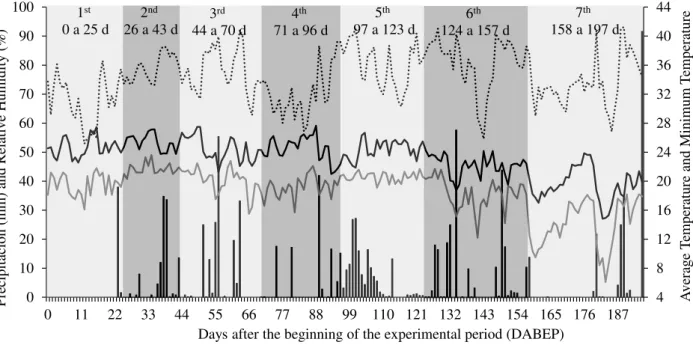
FIGURE 1. Precipitation (mm), average temperature (° C), minimum temperature (° C) and relative
humidity values on November 7th, 2012 to May 20th, 2013. Mariluz / PR.
The soil of the region is classified as Red-Dark Latosol with a sandy-loamy texture (EMBRAPA, 2006), and the soil chemical and particle size analysis is presented in Table 1.
TABLE 1.Chemical and particle size analysis of the soil of the field in the layer 0 - 0.20 m. Mariluz /
PR 2012.
pH P K Ca Mg H+Al Al CEC Sand Silte Clay
CaCl2 mg dm-3 cmolc dm-3 cmolc dm-3 (%) (%) (%)
5.6 4.65 0.58 3.2 1.0 2.7 0.0 7.5 56.8 12.5 30.7
Eight pickets of 12 m of wide and 23 m of length with an area of 276 m² each composed the experimental area, consisting of four irrigated and four non-irrigated pickets, with a total area of
2,208 m2. The area surrounding the experiment was composed of Tifton 85 pasture with smooth
undulating slope of 6%. Each picket was divided into strips of three meters for the different
fertilizations with nitrogen doses, with 69 m2 each, totalizing four strips with 3 m of width and 23 m
of length.
The experimental design was randomized blocks with sub subdivided plots. The plots were divided into irrigated (I) and non-irrigated (NI) and the subplots as nitrogen doses in coverage. The
doses used were: 25 kg N ha-1 cycle-1, 50 kg N ha-1 cycle-1, 75 kg N ha-1 cycle-1 and 100 kg N ha-1
cycle-1. Seven collection cycles were carried out, composing 197 days of experiment.
Nitrogen doses, in the form of urea, were always carried out at each collection cycle, with 35
kg ha-1 of K
2O, in the form of potassium chloride (KCl). The fertilization of base was done with
simple superphosphate with application of 180 kg ha-1 of P
2O5 and PRNT dolomitic limestone 80%
applying 1.000 kg ha-1 year-1.
The irrigation was composed of low flow sprinklers installed in the spacing of 12 m by 12 m
with application intensity (AI) of 2.4 mm h-1 at 40 mwc of pressure, with a total irrigation level (L)
TABLE 2. Precipitation, levels and irrigation numbers during the experiment *. Mariluz / PR, 2012-2013.
Interval (days) Grazing Cycles L (mm) IN P (mm)
01 – 25 1st Cycle (0 to 25 days) 47.8 9 39.6
26 – 43 2nd Cycle (26 to 43 days) 7.7 3 111.6
44 – 70 3rd Cycle (44 to 70 days) 14.2 2 180.4
71 – 96 4th Cycle (71 to 96 days) 53.7 8 117.2
97 – 123 5th Cycle (97 to 123 days) 0.0 0 167.0
124 – 157 6th Cycle (124 to 157 days) 7.3 2 240.4
158 – 197 7th Cycle (158 to 197 days) 22.0 6 197.2
Total 152.7 30 1053.4
* L—Irrigation level, IN – Irrigation Number, P – Precipitation.
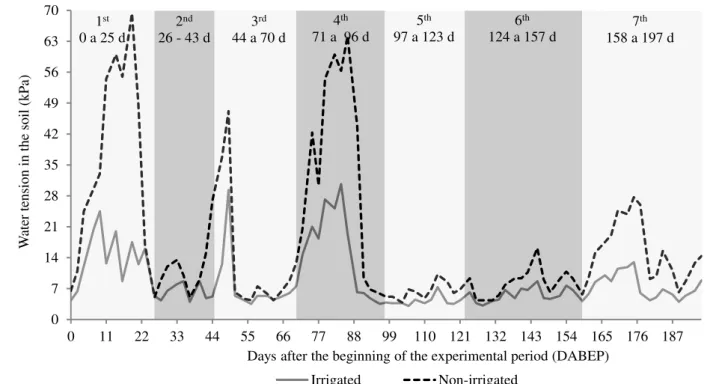
Irrigation management was performed using the tensiometry method, monitoring the soil water potential by means of tensiometers installed at 0.20 meters depth. Twelve tensiometers were installed, six in the irrigated area and six in the non-irrigated area. Tension readings were carried out three times a week, with subsequent irrigation whenever the value of 10 kPa exceeded in the irrigated area. According to FONSECA et al. (2007), the appropriate time to start irrigation is when there is 50% of humidity in the field capacity corresponding to higher values of tension, however, due to the low capacity of the reservoir, more frequent irrigations were adopted in order to maintain the soil with humidity close to the field capacity (6 kPa), according to ANDRADE & STONE (2011). The average values of tension along the cycles in the irrigated and non-irrigated area were 14.1 and 37.2 kPa; 6.3 and 9.8 kPa; 7.8 and 14.3 kPa; 16.1 and 35.8 kPa; 4.2 and 6.4 kPa; 5.4 and 8.4; 7.4 and 15.1 in the respective cycles, according to Figure 2.
0 7 14 21 28 35 42 49 56 63 70
0 11 22 33 44 55 66 77 88 99 110 121 132 143 154 165 176 187
W
ate
r te
nsion in the
soil (k
Pa)
Days after the beginning of the experimental period (DABEP)
Irrigated Non-irrigated
1st
0 a 25 d
2nd
26 - 43 d
3rd
44 a 70 d
4th
71 a 96 d
5th
97 a 123 d
6th
124 a 157 d 7
th 158 a 197 d
FIGURE 2. Water tension in the soil values for the Tifton 85 overseeding with oats, with and Non-irrigated. Mariluz / PR, 2012-2013.
Federal University of Grande Dourados (UFGD), Brazil, by the Richard’s extractor and adjusted by the GENUCHTEN equation (1980):
where,
c = Current volumetric humidity (cm3 cm-3)
Ψ = Current tension of water in the soil (kPa).
The collection cycles were always carried out from a plant height of 0.35 m, and a collection
frame of 0.25 m2 per subplot was launched at random. After forage harvesting, the downgrade of
the graze was done with dairy cattle. The forage inside the frame was cut at the grazing height, equal to 10 cm. The procedure was repeated in each cycle. After each collection, nitrogen
fertilization in the form of urea and 35 kg ha-1 of K
2O in the form of potassium chloride (KCl) were
carried out.
In the laboratory, samples of Tifton 85 grass were divided into leaf, stem and dead material.
The samples were then sent to the forced air oven at 65 o C for 72 hours to determine the dry matter
(DM). From the botanical separation, the following was determined: leaf mass, stem and dead material, leaf/stem ratio and total dry matter yield (DMY). The following bromatological parameters were evaluated: crude protein content (CP), neutral detergent fiber (NDF), acid detergent fiber (ADF) and dry matter in vitro digestibility (DMivD), according to the compendium of SILVA & QUEIROZ (2002).
For the bromatological evaluations (nutritional value) only the values corresponding to 4 grazing cycles were adopted, due to the lack of production in the non-irrigated area in the 1st cycle at 25 days, 2nd cycle at 43 days and 7th cycle at 197 days. The cycles adopted for evaluation were: 3rd cycle at 70 days, 4th cycle at 96 days, 5th cycle at 123 days and 6th cycle at 157 days.
The experimental data were submitted to analysis of variance at 5% of probability and when significant differences were verified the Tukey test was used for irrigation and regression analysis for the nitrogen doses. The program used was the Assistat 7.6 beta (SILVA, 2013).
RESULTS AND DISCUSSION
The total dry matter yield (DMY) increased Irrigated, with averages of 3,626.5 and 2,074.1 kg
ha-1, irrigated and non-irrigated, respectively (Table 3). The absence of precipitation in the first 23
days of the experiment (Figure 1) and with 60% of the precipitate in the last week of the second cycle contributed to the absence of productivity in the non-irrigated plots in this period (1st and 2nd cycle), causing average water tensions in soil of 14.1 and 6.3 kPa and non-irrigated of 37.2 and 9.8 kPa (Figure 2).
TABLE 3. Average dry matter yield (kg ha-1) of Tifton 85, with and Non-irrigated, in the grazing
cycle. Mariluz / PR, 2012-2013.
Grazing Cycles
1st 0 to 25
days
2nd 26 to 43
days
3rd 44 to 70
days
4th 71 to 96
days
5th 97 to 123
days
6th 124 to 157
days
7th 158 to 197
days GA
I 4,603.8 aA 3,877.8 aB 4,628 aA 3,317.8 bBC 3,237.3 aBC 2,733.3 aC 2,987.5 aC 3,626.5 a
NI 0.0 bD 0.0 bD 3,662.3 bB 4,449.5 aA 3,604.8 aB 2,802.0 aC 0.0 bD 2,074.1 b
GA 2,301.9 CD 1,938.9 DE 4,145.1 A 3,883.6 AB 3,421.1 B 2,767.6 C 1,493.8 E 2,850.3
I – irrigated, NI – Non-irrigated, GA – General Average. Averages followed by the same letters, uppercase in the row and lowercase in the column, do not differ by the Tukey test (p <0.05).
Transforming the DMY into daily forage accumulation rates, we obtained: 128.9 and 73.7 kg
DM ha-1day-1 with and Non-irrigated, respectively. In a study with Tifton 85 conducted in
Uberaba-MG, AGUIAR et al. (2010) obtained similar responses, with forage accumulation rates of 77 and 55
kg DM ha-1, irrigated and non-irrigated, respectively.
The data obtained with and Non-irrigated are cohesive and corroborate with the greater
accumulation of Tifton 85 Irrigated, which can exceed 96 kg ha -1 day -1 (GOMES et al., 2015;
NOGUEIRA et al., 2013; TEIXEIRA et al., 2013; QUEIROZ et al., 2012; OLIVEIRA et al., 2011; FONSECA et al., 2007). The non-irrigated productivity is compatible with the averages found from
55 to 83 kg ha-1day-1 (FAGUNDES et al., 2012; RIBEIRO & PEREIRA, 2011; AGUIAR et al.,
2010).
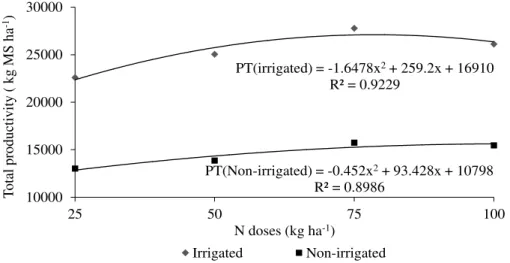
The DMY grows quadratically in relation to the nitrogen fertilization with the highest average
productivity of 21,261.5 kg DM ha-1 in the experimental period in the dosage of 84 kg ha -1 cycle-1
of nitrogen (Figure 3). Studies with Tifton 85 in a greenhouse with nitrogenous dosages of 0, 80,
160 and 240 mg kg-1 of soil, PREMAZZI et al. (2011) also obtained quadratic responses for the
increase of grass leaves reaching the peak between 162 and 187 mg kg-1 of soil. RIBEIRO &
PEREIRA (2011) obtained a linear increase in productivity in Tifton 85 up to a dose of 400 kg N
ha-1 year -1, with a response efficiency of 36.8 kg DM in each kg of nitrogen applied.
PT(irrigated) = -1.6478x2+ 259.2x + 16910
R² = 0.9229
PT(Non-irrigated) = -0.452x2+ 93.428x + 10798
R² = 0.8986 10000
15000 20000 25000 30000
25 50 75 100
To
tal
p
ro
du
ct
iv
ity
( kg
MS
ha
-1)
N doses (kg ha-1)
Irrigated Non-irrigated
FIGURE 3. Total productivity (PT) of Tifton 85 grass in the experimental period in function of irrigation and nitrogen doses. Mariluz / PR, 2012-2013.
The highest yields for the four applied doses were reached in both irrigated and non-irrigated
at doses of 75 kg ha-1cycle-1 of nitrogen of 27,782.1 and 15,745 kg DM ha-1. OLIVEIRA et al.
(2011) researching from November to April 2000 with irrigated Coastcross grass found the highest yield of 16,042.5 kg DM ha-1 at a dose of 100 kg ha-1 cycle-1. With adjustment by the equation
(Figure 3), the estimated maximum attainable was with the doses of 78.65 and 103.35 kg ha-1 cycle-1
of nitrogen for irrigated and non-irrigated, respectively.
In daily accumulation, the highest yields reached in the field were 141 and 79.9 kg ha-1 day-1
and QUARESMA et al. (2011) in Cáceres-MT working with doses of 0 to 60 and 0 to 400 kg N ha-1
in the summer, observed linear increases in productivity of Tifton 85 grass, where the accumulation
of dry mass was between 21.2 to 107. 6 kg ha-1 day-1 and 50 to 108.3 kg ha-1, respectively.
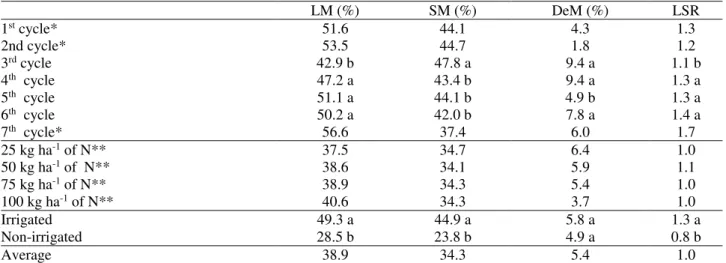
The average leaf stem relation (LSR) showed in Table 5 was 1.0, similar to those found in the literature (QUARESMA et al., 2011; OLIVEIRA et al., 2011). As well as QUARESMA et al. (2011) working with nitrogen doses in Tifton 85 at Cáceres-MT in the summer, the LSR did not present significant differences in function of nitrogen, with an average of 1.09. According to OLIVEIRA et al. (2011), nitrogen fertilization contributes to the elongation of the stem and, therefore, with the highest forage production occurring and there may be a decrease in the LSR.
TABLE 5. Botanical composition and leaf/stem relation of Tifton 85 grass Irrigated and Non-irrigated, over the cycles under nitrogen doses. Mariluz / PR, 2012-2013.
LM (%) SM (%) DeM (%) LSR
1st cycle* 51.6 44.1 4.3 1.3
2nd cycle* 53.5 44.7 1.8 1.2
3rd cycle 42.9 b 47.8 a 9.4 a 1.1 b
4th cycle 47.2 a 43.4 b 9.4 a 1.3 a
5th cycle 51.1 a 44.1 b 4.9 b 1.3 a
6th cycle 50.2 a 42.0 b 7.8 a 1.4 a
7th cycle* 56.6 37.4 6.0 1.7
25 kg ha-1 of N** 37.5 34.7 6.4 1.0
50 kg ha-1 of N** 38.6 34.1 5.9 1.1
75 kg ha-1 of N** 38.9 34.3 5.4 1.0
100 kg ha-1 of N** 40.6 34.3 3.7 1.0
Irrigated 49.3 a 44.9 a 5.8 a 1.3 a
Non-irrigated 28.5 b 23.8 b 4.9 a 0.8 b
Average 38.9 34.3 5.4 1.0
LM – leaf mass, SM – stem mass, DeM – dead matter and LSR – leaf/stem relation. The averages in the column followed by the same letter do not differ by the Tukey test (p <0.05). * The averages correspond only to irrigated plots. ** Quantitative data the average test does not apply, in this case, regression analysis.
The irrigated LSR was higher than the non-irrigated (Table 5), as well as for SANCHES et al. (2015) working with Tifton overseeding with oats found average values of 2.8 and 1.8 with and non-irrigated, respectively. The DeM depending on the doses showed a slight linear decrease (Y = 7.51 - 0.035 * N), as well as in a study conducted in Adamantina-SP, with Tifton 85, in which percentage of DeM decreases from 17 to 7% from the highest to the lowest dose of nitrogen (FAGUNDES et al., 2012). Thus, according to MARENCO & LOPES (2009), leaf senescence is a symptom of nitrogen deficiency for the plant.
TABLE 6. Nutritional value of irrigated and non-irrigated Tifton 85 grass, over the cycles under nitrogen doses. Mariluz / PR, 2012-2013.
Grazing Cycles Average
Bromatological Components
1st *
0 to 25
2nd *
26 to 43
3rd
44 to 70
4th
71 to 96
5th
97 to 123
6th
124 to 157
7th *
158 to 197
CP I NI 16.1 - 15.3 - 12.0 bA 13.8 aA 15.2 aA 13.2 bA 14.8 bA 16.8 aA 16.3 bA 18.7 aA 18.1 - 16.1 a 14.1 b
Average --- --- 10.7 C 10.6 C 11.6 B 13.0 A --- 11.5
NDF I NI 73.0 - 71.8 - 76.3 bAB 79.3 aA 75.3 bBC 80.1 aA 77.7 aA 79.1 aA 75.6 aB 73.8 aC 75.22 - 75.8 a 78.5 a
Average --- --- 77.8 A 77.7 A 78.4 74.7 B --- 77.2
ADF I NI 36.4 - 33.2 - 39.6 aA 40.3 aA 32.1 bC 40.6 aA 36.5 aB 35.7 aB 33.7 aB 32.9 aC 34.8 - 35.4 a 37.4 a
Average --- --- 39.9 A 36.3 B 36.1 B 33.3 C --- 36.4
DMivD
I 91.7 92.4 83.8 bA 83.4 aA 84.2 aA 84.6 aA 83.7 84.0 a
NI - - 87.7 aA 80.2 bB 81.5 bB 81.2 bB - 82.7 a
Average --- --- 85.8 A 81.8 B 82.9 B 82.9 B --- 83.3
I: Irrigated and NI: Non-irrigated. CP - crude protein, NDF - neutral detergent fiber, ADF - acid detergent fiber and DMivD - dry matter in vitro digestibility. Averages followed by the same letters, uppercase in the row and lowercase in the column, do not differ by the Tukey test (p <0.05). * The averages correspond only to irrigated plots.
In the fourth grazing cycle, NDF and ADF values were lower in irrigated treatments. Therefore, the irrigation collaborated to the formation of new growth cells; being these with lower cellular content, consequently lower levels of NDF and ADF (BARBERO et al., 2010). The NDF and ADF values are within the literature, from 70 to 85% and 30 to 45%, respectively (BOW & MUIR et al., 2010; NERES et al., 2012; SANCHES et al., 2015).
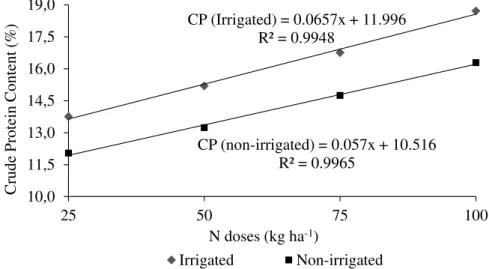
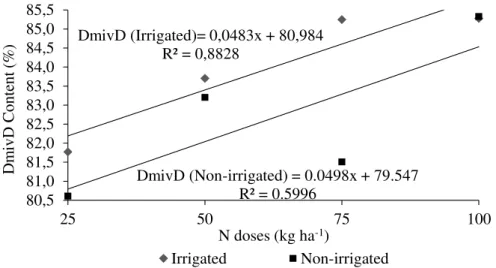
The NDF and ADF values did not respond to the applied nitrogen doses. The CP (%) and DMivD (%) responded linearly when increasing the nitrogen application, as observed in figures 4 and 5. Positive linear responses were also observed by OLIVEIRA et al. (2011) researching Coastcross grass of the same genre. With 28 days of regrowth, the CP and DMivD values were
25.9% and 73.5% for the highest dosage, which was 133 kg N ha-1cut-1.
CP (Irrigated) = 0.0657x + 11.996 R² = 0.9948
CP (non-irrigated) = 0.057x + 10.516 R² = 0.9965
10,0 11,5 13,0 14,5 16,0 17,5 19,0
25 50 75 100
Cru
de
Pro
tei
n
Co
nt
en
t (%
)
N doses (kg ha-1)
Irrigated Non-irrigated
DmivD (Irrigated)= 0,0483x + 80,984 R² = 0,8828
DmivD (Non-irrigated) = 0.0498x + 79.547 R² = 0.5996
80,5 81,0 81,5 82,0 82,5 83,0 83,5 84,0 84,5 85,0 85,5
25 50 75 100
D
m
iv
D
Con
ten
t (%
)
N doses (kg ha-1)
Irrigated Non-irrigated
FIGURE 5. Dry matter "in vitro" digestibility content (DMivD) in Tifton 85 grass in function of irrigation and nitrogen doses. Mariluz / PR, 2012-2013.
Results obtained by QUARESMA et al. (2011) did not corroborate with the authors mentioned previously, since significant NDF results were observed with a linear reduction of
0.0143 dag kg-1 for each kg ha-1 of N applied in Tifton 85, without changes in the ADF and with
additions in the CP content of 0.0095 dag kg-1 for each kg ha-1 of N applied. Although not
significant, for the NDF and the ADF there was an average negative variation of 2.7 and 2 percentage points when compared to the non-irrigated treatment, respectively (Table 6).
CONCLUSIONS
1. The irrigation promoted higher production of Tifton 85 grass over the cycles, contributing to
more harvest cycles, with average yields of 3,625.5 and 2,074.1 kg ha-1 cycle-1 of forage dry mass,
irrigated and non-irrigated, respectively.
2. The Tifton 85 grass yield showed a quadratic response to the applied nitrogen rates, and the
increase in production occurred up to the nitrogen rates of 78.65 and 103.35 kg ha-1. The nitrogen
dose of 75 kg ha-1 reached the highest productivity of grass in both irrigated and non-irrigated, with
averages of dry mass of 27,782.1 and 15,745 kg ha-1, respectively.
3. The leaf/stem indexes were higher in the irrigated treatment with values of 1.3 and 0.8, irrigated and non-irrigated, respectively. The crude protein accumulation in the grass responded positively to irrigation and nitrogen rates. The nitrogen also contributed to increase the dry matter "in vitro"
digestibility, and decreased the dead matter. The NDF and ADF did not respond to the irrigation and the different doses applied of nitrogen.
REFERENCES
ALENCAR, C. A. B.; CUNHA, F. F.; MARTINS, C. E.; CÓSER, A. C.; ROCHA, W. S. D.;
ARAÚJO, R. A. S. Irrigação de pastagem: atualidade e recomendações para uso e manejo. Revista
Brasileira de Zootecnia.Brasília, DF, v. 38, p. 98-108, 2009.
AGUIAR, A. D.; DRUMOND, L.; CAMARGO, A.; MIN MA, J. H.; SCANDIUZZI, R.;
RESENDE, J.; APONTE, J. Parâmetros de crescimento de uma pastagem de tifton 85 (“Cynodon
dactylon” x “Cynodon nlemfuensis” cv. Tifton 68) irrigada e submetida ao manejo intensivo do
pastejo. FAZU em Revista, Uberaba, v.3, p. 25-27, 2006.
AGUIAR, A.; DRUMOND, L.; FELIPINI, T.; PONTES, P.; SILVA, A. Características de
crescimento de pastagens irrigadas e não irrigadas em ambiente de cerrado. FAZU em Revista,
ANDRADE, R. S.; STONE, L. F. Estimativa da umidade na capacidade de campo em solos sob
Cerrrado. Revista Brasileira de Engenharia Agrícola e Ambiental, Campina Grande, v.15,
p.111-116, 2011.
BARBERO, L. M.; CECATO, U.; LUGÃO, S. M. B.; GOMES, J. A. N.; LIMÃO, V. A.; ABRAHÃO, J.JS.; ROMA, C.F.C. Produção animal e valor nutritivo da forragem de coastcross
consorciada com amendoim forrageiro. Arquivo Brasileiro de Medicina Veterinária e
Zootecnia. Belo Horizonte, v. 62, n. 3, p. 645-653, 2010.
BOW, J. R.; MUIR, J. P. Dynamics of harvesting and feeding Cynodon hybrid Tifton 85 hay of
varying maturities to wether kids. Small Ruminant Research, Amsterdam, v. 93, p. 198-201,
2010.
DE ALENCAR, C. A. B.; MARTINS, C. E.; CÓSER, A. C.; DE OLIVEIRA, R. A.; CECON, P. R.; LEAL, B. G.; DA CUNHA, F. F. Efeito de doses nitrogenadas e estações anuais sob as
caracteristicas cobertura de solo e altura de gramíneas irrigadas. Bioscience Journal, Uberlândia,v.
25, n.1, p. 122-130, 2009.
DE MATOS, A. T.; SILVA, D. F.; MONACO, P. A. V. L.; PEREIRA, O. G. Produtividade e Composição química do capim-Tifton 85 submetido a diferentes taxas de aplicação do percolado de
resíduo sólido urbano. Engenharia Agrícola, Jaboticabal, v.33, n.1, p.188-200, 2013.
DIAS-FILHO, M.B. Os desafios da produção animal em pastagens na fronteira agrícola brasileira.
Revista Brasileira de Zootecnia, Brasília, DF, v.40, p. 243-252, 2011. Número especial.
EMBRAPA - Empresa Brasileira de Pesquisa Agropecuária. Sistema brasileiro de classificação
dos solos. Brasília, DF, 2006. 306p.
FAGUNDES, J. L.; MOREIRA, A. L.; FREITAS, A. W. P.; ZONTA, A.; HENRICHS, R.; ROCHA, F. C. Produção de forragem de Tifton 85 adubado com nitrogênio e submetido à lotação
contínua. Revista Brasileira de Saúde e Produção Animal, Salvador, v. 13, n. 2, p. 306-317,
2012.
FONSECA, A. F.; MELFI, A. J.; MONTEIRO, F. A.; MONTES, C. R.; ALMEIDA, V. V. D.; HERPIN, U. Treated sewage effluent as a source of water and nitrogen for Tifton 85 bermudagrass.
Agricultural Water Management, Amsterdam, v. 87, n. 3, p. 328-336, 2007.
GOMES, E. P.; RICKLI, M. E.; CECATO, U.; VIEIRA, C. V.; SAPIAS, J. G.; SANCHES, A. C.
Produtividade do capim Tifton 85 sob irrigação e doses de nitrogênio. Revista Brasileira de
Engenharia Agrícola e Ambiental, Campina Grande, v.19, p. 317-323, 2015.
MANOSSO, F. C.; GOMES, M. F.; AOKI, A. Distribuição espacial e temporal da precipitação e
temperatura média na região da serra do cadeado (PR). Revista Brasileira de Climatologia,
Curitiba, v. 12, n. 1, 2013.
MARCHESAN, R.; PARIS, W.; ZIECH, M. F.; PROHMANN, P. E. F.; ZANOTTI, J.; HARTMANN, D. V. Produção e composição química-bromatológica de Tifton 85 (Cynodon
dactylon L. Pers) sob pastejo contínuo no período hibernal. Semina: Ciências Agrárias, Londrina,
v.34, n. 4, p. 1935-1944, 2013.
MARENCO, R. A.; LOPES, N. F. Fisiologia Vegetal. Viçosa: Editora UFV, 2009. 486p.
MARSALIS, M. A.; ALLENS, V. G.; BROWN C. P.; GREEN, C. J. Yield and nutritive value of
forage bermudagrasses grown using subsurface drip irrigation in the southern high plains. Crop
Science. Madison, v.47, p. 1247-1256, 2007.
NERES, M. A.; CASTAGNARA, D.D.; SILVA, F. B.; DE OLIVEIRAI, P. S. R.; MESQUITA, E. E.; BERNARDI, T. C.; GUARIANTI, A. J.; VOGT, A. S. L. Características produtivas, estruturais e bromatológicas dos capins Tifton 85 e Piatã e do feijão-guandu cv. Super N, em cultivo singular
NEWMAN, Y. C.; SINCLAIR, T. R.; BLOUNT, A. S.; LUGO, M. L.; VALENCIA, E. Forage production of tropical grasses under extended daylength at subtropical and tropical
latitudes. Environmental and experimental botany, v.61, nº1, p. 18-24, 2007.
NOGUEIRA, S. F.; PEREIRA, B. F. F.; GOMES, T. M.; DE PAULA, A. M.; DOS SANTOS, J. A.; MONTES, C. R. Treated sewage effluent: Agronomical and economical aspects on
bermudagrass production. Agricultural water Management, Amsterdam, v. 116, p. 151-159,
2013.
OLIVEIRA, M. A.; PEREIRA, O. G.; RIBEIRO, K. G.; SANTOS, M. E. R.; CHIZZOTTI, F. H.M.; CECON, P. R. Produção e valor nutritivo do capim-coastcross sob doses de nitrogênio e
idades de rebrotação. Arquivo Brasileiro de Medicina Veterinária e Zootecnia, Belo Horizonte,
v. 63, p. 694-703, 2011.
PEREIRA, O. G.; ROVETTA, R.; RIBEIRO, K. G.; SANTOS, M. E. R.; FONSECA, D. M.; CECON, P. R. Growth analysis of Tifton 85 bermudagrass under nitrogen fertilization and plant
height. Revista brasileira de Zootecnia, Brasília, DF, v. 41, n. 1, p. 30-35, 2012.
PREMAZZI, L. M.; MONTEIRO, F. A.; DE OLIVEIRA, R. F. Crescimento de folhas do
capim-bermuda tifton 85 submetido à adubação nitrogenada após o corte. Revista Brasileira de
Zootecnia, Brasília, DF, v. 4, n. 3, p. 518-526, 2011.
QUARESMA, J. P. D. S.; ALMEIDA, R. G. D.; ABREU, J. G. D.; CABRAL, L. D. S.; OLIVEIRA, M. A. D.; CARVALHO, D. M. G. D. Produção e composição bromatológica do
capim-tifton 85 (Cynodon spp) submetido a doses de nitrogênio. Acta Scientiarum, Animal
Science, Maringá, v. 33, n. 2, p. 145-150, 2011.
QUEIROZ, D. S.; MENEZES, M. A.C.; OLIVEIRA, R. A. D.; VIANA, M. C. M.; SILVA, E. A. D.; RUAS, J. R. M. Nitrogen fertilization strategies for xaraes and tifton 84 grasses irrigated in the
dry season. Revista Brasileira de Zootecnia, Brasília, DF, v. 41, n. 8, p. 1832-1839, 2012.
RIBEIRO, K. G., e PEREIRA, O. G. Produtividade de matéria seca e composição mineral do
capim-Tifton 85 sob diferentes doses de nitrogênio e idades de rebrotação. Ciência
Agrotecnologia, Lavras, v. 35, n. 4, p. 811-816, 2011.
SANCHES, A. C.; GOMES, E. P.; RICKLI, M. E.; FASOLIN, J. P.; SOARES, M. R. C.; DE GOES, R. H. T. B. Produtividade e valor nutritivo do capim Tifton 85 irrigado e sobressemeado
com aveia. Revista Brasileira de Engenharia Agrícola e Ambiental, Campina Grande, v. 19, n. 2,
p. 126-133, 2015.
SILVA, D. J.; QUEIROZ, A. C. Análise de alimentos: métodos químicos e biológicos. 3. ed.
Viçosa: UFV, 2002.
SILVA, F. DE A. S. Assistat versão 7.6 beta 2012. Campina Grande: Assistência Estatística,
Departamento de Engenharia Agrícola do CTRN-Universidade Federal de Campina Grande. Disponível em: <http://www.assistat.com/>.
SKONIESKI, F. R.; VIÉGAS, J.; BERMUDES, R. F.; NÖRNBERG, J. L.; ZIECH, M. F.; COSTA, O. A. D.; MEINERZ, G. R. Botanic and structural composition and nutritional value on
intercropped ryegrass pastures. Revista Brasileira de Zootecnia, Brasília, DF, v. 40, n. 3, p.
550-556, 2011.
TEIXEIRA, A. M.; JAYME, D. G.; SENE, G.A.; FERNANDES, L. O. BARRETO, A. C.; RODRIGUES JÚNIOR, D. J.; GLÓRIA, J. R. Desempenho de vacas Girolando mantidas em
pastejo de Tifton 85 irrigado ou sequeiro. Arquivo Brasileiro de Medicina Veterinária e
Zootecnia, Belo Horizonte, v. 65, n. 5, p. 1447-1453, 2013.
VAN GENUCHTEN, M. TH. A closed-from equation for predicting the conductivity of unsaturated