Copyright © 2020 Wolters Kluwer Health, Inc. Unauthorized reproduction of this article is prohibited.
Neurology
DOI: 10.1212/WNL.0000000000009673
Scoping review of prevalence of neurologic comorbidities in patients hospitalized for
COVID-19
Authors: Collin Herman
1, MD; Kirby Mayer
2, DPT, PhD; Aarti Sarwal
1, MD
Affiliations:
1. Department of Neurology, Wake Forest Baptist Medical Center, Winston Salem, NC
2. Department of Physical Therapy, University of Kentucky College of Health Sciences,
Lexington, KY
Corresponding Author:
Collin Herman, MD
[email protected]
Search Terms: Covid-19, coronavirus, neurological, complication, comorbidity
Submission Type: Review Article
Title Character Count: 96
Number of Tables: 3
Number of Figures: 1
Word Count of Abstract: 204
Word Count of Manuscript: 1671
Statistical Analysis: Conducted by Dr. Kirby Mayer at the University of Kentucky College of
Health Sciences
Study Funding:
No targeted funding reported.
Disclosure:
Copyright © 2020 Wolters Kluwer Health, Inc. Unauthorized reproduction of this article is prohibited.
Abstract
Objective: The emergence of COVID-19 presents a challenge for neurologists caring for
patients with pre-existing neurological conditions hospitalized for COVID-19 or for evaluation
of patients who suffer neurological complications during COVID-19 infection. We conducted a
scoping review of available literature on COVID-19 to assess the potential impact on
neurologists in terms of prevalent comorbidities and incidence of new neurological events in
patients hospitalized with COVID-19.
Methods: We searched Medline/PubMed, CINAHL (EBSCO), and SCOPUS databases for adult
patients with pre-existing neurologic disease that were diagnosed and hospitalized for
COVID-19, or reported incidence of secondary neurologic events following diagnosis of COVID-19.
Pooled descriptive statistics of clinical data and comorbidities were examined.
Results: Among screened articles, 322 of 4014 (8.0 %) of hospitalized patients diagnosed and
treated for COVID-19 had a pre-existing neurological illness. Four retrospective studies
demonstrated an increased risk of secondary neurological complications in hospitalized patients
with COVID-19 (incidence of 6%, 20% and 36.4%, respectively). Inconsistent reporting and
limited statistical analysis among these studies did not allow for assessment of comparative
outcomes.
Conclusion: Emerging literature suggests a daunting clinical relationship between COVID-19
and neurological illness. Neurologists need to be prepared to reorganize their consultative
practices to serve the neurological needs of patients during this pandemic.
Copyright © 2020 Wolters Kluwer Health, Inc. Unauthorized reproduction of this article is prohibited.
Introduction
The recent outbreak of SARS-CoV-2, designated “COVID-19” by the World Health
Organization (WHO), was officially declared a pandemic on March 11, 2020 and is expected to
continue to spread globally.
1, 2The disease spectrum ranges from largely asymptomatic
infections with or without mild pneumonia to severe hypoxic respiratory failure with multi-organ
dysfunction and/or shock.
2COVID-19 is spread through droplets with a highly variable
incubation period (5-14 days) with a case-fatality rate of 1.8-3.4%.
3The highly transmissible
nature, asymptomatic carriage, and the wide spectrum of illness make this disease challenging
for healthcare systems. Neurologists face the daunting task of caring for patients with
pre-existing neurological disease that contract the virus, infected individuals who present with
neurological emergencies requiring neurological consultation, and patients with COVID-19 who
develop secondary neurological complications such as ischemic stroke, seizures, or
encephalopathy during the course of their illness.
4-6This necessitates personal protective
equipment (PPE) for emergent neurological consultations as well as consideration of telehealth
alternatives to reduce physical exposure for neurologists. A recent meta-analysis examining the
prevalence of comorbidities in COVID-19 infections surprisingly reported no neurological
comorbidities and risk stratification scores that qualify patients for therapies like chloroquine
have not yet incorporated neurological illness.
7, 8Hence, we conducted a scoping review of
available literature on COVID-19 to assess the prevalence of patients with pre-existing
neurologic disease and the incidence of neurological complications following COVID-19
diagnosis.
Copyright © 2020 Wolters Kluwer Health, Inc. Unauthorized reproduction of this article is prohibited.
Materials and Methods
The authorship team designed a primary literature search to understand the incidence
of patients with pre-existing neurological disease that were diagnosed with and hospitalized for
COVID-19, or had reported incidence of secondary neurologic events following diagnosis of
COVID-19.
Eligibility Criteria: Research studies were selected for inclusion if they met the
following criteria: 1) adult patients (≥18 years of age); 2) diagnosed and received inpatient
treatment for COVID-19; and 3) reported data on pre-existing neurological comorbidities or
neurological events occurring during the course of the illness. Additional articles were included
through a “gray search” via Google search engine and manual review of references listed articles
to find relevant articles. Studies were not restricted according to design and had to be available in
the English language. Due to the rapidly evolving state of the COVID-19 pandemic, non-peer
reviewed articles available via pre-acceptance open access were included. We did not find any
pediatric literature relevant to this review.
Information Sources and Search Strategy: We searched electronic databases:
Medline/PubMed, CINAHL (EBSCO), and Scopus from January 1, 2020 to April 15, 2020. We
summarize the comprehensive search strategies with Boolean operators in Table 1.
Study Selection and Data Collection: At least two independent reviewers
Copyright © 2020 Wolters Kluwer Health, Inc. Unauthorized reproduction of this article is prohibited.
inclusion criteria. After agreement on included manuscripts, one reviewer independently
retrieved comorbidity and clinical variables from the selected manuscripts.
Statistical Analysis: Pooled descriptive statistics of clinical data and comorbidities
were examined.
9The primary goal of this scoping review was to report on the incidence of
neurological comorbidities and occurrence of secondary neurological events; as such,
meta-analysis was not performed.
Results
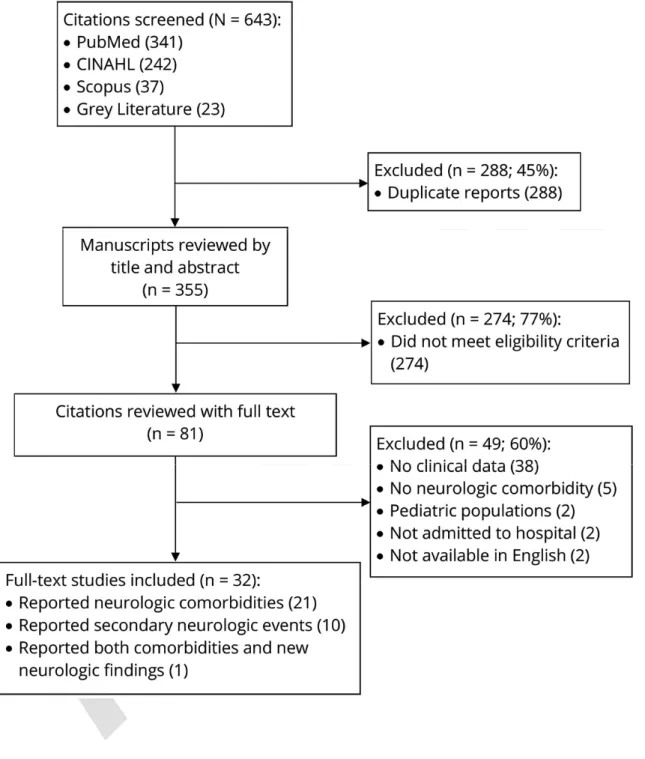
Pre-existing neurologic disease and COVID-19 diagnosis: Articles were screened by
title and abstract. Twenty-two studies met the inclusion criteria (Figure 1). Twenty retrospective
studies,
6, 10-28one prospective observational trial,
29and one randomized controlled trial
30were
included. Twenty studies were conducted in China, one in Italy, and one in France. In total, 4014
patients were included with a mean age 55.6 ± 8.4 and 57% male predominance. The pooled
percentage for having a pre-existing neurological disease was 8.0% (n=322/4014, range of
0-40% for individual studies; Table 2). The presence of pre-existing neurological disease was
frequently not specified and grouped only as “cerebrovascular disease,” “nervous system
disease,” or history of prior “stroke.” Additionally, five studies grouped cerebrovascular disease
and cardiovascular disease together, potentially inflating the incidence.
17, 19-21We found headache to be a commonly reported symptom at presentation as it was
mentioned in 22 articles. However, headache was not reported as a comorbidity and hence not
Copyright © 2020 Wolters Kluwer Health, Inc. Unauthorized reproduction of this article is prohibited.
included. Other neurological comorbidities rarely mentioned in screened articles included
dementia and Parkinson’s disease (Table 1). We did not find a mention of anosmia in any
searched scientific literature. We attempted but were unable to assess comparative outcomes
from COVID-19 in patients with pre-existing neurological disease due to inconsistency in
reporting, potential overlap in multiple studies reporting similar patients, and limited statistical
analysis of the included studies. However, a few studies assessed the risk of worse patient
outcomes and considered demographic and clinical variables including comorbidities as
predictors in the analysis.
Among all patients with COVID-19, those requiring treatment in an intensive care unit
(ICU) were more likely to be older, male sex, and have an underlying comorbidity, specifically
cerebrovascular disease (16.7% vs 1.0%).
12Similarly, patients that did not have clinical
improvement or remission of symptoms within the first ten days of hospitalization had higher
incidence of pre-existing cerebrovascular disease (8.2% vs 0%).
11Patients with COVID-19 and
underlying cerebrovascular disease were also more likely to develop acute respiratory distress
syndrome (ARDS) (11% vs 0%) in a cohort of 109 patients in Wuhan.
18Univariate analysis in a
prospective cohort of 179 patients with COVID-19 pneumonia showed that pre-existing
cardiovascular or cerebrovascular disease was predictive of mortality (OR =11.059, 95% CI = 4
– 30).
29We also observed a reported co-incidence of Parkinson’s disease in COVID-19 similar
to previously reported with SARS-CoV.
31, 32This correlation has been previously explored in
several publications.
33Copyright © 2020 Wolters Kluwer Health, Inc. Unauthorized reproduction of this article is prohibited.
Incidence of secondary neurological disease after COVID-19 (Table 3): We found ten
publications reporting secondary neurological events in patients diagnosed with COVID-19.
Four retrospective studies demonstrated a relationship between secondary neurological events
and treatment for COVID-19. One study demonstrated that 36% of 214 patients hospitalized for
COVID-19 developed neurological symptoms or secondary cerebral events.
20Another study
demonstrated that 6% of 221 patients hospitalized for COVID-19 suffered an acute
cerebrovascular event (ischemic stroke, cerebral thrombosis, and/or cerebral hemorrhage) while
undergoing treatment.
21Hypoxic ischemic encephalopathy was reported in 20% of patients in
another case series.
24A French study reported confusion in 65% patients and diffuse
corticospinal signs in 67% patients during hospitalization. This study also reported dysexecutive
syndrome in 33% of patients at discharge. Among 13 patients undergoing MRI brain in this
study, 3 had acute/subacute ischemic strokes, 11 had bilateral frontotemporal hypoperfusion, and
8 had leptomeningeal enhancement with negative CSF RT-PCR.
28Older age, more severe
illness, and underlying cardiovascular or cerebrovascular disease were risk factors for secondary
cerebrovascular events.
20, 21Further case reports have described various neurological illnesses
including acute necrotizing encephalopathy, ischemic strokes, seizures, intracranial hemorrhage,
Guillain Barre Syndrome, and meningo-encephalitis.
22, 34-38Discussion
These data suggest that patients with underlying neurologic impairment are vulnerable to
more severe illness when infected with COVID-19. We saw a trend towards patients with
pre-existing cerebrovascular disease having higher risk of ICU admission as well as overall
Copyright © 2020 Wolters Kluwer Health, Inc. Unauthorized reproduction of this article is prohibited.
mortality. In addition, patients hospitalized with COVID-19 showed a 6-36% incidence of
neurological events during the course of their illness.
Whether the trend towards worse outcomes is related to vulnerability from neurological
disorders or the presence of other cardiovascular comorbidities leading to neurological
complications in these patients is difficult to discern without further data. The neurotropism of
the coronavirus itself is being investigated as a possible mechanism behind the higher incidence
of brainstem-mediated cardiopulmonary complications in patients who have more severe
disease.
39, 40Experimental data including autopsy samples of human brain tissue suggest a
neuroinvasive potential of respiratory pathogens including coronaviruses in patients with and
without pre-existing neurologic disease.
41-43Published case series of other corona respiratory
viruses like MERS-CoV and SARS-CoV in prior years have listed similar neurological
complications including intracranial hemorrhage, ischemic stroke, polyneuropathy, Bickerstaff’s
encephalitis, and Guillain Barre Syndrome.
44Further data on the vulnerability of patients with neurological illness may be impactful in
targeting this population for proactive viral screening. Risk stratification scores that identify
patients at high risk of deterioration or that qualify patients for empiric therapies like
hydroxychloroquine also need to reconsider adding patients with cerebrovascular disease.
8Copyright © 2020 Wolters Kluwer Health, Inc. Unauthorized reproduction of this article is prohibited.
The burden of neurological events occurring in hospitalized patients demonstrates the
need for appropriate infrastructure to facilitate neurological assessments in this population that
may be deterred by the cumbersome nature of protection required required for clinical
assessments. This infrastructure may include a robust supply of PPE for neurologists to assess
patients, telemedicine alternatives for remote assessment of bedside exam, and protocols for
transporting these patients for neuroimaging including emergent evaluation for cerebrovascular
disease.
This scoping review has several limitations. Our analyses are limited by small sample
sizes, even smaller incidences of neurological comorbidities, lack of long-term follow-up, and
the possibility of overlap in populations described in reviewed articles potentially biasing the
results. The studies included in this scoping review also have inherent bias based on the study
designs. The retrospective nature of most of the included studies potentially present selection and
presentation bias. Retrospective studies are subject to misclassification bias with limited ability
to control for all potential confounders. Additionally, retrospective studies require large sample
sizes to generate statistical power to determine different in-study endpoints. We did not
specifically perform a risk of bias assessment in this scoping review, but instead choose to focus
on the overall prevalence. Lack of neurological history reported in medical records by an
overstretched health care system, lack of exhaustive reporting of neurological comorbidities in
acutely reported publications, and challenges of neurological assessments or neuroimaging in
patients with COVID-19 may have contributed to the lower reported incidence of neurological
comorbidities or secondary neurological events in hospitalized patients. Two meta-analyses
reporting comorbidities in COVID-19 and MERS-CoV failed to report neurological
Copyright © 2020 Wolters Kluwer Health, Inc. Unauthorized reproduction of this article is prohibited.
comorbidities, highlighting challenges of collecting such data.
7, 45We were unable to perform
meta-analysis or predict worse outcomes based on comorbidity status.
Conclusions
The culmination of studies indicates a daunting clinical relationship between COVID-19
and secondary neurological complications and needs a concerted effort by neurologists to
reorganize consultative practices to serve the neurological needs of patients during this
pandemic. More sensitive data extraction measures and comprehensive clinical documentation
are required to better understand the prevalence of neurological comorbidities and pre-existing
neurological disorders in patients with COVID-19.
Copyright © 2020 Wolters Kluwer Health, Inc. Unauthorized reproduction of this article is prohibited.
Appendix. Authors
Author
Location
Contribution
Collin Herman, MD
Department of Neurology
Wake Forest Baptist Medical
Center
Winston Salem, NC
Drafted the manuscript for
intellectual content
Kirby P. Mayer, DPT, PhD
Department of Physical
Therapy
University of Kentucky
College of Health Sciences
Lexington, KY
Major role in the acquisition of
data; performed statistical
review of results; interpreted
the data; revised the
manuscript for intellectual
content
Aarti Sarwal, MD
Department of Neurology
Wake Forest Baptist Medical
Center
Winston Salem, NC
Designed and conceptualized
study; major role in the
acquisition of data; interpreted
the data; revised the
manuscript for intellectual
content
Copyright © 2020 Wolters Kluwer Health, Inc. Unauthorized reproduction of this article is prohibited.
References
1
"Coronavirus disease 2019 (COVID-19) Situation Report-51." Available at
http://www.who.int
. March 20, 2020
2
Gorbalenya, AE, SC Baker, RS Baric, et al. "The species Severe acute respiratory
syndrome-related coronavirus: classifying 2019-nCoV and naming it SARS-CoV-2."
Nature Microbiology 2020 5(4): 536-544.
3
Lauer, SA, KH Grantz, Q Bi, et al. "The Incubation Period of Coronavirus Disease 2019
(COVID-19) From Publicly Reported Confirmed Cases: Estimation and Application."
Ann Intern Med 2020: M20-0504.
4
Bai, Y, L Yao, T Wei, et al. "Presumed Asymptomatic Carrier Transmission of
COVID-19." JAMA 2020.
5
Li, Q, X Guan, P Wu, et al. "Early Transmission Dynamics in Wuhan, China, of Novel
Coronavirus–Infected Pneumonia." New England Journal of Medicine 2020.
6
Guan, W-j, Z-y Ni, Y Hu, et al. "Clinical characteristics of 2019 novel coronavirus
infection in China." medRxiv 2020: 2020.2002.2006.20020974.
7
Yang, J, Y Zheng, X Gou, et al. "Prevalence of comorbidities in the novel Wuhan
coronavirus (COVID-19) infection: a systematic review and meta-analysis." Int J Infect
Dis 2020.
8
Caramelo, F, N Ferreira, B Oliveiros. "Estimation of risk factors for COVID-19 mortality
- preliminary results." medRxiv 2020: 2020.2002.2024.20027268.
9
Wan, X, W Wang, J Liu, T Tong. "Estimating the sample mean and standard deviation
from the sample size, median, range and/or interquartile range." BMC Medical Research
Methodology 2014 14(1): 135.
10
Wu, C, X Chen, Y Cai, et al. "Risk Factors Associated With Acute Respiratory Distress
Syndrome and Death in Patients With Coronavirus Disease 2019 Pneumonia in Wuhan,
China." JAMA Internal Medicine 2020.
11
Mo, P, Y Xing, Y Xiao, et al. "Clinical characteristics of refractory COVID-19
pneumonia in Wuhan, China." Clinical Infectious Diseases 2020.
12
Wang, D, B Hu, C Hu, et al. "Clinical Characteristics of 138 Hospitalized Patients With
2019 Novel Coronavirus–Infected Pneumonia in Wuhan, China." Jama 2020 323(11):
1061-1069.
13
Shi, H, X Han, N Jiang, et al. "Radiological findings from 81 patients with COVID-19
pneumonia in Wuhan, China: a descriptive study." The Lancet Infectious Diseases.
14
Wang, L, YH Gao, LL Lou, GJ Zhang. "The clinical dynamics of 18 cases of COVID-19
outside of Wuhan, China." The European respiratory journal 2020.
15
Deng, S-Q, H-J Peng. "Characteristics of and Public Health Responses to the Coronavirus
Disease 2019 Outbreak in China." J Clin Med 2020 9(2).
16
Wang, W, J Tang, F Wei. "Updated understanding of the outbreak of 2019 novel
coronavirus (2019-nCoV) in Wuhan, China." Journal of medical virology 2020 92(4):
441-447.
17
Chen, N, M Zhou, X Dong, et al. "Epidemiological and clinical characteristics of 99
cases of 2019 novel coronavirus pneumonia in Wuhan, China: a descriptive study." The
Lancet 2020 395(10223): 507-513.
18
Liu, Y, W Sun, J Li, et al. "Clinical features and progression of acute respiratory distress
syndrome in coronavirus disease 2019." medRxiv 2020: 2020.2002.2017.20024166.
Copyright © 2020 Wolters Kluwer Health, Inc. Unauthorized reproduction of this article is prohibited.
19
Chen, J, T Qi, L Liu, et al. "Clinical progression of patients with COVID-19 in Shanghai,
China." Journal of Infection 2020.
20
Mao, L, M Wang, S Chen, et al. "Neurological Manifestations of Hospitalized Patients
with COVID-19 in Wuhan, China: a retrospective case series study." medRxiv 2020:
2020.2002.2022.20026500.
21
Li, YaW, Mengdie and Zhou, Yifan and Chang, Jiang and Xian, Ying and Mao, Ling and
Hong, Candong and Chen, Shengcai and Wang, Yong and Wang, Hailing and Li, Man
and Jin, Huijuan and Hu, Bo, (2020). Acute Cerebrovascular Disease Following
COVID-19: A Single Center, Retrospective, Observational Study SSRN.
22
Filatov A, SP, Hindi F, Espinosa P. "Neurological Complications of Coronavirus Disease
(COVID-19): Encephalopathy." Cureus 2020 12 (3): e7352.
23
Onder, G, G Rezza, S Brusaferro. "Case-Fatality Rate and Characteristics of Patients
Dying in Relation to COVID-19 in Italy." Jama 2020.
24
Chen, T, D Wu, H Chen, et al. "Clinical characteristics of 113 deceased patients with
coronavirus disease 2019: retrospective study." BMJ (Clinical research ed) 2020 368:
m1091.
25
Xu, XW, XX Wu, XG Jiang, et al. "Clinical findings in a group of patients infected with
the 2019 novel coronavirus (SARS-Cov-2) outside of Wuhan, China: retrospective case
series." BMJ (Clinical research ed) 2020 368: m606.
26
Du, Y, L Tu, P Zhu, et al. "Clinical Features of 85 Fatal Cases of COVID-19 from
Wuhan: A Retrospective Observational Study." American journal of respiratory and
critical care medicine 2020.
27
Guo, W, M Li, Y Dong, et al. "Diabetes is a risk factor for the progression and prognosis
of COVID-19." Diabetes/metabolism research and reviews 2020: e3319.
28
Helms, J, S Kremer, H Merdji, et al. "Neurologic Features in Severe SARS-CoV-2
Infection." New England Journal of Medicine 2020.
29
Du, RH, LR Liang, CQ Yang, et al. "Predictors of Mortality for Patients with COVID-19
Pneumonia Caused by SARS-CoV-2: A Prospective Cohort Study." The European
respiratory journal 2020.
30
Cao, B, Y Wang, D Wen, et al. "A Trial of Lopinavir–Ritonavir in Adults Hospitalized
with Severe Covid-19." New England Journal of Medicine 2020.
31
Deng, S-Q, H-J Peng. "Characteristics of and Public Health Responses to the Coronavirus
Disease 2019 Outbreak in China." J Clin Med 2020 9(2): 575.
32
Moni, MA, P Liò. "Network-based analysis of comorbidities risk during an infection:
SARS and HIV case studies." BMC Bioinformatics 2014 15(1): 333.
33
Fazzini, E, J Fleming, S Fahn. "Cerebrospinal fluid antibodies to coronavirus in patients
with Parkinson's disease." Movement Disorders 1992 7(2): 153-158.
34
Poyiadji, N, G Shahin, D Noujaim, M Stone, S Patel, B Griffith. "COVID-19-associated
Acute Hemorrhagic Necrotizing Encephalopathy: CT and MRI Features." Radiology
2020: 201187.
35
Zhai, P, Y Ding, Y Li. "The impact of COVID-19 on ischemic stroke: A case report, 31
March 2020, PREPRINT (Version 1)." Research Square 2020.
36
Karimi, N, A Sharifi Razavi, N Rouhani. "Frequent Convulsive Seizures in an Adult
Patient with COVID-19: A Case Report." Iran Red Crescent Med J 2020 22(3): e102828.
37
Sharifi-Razavi, A, N Karimi, N Rouhani. "COVID 19 and Intra cerebral hemorrhage:
Copyright © 2020 Wolters Kluwer Health, Inc. Unauthorized reproduction of this article is prohibited.
38
Moriguchi, T, N Harii, J Goto, et al. "A first Case of Meningitis/Encephalitis associated
with SARS-Coronavirus-2." Int J Infect Dis 2020.
39
Li, YC, WZ Bai, T Hashikawa. "The neuroinvasive potential of SARS-CoV2 may play a
role in the respiratory failure of COVID-19 patients." J Med Virol 2020.
40
Baig, AM, A Khaleeq, U Ali, H Syeda. "Evidence of the COVID-19 Virus Targeting the
CNS: Tissue Distribution, Host-Virus Interaction, and Proposed Neurotropic
Mechanisms." ACS Chem Neurosci 2020 11(7): 995-998.
41
Bohmwald, K, NMS Gálvez, M Ríos, AM Kalergis. "Neurologic Alterations Due to
Respiratory Virus Infections." Front Cell Neurosci 2018 12: 386-386.
42
Arbour, N, R Day, J Newcombe, PJ Talbot. "Neuroinvasion by Human Respiratory
Coronaviruses." Journal of Virology 2000 74(19): 8913.
43
Xu, J, S Zhong, J Liu, et al. "Detection of severe acute respiratory syndrome coronavirus
in the brain: potential role of the chemokine mig in pathogenesis." Clin Infect Dis 2005
41(8): 1089-1096.
44
Umapathi, T, AC Kor, N Venketasubramanian, et al. "Large artery ischaemic stroke in
severe acute respiratory syndrome (SARS)." Journal of neurology 2004 251(10):
1227-1231.
45
Badawi, A, SG Ryoo. "Prevalence of comorbidities in the Middle East respiratory
syndrome coronavirus (MERS-CoV): a systematic review and meta-analysis."
International Journal of Infectious Diseases 2016 49: 129-133.
46
Zhao, H, D Shen, H Zhou, J Liu, S Chen. "Guillain-Barre syndrome associated with
SARS-CoV-2 infection: causality or coincidence?" The Lancet Neurology.
Copyright © 2020 Wolters Kluwer Health, Inc. Unauthorized reproduction of this article is prohibited.
Copyright © 2020 Wolters Kluwer Health, Inc. Unauthorized reproduction of this article is prohibited.
Table 1: Electronic Database Search Strategy
Aim Search Strategy with Boleen operators Results1
Pubmed CINAHL Scopus Prevalence of
neurologic comorbidity in patients hospitalized
for Covid-192
(("covid-19") AND (neuro* OR neurol manifestation))
190 156 8
(("covid-19”) AND (brain* OR brain infarct)) 63 41 7
(("covid-19”) AND (stroke)) 6 5 0
(("covid-19”) AND (seizure OR epilepsy) 2 3 0
(("covid-19”) AND (encephalitic OR encephalopathy))
15 3 2
(("covid-19”) AND (coma OR
unconsciousness)) 5 2 1
(("covid-19") AND (cerebral edema OR “cereb*”))
22 7 0
(("covid-19") AND (cranial hemorrhage OR intracranial hemorrhage OR subarachnoid hemorrhage))
1 2 0
(("covid-19”) AND (migraines OR “headache)) 28 20 18 (("covid-19”) AND (neuropathy OR
neuromuscular OR myasthenia)) 6 2 0
(("covid-19”) AND (dementia or neurocognitive
disorder)) 3 1 1
Total 341 242 37
1
Search terms were applied with date filter of Jan 1, 2020 to April 12, 2020.
2Covid-19 MeSH term;
https://meshb.nlm.nih.gov/record/ui?ui=C000657245
Copyright © 2020 Wolters Kluwer Health, Inc. Unauthorized reproduction of this article is prohibited. Table 2: Prevalence of pre-existing neurologic diseases for patients hospitalized for COVID-19 First
Author
Study
Design Location Sample
Diagnosis of COVID Age (mean ± SD) Male (%) Neuro* comorbidity n (%) Description of neuro*
comorbidity Clinical Notes
Guan6 Retro 552 hospitals in 30
provinces 1099 Confirmed with RT-PCR 44.2 ± 23.9 58 15 (1.4%) cerebrovascular disease
Comorbidity was more common in severe cases of COVID-19 (38.2% vs. 22.5%)
Wu10 Retro Wuhan Jinyintan
Hospital, in China 201 Confirmed with RT-PCR 51.5 ± 17.9 64 7 (3.5%) nervous system disease
Older patients with comorbidities of hypertension and diabetes more likely to develop ARDS
Mo11 Retro Hospital, Wuhan Zhongnan
University 155
Confirmed with
RT-PCR 53.5 ± 10.3 55 7 (4.5%) cerebrovascular disease
Patients with baseline
cerebrovascular more likely to be in “refractory group”
Cao30 RCT Hospital, Wuhan, Jin Yin-Tan
China
199 Confirmed with RT-PCR 58.5 ± 11.2 60 13 (6.5%) cerebrovascular disease Statistical analysis focused on intervention
Wang14 Retro First Affiliated Hospital of Zhengzhou University Zhengzhou, China
18 Confirmed with RT-PCR 40.5 ± 7.5 56 2 (11.1%) stroke 2 patients with history of stroke; time or severity of stroke not documented Shi13 Retro Wuhan Jinyintan hospital or Union Hospital of Tongji Medical College,Wuhan, China 81 next-generation sequencing or RT-PCR 49.5 ± 11 52 6 (7%) cerebrovascular disease
Older age, male sex, and presence of comorbidity increase risk of poor prognosis Wang12 Retro Zhongnan Hospital of Wuhan University, Wuhan, China
138 Confirmed with RT-PCR 56.5 ± 20.2 54 7 (5.1%) cerebrovascular disease
Patients receiving ICU care were significantly older (66 vs 51) and had underlying cerebrovascular disease (16.7% vs 1.0%1)
Deng15 Retro Mainland China 26 NR NR NR 4 (15.4%)
2 (7.7%) Parkinson’s disease cerebral infarction Retrospective report of patients that died from COVID-19
Wang16 Retro Wuhan, China 17 NR 71.5 ± 11.5 76 3 (18%)
2 (12%) Parkinson’s Disease Cerebral infarction Analysis of the first 17 patients that died in Wuhan, China Chen17 Retro Jinyintan Hospital
in Wuhan, China 99 Confirmed with RT-PCR 55.5 ± 13.1 68 40 (40%) 1 (1%)
cardio-cerebrovascular disease, nervous system
disease Liu18 Retro Central Hospital,
Wuhan 109 Confirmed with RT-PCR 55 ± 11 54 6 (5.5%) cerebrovascular disease
Older patients with severe COVID-19 more likely to develop neurological complication
Copyright © 2020 Wolters Kluwer Health, Inc. Unauthorized reproduction of this article is prohibited. Chen19 Retro Shanghai Public Health Clinical Center (SPHCC), Shanghai, China
249 Confirmed with RT-PCR 51 ± 10 51 55 (21.7%) cardio-cerebrovascular disease Older age and presence of any comorbidity associated with ICU stay Mao20 Retro Union Hospital of Huazhong University of Science and Technology, Wuhan, China.
214 Confirmed with RT-PCR 52.8 ± 15 41 15 (7.0) cardio-cerebrovascular disease Cerebrovascular disease prevalence was not different in severe and non-severe cases
Li21 Retro Union Hospital,
Wuhan, China 221 Confirmed with RT-PCR 53.3 ± 16 59 17 (7.7) cardio-cerebrovascular disease
Older patients with severe COVID-19 more likely to develop neurological complications Filatov22 Retro Florida Atlantic University Hospital, Boca Rota, FL
1 NR 74 CR 1 (100) cardioembolic stroke, Parkinson Disease
Case report of older male requiring ICU care with mechanical ventilation; developed encephalopathy
Onder23 Retro Italy 355 Confirmed with
RT-PCR NR NR 24 (6.8) 34 (9.6) dementia stroke Presence of comorbidities may have increased mortality risk Chen24 Retro Tongji Hospital,
Wuhan, China 274 Confirmed with PT-PCR 60 (11.5) 62 4 (1.5) cerebrovascular disease
Patients that died were older, predominantly male, and had pre-existing comorbidities
Du29 Prospec Wuhan Pulmonary Hospiatal, Wuhan,
China
179 Confirmed and probable cases 57.6 (13.7) 54% 29 (16.2) Cardio-cerebrovascular disease Older age (>65 years old) and presence of cardio-cerebrovascular disease was predictive of mortality Du26 Retro and Wuhan Union Hannan Hospital
Hospital 85
Confirmed OR
contact history 65.8 (14.2) 73 7 (8.2) cerebrovascular disease
In 85 patients that died from COVID-19, most cases were males over age of 50 and had pre-existing comorbidity
Xu25 Retro Multiple hospitals
in Zhejiang, China 62 Confirmed with RR-PCR 42 (14.7) 56 1 (2) cerebrovascular disease
Retrospective study of the clinical characteristics of cohort of patients with severe acute respiratory syndrome and COVID-19
Guo27 Retro Wuhan Union hospital of Tongji Medical College, Huazhong University of Science & Tech
174 Confirmed with PT-PCR 58 (8.5) 44 13 (7.5) cerebrovascular disease
Retrospective study focused on diabetes as a risk factor of the progression and prognosis of COVID-19
Helms28 Retro Strasbourgm
France 58 Confirmed with RT-PCR 63 NR 7(12)
TIA, partial epilepsy, mild cognitive
impairment
Retrospective study reporting neurological features in COVID-19 patients
Totals 4014 55.68 (8.4) 57 322 (8.0%)
Copyright © 2020 Wolters Kluwer Health, Inc. Unauthorized reproduction of this article is prohibited. First Author Study
design Location Sample Outcomes
Li**21 Retro Wuhan,
China 221 13 (6%) patients suffered neurologic complication: 11 (5%) acute ischemic stroke, 1 (0.5%) cerebral venous sinus thrombosis, and 1 (0.5%) cerebral hemorrhage. Patients with event were older with higher severity of illness and had pre-existing hypertension or history of cerebrovascular disease.
Mao**20 Retro Wuhan,
China 214 78 (36.4%) had neurologic manifestations including 5 reports of ischemic stroke, 1 patient suffered cerebral hemorrhage, 23 reports of neuromuscular injury. Patient with higher severity of illness were more likely to develop neurological symptoms.
Chen24 Retro Wuhan,
China 274 23 (20%) developed hypoxic encephalopathy after diagnosis COVID-19. Older male patients with chronic hypertension and other comorbidities had higher mortality. Helms28 Retro Strasburg,
France
58 58 patients with median age 63 years. 26 of 40 patients examined after weaning sedation had confusion. 39 (67%) patients had diffuse corticospinal signs. 15 of 45 discharged (33%) had dysexecutive syndrome. 11 of 13 patients with MRI had bilateral frontotemporal hypoperfusion and 8 had leptomeningeal enhancement. 3 patients had acute/subacute ischemic stroke. 8 patients had EEG with nonspecific findings. 7 patients had CSF studies with all studies negative for RT-PCR, 1 with elevated IgG, 2 with elevated oligoclonal bands, 1 with elevated IgG and protein.
Poyiadji34 Retro Detroit, MI,
USA
1 Female patient (late fifties), diagnosed with acute necrotizing encephalopathy with CT images revealing symmetric hypoattenuation within the bilateral medial thalami and brain MRI showing hemorrhagic ring enhancing lesions.
Zhai35 Retro Hubei
Provincial Hospital
1 79 year old male diagnosed with acute ischemic stroke (lacunar infarction on CT imaging) after presenting to hospital with right extremity weakness and diagnosed with stroke and found to be COVID-19 positive. Filatov22 Retro Boca Raton,
FA, USA 1 74 year old male with history of atrial fibrillation, cardioembolic stroke, Parkinson’s disease, chronic obstructive pulmonary disease, and cellulitis presented to emergency department with cough and altered mentation, found to be encephalopathic, EEG demonstrated bilateral slowing and focal slowing in left temporal region.
Karimi36 Retro Sari, Iran 1 30 year old female (previously healthy) admitted with tonic-clonic seizures; 5 seizures in 8-hour period. CT and
MRI of head was negative.
Sharifi-Razavi37 Retro Sari, Iran 1 79 year old male with 3 days of fever and cough, presented to the hospital and suffered acute loss of
consciousness in emergency room. Brain CT showed massive intra-cerebral, intra-ventricular and subarachnoid hemorrhage. RT-PCR confirmed COVID-19.
Moriguchi38 Retro Yamanashi,
Japan
1 24 year old male with symptoms of headace, fatigue, and fever; 9 days after initial onset he was found down with loss of consciousness; multiple epileptic seizures, diagnosed with meningitis, ventriculitis, and encephalitis.
Zhao46 Retro Wuhan,
China
1 Travel history to Wuhan and possibly presented with Guillian Barre syndrome attributed to COVID-19. ICU: intensive care unit; EMG/NCV: electromyography/nerve conduction velocity
DOI 10.1212/WNL.0000000000009673
published online April 28, 2020
Neurology
This information is current as of April 28, 2020
Services
Updated Information &
673.full
http://n.neurology.org/content/early/2020/04/24/WNL.0000000000009
including high resolution figures, can be found at:
Subspecialty Collections
http://n.neurology.org/cgi/collection/covid_19
COVID-19
following collection(s):
This article, along with others on similar topics, appears in the
Permissions & Licensing
http://www.neurology.org/about/about_the_journal#permissions
its entirety can be found online at:
Information about reproducing this article in parts (figures,tables) or in
Reprints
http://n.neurology.org/subscribers/advertise
Information about ordering reprints can be found online:
rights reserved. Print ISSN: 0028-3878. Online ISSN: 1526-632X.
1951, it is now a weekly with 48 issues per year. Copyright © 2020 American Academy of Neurology. All ® is the official journal of the American Academy of Neurology. Published continuously since