Publishers NAISIT Chief in Editor [email protected] Email: Portugal, Interior, Beira of University Ferreira, J. J. Editors Associate Portugal interior, Beira of University Ferreira, M. J. João Editor-in-Chief: Editors: Main USA Memphis, of University and Portugal Lisbon, of Institute University Ferreira, F. A. Fernando Spain Barcelona, of University Lindahl, Merigó M. José Editors: Assistant University, Portucalense and (UBI) Sciences Business in Unit -Research NECE at Reseacher Fernandes, Cristina Portugal UK Reading, of University Co, Jess Portugal Lisbon, of Institute University Jalali, S. Marjan Board: Advisory Editorial UK Management, of School Cardiff Lincoln, Adebimpe Israel College, Academic Netanya Tziner, Aharon USA Pennsylvania, University, Morris Robert Smith, D. Alan Spain Barcelona, of University Lafuente, G. Maria Ana Norway Management, of School Oslo Mariussen, Anastasia Spain Barcelona, de Autònoma Universitat Tarrés, i Serarols Christian UK university, City -Birmingham School Business Millman, Cindy Romania Bucharest, of University Gh, Popescu R. Cristina UK School, Business University Newcastle Irawati, Dessy Spain Valencia, of University Ribeiro, Domingo USA Business, of Schools Carayannis, G. Elias USA University, Technological Michigan Oliveira, Emanuel Spain Seville, of University Liñán, Francisco UK University, City Birmingham Matlay, Harry Romania Studies, Economic of University Bucharest The Purcarea, Irina HK University, Polytechnic Kong Hong The Choi, Jason Spain Valencia, of University Vila, Jose Canada Montréal, HEC Filion, Jacques Louis Italy II, Federico Naples of University Landoli, Luca Brazil Paulo, Säo de Universidade at Researcher Sakuda, Ojima Luiz Portugal Interior, Beira of University Raposo, L. Mário Spain València, de Politècnica Universitat Peris-Ortiz, Marta Zealand New Waikato, of University The Akoorie, Michele Canada Trois-Rivières, à Québec du Université Julien, Pierre-André Jordan University, Hashemite The Karabsheh, Radwan Zimbabwe Technology, and Science of University National Mhlanga, Richard Brazil – Vargas Getulio Fundação Bandeira-de-Mello, Rodrigo Netherlands The -University Tilberg Rutten, Roel Verde Cabo Empresariais, e Económicas Ciências de Superior Instituto Cruz, Rosa
Denmark University, Business Copenhagen Hollensen, Svend Austria Vienna, of University Frisch, Walter USA University, State Colorado Byrne, S. Zinta Board Review Editorial Turkey Turkey, University Selçuk Ögüt, Adem Greece Athens, of University Agricultural Sideridis, B. Alexander Netherlands The Amsterdam, University VU Sharpanskykh, Alexei USA York, -York, University State Pennsylvania Kara, Ali Brazil Rio, Grande Universidade Freitas, Angilberto Portugal Interior, Beira of University Paço, do Arminda Finland Jyväskylä, of University Ojala, Arto Portugal Douro, Alto e Tras-os-Montes of University Marques, Carla Turkey University, Çukurova Tanova, Cem Brazil Catarina, Santa de Federal Universidade Tolfo, Cristiano Portugal Branco, Castelo of Institute Polytechnic Estevão, S. Cristina Croatia Split, of University Miocevic, Dario Zealand New School, Business Auckland of University The Askarany, Davood USA Washington, of University Revere, Debra USA Ohio, Cincinnati, of University Gormley, Kolesar Denise Kong Hong Technology, and Science of University Kong Hong Chiu, K.W. Dickson Spain Navarra, of University Melé, Domènec Brazil School, Business FUCAPE Mainardes, Emerson USA University, Arizona Northern Otenyo, E. Eric USA University, Illinois Southern Watson, W. George Brazil Maria, Santa de Federal Universidade Moura, de Luiz Gilnei China University, Psychology,Zhejiang of Department Zhong, An Jian Portugal Lisbon, University, Catholic Portuguese Sciences, Human of Faculty Pinto, Carneiro Joana Spain Valencia, of University Alegre, Joaquín USA Jersey, New Business, of School Anisfield Rakotobe, Thierry Joel USA , FL Sanford, Florida, Central of University Matusitz, Jonathan India Kharagpur, Technology of Institute Indian Srivastava, L. B. Kailash Netherlands Twente,The of University Sanders, Karin Germany Koblenz-Landau, of University Troitzsch, G. Klaus China Nanjing, Technology, of University Nanjing Shi, Kuiran Portugal ISLA, Faria, Costa da Liliana Canada Ontario, Western of University Capretz, Fernando Luiz USA Business, of College Godkin, Lynn Canada Winnipeg, of University Liu, Chunhui Maggie Belgium Liège, of University Ausloos, Marcel USA Texas, University,Denton, Woman's Texas Benham-Hutchins, Marge Spain Granada, of University Pérez-Aróstegui, Nieves María Italy Udine, of University Cagnina, Rosita Maria University,Taiwan Hwa Dong National Tabata, Mayumi
Portugal Coimbra, of University Cunha, Rupino Paulo Germany University, Saarland Loos, Peter Spain Vigo, de Empresas de Administración e Economia de F. García, Piñero Pilar Romania Bucharest, Studies, Economic of University Bucharest Gheorghe, N. Popescu Economic of University Bucharest The and Satu-Mare of Academy Commercial The Adriana, Veronica Popescu Romania Bucharest, Studies, India Technology, and Management of Institute Singh, Ramanjeet Portugal of University Catholic Morais, Ricardo Spain Rioja, of University Ortiz, Fernández Ruben Canada Manitoba, of University Thulasiram, K. Ruppa USA NJ, University,Montclair, State Montclair Kim, Soo Taiwan University, Yat-Sem Sun National Chiou, Wen-Bin USA GA, ,Augusta, College Paine Lawless, Willaim Singapore University, Management Singapore Koh, T.H. Winston
NAISIT Publishers Issue11 - (Jan-Mar 2014)
Table of Contents
1 THE RELATIONSHIP BETWEEN ORGANIZATIONAL STRUCTURE AND
MARKET ORIENTATION. AN EMPIRICAL APROACH
TOMáS CABELLO CABELLO, University of Seville, Spain
MARíA ÁNGELES REVILLA CAMACHO, University of Seville, Spain MANUELA VEGA VáZQUEZ, University of Seville, Spain
48 EFFECTS OF E-BANKING ON GROWTH OF CUSTOMER BASE IN KENYAN
BANKS
BICHANGA WALTER OKIBO , University of Agriculture and Technology, Kenya ALI YATTANI WARIO , University of Agriculture and Technology, Kenya
64 THE PENETRATION OF BUSINESS INFORMATION SYSTEMS IN SMALL AND
MEDIUM-SIZED ENTERPRISES IN ITALY AND HUNGARY: A COMPARATIVE STUDY
SELENA AURELI, University of Bologna , Italy MASSIMO CIAMBOTTI, Universiy of Urbino , Italy PéTER SASVÁRI, University of Miskolc, Hungary
96 DETERMINANTS OF LOYALTY TOWARD BOOKING.COM BRAND
RAQUEL DA SILVA E CRUZ, Instituto Politécnico de Leiria, Portugal
ALZIRA MARIA DA ASCENSãO MARQUES, Instituto Politécnico de Leiria, Portugal
124 LAYOUT DESIGN AS A RISK DRIVER FOR ENERGY EFFICIENCY OF
ADRIAN DUMITRU TANţăU, Bucharest University of Economic Studies, Romania HORAţIU REGNEALă, Bucharest University of Economic Studies, Romania ELIZA LAURA CORAş, Bucharest University of Economic Studies, Romania
The International Journal of Management Science and
Information Technology (IJMSIT)
96
Determinants OF LOYALTY TOWARD Booking.com BRAND
Raquel da Silva e Cruz
Master in Relationship Marketing, ESTG, Instituto Politécnico de Leiria; [email protected]
Alzira Maria da Ascensão Marques
Teacher Coordinator, CIGS, ESTG, Instituto Politécnico de Leiria [email protected]
Abstract
Relations "customer - supplier" are increasingly more valuable and less consistent, especially in the online context. In this sense, the supplier seeks to make a website visitor into a satisfied customer and a satisfied customer into a loyal customer as a condition to become more competitive. Understanding what determines the loyalty of an online customer and the role of satisfaction and trust in this relationship is the main purpose of this research. So, based on information gathered through a questionnaire in a sample of 104 customers of the Booking.com portal, we performed a quantitative study, transversal and exploratory, in order to study the relationship between the variables: website characteristics, personality of online consumers, e-satisfaction, e-trust and brand loyalty to Booking.com. The results showed that the personality of Booking.com customers and e-satisfaction are able to explain customers’ loyalty toward Booking.com brand.
Keywords: e-loyalty, e-commerce, e-satisfaction, e-trust, personality of the consumer.
1. Introduction
Customers’ loyalty has become a strategic purpose for most organizations, considering the positive impact it has over their profitability. This idea is based on the growing expression of relationship marketing in academia research and scientific publications. Adding to this, there is the exponential growth of internet use as a means of transaction that has been observed in the past few years. As it is a recent area of high potential, it becomes relevant to study customers’ loyalty in the online context.
This being said, the recency of the subject - customer loyalty to brands- and the importance of e-commerce in the economy of present day society, have deemed relevant to develop a research on this subject. In a way, the purpose is to obtain a better understanding about the behavior of the online consumer, in order to improve and substantiate strategies of brand loyalty, in what is truly the source of customer value.
In order to do so, we chose to analyze factors that influence loyalty toward Booking.com brand, and more specifically portal features, customer personality, satisfaction and trust of online consumers. In that sense, we intend to answer the following research question:
Which are the determinants of loyalty to the Booking.com brand?
Is it the portal features? Is it the personality of online consumers? What is the role of satisfaction and trust in online shopping on the brand loyalty to an online portal selling tourist accommodations? These are the research questions to which this research intends to answer, developing some discussion based on the theoretical background presented below.
2. Theoretical background
The theoretical background focuses on relationship marketing within the context of e-commerce, seeking to identify some determinants of customer loyalty, in the context of e-commerce platforms. More specifically, it seeks to reveal the relationship between website features, customer personality, satisfaction, trust and customer loyalty.
2.1 Relationship Marketing and Customers Loyalty
The present complex market scenario, where competition is growing more aggressive and unfolding options are made available in products and services, all linked to a decrease in technology costs, make loyalty to a brand or corporate identity to become more difficult. So, the costs of acquiring more customers are soaring, being five to ten folds as more expensive to conquer a new customer as to keep present customers (Kotler, 2000). An increase in customers’ loyalty may lead to significant savings for companies, resulting from the reduction of marketing costs, fewer transaction costs and less non-quality costs (Huang and Hsieh, 2012; Barroso and Picon, 2012).
98
The majority of organizations are abandoning transaction oriented marketing that emphasizes sales, to practice relationship marketing that emphasizes the developing and maintenance of profitable long term relationships with customers, offering them higher value and satisfaction (Kotler, 2000).
Kalwani and Narayandas (1995) considered that companies having long term relationships with selected consumers have better conditions to generate loyalty and even potentiate their level of profitability, than companies that still persist in a transactional kind of philosophy. To Engel, Blackwell and Miniard (2000), there is a growing acknowledgement that satisfaction and customer retention are key aspects for companies’ success.
Relationship marketing is focused on customer retention and on a high level of contacts and service (within a long term relationship perspective). The essence of relationship marketing has to be based on the maintenance of a profound relationship with customers (Berry, 1995). So, loyalty can be defined as the customer commitment toward a certain brand, shop or supplier, based on a strong favorable attitude, expressed in consistent purchase (Sheth et al., 1995). Online loyalty refers to loyalty as the way the customer behaves toward a retailer in the online environment.
Oliver (1999) defines loyalty as a strong compromise in consistently repurchasing the favorite product or service in the future, purchasing repeatedly, without dwelling on circumstantial factors or on the determination of the competition in marketing driven to change behaviors. To this author, loyalty is the result of an evaluation process made by the customer and from what results from his relationship with the brand.
To Zeithalm et al. (1996) loyalty tends to be expressed in several ways. For instance, choosing one company over another, through continuous purchase (repurchasing) or the intention of continuing to purchase in the future (purchase volume), and last but not least, following recommendations from other people regarding the company. Barroso and Picon (2012) considered loyalty as a multidimensional concept, comprehending dimensions such as affection, cognition and future intention to be loyal.
The internet is perhaps the largest and most known implementation of interconnected nets, connecting hundreds of thousands of individual nets all around the world. It has opened a wide range of opportunities, some of which are being used by companies, as e-commerce and e-business. To Turban et
al. (2000), the internet has a huge impact in companies’ competitiveness because it provides:
- lower costs for customers: it allows the customer to find products or services more easily, at a better ratio quality/price, forcing companies to reduce prices and/or improve their product or service quality; - swift comparisons and analyses: customers are able to compare, analyze and find products/services more rapidly.
- differentiation: e-commerce allows product customization. Customers appreciate differentiation and are willing to pay more for it, which helps to reduce the substitution rate between products and/or services.
The internet has also created the opportunity for companies to simultaneously advertise, sell and receive payments (Schumann et al., 2001). It offers online techniques for companies to reach customers all around the world, at any time, using interactive messages; information about the company, its products and services; updates; sectorial information; contacts and links for customers; virtual shops and tools for customers’ service, like channels for group discussions among buyers, online doubt clarifications, and so forth (Boone and Kurtz, 2001).
The internet has become the basis to manage relationships through technology. With the appearance of new companies made possible by technology and the potential for wealth generation residing in the relationship between the company and its customers and partners, the internet has emerged as a key engine for companies’ growth and profitability (Shawney and Zabin, 2002).
To Kotler (2000), e-marketing has at least five advantages when compared with offline marketing. First, small companies like larger ones are able to withstand its costs; second, there is no real space limitation for advertising, unlike in traditional communication means; third, information access and recovery is fast; forth, the website is available to all the world, around the clock; fifth, the purchase can be private and fast.
The internet has provided a different kind of communication between companies and their consumers: more direct, customized and somewhat more relational. In fact, technology is here to provide interaction between producers or suppliers and customers, originating new interfaces between business partners (Sheth and Parvatiyar, 1995). The database technology and the internet have made relationship marketing more practical and cost efficient (Peppers and Rogers, 1999).
100
To Kotler and Gary (1999: 327) internet is a powerful tool that helps marketeers to be updated about their consumers needs (…), providing the means to reach for segments of smaller groups of customers with more elaborate messages”. According to Churchill and Peter (2000), companies may generate value providing customized information in their website based on the buying background and preferences shown by each internet user.
The high growth of e-commerce in the last years, and subsequent growing competition, demand a huge effort from managers and entrepreneurs of online platforms to create significant differentiation in order to attract and maintain customers coming to the website, as the changing costs for customers are considerably lower in internet, when compared to the traditional channel (Hernandez, 2001). In this context, loyalty has been referred to as an option to establish competitive advantage (Gommans et al. 2001).
In spite of the growing number of users and financial transactions year after year, studies about loyalty in the online segments are still very little (Gummerus et al, 2004). However, managers and entrepreneurs operating in the online environment recognize it as a chief concern (Abbott et al, 2000).
2.3 E-commerce: Website characteristics
According to Shih (2004), websites should be addressed as crucial instruments of persuasion and customers’ service, and not just as electronic catalogues with endless product lists. Competition in
e-commerce is growing bigger due to the easiness and the low cost of transactions via the internet,
making it the more important to have well planned and implemented systems.
For Eroglu et al. (2001), the online shop scenario do not present all the scenario features of the offline shop (for instance, the sense of smell), but has rather different characteristics (such as flexibility of time and space). The ability of an offline shop to appeal to all the customers’ senses through an infinity of combinations using social, structural and aesthetic elements, ends up narrowed to mainly visual appeals through a screen.
Eroglu et al. (2001) classify the online commerce environment focusing on two characteristics: Highly Relevant (HR) task environment and of Little Relevance (LR) task environment. HR elements
comprehend the website description features (text or images) that appear on the screen to facilitate and make it possible for customers to achieve their purposes of purchase. The characteristics of LR environment represent the website contents that have not much influence in the purchase finishing such as colors, fonts, animations, music, entertainment (games or competitions), icons, security indicators, etc.
The main conclusion drawn from Eroglu et al. (2003) study is that the scenario of the online shop influences the customer. A well cared and strategically designed virtual scenario enhances the level of pleasure felt by the online customer. This effect is moderated by the engagement and response behavior of the customer toward the shop scenario. The effect of the scenario on attitude, satisfaction and behavior of approaching/withdrawal is not direct, but seems to be resulting from the emotions experienced by the customer.
Insights and knowledge gathered from previous research lead the authors Novack et al. (2000) to conclude that the creation of a nice and attractive online scenario may bring countless positive consequences to e-commerce. The nice scenario has positive consequences in e-commerce (Novack et
al. 2000); on the other hand, the security element brings mainly negative consequences, being an
element to consider specially when designing a website (Souza et al., 2007). Souza et al. (2007) indicate the lack of security of this new buying experience from the customers’ point of view as one of the main reasons preventing the adoption of this practice and the online growth.
The increase of credible sources, the growing amount of information available to customers, the easiness to access information while searching and selecting products/services, the easiness of purchase and delivery in an efficient and effective way, all change substantially the customer purchasing behavior (Zeithaml et al., 2000).
E-commerce has an added value based mainly on its interactive nature. This includes its availability 24
hours a day, seven days a week; its approachability from multiple locations (Hoffman e Novak, 1996); the cost reduction of information prior to the purchase; the wide range of product alternatives (Narayandas et al., 2002) which raises search efficiency and effectiveness, avoiding several trips to different selling points.
Online shops may improve the purchase experience by reducing time and effort spent in the buying process and in the quality of service encounter. In this perspective, online shops may define as priorities
102
to sell products organized by categories for an easy and swift purchase; offer several means of payment; provide detailed information and price comparison; disclose return policies and allow customers to share information online (Chen et al., 2010; Pan et al., 2012).
Website design, browsing easiness, information content and images, and an exceptional performance quality, represent the critical factors for virtual environment success. This performance element, meant to be both simple and provocative, allows more satisfactory results if the design of the different dimensions of the website is cautious and rational, bearing the audience in mind. In brief, organizations intending to use the internet as a stage should assess and determine which theatrical elements are more significant for their audience, in what concerns the impressions and experience they want to bring to their customers.
A huge part of online interactions tend to be customized, allowing a company to individually follow its customers throughout the touching points and all kinds of transactions, setting up its offer in a digital way. Amazon is such an example. The process tends to be more active and dynamic, becoming a real “learning relationship” (Grove and Fisk, 2001; Peppers and Rogers, 1999).
Thus, we can state that customization, security, privacy, convenience, customer support and community, are new functions to be performed by e-marketing, to complement traditional 4 P marketing (Kalyanam and McIntyre, 2002).
Understanding which dimensions are relevant while developing web pages becomes highly critical for the companies competitive positioning (Palmer et al., 1998). Adopting measures and relationship models in online marketing is a priority; it brings out the focus on the customer/consumer and on the analysis of its business ways, representing thus one of the main goals of this research work.
Customer behavior in the online environment has been the focus of several studies, namely when the effects of variables on online loyalty are intended to be analyzed, whether it is under the behavioral aspect (Cases et al., 2010), the attitudinal aspect (Caruana and Ewing, 2010; Mouakket and Al-hawari, 2012;) or, in a more general perspective, as a one-dimensional concept (He et al., 2011; Llach et al, 2012; Vlachos and Vrechopoulos, 2012; Rabbanee et al., 2012; Pan et al., 2012).
In spite of the importance given to internet in several scientific researches (Hoffman and Novak, 1996; Ratchford et al., 2003) and, more specifically, in what concerns the implications of internet in the purchase behavior of the customer (Alba et al., 1997; Deighton, 1997), there is a gap in literature concerning the adoption of internet as a means of product/service purchase (Roy and Ghose, 2006). There have also emerged some studies about the online purchasing behavior of the customer (Alba et
al., 1997) and about the reasons preventing the purchase of products in the virtual market (Peterson et al., 1997)
It is crucial to understand if customers will behave and act differently, whether they are in an online or offline environment. If, in fact, they do behave and act differently, then it remains to be known which metric methods to apply to capture those differences. It is irrefutable evidence that customers cannot rely on their five senses to shop online; on the contrary, they have to base their options on photos, images or other means of representation, inevitably limited. However, there are studies showing that these online product representations are important to consolidate the attitude toward the act of purchase, as well as toward the intention of purchasing (Jarvenpaa and Todd, 1997; Novak et al., 2000).
Morrisette et al (1999) state that, in general, the online customer believes to be more powerful and demanding than the offline customer. This power and demand are reflected in the level of loyalty, which is usually lower in the virtual context. Like in physical context, the online customer loyalty is influenced by the product or service availability, the content relevance and by the tempting and pleasant context (Rice, 1997; Eighmey, 1997; Eighmey and McCord, 1998).
According to Bhatnagar et al. (2000), unlike physical context customers, online customers show concern about the risk associated to web purchases. So, perceived risk of shopping in virtual markets as well as perceived use easiness, are demonstrated to influence attitudes concerning online purchases (Heijden
et al., 2001).
In short, services delivered by websites are very special services, though of growing importance, whose quality can only be assured as long as customers’ expectations are known (Pinho et al., 2008).
Consumer Personality
Personality comprehends “all internal characteristics” and behaviors that make a person unique (Walczuch e Lundgren, 2004). Several personal characteristics influencing consumer behavior have been studied; they indicate personality as an influential characteristic in predicting behavior throughout time
104
and situations (Woszczynski et al., 2002) and as an element influencing a wide range of behaviors and human choices (Landers and Lounsbury, 2006).
Recent studies suggest that personality is also a fundamental factor in predicting different online behaviors (Yoo and Gretzel, 2011; Acar and Polonsky, 2007; Tuten and Bosnjak, 2001).
The model already used in several studies, by different authors (for example: Carver and Scheier, 1992; Gleitman 1995; Olson et al, 1998) assumes that the personality of an individual may be described as a combination of five factors: neuroticism, extroversion, openness to experience, agreeableness and conscientiousness (Walczuch e Lundgren, 2004).
Neuroticism is generally described resorting to words like fear, anxiety, pessimism, concern, and insecurity (Barrick and Mount, 1991). Extroversion considers and comprehends sociability, talkativeness and the ability to make friends (Cabrera et al., 2006). The openness to experience is described with adjectives such as imaginative, curious, original, open minded and intelligent (Barrick and Mount, 1991). Agreeableness refers to the ability of being courteous, flexible, good-natured, cooperative and tolerant (Barrick and Mount, 1991; Costa and McCrae, 1992). Finally, conscientiousness is described as the tendency to be organized, efficient and methodic (Barrick and Mount, 1991; Saucier, 1994).
Acar and Polonsky (2007) studied the influence of extroversion in terms of online social networks use and found that extroverted people are more likely to adhere to social networks and to maintain long term relationships with them. Tuten and Bosnjak (2001) studied the influence of personality on the use of the web and found that openness to experience as described in the five factors model is positively related with the use of internet for purposes of entertainment and information search about products, while neuroticism is negatively related with the use of the web. This model will be the basis for the present study, in what concerns the study of personality as a determinant in brand loyalty.
2.5 Determinants of online loyalty: E-Satisfaction and E-trust
The major goal of relationship marketing is to establish, maintain and promote long term relationships with customers (Dick and Basu, 1994; Raval e Gronroos, 1996). To achieve it, satisfaction and trust play a very important role in the construction of that relationship.
Satisfaction is one of the most important variables used by companies to measure the level of success of their planning and strategies, being used as a connection between purchase and consumption processes and the post-buying phenomena, such as attitude change, repeated purchase and loyalty (Churchill and Surprenant, 1982; Capraro et al., 2003).
E-satisfaction may be defined as the consumer’s fulfillment following a previous purchase experience in a given website (Anderson and Srinivasan, 2003; Lee et al., 2009), or it may be defined as well as the perception of pleasure while using the portal (Ranaweera et al., 2008).
Customer satisfaction has been associated to a much diversified set of desirable consequences, of which loyalty and customer retention stand out (Oliver, 1997; Kotler, 2000; Reichheld, 2001; Lin, 2007), enhancing thus a better performance and a higher company competitiveness (Pinho et al., 2008).
To be competitive, companies have to render high quality services, satisfying customers and fostering their loyalty to the organization (Shemwel et al., 1998). Thus, the organization website should be regarded as service rendering by which trust, loyalty and customer satisfaction may be promoted. In turn, loyalty originates in the trust the company deserves from the consumer’s point of view (Reichheld and Schefter, 2000).
Trust emerges when a consumer experiences a service, regards it as having consistent superior level and tends to repeat the experience. (Reichheld and Schefter, 2000). Trust is the will to benefit from the reliability of a partner to ensure commercial relations. So relationship does not exist without the trust element. (Moorman et al., 1992).
To conquer consumer loyalty it is necessary to conquer his trust. This is paramount in the internet, as businesses are conducted at a distance and risks and uncertainties are amplified (Reichheld and Schefter, 2000).
Trust is connected to the customer perception of security in transactions he makes with the organization (Sivadas and Baker-Prewitt, 2000) and to the permanent idea that customers are more precious than organization’s profit (Reichheld, 2001).
Customer trust can positively influence loyalty. Trust warrants that customer expectations toward the performance of the company will be excelled, that the consumer will continue his relationship with the
106
company. Consequently, the more the consumer trusts on the company, the higher will be the probability to make future businesses with it, influencing loyalty (Garbarino and Johnson, 1999).
Vieira and Slongo (2008) state that trust has a central role in developing loyalty and it is trust that drives consumers to foster future actions and intentions toward the company with which they already have a fairly long term relationship.
The construct of trust and the various definitions applied have been referred to in several researches that analyze online and offline subjects (Mukherjee and Nath, 2007). To Zeithaml and Bitner (2000), trust represents the degree of certainty that a customer has on commercial options, whether the transaction happens in the online or the offline channel. Research in this field refers trust as a critical variable to develop e-commerce (Frederick, 2000; Gefen, 2000).
In the online perspective, trust includes customer perceptions about the reliability of the website and its response ability. There are many models who characterize trust in the online environment; however, trust may be considered within a scope of feelings - trust on the seller; trust on the internet as a means of distribution; trust on the online business and regulations environment; and the trust on stories of successful or unsuccessful online shopping (Mingardo and Van Meerkerk, 2012; Park et al., 2012). The development of a trustworthy relationship emerges when consumers have a positive experience with an online shop, whether through service fulfillment, product satisfaction or the reputation of the online shop. Trust emerges as a process of repeated visits to a website where the user acquires experience and believes that his expectations are met during those visits (Urban et al. 2009).
Flavián et al. (2006) carried out an empirical study on the online trust domain. In this study several evidences were verified, such as: consumer trust increases when he perceives the system to have usability, which results in a greater loyalty to the website; high levels of usability influence positively consumer satisfaction, thus providing higher loyalty.
It is unanimous among several authors (Gefen, 2000; Urban et al., 2000; Gefen et al., 2003): they recognize that one of the obstacles to the growth of online shopping is the lack of trust that individuals may have in this context.
Trust has a central role in explaining why some websites are so popular, when compared with others (Gefen, 2000; Gefen, 2003; Ribbink et al., 2004), as trust is referred to as a critical factor for the success of a website (Torkzadeh e Dhillon, 2002).
According to some authors (Ganesan, 1994 and Doney and Cannon, 1997), trust is a fundamental construct to achieve success in long term relationships in the online context. Mukherjee and Nath (2007) add that because there is no physical interaction between customers and sellers in this context, the way companies use to deliver their promises and boost their customers trust becomes paramount. Trust emerges as a fundamental determinant of loyalty in the online context (Reichheld and Schefter, 2000).
In sum, in the theoretical background the role of internet in business reconfiguration and marketing is evident. Relationship marketing, offline and online, is growing more important. It may be concluded that in e-commerce website characteristics and customers personality are associated to loyalty, influencing it. Satisfaction and online customers trust play a crucial role in consolidating loyalty. The creation of long term relationships may be based on satisfaction drawn from the process of online purchase (Ding et al., 2011) and the trust on the process of purchase (Urban et al., 2009; Forgas et al., 2010; He et al., 2011).
3. Methodology
This empirical study intends to test the following research theoretical hypothesis:
Portal characteristics, the personality of online consumers’, e-satisfaction and e-trust influence loyalty toward Booking.com brand.
The goal of this research is to study the impact of four variables (personality of online customer, website characteristics, e-satisfaction, e-trust) on brand loyalty.
After introducing the theoretical hypothesis, it is necessary to identify observable and comparable facts that allow corroborating the theoretical hypothesis; they may be identified as basic hypothesis, as formulated below.
3.1 Determinants of loyalty toward Booking.com site
According to McCole (2002), if the companies operating in the online environment want to develop users trust and subsequent loyalty, they will have to pay attention to crucial characteristics inherent to a
108
website, such as: usability, complete information, design and security. Additional information about rendered services and reward systems are examples of characteristics that attract customers, making them more satisfied, driving them to a trustworthy relationship and, afterwards, to the loyalty toward the corporate brand. In brief, some website characteristics raise loyalty in online customers. These considerations allow us to formulate the following research hypothesis:
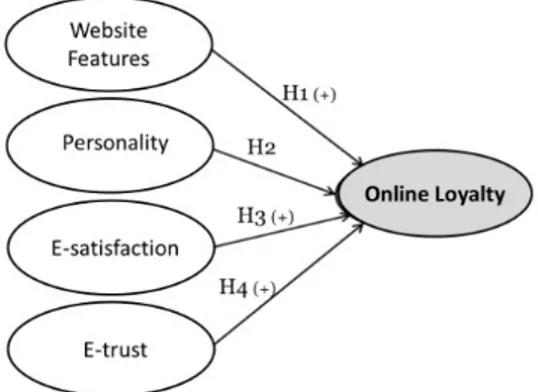
H1 – Website characteristics have a positive influence on loyalty toward Booking.com brand.
The personality of an individual is related to a wide variety of behaviors and choices, such as work performance, service quality and internet use (Yoo and Gretzel, 2011). Walczuch and Lundgren (2004) conclude from their research that personality influences e-trust and subsequently e-loyalty. To confirm the influence of personality on e-loyalty toward Booking.com brand, we have formulated the following research hypothesis:
H2 – Customer personality influences e-loyalty toward Booking.com brand.
Customer satisfaction has been associated to a diversified set of desirable consequences, of which trust, customer retention and loyalty stand out (Kotler, 2000; Reichheld, 2000a; Lin, 2007). To test this relationship between e-satisfaction and e-loyalty, we have formulated the following research hypothesis:
H3 - E-satisfaction influences positively e-loyalty toward Booking.com brand.
Reichheld and Schefter (2000a) state that to conquer customers’ loyalty in the internet, it is necessary to conquer their trust, as transactions are made at a distance and so, risks and uncertainties rise. Still, the authors add that the increase of the customers’ trust on the website platform results in a stronger brand loyalty. Trust warrants that the company will excel the consumer expectations and that he will maintain his relationship with the company. Accordingly, the more the consumers trust on the company, the higher the probability they will do business with it in the future, influencing loyalty. Finally, and considering the above, we intend to answer the following research hypothesis:
Answers to these hypotheses will allow predicting behaviors by acknowledging the determinants of loyalty toward Booking.com brand. So, based on the formulated hypotheses, we intend to estimate the following Multiple Linear Regression Model (figure 1):
Figure 1 – The antecedents of online loyalty
The target-group of this study was composed by consumers of Booking.com portal, especially all the individuals that had already made, at least, one reservation using this portal. Impossible as it is to study all the target-group, only a small part of it was studied, using a convenience sample.
Data were gathered using a questionnaire made available in Google Docs. The questions had all the answers under compulsory status, so questionnaires could not be submitted unless all the answers were filled out. This way, we gathered 105 answers from Booking.com consumers.
Publication and call to cooperation of Booking.com consumers to answer the questionnaire were made in social networks such as Facebook and Linked In, and using a database of e-mail accounts. Reminders were sent to the e-mail accounts and a systemic share in the social networks was made, recalling who had not answered yet. Only the answers received between December 1st, 2011 and March 1st, 2012
were considered.
According to Sheenan (2001), the use of the online environment allows a more precise control and improvement on the response quality, from the researcher point of view. It also allows a more swift response, with significantly fewer costs than if using other means (Schaefer and Dillman, 1998).
110
On more sensitive issues, it is important that researchers ensure confidentiality, within what is considered appropriate. Reminders also contribute to the response rate, so it is important that they enclose the questionnaire in order to increase the response rate (Schaefer and Dillman, 1998).
Gathered data were entered into SPSS 20.0 (Statistical Package for Social Sciences). A previous analysis of the data was made in order to identify errors or incoherencies. This way, two questionnaires were considered invalid for response repetition throughout the questionnaire. Thus, this research is based on 104 valid responses to the questionnaire.
Regarding sample composition, most of the individuals (58.7%) are aged between 32 and 36 years, 61.5% are women, 39.4% live alone and 32.7% belong to a household of two and live with a monthly family budget not higher than 2499.00 EUR. As for schooling, 77% of the sample has a school degree or higher.
To measure the different latent variables, scales based in the literature were used. Most of the variables were assessed through Likert scales of five points where 1 represents “I totally disagree” and 5 “I totally agree”. According to Malhotra (2003), this kind of scale allows to numerically graduate each answer, as the respondent is asked to signal his level of agreement/disagreement toward the statements.
The different variables (website characteristics, personality, e-satisfaction, e-trust and loyalty) were measured using scales based on different researches, all implemented within the internet.
Personality variable was measured according to five dimensions composing the five factors model, also known as Big Five. This model was introduced by Thurstone in 1934, although defended and promoted mainly by Goldberg (1992). He assumes that the personality of an individual may be described as a combination of five specific factors, including: neuroticism, extroversion, openness to experience, agreeableness and conscientiousness.
In what concerns e-trust, e-satisfaction and loyalty toward Booking.com brand, a scale proposed by Kim
et al. (2009) was used to study the role of e-trust and e-satisfaction in developing online loyalty.
Before being sent to the sample respondents, the questionnaire was pre-tested on 10 Booking.com users. Based on this pre-test, a set of information and suggestions was gathered and used to make some adjustments to the questionnaire.
Data gathered using the questionnaire was statistically treated. First, for each scale, a preliminary analysis was conducted on the data using ITEM-TOTAL correlations. All items showing a very low correlation between items (under 0.4) were excluded. Then, an assessment of the scales was conducted driven by reliability and validity, as referred by Malhotra (2003). Aiming to find a set of items that evinces a one-dimensional concept (or factor) the Churchill (1979) traditional approach was used. So, an exploratory factor analysis was performed, followed by an analysis of the alpha coefficients (Cronbach, 1951).
All the chi-square values obtained for the Bartlett sphericity test are significant (p<0.05), meaning that there is a good correlation between variables. Values obtained for the KMO test are all above 0.72, indicating a good suitability of the sample dimension to the items under scrutiny (Hair et al., 1998; Malhotra, 2003). So, the exploratory factor analysis continued. Table 1 shows the results from the one-dimensional study and the validity of the models used. The total variance explained equals or is above 50%, thus being acceptable (Hair et al., 1998).
Table 1: Analyses results of reliability and validity of the measurement model
Exploratory Factor Analysis Reliability Analysis Latent Variables
Number of
components Total VarianceExplain One-dimensionalevaluation Cronbach Alfa ()
Personality 4 56% Multidimensional
Openness to experience and conscientiousness 1 One-dimensional 0.858
Extroversion 1 One-dimensional 0.859
Neuroticism 1 One-dimensional 0.723
Agreeableness 1 One-dimensional 0.794
Website features 3 57% Multidimensional
Booking.com commercial offer One-dimensional 0.893
Website platform One-dimensional 0.865
Security One-dimensional 0.811
E-trust 1 64% One-dimensional 0.884
E-satisfaction 1 80% One-dimensional 0.884
112
The analysis of the properties concerning concepts one-dimension and validity has followed the recommendations by Garver and Mentzer (1999). The results are good. All concepts have evinced one-dimensionality and demonstrated to have conceptual consistency. The measurement models proposed for each concept are satisfactorily adjusted to data. So, the items of each one of the ten concepts extracted from exploratory factor analysis using the main component method were narrowed to ten new variables, using the regression analysis and were saved for future multivariate analysis and thus to test the research hypotheses.
4. Results
The techniques used to test this research hypotheses, confirmed the linearity assumptions between variables, the normality of distribution and the non multicollinearity, in association with the coefficient analysis of the Pearson correlation and estimation of the Multiple Linear Regression Model (MLRM). We continued its application and show the results below.
In Table 2, correlations statistically significant between variables can be observed, at the level of 1%, which allow predicting that independent variables will be able to explain the dependent variable of loyalty toward Booking.com brand.
Table 2 – Coefficient of Pearson’s Correlation
VARIABLE 1 P 2 P 3 P 4 P 5 W 6 W 7 W 8 E-c 9 E-s 10 L
10 Loyalty toward Booking.com
brand -0.031 0.130 -0.115 0.335** 0.379** 0.397** -0.009 0.638** 0.713** 1 **. Significant Correlation at level 0.01 (2-tailed).
*. Significant Correlation at level 0.05 (2-tailed). Caption:
1P: Personality Variable- Openness to experience and conscientiousness 2P: Personality Variable - Extroversion
3P: Personality Variable - Neuroticism 4P: Personality Variable – Agreeableness
5W: Website characteristics variable - Booking.com commercial offer 6W: Website characteristics variable - Website platform
7W: Website characteristics variable - Security 8E-c: E-trust variable
9E-s: E-satisfaction variable
10L: Loyalty toward Booking.com brand variable
Results in Table 2 evince statistically significant correlations between the dependent variable and the several independent variables in most of its dimensions.
The dependent variable of loyalty toward Booking.com brand evinces statistically significant correlations with one of the four dimensions used to assess personality: agreeableness (Pearson’s R = 0.335, p<0.01); with two out of three dimensions used to assess website characteristics: Booking.com commercial offer (Pearson’s R = 0.379, p<0.01) and website platform (Pearson’s R = 0.397, p<0.01); with e-trust (Pearson’s R = 0.638, p<0.01) and e-satisfaction (Pearson’s R = 0.713, p<0.01). Regarding the other variables: openness to experiences and conscientiousness, extroversion, neuroticism and website security, the loyalty toward Booking.com brand evinces positive correlations, but statistically non-significant.
In this study, stepwise method was used to estimate MLRM. According to Pestana e Gageiro (2005), this method has the advantage of eliminating possible problems related to multicollinearity. Such problems usually call into question the significance of estimated coefficients. This way, we present in the table below the results of the analysis using MLRM for the dependent variable loyalty toward Booking.com brand (Table 3).
Table 3 – MRLM Results: determinants of loyalty toward Booking.com brand
R Square Change Beta Coefficient T Statistics Significance Customer Personality
Openness to experience and
conscientiousness 0.038 -0.191 -2.840 0.005
Extroversion 0.030 0.453 0.652
Neuroticism -0.008 -0.115 0.909
Agreeableness 0027 0.169 2.508 0.014
Website Characteristics
Booking.com Commercial offer -0.032 -0.395 0.694
Website platform 0.090 1.212 0.228 Security -0.084 -1.250 0.214 E-satisfaction 0.508 0.716 10.375 0.000 E-trust 0.130 1.245 0.216 Model: Total R2 Adjusted = 0.560 df =103 F = 44.700, with p<0.001
H1 hypothesis predicts the positive influence of website characteristics on loyalty toward Booking.com brand. In this study, dimensions such as website characteristics were excluded from the regression model for not being statistically significant. However, coefficients of Pearson’s correlation evince statistically significant positive correlations with loyalty, for two dimensions: commercial offer and website platform. So, this study results partially support H1.
H2 hypothesis predicts that personality influences loyalty toward Booking.com brand. On one hand, this hypothesis is supported by this study, given that one of the dimensions of personality – agreeableness -
114
has a positive correlation statistically significant with loyalty (1= 0.169, t=2.508, p<0.05). On the other
hand, openness to experience and conscientiousness also seem to be capable to partially explain loyalty (1= -0.191, t= -2.840, p<0.01) evincing a negative influence on loyalty. So, agreeableness explains 2.7%
of the loyalty toward Booking.com brand, while openness to experience and conscientiousness account for 3.8%.
H3 hypothesis predicts an influence of e-satisfaction on the loyalty toward Booking.com brand. This hypothesis is supported by the study, suggesting that the higher the degree of e-satisfaction, the higher the degree of loyalty toward Booking.com brand. E-satisfaction has a statistically significant positive correlation with loyalty (1= 0.716, t=10.375, p<0.001). So, e-satisfaction explains e-loyalty in 56.8%.
H4 hypothesis predicts an influence of e-trust on loyalty toward Booking.com brand. This hypothesis is supported only by the coefficient of Pearson’s correlation, as it is observed a statistically significant positive correlation with the loyalty toward Booking.com brand. So, we consider H4 to be partially corroborated.
5. Discussion
The theoretical model of online loyalty antecedents based on the above theoretical background was tested through the estimation of a Multiple Linear Regression Model, the independent variables such as customer’s satisfaction and personality being able to explain 56% of the variation of online loyalty (R2
Adjusted = 0.560; p<0.001).
The website features did not evince the ability to explain online loyalty, though positive Pearson correlations, statistically significant, may be observed between them. As in other studies (McCole, 2002), we think that the impact of the website features in the online loyalty will be influenced by satisfaction and trust. If Booking.com portal wishes to promote online satisfaction and develop its consumer’s trust and subsequent loyalty, it will have to take into consideration crucial characteristics inherent to a website, not only to its commercial offer but to the very own portal characteristics, such as: usability, information content, design and security.
Consumer’s personality has evinced the ability to explain online loyalty. So the results confirm that the higher the level of agreeableness in consumer’s personality, the stronger his loyalty will be toward
Booking.com brand, and the higher the degree of openness to experience and conscientiousness in consumer’s personality, the less likely will he demonstrate loyalty toward the brand. To Walczuch and Lundgren (2004), individuals with high levels of agreeableness have positive beliefs toward others and appreciate their values, the others being companies/brands. Though individuals with high levels of openness to experiences tend to trust more easily, they express a low level of loyalty, as they change easily from brand to brand for being susceptible to new experiences, the authors also add.
E-trust was not able to explain loyalty toward Booking.com brand, though both evince positive Pearson correlations, statistically significant. However, marketing literature has been emphasizing trust as a critical variable to build and maintain long term relationships. A study developed by Kim et al. under this scope (2000) supports the positive relationship between trust and loyalty. Reichheld and Schefter (2000b) also refer that in order to conquer consumer’s loyalty it is necessary to conquer his trust, this aspect being particularly important on the internet, as businesses are conducted at the distance and, subsequently, the risks of uncertainty are amplified.
E-satisfaction has a strong ability to explain loyalty toward the Booking.com brand, indicating the brand is meeting consumer’s expectations. It may also mean that buying online surpasses the experience of traditional shopping. To Szymanski and Hise (2000) website design and convenience seem to play a major role when assessing consumer’s e-satisfaction, both combined with consumer’s privacy and information security; this appears to indicate that website features and trust have an impact on consumer’s satisfaction, which in turn, positively affects the online loyalty.
5. Conclusion
In sum, we can conclude that the theoretical hypothesis of this research was partially corroborated by results. Everything seems to indicate that customer’s loyalty toward Booking.com brand is, at least in part, explained by the consumer’s personality. Seemingly, there are two categories of customers: some with a clearly relational profile (nice and agreeable) that tend to be loyal, and others, with a researcher profile (open to experience and conscientious) that are likely to be less loyal. E-satisfaction and e-trust also influence the loyalty toward Booking.com brand, the results suggesting that the higher the degree of satisfaction and trust felt by consumers, the more he will tend to be loyal.
116
This research aimed to create and validate a marketing model that contributes to increase scientific knowledge and, at the same time, that could be applied in business management of companies operating in the internet.
So, at the theoretical level, this study contributes to the development of literature about relationship marketing, within the e-business context. We discovered that if Booking.com Corporation wants to promote loyalty among its customers, it will have to continue to promote a sophisticated and user friendly portal, with diversified commercial offers based on marketing customized to the personality of its customers, acknowledging from the very start that it will have customers with different personal profiles. So, at a practical level, this research contributes to help online business managers, particularly those from Booking.com, to segment their customers’ database, based on their personality and to define a web marketing strategy, based on the source of customer value.
For companies operating in online touristic services, this study provides clues on how to develop some website characteristics, bearing in mind their impact on the consumer’s behavior, as generators of e-satisfaction, e-trust and subsequent loyalty.
The results of this research allow some recommendations to brand management leaders about the online environment. While developing and managing websites, leaders responsible for the brand and platform should be very careful about the hotel offers provided, as well as to the content and form of information provided, after-sales service, design and visual elements, as they are shown to influence loyalty.
Still we emphasize the fact that if a customer is satisfied with the website, he will tend to become loyal to it. Besides, if the costumer trusts the platform, he will also tend to become loyal to it. Thus, in order for brand managers to attract loyalty, they should adopt measures to assess the levels of satisfaction and trust toward the brand.
To know customers’ personality is also crucial to perfect and substantiate strategies leading to loyalty toward the online brand. Thus, we recommend the introduction of personality as a segmentation criterion, in order to perfect loyalty strategy.
This research has some limitations. Although they may create “boundaries” when applying or using acquired knowledge, limitations represent the bases and reasons to continue researching (Childers et
al., 2001) and, in this case, to improve knowledge about the determinants of brand loyalty.
The choice of online tourism may be justified by its relevance in the Portuguese economy, its growth potential and the reduced number of studies in this domain. It may be considered a limitation of this work because generalization of results to other sectors, inside and outside the country, will always be conditioned.
To examine the loyalty determinants within a given period of time is, nonetheless, a limitation of this research, and it may be preferable to adopt a longitudinal approach. We suggest another line of research by implementing longitudinal studies aiming to research on the nature of relationships across time, between brand and customer, thus allowing a dynamic analysis about customer behavior.
The very small size of the sample of volunteers is clearly a limitation that has favored the necessary time to apply the questionnaire but has prevented the possibility of assuring a representative randomized sample of the population. Accordingly, generalizing results from this study should be considered with due precautions.
Although the sample was extracted from the Booking.com customers, it was based on a majority of answers gathered in Leiria (Portugal), a fact that may influence the application of drawn conclusions. This could also be extended to other countries because Booking.com is a global brand.
The statistical techniques used to test the research hypothesis are also limited, because they do not enable estimating the effects of mediating variables – e-satisfaction and e-trust - and the indirect effects of personality and website characteristics on loyalty. Thus, for future researches we suggest the use of structural equation modeling.
References
1.Abbott, M., Chiang, K., Hwang, Y., Paquin, J., & Zwick, D. (2000). The process of on-line store loyalty formation. Advances in Consumer Research, Provo, UT: Association for Consumer
118
2. Acar, A. S., & Polonsky, M. (2007). Online social networks and insights in to marketing communications. Journal of Internet Commerce, 6(4), 55-72.
3. Alba, J. , J. Lynch, B. Weitz, C. Janiszewski, R. Lutz, A. Sawyer, & S. Wood (1997). Interactive home shopping: consumer, retailer, and manufacturer incentives to participate in electronic marketplaces. Journal of Marketing, 61(3)3, 38-53.
4. Anderson, R. E. & Srinivasan, S. S. (2003). E-satisfaction and e-loyalty: a contingency framework.
Psychology and Marketing, 20 (2), 123-138.
5. Barrick, R. & Mount, K. (1991). The Big Five personality dimensions and job performance - a meta-analysis. Personnel Psychology, 44, 1-26.
6. Barroso, C. & Picón, A., 2012. Multi-dimensional analysis of perceived switching costs. Industrial Marketing Management. 41(3), 531–543.
7. Berry, L. (1995). Relationship Marketing of Services – Growing Interest, Emerging perspectives. Journal of the academy of Marketing Sience, 23(4), 236-245.
8. Bhatnagar, A., S. Misra & H. Rao (2000). On Risk, Convenience and Internet Shopping Behavior.
Communications ACM, 43(11), 98-105.
9. Boone, L. & D. Kurtz (2001). Contemporary Marketing. 10ª ed., Orlando: Harcourt College Publishers.
10. Cabrera, A., Collins, W. C., & Salgado, J. F. (2006). Determinants of individual engagement in knowledge sharing. International Journal of Human Resource Management,17(2), 245-264. 11. Capraro, A., S. Broniarczyk, & R. Srivastava (2003). Factors influencing the likelihood of customer
defection: The role of consumer knowledge. Journal of the Academy of Marketing Science, 31, 164-175.
12. Caruana, A., & Ewing, T. (2010). How Corporate Reputation, Quality, And Value Influence Online Loyalty. Journal Of Business Research, 63(9-10), 1103-1110.
13. Carver, C. S. & Scheier, M. F. (1992). Effects of optimism on psychological and physical well-being: Theoretical overview and empirical update. Cognitive Therapy and Research, 16, 201-228. 14. Cases, A.-S., Fournier, C., Dubois, P.-L., & Tanner, J. F. (2010). Web Site spill over to email
campaigns: The role of privacy, trust and shoppers’ attitudes. Journal of Business Research, 63(9-10), 993–999.
15. Chen, Ying-Hueih, I-Chieh Hsu, & Chia-Chen Lin (2010). Website attributes that increase consumer purchase intention: A conjoint analysis. Journal of Business Research, 63(9-10), 1007– 1014.
16. Childers, T., C. Carr, J. Peck, & S. Carson (2001). Hedonic and utilitarian Motivations for Online Retail Shopping Behavior. Journal of Retailing, 77 (4), 511-535.
17. Churchill C., & C. Surprenant (1982). An Investigation into the Determinants of Customer Satisfaction. Journal of Marketing Research, 19 (4), 491-504.
18. Churchill, A., Peter, P. (2000), Marketing: criando valor para o cliente. São Paulo, Saraiva.
19. Costa, P. T., & McCrae, R. R. (1992). Professional manual for the NEO PI-R and NEO-FFI. Odessa, Florida: Psychological Assessment Resources.
20. Cronbach, L.J. (1951). Coefficient Alpha and the Internal Structure of Tests. Psychometrika,16, September, 297-334.
21. Deighton, J. (1997). Commentary of exploring the implications of the internet for consumer marketing. Journal of Academy of Marketing Science, 25(4), 347- 351.
22. Dick, A.S. & K. Basu (1994). Customer loyalty: toward an integrated conceptual framework.
Journal of the Academy of Marketing Science,22 (2), 99-113.
23. Ding, D. X., Hu, P. J.-H., & Sheng, O. R. L. (2011). E-SELFQUAL: A scale for measuring online self-service quality. Journal of Business Research, 64(5), 508–515.
24. Doney, P., & J. Cannon (1997). An Examination of the Nature of Trust in Buyer-Seller Relationships. Journal of Marketing, 61(2), 35-51.
25. Eighmey, J. & L. McCord (1998). Adding Value in the Information Age: Uses and Gratifications of
sites on the World Wide Web. Journal of Business Research, 41(3), 187-195.
26. Eighmey, J. (1997). Profiling user responses to commercial websites. Journal of Advertising
Research, 37(3), 59-67.
27. Engel, J. F.; Blackwell, R. D. & Miniard, P. W. (2000). Comportamento do consumidor. Rio de Janeiro, LTC, 2000. 8ª edição.
28. Eroglu, Sevgin A.; Machleit, Karen A., & Davis, Lenita M. (2001). Atmospherics qualities of online retailing: a conceptual model and implications. Journal of Business Research, New York, 54(2), 177-184.
29. Eroglu, Sevgin A.; Machleit, Karen A., & Davis, Lenita M. (2003). Empirical testing of a model of online store atmospherics and shopper responses. Psychology & Marketing, Hoboken, New Jersey,20 (2),139-150.
30. Flavián, C., Guinalíu, M., & Gurrea, R. (2006). The role played by perceived usability, satisfaction and consumer trust on website loyalty. Information & Management, 43 (1-14).
31. Forgas, S., Moliner, M. a, Sánchez, J., &Palau, R. (2010). Antecedents of airline passenger loyalty: Low-cost versus traditional airlines. Journal of Air Transport Management, 16(4), 229-233. 32. Frederick, R.F. (2000). E-Loyalty: your secret weapon on the web. Harvard Business Review, 78
(4), 105-113.
33. Ganesan, S. (1994). Determinants of long-term orientation in buyer-seller relationships. Journal
of Marketing, 58 (2), 1-21.
34. Garbarino, E. & Johnson, M. (1999). The Different Roles of Satisfaction Trust and Commitment for Relational and Transactional Consumers. Journal of Marketing, 63, 70-87.
35. Garver, M.S. & Mentzer, J.T. (1999). Logistics Reseach Methods: Employing Structural Equation Modeling to Test for Construct Validity. Journal of Business Logistics, 20 (1), 33-57.
36. Gefen, D. (2000). E-Commerce: the role of familiarity and trust. International Journal of
Management Science, 28(6), 725-37.
37. Gefen, D. (2003). TAM or Just Plain Habit: A Look at Experienced Online Shoppers. Journal of End
User Computing, 15 (3), 1-13.
38. Gefen, D., Karahanna, E., & Straub, W. (2003). Inexperience and experience with online stores: The importance of TAM and trust. IEEE Transactions on Engineering Management, 50(3), 307-321.
120
40. Goldberg, L. R. (1992). The development of markers for the Big-five factor structure. Journal of
Personality and Social Psychology, 59 (6), 1216-1229.
41. Gommans, M., Krishnan, K. S., & Scheffold, K. B. (2001). From brand loyalty to e-loyalty: a conceptual framework. Journal of Economic and Social Research, 3 (1), 43-58.
42. Grove, S. & R. Fisk (2001). Service Theater: An Analytical Framework for Services Marketing. Lovelock, C., Services Marketing, 4th Edition, Prentice Hall, 83-92.
43. Gummerus, J., Liljander, V., Pura, M., & Van-Riel, A. (2004). Customer royalty to content-based web sites: the case of an on-line health-care service. Journal of Services Marketing, 18 (3), pp. 175-186.
44. Hair, J., Anderson, R., Tatham, R. & Black, W. (1998). Multivariate Data Analysis. 5th ed.
Englewood Cliffs, New Jersey: Prentice Hall.
45. He, H.; Li, Yan & Harris, L. (2011). Social identity perspective on brand loyalty. Journal of Business
Research. Elsevier B.V.
46. Heijden, H. van der, T. Verhagen & M. Creemers (2001). Predicting online purchasing behaviour: Replications and tests of competing models. Proceedings of the 34th Hawaii International
Conference System Science, Maui, HI.
47. Hernandez, J. M. (2001). Brand trust and online consumer behavior. Administração, Campinas,
SP, (25).
48. Hoffman, L., & Novak, P. (1996). Marketing in hypermedia computer-mediated environments: conceptual foundations. Journal of Marketing, 60, 50-58.
49. Huang, Lan-Ying, & Ying-Jiun Hsieh (2012). Consumer eletronics acceptance based on innovation attributes and switching costs: The case of e-book readers. Eletronic Commerce Research and
Applications, 11(3),218–228.
50. Jarvenpaa, S.L. & P.A. Todd (1997). Consumer Reactions to Electronic Shopping on the Internet.
Journal of Electronic Commerce, 1(2), 59-88.
51. Kalwani, M.U. & N. Narayandas (1995). Long-term manufacturer-supplier relationships: Do they pay off for supplier firms? Journal of Marketing,59, January,1-16.
52. Kalyanam, K. & S. McIntyre (2002). The E-Marketing Mix: A Contribution of the etailing wars.
Journal of the Academy of Marketing Science, 30 (4), 487-499.
53. Kim, Byoungho Jin, & Jane L. Swinney (2009). The role of etail quality, e-satisfaction and e-trust in online loyalty development process. Journal of Retailing and Consumer Services,16, 239–247. 54. Kim, J.; Jin, B. & Swinney, J. L. (2009). The role of etail quality, e-satisfaction and e-trust in online
loyalty development process. Journal of Retailing and Consumer Services,6(4).
55. Kotler, P. &Armstrong, G. (1999). Princípios de Marketing. Sétima edição. LTC – Livros Técnicos e Científicos Editora S.A.
56. Kottler, Philip (2000). Administração de Marketing, 10ª edição, Prentice Hall.
57. Landers, R. N. & Lounsbury, J. W. (2006). An investigation of Big Five and narrow personality traits in relation to Internet use. Computers in Human Behavior, 22, 283–293.
58. Lee, Y. & Choi, Kang (2009). Formation of e-satisfaction and repurchase intention. Expert