ABSTRACT Nutrition began its constitution as an independent profession in the 1930s. It has achieved the status of higher education in 1967. With the emergence of the Collective Health Space in the 1970s, it was verified the construction of an area of Food and Nutrition in Collective Health. Nutritionists integrate this multiprofessional field in its different spheres. To what extent does this insertion correspond to an integration into the Collective Health Space or does it persists as a subspace articulated to it? In order to partially answer this ques-tion, the characteristics of nutritionists in the postgraduate programs were analyzed from the Lattes curricula of all those that comprised the permanent framework of courses in 2010. The indicators used were: main area of activity, doctoral area, research lines and publica-tions, among others. Among the 944 professors, 42 were nutritionists (4.4%). Of these, 47.6% indicated Collective Health and 42.9% indicated Nutrition as the first activity area. Nutrition and Food was referred as the first line of research by 40.5%; and Epidemiology by 14.3%. The topic of the thesis was Epidemiology for 42.9%, followed by Evaluation (14.3%) and Social Sciences (11.9%). These findings are indicative that, although nutritionists have a place in the Collective Health Space, their positioning evidences strategies of belonging to the field of origin.
KEYWORDS Nutritionists. Public health. Health postgraduate programs.
RESUMOA Nutrição iniciou sua constituição como profissão independente na década de 1930. Conquistou estatuto de formação superior em 1967. Com a emergência do Espaço da Saúde Coletiva nos anos 1970, verificou-se a construção do espaço da Alimentação e Nutrição em Saúde Coletiva. Os nutricionistas integram esse campo multiprofissional nos seus diversos âmbitos. Em que medida essa inserção corresponde a uma integração ao Espaço da Saúde Coletiva ou persiste como um subespaço a ele articulado? Visando responder parcialmente esta indagação, foram analisadas características dos nutricionistas nos programas de pós-graduação a partir dos currículos Lattes de todos que compunham o quadro permanente dos cursos em 2010. Os in-dicadores foram: principal área de atuação, área do doutorado, linhas de pesquisa e publicações, entre outros. Entre os 944 docentes, 42 eram nutricionistas (4,4%). Desses, 47,6% indicaram a
Analysis of the insertion of nutritionists in
Postgraduate Programs in Collective Health:
identities, trajectories and position-taking
Análise da inserção dos nutricionistas nos Programas de
Pós-Graduação em Saúde Coletiva: identidades, trajetórias e tomadas de
posição
Camila Ramos Reis1, Jamacy Costa-Souza2, Ligia Maria Vieira-da-Silva3
DOI: 10.1590/0103-11042018S219
1 Universidade Federal da
Bahia (UFBA), Instituto de Saúde Coletiva (ISC) – Salvador (BA), Brasil. Orcid: https://orcid. org/0000-0001-5646-4355
2 Universidade Federal da
Bahia (UFBA), Escola de Nutrição – Salvador (BA), Brasil.
Orcid:https://orcid. org/0000-0003-4198-351X
3 Universidade Federal da
Bahia (UFBA), Instituto de Saúde Coletiva (ISC) – Salvador (BA), Brasil. Orcid: https://orcid. org/0000-0003-2518-411X
Introduction
The social process that would lead to the profession of nutritionist arose between the years 1930-1940, during the government of Getúlio Vargas1,2. Although it has originally
been a discipline of Medicine, Nutrition has historically been a relatively independent space. The first regulation of this profession occurred in 19673; its Council was
estab-lished in 19784; and, in 1991, a new law
ex-tended its guarantees5. With the emergence
of the Collective Health Space (ESC), in Brazil, in the 1970s6, it was started, within
it, the construction of a Food and Nutrition space, in view of the multiple interfaces between the two social spaces7.
This intersection between Collective Health (CH) and Nutrition occurs mainly in the scope of postgraduate and research. If in the Coordination for the Improvement of Higher Education Personnel (Capes) there is a separation between the committees that evaluate the postgraduate programs of each area, in the National Council for Scientific and Technological Development (CNPq) both are gathered in a single committee.
Furthermore, nutritionists integrated the movement for a Brazilian Sanitary Reform (RSB), whose process is intimately related to the creation of the Brazilian CH as a field of knowledge and practices8 or a specific
space with a project of becoming a field6,9.
This participation resulted in the creation, in the scope of the Brazilian Association of Collective Health (Abrasco), of a Working Group on Food and Nutrition in Collective Health (GT-ANSC), in July 200810, which
has played an important role in the discus-sion of this thematic.
Some studies on nutritional policies show that the thematic of Nutrition has occupied a secondary plan in the ESC. An example is the Fiscal Incentives Program for Workers’ Nutrition (Pifat/PAT), which, although it daily reaches more than 16 million people and involves about 19% of the Brazilian nutritionist posts11,12, is not even part of the
National Health Promotion Policy (PNPS) and the National Worker and Worker Health Policy (PNSTT)13.
Regarding the relations between Nutrition and Post-Graduation in Collective Health, despite the existence of studies on the characteristics of post-graduation in the Nutrition sub-area14-17, the inclusion of
nu-tritionists in the Postgraduate Programs in Collective Health (PPGSC) has been little investigated.
Thus, some questions have emerged: how do the teachers of the PPGSC, gradu-ated in Nutrition, integrate CH? What is the profile of the nutritionists who make up the PPGSC? Are they constituting a specific sub-space within the CH or do they keep identity with Nutrition?
Saúde Coletiva e 42,9% a Nutrição como primeira área de atuação. Nutrição e Alimentação foi referida como a primeira linha de pesquisa por 40,5%; e Epidemiologia por 14,3%. O tema da tese foi Epidemiologia para 42,9%, seguido de Avaliação (14,3%) e Ciências Sociais (11,9%). Estes achados são indicativos de que, embora os nutricionistas tenham inserção no Espaço da Saúde Coletiva, suas tomadas de posição evidenciam estratégias de pertencimento ao campo de origem.
With the purpose of contributing to fill some of these gaps, the present study de-scribes the main characteristics of the nutri-tionist teachers of the PPGSC.
Methodology
Guided by the theory of social world of Pierre Bourdieu, a cross-sectional study was carried out on the main characteristics of all the teaching nutritionists of the 55 PPGSCs who were submitted to the Capes evaluation (2007-2009). This study was part of a project that investigated the ESC and the 944 teach-ers who worked in the PPGSC in 20106,18,19.
This insertion made it possible to compare the characteristics of graduates in Nutrition with those from other professions.
The data sources were the Lattes curricula of the 42 nutritionists who made up the per-manent teacher board of the Postgraduate Programs in Public Health, in 2010.
The agents, teachers of the PPGSC with graduation in Nutrition, were analyzed from the following characteristics and indica-tors: professional trajectory and position in the ESC (institution, function and positions held); position-taking in relation to research lines and area of action (epidemiology, plan-ning or social sciences).
For purposes of analysis, the concepts of field, social space, capital, trajectory and po-sitioning were used20. Field was understood
as a field of forces and struggles with relative autonomy to transform these relations of forces and establish the legitimate rules dis-putes within it. A specific social space can be considered as a space of relations between agents located in different fields, but having common interests, related to the issues at stake21-23. It is, therefore, a more flexible
notion, which can be either a field itself, or a microcosm within it, or even an inter-fields space21. Capital is a kind of asset, a social
energy that allows its bearer to compete and fight according to the specific and authen-tic rules of each parauthen-ticular space24. And the
distribution of agents in the social space is given by the structure and volume of dif-ferent capitals, such as cultural, economic, and political capitals6. The analysis of the
trajectory allows to identify the successive positions occupied by the agents in a certain social space, in a determined time. And the relationship between the position occupied and the trajectory make it possible to iden-tify the positioning, which helps, in turn, the understanding of the structure of the field and the issues that are at stake21.
The ‘Collective Health Space’ project, which houses this study, was approved by the Committee on Ethics in Research of the Institute of Collective Health of the Federal University of Bahia (UFBA) under opinion 054/07/CEP/ISCFR167674.
Results and discussion
The position of nutritionists in the
scientific subspace of Collective
Health
Table 1. Teachers of the Postgraduate Programs in Collective Health (n and %), according to area of graduation
N %
Medicine 425 45
Nursing 62 6.6
Nutrition 42 4.4
Applied Social Sciences 35 3.7
Psychology 34 3.6
Dentistry 30 3.2
Pharmacy 23 2.4
Health Sciences 18 1.9
Social Service 10 1.1
Human Sciences 9 1
Economy 9 1
Medical Statistics 9 1
Philosophy 9 1
Law 8 0.8
History 8 0.8
Education 5 0.5
Sociology 5 0.5
Administration 4 0.4
Physical Education 4 0.4
Physiotherapy and Occupational Therapy 3 0.3
Geography 3 0.3
Political Science 2 0.2
Communication 2 0.2
Architecture and Urbanism 1 0.1
Other Medical Specialties 1 0.1
Others 164 17.4
No information 19 2
Total 944 100
Source: Own elaboration based on the Lattes curriculum (CNPq), 2010.
In view of a relatively recent field under construction, identity with CH is still a ques-tion at stake in this social space. In the same way, the nutritionists who participate in it are practically divided between desiring rec-ognition as belonging to the field and pro-tecting their identity as nutritionists. This ambivalence can be observed in the analysis
A dual performance can be observed by nutritionists, whether in the academic career – being stronger in CH – or by strengthening the profession of nutritionist, while trying to preserve their identity. In this way, it is observed the same phenomenon that hap-pened in the first area of action with the clas-sification of the area of the doctoral thesis
by the teachers. CH predominated among teachers of PPGSC, although with a percent-age of 42.6%, which shows that the majority classified the area of their thesis as out of CH. Nutritionists classified them in almost equal proportions, both in CH (38.1%) and in Nutrition (35.7%) (table 3).
Table 2. Nutritionist teachers of the Postgraduate Programs in Public Health (n and %), according to the area of activity
N %
Collective Health 20 47.6
Nutrition 18 42.9
Medicine 1 2.4
Anthropology 1 2.4
Others 1 2.4
No information 1 2.4
Total 42 100
Source: Own elaboration based on the Lattes curriculum (CNPq), 2010.
Table 3. Nutritionist teachers of the Postgraduate Programs in Collective Health (n and %), according to area of the doctoral thesis
N %
Collective Health 16 38.1
Nutrition 15 35.7
Medicine 2 4.8
Social Sciences 2 4.8
Others 1 2.4
No Information 6 14.3
Total 42 100
Source: Own elaboration based on the Lattes curriculum (CNPq), 2010.
About the subarea of the doctoral thesis, the majority classified as public health (16.4%), followed by epidemiology (16%) and medical clinic (4%). Among the nutritionist teachers, most classified as nutritional anal-ysis of the population (19%), followed by epi-demiology (16.7%) and public health (11.9%). These data may indicate that the inser-tion of teachers graduated in Nutriinser-tion into CH occurs ambivalently, which also suggests
a strong influence of the space of origin (Nutrition). This fact was also verified by reference to PPGSC teachers, graduated in other health professions, such as Dentistry25
or other health professions19. There is a
insertion movement and the search for de-limitation of a specific space.
Nutritionists are distributed in the sci-entific subfield of CH in a proportionally equivalent way to the other researchers and their presence in this field. The proportion of scholarship holder nutritionists in CNPq, an indicator of high scientific capital, was very close to that of the total number of pro-fessors from other graduations. In relation to the latter, of the 944 teachers, 244 (25.8%) had a study grant. In relation to nutrition-ists, the proportion was almost equivalent: 23.8% (out of 42 teachers, 10 had a produc-tivity study grant). However, a considerable number of agents (76.2%) were not a schol-arship holder in productivity. This fact has been related to the historical freezing of the number of study grants, due to the existence of several researchers that meet the criteria of the productivity study grants, but they do not have their requests received due to lack of CNPq resources.
Nutrition teachers had updated their Lattes curricula in less than 30 days, which is shorter than that of all the PPGSC faculty members who did the update in up to 90 days. This fact reveals the importance given by these teachers to the platform,
characterized as a relevant instrument for the scientific field.
The post-doctorate is not yet a predomi-nant activity in ESC, since almost 70% of its agents have not done it yet; the same is ob-served when it comes to nutritionists. While in CH n=300 (31.8%) of teachers already have it, among nutritionists, this percentage drops a bit, going to n=11 (26.2%).
In relation to the doctoral programs, both for CH and for nutritionists, the universities of the Southeast presented a greater number of teachers. In CH, the University of São Paulo (USP) Public Health n=117 (22.7%), the Oswaldo Cruz Foundation (Fiocruz) Public Health n=103 (20%), the State University of Rio de (UERJ) n=57 (11%), followed by the programs of the State University of Campinas (Unicamp) and the Institute of Collective Health/Federal University of Bahia (ISC/UFBA), with n=37 (7.2%) and n=27 (5.2%), respectively. In the case of nu-tritionists, most of them outstand in USP Public Health n=11 (26.2%), Uerj Collective Health n=7 (16.7%) and Unicamp Collective Health n=3 (7.1%), followed by programs of UFBA Collective Health and USP Nutrition in Public Health, both corresponded to a n=2 (4.8%) (table 4).
Table 4. Nutritionist teachers of the Postgraduate Programs in Collective Health (n and %), according to theme of the doctoral thesis
N %
Epidemiology 18 42.9
Evaluation 6 14.3
Social Sciences in Health 5 11.9
Basic Area 4 9.5
Clinical Epidemiology 3 7.1
Social Sciences 2 4.8
Clinical 2 4.8
Management 1 2.4
Others 1 2.4
Total 42 100
On the themes of the doctoral thesis, epi-demiology is individually the most frequent, both for CH and for nutritionists, and the proportion of the latter is even greater. The CH professors, for the most part, classified as epidemiology (28.8%), followed by evalu-ation (14.3%) and social sciences in health (11.9%). Nutritionists classified as epidemi-ology n=18 (42.9%), followed by evaluation n=6 (14.3%) and social sciences in health n=5 (11.9%) (table 3).
Regarding the master’s degree, most teachers of CH indicated public health as area of knowledge (31.2%), followed by CH (15.5%), Medicine (6.3%) and Preventive Medicine (5.1%), characterizing a more heterogeneous distribution for CH. In re-lation to nutritionists, there is a predomi-nance, as area of knowledge, of public health (40.5%), followed by Nutrition (9.5%), CH and social sciences (7.1%), with a consider-able number of teachers who have complet-ed master’s degree in other areas (23.8%). This fact reveals the importance of public health as the identity of PPGSC teachers, both because some consider it as synony-mous with CH18 and by the fact that some
important programs preserve the name of Public Health. Also, the dominance of the
designation ‘Public Health’ may be related to the need for international dialogue, due to the fact that equivalent disciplines and areas of knowledge are so named.
Regarding the time and university of completion of the master degree, in the years 1990-2000 (52.1%), the program that alone formed the largest proportion of masters of CH was that of USP (18.5%), followed by those who graduated in universities outside the Country (12.6%). Among nutritionists, the majority n=30 (75%) graduated between 1990-2000, at the USP (26.2%), followed by those who graduated outside the Country (11.9%) and those who graduated in the Federal University of Pernambuco (UFPE) (7.1%) and in the National School of Public Health Sergio Arouca (Ensp/RJ) (7.1%).
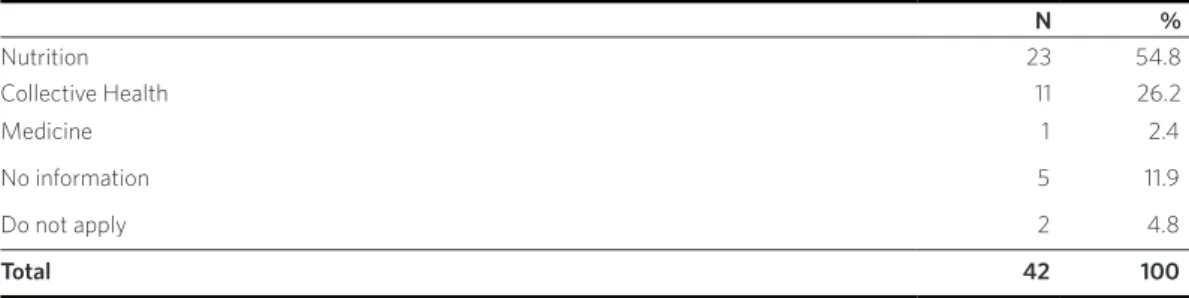
In relation to the area of dissertation of the masters, the majority of CH indicated as area the CH (36.8%) and Nutrition (3%). Specifically among nutritionists, the major-ity (54.8%) indicated Nutrition, followed by CH (26.2%), this being, perhaps, once again, a way for nutritionists to delimit their space, as a position. That is, although they are in ESC, they delimit their membership in a subspace of Nutrition (table 5).
Table 5. Nutritionist teachers of the Postgraduate Programs in Collective Health (n and %), according to the dissertation area of the master’s degree
N %
Nutrition 23 54.8
Collective Health 11 26.2
Medicine 1 2.4
No information 5 11.9
Do not apply 2 4.8
Total 42 100
The analysis of sub-areas of the masters indicates that it does not seem to be a rel-evant topic for CH agents, since a consid-erable number did not fill this information (18.9%); and, among those who informed, the majority were so dispersed that 21.1% indicated other subareas. Nevertheless, it should be mentioned that most of the teach-ers indicated public health as subarea n=156 (16.5%), followed by epidemiology n=113 (12%) and medical clinic n=32 (3.4%). For nutritionists, the majority indicated the Nutritional Analysis of Population (26.2%), followed by public health (16.7%) and epide-miology (9.5%). It can be seen that epidemi-ology appears in both subspaces, however, as previously identified, the delimitation of space for nutritionists becomes clearer when they indicate the nutritional analysis of the population as subarea. This finding reinforces the hypothesis that nutritionists try to establish themselves within CH with their own identification, either as a profes-sional category, a space of belonging or an area of knowledge.
The analysis of master’s degree disserta-tions indicates that the dominant theme is related to epidemiology (28.2%), followed by social sciences (22.5%) and planning and management area (12.8%). Among the nutri-tionists, the dominant theme is epidemiol-ogy (40.5%), followed by evaluation (9.5%) and clinical (9.5%).
In relation to the year of graduation, the majority of the CH graduated between the years 1970 and 1980. Among the nutrition-ists, the majority graduated in the years 1975 and 1990. That is, the incorporation of nutri-tionists into space is more recent than other ESC professionals.
Regarding the academic background, it was noticed that there is a similarity, both for nutritionists and for CH profes-sors, regarding the post-doctorate, the doctorate and the graduation year. For the master’s degree, many nutritionists gradu-ated between the years 1990 and 2000,
characterizing a more recent training in relation to the other agents analyzed.
As far as the academic career is con-cerned, most nutritionists are Exclusive Dedication (ED), while the data suggest that, for CH, there are a greater number of agents transiting through other subspaces, such as bureaucracy, politics, consulting and clinic.
Position-taking within the scientific
field
Almost ¾ (73.8%) of nutritionists have an ED contract. In CH, although the ED is the ma-jority, this is in a lower percentage (56.3%). And the regimen of 40 hours is more incident than among nutritionists (31.8% and 21.4%, respectively). These findings may indicate that, while the vast majority of nutritionists follow an exclusively academic career, there is a greater number of CH workers transiting through other subspaces, such as bureaucra-cy, politics, consulting, and the clinic.
With regard to research lines, a great dispersion is verified. In CH, the most men-tioned (epidemiology) is reported by only 14.7% of teachers, followed by policy, plan-ning and management (5.9%). Among the nutritionists, a greater consistency is veri-fied: there is a large proportion of teachers that indicate as main line of research themes related to nutrition and food (40.5%) – a very comprehensive designation –, followed by epidemiology (14.3%) and ‘others’ (16.7%).
The analysis of the themes of choice of the first research projects for nutritionists shows that epidemiology predominates (47.6%), fol-lowed by social sciences in health (14.3%) and evaluation (9.5%). In CH, most of the themes are also about epidemiology (23.1%).
Final considerations
CH, the option to participate in PPGSC and the indication of the CH as the first area of action by a high proportion of nutritionists are indicators of a movement aimed at integrating the latter into the ESC. On the other hand, the persistence of an almost equivalent proportion of teachers who still indicate Nutrition as the first area of activity, who have master’s and doc-toral degrees in Nutrition programs or in other areas of knowledge, characterizes a second modality of participation, which maintains the identity with the space of Nutrition. A third possibility, in cases where the first and second area of action are CH and/or Nutrition, could express an ambivalent participation, between the identification with CH and the reaffirma-tion of identity and belonging to Nutrireaffirma-tion.
The teachers graduated in Nutrition dis-tribute themselves in the diverse positions of the scientific subfield of the CH, in a propor-tional way. In the dominant pole, the ratio of research productivity scholarship holders in relation to researchers is relatively equiva-lent to that of the universe.
Although nutritionists constitute a part of the PPGSC teachers and, in the indication for the first area of action, there is a small pre-dominance of CH, the analysis pointed out that their positioning prioritizes objects linked to Nutrition. In a social space still dominated by doctors and disputed by social scientists, dentists and nurses, among others, nutrition-ists possibly seek to delimit their subspace by resorting to their identity of origin. It is pos-sible that this ambiguity will eventually affect the provisions for the struggles within the ESC, which may help to understand the lack of pri-oritization or even the absence of the themes of food and nutrition in the main agenda of the Brazilian CH. On the other hand, the double identity is part of the process of autonomi-sation of the CH field, where the loss of the professional identity of origin is ambivalent, considering that a new professional identity has not yet been consolidated18,19.
Regarding the incorporation of nutrition-ists in this space, it has been perceived that it has occurred in a gradual way, like other pro-fessions, such as the medical. When consider-ing the scientific capital, synthesized in the form of productivity scholarship of the CNPq, it is observed that the nutritionists occupy a position proportionally equivalent to the other researchers, demonstrating a certain political force for this subarea, since they have conquered/delimited some scientific spaces inside the CH, as in the case of the creation of GT-ANSC of the Abrasco, which, alongside the WG of Oral Health, has thematic associated with a professional delimitation, with 89.5% of its members being nutritionists26.
The present study presents some limita-tions, mainly because it was based only on the analysis of Lattes curricula. A better understanding of the relationships between Nutrition and CH requires the execution of investigations that incorporate other sources of data, such as in-depth interviews and doc-uments capable of allowing a more complete analysis of the architecture and dynamics of this social space and of the issues at stake. Although the data refer to the 2006-2009 evaluation, and need to be compared with those of subsequent evaluations, its impor-tance lies in making a first approximation to the subspace of Nutrition within the CH, with a systematic and theoretically oriented and compared approach with the teaching universe of the PPGSC. This study may serve as a baseline for subsequent analysis.
Collaborators
References
1. Viana SV. Perspectiva Relacional no Estudo do
Pro-cesso de Trabalho em Saúde: Contribuição Para uma Nova Abordagem a Partir do Estudo da Prática do Nutricionista no Campo da Alimentação Institu-cional. Cad Saúde Pública. 1995 out-dez;
11(4):616-620.
2. Vasconcellos FAG. O nutricionista no Brasil: uma análise histórica. Rev. Nutrição. 2002 maio-ago;
15(2):127-138.
3. Brasil. Lei nº 5.276, de 4 de abril de 1967. Dispõe so-bre a profissão de Nutricionista, regula o seu
exer-cício e dá outras providências. Diário Oficial da União. 4 Abr 1967 [acesso em 2018 jun 7]. Dispo-nível em: http://www.planalto.gov.br/ccivil_03/ Leis/1950-1969/L5276impressao.htm.
4. Brasil. Lei nº 6.583, de 20 de outubro de 1978. Cria os Conselhos Federal e Regionais de Nutricionistas, regula o seu funcionamento e dá outras
providên-cias. Diário Oficial da União. 20 Out 1978 [acesso em 2018 jun 7]. Disponível em: http://www.planal-to.gov.br/ccivil_03/Leis/1970-1979/L6583.htm.
5. Brasil. Lei nº 8.234, de 17 de setembro de 1991. Re-gulamenta a profissão de Nutricionista e determina outras providências. Diário Oficial da União. 17 Set 1991 [acesso em 2018 jun 7]. Disponível em: http://
www.planalto.gov.br/ccivil_03/Leis/1989_1994/ L8234.htm#art7.
6. Vieira-da-Silva L, Pinell P. The genesis of collective
health in Brazil. Sociol. Health Illn. [internet]. 2014 [acesso em 2018 jun 17]; 36(3):432-446. Disponível em: https://doi.org/10.1111/1467-9566.12069.
7. Vasconcellos FAG, Batista Filho M. História do campo da Alimentação e Nutrição em Saúde Cole-tiva no Brasil. Ciênc Saúde Colet. 2011; 16(1):81-90.
8. Paim JS. Reforma Sanitária Brasileira: avanços, li-mites e perspectivas. Rio de Janeiro: Fiocruz; 2008.
9. Vieira-da-Silva LM, Paim JS, Schraiber LB. O que é
Saúde Coletiva? In: Paim JS, Almeida Filho N,
orga-nizadores. Saúde Coletiva: Teoria e Prática. Rio de Janeiro: Medbooks; 2013. p. 3-12.
10. Castro IRR, Medeiros MAT, Recine E.
Alimenta-ção e NutriAlimenta-ção em Saúde Coletiva. Ensaios Diálogos Saúde Colet [internet]. 2017 jun [acesso em 2018 jun 7]; 4:40-42. Disponível em: https://www.abras-co.org.br/site/wp-content/uploads/2017/10/PDF_
ENSAIOS_COMPLETA_4.pdf.
11. Reis C, Costa J, Vieira-da-Silva LM. O programa de alimentação do trabalhador (PAT) nas conferências
de saúde do trabalhador. In: X Congresso Brasileiro de Saúde Coletiva. Porto Alegre: UFRGS; 2012.
12. Souza JC, Vieira-da-Silva LM, Pinell P. Uma
abor-dagem sócio-histórica à análise de políticas: o caso do Programa de Alimentação do Trabalhador no Brasil. Cad Saúde Pública. 2018 fev; 34(1):1-15.
13. Brasil. Portaria nº 1.823, de 23 de agosto de 2012. Institui a Política Nacional de Saúde do Trabalha-dor e da TrabalhaTrabalha-dora. Diário Oficial da União. 23 Ago 2002 [acesso em 2018 jun 7]. Disponível
em: http://bvsms.saude.gov.br/bvs/saudelegis/ gm/2012/prt1823_23_08_2012.html.
14. Araújo MDPN, Souza JC. A alimentação do
traba-lhador no Brasil: um resgate da produção científi-ca nacional. Hist. Ciênc. Saúde-Manguinhos. 2010; 17(4):975-992.
15. Olinto MTA, Lira PIC, Marchini JS, et al. Formação humana, pesquisa e produção científica na subárea de avaliação “nutrição” da Coordenação de Aperfei-çoamento de Pessoal de Nível Superior, no Brasil, de
2007 a 2009. Rev. Nutr. 2011 nov-dez; 24(6):917-925.
16. Campos FM, Prado SD, Ferreira FR, et al. Alimen-tação coletiva no campo científico da AlimenAlimen-tação
e Nutrição: reflexões sobre concepções científicas e pesquisa. Rev. Nutr. 2016 maio-jun; 29(3):425-435.
Nutri-ção publicada pela Scientific Electronic Library sob o olhar da avaliação da Coordenação de Aperfeiçoa-mento de Pessoal de Nível Superior. Rev. Nutr. 2017
mar-abr; 30(2):147-161.
18. Vieira-da-Silva LM. Gênese Sócio-Histórica da Saúde Coletiva no Brasil. In: Lima NT, Santana JP,
Paiva CHA, organizadores. Saúde Coletiva: a Abras-co em 35 anos de história. 1. ed. Rio de Janeiro: Fio-cruz; 2015. 25-48.
19. Vieira-da-Silva LM. Salud Colectiva brasilena: ar-quitectura y dinamica de un campo. In: Castro R, Suarez HJ, organizadores. Pierre Bourdieu en la so-ciologia Latinoamericana: Campo y Habitus. 1. ed.
Cuernavacas: Universidad Nacional Autonoma de México; 2018. p. 143-166.
20. Bourdieu P. Homo Academicus. Paris: Minuit; 1984.
21. Vieira-da-Silva LM, Chaves SCL, Esperidião MA, et al. Análise sócio-histórica das políticas de saúde: al-gumas questões metodológicas da abordagem
bour-dieusiana. In: Teixeira CF, organizadora. Observa-tório de Análise Política em Saúde. 1. ed. Salvador: Edufba; 2016. p. 15-40.
22. Bourdieu P. Razões Práticas: sobre a teoria da ação. Campinas: Papirus; 1997.
23. Bourdieu P. As regras da arte. Gênese e estrutura do campo literário. Lisboa: Presença; 1996.
24. Pinto L. Pierre Bourdieu et la théorie du monde
so-cial. Paris: Albin Michel; 1998.
25. Costa JB. Perfil dos Docentes com Graduação em Odontologia Pertencentes aos Programas de
Pós--Graduação em Saúde Coletiva [dissertação]. Salva-dor: UFBA/ISC; 2018.
26. Associação Brasileira de Saúde Coletiva. GT
Ali-mentação e Nutrição em Saúde Coletiva. Rio de Janeiro: Abrasco; 2018 [acesso em 2018 jul 1]. Dis-ponível em: https://www.abrasco.org.br/site/gtali-mentacaoenutricaoemsaudecoletiva.