ISBN: 1646-8929
IET Working Papers Series No. WPS06/2008
Monika Urbanowicz (e-mail: [email protected])
Concept of Customer Relationship Management as an
example of innovation
in banking sector
Grupo de Inv. “Innovation Systems” IET
Research Centre on Enterprise and Work Innovation Centro de Investigação em Inovação Empresarial e do Trabalho
Faculdade de Ciências e Tecnologia Universidade Nova de Lisboa
„Everybody talks about financial innovation,
but (almost) nobody empirically
tests hypotheses about it.”
Frame and White
Concept of Customer Relationship
Management as an example of innovation
in banking sector
Author: Monika Urbanowicz
Index
1 Innovations in banking sector _______________________________________ 3
2 Concept of Customer Relationship Management ________________________ 5
3 Benefits of introduction CRM systems _________________________________ 7
4 Technology in banking _____________________________________________ 9
5 Relations with customers in banking industry _________________________ 11
6 Customer Relationship Management as an innovation __________________ 16
1 Innovations in banking sector
The origin of word
innovation
comes from Latin word "innovatus" and means renewal or
renewed. The dictionary definition of the concept of innovation is the introduction of something
new, a newly introduced new, reform. However nowadays very often innovation is understood
only as a new product, whereas the meaning of this concept is much wider – it could be a new
service, new process, new idea or technology. Financial Innovation could be understood as
something new which is supposed to reduce costs, risk, or provide improved product, service,
that better meets needs of demand of financial market’s participants demand. The objective of
financial market innovation can be diverse, for example making the financial service offered on
the market cheaper to use, more available or of higher quality. In financial innovation we can
distinguish four following groups:
-
Product innovations – offering of non existing previously products
-
Services innovations – new methods or distribution channels
-
Process innovations – new type of production processes
-
Organization – new forms of organizations
In financial sector main entities participating in creation, implementation and taking
advantage of innovation are financial institutions, customers, regulation institutions, technology
suppliers, society as a whole, and also entities from the bank itself such as owners, workers and
managers. We can distinguish two groups of factors which create the need for innovation. In the
first, according with the principle of rationality behaviour of entrepreneurs and consumers, we
assume that they will tend to look for improved products, processes and organizational
structures. In this context investment in research and development should bring effects in the
form of more efficient allocation of capital or greater income from in financial transactions. The
second group of factors for creating the need for innovation constitute the uncertainty of future
environment, its fluctuations which in consequence generate risk. Most of the companies tend to
eliminate or minimize risk in their businesses, that is why they regard it as a cost, what in
consequence arises the need for innovation. Innovation can be introduced both as a result of
deliberate and formal actions or ventures of the research and development departments.
The introduction of innovation is usually a highly risky action, especially in the financial sector,
because of the threat of easy imitation. This is related to the intangible nature of the service, very
high costs related to the introduction of new technologies, growing speed of its changes, the
necessity of ensuring high security and competition of the banking sector. Due to all of this
factors, it is particularly important to protect know-how, trademarks or patents. Research shows
that there is very high risk of failure of introduction of innovation and small percentage of ideas
which are chosen to be introduced.
The crucial factor in the process of introducing innovations should be customers needs
and expectations. Innovations not only influence particular group of customers, by due to social
needs of each person to be understood and accepted among others, it can influence consumption
of banking services related to this innovation among other groups. Innovative banking services
can become symbols of consumption. The more wealthy becomes the society, the biggest need
arises to differentiate itself among people, to achieve the consumption level of groups of higher
social hierarchy and imitate the reference groups. During the initial stage of introducing banking
service, there is very important role of demonstration which influences the spread of innovation
and after some period of time enables general acceptance for the service.
The intangibility of banking services causes that their quality is usually related to image
of the bank and attitude and behaviour of bank’s employees. Although new distribution channels
dynamically appear, the most important decisions still require personal contact. Customers
expect more and more financial advices and individual attitude towards them. High competition
in banking sector implies that it is not enough for banks to compete only through new types of
services. Especially important for them to provide at the same time both elements – innovative
2 Concept of Customer Relationship Management
The concept of Customer Relationship Management has its roots in relationship
marketing. The following figure presents the triangle showing differences between those terms.
Figure 2.2
Customer Relationship Management
Relationship marketing brought new approach to relations with customers, creating at the
same time new market assumptions. CRM is a business strategy focused on maximizing
shareholder value through winning, growing, and keeping the right customers. We can
distinguish here two important elements. First of all, concentrating on the most important from
company’s perspective customers and second of all retaining long-term relationship with them.
That is why it is essential to collect consequently customers’ opinions, complaints and new
needs. In this way it is possible to approach a client more individually, and make them feel
important for the company, because each company is worth as much as customer values it.
Satisfied client will also recommend company’s products to their friends. Therefore the main
challenges are:
·
building long - term partner relations with customers,
·
identifying and focusing on the most significant customers,
In developing CRM strategies whole organizations should be engaged. It includes adequate
approach in terms of sales, marketing and customer support. A truly comprehensive picture of a
customer might include information collected by sales partners, suppliers or collaborative service
deliverers. When company limits whole its attention only to operational activities, it can decrease
communication between business and customer.
Initial CRM implementations should be based on adequate information and perspective about
customers and the firm’s demand environment. Once implemented, CRM should allow
organizations to see beyond the boundaries of the internal enterprise, and collect, analyze, and
leverage such insight. It should include following issues:
·
understanding markets and customers (gathering market information, selecting target
markets),
·
ability of dealing with different customers in different ways,
·
focusing on one-to-one relations by satisfying needs of individual customers,
·
developing an offer (selecting products, positioning, differentiating),
·
providing customer care (delivery process, service process, support, loyalty programs).
According to M. Stanusha, the main purpose of the concept from this perspective should be
achieving such state, when high – profitable customers, each time they have a specific need, they
would see only one company, that could satisfy it. It is big challenge, however possible thanks to
good communication with customer. CRM systems enable any representative of a company to
remember who they are talking to, no matter what the transaction might be. It is essential to get
to know all the processes used by potential customer to create value. J.Otto said that company
which wants to follow rules of CRM concept should use all the means in order to precisely get to
know these processes. It should also concentrate on retaining mutual trust between company and
customer. The product itself is important, but it is not enough just to produce it, advertise and
find recipients. In order that customers keep it in conscience, it is important also to take care of
such things as additional service, such as transport, insurance and guarantee. Such activities help
to consolidate this relationship and attach customer to the company. CRM enables to
differentiate products by adding new dimension, where even mass-produced products can differ
with type of relationship which company has with its customers. So there is no point on
strong and long – term relationship with customer. The shift to customer-centricity has
implications for the entire organization, requiring changes in company’s business culture,
processes, and supporting systems. However to get full benefits, it is necessary to create
interactions which are based on trust between both parties and aim to mutual improvement of
this relationship.
Summing up, CRM as a strategy focuses on building and consolidating a loyal group of
regular customers, through constant satisfying of their needs and even going beyond these needs
and individual preferences. In order to achieve this goal it is necessary to build strong
relationships with those customers based on mutual trust.
3 Benefits of introduction CRM systems
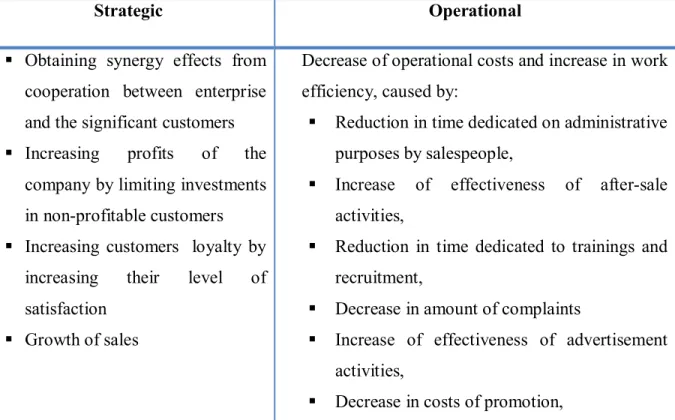
J. Otto divides benefits of introducing CRM systems into two categories: strategic
benefits and operational. Following table presents the lists of those benefits.
Table 2.2
Benefits of introducing CRM systems
Strategic
Operational
§
Obtaining synergy effects from
cooperation between enterprise
and the significant customers
§
Increasing profits of the
company by limiting investments
in non-profitable customers
§
Increasing customers’ loyalty by
increasing their level of
satisfaction
§
Growth of sales
Decrease of operational costs and increase in work
efficiency, caused by:
§
Reduction in time dedicated on administrative
purposes by salespeople,
§
Increase of effectiveness of after-sale
activities,
§
Reduction in time dedicated to trainings and
recruitment,
§
Decrease in amount of complaints
§
Increase of effectiveness of advertisement
activities,
§
Saving time of work of employees in
promotion department,
§
Possibility of full control budget dedicated
for promotion,
§
Estimating effectiveness of particular
promotion departments,
§
Control of work of sales departments through
estimating
state
of
negotiations
with
particular customers in whole company,
§
Identifying customers with whom
negotiations has stopped in some deadlocks
§
Possibility of evaluating salespeople by:
-
Amount of acquired potential customers
and its relation to the amount of acquired
orders,
-
Amount of new contracts concerning
new and regular customers,
-
daily, weekly and monthly contacts with
customers,
-
contacts with customers taking into
consideration its type (visits, telephones,
letters),
Nowadays more and more companies decide to introduce CRM systems in their companies.
Main factors which facilitate this process and cause its popularity are:
·
increase of computing power of computers,
·
decreasing costs of buying computers,
·
increasing possibilities of gathering information by computers,
·
decreasing costs of storing data,
·
arability of more and more advanced tools for data analysis, data mining or methods for
·
growth of e-commerce and ways of interacting with customers via internet, due to which
the cost of such interactions is much lower than in case of traditional ways,
·
increase in awareness of importance of current customers’ behavior and importance of
customer lifetime value,
·
increase of complexity and improvement of marketing approaches, including one-to-one
marketing, permission marketing and mass customization,
CRM systems can be used in various types of organizations. However how much company will
benefit from such systems depends among other things on level of its customer – orientation and
characteristics of its branch. In high – competitive sectors CRM systems are especially useful,
because due to equal level of technology and similar offer of products the only field to compete
between companies operating in such sectors is customer service. We can mention here such
sectors as: motor industry, telecommunication, banking, consulting, but also CRM systems
become more and more popular in such organizations as universities, health centre and many
others. This class of systems is also good for coordinating activities of organization, which is
spread geographically in form of networks.
4 Technology in banking
Every day banks have to take many accurate decisions. In order to decrease the risk associated
with them, they need to have reliable information. For that purpose they mostly use data warehouses, in
which they store all data necessary for conducting business – both those concerning customers’ behavior,
which enable storing all information in one place and evaluation of customer’s risk and those which
enable real-time reaction to events on financial markets. For many banks, there exists serious problem of
information quality. The main reason for that is the low quality of transactional systems, mainly lack of
enough care about data accuracy. However since the size of information is growing, it takes more and
more time for analytics to analyze them. That is why there is urgent need for good IT software that could
solve those problems. 10 years ago, very popular in banks were easy to introduce, departmental systems.
In the moment when the banks started growing, it often turned out that each department has different
system for risk management and information about customers was not uniform. And then the banks had to
period of centralized solutions, new requirements for IT systems appear, such as open architecture, which
arise from the business need of introduction specialized solutions, for example for credits or selling
systems, and also the need for integration of systems among given financial group. Main attention in
banking sector is put to the systems which enable better usage of customer information and preparing the
best offer for them. According to many specialists, the most popular are systems using Business
Intelligence, such as CRM systems or decision assistance.
Financial institutions develop customer relationships across a broad spectrum of touchpoints
-branches, kiosks, ATMs, internet, PDA, emails, electronic banking, smart cards, call centers, and phones.
Additionally CRM systems use various technologies for customer management applications, for example
Siebel, Peoplesoft CRM, Oracle CRM, Pivotal, database technologies and architectures such as for
example Oracle, Sun, Microsoft. It is very difficult to measure positive impact of technology in banking
sector. The main reason for that is the fact that very often it provides intangible benefits, such as
customer’s satisfaction, for example after introduction of ATMs machines, the expected reduction of
branch cost was not accomplished but instead significantly increased the number of customer
transactions and customers’ satisfaction. The same characteristics had Internet Banking. At the
beginning managers thought that it will be a lower-cost delivery channel and a way to increase sales.
Studies have now shown, however, that the primary value of offering Internet banking services lies in
the increased retention of highly valued customer segments. According to P.A. Dabholkar, when
customer is in direct contact with the technology, bank can have greater control, on what they are
doing. On the other hand, if there is an absence of direct contact, such as for example in case of
telephone banking it is assumed that there is less control perceived by the customer during this
transaction. When a consumer freely chooses to use technology as a form of service delivery the impact
on their satisfaction is high. Moreover Weatherall claims that consumers have positive perception of
technology based services since they believe technology will deliver a faster and more efficient service
than that of the employee. However customers put also much attention to efficiency and speed of those
services. In some countries with developed systems of electronic banking arose even special sector
-electronic private banking (e-private banking), which takes care about providing specialized services,
5 Relations with customers in banking industry
Banks are increasingly developing various marketing strategies in order to develop a competitive
advantage that provides customers with superior value compared to competitive offerings. Nowadays
there are more and more marketing oriented banks, using IT systems that are focused on individual
customers. Very often banking staff dealing with a current account know that the account holder had
already a mortgage, credit card and unit trust with the bank. Financial institution using its greatest asset,
which is huge knowledge about their customers, can gain their competitive advantage by retaining those
customers who represent the highest lifetime value and profitability. Increasing competition,
deregulation, and the internet have all contributed to the increase in customer power. There is almost
no barrier for customers to switch to another bank, when they find their offer more appealing.
Customers’ expectations are all the time significantly rising. Customers care now more about the choice
than about brand and they expect consistency across multiple channels or "touch points”. Therefore
retaining customers has become one of the major challenges for financial institutions.
Banks take part in flow of capital between various entities. We can distinguish three types of
bank customers: natural persons, business entities and institutions, which either look for beneficial and
safe deposit of their money resources or need to borrow some money to finance their consumption or
production needs. Natural persons usually have surplus of resources, because they often save them to
cover future needs. On the other hand business entities usually have deficit, because they receive
profits only after some time and must buy production factors. Additionally they usually are not able to
invest only using their own resources and must for that purpose they take out bank loan. However
customers among each of the following groups vary significantly, they all have their own specific needs
and preferences, they are also aware of the strong position, which they have on the market. Nowadays,
bank customers not only expect individual approach, but they also take it for granted. They tend to
adapt to new technologies and environmental changes much quicker than banks themselves. Especially
in retail banking, if bank does not know how to satisfy its customers, there will be some other one that
will able to do it. For example, when new and modern bank appears on the market, it takes some
customers from existing more traditional banks, which can’t or don’t make the effort to follow the
needs of their modern and demanding customers. Nowadays the crucial term in retail banking is the
relationship, and not the price or even the quality. Following figure presents how customer’s lifecycle
Figure 1.5Bank customer’s life cycle
Banks belong to group of businesses, which possess extended information about their customers. However in many cases collected information is not further effective used and analyzed. The common problem in many banks is that, this information is spread in many different places and very often stored in various formats, grouped according to their origin, products or organizational structure. Sometimes there is no flow of data between some departments, so there is stored a lot of redundant data. So the main source of problem is not lack of collecting data, but inability to process it. The good knowledge about customers is very crucial and enables - when it is effectively analyzed using business intelligence - to create right proposal in right time for right person using right distribution channel. The main sources of creating information about customers are their profiles, history of operations, contacts and activities, list of transactions, preferences and tastes, complaints, events, or information searched on bank’s web page. We can distinguish eight main fields of bank customers’ expectations:
a)
Reliability – in case of banks reliability is extremely important. Customer expect that
the service which they receive will be exactly in accordance with bank’s offer
b)
Responsiveness – they expect that bank employees will be always willing to help
them and solve their all doubts. They expect precise and proper answer for their
problems.
c)
Appearance – bank should appear as a professional and trustworthy place in which
customer can leave their money safely. The same things concern the image of bank
employees.
d)
Accessibility – they expect that bank and their employees will be available always in
e)
Competence – they expect bank employees to have enough professional knowledge
which is mandatory to explain them all the technical details and implications of the
services which they are going to buy.
f)
Courtesy – bank’
s customers expect that employees will be always friendly to them
and will behave with respect towards them.
g)
Features – they expect to get some additional features such as for example ATM card
while buying specific bank’
s service
h)
Clarity – they expect clear and easy to understand language from bank employees.
Customers want communication directed to them to be clear.
Specificity of financial institutions implies that one of the main issues for customers is trust directed
toward banks. Bank has to be reliable and stable institution in which customer feel safe to leave their
money. The crucial thing in the process of creating bank’s customer loyalty is providing high standard
service that meets customer expectations. Following steps can be summarized below: