ARE CELEBRITIES MEDIATORS FOR NEGATIVE SPILLOVER? AN EMPIRICAL STUDY.
David Maximilian Hassler #761
A Project carried out on the Marketing Field Lab – Children Consumer Behavior, under the supervision of Luisa Agante
January 6th, 2012
Abstract
The aim of this research is to investigate if a celebrity can be a mediator between two brands so that a negative event happening to one brand can spill over to a completely unrelated brand, which shares with the first brand only the celebrity endorser. Even though celebrity endorsement is a popular marketing strategy and celebrities often endorse multiple brands, so far there has not been any systematic study on this topic. Drawing on Associative Network Theory and the Meaning Transfer Model as theoretical framework, this research finds out that negative publicity about a brand can spill over and thereby not only hurt consumers’ attitude toward the celebrity endorser but also toward a second brand that is endorsed by the same celebrity. An unexpected finding is that celebrities can act as a protective shield for brands by weakening the direct impact of negative publicity.
Keywords
Celebrity Endorsement, Negative Spillover, Negative Publicity, Meaning Transfer Model, Associative Network Theory
1. Introduction
In 1893, Lillie Langtry advertised a pack of soap, which became the first example of a celebrity endorsement (Mistry, 2006). Ever since then, billions of dollars are spent each year on celebrity endorsement contracts to have branded products supported by famous faces (Junokaite et al., 2007). Celebrities play an important role in the advertising industry (Amos et al., 2008; Junokaite et al., 2007). Research has found, that in western countries such as the United States or the United Kingdom approximately 25% of all TV advertisements include a celebrity; and these celebrities are present in every kind of media (Erdogan et al., 2001; Junokaite et al., 2007; Mistry, 2006). Some celebrities even endorse multiple brands, like Lionel Messi (e.g. Adidas, Pepsi Co., Konami, Audemars Piquet, Chery Automobile and Air Europa), Shaun White (e.g. Red Bull, Target, Burton and Oakley) or Lewis Hamilton (e.g. Hugo Boss, Abbey National Bank, TAG Heuer, Reebok).
By choosing celebrity endorsers to promote their brands, companies expect not only an increase of awareness but also a benefit through a transfer of the celebrity’s positive image toward the endorsed brand (Atkin and Block, 1983; Erdogan et al., 2001; Hofmann and Heidemann, 2011).
Nevertheless companies also face a risk using celebrity endorsers, because not only the positive image, but also negative information about the celebrity can affect the endorsed brand (Till and Shimp, 1998). Some incidents, like Tiger Woods’ sex scandals or Wayne Rooney’s affairs with hookers, even lead to an early termination of the contracts, 1 because brands are afraid these negative associations would spill over and destroy their positive image (Till and Shimp, 1998). On the other hand celebrities
1 Accenture ended the contract with Tiger Woods in December 2009; Wayne Rooney was dropped by his
deliberately choose their promoted brands in order to manage their own image, which can be influenced by endorsements (Till, 2001).
Bearing in mind that in today’s marketplace an increasing number of brands are affected by negative publicity (Xie and Peng, 2009), is it a reasonable concern of endorsing celebrities to consider if such incidents affect their own image? And furthermore, should brands that use the same celebrity endorser as a brand involved in a scandal be worried that these negative associations spill over to their own brands?
The goal of this study is to find out if negative publicity toward a brand will spill over to the endorsing celebrity and via the celebrity to a second brand that is endorsed by the same celebrity but has, besides this connection, nothing in common with the negatively affected brand.
The models that will be introduced explain how associations in general are transferred between entities. Negative publicity is chosen to explore the spillover, because the increasing number of companies that engage in corporate social responsible actions shows the growing concern of a misrepresentative brand image (The Economist, 2008). Additionally, negative information has a higher weight in consumers’ minds than positive information so that it is more likely to spill over to other entities that are connected to the scandalized brand (negativity effect) (Mizerski, 1982; Roehm and Tybout, 2006).
Extant research has already analyzed consumers’ reactions toward negative publicity of a directly affected brand (e.g. Ahluwalia et al., 2000; Dawar and Pillutla, 2000; Pullig et al., 2006). Others have investigated the effect negative publicity has on indirectly affected brands, such as brands in the same portfolio (e.g. Lei et al., 2008), brands in brand alliances (e.g.Votolato and Unnava, 2006) and competing brands (e.g. Cleeren et
al., 2008; Dahlén and Lange, 2006; Roehm and Tybout, 2006; Van Heerde et al., 2007). Most of the studies found a significant effect, even on the indirectly affected brands. But up until now, there has not been any research that investigates if negative publicity has an effect on a brand that is indirectly related to the focal brand only via the same celebrity endorser.
Concerning celebrity endorsement, there has been a lot of research, too. Erdogan (1999), Amos et al. (2008) and Erfgen (2011) give an overview of this literature. Most of the articles study the effect that an endorser has on the brand (e.g. Seno and Lukas, 2007; Spry et al., 2011) and the factors that are crucial for an effective celebrity endorsement (e.g. McCracken, 1989; Mowen and Brown, 1981; Silvera and Austad, 2004). Only a few papers consider the impact an endorsement campaign has on the celebrity (e.g. Doss, 2011; Seno and Lukas, 2007; Till, 2001; Votolato and Unnava, 2006). Some researches investigate the spillover effect on brands in case a celebrity endorses multiple brands (e.g. Mowen and Brown, 1981; Tripp et al., 1994; Um, 2008). There has not been any research in how celebrities transfer associations from one brand to another when doing multiple endorsements. This research is a first attempt to close this gap.
2. Literature Review and Hypotheses
This study examines whether or not a celebrity serves as a mediator for spillover of negative publicity that occurs to one of his or her endorsed brands. More specifically, it studies if a diminished attitude toward an endorsed brand caused by negative publicity spills over to another brand, which is connected only through the same celebrity endorser.
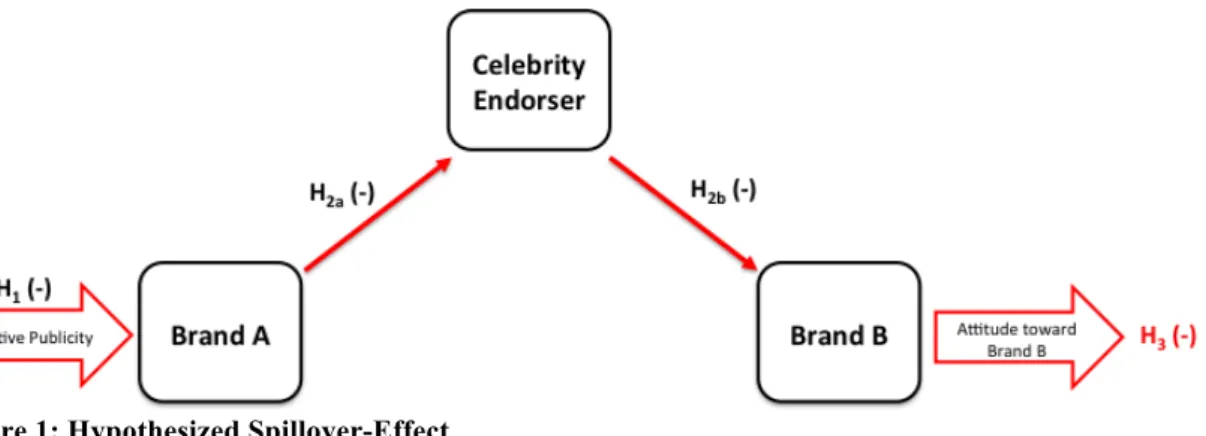
Figure 1: Hypothesized Spillover-Effect
Figure 1 illustrates the proposed spillover effect. First it has to be assessed that negative publicity affects the attitude toward a brand, which has been researched extensively over the past decade (e.g. Ahluwalia et al., 2000; Dawar and Lei, 2009; Dawar and Pillutla, 2000; Pullig et al., 2006). The vast majority of the studies identifies that negative publicity is likely to damage the evaluation of the brands.
Hence, Hypothesis 1 is derived as follows:
H1: Negative publicity about a brand will have a negative impact on consumer attitude
toward this brand.
Next, the relation between celebrities and brands will be discussed. A celebrity endorser can best be defined as “any individual who enjoys public recognition and who uses this recognition on behalf of a consumer good by appearing with it in an advertisement” (McCracken, 1989, p. 310). Similar to a brand, a celebrity possesses a distinct set of meaningfully related associations (Meyers-Levy, 1989; Thomson, 2006).
Two theories will be introduced to illustrate how these associations can spill over from the brand to the celebrity and vice versa, the Meaning Transfer Model by McCracken (1989) and the Associative Network/Learning Theory (Anderson, 1983; Collins and Loftus, 1975; Till, 1998).
McCracken’s (1989) Meaning Transfer Model illustrates in three stages, how celebrities acquire their meanings (associated attributes), how the meanings associated with the celebrity endorser transfer to the branded product and ultimately to the consumer.
The first stage describes how celebrities obtain their detailed and powerful meaning. The celebrities’ roles in television, movies, sports or other careers are like large advertising campaigns, in which they get in contact with a number of objects, persons and contexts, which give them meanings that then reside in the celebrities. In short, celebrities gain meanings out of every single endorsement (McCracken, 1989). Doss (2010, p. 8) supports this conjecture in his findings by stating that “the perceived attitude of an endorsed brand influence[s] the perception of the celebrity endorser”. In the second stage, the meaning linked to the endorser transfers to the brand, which then becomes associated with it in consumers’ minds. Marketers often use additional objects, contexts and people in their campaigns to cue the consumer’s mind to the desired meanings (associated with the celebrity) that they should transfer to the brand (McCracken, 1989).
The last stage explains how consumers build their identity upon the meanings associated with the brand. Further details will not be provided, since it is irrelevant for this study.
The Associative Network Theory assumes that each individual’s memory has the structure of an associative network, which consists of patterns of nodes connected to each other (Anderson, 1983; Collins and Loftus, 1975; Till, 1998; Till and Shimp, 1998).
Brands and celebrities are also nodes, which establish a connection to each other during the advertising campaign, a process called associative learning (Collins and Loftus, 1975; Till, 1998). When an associative link between the two is formed, the celebrity becomes part of the brand’s set of associations and vice versa (Till, 1998). Through ‘spreading activation’, this link is now being activated whenever a consumer thinks about the brand or the celebrity and the entire set of associations toward both is being retrieved (Anderson, 1983; Collins and Loftus, 1975).
A requirement for both theories to explain the spillover is a sufficiently strong associative link or high fit between the celebrity and the brand (Till and Busler, 1998; Till and Shimp, 1998), which can best be described by the Match-Up Hypothesis (Kamins, 1990). For a successful meaning transfer, the celebrity and the brand must have an inherent match or congruency (McCracken, 1989). Similar conditions apply for the spreading activation to work: The link between both concepts has to be sufficiently strong (Till and Shimp, 1998). Therefore, the characteristics of the celebrity should fit to the determinants of the brand in order to connect both in consumers’ minds (Till and Busler, 1998).
But it is not only important to fit the celebrity to the brand and vice versa, additionally the celebrity has to carry a certain amount of source credibility (Ohanian, 1990). The
Source Credibility Model helps to establish an effective celebrity endorsement by
ensuring that the celebrity possesses three principles: trustworthiness, expertise and attractiveness (Ohanian, 1990). Trustworthiness describes the level of confidence and trust in the endorser and his or her message (Ohanian, 1990). “Expertise refers to the perceived level of knowledge, experience, or skills possessed by an endorser” (Um,
2008, p. 106). Attractiveness refers to the outer appearance and has a major influence on an individual’s initial judgment of the celebrity (Ohanian, 1990).
Provided those conditions, it can be hypothesized that, if a brand creates negative publicity, consumers’ derived negative associations toward the brand will firstly spill over to the celebrity. Thus the celebrity’s image will worsen. As a second step, the badly influenced image of the celebrity will be transferred to the second advertised brand through the strong associative link between them.
Therefore hypotheses 2a and 2b are as follows:
H2a: Given a credible celebrity endorser and a sufficiently strong associative link (fit)
between brand A and the celebrity endorser, diminished consumer attitude toward brand A will spillover to the celebrity.
H2b: Given a credible celebrity endorser and a sufficiently strong associative link (fit)
between the celebrity endorser and brand B, diminished consumer attitude toward the celebrity will spill over to brand B.
An extension of the Associative Network Theory is the Accessibility-Diagnosticity Framework by Feldman and Lynch (1988). Accessibility, similar to the Associative Network Theory, refers to how sets of associations reside in a network and are activated via spreading activation when the links between them are strong (Roehm and Tybout, 2006). Diagnosticity depicts if one node is informative about (diagnostic for) another node and if so, that observations about one node will be inferred to also apply to the other node (Roehm and Tybout, 2006). Applying this idea to the spillover of negative publicity, spillover will occur when the second brand is accessed through the network of nodes of the focal brand. An illustration of this concept is the case of a car brand being involved in negative publicity about unintended acceleration problems with one of their
models. Consumers could assume that a second model from the same manufacturer could have the same problems because both models are produced by the same manufacturer. In this case the first model is diagnostic for (informative about) the second model. The manufacturer establishes an associative link between the two models.
This implies, it has to be ensured, that brand A and brand B in the upcoming experiment must not be related, otherwise the predicted change in attitude toward brand B are due to an associative link between brand A and brand B and not due to the same endorsing celebrity.
Taking into account this constraint, Hypothesis 3 summarizes the studied spillover effect:
H3: Given that brand A and brand B are not directly related (no associative link), the
weakened associations of brand A will only spillover to brand B via the celebrity endorser (mediator).
3. Methodology
To test our assumptions a 2 (negative publicity/no publicity) x 2 (celebrity/no celebrity) between-subjects design was conducted. A total of 435 people from 30 different nations across the world participated in the final experiment through an online survey. The sample is composed of 53% male and 47% female adults of all ages. The biggest represented nation is Germany with 181 participants. Additionally, 60 German university students participated in the pretests.
3.1 Materials
In order to generate the stimuli for the main study, three pretests were run to select an appropriate celebrity and two appropriate brands.
Pretest 1.2 In the first pretest, the credibility of four international well-known celebrities
was tested in regard of possible product categories. The four celebrities included the two athletes, Cristiano Ronaldo and Roger Federer, the singer Katy Perry and the actor George Clooney. A total of 20 university students evaluated the credibility (trustworthiness, expertise and attractiveness) of the celebrities using 7-item 7-point semantic differential scales (Tripp et al., 1994; Till and Shimp, 1998). Higher numbers on a scale represent a more positive evaluation of the credibility and a participant’s evaluation of credibility is composed of the average of the seven scales measuring this variable. George Clooney and Roger Federer were perceived as the celebrities with the highest credibility (mean = 5.94 and mean = 5.49, respectively) followed by Katy Perry (mean = 4.43) and Cristiano Ronaldo (mean = 3.81). Roger Federer was chosen because interviews with participants revealed that he has fewer existing associations (links to various nodes like e.g. other advertised products) compared to George Clooney. This amplifies the linkage strength of any link, including the link to two fictitious brands that was intentionally established for the purpose of this study, and thus enhances the possibility of spillover (Lei et al., 2008).
Pretest 2 & 3.3 The two product categories, on which Roger Federer’s (R.F.) credibility
was tested (pretest 1), were a sports brand and a coffee brand. Therefore, two carefully elaborated fictitious brands of these categories, a sports brand named ‘Halma’ (H.) and a coffee brand named ‘Caffè Serenità’ (C.S.), were designed and tested upon their appropriateness for the experiment. This was done with a second and a third pretest, to ascertain a good fit between the celebrity and each of his two endorsed brands (Pretest
2) (cf. Match-Up Hypothesis) as well as no fit (no direct associative link) between the
2 For more details of Pretest 1 please refer to Appendix 6.2.1.1 in Booklet II.
sports brand and the coffee brand (Pretest 3) (cf. Accessibility-Diagnosticity Framework).
In pretest 2, 20 university students evaluated the fit between Roger Federer and the fictitious brands on 7 items using 7-point semantic differential scales (Simmons and Becker-Olsen, 2006). Higher numbers on a scale represent a more positive evaluation of the fit and a participant’s evaluation of fit is composed of the average of the seven scales measuring this variable. For both brands the connection between the celebrity and the brand was perceived as clearly suitable (meanFit R.F. and C.S. = 4.96 and meanFit R.F. and H. = 6.09).
In pretest 3, another 20 university students evaluated the fit between the two fictitious brands on 2 items using 7-point semantic differential scales (Simmons and Becker-Olsen, 2006).4 Similar to the previous two pretests higher numbers on a scale represent a more positive evaluation of the fit and a participant’s evaluation of fit is composed of the average of the two scales measuring this variable. As desired, this pretest revealed that there was no evident fit (no direct associative link) between the two brands (meanFit C.S. and H. = 2.1).
3.2 Measures
Brand attitude can best be defined as consumers’ overall evaluation of a brand. It represents the major part of brand image and often forms the basis for consumer behavior (Keller, 1993). Therefore, the dependent variables of interest were attitude toward the brand and attitude toward the celebrity endorser.
Attitude toward the brand was measured on 7-point semantic differential scales (good/bad, favorable/unfavorable, desirable/undesirable, nice/awful, high quality/low quality) used in a prior study of Votolato and Unnava (2006).5
Attitude toward the celebrity was measured on 7-point semantic differential scales (good/bad, like/dislike, pleasant/unpleasant and nice/awful) used in a prior study of Misra and Beatty (1990).6 According to prior procedures higher numbers on a scale represent more positive attitudes and a participant’s evaluation of attitude is composed of the average of the scales measuring each variable.
3.3 Procedure
In the experiment participants were randomly assigned to one of four different groups (see Table 1). Experimental Design Negative Article on Halma No Negative Article on Halma
Celebrity Group 1 Group 2
No Celebrity Group 3 Group 4
Table 1: Overview of the Different Groups
Group 1 was introduced to the celebrity endorser Roger Federer and to his endorsement campaigns with Halma and Caffè Serenità. This included three realistic print ads for each endorsement campaign, showing Roger Federer with the brand. Next, they were shown a newspaper article with negative moral information on the brand Halma. Subsequently, participants were asked to evaluate their attitude toward each of the two brands and toward Roger Federer.7
5 Adjustment of 9-point scales to 7-point scales for a uniform questionnaire. 6 Adjustment of 5-point scales to 7-point scales for a uniform questionnaire.
Group 2 received a similar survey but was not confronted with the newspaper article.8 The intention behind questioning these two groups is to assess the difference in evaluation with or without negative publicity.
Group 3 was only introduced to the two brands and the negative newspaper article on Halma, without any connection to Roger Federer. 9 Again, group 4 received a similar survey as group 3, but without the newspaper article on Halma.10 In both groups participants were subsequently asked to evaluate their attitude toward the two brands. These latter two groups were to control if the possible negative spillover (different evaluations of Caffè Serenità between group 1 and 2) might only be caused by a general negative mindset of the participants, which might have evoked through the negative setting of the negative article. At the end of each survey, demographics were collected. Additionally, group 1 and group 2 evaluated the appropriateness of the endorsements. This is done in order to control for biased responses. Consumers could figure that Roger Federer would never endorse the tested fictitious brands because of his existing endorsements of competitor brands in reality. Furthermore, by checking the appropriateness, an even stronger link between Roger Federer and each of the two brands could be ensured. Appropriateness was measured on two 7-point semantic differential scales (appropriate/inappropriate, effective/ineffective) used by Till and Shimp (1998) in a prior study. A test person’s evaluation of appropriateness is composed of the average of the two scales measuring this variable.
Before launching the surveys, they were pretested on 12 university students to ensure they were clearly comprehensible and effective.
8 For more details of group 2’s survey please refer to Appendix 6.2.2.1 in Booklet II. 9 For more details of group 3’s survey please refer to Appendix 6.2.2.2 in Booklet II. 10 For more details of group 4’s survey please refer to Appendix 6.2.2.2 in Booklet II.
3.4 Results and Analysis
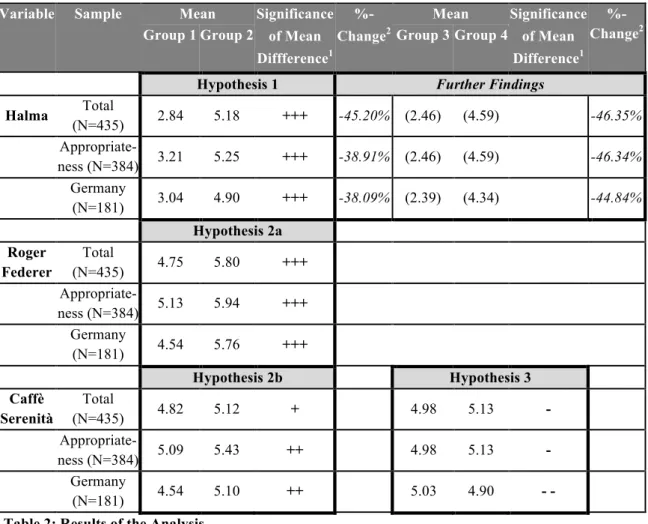
The data was analyzed with SPSS using ANOVA and T-tests. The main results are illustrated in Table 2. The data were analyzed three times, each analysis considering a different segment of the entire sample (see column: Sample).
Variable Sample Mean Significance
of Mean Diffference1 %-Change2 Mean Significance of Mean Difference1 %-Change2
Group 1 Group 2 Group 3 Group 4
Hypothesis 1 Further Findings
Halma Total (N=435) 2.84 5.18 +++ -45.20% (2.46) (4.59) -46.35% Appropriate-ness (N=384) 3.21 5.25 +++ -38.91% (2.46) (4.59) -46.34% Germany (N=181) 3.04 4.90 +++ -38.09% (2.39) (4.34) -44.84% Hypothesis 2a Roger Federer Total (N=435) 4.75 5.80 +++ Appropriate-ness (N=384) 5.13 5.94 +++ Germany (N=181) 4.54 5.76 +++ Hypothesis 2b Hypothesis 3 Caffè Serenità Total (N=435) 4.82 5.12 + 4.98 5.13 - Appropriate-ness (N=384) 5.09 5.43 ++ 4.98 5.13 - Germany (N=181) 4.54 5.10 ++ 5.03 4.90 - -
Table 2: Results of the Analysis
+p < 0.05 (one-tailed); ++p < 0.05; +++p < 0.001; -p > 0.25; - -p > 0.45
1Significance of mean difference based on T-Test, Welch-Test and previous Levene-Test. 2Percentage change of attitude toward Halma caused by the negative article.
In Analysis 1, all participants were considered (N=435). As predicted in H1, participants’ attitude toward the brand affected by negative publicity is significantly lower than toward the brand without negative publicity (meanHalma, Group 1 (neg. article on
Halma) = 2.84, meanHalma, Group 2 (no article) = 5.18; t(193) = -14,63, p < 0.001)11. That means negative publicity on a brand significantly harms the attitude toward this brand (H1). Not only the brand itself, but also the image of the endorsing celebrity suffers from negative publicity on his endorsed brands (H2a): The attitude toward the celebrity when endorsing a negatively affected brand is significantly worse than the attitude toward the celebrity when the brand is not related to negative publicity (meanRoger Federer, Group 1 (neg. article on Halma) = 4.75, meanRoger Federer, Group 2 (no article) = 5.80; F(1,225) = 33,59; p < 0.001)12. H2b predicted that negative publicity on a brand not only affects the attitude toward this brand, but also spills over and diminishes the attitude toward another brand that is endorsed by the same celebrity. This hypothesis can be confirmed by the marginal significantly lower evaluation of Caffè Serenità in the case of negative publicity on Halma and an endorsing celebrity compared to the case without negative publicity (meanCaffè Serenità, Group 1 (neg. article on Halma) = 4.82, meanCaffè Serenità, Group 2 (no article) = 5.12; t(225) = -1.78, p < 0.05 (one-tailed))13.
To ensure this difference in means is only explained by the spillover via the celebrity and not by a possible negative overall mindset caused by the negative article, H3 was established. By comparing the evaluations of the two groups that were exposed to the setting in which the brands were not connected to the celebrity Roger Federer, the analysis revealed no significant difference in consumer attitude toward Caffè Serenità (meanCaffè Serenità, Group 3 (neg. article on Halma) = 4.98, meanCaffè Serenità, Group 4 (no article) =5.13; t(206) = -1.12, p > 0.25)14. This means that the attitude change toward Caffè Serenità in the
11 For more details please refer to Appendix 6.3.1.b in Booklet II. 12 For more details please refer to Appendix 6.3.1.a in Booklet II. 13 For more details please refer to Appendix 6.3.1.b in Booklet II. 14 For more details please refer to Appendix 6.3.1.a in Booklet II.
case of celebrity endorsement must be explained by the celebrity acting as a mediator for the negative spillover.
Furthermore, the query of the appropriateness of the endorsements enables to analyze a further case. Biased responses caused by the factitiousness of the brands could be excluded from the sample, with 51 respondents being eliminated. Thus, the requirement of sufficiently strong links between the celebrity and each of the two brands (cf. Match-Up Hypothesis), which was already fulfilled by pretest 2, could be satisfied in this controlled group even more.
Therefore, the second analysis only considered respondents that evaluated the links as sufficiently appropriate (meanRespondent i, Appropriateness R.F. and H. > 3 and meanRespondent i, Appropriateness R.F. and C.S. > 3; N=384).
As expected due to the stronger link, the difference in attitude toward Caffè Serenità and consequently the spillover of negative publicity becomes even more significant (t(174) = -2.40, p < 0.05)15. Mean differences of Halma and Roger Federer stayed at a similar level of significance.16
The advantage of interviewing respondents from over 30 different countries around the globe, as it was done in this study, is to be able to generalize the findings across different nations. But brand evaluations can differ between countries (Fischer et al., 2010). Since this study is based on a between subject design, it is necessary to guarantee that the mean differences are not a result of possible cultural differences in evaluation.17 Therefore, the third analysis considered a sample of homogeneous people in terms of nationality. Participants from Germany represented the largest group of people from the
15 For more details please refer to Appendix 6.3.2.b in Booklet II. 16 For more details please refer to Appendices 6.3.2.a and b in Booklet II.
17 Participants were randomly assigned to the groups, therefore it could not be assured that every nation
same nation, subsequently only this sub-sample was considered (N=181). In this setting all hypotheses could be confirmed again.18 Participants of group 1 evaluated Caffè Serenità significantly better than participants of group 2 (meanCaffè Serenità, Group 1 (neg. article) =4.54, meanCaffè Serenità, Group 2 (no article) =5.10; t(89) = -2.22, p < 0.05)19 and there was no significant difference in the attitude toward Caffè Serenità between group 3 and group 4 (t(73) = 0.69, p > 0.45)20 to only mention the central results.
Interestingly, all three analyses also discovered a significant difference in the evaluation of attitude toward Halma, depending on the brand Halma being endorsed by a celebrity or not. The attitude toward Halma was significantly more positive in group 2 (celebrity/no article) compared to group 4 (no celebrity/no article) (N=435: t(207.57) = 4.93, p < 0.001; N=384: t(190.68) = 5.13, p < 0.001; N=181: t(177) = 2.67, p < 0.01)21. These results highlight the reliability of this experiment by emphasizing once more what extant research has already proven: A celebrity endorser helps to positively influence a brand image (e.g. Friedman et al., 1976).
Similarly, the evaluation of Halma in group 1 (celebrity/negative article) was significantly more positive compared to group 3 (no celebrity/negative article) (N=435: t(211.97) = 2.19, p < 0.05; N=384: t(149.71) = 3.96, p < 0.001; N=181: t(177) = 3.01, p < 0.005)22. Therefore, this positive effect must even be true when a celebrity endorses a brand that is affected by negative publicity. But more interestingly, these results lead to the question if a brand endorsed by a celebrity will not suffer as much from negative publicity as a brand that lacks a celebrity endorser. In this case, the celebrity would act like a buffer for negative publicity. Analyzing the percentage decrease in attitude
18 For more details please refer to Appendices 6.3.3.a and b in Booklet II. 19 For more details please refer to Appendix 6.3.3.b in Booklet II. 20 For more details please refer to Appendix 6.3.3.b in Booklet II.
21 For more details please refer to Appendices 6.3.1.a, 6.3.2.a, and 6.3.3.a in Booklet II. 22 For more details please refer to Appendices 6.3.1.a, 6.3.2.a, and 6.3.3.a in Booklet II.
toward Halma, between group 2 (celebrity/no article) and group 1 (celebrity/negative article) compared to the percentage decrease in attitude between group 4 (no celebrity/no article) and group 3 (no celebrity/negative article) for all three analyses, this percentage decrease of attitude was lower for the groups with a celebrity (percentage decrease in attitude toward Halma for N=435: group 2 to group 1: -45,2 % vs. group 4 to group 3: -46,35%; for N=384: 38.91% vs. 46.35%; for N=181: 38.09% vs. 44.84%)23. This implies that brands are able to somehow defend themselves from negative publicity with the help of a celebrity endorser.
4. Discussion and Implications
Negative information about brands and companies is widespread in the marketplace. At the same time, the use of celebrity endorsers in marketing enjoys high popularity, so that celebrities often have multiple endorsement campaigns with different brands and companies.
By using a credible celebrity and two fictitious brands that both have a strong link to the celebrity but are not directly linked to each other, this study proves that negative publicity in terms of moral information not only hurts the focal brand but is also likely to spill over and diminish the image of the celebrity as well as the image of another brand that is connected to the focal brand solely through the same celebrity endorser. Additionally, the experiment discovers that celebrities positively influence the evaluations of a brand and that the general negative effect of bad publicity can be somehow defended by means of a celebrity endorser.
These findings offer helpful implications for managers of brands and human brands (celebrities).
In today’s world of companies seeking for a positive image by e.g. pledging themselves to corporate social responsibility guidelines, it seems absolutely necessary to protect a brand from damage by negative publicity even before such a scandal happens. Companies should therefore carefully manage all controllable entities in the close environment of the brand to avoid incidents that consequence in negative publicity. Additionally, they can push the image of the brand by selecting an appropriate celebrity for their advertising campaign and subsequently benefitting from the positive impact a celebrity has on an endorsed brand. Nevertheless, brands have to bear in mind that by selecting a celebrity with multiple endorsements for their advertising campaign, an uncontrollable factor influences their striving for good images. A brand otherwise not related to the focal brand can negatively impact consumers’ evaluations of the focal brand by means of the celebrity. Therefore brand managers should carefully inspect the celebrities’ additional endorsements to make sure they will not have a bad experience, and include additional clauses in the endorsement contracts, in order to prevent future endorsements of the celebrity with other brands. On the other hand, choosing a celebrity endorser might mitigate the negative impact of a scandal that directly affects their brands. Celebrities do not only create better brand evaluations right from the beginning compared to the case of no celebrity. They are also able to prevent brands from harming their image too badly after a scandal. This study shows that in the case of a celebrity endorsement brand evaluations drop less after a scandal compared to the case of no endorsement. This means that brands are good advised to use a celebrity as a sort of protective shield for negative publicity. In summary, brand managers have to weigh the pros and cons and decide which factor is most important for them to successfully build or maintain favorable brand evaluations.
Not only the brands but also celebrities and particularly their agents have to carefully screen the brands that they are offered to advertise. They should always take into account that image-crashing incidents of the endorsed brands can potentially damage the image of the celebrity. This can be extremely destructive since the image of superstars is often exclusively built on superficial factors published by media.
To summarize the findings of this study, not only brands but also celebrities should carefully choose their advertising partner in order to avoid any harming experience that is caused by the partner. On the other hand both parties can benefit from their alliance so that they should carefully assess the potential trade off between profiting from the alliance and potentially being harmed by negative publicity about the alliance partner.
5. Limitations and Further Research
Although the reported findings are robust across three different samples, there are some limitations and gaps for further research.
Most importantly, this experiment focuses on negative publicity in the context of moral information, because previous literature suggests that this sort of negative information is more diagnostic and therefore more likely to spill over compared to product related issues. However, this is reasoned by the fact that it is the first study of its kind. With this study as a basis, the findings should be extended to other kinds of negative information such as product-harm crises or negative word-of-mouth. Simultaneously, it is highly interesting to explore if positive as well as negative changes of attitude or associations in general also spill over via a celebrity.
Furthermore, the brands used in the advertisements are fictitious, so subjects do not have prior information or experiences with the brand. Negative publicity might have a different effect on established brands, therefore the implications of this study can
primarily be applied to new or relatively unknown brands for which consumer’s knowledge structures are rare. Further research should take this into account to generalize the findings for all brands.
Additionally, following studies should also consider populations from the eastern world and they should make use of other contexts such as television advertisements, non-forced exposure settings and various kinds of celebrities (e.g. musicians and actors) as well as a wider variety of the content of the advertising campaign.
To be precise, also the level of prominence might play a role when discovering this sort of spillover. Since brand strength in general is influenced by the level of familiarity (Clement et al., 2008) and celebrities may be viewed as human brands (Thomson, 2006), it could be interesting to analyze if for example a famous celebrity has a different mediating power versus a lesser known celebrity.
Finally, the indicated analysis to determine whether an endorsing celebrity can act as a sort of protective shield of possible negative publicity on a brand should be picked up again. Particularly in view of all the brand scandals that happened lately and the companies’ concern of how to best protect themselves.
In conclusion, this study can be seen as a pilot study. Therefore, generalizing the study results may be premature. Despite of the limitations mentioned above, the findings should be considered as an important initial effort to illustrate the spillover of negative publicity in between brands that are solely connected to each other via the same celebrity endorser.
References
Ahluwalia, Rohini, Robert E. Burnkrant and H. Rao Unnava (2000): Consumer
Response to Negative Publicity: The Moderating Role of Commitment, in: Journal of
Marketing Research, 37 (2), p. 203-214.
Amos, Clinton, Gary Holmes and David Strutton (2008): Exploring the Relationship
Between Celebrity Endorser Effects and Advertising Effectiveness: A Quantitative Synthesis of Effect Size, in: International Journal of Advertising, 27 (2), p. 209-234.
Anderson, John R. (1983): A Spreading Activation Theory of Memory, in: Journal of
Verbal Learning and Verbal Behavior, 22 (3), p. 261-295.
Atkin, Charles and Martin Block (1983): Effectiveness of Celebrity Endorsers, in:
Journal of Advertising Research, 23 (1), p. 57-61.
Cleeren, Kathleen, Marnik G. Dekimpe and Kristiaan Helsen (2008): Weathering
Product-Harm Crises, in: Journal of the Academy of Marketing Science, 36 (2), p. 262-270.
Clement, Michel, Franziska Völckner, Nancy Granström and Tim van Dyk (2008):
Messung der Markenstärke von Künstlermarken, in: Marketing ZFP, 30 (2), p. 93-108.
Collins, Allan M. and Elizabeth F. Loftus (1975): A Spreading-Activation Theory of
Semantic Processing, in: Psychological Review, 82 (6), p. 407-428.
Dahlén, Micael and Fredrik Lange (2006): A Disaster Is Contagious: How a Brand in
Crisis Affects Other Brands, in: Journal of Advertising Research, 46 (4), p. 388-397.
Dawar, Niraj and Jing Lei (2009): Brand Crises: The Roles of Brand Familiarity and
Crisis Relevance in Determining the Impact on Brand Evaluations, in: Journal of
Business Research, 62 (4), p. 509-516.
Dawar, Niraj and Madan M. Pillutla (2000): Impact of Product-Harm Crises on
Brand Equity: The Moderating Role of Consumer Expectations, in: Journal of
Marketing Research, 37 (2), p. 215-226.
Doss, Samuel (2011): The Transference of Brand Attitude: The Effect on the Celebrity
Endorser, in: Journal of Management and Marketing Research, 7 (March), p. 1-11.
Erdogan, Zafer B. (1999): Celebrity Endorsement - A Literature Review, in: Journal
of Marketing and Management, 15 (4), p. 291-314.
Erdogan, Zafer B., Michael J. Baker and Stephen Tagg (2001): Selecting Celebrity
Endorsers: The Practioner's Perspective, in: Journal of Advertising Research, 41 (3), p. 39-49.
Erfgen, Carsten (2011): Impact of Celebrity Endorsement on Brand Image: A
Communication Process Perspective on 30 Years of Empirical Research, in: Research
Papers on Marketing and Retailing, University of Hamburg, Hamburg
Feldman, Jack M. and John G. Lynch (1988): Self-Generated Validity and Other
Effects of Measurement on Belief, Attitude, Intention, and Behavoir, in: Journal of
Fischer, Marc, Franziska Völckner and Henrik Sattler (2010): How Important Are
Brands? A Cross-Category, Cross-Country Study, in: Journal of Marketing Research, 47 (5), p. 823-839.
Friedman, Hershey H., Salvatore Termini and Robert Washington (1976): The
Effectiveness of Advertisements Utilizing Four Types of Endorsers, in: Journal of
Advertising, 5 (3), p. 22-24.
Hofmann, Julian and Britta Heidemann (2011): Markendifferenzierung durch die
Nutzung von Human Brands, in: Markendifferenzierung, eds. Voelckner, Willers and Weber, p. 295-314, Wiesbaden: Gabler Verlag.
Junokaite, Kamile, Sonata Alijosiene and Rasa Gudonaviciene (2007): The
Solutions of Celebrity Endorsers Selection for Advertising Products, in: Economics and
Management, 2, p. 384-390.
Kamins, Michael A. (1990): An Investigation Into the "Match-Up" Hypothesis in
Celebrity Advertising: When Beauty May Be Only Skin Deep, in: Journal of
Advertising, 19 (1), p. 4-13.
Keller, Kevin L. (1993): Conceptualizing, Measuring, and Managing Customer-Based
Brand Equity, in: Journal of Marketing, 57 (1), p. 1-22.
Lei, Jing, Niraj Dawar and Jos Lemmink (2008): Negative Spillover in Brand
Portfolios - Exploring the Antecedents of Asymmetric Effects, in: Journal of
Marketing, 72 (3), p. 111-123.
McCracken, Grant (1989): Who Is the Celebrity Endorser? Cultural Foundation of the
Endorsement Process, in: Journal of Consumer Research, 16 (3), p. 310-321.
Meyers-Levy, Joan (1989): The Influence of a Brand Name's Association Set Size and
Word Frequency on Brand Memory in: Journal of Consumer Research, 16 (2), p. 197-207.
Misra, Shekhar and Sharon E. Beatty (1990): Celebrity Spokesperson and Brand
Congruence - An Assessment of Recall and Affect, in: Journal of Business Research, 21 (2), p. 159-173.
Mistry, Bahavna (2006): Star Spotting, in: Marketing, (June), p. 33-34.
Mizerski, Richard W. (1982): An Attribution Explanation of the Disproportionate
Influence of Unfavorable Information, in: Journal of Consumer Research, 9 (3), p. 301-310.
Mowen, John C. and Stephen W. Brown (1981): On Explaining and Predicting the
Effectiveness of Celebrity Endorsers, in: Advances in Consumer Research, 8 (1), p. 437-441.
Ohanian, Roobina (1990): Construction and Validation of a Scale to Measure
Celebrity Endorser's Perceived Expertise, Trustworthiness, and Attractiveness, in:
Journal of Advertising, 19 (3), p. 39-52.
Pullig, Chris, Richard G. Netemeyer and Abhijit Biswas (2006): Attitude Basis,
Certainty, and Challenge Alignment: A Case of Negative Brand Publicity, in: Journal of
Roehm, Michelle L. and Alice M. Tybout (2006): When Will a Brand Scandal Spill
Over, and How Should Competitors Respond?, in: Journal of Marketing Research, 43 (3), p. 366-373.
Seno, Diana and Bryan A. Lukas (2007): The Equity Effect of Product Endorsement
by Celebrities: A Conceptual Framework from a Co-Branding Perspective, in:
European Journal of Marketing, 41 (1/2), p. 121-134.
Silvera, David H. and Benedikte Austad (2004): Factors Predicting the Effectiveness
of Celebrity Endorsement Advertisements, in: European Journal of Marketing, 38 (11/12), p. 1509-1526.
Simmons, Carolyn J. and Karen L. Becker-Olsen (2006): Achieving Marketing
Objectives Through Social Sponsorships, in: Journal of Marketing, 70 (4), p. 154-169.
Spry, Amanda, Ravi Pappu and T. Bettina Cornwell (2011): Celebrity Endorsement,
Brand Credibility and Brand Equity, in: European Journal of Marketing, 45 (6), p. 882-909.
The Economist (2008): Just Good Business - A Special Report on Corporate Social
Responsibility, in: The Economist, January 10th, p. 1-14.
Thomson, Matthew (2006): Human Brands: Investigating Antecedents to Consumers’
Strong Attachments to Celebrities, in: Journal of Marketing, 70 (3), p. 104-119.
Till, Brian D. (1998): Using Celebrity Endorsers Effectivly: Lessons From Associative
Learning, in: Journal of Product & Brand Management, 7 (5), p. 400-409.
Till, Brian D. (2001): Managing Athlete Endorser Image: The Effect of Endorsed
Product, in: Sport Marketing Quarterly, 10 (1), p. 35-42.
Till, Brian D. and Terence A. Shimp (1998): Endorsers in Advertising: The Case of
Negative Celebrity Information, in: Journal of Advertising, 27 (1), p. 67-82.
Till, Brian D. and Michael Busler (1998): Matching Products With Endorsers:
Attractiveness Versus Expertise, in: Journal of Consumer Marketing, 15 (6), p. 576-586.
Tripp, Carolyn, Thomas D. Jensen and Les Carlson (1994): The Effects of Multiple
Product Endorsements by Celebrities on Consumers' Attitudes and Intentions, in:
Journal of Consumer Research, 20 (4), p. 535-547.
Um, Nam-Hyun (2008): Exploring the Effects of Single vs. Multiple Products and
Multiple Celebrity Endorsements, in: Journal of Management and Social Sciences, 4 (2), p. 104-114.
Van Heerde, Harald, Kristiaan Helsen and Marnik G. Dekimpe (2007): The Impact
of a Product-Harm Crisis on Marketing Effectiveness, in: Marketing Science, 26 (2), p. 230-245.
Votolato, Nicole L. and H. Rao Unnava (2006): Spillover of Negative Information on
Brand Alliances, in: Journal of Consumer Psychology, 16 (2), p. 196-202.
Xie, Yi and Siqing Peng (2009): How to Repair Customer Trust After Negative
Publicity: The Roles of Competence, Integrity, Benevolence, and Forgiveness, in: