CREATING AGROFORESTRY INNOVATION AND BEST
PRACTICE LEAFLETS
Burgess P1*, Moreno G2, Pantera A3, Kanzler M4, Hermansen J5, Van Lerberghe P6, Balaguer F7, Girardin N8, Rosati A9,
Graves A1, Watté J10, Mosquera-Losada R11, Waldie K12, Pagella T13, Liagre F8
(1) Cranfield University, Cranfield, Bedfordshire, MK43 0AL, UK (2) Universidad de Extremadura, Plasencia, Spain (3) Technological Education Institute (TEI) Stereas Elladas, 36100 Karpenissi, Greece (4) Brandenburg University of Technology Cottbus-Senftenberg, Germany (5) Department of Agroecology, Aarhus University, Denmark (6) Institut
pour le Développement Forestier, 75116 Paris, France 32 000 Auch, France (8) AGROOF, 30 140 Anduze, France (9) Consiglio per la Ricerca in Agricoltura e l'Analisi dell'Economia Agraria
(CREA), 00198 Rome, Italy (10) Wervel vzw, 1050 Elsene Belgium; (11) University of Santiago de Compostela, 27002 Lugo, Spain (12) Organic Research Centre, Berkshire, UK (13) World Agroforestry Centre, Nairobi, Kenya
*Corresponding author: [email protected]
Abstract
A key output of the EU FP7 project AGFORWARD was a series of 46 agroforestry innovation and 10 agroforestry best practice leaflets for European farmers and other stakeholders. This paper describes the process of over 80 people working together to create the leaflets and the overall result.
Keywords: promotion; innovation; dissemination; communication; internet
Introduction
As indicated in the abstract, a major output of the EU FP7 project AGFORWARD was a series of 46 agroforestry innovation and 10 agroforestry best practice leaflets. This paper briefly describes the process of creating the innovation leaflets, the best practice leaflets, and an accompanying folder, together with the initial dissemination of the leaflets in hard copy and on the internet.
Creation of the innovation leaflets
The original format of the innovation leaflets was discussed at the Third General Assembly meeting of the AGFORWARD project in Montpellier in 26-27 May 2016. One of the original proposals was a series of case study stories, but eventually the consensus of the participants was that a two-sided leaflet format was the most useful way of describing the wide range of agroforestry innovations tested across 40 stakeholder groups. After the meeting, it was decided to pilot the format using the results from the Italian asparagus and olive system, but it proved difficult to make progress using only electronic communication. The need to use professional design software and the high memory requirements of the high resolution images meant that logistically all of the design work needed to be undertaken at the AGROOF offices in Anduze, France. Eventually in March 2017, the first leaflet was produced through an intensive iterative
- isited the AGROOF offices.
Each subsequent leaflet followed the same format of the pilot leaflet. The top of the front page large landscape format photo, the main and secondary titles, and the www.agforward.eu web-address. The remainder of front page was then split into a left-hand column occupying a third of the page and a right-hand column comprising two-thirds. The title of least one column (on 38 of the 46 leaflets) was phrased in the form of a question and there was always at least one additional colourful image. The second side of the leaflet also followed a third and two-thirds of a page column split. The left hand column included a section entitl
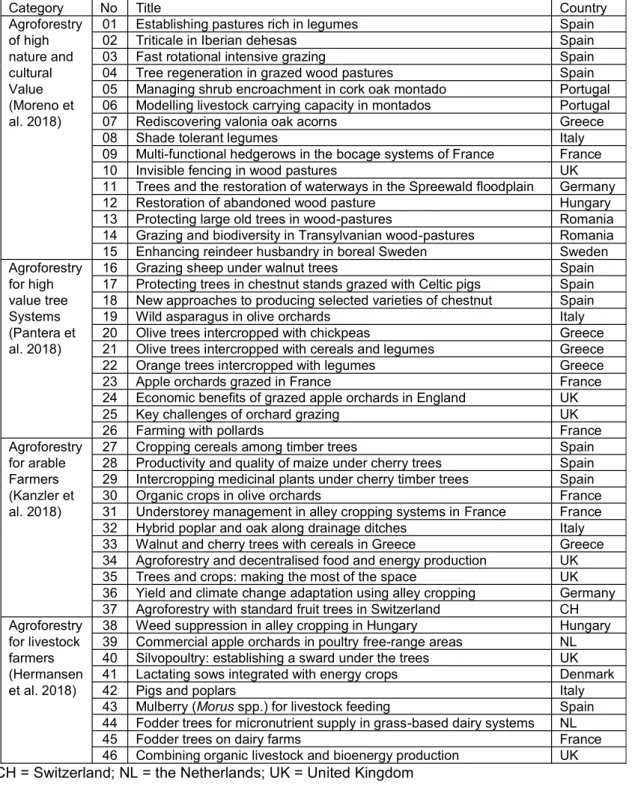
and the author contact details. The second column provided detailed information about the innovation and always concluded with sources of further information. Eventually by November 2017, 46 agroforestry innovation leaflets were produced describing 15 innovations related to agroforestry of high nature and cultural value, 11 related to agroforestry with high value tree systems, 12 related to agroforestry for arable farmers, and 8 related to agroforestry for livestock farmers (Table 1). The leaflets encompassed 13 countries including Spain (12 leaflets), the UK (7), France (6), Italy and Greece (4), two leaflets each from Germany, Hungary, the Netherlands, Portugal, and Romania, and a single leaflet each from Denmark, Sweden, and Switzerland.
Each of the leaflets was reviewed by at least two participants on the AGFORWARD project for the technical content, and two participants in terms of the English and layout. The initial draft text was created in Microsoft Word, but the final formatting was undertaken by AGROOF using Adobe InDesign. Many of the images used in the design were of high resolution and the process of creating the leaflets necessitated the purchase of additional storage on DropBox file hosting service. The final leaflets were produced in a pdf format with margins suitable for commercial printing, and also as pdfs without margins which could be printed directly from the web. Each of the innovation leaflets is available from the following webpage: http://www.agforward.eu/index.php/en/Innovation-leaflets.html
Table 1: The innovation leaflets co-authored by 83 people covered 46 topics and 13 countries http://www.agforward.eu/index.php/en/Innovation-leaflets.html
Category No Title Country
Agroforestry 01 Establishing pastures rich in legumes Spain
of high 02 Triticale in Iberian dehesas Spain
nature and 03 Fast rotational intensive grazing Spain
cultural 04 Tree regeneration in grazed wood pastures Spain
Value 05 Managing shrub encroachment in cork oak montado Portugal
(Moreno et 06 Modelling livestock carrying capacity in montados Portugal
al. 2018) 07 Rediscovering valonia oak acorns Greece
08 Shade tolerant legumes Italy
09 Multi-functional hedgerows in the bocage systems of France France
10 Invisible fencing in wood pastures UK
11 Trees and the restoration of waterways in the Spreewald floodplain Germany
12 Restoration of abandoned wood pasture Hungary
13 Protecting large old trees in wood-pastures Romania
14 Grazing and biodiversity in Transylvanian wood-pastures Romania
15 Enhancing reindeer husbandry in boreal Sweden Sweden
Agroforestry 16 Grazing sheep under walnut trees Spain
for high 17 Protecting trees in chestnut stands grazed with Celtic pigs Spain
value tree 18 New approaches to producing selected varieties of chestnut Spain
Systems 19 Wild asparagus in olive orchards Italy
(Pantera et 20 Olive trees intercropped with chickpeas Greece
al. 2018) 21 Olive trees intercropped with cereals and legumes Greece
22 Orange trees intercropped with legumes Greece
23 Apple orchards grazed in France France
24 Economic benefits of grazed apple orchards in England UK
25 Key challenges of orchard grazing UK
26 Farming with pollards France
Agroforestry 27 Cropping cereals among timber trees Spain
for arable 28 Productivity and quality of maize under cherry trees Spain
Farmers 29 Intercropping medicinal plants under cherry timber trees Spain
(Kanzler et 30 Organic crops in olive orchards France
al. 2018) 31 Understorey management in alley cropping systems in France France
32 Hybrid poplar and oak along drainage ditches Italy
33 Walnut and cherry trees with cereals in Greece Greece
34 Agroforestry and decentralised food and energy production UK
35 Trees and crops: making the most of the space UK
36 Yield and climate change adaptation using alley cropping Germany
37 Agroforestry with standard fruit trees in Switzerland CH
Agroforestry 38 Weed suppression in alley cropping in Hungary Hungary
for livestock 39 Commercial apple orchards in poultry free-range areas NL
farmers 40 Silvopoultry: establishing a sward under the trees UK
(Hermansen 41 Lactating sows integrated with energy crops Denmark
et al. 2018) 42 Pigs and poplars Italy
43 Mulberry (Morus spp.) for livestock feeding Spain
44 Fodder trees for micronutrient supply in grass-based dairy systems NL
45 Fodder trees on dairy farms France
46 Combining organic livestock and bioenergy production UK
CH = Switzerland; NL = the Netherlands; UK = United Kingdom
Creation of the best practice leaflets
Unlike the agroforestry innovation leaflets, the ten best practice leaflets were authored by a single person: Philippe Van Lerberghe of the Institut pour le Développement Forestier in France. In this case, some of the leaflets extended to four rather than two sides. The leaflets are primarily focused on the process of creating an alley cropping system starting with the key objectives, the choice of tree species and planting material, the selection of tree density and planting distances, tree protection, land preparation, mulching, and lastly tree pruning (Table 2). The format of the front page was similar to the innovation leaflets but used an orange, rather than a blue, banner. The last page again provided contact details and a list of references for
further information. There was also a similar process for reviewing the best practice leaflets for their technical content and to minimise English and presentation errors.
Table 2: The agroforestry best practice leaflets comprised 10 titles (Liagre et al. 2018) http://www.agforward.eu/index.php/en/best-practices-leaflets.html
Number Title
01 Alley cropping systems: key objectives
02 Analysing the site and choosing tree species
03 Choosing quality-planting material
04 Planning an agroforestry project
05 Protecting trees against wildlife damage: assessing the options
06 Preparing the land
07 Planting the trees
08 Fitting tree protection to prevent deer damage
09 Mulching for healthy tree seedling
10 Shaping the trees
Creation of the folder, launch and next steps
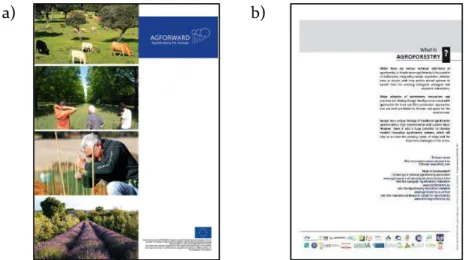
In addition to the innovation and best practice leaflets, staff at AGROOF also led on the design of a folder to hold the leaflets (Figure 1). A number of designs were reviewed with the final design including four images on the front page to encompass the wide range of agroforestry systems covered. The inside of the folder comprised two flaps. The left-hand flap provided a description of the AGFORWARD project and outlined the nature of the leaflets. The right-hand flap included a montage of nine agroforestry images which could then be opened to reveal the leaflets. Behind the leaflets was a map showing the location of the 46 innovations and the right-hand panel provided the titles listed in Table 1 and a reference for the folder (Balaguer et al. 2017).
Figure 1: The 46 innovation leaflets and 10 agroforestry best practice leaflets were included in a folder (Balaguer et al. 2017). The images show the a) front and b) back page of the folder.
The back page of the folder
-links, and the logos of 28 participants in the project. Over 800 hardcopy packs of the leaflets and the folders were assembled at the Wervel offices in Brussels in November 2017 which required substantial manpower! The completed leaflets and folder were launched at the European Parliament on 29 November 2017. The leaflets are now being translated into a range of languages to maximise their impact and the plan is that copies of the folder will be available at the 2018 European Agroforestry Conference.
Acknowledgements
We are thankful to the 83 authors of the innovation leaflets. We acknowledge support of the European Commission through the AGFORWARD FP7 research project (contract 613520). The views and opinions expressed in this report are purely those of the writers and may not in any circumstances be regarded as stating an official position of the European Commission.
References
Balaguer F, Waldie K, Van Lerberghe P, Liagre F, Girardin N, Pagella T, Burgess PJ (Eds) (2017) Folder for AGFORWARD Agroforestry Innovation and Best practice Leaflets. 8 November 2017. AGFORWARD project. www.agforward.eu (accessed 17/04/2018).
Hermansen JE, Bestman M, Westaway S, Kongsted AG, Bondesan V, Mosquera-Losada MR, Luske B, Novak S, Smith J (2017) Guidelines for improved agroforestry systems for livestock production. Deliverable 5.15 (5.3) for EU FP7 Research Project: AGFORWARD 613520. (15 January 2018), 23 pp.
http://www.agforward.eu/index.php/en/guidelines-for-improved-agroforestry-systems-for-livestock-production.html (accessed 17/04/2018).
Kanzler M, Tsonkova P, Arenas G, Dalla Valle C, Desclaux D, Ferreiro-Domínguez N, Guérin O, Herzog F, Jäger M, Kiss-Szigeti N, Mantzanas K, Marosvölgyi B, Mézière D, Mirck J, Moreno G, Mosquera-Losada MR, Panozzo A, Paris P, Rigueiro-Rodríguez A, Romero-Franco R, Schettrer P, Smith J, Vityi A, Wartelle R, Westaway S, Wolfe M, Burgess, PJ (2018) Agroforestry for arable farmers: guidelines. Deliverable 4.12 (4.3) for EU FP7 Research Project: AGFORWARD 613520. (17 January 2018), 33 pp. http://www.agforward.eu/index.php/en/agroforestry-for-arable-farmers-guidelines.html (accessed 17/04/2018). Liagre F, Van Leberghe P, Balaguer F, Waldie K, Girardin N, Pagella T, Moreno G, Pantera A, Kanzler M, Hermansen
J, Burgess PJ (2018) Deliverable 9.30 (9.6) Agroforestry folder for farmers and advisors. AGFORWARD project. 26 January 2018, 45 pp. http://www.agforward.eu/index.php/en/best-practices-leaflets.html (accessed 17/04/2018).
Moreno G, Amaral Paulo J, Aviron S, Berg S, Burgess PJ, Cáceres Y, Catalán M, Chinery F, Crous-Duran J, Eriksson E, Faias S, Firmino P, Franca A, Giannitsopoulos M, Guéhenneuc T, Hartel T, Hernández-Esteban A, Lind T, Menguy C, Mirck J, Oliveira TS, Palma JHN, Palomo G, Papadopoulos A, Pérez-Casenave C, Pershagen E, Poblaciones MJ, Pulido F, Re GA, Sanna F, Rodrígo S, Santamaría O, Thenail C, Tsonkova P, Valinger E, Varga A, Viaud V (2018) Agroforestry of high nature and cultural value: Guidelines for farmers. Deliverable 2.6 for the EU FP7 Research Project: AGFORWARD 613520. (7 January 2018), 37 pp.
http://www.agforward.eu/index.php/en/agroforestry-of-high-nature-and-cultural-value-guidelines-for-farmers.html (accessed 17/04/2018).
Pantera A, Burgess PJ, Mosquera-Losada MR, Rosati A, Moreno G, McAdam J, Mantzanas K, Corroyer N, Van Lerberghe P, Ferreiro-Domínguez N, López ML, Santiago Freijanes JJ, Rigueiro-Rodriguez A, Fernández-Lorenzo JL, González-Hernández P, Fraga-Gontán P, Martínez-Cabaleiro M, Chinery F, Eriksson G, Pershagen E, Perez-Casenave C, Giannitsopoulos M, Colin J, Balaguer F (2018) Agroforestry for High Value Tree Systems: guidelines for farmers. Deliverable 3.9 (3.3) for EU FP7 Research Project: AGFORWARD 613520. (17 January 2018), 30 pp. http://www.agforward.eu/index.php/en/agroforestry-for-high-value-tree-systems-guidelines-for-farmers.html (accessed 17/04/2018).