A
NCIENT
D
EATH
W
AYS
Proceedings of the workshop on archaeology and mortuary practices
Uppsala, 16–17 May 2013
Edited by
Kim von Hackwitz
&
von Hackwitz, K. & Peyroteo-Stjerna, R. 2015. Ancient Death Ways – Proceedings of the workshop on archaeology and mortuary practices – Uppsala, 16-17 May 2013. Occasional
Papers in Archaeology 59. 200 pp. Uppsala 2015. ISSN 1100-6358 ISBN 978-91-506-2446-5.
Abstract
Ancient Death Ways – proceedings of the workshop on archaeology and mortuary practices, contains
articles of the work in progress presented and discussed at the Ancient Death Ways 2013 meeting, which was organised around three main themes: current research, landscapes of death, and defining death. The diversity of case studies and subjects tackled by the participants re-flects the richness of the field of archaeological research concerning death studies. This book does not aim to be a treaty on the archaeology of death in 2013, but rather a straight-forward outcome of the sessions. The series of eight articles is introduced and closed by two commentary essays from two of the moderators of the workshop.
Keywords: Mesolithic, Neolithic, death, funerary archaeology, mortuary practices,
archaeo-thanatology, cremation, ritual practice, GIS, landscape archaeology
ISSN 1100-6358
ISBN 978-91-506-2446-5 © The authors 2015
Series editors: Frands Herschend & Neil Price Proofreading: Jill Kinahan
Cover image: Atlas and third cervical vertebra with cutmarks, adult male (no. 15), Ofnet, Germany. Photograph courtesy of Jörg Orschiedt.
List of Contributors ... 7 Preface ... 9
Kim von Hackwitz & Rita Peyroteo-Stjerna
1. Opening Ancient Death Ways: Caring for the Dead ... 11
Åsa M. Larsson
2. Mesolithic Skull Cults? ... 19
Rick J. Schulting
3. Perfect Death: Examples of Pitted Ware Ritualisation of the Dead ... 47
Paul Wallin
4. Cremating Corpses – Destroying, Defying or Deifying Death? ... 65
Terje Oestigaard
5. Dread of the dead – Living in the Vicinity of Dead Relatives in
Finland 1751–1850 ... 85
Milton Núñez
6. Death in Place: Rituals in Practice ... 105
Rita Peyroteo-Stjerna
7. Location! Location! – What are some of the Defining Factors in
the Placement of Megalithic Tombs in the Landscape? ... 127
Anne Birgitte Gebauer
8. Landscapes of Mortuary Practices ... 143
9. Body on paper. Applying Archaeothanatological Principles in
Re-analysing the Tamula XXII Neolithic Burial from Estonia ... 167
Mari Tõrv
10. Closing Ancient Death Ways: The Ethics of Manipulating
the Dead ... 191
7
Dr Anne Birgitte Gebauer is Guest Researcher at The National
Muse-um of Denmark, Copenhagen, Denmark.
Dr Kim von Hackwitz is Researcher and Coordinator at the
Depart-ment of Archaeology and Ancient History, Uppsala University, Sweden.
Dr Åsa M. Larsson is Director of Societas Archaeologica Upsaliensis
(SAU), Uppsala, Sweden.
Dr Karl-Johan Lindholm is Lecturer at the Department of
Archaeolo-gy and Ancient History, Uppsala University, and Associate Professor at the Swedish University of Agricultural Sciences, Uppsala, Sweden.
Dr Malin Masterton is Researcher at the Department of Public Health
and Caring Sciences, Health Services Research, Uppsala University, Sweden.
Prof. Milton Núñez is Professor of Archaeology at University of
Ou-lu, Finland.
Dr Terje Oestigaard is Senior Researcher and Associate Professor at
The Nordic Africa Institute, Uppsala, Sweden.
Rita Peyroteo-Stjerna is Doctoral Candidate at the Department of
Ar-chaeology and Ancient History, Uppsala University, Sweden.
Dr Rick Schulting is Lecturer in Scientific and Prehistoric Archaeology
at School of Archaeology, University of Oxford, UK.
Mari Tõrv is Doctoral Candidate at the Institute of History and
Ar-chaeology, University of Tartu, Estonia and at the
Centre for Baltic and Scandinavian Archaeology, Germany.
Prof. Paul Wallin is Professor in Archaeology at the Department of
Archaeology and Ancient History, Uppsala University, Campus Got-land, Visby, Sweden.
105
6
D
EATH IN
P
LACE
:
R
ITUALS IN
P
RACTICE
Rita Peyroteo-Stjerna 1Abstract
This paper explores the intricate relations between mortuary ritual practice and the active role of memory in the construction and re-construction of place by hunter-gatherer groups.
The data for this preliminary study are drawn from the Mesolithic shell midden sites located in the Tagus and Sado valleys in Portu-gal, where ca. 374 human burials have been excavated since the late nineteenth century.
The aim of this essay is to rehearse a holistic approach to the study of the Mesolithic hunter-gatherers, by sewing together the spheres of death, memory and place.
Keywords: hunter-gatherers; death; memory; ritual practice; place; Tagus and Sado valleys, Portugal
Introduction
The Mesolithic shell middens located in the Tagus and Sado valleys in Por-tugal are known for the unusually large number of human burials. These sites with burial grounds have been interpreted as hunter-gatherer territorial claims to establish control over economic resources (Arnaud 1989: 621), and as a base line argument for the origins of social complexity (Bicho et al. 2013). These interpretations are valid and plausible; however, these ap-proaches do not address the question of how these sites have been kept
1 Department of Archaeology and Ancient History, Uppsala University, Box 626, 751 26
106
meaningful and socially recognised during their long chronology of use. Furthermore, these classic approaches tend to ignore hunter-gatherers as agents of history, somewhat perceived as highly adaptive humans with a functional responsive behaviour.
Here, regardless of functional or symbolic interpretations, I wish to suggest that mortuary ritual practice plays a key role in the construction and maintenance of these places, because this social practice is a powerful memory aid. With this approach I wish to stress the active role of memory, performed by mortuary ritual practice, key in the construction and re-construction of these places. This aspect of social memory, the memory transmitted through bodily practices, has been widely neglected, particularly in hunter-gatherer studies, which some authors have rightly criticised (Sas-saman & Holly 2011). In this view, and in the scope of hunter-gatherer studies, landscapes are meaningful social environments rather than mere repositories of natural resources.
Following the open character of the Ancient Death Ways Workshop, in this essay I wish to rehearse a holistic approach to the study of the Mesolithic hunter-gatherers, by sewing together the spheres of death, memory and place, which I aim to develop in future studies.
Shell middens in the Tagus and Sado valleys
The archaeological sites under analysis are located in Portugal, some of them having been discovered and excavated since the late nineteenth centu-ry. These sites are characterised by the anthropogenic accumulation of ma-rine animals, terrestrial fauna and stone artefacts. This type of site is known as shell midden after its most visible feature, the sea shells. Here, in the south-western Atlantic coast of Europe, the rise of sea levels during the Atlantic climatic optimum (ca. 8350–6300 cal BP) resulted in the formation of large estuaries. The typical coastal sites known for the Pre-boreal and Boreal (ca. 11480–8350 cal BP) are now consigned to interior estuarine regions, by these new ecosystems (Araújo 2003). Today, far from the sight and influ-ence of marine waters, these Late Mesolithic shell middens can be very large archaeological sites, many of them with well preserved human remains (Fig-ure 6.1).
Rita Peyroteo-Stjerna
107 Figure 6.1. Iberian Peninsula and the location of Late Mesolithic shell midden sites in the Tagus and Sado valleys, Portugal.
This new form of settlement is accompanied by a different relation to death. New born babies, children, young adults, men and women were carefully buried in these places. In the shell middens of the Tagus and Sado valleys burial practice is a common form of disposal of the dead. From the 12 mid-dens identified in the Tagus valley, six have human burials (Figure 6.2) in a total of at least 262 individuals (Bicho et al. 2013; Cunha & Cardoso 2001, 2002–2003; Jackes & Meiklejohn 2008; Meiklejohn et al. 2009; Roksandic 2006). Similarly, in the Sado valley, there are 11 middens known, six of which with human burials (Figure 6.3) in a total of ca. 112 individuals (Cunha & Umbelino 1995–1997). The archaeological data regarding this practice of inhumation (i.e. burial) is in clear contrast with previous and contemporaneous sites in the region; burial as a mortuary practice is known in the Iberian Peninsula; however, it was never a common practice (Pey-roteo-Stjerna in press).
108
Figure 6.2. Tagus valley: shell midden sites with human burials. Site/Minimum Number of Individuals (MNI): Fonte do Padre Pedro/2–3 (Meiklejohn et al. 2009); Flor da Beira/4–5 (Meiklejohn et al. 2009); Cabeço da Arruda/110 (Cunha & Cardoso 2002–2003; Roksandic 2006); Moita do Sebastião/85 (Jackes & Meiklejohn 2008); Cabeço da Amoreira/29 (Bicho et al. 2013; Cunha & Cardoso 2001; Roksandic 2006); Cova da Onça/32 (Cunha & Cardoso 2002–2003).
Figure 6.3. Sado valley: shell midden sites with human burials. Site/Minimum Number of Individuals (MNI) (Cunha & Umbelino 1995–1997): Arapouco/32; Poças de S. Bento/15; Cabeço das Amoreiras/6; Vale de Romeiras/26; Cabeço do Pez/32–36; Várzea da Mó/1
Rita Peyroteo-Stjerna
109
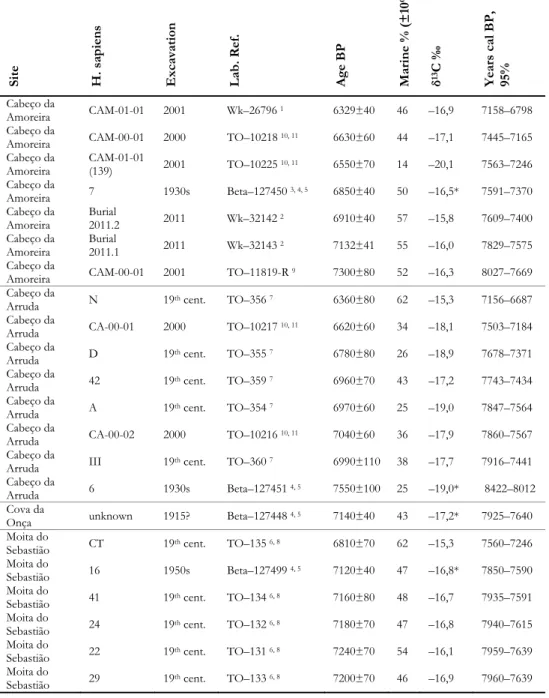
According to the currently available radiocarbon dates (Table 6.1) 2 the
chronology of the human burials in the Tagus valley ranges from ca. 8422 to 6687 cal BP. The data is more limited for the Sado valley, with only three human burials dated so far (Table 6.2) ranging from ca. 8175 to 7333 cal BP. I am currently running a radiocarbon programme to upgrade the availa-ble data, in the scope of current research on the mortuary practices in these two valleys. Nevertheless, for this chronology, this concentration of human burials is unique in the Iberian Peninsula and also one of the largest and oldest concentrations known in Europe.
These sites are also rich in faunal remains (Detry 2007; Lentacker 1986, 1994; Rowley-Conwy 2004) providing evidence for the consumption in situ of a varied range of food resources, both marine and terrestrial (Umbelino 2006; Umbelino et al. 2007). According to these studies there is no evidence for domesticated plants or animals, except for the domestic dog (Detry & Cardoso 2010). Stone tool production is also well documented for all stages of the chaîne opératoire (Araújo 1995–1997; Marchand 2001; Nukushina 2012). The relatively few ceramic fragments found in some of these con-texts are attributed to later occupations, to the Early and Late Neolithic (Diniz 2010).
2 Tables 6.1 and 6.2: Samples were calibrated through OxCal v4.2 (Bronk Ramsey 2009)
using IntCal13 curve (Reimer et al. 2013) for terrestrial samples. Marine samples and human samples with mixed diet were calibrated using Marine13 curve (Reimer et al. 2013) and regional ΔR accordingly; ΔR= 140±40 14C yr BP for the Tagus valley and ΔR= –100±155 14C yr BP for the Sado valley (Martins et al. 2008). Marine diets (%) were calculated
follow-ing Ambrose (1993) usfollow-ing assumed marine and terrestrial endpoints of –12 and –21‰ respectively (Schulting & Richards 2001).
The (*) δ13C values were obtained by accelerator mass spectrometry (AMS) during the
process of 14C measurement and not independently by isotope-ratio mass spectrometry
(IRMS) (C. Umbelino, personal communication, December 2014). The offset is variable and although the AMS- and IRMS-based values may be highly correlated (Schulting & Richards 2001) with an average offset lower than 2‰, it can be as high as 10‰ (Taylor & Bar-Yosef 2014). Only IRMS-based δ13C values should be used for dietary reconstructions
or other isotopic-based environmental analysis such as reservoir corrections (Millard 2014:557; Taylor & Bar-Yosef 2014) and for this reason, these values and the respective calibrations should be interpreted with caution.
110
Table 6.1. Tagus valley shell middens: published radiocarbon dates on human remains. (1) Bicho et al. 2011, (2) 2013; (3) Cunha & Cardoso 2001, (4) 2002–2003; (5) Cunha et al. 2003; (6) Lubell & Jackes 1985, (7) 1988; (8) Meiklejohn et al. 1986, (9) 2009; (10) Roksandic 2006; (11) Rolão et al. 2006.
Site H. sa
piens
Excavation Lab. Ref. Age B
P Marine % (±1 0%) δ 13C ‰ Years cal BP, 95% Cabeço da Amoreira CAM-01-01 2001 Wk–26796 1 6329±40 46 –16,9 7158–6798 Cabeço da
Amoreira CAM-00-01 2000 TO–10218 10, 11 6630±60 44 –17,1 7445–7165 Cabeço da
Amoreira CAM-01-01 (139) 2001 TO–10225 10, 11 6550±70 14 –20,1 7563–7246 Cabeço da Amoreira 7 1930s Beta–127450 3, 4, 5 6850±40 50 –16,5* 7591–7370 Cabeço da Amoreira Burial 2011.2 2011 Wk–32142 2 6910±40 57 –15,8 7609–7400 Cabeço da Amoreira Burial 2011.1 2011 Wk–32143 2 7132±41 55 –16,0 7829–7575 Cabeço da
Amoreira CAM-00-01 2001 TO–11819-R 9 7300±80 52 –16,3 8027–7669 Cabeço da
Arruda N 19th cent. TO–356 7 6360±80 62 –15,3 7156–6687
Cabeço da
Arruda CA-00-01 2000 TO–10217 10, 11 6620±60 34 –18,1 7503–7184 Cabeço da
Arruda D 19th cent. TO–355 7 6780±80 26 –18,9 7678–7371
Cabeço da
Arruda 42 19th cent. TO–359 7 6960±70 43 –17,2 7743–7434
Cabeço da
Arruda A 19th cent. TO–354 7 6970±60 25 –19,0 7847–7564
Cabeço da
Arruda CA-00-02 2000 TO–10216 10, 11 7040±60 36 –17,9 7860–7567 Cabeço da
Arruda III 19th cent. TO–360 7 6990±110 38 –17,7 7916–7441
Cabeço da
Arruda 6 1930s Beta–127451 4, 5 7550±100 25 –19,0* 8422–8012 Cova da
Onça unknown 1915? Beta–127448 4, 5 7140±40 43 –17,2* 7925–7640 Moita do
Sebastião CT 19th cent. TO–135 6, 8 6810±70 62 –15,3 7560–7246 Moita do
Sebastião 16 1950s Beta–127499 4, 5 7120±40 47 –16,8* 7850–7590 Moita do
Sebastião 41 19th cent. TO–134 6, 8 7160±80 48 –16,7 7935–7591 Moita do
Sebastião 24 19th cent. TO–132 6, 8 7180±70 47 –16,8 7940–7615 Moita do
Sebastião 22 19th cent. TO–131 6, 8 7240±70 54 –16,1 7959–7639 Moita do
Rita Peyroteo-Stjerna
111 Table 6.2. Sado valley shell middens: published radiocarbon dates on human remains. (1) Cunha & Umbelino 2001; (2) Umbelino 2006.
Places in the Landscape
A common geographic trait of these sites is their location by the palaeo-estuaries of large rivers. In the Tagus valley all sites are located in low ter-races right by the shores of the palaeo-estuary, subject to occasional floods. This location close to the aquatic resources seems to be the privileged area of settlement. At Sado, however, some large sites are placed further inland and all are located at relatively higher altitudes. Here, a location with good visibility through the valley seems to be more important than the proximity to aquatic resources (Diniz & Arias 2011: 147).
In both valleys there are sites with and without human burials, but the dis-tribution of sites with burials seems to follow a different pattern. In the Tagus valley the sites with human remains are concentrated in the Muge area, with the exception of Cova da Onça, located by the tributary Magos (Figure 6.2). In contrast, in the Sado valley, the human burials are not con-centrated in any specific area of the valley, with one exception for the sites of Cabeço do Pez and Vale de Romeiras (Figure 6.3).
There is a fundamental difference in site formation in these two valleys, which is reflected in their stratigraphic complexity and ultimately in the spa-tial arrangement of the burials in the sites. In the Tagus valley, these artifi-cial mounds are formed by the superposition of cultural layers and can reach 4 to 5 metres in classic vertical stratigraphy (Roche 1965, 1967). In contrast, the middens in the Sado valley are relatively shallow and visually difficult to identify. Here, the site formation is mainly on a horizontal logic
Site H. sa
piens
Excavation Lab. Ref. Age B
P Marine % (±10%) 13δC ‰ Year s cal BP, 95% Arapouco 2A 1960s Sac–1560 1, 2 7200±130 46 –16.9* 8175–7655 Cabeço das Amoreiras 5 1950s Beta–125110 1 7230±40 7 –20.8* 8156–7945 Cabeço do Pez 4 1950s Beta–125109 1 6760±40 0 –22.6* 7675–7570 Cabeço do Pez 4 1950s Sac–1558 1 6740±110 22 –19.3* 7752–7333
112
of occupation with a current stratigraphic width of 60 to 80 cm at most (Arnaud 1989; Diniz & Arias 2011; Larsson 1996). This stratigraphic differ-ence is possibly related to the relative location of the sites to aquatic re-sources but also to ecological constraints under study (Diniz & Arias 2011). The stratigraphic argument supports once again the secondary importance, for reasons still under investigation, of the shell element in the Sado valley middens in comparison to the Tagus sites.
Another common characteristic seems to be the placement of the burials in clusters within the sites, as observed from available field records from the old excavations. The excavation strategy in the 1950s in the Sado valley, when more than 100 burials were recovered, consisted of opening long nar-row trenches along the recognised limits of the site. Then, if human remains were found these trenches were expanded. In all sites the human remains were found in one trench, later expanded as the main excavation area. One exception is the large site Cabeço do Pez, where the site plan from 1956, in the archives of the National Museum of Archaeology in Lisbon, shows two areas with human remains. Although the records are sparser for the Tagus valley, this seems to be also the case at least at Cabeço da Arruda, Moita do Sebastião and Cabeço da Amoreira. Unfortunately there are no records for the other sites with human burials in the Tagus valley. In the Tagus valley most of the burials known were recovered from the bottom layers of the shell middens. However, there are some cases of burials through the stratig-raphy and in the upper layers, confirmed by recent field work in both Cabeço da Arruda (Roksandic 2006) and Cabeço da Amoreira (Bicho et al. 2013; Roksandic 2006). Similarly, in the Sado valley, most burials were found in the sandy bottom layers. In general, in both valleys, the burials seem to be spatially organised in tight areas within a much larger area of the site. The relation between these burial clusters with the remaining areas of the sites remains an open question.
For reasons still to be clarified, the settlement strategy was slightly different in the two valleys. However, I would like to emphasise a core set of com-mon practices for the treatment of the dead. In both Tagus and Sado val-leys, the natural processes of decomposition were hidden, buried under-ground – or at least covered with piles of shells and sediment. As demon-strated by Nilsson Stutz (2010) in her study on early mortuary practices in the Baltic area, here as well, the last image of the dead was ritually staged as lifelike (p. 136): the bodies were carefully laid in their final place – in the form of a primary burial. Also, in both valleys, the respect for the integrity of the body
Rita Peyroteo-Stjerna
113
is clear. The location of the graves was remembered and respected, and earlier graves were seldom disturbed by later graves.
Places for the dead?
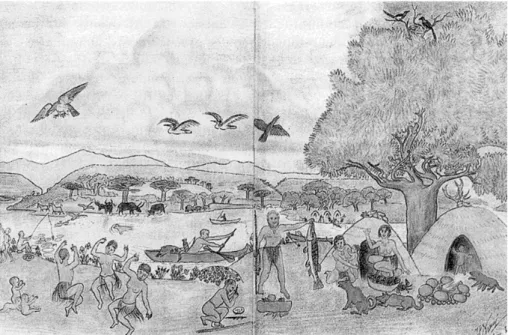
Despite the unusual number of human burials, these sites have been studied almost exclusively from the perspective of settlements for the living. Models of seasonal occupation have been proposed (Arnaud 1989; Marchand 2001); detailed studies on palaeo-diets (Umbelino 2006) and palaeo-populations focused on the Mesolithic-Neolithic transition have been done (Jackes & Lubell 1995; Jackes & Meiklejohn 2008), and just very recently some brief syntheses on mortuary practices have been published (Jackes & Lubell 2012; Jackes et al. 2014; Roksandic & Jackes 2014; Roksandic 2006; Umbelino & Cunha 2012). Although the dead have been the main reason why these sites have been excavated and internationally recognised, their place in archaeo-logical interpretation has been largely ignored. The following painting by the French archaeologist H. Breuil (1949) (Figure 6.4) illustrates this perspective well, making no allusion to mortuary practices. Interestingly, by this time, more than 200 burials had been recovered from the Muge shell middens. The painting is accompanied by a page long text with just a very brief refer-ence to burial practices:
They must have lived in straw or reed huts quite near their heaps of shell-fish, in which they often buried their dead; the bodies were generally doubled up. (Breuil 1949: 93)
This apparent disregard for the place of the dead is certainly related to general research trends. In practice, however, problems in terminology could also explain this seeming disinterest. Questions of terminology are important because they influence our interpretations, and here I would like to high-light some terms that may be useful when analysing archaeological contexts with human remains.
114
Figure 6.4. Daily life in a Muge shell midden, Tagus valley, Portugal (Breuil 1949: 94–95).
First, we may consider the disposal of human remains in one single structure. Assuming that the intentionality of the mortuary practice is confirmed, one must take into account the number of individuals, and most importantly, the tempo of disposal. Accordingly, funerary deposits in one single structure can be: individual, multiple or collective deposits (Figure 6.5).
Individual deposit Multiple deposit Collective deposit
• one structure • one structure • one structure
• one individual • two or more individ-uals
• two or more individ-uals • simultaneous or successive deposit in a short period of time • successive deposit in a more or less long time interval
Figure 6.5. Terminology: funerary deposits in one single structure.
One single funerary structure defined for the mortuary remains of one indi-vidual is an indiindi-vidual deposit. This structure can be as simple as a pit dug in the soil or as complex as a pyramid for a pharaoh. A ceramic pot containing the cremated remains of one individual also belongs in this category.
Rita Peyroteo-Stjerna
115
The distinction between multiple and collective deposits is based on the tempo of disposal. These terms are often used interchangeably. However, these expressions reflect specific cultural options that should be clear by the use of appropriate terminology. The simultaneous disposal of two or more individuals in one funerary structure is a multiple deposit. Multiple deposits can also include the successive disposal of various individuals, but in a short time frame between each disposal, as in contexts of mortality crisis related to catastrophes, massacres or plagues (Duday 2009: 98). The mortuary prac-tices in a collective deposit follow a very different cadence. A collective funerary structure is used over a more or less long period of time where two or more individuals are deposited during separate events. Passage graves and dol-mens are good examples of collective funerary deposits. These are single funerary structures successively re-opened for the deposit of new individu-als over a period of time.
After considering the different types of disposal of human remains in one single structure, according to the number of individuals and time frame, we can focus on contexts with more than one funerary structure, i.e. cemeteries. Es-sentially, a cemetery accommodates a number of funerary structures regard-less of the number of individuals and tempo of disposal. In its simplest def-inition, a cemetery can be defined as a funerary complex that accommodates more than one funerary structure, organised in a more or less complex manner (Duday 2009: 13). In modern cemeteries it is not uncommon to find the three types of funerary deposits described above: individual, multi-ple and collective (Figure 6.6), but this seems to be less common in earlier periods. As a last observation on terminology, I have chosen to avoid the term necropolis and opted for the term cemetery instead. Necropolis is a common term used in archaeology and it has been used to cover a variety of categories when human remains are found in archaeological contexts, in-cluding cemeteries. Besides its vague definition, the term has an urban con-notation derived from the Hellenistic Greek language, “the city of the dead”, which may not be the most suitable for deeper chronologies.
116
Figure 6.6. Terminology: a cemetery accommodates more than one funerary structure and can include all three categories of single funerary structures.
Accordingly, the burial grounds known for the shell middens in the Tagus and Sado valleys can be considered cemeteries by definition. Through a period of time, various individuals have been buried in these sites, mostly in simple individual structures and organised in a more or less complex man-ner (Figure 6.7). This observation does not exclude other interpretations of further uses of these sites. This observation implies solely that at least part of these sites was used as a cemetery over a more or less long period of time, in a more or less continuous manner.
As mentioned, the practice of inhumation was not common in the Iberian Peninsula, neither for previous chronologies nor in contemporaneous sites (Peyroteo-Stjerna in press). Yet it is common mortuary behaviour in these valleys during the Late Mesolithic and apparently since the first episodes of use of these sites. This particular form of dealing with death, with the con-stitution of cemeteries, is a key aspect in the life of the last hunter-gatherers of this region, and should not be overlooked.
cemetery collective deposit multiple deposit individual deposit
Rita Peyroteo-Stjerna
117 Figure 6.7. Sado valley, Vale de Romeiras, site plan, 1958. Archives of the National Museum of Archaeology, Lisbon, Portugal. Original drawing by Dario de Sousa, 1958. Adapted from a photograph by J.P. Ruas.
It could be argued that in these semi-sedentary societies (Arnaud 1987, 1989), this concentration of human burials was essentially a practical need. These bodies would simply be buried on location, as a way of dealing with a decomposing corpse. This practicality was possibly one motivator for this mortuary behaviour. However, considering the longevity of use of some of these cemeteries, in contrast with the relatively low number of buried indi-viduals, it can be suggested that only a segment of the population received this treatment. Additionally, there is a clear respect for the integrity of the body in the long term, hence a practice that goes beyond the practical need of hiding a decomposing corpse.
The processual interpretations link these Late Mesolithic cemeteries to hunter-gatherer territorial claims to establish control over economic re-sources provided by the new environmental conditions in these estuaries (Arnaud 1987, 1989). These are valid and persuasive arguments. However, I argue that the economic motivator cannot be sustained on its own. Fur-thermore, the construction and maintenance of cemeteries in these early
118
chronologies has been regarded as an indicator of social complexity. Ac-cording to this view social complexity will be mirrored by mortuary com-plexity (Binford 1971). This may be factual in certain contexts; however, I argue that in these sites this correlation is not necessarily valid, as these cemeteries are not necessarily more complex than other funerary practices that do not engage in construction of cemeteries.
This particular approach to death, with the development of cemeteries in open air sites, as opposed to a concealed death in caves or in remote places, reveals a relation of death to a daily landscape. Thus, instead of focusing on economic constraints and issues of social complexity, I would like to em-phasise the role of mortuary practices in the construction and maintenance of these locations as meaningful places remembered over generations. In this perspective, these locations are not only a repository of resources but spaces that hold experiences, events and memories (Low & Lawrence-Zúñiga 2003). The commitment of the living to the formation and mainte-nance of these cemeteries is a positive indicator of the importance of the dead in defining space and place (Wright 2013: 414) in the long term. In practice, consciously and/or unconsciously, death plays a role in the collec-tive memory of these sites.
Topographical relationships of Death
Barrett (1996) highlights how mortuary rituals structure the topographical
rela-tionships of death. Following Van Gennep’s (1960) threefold division of rites
of passage, Barrett identifies critical spatial differences in the rites involved in primary burial (i.e. inhumation), secondary burial and cremation. As op-posed to inhumation, secondary burial practices and cremation afford a spatial and temporal separation between the initial rites of liminality and the concluding rites of incorporation (Barrett 1996: 397). Conversely, the mor-tuary rituals involved in a primary burial will settle both the place and the moment of the transition of death (Barrett 1996: 398) in a permanent place in the landscape.
Inhumation and respect for the body as a whole were significant elements in the mortuary practices of the last hunter-gatherers of the Tagus and Sado valleys. Here, the dead were not removed from daily landscapes. Rather, they were granted with a formal and permanent location possibly in the heart of the social and daily life of these hunter-gatherers.
Rita Peyroteo-Stjerna
119
In this perspective, these sites, as with other early cemeteries, reveal a new conceptual link between the dead and the landscape (Pettitt 2011: 263). Through the development of a place for the dead, the experiences and con-sciousness of the participants take a material and spatial form with im-portant implications in the construction of a conceptual landscape. This angle in the perspective is important because in fact, as some authors have argued (Low & Lawrence-Zúñiga 2003), places are not in the landscape but in people’s minds.
Memory in the Landscape: Rituals in Practice
The stress on memory emphasises the role of ritual practice in the construc-tion of the landscape. This approach acknowledges the archaeological rec-ord of burial practices as material traces of memory construction. In this perspective, mortuary rituals are key elements in the construction of places. Following this, I would like to argue that it is through mortuary ritual prac-tices that these sites are remembered and kept meaningful in the landscape. Memory, here as shared memory of a social order, requires certain mecha-nisms to be maintained and transmitted within the social group over time and across generations. Memory can be inscribed in monuments and texts. In archaeological contexts, monuments are evident traces of memory and commonly emphasised, but incorporated memory leaves archaeological traces as well (Preucel & Meskell 2004: 216; Van Dyke 2010: 279). Memory can be materialised in representations, objects, ritual behaviours and places (Van Dyke & Alcock 2003), and ritual behaviour in particular, can be re-vealed through the observation of the remains of mortuary practices in the archaeological context.
As Connerton (1989) demonstrates, embodied or incorporated memory, manifested through performative rituals and physical behaviour, is much more effective in the production and transmission of social memory. In his work How Societies Remember, Connerton (1989) shows through various case-studies that memory is transmitted in non-textual and non-cognitive ways through ritual practice. This is shown to be a powerful system to enhance memory because ritual practice is a formalised, sequential and repetitive performative language that implies continuity with the past (Connerton 1989: 45). Thus, Connerton (1989) argues, incorporating practices through embodied behaviour provides a particularly effective system of mnemonics.
120
Nevertheless, inscribed memory is commonly considered the privileged form for the transmission of the memories of a given society. In archaeolo-gy, this aspect of social memory, the memory transmitted through bodily practices has been widely neglected, particularly in hunter-gatherer studies, as authors such as Sassaman and Holly (2011) have pointed out. However, it has been shown that systems of inscription, even the more complex, do not correlate to the capacity of a society to remember (Connerton 1989: 102). Thus, following Connerton’s (1989) premises, mortuary ritual practic-es are determinant in the procpractic-ess of memorialisation of thpractic-ese placpractic-es.
Death in Place
The topographical placement of the dead within the landscape of the living is a key element in the social dynamics of the last hunter-gatherers of the Tagus and Sado valleys.
Memory could be reproduced some other way, but here the dead were granted a permanent location through the construction and maintenance of cemeteries, affording them a concrete place of memory.
In this essay I have considered the spheres of death, memory and place were intricate components in the life of the Mesolithic hunter-gatherers. It is my view that archaeological interpretation can be enhanced if these spheres are approached in a holistic manner. Among other possible features and interpretations, these shell middens are mutually a place for the dead, and a place of ritualised codes. In this context, death rituals play a central role in the life of these hunter-gatherers in developing a sense of communi-ty within the landscape, as well as maintaining the social ties in both life and death.
Acknowledgements
This paper is part of my ongoing doctoral programme Death in the Mesolithic:
mortuary practices of the last hunter-gatherers in the extreme SW Europe and I am
grateful to The Portuguese National Science Foundation (FCT) for funding this research (SFRH/BD/72758/2010). I would like to thank the partici-pants of Ancient Death Ways for the stimulating discussions and input.
Rita Peyroteo-Stjerna
121
References
Ambrose, S. 1993. Isotopic analysis of paleodiets: methodological and interpretive considerations. In: M.K. Sandford (ed.) Investigations of Ancient Human Tissue. Chemical Analyses in Anthropology. Langhorne: Gordon and Breach Science Pub-lishers, pp 59–130.
Araújo, A.C. 1995–1997. A indústria lítica do concheiro de Poças de S. Bento (Vale do Sado) no seu contexto regional. O Arqueólogo Português 13–15: 87–159. Araújo, A.C. 2003. Long Term Change in Portuguese Early Holocene Settlement
and Subsistence. In: L. Larsson, H. Kindgren, K. Knutsson, D. Loeffler & A. Åkerlund (eds) Mesolithic on the Move: Papers Presented at the Sixth International Confer-ence on the Mesolithic in Europe, Stockholm 2000. Oxford: Oxbow Books, pp 569–580. Arnaud, J. 1987. Os concheiros mesolíticos dos Vales do Tejo e do Sado:
semelhanças e diferenças. Arqueologia 15: 53–64.
Arnaud, J. 1989. The Mesolithic Communities of the Sado Valley, Portugal, in Their Ecological Setting. In: C. Bonsall (ed.) The Mesolithic in Europe: Papers Pre-sented at the Third International Symposium. Edinburgh: John Donald Publishers Ltd, pp 614–631.
Barrett, J. 1996. The Living, the Dead and the Ancestors: Neolithic and Early Bronze Age Mortuary Practices. In: R.W. Preucel & I. Hodder (eds) Contempo-rary Archaeology in Theory. Oxford: Blackwell, pp 395–412.
Bicho, N., J. Cascalheira, J. Marreiros & T. Pereira. 2011. The 2008–2010 excavations of Cabeço da Amoreira, Muge, Portugal. Mesolithic Miscellany 21(2): 3–13.
Bicho, N., J. Cascalheira, J. Marreiros, C. Gonçalves, T. Pereira & R. Dias. 2013. Chronology of the Mesolithic occupation of the Muge valley, Central Portugal: The case of Cabeço da Amoreira. Quaternary International 308–309: 130–139. Binford, L. 1971. Mortuary Practices: their study and their potential. In: Approaches
to the Social Dimensions of Mortuary Practices. Memoirs of the Society for American Archaeology 25. Washington: Society for American Archaeology, pp 6–29. Breuil, H. 1949. Beyond the Bounds of History. Scenes from the Old Stone Age.
Trans-lated by Mary E. Boyle. London: Gawthorn.
Bronk Ramsey, C. 2009. Bayesian Analysis of Radiocarbon Dates. Radiocarbon 51(1): 337–360.
Connerton, P. 1989. How Societies Remember. Themes on the Social Sciences. Cambridge: Cambridge University Press.
Cunha, E. & F. Cardoso. 2001. The osteological series from Cabeço da Amoreira (Muge, Portugal). Bull. et Mém. de la Société d’Anthropologie de Paris 13(3–4): 323– 333.
122
Cunha, E. & F. Cardoso. 2002–2003. New data on Muge shell middens: a contri-bution to more accurate numbers and dates. Muge. Estudos Arqueológicos 1: 171– 183.
Cunha, E. & C. Umbelino. 1995–1997. Abordagem antropológica das comunidades mesolíticas dos Concheiros do Sado. O Arqueólogo Português 13–15: 161–179.
Cunha, E. & C. Umbelino. 2001. Mesolithic People from Portugal: an approach to Sado osteological series. Anthropologie 39(2–3): 125–132.
Cunha, E., F. Cardoso & C. Umbelino. 2003. Inferences about Mesolithic life style on the basis of anthropological data. The case of the Portuguese shell middens. In: L. Larsson, H. Kindgren, K. Knutsson, D. Loeffler & A. Åkerlund (eds) Mesolithic on the Move: Papers Presented at the Sixth International Conference on the Meso-lithic in Europe, Stockholm 2000. Oxford: Oxbow Books, pp 184–188.
Detry, C. 2007. Paleoecologia e paleoeconomia do Baixo Vale do Tejo no Mesolítico Final: o contributo dos mamíferos dos concheiros de Muge. Unpublished PhD thesis. Lisboa: Universidade Autónoma de Lisboa e Universidade de Salamanca.
Detry, C. & J.L. Cardoso. 2010. On Some Remains of Dog (Canis Familiaris) from the Mesolithic Shell-Middens of Muge, Portugal. Journal of Archaeological Science 37: 2762–2774.
Diniz, M. 2010. O Concheiro Mesolítico das Amoreiras (S. Romão, Alcácer do Sal): um (outro) paradigma perdido? In: J.F. Gibaja & A.F. Carvalho (eds) Os últimos caçadores-recolectores e as primeiras comunidades produtoras do sul da Península Ibérica e do Norte de Marrocos. Promontoria Monográfica. Faro: Universidade do Algarve, pp 49–61.
Diniz, M. & P. Arias. 2011. O povoamento humano do paleo-estuário do Sado (Portugal): problemáticas em torno da ocupação dos concheiros mesolíticos. In: A.C. Almeida, A.M.S. Bettencourt, D. Moura, S. Monteiro–Rodrigues & M.I.C. Alves (eds) Mudanças ambientais e interação humana na fachada atlântica ocidental. Coimbra: APEQ/CITCEM/CEGT/CGUP/CCT, pp 139–157.
Duday, H. 2009. The Archaeology of the Dead: Lectures in Archaeothanatology. Oxford: Oxbow Books.
Jackes, M., P. Alvim, J. Anacleto, & M. Roksandic. 2014. New Photographic Evi-dence on the 1954 Excavations at Moita do Sebastião, Muge, Portugal. In: M. Roksandic, S. Mendonça, S. Eggers, M. Burchell & D. Klokler (eds) The Cultural Dynamics of Shell–Matrix Sites. Albuquerque: University of New Mexico Press, pp 131–149.
Jackes, M. & D. Lubell. 1995. Human Skeletal Biology and the Mesolithic-Neolithic Transition in Portugal. In: L’Europe Des Derniers Chasseurs, 5e Colloque International UISPP, 18·28 Septembre 1995, pp 59–64.
Rita Peyroteo-Stjerna
123 Jackes, M. & D. Lubell. 2012. Mortuary Archaeology of the Muge Shell Middens.
In: J.F. Gibaja, A.F. Carvalho & P. Chambon (eds) Funerary Practices in the Iberian Peninsula from the Mesolithic to the Chalcolithic. BAR International Series 2417. Ox-ford: Archaeopress, pp 67–76.
Jackes, M. & C. Meiklejohn. 2008. The Paleodemography of Central Portugal and the Mesolithic-Neolithic Transition. In: J-P Bocquet-Appel (ed.) Recent Advances in Paleodemography. Springer Science+Business Media B.V., pp 209258.
Larsson, L. 1996. Late Atlantic Settlement in Southern Portugal. Results of an Excavation of a Mesolithic Shell Midden by the River Sado. Current Swedish Archaeology 4: 123–139.
Lentacker, A. 1986. Preliminary Results of Fauna of Cabeço de Amoreira and Cabeço Da Arruda (Muge, Portugal). Trabalhos de Antropologia e Etnologia 26(1– 4): 9–26.
Lentacker, A. 1994. Fish Remains from Portugal: Preliminary Analysis of the Mes-olithic Shell-Midden Sites of Cabeço da Amoreira and Cabeço da Arruda. An-nales Du Musée Royal de l’Afrique Centrale, Sciences Zoologiques 274: 263–271. Low, S. & D. Lawrence–Zúñiga. 2003. Locating Culture. In: S. Low & D.
Law-rence-Zúñiga (eds) The Anthropology of Space and Place. Locating Culture. Oxford: Blackwell Readers in Anthropology, Blackwell, pp 1–47.
Lubell, D. & M. Jackes. 1985. Mesolithic-Neolithic continuity: evidence from chronology and human biology. In: Actas da I Reunião do Quaternário Ibérico. Lisboa: Grupo de Trabalho Português para o Estudo do Quaternário 1, pp 113–133.
Lubell, D. & M. Jackes. 1988. Portuguese Mesolithic-Neolithic subsistence and settlement. Rivista di Antropologia 66: 231–248.
Marchand, G. 2001. Les traditions techniques du Mésolithique final dans le sud du Portugal: les industries lithiques des amas coquilliers de Várzea da Mó et de Cabeço do Rebolador (fouilles M. Heleno). Revista Portuguesa de Arqueologia 4(2): 47–110.
Martins, J.M., A.F. Carvalho & A.M. Soares. 2008. A calibração das datas de radiocarbono dos esqueletos humanos de Muge. Promontoria Monográfica 6: 73– 93.
Meiklejohn, C., M. Jackes & D. Lubell. 1986. Radiocarbon dating of human skele-tal material from two sites in Portugal. Mesolithic Miscellany 7(2): 4–6.
Meiklejohn, C., M. Roksandic, M. Jackes & D. Lubell. 2009. Radiocarbon dating of Mesolithic human remains in Portugal. Mesolithic Miscellany 20(1): 4–16.
Millard, A. 2014. Conventions for reporting radiocarbon determinations. Radiorcar-bon 56(2): 555–559.
Nilsson Stutz, L. 2010. A Baltic Way of Death? A Tentative Exploration of Identi-ty in Mesolithic Cemetery Practices. In: Å.M. Larsson & L. Papmehl-Dufay
124
(eds) Uniting Sea II. Stone Age Societies in the Baltic Sea Region. OPIA Series 51, De-partment of Archaeology and Ancient History, Uppsala University, pp 127– 144.
Nukushina, D. 2012. Tecno-tipologia lítica e cronometria no Mesolítico final do vale do Sado: o caso do concheiro das Amoreiras (Alcácer do Sal). Unpublished MA thesis. Lisboa: Faculdade de Letras da Universidade de Lisboa.
Pettitt, P. 2011. The Palaeolithic Origins of Human Burial. Abingdon: Routledge. Peyroteo–Stjerna, R. in press. Roots of Death: Origins of Human Burial and the
Research on Early Holocene Mortuary Practices in the Iberian Peninsula. In: Mesolithic burials – Rites, symbols and social organisation of early postglacial communities, Tagungen Des Landesmuseums Für Vorgeschichte Halle/Congresses of the State Museum for Prehistory Halle. Halle (Saale): State Office of Heritage Man-agement and Archaeology Saxony-Anhalt (LDA)–State Museum for Prehistory, Halle (Saale).
Preucel, R.W. & L. Meskell. 2004. Places. In: R.W. Preucel & L. Meskell (eds) A Companion to Social Archaeology. Oxford: Blackwell, pp 215–229.
Reimer, P., E. Bard, A. Bayliss, J.W. Beck, P.G. Blackwell, C. Bronk Ramsey, P.M. Grootes, T.P. Guilderson, H. Haflidason, I. Hajdas, C. Hattž, T.J. Heaton, D. L. Hoffmann, A.G. Hogg, K.A. Hughen, K.F. Kaiser, B. Kromer, S.W. Man-ning, M. Niu, R.W. Reimer, D.A. Richards, E.M. Scott, J.R. Southon, R.A. Staff, C.S.M. Turney & J. van der Plicht. 2013. IntCal13 and Marine13 Radio-carbon Age Calibration Curves 0–50,000 Years cal BP. RadioRadio-carbon 55(4): 1869– 1887.
Roche, J. 1965. Données récentes sur la stratigraphie et la chronologie des amas coquilliers d’âge mésolithique de Muge (Portugal). Quaternaria, VII: 155–163. Roche, J. 1967. Note sur la stratigraphie de l’amas coquillier mésolithique de
Cabeço da Arruda (Muge). Comunicações dos Serviços Geológicos de Portugal, LII: 79– 94.
Roksandic, M. 2006. Analysis of Burials from the New Excavations of the Sites Cabeço da Amoreira and Cabeço da Arruda (Muge, Portugal). In: N. Bicho & H. Veríssimo (eds) Do Epipaleolítico ao Calcolítico na Península Ibérica, Actas do IV Congresso de Arqueologia Peninsular, Promontória Monográfica 4. Faro: Universidade do Algarve, pp 43–54.
Roksandic, M. & M. Jackes. 2014. The Skeletal Assemblage and Burial Ritual at the Site of Cabeço da Amoreira: The 1960s Excavations by Veiga Fereira and Roche. In: M. Roksandic, S. Mendonça, S. Eggers, M. Burchell & D. Klokler (eds) The Cultural Dynamics of Shell–Matrix Sites. Albuquerque: University of New Mexico Press, pp 113–129.
Rolão, J., A. Joaquinito & M. Gonzaga. 2006. O complexo mesolítico de Muge: novos resultados sobre a ocupação do Cabeço da Amoreira. In: N. Bicho & H. Veríssimo (eds) Do Epipaleolítico ao Calcolítico na Península Ibérica, Actas do IV
Rita Peyroteo-Stjerna
125 Congresso de Arqueologia Peninsular. Promontória Monográfica 4. Faro: Universidade do Algarve, pp 27–42.
Rowley-Conwy, P. 2004. Complexity in the Mesolithic of the Atlantic Façade: De-velopment or Adaptation? In: M.G. Morales & G. Clark (eds) The Mesolithic of the Atlantic Façade. Anthropological Research Papers 55. Tucson: Arizona State University Press, pp 1–12.
Sassaman, K. & D.H. Holly Jr. (eds). 2011. Hunter-gatherer archaeology as historical process. Amerind Studies in Archaeology. Tucson: The University of Arizona Press.
Sassaman, K. & D. Holly Jr. 2011. Transformative Hunter-Gatherer Archaeology in North America. In: K. Sassaman & D. Holly Jr. (eds) Hunter-Gatherer Archae-ology as Historical Process. Amerind Studies in ArchaeArchae-ology. Tucson: The Univer-sity of Arizona Press, pp 1–13.
Schulting, R. & M. Richards. 2001. Dating Women and Becoming Farmers: New Paleodietary and AMS Dating Evidence from Breton Mesolithic Cemeteries of Téviec and Hoëdic. Journal of Anthropological Archaeology 20: 314–344.
Taylor, R. & Bar-Yosef, O. 2014. Radiocarbon dating: an archaeological perspective, 2nd ed.
Walnut Creek, CA: Left Coast Press.
Umbelino, C. 2006. Outros Sabores do Passado. As análises de oligoelementos e de isótopos estáveis na reconstituição da dieta das comunidades humanas do Mesolítico Final e do Neolítico/Calcolítico do território português. Unpublished PhD thesis. Coimbra: Universidade de Coimbra.
Umbelino, C. & E. Cunha. 2012. The Sado Shell Middens: Anthropological and Paleodietary Deciption. In: J.F. Gibaja, A.F. Carvalho & P. Chambon (eds) Fu-nerary Practices in the Iberian Peninsula from the Mesolithic to the Chalcolithic. BAR International Series 2417. Oxford: Archaeopress, pp 91–102.
Umbelino, C., A. Pérez-Pérez, E. Cunha, C. Hipólito, M.C. Freitas & J.P. Cabral. 2007. Outros sabores do passado: um novo olhar sobre as comunidades humanas mesolíticas de Muge e do Sado através de análises químicas dos ossos. Promontoria 5(5): 45–86.
Van Dyke, R.M. & S.E. Alcock. 2003. Archaeologies of Memory: An Introduction. In: R.M. Van Dyke & S.E. Alcock (eds) Archaeologies of Memory. Oxford: Black-well, pp 1–13.
Van Dyke, R.M. 2010. Memory, Place, and the Memorialization of Landscape. In: B. David & J. Thomas (eds) Handbook of Landscape Archaeology. Paperback edi-tion. World Archaeological Congress Research Handbooks in Archaeology. Walnut Creek, CA: Left Coast Press, pp 277–284.
Van Gennep, A. 1960. The Rites of Passage. Oxford: Routledge.
Wright, J. 2013. Land Ownership and Landscape Belief. Introduction and Con-texts. In: S. Tarlow & L.N. Stutz (eds) The Oxford Handbook of the Archaeology of Death & Burial. Oxford: Oxford University Press, pp 405–419.
Occasional Papers in Archaeology
Editors: Frands Herschend & Neil Price
1 The Bjurselet settlement III. Vol.1–2. Hans Christiansson and Kjel Knutsson (eds.). Uppsala 1989. 274 pp. 155 pp.
2 U. Alström. Hus och gård i Olavs vård: Trondheim ca 990–1300 (Houses and farmsteads in Olav’s care. Trondheim c. 990–1300). Uppsala 1991. 72 pp., 43 figs.
3 F. Herschend. The recasting of a symbolic value: three case studies on rune-stones. Uppsala 1994. 123 pp., 48 figs.
4 A. Kaliff. Brandgravskick och föreställningsvärld: en religionsarkeologisk dis-kussion (Cremation burial practice and religious beliefs). Uppsala 1992. 148 pp., 12 figs. (Out of print).
5 S. Welinder. Människor och artefaktmönster. (Humans and artifact patterns). Uppsala 1992. 76 pp., 56 figs.
6 K. Andersson. Romartida guldsmide i Norden II: fingerringar (Roman Period gold jewellery in the Nordic countries. II: finger rings). Uppsala 1993. 158 pp., 103 figs. (out of print)
7 Arkeologi och miljögeologi i Gamla Uppsala: studier och rapporter I (Ar-chaeology and environmental geology in Gamla Uppsala: studies and reports I). W. Duczko (ed.). Uppsala 1993. 127 pp., 37 figs.
8 L. Wilson. Runstenar och kyrkor: en studie med utgångspunkt från runstenar som påträffats i kyrkomiljö i Uppland och Södermanland (Rune-stones and churches). Uppsala 1994. 143 pp., 42 figs.
9 J. Coles. Rock carvings of Uppland: a guide. Uppsala 1994. 98 pp., 82 figs., 11 maps.
10 B. Johnsen & S. Welinder. Arkeologi om barn. Uppsala 1995. 83 pp.
11 Arkeologi och miljögeologi i Gamla Uppsala: studier och rapporter II (Ar-chaeology and environmental geology in Gamla Uppsala: studies and reports II). W. Duczko (ed.). Uppsala 1996. 230 pp., 50 figs.
12 J. Hegardt. Relativ betydelse: individualitet och totalitet i arkeologisk kulturte-ori (Relative meaning: individuality and totality in archaeological cultural the-ory). Uppsala 1997. 277 pp., 2 figs.
13 K. Andersson & F. Herschend. Germanerna och Rom, (The Germans and Rome). Uppsala 1997. 140 pp., 36 figs.
14 F. Herschend. Livet i hallen: tre fallstudier i den yngre järnålderns aristokrati (Life in the hall: three case-studies, on aristocracy). Uppsala 1997. 94 pp., 12 figs.
15 F. Herschend. The idea of the good in Late Iron Age society. Uppsala 1998. 210 pp., 41 figs.
16 Proceedings from the Third Flint Alternatives Conference at Uppsala, Sweden, October 18– 20, 1996. Holm, L. & Knutsson, K. (eds.). Uppsala 1998. 206 pp.
17 S. Norr. To rede and to rown: expressions of early Scandinavian kingship in written sources. Uppsala 1998. 253 pp., 4 figs.
18 F. Herschend. I förhållande till arkeologi (In relation to archaeology). Uppsala 1998. 176 pp., 16 figs.
19 “Suionum hinc civitates”: nya undersökningar kring norra Mälardalens äldre järnålder (“Suionum hinc civitates”: new investigations concerning the Early Iron Age in the northernpart of the Lake Mälaren Valley). K. Andersson (red.). Uppsala 1998. 275 pp., 93 figs.
20 A. Kaliff. Arkeologi i Östergötland: scener ur ett landskaps förhistoria (Östergötland: scenes from the Prehistory of a Swedish province). Uppsala 1999. 163 pp., 59 figs.
21 R. Meurman. Silverberg i Järnbärarland: bergshanteringens begynnelse i ljuset av Schmidt Testhammar-datering (Silver mountains in iron ore country: the beginning of mining as reflected in Schmidt’s Test-hammer datings. Uppsala 2000. 184 pp., 74 figs.
22 M. Notelid. Det andra påseendet: en studie av övergångar i den arkeologiska disciplinens historia (The second glance: a study of transitions in the history of the archaeological discipline). Uppsala 2000. 217 pp., 2 figs.
23 M. Notelid. Det andra påseendet, del II. Den omvända diskursen (The Second Glance, part II: The reversed discourse). Uppsala 2001. 43 pp.
24 F. Herschend. Journey of civilisation: the late Iron Age view of the human world. Uppsala 2000. 200 pp. 19 figs.
25 H. Göthberg. Bebyggelse i förändring: Uppland från slutet av yngre bronsålder till tidig medeltid (Changing settlements: Uppland from the end of the Late Bronze Age to the Early Middle Ages). Uppsala 2001. 262 pp., 87 figs.
26 A. Kaliff. Gothic connections: contacts between eastern Scandinavia and the southern Baltic coast 1000 BC–500 AD. Uppsala 2001.
27 (= SAR 39) Mellan sten och brons: uppdragsarkeologi och forskning kring senneolitikum och bronsålder (Between stone and bronze: rescue archaeology and research concerning the Late Neolithic Period and the Bronze Age). H. Bolin, A. Kaliff, T. Zachrisson (red.). Uppsala & Stockholm 2001. 152 pp., 31 figs., 4 tables.
28 A. Sundkvist. Hästarnas land: aristokratisk hästhållning och ridkonst i Svealands yngre järnålder (The land of the horses: aristocratic horsemanship and riding in the Late Iron Age). Uppsala 2001. 260 pp., 90 figs., 4 tables. 29 A-S. Gräslund. Ideologi och mentalitet: om religionsskiftet i Skandinavien från
en arkeologisk horisont (Ideology and mentality: the conversion of Scandinavia from an archaeological perspective). Uppsala 2001. Revised 2002. 172 pp. 40 figs.
30 J. Ros. Sigtuna. Staden, kyrkorna och den kyrkliga organisationen (Sigtuna: the town, churches and the ecclesiastical organisation). Uppsala 2001. 310 pp. 48 figs.
31 L. Lager. Den synliga tron: runstenskors som spegling av kristnandet i Sverige (The visible faith: runestone crosses as reflections of the christianisation of Sweden). Uppsala 2002. 274 pp. 83 figs.
32 (= Riksantikvarieämbetet arkeologiska undersökningar skrifter no 44) L. Kar-lenby. Bronsyxan som ting och tanke i skandinavisk senneolitikum och äldre bronsålder (Object and symbol: the bronze axe in Late Neolitithic and Early Bronze Age in Scandinavia). Uppsala 2002. 128 pp., 21 figs.
33 Uniting Sea: Stone Age Societies in the Baltic Region. Proceedings from the First Uniting Sea Workshop at Uppsala University, Sweden, January 26–27, 2002. C. Samuelsson & N. Ytterberg (red.). Uppsala 2003. 256 pp., 95 figs. 34 A. Sanmark. Power and Conversion – a Comparative Study of Christianization
in Scandinavia. Uppsala 2004. 322 pp., 5 maps, 13 figs, 4 diagrams, 1 table. 35 A Kaliff & O. Sundqvist. Oden och Mithraskulten. Religiös ackulturation
un-der romersk järnålun-der och folkvandringstid (Óðinn and the Cult of Mithras. Religious Ackulturation in the Roman and Migration Periods). Uppsala 2004. 126 pp., 28 figs.
36 F. Markus. Living on Another Shore: Early Scandinavian Settlement on the North-Western Estonian Coast. Uppsala 2004. 226 pp., 53 figs, 6 tables. 37 F. Andersson. Med historien i ryggen: om den arkeologiska uppgiften. (With
History at our Backs. On the Archaeological Mission. Uppsala 2005. 186 pp., 3 figs.
38 F. Herschend. Ackulturation och kulturkonflikt. Fyra essäer om järnålders-mentalitet (Acculturation and cultural conflict. Four essays on iron-age mental-ity). Uppsala 2005. 116 pp., 22 figs and tables.
39 A. Larsson. Klädd Krigare: Skandinaviskt dräktskifte omkring år 1000. Uppsa-la 2007. 370 pp., 54 figs and 7 tables.
40 J. Hegardt. Fyrtio minuter. En essä om arkeologins berättelser. Uppsala 2007. 213 pp., 29 figs.
41 Olof Sundqvist. Kultledare i fornskandinavisk religion.(Cult Leaders in An-cient Scandinavian Religion – A Collection of Articles). Uppsala 2007. 272 pp., 39 figs.
42 Valsgärde Studies: The Place and its People, Past and Present. S. Norr (ed.). Uppsala 2008. 210 pp., 94 figs, 20 tables, 6 apps.
43 Roger Edenmo. Prestigeekonomi under yngre stenåldern. Gåvoutbyten och regionala identiteter i den svenska båtyxekulturen. (Prestige Economy in the Younger Stone Age. Gift Exchange and Regional Identities in the Swedish Boat Axe Culture.) Uppsala 2008. 298 pp., 78 figs and 11 tables.
44 Lotta Mejsholm. Gränsland. Konstruktion av tidig barndom och begravnings-ritual vid tiden för kristnandet i Skandinavien. (Borderland. Constructions of Early Childhood and Burial Rituals during the Christianisation in Scandinavia). Uppsala 2009. 298 pp., 21 figs and 18 tables.
45 Jonas Ros. Stad och gård. Sigtuna under sen vikingatid och tidig medeltid. (Town and house. Sigtuna during late Viking Age and Early Medieval period). Uppsala 2009. 288 pp., 85 figs.
46 Frands Herschend. The Early Iron Age in South Scandinavia. Social order in settlement and landscape. Uppsala 2009. 410 pp., 124 figs.
47 Carl Gösta Ojala. Sámi Prehistories. The Politics of Archaeology and Identity in Northernmost Europe. Uppsala 2009. 353 pp., 33 figs and 2 tables.
48 Frands Herschend. Mellan tal och skrift. Essäer om runinskrifter. (Between speech and writing. Essays on runic inscriptions). Uppsala 2009. 110 pp., 33 figs.
49 Magnus Alkarp. Det Gamla Uppsala – berättelser och metamorfoser. (The Old Uppsala – Stories and Matamorphoses). Uppsala 2009. 460 pp., 21 figs. 50 Charlotta Hillerdal. People in Betweencity and Material Identity, a New
Ap-proach to Deconstructed Concepts. Uppsala 2009. 318 pp., 11 figs.
51 Pierre Vogel. Vardagslivets aktiva oförändring. En studie av kultur genom arkeologi och stenåldersboplatser. Uppsala 2010. 311 pp., 72 figs.
52 Sara Hagström Yamamoto. I gränslandet mellan svenskt och samiskt. Identi-tets-diskurser och förhistorien i Norrland från 1870-tal till 2000-tal. Uppsala 2010. 221 pp., 21 figs.
53 [51] Uniting sea II. Stone Age Societies in the Baltic Sea Region. Ed:s Asa M. Larsson & Ludvig Papmehl-Dufay. Uppsala 2010. 283 pp., 67 figs.
54 Ola Kyhlberg. Den långa järnåldern. Sociala strategier, normer, traditioner. Uppsala 2011. 344 pp., 68 figs.
55 Leif Karlenby. Stenbärarna. Kult och rituell praktik i skandinavisk bronsålder. 308 pp., 48 figs.
56 Lars Landström. Med Uppsala i centrum. Uppsala 2012
56a Anders Kaliff & Terje Østigård. Kremation och kosmologi – en komparativ arkeologisk introduktion. (Cremation and Cosmology – A Comparative Ar-chaeological Introduction) Uppsala 2013. 150 pp., 49 figs.
57 Wulfila 311–2011. International Symposium. Anders Kaliff & Lars Munk-hammar (eds.). Uppsala 2013. 229 pp.
58 Gustaf Svedjemo. Landscape Dynamics: Spatial analyses of villages and farms on Gotland AD 200–1700. Uppsala 2014. 255 pp.