Introduction
2,3-, 3,5- and 2,6-dimethoxybenzoic acids are crystalline solids sparingly soluble in cold water [1-5]. The literature survey shows that in principle there is no information about the complexes of these acid anions with various cations. Papers exist only on their compounds with rare earth elements in solution and solid state [2, 6, 7]. At present, we decided to obtain the complexes of Cu(II) ions with 2,3- , 3,5- and 2,6-dimethoxybenzoic acid anions as solids, to examine some of their physico-chemical properties and to compare them.
In our previous papers [8-12] we characterized these complexes by elemental
analysis, IR spectral data, thermogravimetric studies and X-ray diffraction measurements but now taking into account the presence and positions of two methoxy-groups in benzene ring we decided to compare the properties of Cu(II) compounds in order to investigate the influence of substituent positions on their properties.
Experimental details
2,3- , 3,5- and 2,6-dimethoxybenzoates of Cu(II) were prepared by the addition of equivalent quantities of 0.1 M ammonium 2,3- , 3,5- and 2,6-dimethoxybenzoates (pH≈5) to hot 0.1 M aqueous solutions containing the nitrates
www.scielo.br/eq
Volume 31, número 3, 2006
Comparison of some properties of
Cu(II) 2,3- , 3,5- and 2,6-dimethoxybenzoates
W. Ferenc1*, A. Walków-Dziewulska1, J. Sarzynski2 and B. Paszkowska1
1Department of General and Coordination Chemistry, Maria Curie-Sklodowska
University, Pl 20-031, Lublin, Poland
2Institute of Physics, Maria Curie-Sklodowska University, Pl 20-031, Lublin,Poland
* Corresponding author: e-mail: [email protected]
Abstract: The physico-chemical properties and thermal stability in air of Cu(II) 2,3- , 3,5- and 2,6-dimethoxybenzoates were compared and the influence of the position of –OCH3substituent on their thermal stability was investigated. The complexes are crystalline, hydrated salts with blue colour. The carboxylate ion is a bidentate chelating or bridging group. The thermal stability of analysed Cu(II) dimethoxybenzoates was studied in the temperature range of 293-1173 K. The positions of methoxy-groups in benzene ring influence the thermal properties of studied complexes. Their different thermal properties are markedly connected with the various influence of inductive, mesomeric and steric effects of –OCH3substituent on the electron density in benzene ring. The magnetic susceptibilities of the complexes were measured over the range of 76-300 K and the magnetic moments were calculated. The results show that they form dimers.
Keywords: dimethoxybenzoates; complexes of Cu(II); magnetic moments; thermal behavior; FTIR spectra.
(V) of Cu(II) ions and crystallizing at 293 K. The solids were filtered off, washed several times with hot water and methanol to remove the ammonium ions and dried at 303 K.
Elemental analysis for C, H was performed using a Perkin-Elmer CHN 2400 analyser. The contents of Cu2+ metal ions were established gravimetrically, and by ASA method with the use of ASA 880 spectrophotometer (Varian).
The FTIR spectra of the complexes were recorded in the range of 4000 – 400 cm-1using an FTIR 1725X Perkin – Elmer spectrometer. The samples for the FTIR spectroscopy were prepared as KBr discs. Some of the results are presented in Table 1.
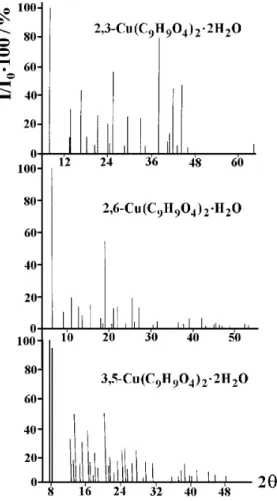
The X-ray diffraction patterns were taken on a HZG-4 (Carl Zeiss, Jena) diffractometer using Ni filtered CuKα radiation. The measurements were made within the range of 2Θ=4-80°by means of the Debye-Scherrer-Hull method. The relationships between I/I0 and 2Θ for these complexes are presented in Fig. 2.
The thermal stability and decomposition of the complexes were studied in air using a Q-1500 D derivatograph with a Derill converter, which simultaneously records TG, DTG and DTA curves. The measurements were made at a heating rate of 10 K⋅min-1. The 100 mg samples were heated in platinum crucibles in static air to 1273 K with a TG sensitivity of 100 mg (i.e., the whole scale of the balance was equal to 100 mg). The DTG and DTA sensitivities were regulated by the Derill computer programme. The paper speed was 2.5 mm⋅min-1and Al2O3was used as the standard. The decomposition products were calculated from the TG curve and verified by powder diffraction analysis.
-5cm3⋅g-1. Correction for diamagnetism of the
cal-ibrant atoms was calculated by the use of Pascal’s constants [13, 14]. Magnetic moments were calculated from Eq.(1)
µ= 2.83 ( χM⋅T )1/2 (1)
The solubilities of 2,3-, 3,5- and 2,6-dimethoxybenzoates of Cu(II) in water were meas-ured at 293 K. Saturated solutions of the obtained compounds were prepared under isothermal condi-tions. The contents of Cu(II) were determined by using ASA 880 spectrophotometer (Varian). The values of solubilities are presented in Table 1.
Results and Discussion
The complexes of the 2,3-, 3,5- and 2,6-dimethoxybenzoates of Cu(II) were obtained as polycrystalline blue solids with a metal to ligand ratio of 1:2 and the general formula Figure 1. IR spectra of 2,3-dimethoxybenzoic acid
(A); 2,3-dimethoxybenzoate of Cu(II) (B); 2,6-dimethoxybenzoic acid (C); 2,6-dimethoxyben-zoate of Cu(II) (D); 3,5-dimethoxybenzoic acid (E); 3,5-dimethoxybenzoate of Cu(II) (F).
Cu(C9H9O4)2⋅nH2O, where n=2 for 2,3- and 3,5-dimethoxybenzoates and n=1 for 2,6-dimethoxybenzoate [8-12]. The details connected with their identification by elemental and spectral analyses were extensively presented in our pervious papers [8-12]. Therefore, in this article only some selected results of the FTIR investigations were presented in Table 1. There are two bands arising from asymmetric and symmetric vibrations of the COO- groups at 1607-1578 cm-1 and 1442-1392 cm-1, respectively for analysed complexes [15-21]. The bands due to ν(M-O) appear in the range of 497-472 cm-1. The magnitudes of the separation
∆νOCO- (where ∆νOCO-= ν
asOCO-- νsOCO-), which characterize the type of metal ion-oxygen bond change from 206 cm-1 to 184 cm-1. According to spectroscopic criteria and especially with regard to Nakamoto [20, 21] the carboxylate groups in the analysed complexes show different modes of coordination. In the 2.3-and 3,5-dimethoxybenzoates they may function as bidentate chelating or bidentate bridging groups and in the 2,6-dimethoxybenzoate only as bidentate bridging ones.
The X-ray diffraction patternes of the 2,3, 3,5- and 2,6-dimethoxybenzoates of Cu(II) were recorded. The analysis of the diffractograms suggests that the complexes are polycrystalline compounds with various degrees of crystallinity and different structures [22]. Their structures have not been determined as attempts to obtain single crystals failed.
The thermal stability of Cu(II) 2,3-, 3,5-and 2,6-dimethoxybenzoates was studied in air. All the details concerning the thermal decomposition of these complexes in air were described in our previous papers [8-12].
increases in order: 2,6- < 2,3- < 3,5- while that of hydrated ones in the sequence: 3,5- < 2,3- < 2,6-. From the comparison of the decomposition way results it follows that the various position of -OCH3 substituents in benzene ring influences the decomposition process being strongly connected with the various participations of the inductive and mesomeric effects of methoxy- groups in the electron density of the system.
The way of the thermal decomposition of 2,3-dimethoxybenzoate of Cu(II) is as follows:
CuL2·2H2O → CuL2·H2O → CuL2→ CuO, where L=C9H9O4
CuL2·2H2O →CuL2∑→CuO in the case of 3,5-dimethoxybenzoate and
CuL2·H2O → CuL2∑→ CuO, in 2,6-dimethoxybenzoate
Considering the temperature at which the dehydration processes occur and the ways in which they proceed it is possible to assume that the water molecules are in the outer or inner coordination spheres of the complexes [23-25].
The solubilities of analysed dimetho-xybenzoates in water at room temperature were determined (Table 1). They are of the order of 10-5 -10-2mol⋅dm-3. 2,6-dimethoxybenzoate of Cu(II) is the best soluble salt while that of 3,5-dimethoxy-benzoate the least one. The values of solubilities increase in the order: 3,5- < 2,3- < 2,6-. The changes in the values presented above are connected with various influences of inductive, mesomeric and steric effects of methoxy- groups on the electron density of the system depending on their position in benzene ring. The inductive effects of each methoxy- groups cause the delocalization of the electrons in the molecule and the change of its ener-gy state brought about the conjugation at electrons. It leads to the stabilization of the system [26-28].
Magnetic susceptibility of the analysed compounds was measured in the range of 76-303 K
(Table 3). Their values increase with rising temper-ature. The effective magnetic moment values of the 2,3-, 3,5- and 2,6-dimethoxybenzoates of Cu(II) change from 0.47 BM (at 77 K) to 1.47 BM (at 296 K) for 2,3-dimethoxybenzoate, from 0.67 BM (at 77 K) to 1.75 BM (at 298 K) for 3,5-dimethoxyben-zoate and from 0.46 BM (at 76 K) to 1.47 BM (at 303 K) for 2,6-dimethoxybenzoate of Cu(II). This kind of dependence is typical behaviour of copper dimers exhibiting characteristic antiferromagnetic interactions between the Cu(II) centres, which obey the Bleaney-Bowers equation [29-33] Eq. (2):
(2)
where: N-Avogadro constant, β-Bohr magneton, k-Boltzmann constant, T-absolute temperature, J-exchange parameter, gav–average coefficient of the spectroscopic splitting for the dimer experimentally determined from EPR spectra.
centres. The variable-temperature magnetic results for complexes of Cu(II) are given in Tables 3 and 4. The magnetic susceptibility reaches highest values at room temperature and decreases with decreasing temperature. The magnetic moment values of the Cu(II) complexes decrease from 1.46 BM, 1.47 BM and 1.75 BM at about 300 K to 0.46 BM, 0.47 BM and 0.67 BM at 77 K, as a consequence of depopulation of the excited triplet (S=1) separated by 2J [31, 36]. The interaction will be antiferromagnetic (J<0) if S=0 is the ground state; on the contrary if S=1, the interaction will be ferromagnetic [31, 36]. According to Kahn’s theory, the exchange coupling constant is the sum of ferromagnetic and antiferromagnetic contributions [37]. The ferromagnetic contribution is weak when the metal ions are bridged by polyatomic extended ligands [38]. However, the magnitude of the antiferromagnetic interaction is primarily governed by the overlap of two magnetic orbitals centered on nearest-neighbour copper(II) ions [39]. Whereas ferromagnetic contributions are usually small, antiferromagnetic ones may be considered as being proportional to the square of the gap between the molecular constructed from the magnetic orbitals [40]. For dinuclear Cu(II) complexes the magnetic coupling constant J is directly related to energy separation between the singlet and triplet states. In the lower temperature range only lowest levels of dimers are occupied. They may be followed by the course of χCu=f(T) for copper(II) dimers with states S=1 and S=0 [41]. The electron population in both levels is combined with the Boltzmann contribution law and is temperature dependent. At higher temperatures and for relatively high exchange parameters |J|(J<0), both states are occupied ( the triplet state dominating) and the magnetic moment has values close to the pure spin (1.73 BM), but it is usually lower. With decreasing temperature, the population of the triplet state decreases and within the lowest temperature range, only the singlet state is occupied (S=0) and µ=0 BM.
The magnetic features of the 2,3-, 3,5- and 2,6-dimethoxybenzoates of Cu(II) indicate the mode of the metal ion-ligand coordination and the geometry around the metal ions. The geometry exerts a marked influence on the magnetic exchange interaction. Therefore, the weak antiferromagnetic interaction may be mainly brought about by the
geometrical structures of this complex and the prop-erties of the bridged ligands [29, 42-44].
The magnetic measurements reveal that 2,3-, 32,3-,5- and 22,3-,6-dimethoxybenzoates of Cu(II) form dimers with bidentate bridging carboxylate groups. This type of dentate of COO-groups was confirmed by IR spectral data (Table 1). In the case of the 2,3-and 2,6-dimethoxybenzoates of Cu(II), the electron densities on the oxygen atoms increase which leads to stronger covalent metal ion-oxygen bonds and thereby to an increased overlap of the orbitals of the two unpaired electrons in the binuclear units (µeff=1.47 BM at room temperature). However in the case of the 3,5-dimethoxybenzoate of Cu(II) the electron density on the oxygen atoms of the car-boxylate group is decreased causing a weakening of the metal-oxygen bond and a decrease of the overlap of the two unpaired electron orbitals in the binuclear units (µeff=1.75 BM at room temperature) [33].
Conclusions
dimethoxybenzoate anions in the basal plane and one oxygen atom of water molecule at the apex.
The proposed formulae for the analyzed complexes may be following:
[Cu2(2,3-L)4(H2O)2]⋅2H2O, [Cu2(3,5-L)4(H2O)4], and [Cu2(2,6-L)4(H2O)2], where L=C9H9O4-.
Received 08 June 2006 Accepted 17 August 2006
References
[1] L. D. Pethe and B. D. Mali, Indian J. Chem.,16 (1978) 364
[2] Gmelin Handbook of Inorganic Chemistry, Vol. D5, Springer Verlag, Berlin 1984, p 105
[3] M. Georgieva, Anal. Chim. Acta, 101 (1978) 139 [4] L. D. Pethe and V. G. Hirve, Indian J. Chem.,22A (1983) 107
[5] Beilsteins Handbuch der Organischen Chemie, Bd IX, Verlag von Julius Springer, Berlin, 1927, p 405
[6] S. L. Erre, G. Micera and F. Cariati, G. Ciani, A. Sironi, H. Kozlowski, and J. Baranowski, J. Chem. Soc., Dalton Trans., 2 (1988) 363
[7] S. L. Erre, G. Micera and F. Cariati, Polyhedron, 6 (1987) 1869
[8] W. Ferenc, A. Walków-Dziewulska, and J. Sarzynski, J. Serb. Chem. Soc.70 (2005) 1089
[9] W. Ferenc, A. Walków-Dziewulska, and P. Sadowski, Chem. Pap., 59 (2005) 324
[10] W. Ferenc, A. Walków-Dziewulska, P. Sadowski, and J. Chrusciel, J. Serb. Chem. Soc., 70 (2005) 833
[11] W. Ferenc, A. Walków-Dziewulska, and P. Sadowski, J. Therm. Anal. Cal., 82 (2005) 365
[12] W. Ferenc, A. Walków-Dziewulska, and J. Sarzynski, Magnetic, thermal and spectral characterization of 2,6-dimethoxybenzoates of Co(II), Ni(II) and Cu(II), Ecletica Quimica(in press)
[13] B. N. Figgs, and R. S. Nyholm, J. Chem. Soc., (1958) 4190
[14] E. Konig, Magnetic Properties of Coordination and Organometallic Transition Metal Compounds, Springer, Verlag, Berlin, 1966
[15] L. J. Bellamy, The Infrared Spectra of Complex Molecules,Chapman and Hull, London, 1975
[16] K. Burger, Coordination Chemistry: Experimental Methods, Akademiai Kiadó, Budapeszt, 1973
[17] K. Nakamoto, Infrared and Raman Spectra of Inorganic and Coordination Compounds,Wiley, Toronto 1997.
[18] M. Silverstein, G. C. Bassler, Spectroscopic Methods of Inorganic Compounds. Identifications, Polish Scientific Publisher, Warsaw, 1970
[19] A. Cross, A. R. Jones, An Introduction in Practical Infrared Spectroscopy,Butterworths, London, 1969. [20] R. C. Mehrotra, R. Bohra, Metal Carboxylates, Academic Press, London, 1983
[21] B. S. Manhas, A. K. Trikha, J. Indian Chem. Soc. 59 (1982) 315
[22] E. Lagiewka, Z. Bojarski, X-Ray Structural Analysis, Polish Scientific Publisher, Warsaw, 1988
[23] A. V. Nikolaev, V. A. Logvinenko, L. L. Myachina, Thermal Analysis, Vol. 2, Academic Press, New York, 1969 [24] B. Singh, B. V. Agarwala, P. L. Mourya, A. K. Dey, J. Indian Chem. Soc. 59 (1992) 1130
[25] F. Paulik, Special Trends in Thermal Analysis, Wiley, Chechester, 1995
[26] H. A. Staab, Einführung in theoretische organische Chemie,Verlag Chemie, Weinheim, 1962, p.355
[27] J. Shorter, Correlation Analysis in Organic Chemistry. An Introduction to Linear Free-Energy Relationship, Clarendon Press, Oxford, 1973, p.69
[28] G. Kupryszewski, Wstep do chemii organicznej,PWN, Warszawa 1980, p.392 (in Polish)
[29] C. I. O’Connor, Progress in Inorganic Chemistry, Wiley, New York, 1982
[30] A. Earnshaw, Introduction to Magnetochemistry, Acaemic Press, London, 1968
[31] B. N. Figgis, and R. L. Martin, J. Chem. Soc.,(1956) 3837
[32] B. Bleaney, and K. D. Bowers, Prac. Ray. Soc., London, 214 (1952) 451
[33] M. Melnik, and J. Mrozinski, J. Molec. Struct., 39 (1976) 269
[34] R. Morgan, P. Turner, B. J. Kennedy, T. W. Hambley, P. A. Lay, J. R. Biffin, H. L. Regtop, and B. Wawrick, Inorg. Chim. Acta, 32 A (2001) 150
[35] J. Casanova, G. Aluzet, J. La Torre, and J. Borras, Inorg. Chem., 36 (1997) 2052
[36] E. Kokot, and R. L. Martin, Inorg. Chem., 3 (1964) 1306 [37] J. I. Girard, M. F. Charlot, and O. Kahn, Mol. Phys., 34 (1977) 1063
[38] M. Julve, M. Verdaguer, A. Gleizes, M. Philo-Levisalle, and O. Kahn, Inorg. Chem.,23 (1984) 3808
[39] B. Zurawska, and J. Mrozinski, Inorg. Chem. Acta,342 (2003) 23
[40] O. Kahn, Angew. Chem. Int. Ed. Engl., 24 (1985) 834 [41] J. Mrozinski, Materials Sci., 3 (1988) 23
[42] H. Oshio, and U. Nagashima, Inorg. Chem.,31 (1992) 3295
[43] D. Mrozinska, and J. Mrozinska, Materials Sci., 15 (1989) 65