Article
0103 - 5053 $6.00+0.00*e-mail: [email protected]
The Effect of using Mixed Initiator Systems on the Efficiency
of Photopolymerization of Dental Resins
Miguel G. Neumann,*
,aCarla C. Schmitt,
aIvo C. Correa
band Beatriz E. Goi
aaInstituto de Química de São Carlos, Universidade de São Paulo, CP 780, 13560-970 São Carlos-SP, Brazil
bFaculdade de Odontologia, Universidade Federal do Rio de Janeiro, Rio de Janeiro-RJ, Brazil
Foi realizado um estudo para determinar a eficiência da utilização simultânea dos fotoiniciadores fenilpropanodiona (PPD) e canforquinona (CQ) para a polimerização de polímeros acrílicos e avaliar possíveis mecanismos que levem à sinergia ou antagonismo. Foi encontrado que as eficiências de ambos iniciadores usados individualmente são maiores que a da mistura, indicando que quando os iniciadores são usados simultaneamente há uma transferência de energia do iniciador mais eficiente (CQ) para o menos eficiente (PPD). Também, não foi encontrada nenhuma evidência de reação entre a amina presente na formulação da CQ e o PPD no estado excitado.
A study was performed in order to determine the efficiency of the simultaneous use of the photoinitiators phenylpropanedione (PPD) and camphorquinone (CQ) in the polymerization of acrylic polymers and evaluate possible mechanisms leading to synergism or antagonism. It was found that efficiencies of both initiators taken individually are higher than that of their mixture, indicating that when both dyes are used simultaneously there will be an energy transfer from the more efficient initiator (CQ) to the less efficient one (PPD). Also, there was no proof of any reaction between the amine present in the CQ formulation and the PPD excited state.
Keywords: photoinitiators, photopolymerization, mixed initiator systems, synergy
Introduction
Light-induced polymerization systems are used as permanent restorative dental resin composites in dentistry. Initially, these systems can be divided into two categories, according to the light source: UV or visible light.1 Nowadays, UV sources are not longer used due to negative biological effects.2
In recent years several academic and commercial research laboratories tried to develop new photocurable dental resins (composed, mainly, of organic monomers, inorganic fillers, a photosensitizer, and a co-initiator).3-7 Among them, the photosensitizer is the most important component since it initiates the photopolymerization of the resin composite. Camphorquinone (CQ) is widely used as photosensitizer for visible light curing,8-10 although it presents some drawbacks like low polymerization efficiency, toxicity, and yellowing due to the presence of an amine-derived co-initiator. The low polymerization efficiency of CQ results in low mechanical properties of
the resin composite, as well as possible toxic effects to the human body from residual monomers.
Experimental
Materials
The monomer, methyl methacrylate (Merck) was distilled from ice bath at reduced pressure in the presence of hydroquinone, washed with 5% NaOH in water and dried over CaCl2. 1-Phenyl-1,2-propanedione (PPD), camphorquinone (CQ), and ethyl 4-dimethylaminobenzoate, (EDB) were purchased from Aldrich and used without further purification.
Photopolymerization procedure
The kinetics of the light induced polymerization of MMA (pure monomer, ca. 9 mol L-1) in the presence of photoinitiators systems (PPD, CQ-EDB and PPD-CQ/ EDB) were followed in a dilatometer.11,12 The solution was thoroughly deoxygenated by bubbling oxygen-free nitrogen for 40 min. The dilatometer consisted of two capillaries (internal diameter 0.18 cm) attached to a cylindrical reaction vessel (internal diameter 2.2 cm, volume 8.5 ml), which was placed in a constant temperature bath (25 °C) in front of the irradiation source. The reaction cell was placed in front of a 200 W Hg (Xe) lamp in an Oriel Universal Arc Lamp source. A 395 nm cut-off filter was placed between the lamp and the reaction cell to eliminate the uv-radiation.
Polymerization rates (R
p) were calculated using equation 113
V
Rp = –––– [MMA] (mol L-1 s-1) (1) F.f.t
where V is the volume contraction in the capillary (measured with a cathetometer) at time t,f the volume fraction of monomer MMA in the solution, F the volume contraction related to the densities of polymer and monomer solution, F = [(dp– dm)/dp], and dpand dm
being the densities of the polymer and the monomer, respectively.
Actinometry was performed using the ferrioxalate/ phenanthroline sensitizer. As the quantum efficiency of this actinometer ( ) depends on the irradiating wavelength, appropriate -values were used for different wavelength ranges, i.e., 400 to 436 nm ( = 1.00), 437 to 468 nm ( = 0.85), 469 to 500 nm ( = 0.58).14
The polymerization quantum yields of ( p) were calculated using
Rp
p = –––n (2)
T
werenTis the photon flow in Einstein s-1.
Photochemical measurements
Static fluorescence quenching experiments were carried out at room temperature using a Hitachi F-4500 spectrofluorimeter on air-equilibrated solutions using ethyl acetate as a solvent, due to its properties being quite similar to those of MMA. CQ was excited at 470 nm and the emission was determined at the maximum of the emission peak. Absorption spectra were measured on a Hitachi U-2000 spectrophotometer.
Results and Discussion
Park et al.11 found that the use of both initiators together would increase the rate of polymerization in dentistry formulations. This effect can be, ideally, achieved in three different ways: i) an increase of the amount of light absorbed by the mixture when both dyes are present, taking into account that their absorption spectra are different; ii) the onset of a new mechanism that accelerates the reaction rate; iii) an energy transfer from the less efficient dye to the more efficient one, rendering a higher reaction yield.
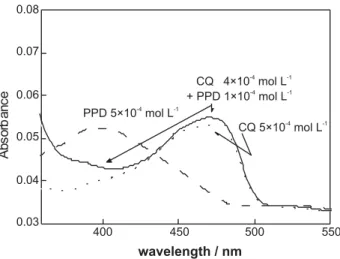
Three different initiating systems containing CQ and PPD were used. In all the total concentration of dye was 5 × 10⁻⁴ mol L-1. Two of them were the pure initiators, i.e., PPD and CQ (in the presence of EDB as co-initiator) and the third, a mixture of CQ (4 × 10⁻⁴ mol L-1) and PPD (1 × 10⁻⁴ mol L-1). The absorption spectra of these solutions are shown in Figure 1. It can be seen that the addition of PPD to CQ will increase the absorption in the blue region. Therefore, depending on the emission output of the lamps used in the process, the amount of photons absorbed by the mixture is larger and should induce the formation of more initiating radicals than when just one dye is used.
MMA was used as a standard to determine the photopolymerization quantum yields, as the experimental determination of the polymerization kinetics of this monomer is easier. The observed effects due to the higher or lower concentration of initiating free radicals, can then be extended to the photopolymerization of other monomers. Additionally, the polymerization of this monomer can be performed in bulk, so that no interference of solvent effects will occur.
The photopolymerization rates of the systems used were measured dissolving the initiators in pure MMA and irradiating with a Xe arc lamp. The kinetic behaviour of all three systems is shown in Figure 2. As can be seen the polymerization rate is faster when initiated with CQ as when using PPD, and the addition of PPD to CQ leads to an intermediate reaction rate.
As shown in a previous report, in order to assess the efficiency of the photopolymerization process, it is
necessary to deal with polymerization quantum yields, rather then with the reaction rates.13 The rate constants of the MMA photopolymerization in the presence of all three initiating systems are shown in Table 1, together with the amount of absorbed photons, and the polymerization quantum yields.
It is noteworthy to notice that the quantum yield for the polymerization initiated by the mixture of the dyes is lower than that of any of both dyes used separately. Assuming that both dyes initiate separately, and that the quantum yield of the mixture can be obtained from the individual contributions of each initiator, the ideal photopolymerization quantum yield for the mixture should be
M = XPPD × PPD + XCQ × CQ (3)
where M is the quantum yield for the photopolymerization initiated by the mixture, and PPD and CQ are the quantum yields for the photopolymerization initiated PPD and CQ, respectively. XPPD and XCQ are the molar fractions of the initiators PPD and CQ. Using equation 3 a value of 411 is obtained for M. The corresponding experimental value shown in Table 1 is 342, indicating that rather than a synergistic effect, the addition of the second dye (PPD) makes the reaction less efficient.
This effect can be attributed to the fact that there is an efficient quenching of the excited camphorquinone by PPD
PPD + 1CQo1PPD + CQ (4)
as shown in Figure 3. The Stern-Volmer constant for this process is 273 mol–1L, which taken together with the reported lifetime for camphorquinone singlet (18 ns)15
gives a quenching rate constant of 1.52 1010 mol–1L s-1. This rate is of the order of the diffusional limit in ethyl acetate.
Table 1. Photopolymerization of MMA in the presence of three initiating systems: polymerization rates (Rp), photon flux and quantum yields ( P)
Photoinitiator/ (mol L-1)
Rp/ (10-5 mol-1L s-1)
photon flux Einstein/
(10-8 s-1)
P/ (mol Einstein-1)
PPD (5×10⁻⁴) 2.86 7.6 376
CQ (5×10⁻⁴) 4.70 11.2 420
PPD (1×10⁻⁴) +
CQ (4×10⁻⁴) 3.25 9.5 342
Figure 1. Absorption spectra of the photoinitiators and their mixture.
(5)
In addition, these results also help to rule out the onset of an alternative mechanism for the photoinitiation by PPD. As demonstrated earlier, the polymerization photoinitiated by CQ only happens in the presence of an amine acting as co-initiator whereas the initiation by PPD is considered to be a mere C-C scission
(6)
In principle, the presence of an amine, as in the CQ/ PPD mixture, could promote a secondary reaction between the amine and the radicals forming more efficient initiating amino radicals
(7)
The fact that there is no increase in the efficiency when the co-initiator amine EDB is present means that reaction 7 does not occur in the system.
Conclusions
The simultaneous use of the photopolymerization initiators CQ and PPD does not lead to a synergistic increase in the polymerization efficiency, although there might be an increase in the degrees of conversion due to the broader absorption band of the mixture of dyes. On the contrary, the polymerization quantum yield when using the mixture is lower than for the individual initiators used alone. This inhibition effect can be traced to an efficient quenching of the more efficient dye (CQ) by the less efficient one (PPD). An increase in the concentration of the dye should be preferred over the mixture with a second dye, when the aim is to enhance the photopolymerization efficiency.
Acknowledgments
Financial support by FAPESP, Brazil (Proc. 03/07770-4) and CNPq (Proc. 471310/2006-9 ) is gratefully acknowledged. Beatriz E. Goi also thanks FAPESP for a post-doctoral fellowship.
References
1. Sun, G. J.; Chae, K. H.; Polymer2000,41, 6205. 2. Rueggeberg, F. A.; J. Prosthet. Dent.2002,87, 364.
3. Peutzfeltdt, A.; Asmussen, E.; Acta Odont. Scand.1989,47, 229.
4. Peutzfeldt, A.; Eur. J. Oral Sci.1997,105, 97.
5. Nie, J.; Lindén, L. - .; Rabek, J. F.; Ekstrand, J.; Angew. Makromol. Chem.1998,257, 47.
6. Sionkowska, A.; Kaminska, A.; Linden, L.-A.; Rabek, J. E.; Polym. Bull.1999,43, 349.
7. Chung, C.-M.; Kim, J.-G.; Kim, M.-S.; Kim, K.-M.; Kim, K.-N.; Dental Mater.2002,18, 174.
8. Teshima, W.; Nomura, Y.; Tanaka, N.; Urabe, H.; Okazaki, M.; Nahara, Y.; Biomaterials2003,24, 2097.
9. Park, Y.-J.; Chae, K.-H.; Rawls, K. R.; Dental Mater. 1999,15, 120.
10. Ogunyinka, A.; Palin, W. M.; Shortall, A. C.; Marquis, P. M.; Dental Mater.2007,23, 807.
11. Neumann, M. G.; Schmitt, C. C.; Ferreira, G. C.; Corrêa, I. C.; Dental Mater.2006,22, 576.
12. Neumann, M. G.; Schmitt, C. C.; Goi, B. E.; J. Photochem. Photobiol. A 2005,174, 239.
13. Block, H.; Ledwin, A.; Taylor, A. R.; Polymer1971,12, 271. 14. Rabek, J. F.; Experimental Methods in Photochemistry and
Photophysics. Part 2, Wiley Interscience: New York, 1982.
15. Allonas, X.; Fouassier, J.-P.; Angiolini, L.; Caretti, D.; Helv. Chim. Acta2001,84, 2577.
Received: April 4, 2008
Web Release Date: August 29, 2008