C
o
m
m
u
ni
c
a
ti
o
n
J. Braz. Chem. Soc., Vol. 19, No. 7, 1244-1247, 2008. Printed in Brazil - ©2008 Sociedade Brasileira de Química 0103 - 5053 $6.00+0.00
*e-mail: [email protected]
Synthesis of Ferrocenyl Oxindole Compounds with Potential Anticancer Activity
Bárbara V. Silva,*
,aNúbia M. Ribeiro,
aAngelo C. Pinto,
aMaria D. Vargas
band Luiz C. Dias
caInstituto de Química-CT, Bloco A, Universidade Federal do Rio de Janeiro, Cidade Universitária, 21945-970 Rio de Janeiro-RJ, Brazil
b Instituto de Química, Universidade Federal Fluminense, Campus do Valonguinho, Centro,
24020-150 Niterói-RJ, Brazil
cInstitute of Chemistry, University of Campinas, UNICAMP, P.O. Box 6154, 13084-971 Campinas-SP, Brazil
Compostos oxindol-ferrocenos com potencial atividade anticâncer foram preparados a partir de reações de oxindóis substituídos e carboxaldeído-ferroceno na presença de KOH como catalisador. Os produtos foram caracterizados por dados espectroscópicos incluindo RMN de 1H e13C, infravermelho e espectrometria de massas. As configurações Ee Z foram estabelecidas por experimentos de nOe ou NOESY.
A series of ferrocenyl oxindoles with potential anticancer activity were prepared from the reactions of substituted oxindoles and ferrocenylcarboxyaldehyde in the presence of KOH as catalyst. The products were characterized by spectral data including 1H and 13C NMR, IR and mass spectrometry. The Eand Z configurations were established by nOe or NOESY experiments.
Keywords: ferrocenyl oxindoles, oxindoles, ferrocenecarboxyaldehyde
Introduction
The ferrocenyl (Fc) group has been incorporated to the structure of a number of biologically active molecules resulting in increased anticancer1,2 and antimalarial3-5
activity, amongst others. Addition, alkylation, acylation, condensation-dehydration, coupling and nucleophilic substitution reactions have been employed to link this group to a variety of compounds.2-4,6,7The mechanisms
of the cytotoxicity of ferrocene derivatives have been investigated.8 Osella et al.9 proposed that the cytotoxic
activity of ferrocenium salts is due to their ability to generate oxygen active species that induce oxidative DNA damage. Kondapi et al.10,11 have shown that ferrocene
derivatives inhibit topoisomerase II, a major molecular target for a number of DNA-binding anticancer drugs.
Indolin-2-ones have been shown to exhibit antitumor activity by inhibiting receptor tyrosine kinases VEGF-R, PDGF-RB or CDK.12 The indolin-2-one 1 (sunitinib) has
been approved by the U.S. Food and Drug Administration for the treatment of metastatic renal cell cancer
and gastrointestinal stromal tumors13,14(Figure 1).
Raghunathan et al.15 reported recently the synthesis of
the ferrocenyl oxindole 2a with (E)-configuration from the reaction of oxindole and ferrocenecarboxyaldehyde (FcC(O)H) in ethanol, in the presence of catalytic amounts of piperidine.
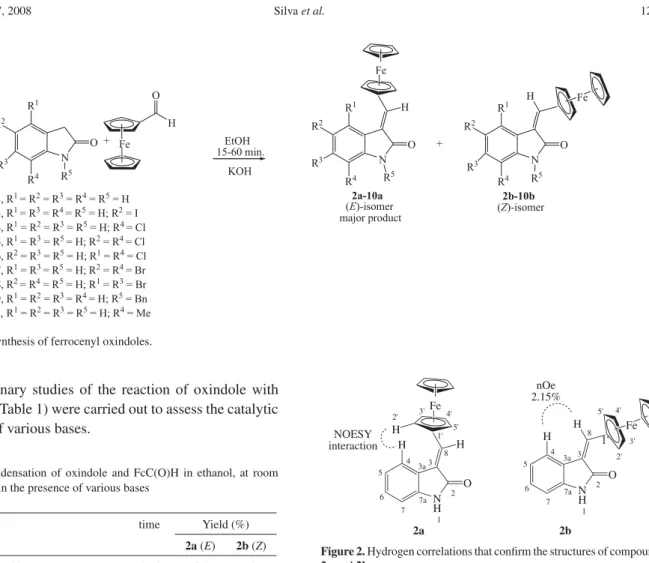
We describe herein the condensation reactions of several oxindole derivatives with FcC(O)H in the presence of KOH in EtOH from which good to excellent yields of the products withE and Z configurations were obtained (Scheme 1).16
The products were characterized by mass spectrometry and infrared, 1H and 13C NMR spectroscopies, including
nOe and NOESY experiments for the determination of the double-bond geometry. N H O H Fe N H O N H O F
NH(CH2)2N(C2H5)2
Me
Me
1(sunitinib)
2a
Silva et al. 1245 Vol. 19, No. 7, 2008
Preliminary studies of the reaction of oxindole with FcC(O)H (Table 1) were carried out to assess the catalytic potential of various bases.
Except for Et3N, all the bases employed led to good conversions. However, formation of products with both E
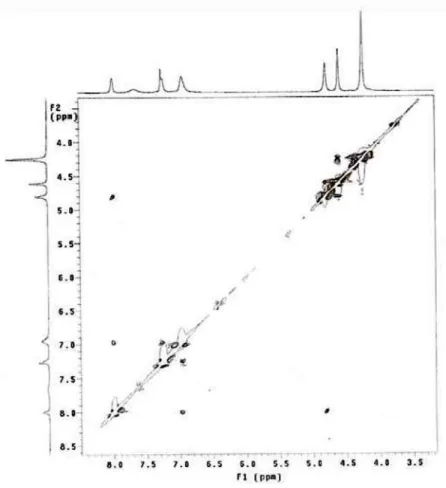
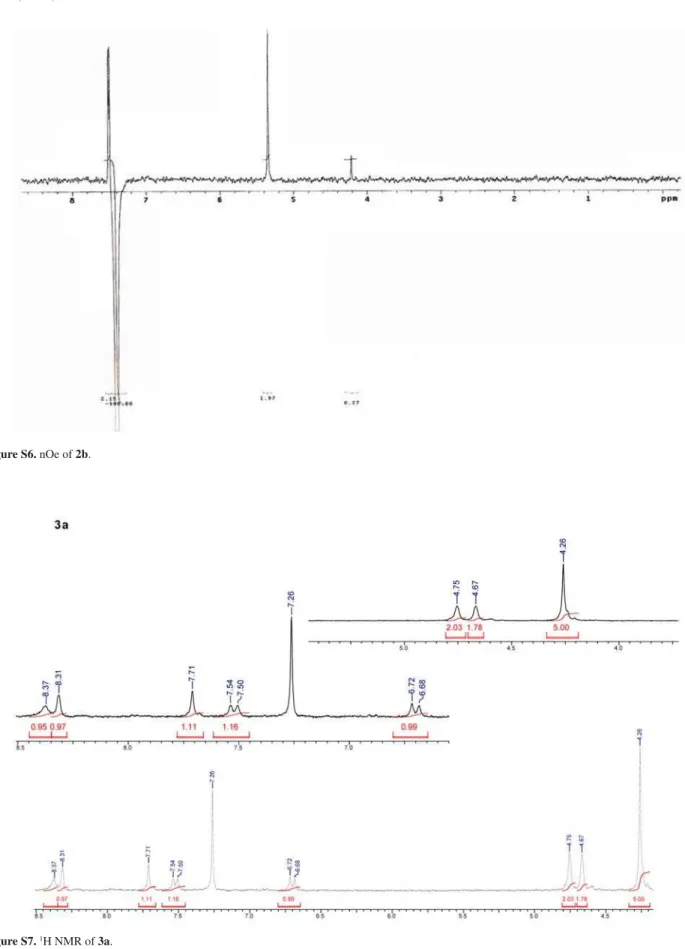
andZ configurations depend on the base employed. The use of KOH in EtOH gave the best yield and selectivity for the E-isomer2a (entry 1). In the presence of piperidine (entry 3) we were able to isolate the E-isomer 2a in 67% yield together with a 30% isolated yield for the correspondingZ-isomer2b. The geometries of isomers 2a and2b were determined by nOe experiments and NOESY interactions. The NOESY experiment for 2a shows a correlation between H4 and H2’ of the cyclopentadienyl ring, thus revealing an (E)-configuration for this isomer. In the case of 2b, we have observed a 2.15% intensity enhancement of the peak corresponding to H4 upon irradiation of H8, which confirms the (Z)-configuration (Figure 2).
The condensation reactions of a series of substituted oxindoles with FcC(O)H were then investigated in the
presence of KOH in EtOH. Products and yields are summarized in Table 2.
The reactions of monosubstituted oxindoles 3,4 and 10 (entries 1, 2 and 8, respectively) gave good conversions and the same product distribution as that of oxindole, with E-products being formed as the major isomers in yields above 90%. Product yields decreased with further ring substitution, and were also sensitive to the relative position of the substituents: whereas the reactions of 5,7-dichloro and 5,7-dibromo oxindoles (5 and 7, entries 3 and 5, respectively) gave both isomers albeit in lower yields than oxindole, those of the 4,7-dichloro and 4,6-dibromo oxindoles (6 and 8, entries 4 and 6, respectively) resulted only in the formation of the E-isomer in around 45% yields.
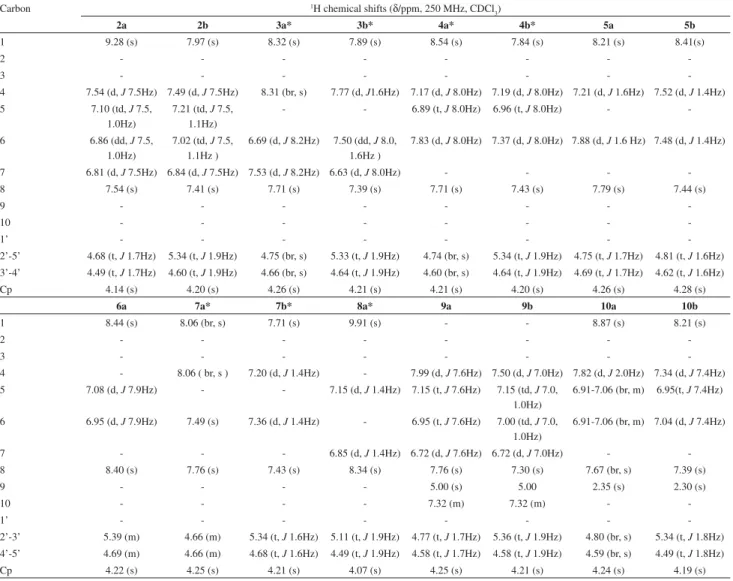
As shown in Table 3, in all cases, the olefinic hydrogen H8 of E-isomer (2a-10a) appear at higher frequency than for theZ-isomer (2b-10b), due to the diamagnetic anisotropy effect of the carbonyl oxygen (C2) on H8 of E-isomers 2a-10a. The same effect was observed for H3´and H5´ of theZ-isomers2b-10b. H8 chemical shifts for compounds 6a and 8a at D 8.40 and 8.34 pm, respectively, confirm the
(E)-configuration. Table 1. Condensation of oxindole and FcC(O)H in ethanol, at room
temperature, in the presence of various bases
Entry Base time Yield (%)
2a(E) 2b (Z)
1 KOH (100 mg) 15 min 95 5
2 K2CO3(100 mg) 15 min 80 18
3 Piperidine (0.025 mL) 15 min 67 30
4 Morpholine (0.025 mL) 15 min 75 20
5 Et3N (0.025 mL) 96 h 33 13
Scheme 1. Synthesis of ferrocenyl oxindoles.
N H O Fe H H 1 2 3 4 5 6 7 7a 8 3a N H O H 1 2 3 4 5 6 7 7a 3a H H Fe 2a 2b 2' NOESY interaction nOe 2.15% 1' 2' 3' 4' 5' 8 1' 3' 4' 5'
Synthesis of Ferrocenyl Oxindole Compounds with Potential Anticancer Activity J. Braz. Chem. Soc. 1246
Conclusion
In conclusion we have described a simple, fast and efficient synthetic route to ferrocenyl oxindoles, potential model compounds for chemical and pharmacological studies.
Acknowledgments
The authors thank the Brazilian agencies National Counsel for Technological and Scinentific Development (CNPq), State of Rio de Janeiro Research Foundation (FAPERJ), State of São Paulo Research Foundation (FAPESP) and Pronex-FAPERJ for financial support. We also thank Prof. Carol H. Collins (Institute of Chemistry, UNICAMP) for helpful suggestions about English grammar and style.
References
1. Top, S.; Tang, J.; Vessières, A.; Carrez, D.; Provot, C.; Jaouen,
G.;Chem. Commun.1996, 955.
2. Hillard, E. A.; Pigeon, P.; Vessières, A.; Amatore, C.; Jaouen,
G.;Dalton Trans.2007, 5073.
3. Domarle, O.; Blampain, G.; Agnaniet, H.; Nzadiyabi, T.; Lebibi, J.; Brocard, J.; Maciejewski, L.; Biot, C.; Georges, A. J.; Millet,
P.; Antimicrob. Agents Chemother.1998,42, 540.
4. Atteke, C.; Ndong, J. M. M.; Aubouy, A.; Maciejewski, L.; Brocard, J.; Lebibi, J.; Deloron, P. J.; Antimicrob. Chemother.
2003,51, 1021.
5. Blackie, M. A. L.; Chibale, K.; Met. Based Drugs2008,2008: ID 495123.
6. Biot, C.; Delhaes, L.; Maciejewski, L. A.; Mortuaire, M.; Camus, D.; Dive, D.; Brocard, J. S.; Eur.J. Med. Chem.2000,
35, 707.
Table 2. Condensation reactions of oxindole derivatives with FcC(O)H in the presence of KOH as catalyst
Entry Substrate Product yields (%)a,b
1 2 3 4 5 6 7 8
a yields are for isolated products after flash column chromatography on silica-gel;b Fc = ferrocenyl.
Table 3. Chemical shifts of H8, and H2’ and H5’ for compounds 2a,b to10a,b
Compound H8 H2’ and H5’
a b a b
2 7.54 (s) 7.41 (s) 4.68 (t, J 1.7Hz) 5.34 (t, J 1.9Hz)
3 7.71 (s) 7.39 (s) 4.75 (br, s) 5.33 (t, J 1.9Hz)
4 7.71 (s) 7.43 (s) 4.74 (br, s) 5.34 (t, J 1.9Hz)
5 7.79 (s) 7.44 (s) 4.75 (t, J 1.7Hz) 4.81 (t, J 1.6Hz)
6 8.40 (s) - 5.39 (m)
-7 7.76 (s) 7.43 (s) 4.66 (m) 5.34 (t, J 1.6Hz)
8 8.34 (s) - 5.11 (t, J 1.9Hz)
Silva et al. 1247 Vol. 19, No. 7, 2008
7. Torres, J. C.; Pilli, R. A.; Vargas, M. D.; Violante, F. A.; Garden, S. J.; Pinto, A. C.; Tetrahedron2002,58, 4487.
8. Köpf-Maier, Köpf, H.; Neuse, E. W.; J. Cancer Res. Clin. Oncol.
1984,108, 336.
9. Osella, D.; Ferrali, M.; Zanello, P.; Laschi, F.; Fontani, M.; Nervi, C.; Cavigiolio, G.; Inorg. Chim. Acta2000,42, 306.
10. Gopal, Y. N. V.; Jayaraju, D.; Kondapi, K.; Arch. Biochem.
Biophys.2000,376, 229.
11. Kondapi, A. K.; Satyanarayana, N.; Sai krishna, A.D.; Arch.
Biochem. Biophys.2006,450, 123.
12. Bramson, H. N.; Corona, J.; Davis, S. T.; Dickerson, S. H.; Edelstein, M.; Frye, S. V.; Gampe, R. T., Jr.; Harris, P. A.; Hassell, A.; Holmes, W. D.; Hunter, R. N.; Lackey, K. E.; Lovejoy, B.; Luzzio, M. J.; Montana, V.; Rocque, W. J.; Rusnak, D.; Shewchuk, L.; Veal, J. M.; Walker, D. H.; Kuyper, L. F.;
J. Med. Chem.2001,44, 4339; Bogoyevitch, M. A; Fairlie, D.
P.; Drug Discov. Today2007,12, 622; Cerchiaro, G.; Ferreira,
A. M. C.; J. Braz. Chem. Soc.2006,17, 1473.
13. Sun, L.; Liang, C.; Shirazian, S.; Zhou, Y.; Miller, T. Cui, J.; Fukuda, J. Y.; Chu, J-Y; Nematalla, A.; Wang, X.; Chen, H.;
Sistla, A.; Luu, T. C.; Tang, F.; Wei, J. Tang., C.; J. Med. Chem.
2003,46, 1116.
14. Roskoski, R. Jr.; Biochem. Biophys. Res. Commun.2007,356, 323.
15. Jayashankaran, J.; Durga, R.; Manian, R. S.; Raghunathan, R.;
Synth. Commun.2006,36, 979; Babu, A. R. S.; Raghunathan,
R.;Tetrahedron Lett.2008,49, 4487.
16.General experimental procedure: A mixture of oxindole
(0.2 mmol), ferrocenecarboxyaldehyde (0.22 mmol), ethanol (5 mL) and 100 mg of KOH was allowed to stir at rt for 15 min (2) or under reflux for 1 h (3-10). The progress of the reactions was monitored by TLC. After total consumption of the substrate, the crude reaction mixture was extracted with ethyl acetate and washed with water. The organic layer was separated, dried (Na2SO4) and concentrated in vacuo. The E and Z products were separated by silica gel column chromatography (using hexane/ ethyl acetate as eluent).
Received: July 15, 2008 Web Release Date: August 27, 2008
S
u
p
p
le
m
e
nta
ry
Inf
o
rm
a
ti
o
n
J. Braz. Chem. Soc., Vol. 19, No. 7, S1-S9, 2008. Printed in Brazil - ©2008 Sociedade Brasileira de Química 0103 - 5053 $6.00+0.00
Synthesis of Ferrocenyl Oxindole Compounds with Potential Anticancer Activity
Bárbara V. Silva,
aNúbia M. Ribeiro,
aAngelo C. Pinto,
aMaria D. Vargas
band Luiz C. Dias
caInstituto de Química-CT, Bloco A, Universidade Federal do Rio de Janeiro, Cidade Universitária,
21945-970 Rio de Janeiro-RJ, Brazil
b Instituto de Química, Universidade Federal Fluminense, Campus do Valonguinho, Centro,
24020-150 Niterói-RJ, Brazil
cInstitute of Chemistry, University of Campinas, UNICAMP, P.O. Box 6154, 13084-971 Campinas-SP, Brazil
Table S1.1H NMR data for compounds 2a-2b to 10a-10b
Carbon 1H chemical shifts (D/ppm, 250 MHz, CDCl
3)
2a 2b 3a* 3b* 4a* 4b* 5a 5b
1 9.28 (s) 7.97 (s) 8.32 (s) 7.89 (s) 8.54 (s) 7.84 (s) 8.21 (s) 8.41(s)
2 - - -
-3 - - -
-4 7.54 (d, J7.5Hz) 7.49 (d, J7.5Hz) 8.31 (br, s) 7.77 (d, J1.6Hz) 7.17 (d, J8.0Hz) 7.19 (d, J8.0Hz) 7.21 (d, J 1.6Hz) 7.52 (d, J1.4Hz)
5 7.10 (td, J7.5,
1.0Hz)
7.21 (td, J7.5, 1.1Hz)
- - 6.89 (t, J8.0Hz) 6.96 (t, J8.0Hz) -
-6 6.86 (dd, J7.5,
1.0Hz)
7.02 (td, J7.5, 1.1Hz )
6.69 (d, J8.2Hz) 7.50 (dd, J 8.0, 1.6Hz )
7.83 (d, J8.0Hz) 7.37 (d, J8.0Hz) 7.88 (d, J1.6 Hz) 7.48 (d, J1.4Hz)
7 6.81 (d, J7.5Hz) 6.84 (d, J7.5Hz) 7.53 (d, J8.2Hz) 6.63 (d, J8.0Hz) - - -
-8 7.54 (s) 7.41 (s) 7.71 (s) 7.39 (s) 7.71 (s) 7.43 (s) 7.79 (s) 7.44 (s)
9 - - -
-10 - - -
-1’ - - -
-2’-5’ 4.68 (t, J1.7Hz) 5.34 (t, J1.9Hz) 4.75 (br, s) 5.33 (t, J1.9Hz) 4.74 (br, s) 5.34 (t, J1.9Hz) 4.75 (t, J1.7Hz) 4.81 (t, J1.6Hz)
3’-4’ 4.49 (t, J1.7Hz) 4.60 (t, J1.9Hz) 4.66 (br, s) 4.64 (t, J1.9Hz) 4.60 (br, s) 4.64 (t, J1.9Hz) 4.69 (t, J1.7Hz) 4.62 (t, J1.6Hz)
Cp 4.14 (s) 4.20 (s) 4.26 (s) 4.21 (s) 4.21 (s) 4.20 (s) 4.26 (s) 4.28 (s)
6a 7a* 7b* 8a* 9a 9b 10a 10b
1 8.44 (s) 8.06 (br, s) 7.71 (s) 9.91 (s) - - 8.87 (s) 8.21 (s)
2 - - -
-3 - - -
-4 - 8.06 ( br, s ) 7.20 (d, J1.4Hz) - 7.99 (d, J7.6Hz) 7.50 (d, J7.0Hz) 7.82 (d, J2.0Hz) 7.34 (d, J7.4Hz)
5 7.08 (d, J7.9Hz) - - 7.15 (d, J1.4Hz) 7.15 (t, J7.6Hz) 7.15 (td, J7.0,
1.0Hz)
6.91-7.06 (br, m) 6.95(t,J7.4Hz)
6 6.95 (d, J7.9Hz) 7.49 (s) 7.36 (d, J1.4Hz) - 6.95 (t, J7.6Hz) 7.00 (td, J7.0,
1.0Hz)
6.91-7.06 (br, m) 7.04 (d, J7.4Hz)
7 - - - 6.85 (d, J1.4Hz) 6.72 (d, J7.6Hz) 6.72 (d, J7.0Hz) -
-8 8.40 (s) 7.76 (s) 7.43 (s) 8.34 (s) 7.76 (s) 7.30 (s) 7.67 (br, s) 7.39 (s)
9 - - - - 5.00 (s) 5.00 2.35 (s) 2.30 (s)
10 - - - - 7.32 (m) 7.32 (m) -
-1’ - - -
-2’-3’ 5.39 (m) 4.66 (m) 5.34 (t, J1.6Hz) 5.11 (t, J1.9Hz) 4.77 (t, J1.7Hz) 5.36 (t, J1.9Hz) 4.80 (br, s) 5.34 (t, J1.8Hz)
4’-5’ 4.69 (m) 4.66 (m) 4.68 (t, J1.6Hz) 4.49 (t, J1.9Hz) 4.58 (t, J1.7Hz) 4.58 (t, J1.9Hz) 4.59 (br, s) 4.49 (t, J1.8Hz)
Cp 4.22 (s) 4.25 (s) 4.21 (s) 4.07 (s) 4.25 (s) 4.21 (s) 4.24 (s) 4.19 (s)
* CDCl3 + DMSO.
Synthesis of Ferrocenyl Oxindole Compounds with Potential Anticancer Activity J. Braz. Chem. Soc.
S2
Table S2.13C NMR data for compounds 2a-2b to 10a-10b
13C chemical shifts (D/ppm, 62.5 MHz, CDCl 3)
2a 170.2, 141.1, 137.3, 128.2, 123.3, 122.4, 122.3, 121.1, 109.8, 78.3, 71.1, 69.6
2b** 168.2, 138.8, 138.4, 127.4, 125.7, 121.5, 118.2, 109.3, 104.7, 73.6, 72.4, 68.9
3a*
3b
4a* 169.4, 140.2, 138.1, 127.9, 124.1, 122.6, 122.3, 120.8, 115.2, 71.9, 71.5, 70.0
4b
5a 168.9, 142.3, 136.4, 127.2, 127.2, 125.0, 121.4, 120.9, 115.4, 72.6, 71.8, 70.2
5b
6a
7a
7b
8a* 167.6, 143.2, 142.1, 128.0, 121.4, 120.5, 119.7, 115.4, 111.7, 74.0, 72.8, 70.1
9a 168.4, 142.3, 138.3, 136.3, 128.7, 128.3, 127.4, 127.3, 122.7, 122.5, 122.1, 121.6, 108.9, 108.9, 73.1, 71.3, 69.9
9b
10a
10b
* * CDCl3 + DMSO; ** 125 MHz.
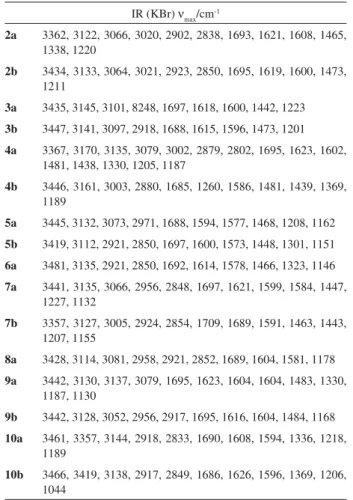
Table S3. Infrared data for compounds 2a-2b to 10a-10b
IR (KBr) Nmax/cm-1
2a 3362, 3122, 3066, 3020, 2902, 2838, 1693, 1621, 1608, 1465, 1338, 1220
2b 3434, 3133, 3064, 3021, 2923, 2850, 1695, 1619, 1600, 1473, 1211
3a 3435, 3145, 3101, 8248, 1697, 1618, 1600, 1442, 1223
3b 3447, 3141, 3097, 2918, 1688, 1615, 1596, 1473, 1201
4a 3367, 3170, 3135, 3079, 3002, 2879, 2802, 1695, 1623, 1602, 1481, 1438, 1330, 1205, 1187
4b 3446, 3161, 3003, 2880, 1685, 1260, 1586, 1481, 1439, 1369, 1189
5a 3445, 3132, 3073, 2971, 1688, 1594, 1577, 1468, 1208, 1162
5b 3419, 3112, 2921, 2850, 1697, 1600, 1573, 1448, 1301, 1151
6a 3481, 3135, 2921, 2850, 1692, 1614, 1578, 1466, 1323, 1146
7a 3441, 3135, 3066, 2956, 2848, 1697, 1621, 1599, 1584, 1447, 1227, 1132
7b 3357, 3127, 3005, 2924, 2854, 1709, 1689, 1591, 1463, 1443, 1207, 1155
8a 3428, 3114, 3081, 2958, 2921, 2852, 1689, 1604, 1581, 1178
9a 3442, 3130, 3137, 3079, 1695, 1623, 1604, 1604, 1483, 1330, 1187, 1130
9b 3442, 3128, 3052, 2956, 2917, 1695, 1616, 1604, 1484, 1168
10a 3461, 3357, 3144, 2918, 2833, 1690, 1608, 1594, 1336, 1218, 1189
10b 3466, 3419, 3138, 2917, 2849, 1686, 1626, 1596, 1369, 1206, 1044
Silva et al. S3 Vol. 19, No. 7, 2008
Figure S2.13C NMR of 2a.
Synthesis of Ferrocenyl Oxindole Compounds with Potential Anticancer Activity J. Braz. Chem. Soc.
S4
Figure S4.13C NMR of 2b.
Silva et al. S5 Vol. 19, No. 7, 2008
Figure S6. nOe of 2b.
Synthesis of Ferrocenyl Oxindole Compounds with Potential Anticancer Activity J. Braz. Chem. Soc.
S6
Figure S8.1H NMR of 3b.
Silva et al. S7 Vol. 19, No. 7, 2008
Figure S10. 13C NMR of 4a.
Synthesis of Ferrocenyl Oxindole Compounds with Potential Anticancer Activity J. Braz. Chem. Soc.
S8
Figure S12.1H NMR of 7b.
Silva et al. S9 Vol. 19, No. 7, 2008