Electron Collisons with Cyclobutane
M. H. F. Bettega†, A. R. Lopes,∗ M. A. P. Lima,∗and L. G. Ferreira∗
† Departamento de F´ısica, Universidade Federal do Paran´a, Caixa Postal 19044, 81531-990, Curitiba, Paran ´a, Brazil
∗Instituto de F´ısica “Gleb Wataghin”, Universidade Estadual de Campinas, 13083-970, Campinas, S ˜ao Paulo, Brazil
Received on 22 January, 2006
We report integral, differential, and momentum transfer cross sections for elastic scattering of low-energy electrons by cyclobutane (c-C4H8), which is an isomer of the C4H8molecule and has a closed chain. Our calcu-lations were performed with the Schwinger multichannel method with pseudopotentials at the static-exchange level of approximation, for energies up to 50 eV. We compare the cross sections of cyclobutane with the cross sections of other three isomers of C4H8, namely, isobutene, cis-2-butene, and skew-1-butene. These isomers have open chain and were the subject of a previous study by our group [Lopeset al.J. Phys. B37, 997 (2004)]. We also show previous calculated integral and momentum transfer cross sections for isomers of C3H4, C3H6 and C4H6, which have open and closed chains. For each isomeric group we discuss theisomer effect focus-ing on the closed chain isomer. Theisomer effectis related to differences in the isomers cross sections due to differences in their geometries.
Keywords: Isomer effect; Cyclobutane; Norm-conserving pseudopotentials
I. INTRODUCTION
In the last three years, motivated by some experimental works [1–4], we have been investigating electron collisions with isomers of small hydrocarbons, focusing on theisomer effect. This effect allows one to distinguish the different iso-mers of a molecule by differences in their cross sections. The main goal of this investigation was to find differences in the electron-collision cross sections due to differences in the (geo-metrical) structures of the isomeric groups. We calculated cross sections for electron collisions with isomers of C3H4[5], C4H6[6], C4H8and C4H10[7], and more recently by isomers of C3H6 [8]. In particular, for C4H8 we have not included cyclobutane (c-C4H8), which has a closed chain. We have no-ticed, however, that for the isomers of C4H6 and C3H6, the integral cross sections for the closed chain isomers, namely cyclobutene and cyclopropane, are smaller than for the other isomers. In this case theisomer effectis more evident for the closed chain isomers.
In this paper we report integral, differential and momen-tum transfer cross sections for cyclobutane, c-C4H8, for en-ergies up to 50 eV. To compute the cross sections we em-ployed the Schwinger multichannel method implemented with pseudopotentials. We compare the cross sections ofc-C4H8 with the cross sections of isobutane, cis-2-butene and skew-1-butene, which are also isomers of C4H8 but having open chains. We also present integral and momentum transfer cross sections for isomers of C3H4, C4H6and C3H6and discuss the isomer effecton the point of view of the closed chain isomers.
In the following we briefly discuss the theoretical method and the computational procedures used in our calculations. Then we present our results and discussions. We end the paper with a brief summary of our findings.
II. THEORY
The Schwinger multichanel (SMC) method [9–11] and its implementation with pseudopotentials [12] have been de-scribed in detail in several publications. We will only discuss the points relevant for the present calculations.
The SMC method is a variational method which results in the following expression for the scattering amplitude
f(~kf,~ki) =−
1 2πm,n
∑
hS~k
f|V|χmi(d
−1)mnhχn|V|S ~k
ii (1)
where
dmn=hχm|A(+)|χni (2)
and
A(+)= Hˆ N+1−
(HPˆ +PHˆ)
2 +
(V P+PV)
2 −V G
(+) P V (3)
In the above equations,|S~k
i,fiis a solution of the unperturbed
HamiltonianH0and is a product of a target state and a plane wave,V is the interaction potential between the incident elec-tron and the elecelec-trons and nuclei of the target,|χmiis a set of(N+1)-electron Slater determinants (Configuration State Functions-CSF’s) used in the expansion of the trial scattering wave function, ˆH=E−His the total energy of the collision minus the full Hamiltonian of the system, withH=H0+V, P is a projection operator onto the open-channel space de-fined by the target eigenfunctions, andG(+)P is the free-particle Green’s function projected on theP-space. The (direct) con-figuration space is constructed as:
where|Φ1iis the target ground state wave function, described at the Hartree-Fock level of approximation, |ϕii is a one-electron function represented by a virtual (unoccupied) or-bital, and
A
is the antisymmetrizer.III. COMPUTATIONAL PROCEDURES
The cross sections were obtained at the static-exchange level of approximation. The molecular geometry was op-timized using the package Gaussian [13] at the MP2 (full) level of approximation with the 6-311++G(2d,p) basis set. In the remaining bound state and in the scattering calculations, the 1s core electrons of the carbons were replaced by the pseudopotentials of Bachelet, Hamann and Schl¨uter [14]. For these calculations, the basis set for the carbon atom included 6 uncontracted s-type functions (with exponents 12.49408, 2.470291, 0.614027, 0.184029, 0.036799, and 0.013682), 5 uncontracted p-type functions (with exponents 5.228869, 1.592058, 0.568612, 0.210326, and 0.072250), and 2 un-contracted d-type functions (with exponents 0.603592, and 0.156753), and was generated according to Ref. [15]. The basis set for the hydrogen atom was taken from Ref. [16] and is shown in Table I. We have not included in our calculations the 3ssymmetric combination of d–type functions, namely [(x2+y2+z2)exp(−αr2)], in order to eliminate any possible linear dependence in the basis set.
IV. RESULTS AND DISCUSSION
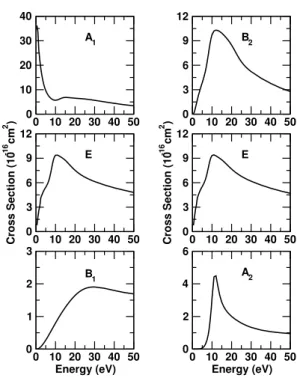
Figure 1 shows our calculated integral and momentum transfer cross sections for cyclobutane. Unfortunately there are no experimental data nor theoretical results available for this molecule for comparison. The most prominent feature seen in these cross sections is the broad structure located around 12 eV. In Fig. 2 we show the symmetry decomposi-tion of the integral cross secdecomposi-tion according to the D2dgroup.
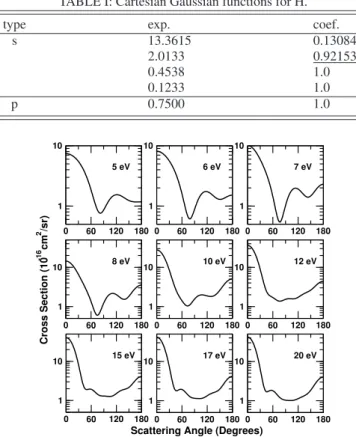
We chose to present the two components of the E symme-try separately, in order to show that they are equivalent. This asserts that our results are converged with respect to the nu-merical quadratures employed in our calculations. The main contribution to the structure seen in Fig. 1 comes from the B2ad E symmetries. We also found another interesting fea-ture that was hidden in the cross sections shown in Fig. 1: a shape resonance located around 10 eV and belonging to the A2 symmetry. In their study concerning electron collisions with the isomers of C3H6, Winsteadet al.[17] found a shape resonance in the cross section of cyclopropane belonging to the A2′ symmetry. They commented that cyclobutane could present a shape resonance analogous to that of cyclopropane. Differential cross sections (DCSs) at selected energies are shown in Fig. 3. A very pronounced minimum is seen in the DCSs from 5 to 10 eV at around 75◦. Another minimum is visible at around 150◦. These features disappear for energies above 10 eV.
Figure 4 compares the integral and momentum transfer cross sections of cyclobutane with the cross sections of other
0 10 20 30 40 50
Energy (eV) 0
10 20 30 40 50
Cross Section (10
-16
cm
2 )
(a)
0 10 20 30 40 50
Energy (eV) 0
10 20 30 40
Cross Section (10
-16
cm
2 )
(b)
FIG. 1: (a) Integral and (b) momentum transfer cross sections for cyclobutane.
0 10 20 30 40 50 0
10 20 30 40
A1
0 10 20 30 40 50 0
3 6 9 12
B2
0 10 20 30 40 50 0
3 6 9 12
Cross Section (10
-16
cm
2 )
E
0 10 20 30 40 50 0
3 6 9 12
Cross Section (10
-16
cm
2 )
E
0 10 20 30 40 50 Energy (eV) 0
1 2 3
B1
0 10 20 30 40 50 Energy (eV) 0
2 4 6
A2
TABLE I: Cartesian Gaussian functions for H.
type exp. coef.
s 13.3615 0.130844
2.0133 0.921539
0.4538 1.0
0.1233 1.0
p 0.7500 1.0
0 60 120 180 1
10
5 eV
0 60 120 180 1
10
6 eV
0 60 120 180 1
10
7 eV
0 60 120 180 1
10
Cross Section (10
-16
cm
2 /sr)
8 eV
0 60 120 180 1
10 10 eV
0 60 120 180 1
10 12 eV
0 60 120 180 1
10 15 eV
0 60 120 180 Scattering Angle (Degrees)
1
10 17 eV
0 60 120 180 1
10 20 eV
FIG. 3: Differential cross sections for cyclobutane at selected ener-gies.
three isomers of C4H8, isobutane, cis-2-butene, and skew-1-butene. From this comparison one may notice that the cross sections for cyclobutane lie below the cross sections of the other isomers. The cross sections match at 50 eV; theisomer effectbeing more evident for cyclobutane, which is the closed chain isomer.
The integral and momentum transfer cross sections of all isomers present a broad maximum located at the same energy (at around 12 eV). However, the cross sections of cyclobutane do not show the low-energy sharp structure seen in the cross sections of the other three isomers. This sharp structure is aπ∗shape resonance and is a characteristic of hydrocarbons with double carbon-carbon bonds; cyclobutane has only single carbon-carbon bonds. Fig. 5 shows the cross sections for the resonant symmetries of isobutane (C2v group), cis-2-butene
(C2vgroup), and skew-1-butene (Csgroup).
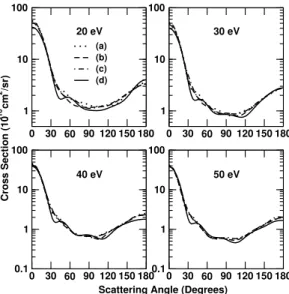
Comparison of the DCSs at 5, 7, 10, 15, 20, 30, 40 and 50 eV for cyclobutane, isobutane, cis-2-butene, and skew-1-butene are shown in Figs. 6 and 7. The DCSs for cyclobutane differ most from the DCSs of the other three isomers for en-ergies below 15 eV. At 15 eV the differences in the DCSs be-come smaller, but at 15 eV and above the DCSs of cyclobutane are still distinguishable from the DCSs of the other isomers by the minima located at around 30◦and 120◦.
In Figs. 8, 9, and 10 we show the integral and momen-tum transfer cross section for the isomers of C3H4, C3H6
0 10 20 30 40 50
Energy (eV) 0
20 40 60
Cross Section (10
-16
cm
2 )
(a)
isobutene cis-2-butene skew-1-butene cyclobutane
0 10 20 30 40 50
Energy (eV) 0
10 20 30 40
Cross Section (10
-16
cm
2 )
(b)
FIG. 4: (a) Integral and (b) momentum transfer cross sections for isobutene, cis-2-butene, skew-1-butene and cyclobutane.
(a) - B2
(b) - A2
0 10 20 30 40 Energy (eV) 0
5 10 15 20
Cross Section (10
-16
cm
2 )
(c) - A´´
FIG. 5: Integral cross sections for (a) isobutene (C2vgroup), (b)
0 30 60 90 120 150 180 1
10 100
5 eV
(a) (b) (c) (d)
0 30 60 90 120 150 180 1
10 100
7 eV
0 30 60 90 120 150 180
Scattering Angle (Degrees) 1
10 100
Cross Section (10
-16
cm
2 /sr)
10 eV
0 30 60 90 120 150 180 1
10 100
15 eV
FIG. 6: Differential cross section for (a) isobutene, (b) cis-2-butene, (c) skew-1-butene and (d) cyclobutane at 5, 7, 10 and 15 eV.
0 30 60 90 120 150 180
1 10 100
20 eV (a) (b) (c) (d)
0 30 60 90 120 150 180
1 10 100
30 eV
0 30 60 90 120 150 180
Scattering Angle (Degrees) 0.1
1 10 100
Cross Section (10
-16
cm
2 /sr)
40 eV
0 30 60 90 120 150 180
0.1 1 10 100
50 eV
FIG. 7: Same as Fig. 5 at 20, 30, 40 and 50 eV.
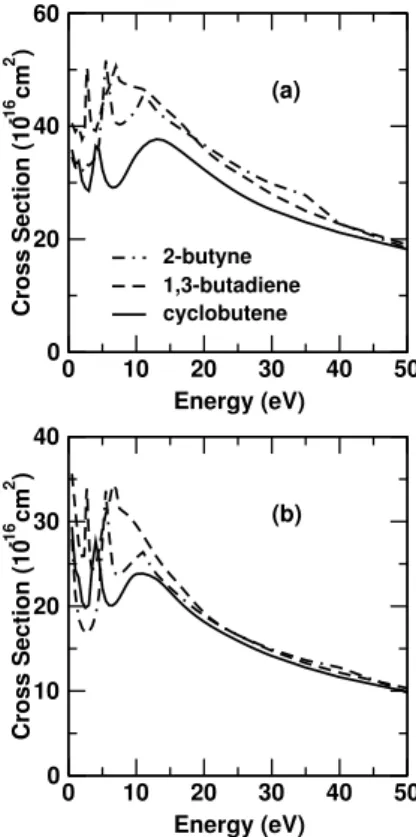
and C4H6. Except for C3H4, the isomers of C3H6and C4H6 present the same behavior as that shown by the isomers of C4H8. The integral and momentum transfer cross sections of the isomers with closed chain, namely cyclopropane, of C3H6, and cyclobutene, of C4H6, also lie below the cross sections of the open chain isomers. Cyclopropane has only single carbon-carbon bonds, and its cross sections do not present the low-energy sharp structure, which is seen in the cross section of propane, which is an open chain isomer with a carbon-carbon double bond. The cross sections of cyclobutene also present a low-energy sharp structure. This isomer has a carbon-carbon double bond.
Figure 11 compares the integral and momentum transfer cross sections for the closed chain isomers of C4H8
(cyclobu-0 10 20 30 40 50
Energy (eV) 0
10 20 30 40 50
Cross Section (10
-16
cm
2 )
(a)
propyne allene cyclopropene
0 10 20 30 40 50
Energy (eV) 0
10 20 30 40
Cross Section (10
-16
cm
2 )
(b)
FIG. 8: (a) Integral and (b) momentum transfer cross sections for isomers of C3H4.
0 10 20 30 40 50 60
Energy (eV) 0
10 20 30 40 50
Cross Section (10
-16
cm
2 )
(a)
cyclopropane propene
0 10 20 30 40 50 60
Energy (eV) 0
10 20 30
Cross Section (10
-16
cm
2 )
(b)
0 10 20 30 40 50 Energy (eV)
0 20 40 60
Cross Section (10
-16
cm
2 )
(a)
2-butyne 1,3-butadiene cyclobutene
0 10 20 30 40 50
Energy (eV) 0
10 20 30 40
Cross Section (10
-16
cm
2 )
(b)
FIG. 10: Same as Fig. 8 for isomers of C4H6.
0 10 20 30 40 50
Energy (eV) 0
10 20 30 40 50
Cross Section (10
-16
cm
2 )
(a)
cyclobutane cyclobutene cyclopropane
0 10 20 30 40 50
Energy (eV) 0
10 20 30 40
Cross Section (10
-16
cm
2 )
(b)
FIG. 11: (a) Integral and (b) momentum transfer cross sections for cyclobutane, cyclobutene and cyclopropane.
tane), C4H6 (cyclobutene) and C3H6 (cyclopropane). The magnitude of the cross sections follows the molecular size, except by the π∗ shape resonance that appears in the cross sections of cyclobutene.
V. SUMMARY
We presented integral, differential and momentum transfer cross sections for cyclobutane, which is one of the isomers of C4H8. We found a shape resonance located around 10 eV and belonging to the A2symmetry of the D2dgroup. Through the
comparison of the integral and momentum transfer cross sec-tions of cyclobutane with those of isobutane, cis-2-butene and skew-1-butene, we concluded that theisomer effect is more evident for cyclobutane, which has a closed chain. The
iso-mer effectis also more evident for closed chain isomers of other molecules. In particular, for cyclopropane, an isomer of C3H6, and cyclobutene, an isomer of C4H6.
Acknowledgments
MHFB, MAPL and LGF acknowledge support from Brazil-ian agency Conselho Nacional de Desenvolvimento Cient´ıfico e Tecnol´ogico (CNPq). MHFB acknowledges support from the Paran´a state agengy Fundac¸˜ao Arauc´aria and from FINEP (under project CT-Infra 1). ARL acknowledges scholar-ship from Fundac¸˜ao de Amparo `a Pesquisa de S˜ao Paulo (FAPESP). The authors acknowledge computational support from Professor Carlos M. de Carvalho at DF–UFPR and from CENAPAD–SP.
[1]Cz. Szmytkowski and S. Kwitnewski, J. Phys. B 35, 3781 (2002).
[2]Y. Nakano, M. Hoshino, M. Kitajima, H. Tanaka, and M. Kimura, Phys. Rev. A66, 032714 (2002).
[3]C. Makochekanwa, H. Kawate, O. Sueoka, M. Kimura, M. Ki-tajima, M. Hoshino, and H. Tanaka, Chem. Phys. Lett.368, 82 (2003).
[4]C. Szmytkowski and S. Kwitnewski, J. Phys. B36, 2129 (2003).
[5]A. R. Lopes and M. H. F. Bettega, Phys. Rev. A 67, 32711
(2003).
[6] A. R. Lopes, M. A. P. Lima, L. G. Ferreira, and M. H. F. Bet-tega, Phys. Rev. A69, 014702 (2004).
[7] A. R. Lopes, M. H. F. Bettega, M. A. P. Lima, and L. G. Fer-reira, J. Phys. B37, 997 (2004).
[8] C. Makochekanwa, H. Kato, M. Hoshino, H. Tanaka, H. Kubo, M. H. F. Bettega, A. R. Lopes, M. A. P. Lima, and L. G. Fer-reira, J. Chem. Phys.124, 024323 (2006).
[10] K. Takatsuka and V. McKoy, Phys. Rev. A30, 1734 (1984).
[11] M. A. P. Lima, L. M. Brescansin, A. J. R. da Silva, C. Winstead, and V. McKoy, Phys. Rev. A41, 327 (1990).
[12] M. H. F. Bettega, L. G. Ferreira, and M. A. P. Lima, Phys. Rev. A47, 1111 (1993).
[13] Gaussian 98, Revision A.11.2, M. J. Frisch, G. W. Trucks, H. B. Schlegel, G. E. Scuseria, M. A. Robb, J. R. Cheeseman, V. G. Zakrzewski, J. A. Montgomery, Jr., R. E. Stratmann, J. C. Burant, S. Dapprich, J. M. Millam, A. D. Daniels, K. N. Kudin, M. C. Strain, O. Farkas, J. Tomasi, V. Barone, M. Cossi, R. Cammi, B. Mennucci, C. Pomelli, C. Adamo, S. Clifford, J. Ochterski, G. A. Petersson, P. Y. Ayala, Q. Cui, K. Morokuma, N. Rega, P. Salvador, J. J. Dannenberg, D. K. Malick, A. D. Rabuck, K. Raghavachari, J. B. Foresman, J. Cioslowski, J. V.
Ortiz, A. G. Baboul, B. B. Stefanov, G. Liu, A. Liashenko, P. Piskorz, I. Komaromi, R. Gomperts, R. L. Martin, D. J. Fox, T. Keith, M. A. Al-Laham, C. Y. Peng, A. Nanayakkara, M. Challacombe, P. M. W. Gill, B. Johnson, W. Chen, M. W. Wong, J. L. Andres, C. Gonzalez, M. Head-Gordon, E. S. Replogle, and J. A. Pople, Gaussian, Inc., Pittsburgh PA, 2001.
[14] G. B. Bachelet, D. R. Hamann, and M. Schl ¨uter, Phys. Rev. B 26, 4199 (1982).
[15] M. H. F. Bettega, A. P. P. Natalense, M. A. P. Lima, and L. G. Ferreira, Int. J. Quantum Chem.60, 821 (1996).
[16] T. H. Dunning Jr., J. Chem. Phys.53, 2823 (1970).