Successional trajectory of the fouling community on a tropical upwelling
ecosystem in southeast Rio de Janeiro, Brazil
The present study describes the successional
trajectory of the fouling community in the upwelling
region of Cabo Frio in southeastern Rio de Janeiro,
Brazil. For 12 months, ive PVC panels were sampled
monthly by underwater photography to record the
percent cover of fouling organisms, which allowed
for the evaluation of the successional process through
functional groups. The variability in the composition
of the fouling community increased throughout the
successional trajectory, creating a mosaic pattern.
The identiication of two associations after a year of
observation, with one characterized by ilamentous
algae, Hydrozoa and Cirripedia and another mainly
by articulated calcareous algae, shows that divergent
trajectories can be observed even under the same
environmental conditions. As an important seasonal
factor of the local oceanographic characteristics,
the upwelling events allowed for an environmental
heterogeneity, and rejecting the classic orderly and
directional succession model.
AbstrAct
Bruno Pereira Masi
1, Ricardo Coutinho
1, Ilana Zalmon
2,*
1 IEAPM - Instituto de Estudos do Mar Almirante Paulo Moreira
(Divisão de Biotecnologia Marinha, Rua Kioto 253, 28930-000, Arraial do Cabo, RJ, Brasil)
2 UENF - Universidade Estadual do Norte Fluminense - Centro de Biociências e Biotecnologia
(Av. Alberto Lamego 2000, 28013-602, Campos, RJ, Brazil)
*Corresponding author: [email protected]
Suporte Financeiro: CNPq/FAPERJ/PRONEX under Grant E-26/111.438/2010
Descriptors: Fouling Community, Succession,
Upwelling, Temperature.
O presente estudo descreve a trajetória sucessional
da comunidade incrustante na região de ressurgência
de Cabo Frio no sudeste do Rio de Janeiro, Brasil.
Durante 12 meses, cinco painéis de PVC foram
amostrados mensalmente por fotograia subaquática
para registrar a porcentagem de cobertura dos
organismos incrustantes, permitindo a avaliação do
processo sucessional através de grupos funcionais.
A variabilidade na composição da comunidade
incrustante aumentou ao longo de toda a trajetória
sucessional, criando um padrão de mosaico. A
identiicação de duas associações após um ano de
observação, sendo uma caracterizada por algas
ilamentosas, Hydrozoa e Cirripedia, e outra
principalmente por algas calcáreas articuladas,
evidencia que diferentes trajetórias podem ser
observadas inclusive quando iniciadas sob mesmas
condições ambientais. Como um importante fator
sazonal das características oceanográicas locais,
os eventos de ressurgência favoreceram uma
heterogeneidade ambiental, rejeitando o clássico
modelo sucessional ordenado e direcional.
resumo
Descritores:
Comunidade Incrustante, Sucessão,
Ressurgência, Temperatura.
INTRODUCTION
A large number of studies on the interface betwe-en bbetwe-enthic ecology and oceanography have idbetwe-entiied a number of the major coastal phenomena that can control or shape the organization of benthic communities (re -viewed by WIETERS et al., 2009). Coastal upwelling is one of these phenomena, and it occurs when deep, cold and nutrient-rich waters reach the surface near the coast (VALENTIN, 1987).
In general, the effect of coastal upwelling on the ben -thic community can be divided into three aspects. The irst one concerns of larval dispersal (MIRATAI et al., 2008; PINEDA et al., 2007; PINEDA et al., 2010). The physical mechanisms involved in larval transport to the coast encom-pass a wide range of temporal and spatial scales and include upwelling, winds and surface currents, linear internal waves and internal tidal bores (LADAH et al., 2005). The second aspect is related to nutrient enrichment and the availability of suspended particles in the water column as an upwelling result. Food availability is one of the critical environmen-tal factors that affect the dynamics of benthic ilter feeding organisms (COMA et al., 2000). The third aspect is tempe-rature variation, one of the most important factors for the regulation of biological processes in ectothermic organisms (KORDAS et al., 2011). Therefore, these aspects may play an important role in the successional process of benthic communities (MCCOOK; CHAPMAN, 1997; MENGE et al., 2004; WIETERS et al., 2009).
Critical reviews of successional trends and mechanis-ms (DRURY; NISBET, 1973; PICKETT et al., 1987) as well as results of studies performed in aquatic environ-ments (SUTHERLAND; KARLSON, 1977; FARRELL, 1991; DRAKE, 1991) contradict the traditional interpre-tation of the successional process: under the same abiotic conditions and with the same species stock, the equili-brium community will be achieved over time.
Fouling communities provide a useful system for the study of ecological succession because space is a limiting and easily deined resource, experimental manipulation is relatively easy, and there is an exchange of species for short periods of time (DEAN; HURD, 1980, BRAM et al., 2005).
In Cabo Frio, which is in southeastern Rio de Janeiro, Brazil, the phenomenon of seasonal upwelling of cold water from the south occurs with lower water temperatu -res (< 18 ºC) during spring and summer and higher water temperatures during fall and winter, which characteri
-zes the non-upwelling period. The present study tests the Figure 1. Location of the study site (x) on Cabo Frio Island, Rio de
Janeiro State, southeastern Brazil.
hypothesis that distinct successional trajectories are created when fouling associations initiated under the same condi -tions are subjected to seasonal upwelling water masses.
MATERIAL AND METHODS
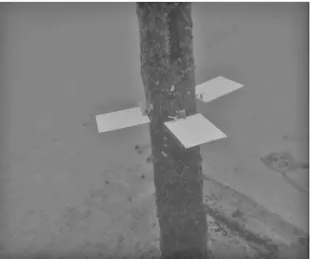
Figure 2. Biofouling multi-experimental units used in the present study to support the PVC panels.
The non-upwelling period in Cabo Frio is characte-rized by warm waters that occur during fall and winter and have temperatures generally above 21 ºC and nutrient concentrations of nitrate and phosphate are below 1 and 0.4 μg-at.-, respectively. Temperatures below 18 ºC and sometimes as low as 13 ºC and high nitrate and phospha-te concentrations of approximaphospha-tely 10 and 0.8 μg-at.l-1 respectively, characterize the upwelling conditions (GUIMARAENS et al., 2005). Therefore, by continuously recording temperature, it is possible to identify the occur -rence of water masses with distinct characteristics throu -ghout the year.
e
xperimentaldesignFive multi-experimental units ixed to the bottom of the ocean individually supported experimental PVC pa-nels (20 x 15 cm) arranged horizontally at 3.5 m depth (Figure 2). Each multi-experimental unit consisted of a PVC tube (5 m height and 20 cm diameter) held on a con-crete block weighing approximately 350 kg. The multi-ex-perimental units were placed 10 m apart from each other and parallel to the shoreline.
t
emperatureThe presence of distinct water masses temporally distributed in the water column was assessed using DS1921H/Z Thermochron iButton sensors that recorded the temperature at every hour at the exact experimental depth over the entire period of panel immersion. The accuracy of the sensors was tested and showed an error of ± 0.5 ºC.
F
OulingcOmmunityThe experimental panels (N = 5) were immersed in July 2009, and the fouling community was monthly sam-pled for a 12-month period. Divers performed a non-des-tructive sampling of ive panels (one from each experi-mental unit) through in situ photography, which avoided
the possible effects panel manipulation and provided a permanent photographic record of the data. The photo -graphs were taken with a DC1200 SeaLife 12-megapixel digital camera in macro mode, which is designed for short and ixed distances.
The photographs were analysed using the software Coral Point Count with Excel extensions (CPCe) (KOHLER; GILL, 2006). A rectangular area was selected in the digital image, which was overlaid with 100 points distributed into a grid (10 lines and 10 columns), and the percentage of points that covered each functional group was estimated. Thus, the relative abundance of the biota was calculated and subsequently transformed (arcsen √x).
The taxonomic nomenclature followed the Integrated Taxonomic Information System (ITIS, 2009). Based on STENECK; DETHIER (1994) and DE MESSANO et al. (2009), the following functional or discrete taxonomic groups were deined: Bioilm 1, Bioilm 2, articulated cal-careous algae, crustose algae, ilamentous algae, sponges, Hydrozoa, bivalves, Cirripedia and encrusting bryozoan. Bioilms 1 and 2 were differentiated by the identiication of the main bioilm organism. Crustose coralline algae (Corallinales, Rhodophyta) were identiied only as a func-tional group.
s
tatisticalanalysisTemperature was evaluated using the number of upwelling events measured at each month studied.
Figure 3. Daily temperature values recorded at 3.5 m of depth (A) and relative frequency of upwelling events (B) over the period of immersion of experimental panels at Cabo Frio Island.
WARWICK, 2001). Multivariate analyses were performed with PRIMER v.6 software.
RESULTS
t
emperatureThe temperature records indicated the occurrence of a typical year of seasonal upwelling (N = 259 events) with temperatures in the study area equal to or less than 18
ºC
from September 2009 to March 2010, which correspon-ded to the 2nd-8th months, respectively, of panel immersion(Figure 3a, b).
t
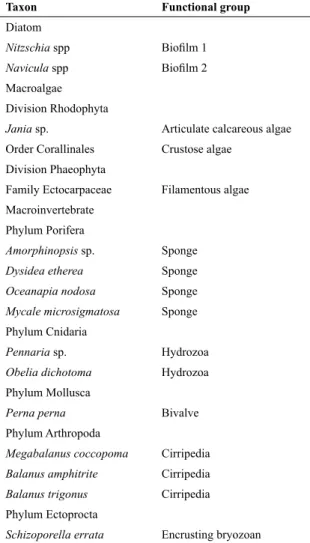
rajectOryOFtheFOulingcOmmunityOver the 12 months, 21 taxa were identiied, compri-sing two diatoms, four macroalgae and 15 macroinverte-brates (Table 1). The most represented functional groups (> 10% coverage in any sampling monthly) were Bioilm 1, Bioilm 2, articulated calcareous algae, ilamentous algae, sponges, Hydrozoa, bivalves and Cirripedia. Crustose algae and encrusting bryozoans were the rarest groups (< 10%).
The mean percent cover of the functional groups along the successional trajectory indicates the relative abundan-ces in the 12 months of immersion (Figure 4). Bioilm 1 predominated in month-1, ilamentous algae domina-ted from month-2 to month-6, and Bioilm 2 dominadomina-ted from month-7 to month-10. In later months, articulated calcareous algae, Hydrozoa and sponges were the most abundant groups (Figure 4).
Table 1. Taxonomic (invertebrates) and functional (algae)
groups recorded on the experimental panels at Cabo Frio Island from July 2009 to July 2010.
Taxon Functional group
Diatom
Nitzschia spp Bioilm 1
Navicula spp Bioilm 2
Macroalgae Division Rhodophyta
Jania sp. Articulate calcareous algae
Order Corallinales Crustose algae
Division Phaeophyta
Family Ectocarpaceae Filamentous algae
Macroinvertebrate Phylum Porifera
Amorphinopsis sp. Sponge
Dysidea etherea Sponge
Oceanapia nodosa Sponge
Mycale microsigmatosa Sponge
Phylum Cnidaria
Pennaria sp. Hydrozoa
Obelia dichotoma Hydrozoa
Phylum Mollusca
Perna perna Bivalve
Phylum Arthropoda
Megabalanus coccopoma Cirripedia
Balanus amphitrite Cirripedia
Balanus trigonus Cirripedia
Phylum Ectoprocta
Schizoporella errata Encrusting bryozoan
The ordination of the sampling units by immersion time (1 to 12 months) shows an increasing dispersion starting in the seventh month with divergent successio-nal trajectories (Figure 5). Two fouling associations were identiied starting at month-10. In one association (two experimental panels: SΔ = 55%), the groups that contribu-ted to this similarity were Hydrozoa (41.82%), Cirripedia (30.91%) and ilamentous algae (18.8%). The other asso-ciation (three panels: SΔ = 59.33%) was composed of arti-culated calcareous algae (79.21%) and Hydrozoa (7.3%). The mean dissimilarity between the two associations was higher than 70%, which was primarily the result of the articulated calcareous algae (41.57%), ilamentous algae (20.31%), sponges (12.47%) and Hydrozoa (10.45%).
Figure 4. Mean values and standard deviation of the percent cover of the most representative fouling organisms over the 12-month period in Arraial do Cabo, Rio de Janeiro State, Brazil.
Figure 5. Non-metric multidimensional scaling plot of the fouling community in each sampling period (1, 2, 3,… 12 months).
Figure 6. A. Cluster analysis (UPGMA) of the fouling community based on mean cover values of functional groups in each month of immersion at an 80% level of similarity (different successional stages are indicated by different colours). B. Non-metric multidimensional
scaling plot of the fouling community in each sampling period and
the successional stages (indicated by colours and letters) related to
the cluster.
from 1 to 6 months and from 7 to 12 months (Figure 6a). At an 80% level of similarity, the formation of ive groups was evident, and they represent the successional stages (Figure 6a). The irst group (A: SΔ = 62.3%) included month-1, which was characterized by ilamentous algae (66.5%) and Bioilm 1 (27%). The second successional stage (B: SΔ = 91.5%) included month-2 and month-3 and was dominated by ilamentous algae (88.56%). The third stage (C: SΔ = 40.4%) included month-4 to mon-th-6 and was characterized by ilamentous algae (50.9%),
bare space (16.2%) and Cirripedia (14.5%) as the main contributors. The fourth successional stage (D: SΔ = 61%) included month-7 to month-9 and was mainly represen-ted by Hydrozoa (66.5%), ilamentous algae (12.1%) and crustose algae (9.3%). The ifth stage (E; SΔ = 47.8%) in-cluded the last three months of immersion and was charac -terized by articulated calcareous algae (33.8%), Hydrozoa (20.3%) and sponges (15.5%) as the main contributors. The continuous successional trajectory was visualized by the nMDS plot (Figure 6b).
The ive successional stages differed signiicantly (ANOSIM: R = 0.518; p = 0.001) and showed a
decre-asing similarity degree (r) when compared sequentially (ANOSIM: A vs. B r = 0.659, B vs. C r = 0.539, C vs. D r = 0.311 and D vs. E = 0.268; p = 0.001).
DISCUSSION
characterized as a continuous process and different from the seasonal circular pattern found at a temperate site by QVARFORDT et al. (2006).
Despite the temporal continuum in colonization, this pro -cess may be separated into stages before and after six months of immersion. The irst stage is characterized by bioilm and ilamentous algae. Bioilms are composed of organic mat-ter and microorganisms such as bacmat-teria and diatoms and serve as an attractive substrate for colonization ilamentous forms (PARK et al., 2011; FONSÊCA-GENEVOIS et al., 2006). The diatoms Nitzschia and Navicula were the main components of Bioilms 1 and 2 and were also identiied by DE MESSANO et al. (2009) in experimental panels placed at the same site. Filamentous algae are characterized by hi -gh growth and reproduction rates, and confer the strategies of opportunistic organisms that are usually present in ear -ly successional stages (SZÉCHY; FARIA DE SÁ, 2008; STENECK; DETHIER, 1994). The reduction of these ila-mentous algae along the immersion period may be related to herbivory. According to CECCARELLI et al. (2011), ish herbivory is an important mechanism that affects benthic succession. During the study, the ish Stephanolepis hispidus
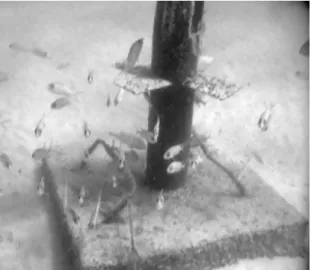
(Actinopterygii, Monacanthidae) was frequently observed feeding on organisms encrusted on the panels (Figure 7), and their bites on ilamentous algae were evident, especially in the irst months of immersion (personal observation). Numerous grazers entirely remove the ilamentous and fo-liose forms, but few can denude larger macroalgae and even fewer can remove coralline crusts (STENECK; DETHIER, 1994). At month-9, predation was less intense and articulated calcareous algae predominated.
Figure 7. Biofouling multi-experimental unit used in the present study showing the ish community associated with the panels.
Starting at month-7, the associations were characteri-zed by Hydrozoa, Cirripedia and articulated calcareous al -gae, although Hydrozoa typically dominate early stages of epibenthic communities (SEBENS, 1986; DE MESSANO et al., 2009). According to FIGUEIREDO et al. (2004), benthic communities may be characterized by increased stability because they have a greater abundance of coria-ceous and articulated calcareous algae (e.g., Jania spp.), which are typical of the inal stages of succession and cor-roborate our results. In the later stages, sponges and the encrusting bryozoan Schizoporella errata were recorded. These organisms have been described in advanced suc-cessional stages as interference competitors because of their ability to exclude other species from the space they occupy (SUTHERLAND, 1978; WHALAN; WEBSTER, 2014). The process of competitive exclusion as a result of dominant competitors can homogenise the community and produce a single stable state called canalised community succession (CIFUENTES et al., 2010). However, starting at month-10, two encrusting associations were identiied: one was dominated by Hydrozoa, Cirripedia and ilamen-tous algae and the other association was characterized by articulated calcareous algae, Hydrozoa and sponges.
The present study began with the assumption that even if the major mechanisms involved in the successio-nal process of the fouling community can be determined, one alteration to the system over a short period of time is enough to modify the course of the process. Thus, it is impossible to predict the future trajectory of the commu -nity because the differences will increase with time ba -sed on the complexity of the stochastic and deterministic factors involved. The formation of distinct associations and the increase in the variability among sampling units are relected in divergent successional trajectories, sho-wing a patchy distribution that is usually found in natural subtidal rocky communities, where several environmen-tal factors are responsible for generating and maintaining the mosaic pattern (MENGE et al., 2005). Therefore, the classic model of orderly and directional succession (sensu
CLEMENTS, 1916; MARGALEF, 1963; ODUM, 1969) in which assemblage variability declines over time is re-jected in favour of the hypothesis of multiple stable points (sensu SUTHERLAND, 1978).
The different associations observed in the present study after 12 months of immersion are interpreted as a random grouping that is indicative of one of the many possible groups that can originate from a similar pool of species. These results emphasise the importance of sam -ple replication. Variable recruitment and the differential ability to invade occupied substrates and resist larval invasion are common characteristics of fouling commu-nities where recruitment and/or adult mortality produce signiicant changes in the structure of these communities (SUTHERLAND; KARLSON, 1977; SUTHERLAND, 1984). Seasonality and environmental stochasticity add complexity to this basic rule.
Coastal upwelling is one of several mechanisms involved in the supply of larvae to coasts (SHANKS, 1995). A better understanding of the oceanographic processes that inluence larval transport and dispersion on a local scale can generate more realistic estimates and consequently contribute to the successful acquisition of knowledge related to the effects of larval supply on the structure of benthic communities.
In summary, divergent successional trajectories were shown when fouling associations were initiated under the same conditions and subjected to seasonal upwelling wa -ter masses, which promoted environmental he-terogeneity and led to the acceptance of the tested hypothesis. Thus, an environment characterised by seasonal upwelling pro-vides an opportunity to evaluate the effect of temporal luctuations of coastal oceanographic conditions, such as temperature, on benthic communities.
ACKNOWLEDGEMENTS
This work was supported by the Brazilian Agency for Research Development - CNPq/FAPERJ/PRONEX under Grant E-26/111.438/2010. We are grateful to the Biofouling Laboratory (IEAPM) team for ield assistance.
REFERENCES
BRAM, J. B.; PAGE, H. M.; DUGAN, J. E. Spatial and temporal variability in early successional patterns of an invertebrate as-semblage at an offshore oil platform. J. Exp. Mar. Biol. Ecol., v. 317, p. 223-237, 2005.
CECCARELLI, D. M.; JONES, G. P.; MCCOOK, L. J. Interac-tions between herbivorous ish guilds and their inluence on algal succession on a coastal coral reef. J. Exp. Mar. Biol. Ecol., v. 399, n. 1, p. 60-67, 2011.
CIFUENTES, M.; KRUEGER, I.; DUMONT, C. P.; LENZ, M.; THIEL, M. Does primary colonization or community structu-re determine the succession of fouling communities? J. Exp. Mar. Biol. Ecol., v. 395, n. 1/2, p. 10-20, 2010.
CLEMENTS, F.E. Plant succession: an analysis of the develo-pment of vegetation. Carnegie Inst. Wash. Publ., v. 242, p. 1-512, 1916.
COMA, R., RIBES, M., GILI, J., ZABALA, M. Seasonality in coastal benthic ecosystems. Trends Ecol Evol., v. 15, n. 11, p. 448-453, 2000.
CLARKE, K. R.; WARWICK, R. M. Change in marine
commu-nities: an approach to statistical analysis and interpretation. 2.
Plymouth: Ed. PRIMER-E, 2001.
DE MESSANO, L. V. R.; SATHLER, L.; REZNIK, L. Y.; COU-TINHO, R. The effect of biofouling on localized corrosion of the stainless steels N08904 and UNS S32760. Int. Biodeter. Biodegr., v. 63, n. 5, p. 607-614, 2009.
DEAN, T. A.; HURD, L. E. Development in an estuarine fouling community: inluence of early colonists on later arrivals. Oe-cologia, v. 46, n. 3, p. 295-301, 1980.
DRAKE, J. A. Community-assembly mechanics and the structure of an experimental species ensemble. Am. Nat., v. 137, n. 1, p. 1-29, 1991.
DRURY, W. H.; NISBET, I. C. T. Succession. J. Arnold Arbor Harv. Univ., v. 54, n. 3, p. 331-368, 1973.
FARRELL, T. M. Models and mechanisms of succession: an example from a rocky intertidal community. Ecol. Monogr., v. 61, n. 1, p. 95-113, 1991.
FIGUEIREDO, M. A. O.; BEATRIZ, M.; BARRETO, B.; REIS, R. P. Characterization of macroalgae in the marine commu-nities of Cairuçú Environmental Protected Area, Parati, RJ - bases for future monitoring. Rev. Bras. Bot., v. 27, n. 1, p. 11-17, 2004.
FONSÊCA-GENEVOIS, V.; SOMERFIELD, P. Colonization and early succession on artiicial hard substrata by meiofau-na. Mar. Biol., v. 148, n. 5, p. 1039-1050, 2006.
GUIMARAENS, A. M.; MORAES, A. D.; COUTINHO, R.
Mo-deling Ulva spp. dynamics in a tropical upwelling region.
Ecol. Model., v. 188, p. 448-460, 2005.
ITIS - Integrated Taxonomic Information System. Available from: <http://www.itis.usda.gov>. Accessed 15 Jan 2009.
KOHLER, K. E.; GILL, S. M. Coral Point Count with Excel ex-tensions (CPCe): A Visual Basic program for the determina-tion of coral and substrate coverage using random point count methodology. Comput. Geosci., v. 32, n. 9, p. 1259-1269, 2006
KORDAS, R. L.; HARLEY, C. D. G.; O’Connor, M. I. Commu-nity ecology in a warming world: The inluence of tempera-ture on interspeciic interactions in marine systems. J. Exp. Mar. Biol. Ecol., v. 400, n. 1/2, p. 218-226, 2011.
LADAH, L. B.; TAPIA, F. J.; PINEDA, J.; LÓPEZ, M. Spatially
heterogeneous, synchronous settlement of Chthamalus spp.
larvae in northern Baja California. Mar. Ecol. Prog. Ser., v. 302, p. 177-185, 2005.
LEPS, J.; REJMÁNEK, M. Convergence or divergence: what should we expect from vegetation succession? Oikos, v. 62, n. 2, p. 261-264, 1991.
MAHIQUES, M. M.; BICEGO, M. C.; SILVEIRA, I. C. A; SOU-SA, S. H. D. M.; LOURENÇO, R. A.; FUKUMOTO, M. M. Modern sedimentation in the Cabo Frio upwelling system, Southeastern Brazilian shelf. An. Acad. Bras. Ciênc., v. 77, n. 3, p. 535-548, 2005.
MCCOOK, L. J.; CHAPMAN, A. R. O. Patterns and variations in natural succession following massive ice-scour of a rocky intertidal seashore. J. Exp. Mar. Biol. Ecol., v. 214, p. 121-147, 1977.
MENGE, B. A.; BLANCHETTE, C.; RAIMONDI, P.; FREI-DENBURG, T.; GAINES, LUBCHENCO, J.; LOHSE, D.
Species interaction strength: testing model predictions along
an upwelling gradient. Ecol. Monogr., v. 74, n. 4, p. 663-684, 2004.
MENGE, A., ALLISON, G.W., BLANCHETTE, C.A., FARRE-LL, T.M., OLSON, A.M., TURNER, T.A., VAN TAMELEN, P. Stasis or kinesis? Hidden dynamics of a rocky intertidal macrophyte mosaic revealed by a spatially explicit approach. J. Exp. Mar. Biol. Ecol., v. 314, n. 1, p. 3-39, 2005.
MITARAI, S.; SIEGEL, D.; WINTERS, K. A numerical study of stochastic larval settlement in the California Current system. J. Mar. Syst., v. 69, p. 295-309, 2008.
ODUM, E. P. The strategy of ecosystem development. Science, v. 164, p. 262-270, 1969.
PARK, S. R.; KANG, Y. H.; CHOI, C. G. Bioilm: a crucial factor
affecting the settlement of seaweed on intertidal rocky surfa
-ces. Estuar. Coast. Shelf Sci., v. 91, n. 1, p. 163-167, 2011. PICKETT, S. T. A.; COLLINS, S. L.; ARMESTO, J. J. Models,
mechanisms and pathways of succession. Bot. Rev., v. 53, n. 3, p. 335-371, 1987.
PINEDA, J.; JONATHAN, H.; SPONAUGLE, S. Larval trans-port and dispersal in the coastal ocean and consequences for population connectivity. Oceanography, v. 20, n. 3, p. 22-39, 2007.
PINEDA, J.; PORRI, F.; STARCZAK, V.; BLYTHE, J. Causes of decoupling between larval supply and settlement and conse-quences for understanding recruitment and population con-nectivity. J. Exp. Mar. Biol. Ecol., v. 392, p. 9-21, 2010. QVARFORDT, S.; KAUTSKY, H.; MALM, T. Development of
fouling communities on vertical structures in the Baltic Sea. Estuar. Coast. Shelf Sci., v. 67, n. 4, p. 618-628, 2006.
SEBENS, K. P. Spatial relationships among encrusting marine organisms in the New England subtidal zone. Ecol. Monogr., v. 56, n. 1, p. 73-96, 1986.
SHANKS, A. L. Mechanisms of cross-shelf dispersal of mari-ne invertebrates. In: MCEDWARD, L. R. (Ed.). Ecology of Marine Invertebrate Larvae. Boca Ratón: CRC Press, 1995. p. 323-367.
STENECK, R. S.; DETHIER, M. N. A functional group approach to the structure of algal-dominated communities. Oikos, v. 69, p. 476-498, 1994.
SUTHERLAND, J. P. Functional roles of Schizoporella and
Styela in the fouling community at Beaufort, North Carolina.
Ecology, v. 59, p. 257-264, 1978.
SUTHERLAND, J. P. The structure and stability of marine ma-crofouling communities. In: COSTLOW J. D.; TIPPER, R. C. (Eds.). Marine Biodeterioration: An Interdisciplinary Study. Maryland: United States Naval Institute, 1984. p. 202-206. SUTHERLAND, J. P.; KARLSON, R. H. Development and
sta-bility of the fouling community at Beaufort, North Carolina.
Ecol. Monogr., v. 47, p. 425-446, 1977.
SZÉCHY, M. T. M.; FARIA DE SÁ, A. D. Seasonal variation of
macroalgal epiphytism in a Sargassum vulgare C. Agardh
(Phaeophyceae - Fucales) population from Ilha Grande Bay, Rio de Janeiro. Oecol. Bras., v. 12, p. 299-314, 2008. VALENTIN, J. L.; ANDRÉ, D. L.; JACOB, S. A. Hydrobiology
in the Cabo Frio (Brazil) upwelling: two-dimensional structu-re and variability during a wind cycle. Cont. Shelf Res., v. 7, p. 77-88, 1987.
WHALAN, S.; WEBSTER, N. S. Sponge larval settlement cues: the role of microbial bioilms in a warming ocean. Sci. Rep., v. 4, p. 1-4, 2014.
WIETERS, E. A.; BROITMAN, B. R.; BRANCH, G. M.
Ben-thic community structure and spatiotemporal thermal regimes in two upwelling ecosystems: comparisons between South