Visoelasti Ferrogel:
Dynami Magneti Suseptibilities
Yu.L. Raikher and V. V. Rusakov
Laboratory ofComplexFluids,Institute ofContinuousMediaMehanis
UralDivisionofRAS,614013, Perm,Russia
Reeivedon16Deember,2000
Theoretial modelto desribe magnetodynamisof a ferrogel, i.e., anassemblyof ferromagneti
nanopartilesembeddedinagel, is proposed. The reorientations ofthe partilesare determined
by the inuene of the elasti matrixand the rotational Brownian motion. Theset of essential
parameters, on whih the omponents of the dynami magneti suseptibility tensor depend, is
disussed. Intheframeworkofthemodel, absorptionoftheenergyofanaeld isstudied. With
allowane for the interation of elasti and Brownian fores, the eetive relaxation times and
eigenfrequeniesforthe longitudinalandtransverseomponentsofthe ferrogelmagnetizationare
evaluated.
I Introdution
Propertiesofomplexmagnetiuids|thisisthename
for omposite materials produed in result of
embed-ding magneti nanopartilesin easily deformable
sub-stanes (soft matter)|are interesting from numerous
viewpoints. On the one hand, magneti partiles by
integrationinsupramoleularstruturesangivebirth
tonewmagnetially-ontrolledintelletualmaterialsas,
e.g.ferroliquidrystals[1,2,3℄orferrogels[4,5℄. Onthe
otherhand,havingbeenadmixedtothematrixinsmall
amounts,thesamepartileswillworkasmagneti-eld
ontrolled miro-rotors that probethe rheologyofthe
arrieruid at the sale omparable with thepartile
size,i.e.,&10nm[6℄. Indeed,insingle-domainpartiles
thespei magneti momentsare high, andaurate
measurementsoftheirresponsetoanaeld(itauses
rotationalswingsofthegrains)arequitefeasible.
How-ever,torelyonsuhmagnetorheologialintrasopy,
be-sides solving tehnial problems of measurement, one
faestheneessitytoadequatelyinterprettheolleted
data. Therefore,atheoryspeializinginmagneti
spe-tra ofsoftferrodispersions isrequired. A good
parti-ularexampleyieldRefs.[7,8,9,10℄, wherethe
experi-mentaltehniqueandtheoretialtreatmentonerning
magneti paints (ferrolaquers) are desribed. In the
systemsstudiedthemagnetipartileswere
aluminum-overed iron needles about 150nm in length with the
aspet ratioabout1:8suspended in aresin-ontaining
uidmatrixsubjetedtosubsequentrosslinking.
that onehas toonsider if theattentionis foused on
thepropertiesof thematrix,the mainontributionto
thesystemresponsegoesfromindividualpartiles.
Un-liketheaseofoarsesuspensions,inananodispersion
the orientational dynamis of the partiles is always
aninterplaybetweenthefore(appliedeld,elastiity
andvisosityoftheenvironment)andnoise(Brownian
diusion) fators. For understanding of the magneti
spetraof omplexmagnetiuids it isequally
nees-saryto aountforbothfators[6,11℄.
InRef.[12℄thesystemunderstudywasaweak
fer-rogel modeled by a dilute suspension of magnetially
hard nanopartiles in an elasti matrix. All the
par-tiles were assumed to be spherial and of equal size.
The oupling of an individual partile to its
environ-mentwasdesribedaordingtothefollowingsheme:
{ the elasti omponent of interation washosen
in theform ofaharmoni potential, i.e., a
fun-tionthatisquadratiwithrespettotheangular
deviationofthepartileaxisfromaertain
equi-libriumdiretion;
{ thedissipative partwas taken in the Stokes
ap-proximationsothatthefritionforeimposedby
thematrix isproportionalto the produt of the
partileveloityandthevisosityoftheuid;
{ the equilibrium thermal utuations were
intro-dued in the dynami equations of the partile
utuation-Theafore-mentionedrotary(torsional)osillatormodel
iswell-knownasoneofthemaintheoretialtoolsinthe
statistial mehanis of suspensions and in moleular
spetrosopy[13, 14, 15℄. For example, in Ref. [13℄ it
wasusedtoexplainthedetailsofthehigh-frequeny
ab-sorptioninpolarliquids. Theinterpretationwasbased
onthealulationofthelongitudinal(the subsript
in-diatestheorientationoftheprobingeldwithrespet
to the equilibrium diretion of the partile axis)
dy-nami suseptibility in anassembly of eletridipoles
subjeted to the Brownian rotary motion. Note that
duetosomepurposes(theresults[13℄arereproduedin
thebook[14℄)onlythelongitudinal,andnottransverse,
suseptibility was taken into aount. Meanwhile, as
is shown below, under strong elastiity the
longitudi-naldynamipolarization\freezes"andbeomesrather
small in omparison with the transverse one. Due to
that, in an elasti material with the haoti
distribu-tionofthepartileaxesitis,rstplae,thetransverse
omponentthatplaysthedominatingr^oleinformation
oftheobserved(marosopi)suseptibility.
InRef.[12℄weadaptedthemodelofatorsional
os-illator surrounded by a Newtonian uid for the ase
of ferrogeland determined the prinipal values of the
magneti suseptibility tensor:
k and
?
. As it was
expeted, our resultsonrmed that with the
elasti-itygrowththemainpartintheresponsesignalbelongs
to thetransversesuseptibility. However,themost
es-sentialresult ofthe work [12℄ wastheonlusion that
in the studied model within the whole physially
rel-evant material parameter range the magneti as well
as orientationalrelaxationofferrogelismonotoni. In
other words, the system is unable for osillationsand
noresonanesouldbeexitedin it.
Inthepresentpaperwemodifythemodel [12℄just
in oneaspet. Namely,nothangingthepart
onern-ingtheequilibriumelastiity,weassumethatthe
dissi-pativemehanismthatouplesapartilewiththe
ma-trix is visoelastiity. This means that the time,
dur-ing whih stress relaxation in the matrixtakes plae,
is admittedto be nite. Thispropertytoasmalleror
greater extent is inherent to any uid [16℄; the more
so|to soft systemslikepolymeri gels [17, 18℄. As it
turned out, assoon as the matrix is taken to be not
just visousbutvisoelasti,themagnetispetrumof
suh a ferrogel hanges drastially. In partiular,
os-illatorydampingregimes beomepossiblethat means
that underexternalexitationthesystemisapableof
aresonanebehavior.
Itisnoteworthytoreallinthisonnetionthe
spe-tra of magneti nanosuspensionswith visoelastibut
uid matries. As far asweknow, thestudies of this
works [19, 20℄, where the kineti equations desribing
the translationalmotion of the partiles were derived
and the orresponding oordinate and veloity
orre-lation funtions were found. In Refs. [6, 11℄ the said
approahwasextendedfortheaseofrotaryBrownian
motion. In the studies of the dynami magneti
sus-eptibility the possibility of a resonanebehaviorwas
demonstrated. Sinethesystemunder disussiondoes
notpossessanequilibriumelastiitysothatthe
restor-ing torque is solely due to the retarded stress in the
matrix,thefoundresonanesturned outtobeloated
atsuÆientlyhighfrequenies.
II Model
Consider an assembly of single-domain partiles
sus-pendedin agel. Thepartilesareassumedtobe
mag-netially hard so that inside eah of them the
mag-netimomentisompletely\frozen-in"inthe
parti-lebody. Inorporationofthepartilesinthestruture
ofthegelismodeledbyanelastiharmonipotential.
Bythis, somepreferredorientationofthepartileaxis
isimposed. Ifthisdiretionisthesameforallthe
par-tiles (e.g. the oligomer matrixwas rosslinked in the
preseneofanexternaleld),thenthesystemis
hara-terizedbythemarosopilongitudinal(
k
)and
trans-verse (
?
)suseptibilities, whih taketheform of the
sumsof the orresponding ontributions of individual
partiles. If,ontheontrary,theequilibriumdiretion
of the partile magneti moment does exist only
mi-rosopiallywhilstthesystemasawhole isisotropi,
thenthemarosopi suseptibilityis determinedasa
weightedaverage= 1
3
k +2
?
,see[21℄,for
exam-ple. Inthis onnetion, note theaboveremark onthe
dieletrisuseptibilitytheoryfor polar uidsgivenin
[13℄.
As the mehanism of the partile / matrix
dis-sipative interation, here we employ the rheologial
Maxwellmodelwithasinglerelaxationtime. This
as-sumptionissimilartothoseofRefs.[6,11,22℄. To
sim-plifythemathematialwork,thepartilesaretakento
beatrotatorssothateahofthemhasjustonedegree
offreedomthatistheangle#betweenitsmagneti
mo-mentandthediretionoftheequilibriumorientation.
Underthoseonditions,theequationofrotational
mo-tionforapartilewiththemomentofinertia I writes
I
#= U
#
+Q(t): (1)
Herethersttermintheright-handside(rhs)hasthe
eld H. The seond term is the frition torque
ow-ingtothedissipativeinteration. Assumingtheelasti
potentialofthematrixto beharmoni,onehas
U = 1
2 K#
2
H
k
os#+H
? sin#
; (2)
where the subsripts that mark the eld omponents
orrespond to the diretions # =0(longitudinal) and
# = =2 (transverse) with respet to the symmetry
(easy)axisoftheelastipotential.
In the Maxwell model of a visoelasti uid, the
torqueexertedbythematrixonthepartileis
hara-terizedbythereferenestressretardationtime
M and
isdesribedbytheequation
Q+
M _
Q= _
#+y(t) (3)
The rst term in rhs of Eq. (3) renders the regular
omponent of the dissipative torque (the Stokes
fri-tion) while the seond one is the random omponent,
i.e., thenoise. Thelatterisassoiatedwith athermal
bathatthetemperature;hereafterwesetthe
Boltz-mann onstant to unity. It is the noise that indues
the Brownian motion of thepartile. Bythe order of
magnitudewesetthefritionoeÆienttobe =6V
that orresponds to aspherial partileof the volume
V embedded in auidwith thevisosity. It iseasy
toshow,see[6,11℄,that therandomtorqueorrelator
atequilibrium is
hy(t)y(t 0
)i=2Æ(t t 0
); (4)
sothatthenoiseinEq.(3)iswhiteandthe
utuation-dissipationtheoremholds.
EliminatingthedissipativetorqueQ(t)fromEq.(1)
with the aid of Eq. (3), at H = 0 we arrive at the
Langevin equation for a Brownian osillator in a
vis-oelastiuid:
I
M
# +
#
+K(
M _
#+#)+ _
#=y(t): (5)
In the limit of a medium that is purely visous
(
M
! 0) equation (5) redues to the
previously-studied model of a torsional osillator that is
hara-terized bythree relaxationtimes:
I ,
K and
D [12℄.
Let us realltheir meanings. From omparison ofthe
inertialI
#andStokesfrition _
#torquestherefollows
thedenitionfortheso-alledinertialtime
I
=I=: (6)
that yields the referene time lapse, after whih the
partileangularveloityequalizeswiththatofthe
sur-rounding medium provided that the latter is visous
withthevisosityoeÆient.
Sineit isassumed that thearriermedium of the
suspension possesses also some equilibrium elastiity,
thenin anaturalwayoneintroduesthereferene
fre-queny!
K
ofrotationalswingsofthepartilesandthe
oupledtoit(bymeansof
I
)orientationaltime:
!
K =
p
K =I=1= p
K
I ;
K
==K=(
I !
2
K )
1
:
(7)
Theinterval
K
havingpassed,thepartileaxissettles
to theequilibriumdiretion withrespetto theelasti
potentialU.
FromthefatthattheBrownianpartileisin
ther-mal equilibrium with its environment (thermal bath)
followstheexisteneofonemoretimesale: the
ther-malfrequeny!
. Thelatter(oneagainbymeansof
I
)islinkedto thewell-knownDebyetime
D
of
ther-malorientationalrelaxation:
!
=
p
=I=1= p
D
I
; (8)
Whenpassingto theaseofavisoelastimedium,
the set of referene times is extended by adding the
retardation time
M
. As one an see from Eq. (5),
at
M
6= 0 the problem aquires one more referene
frequenythat owestothe dynami(non-equilibrium)
elastiityofthematrix:
!
M =1=
p
M
I =
p
K
M
=I; K
M ==
M
: (9)
It is wortha note that it is right this frequeny that
determines the resonane behavior of the partile
re-sponse in avisoelastimedium with zeroequilibrium
elastiitypresent[6,11℄.
Insofarwehavefoundthatthesystemunderstudy
has four independent parameterswith the dimensions
of time. In below we show that in a typial
suspen-sion they dier onsiderably from one another. This
meansthatthesystemresponsetoaprobingeldH(t)
strongly depends upon the relation between the eld
period and the referene times of the problem.
How-ever,priortogettoanalyzingthemodesoftheresponse
to a weak eld, let us hek the ompatibility of our
model withtheStokesapproximation. As known(see,
forexample,Ref.[23℄))theStokeslimitmeansthatthe
Reynolds number is small. When applied to a
parti-le withthelinearsize athatrotateswith theangular
veloity(frequeny) !,thisonditiontakestheform
Re
f
au=
p a
5
!=!
I
1; (10)
where we set that the uid and partile densities
(
f
and
p
, respetively) are of the same order of
magnitude. Substituting into Eq. (10) the referene
frequenies|elasti!
K
fromEq.(7),thermal!
from
that the Stokes approximation (10) remains valid as
longas
I
K ;
D ;
M
: (11)
Inotherwords,theinertialtimeshouldbetheshortest
of thereferenetimesofthesystem.
Itisonvenienttointroduethedimensionlesstimes
of the elasti, Debye(thermal) and Maxwellian
relax-ation denedthroughthesale
I as
T
K =
K =
I =
2
=KI;
T
D =
D =
I =
2
=I;
T
M =
M =
I
; (12)
sothatondition(11)takestheformT
K ;T
D ;T
M 1.
EstimationofT
D
forsuspensionshadbeendonemany
times (see Refs. [6, 12℄) and it may be written as
T
D
a
2
=. Thene, onditionT
D
1at .10 3
K
and &10 2
Pholds starting from a&10 9
m, i.e.,
always.
To makean assessmentfor the parameterT
K , we
remark the following. The elastiity modulus E of a
polymeri gel is of the high-elastiity (entropy)origin
so that bytheorder ofmagnitudeE,where is
thenumberoflinksinaunitvolume. From
dimension-alityonsiderations,itfollowsthatapartileembedded
in apolymeri networkwill arisean additionalenergy
K EV V. Therefore, the elasti onstant by
the order of magnitude equals temperature times the
numberofthegel links foredoutbythepartile. We
assumethat thepartile\senses"the matrixelastiity
if,whenembedded,itousts outatleast onelink. This
impliesK&,sothatT
K
isofthesameorderasT
D ,
for whih inequality(10)is validvirtuallyalways. For
thepartilesofthesizea10nmtheonditionV 1
yields E 10 4
Pa 0:1atm., so that the value of the
link onentration10 18
m 3
oursto beloseto
therealthresholdofgelformationinpolymers[17℄.
III Angle Correlation Funtion
Intheequilibriumstate,theangleorrelationfuntion
dependsonlyonthetimelapsebetweentheinitialand
nal moments and is determined by all the referene
times of the problem. In this setion we shall derive
thegeneralformulafortheangleorrelatorbutrstlet
usonsideritslimitingbehavioratt!0. Forthisase
thephaselagisgivenby
#
t =#+
_
#t+ 1
2
#t 2
; t=
I
1; (13)
hereafter thestarting momentis hosen at t=0. We
multiply Eq. (13) by the initial value # = #(0) and
make theensemble average. Forergodi systems it is
equivalent to the time average,so with allowane for
theequipartition theoremonehas
h# 2
i==K ; h# _
#i= h _
##i=0;
h#
#i= h _
# 2
i= =I: (14)
In result, for the short-time (ballisti) asymptotis of
theorientationorrelatorwend
h#
t
#i=h# 2
i t
2
=2I; t!0: (15)
To obtain the equilibrium angle orrelator at
ar-bitrary times, one has to use the Langevin equation
(5). The general solution of the homogeneous linear
equationorrespondingtoEq.(5), weseekintheform
#/exp( e
t). Substitutionin Eq.(5)yieldsthe
hara-teristiequation
I
M e
3
+ e
2
+K
M e
+1
+ e
=0: (16)
Inthepreviousworks, the partiularasesof this
dis-persionrelationhavebeeninvestigatedtoadetail: for
K = 0 (a free Brownian partile) in [6, 19℄, and for
M
= 0 (torsional osillator in a visous medium) in
[12,13,14℄.
For theanalysis of the rootsof the ubi equation
(16)itisonvenienttoastitin adimensionlessform.
SalingthederementsintheunitsoftheMaxwelltime,
i.e.,denoting=
M e
,weredueEq.(16)to
3
+ 2
+(1+m)T
M +mT
M
=0; m
M =
K : (17)
Fromhereonelearlyseesthatfor
M
6=0the
eigenfre-queniesand derementsof the systemdepend oftwo
dimensionlessparameters: mandT
M
. Sineallthe
o-eÆientsofEq.(17)arereal,omplexrootsthat
orre-spondtotheaseofosillatoryrelaxation,mayemerge
onlyin pairs,andtheVietatheoremtakestheform
1 +
2 +
3 = 1;
1
2 +
1
3 +
2
3
=(1+m)T
M ;
1
2
3
= mT
M
: (18)
FirstweevaluatetherealrootofEq.(17)thatexists
atanyvaluesofthematerialparametersanddesribes
themonotonirelaxationregime;in belowweallthis
solutionther-branh. Forthat, werewriteEq.(17)in
theform
+r=
2
(+1)
(1+m)T
M
; 0r
m
1+m
1: (19)
Asisnotedabove,thevalidityrangeofthemodel
r-branh follows immediately on iterating rhs of Eq.
(19). Intherstorderin1=T
M
,itwrites
r 1 = m
1+m
1+
m
(1+m) 3 T M ; T M 1: (20)
Nowwelookforattheomplex-onjugatedroots
q
i
q
; (21)
ofEq. (17). SubstitutingEq. (21)inEq. (17)and
set-tingtherealandimaginarypartsoftheemerging
equa-tiontozerogives
3
2
+(1+m)T
M mT M (3 1) 2 q
=0; (22)
q
3 2
2+(1+m)T
M 2 q =0:
From this set, one again, one sees that the real
so-lution (r-branh)is ever-existingwhereasthe omplex
roots(q-branh)arepossibleonlyunderondition
2
q
=(1+m)T
M +3
2
20: (23)
Letusdemonstratethat atT
M
1ondition(23)
holdsunderanyirumstanes. Substitutionof
expres-sion(23)intotherstofEqs. (22)transformsitto
q= 4( 1 2 ) 2
(1+m)T
M
; 0q 1
2(m+1)
1
2 : (24)
Thesoughtforsolutionisobtainedoniteratingtherhs
ofEq.(24),sothatforthederementoftheosillatory
modeonegets
q =
1
2(1+m)
1
m 2
(1+m) 3 T M ; T M 1: (25)
Inturn, substitution ofEq.(25)in Eq.(23)yields the
frequeny of atorsional osillator embedded in a
vis-oelastienvironment: q ' p
(1+m)T
M
1
1+4m
8(1+m) 3 T M ' M q ! 2 K +! 2 M = M p
(K+K
M
)=I; T
M
1: (26)
d
The last form of expression (26) learly indiates
that both elasti mehanisms|the equilibrium and
dynami|on equal basis ontribute to the
eigenfre-queny. Toavoidanyonfusion,weremindthatin
for-mulas(17){(26)thederements,andthefrequeny
q
aredimensionless,saledwith
M .
Relations(25) and (26)establish that
q q < 1 2 and q = q
(1 + m) 3=2
T 1=2
M
that entails that at
T
M
1inequality (23)ertainly holds. This leads,in
turn,toafundamentalonlusionthatinthephysially
relevantrangeofmaterialparameters,inthespetrum
ofthesystemunderstudy,besidesthemonotonimode,
there neessarilyexists anosillatoryonewithafairly
highqualityfator:
q =
q 1.
Now, having found the roots of the harateristi
equation,letusproeedtoevaluationoftheangle
or-relator proper. We write the general solution of the
homogeneousequation(5)as
# t = 3 X i=1 C i exp( i t): (27)
Taking into aountthe initial onditions, one arrives
atthesetof linearalgebraiequations
C 1 +C 2 +C 3 =#(0); 1 C 1 + 2 C 2 + 3 C 3 = _ #(0); 2 1 C 1 + 2 2 C 2 + 2 3 C 3 =
# (0); (28)
withrespettotheoeÆientsC
i
. Solutionbya
stan-dardmethodgives
Here k j k j and D
1 1 1
1 2 3 2 1 2 2 2 3 = 32 2 1 1 ( 2 + 3 )+ 2 3 : (30)
By multiplying the phase evolution equation (29) bythe initial value of the angle # and taking the equilibrium
ensembleaveragewithallowaneforEqs.(14),onearrivesat theexpression
h#
t #i=
KD 32 2 3 ! 2 K e 1t + 13 1 3 ! 2 K e 2t + 21 1 2 ! 2 K e 3t : (31) d
In theframeworkof thestudied modelthis formulais
the exat result. It determines the angle orrelation
funtion for arbitrary values of the material
parame-ters. Forexample,assumingtsmallandexpandingEq.
(31) in aseries, after simplealthough tedious
alula-tionsonereoverstheshort-timelimit(15).
As stated in above, for the physis of
nanoparti-le dispersions in uids and gels the most interesting
time domain is T
M ; T
D ; T
K
1. In this limit,
rela-tion (31) may be simplied onsiderably. Let us rst
transformitinsuhawaythattheoeÆientalongside
eaheigenfuntionwoulddependonlyontherespetive
eigenvalue. Forexample, fromEq. (31)it followsthat
theoeÆientin frontofexp(
1
t)isthefration
A 1 = 2 3 ! 2 k 2 M 2 1 1 ( 2 + 3 )+ 2 3 : (32)
Eliminatingfromit
2 and
3
withtheaidoftheVieta
theorem(18),onegets
A 1 = T M + 1 ( 1 1)
(1+m)T
M +3 2 1 +2 1 : (33)
Sinealltheeigenvaluesentertheorrelatorin a
sym-metrialway,withtheaidofthesheme(33)itanbe
presentedin theform
h#
t
#i=h# 2 i 3 X n=1 T M + n ( n +1)
(1+m)T
M +3 2 n +2 n exp( n t): (34)
Ameritofthisexpressionisthat itexpliitlyinorporatesthelargeparameterT
M
. Expandingtheorrelatorwith
respetto1=T
M
1withallowaneforrelationships(20),(25)and(26)onendsin theleadingorder:
h#
t #i =
h# 2
i
1+m e r t + 1 2 me q t
(1 i )e i q t +:: (35) = h# 2 i
1+m
e
r t
+me
q t
os(
q t )
os
:
Note thatinEq.(35)wehavereturnedtothedimensionalform sothat
r = 1 M m
1+m = 1 M + K ; q = 1 2 M
(1+m)
; (36)
q =
r
K+K
M I = s 1 I 1 M + 1 K
Formulas(35)showslearlythattheparameterthat
ontrols theontribution ofthe osillatorymehanism
in the orientationalrelaxationhas theform of the
ra-tio of tworeferene times: m =
M =
K
=K =K
M . As
it should have been expeted, in the ase where the
visoelastiityofthesystemis low(
M
K
)the
ori-entationalrelaxationofthepartilesismonotoni;this
proesswasstudiedto adetailin Ref.[12℄.
IV Equilibrium Distribution
Funtion. Stati
suseptibil-ity
Generallyspeaking, to obtaintheequilibrium
orienta-tionaldistributionofthepartilesinavisoelasti
envi-ronmentand in anarbitrary axially-symmetri
poten-tial U(#), one has to solve the orresponding kineti
equation,see, forexample,Refs. [11,24℄. However,for
thease ofaharmonipotential,studied here,the
re-sult is easilyahievedby thefollowingproedure [19℄.
Aording toonstitutiveequations (1) and(3) ofthe
model,itsnaturalphasevariablesaretheangle#,
angu-larveloity _
# andtorqueQ. A reasonableassumption
is that the sought for distribution is the funtion of
allthosequantities. Moreover,theangularpartofthe
equilibrium distributionfuntion should be,of ourse,
determinedbytheBoltzmannformula
W
s
(#)/exp[ U(#)=℄: (37)
The equilibrium orrelators,i.e., the meansquares
oftheangularvariablesaregivenbyrelations(14). Now
weneedtheross-orrelatorsbetweentheangular
vari-ablesandthetorque. MultiplyingEq.(1)byd#=dt
weget
d
dt
1
2 I
2
+U
=Q:
After ensemble averaging and substitution of
equilib-riumorrelatorsthisyields
hQi=h _
# Qi= h# _
Qi=0: (38)
MultiplyingEq.(3)by#and,oneagain,averagingone
nds
1
M
h#( Q+ y(t))i= h# _
Qi=0: (39)
Sine the orrelator h#y(t)i turns to zero due to
Æ-orrelationofthenoisey(t)andh#ivanishesbeause
oftheequipartitiontheorem, Eq.(39)yields
h#Qi=0: (40)
This relationshipendsuptheproof ofthefat that in
equilibrium alltheross-orrelationsarezero, i.e.,
dif-ferentphasevariablesarestatistiallyindependent.
Letusndtheequilibriumutuationofthetorque
under assumptionthat thereis noorrelationbetween
Q andthe orientationalpotentialthat is expressed by
an arbitrary angular funtion U(#). This hypothesis
nds its justiation in the struture of Eq. (3) that
does notbear any signof angular dependene.
Multi-plyingEq.(1)byQandthenusingEq.(3)andrelations
(14),weget
hQ 2
i=hQ
I _
+ U
#
i=IhQ _
i= Ih _
Qi= I
M
h( Q+ y(t))i=
M
: (41)
Fromtheabovegivenonsiderationitfollowsthattheequilibriumdistributionfuntionisompletelydetermined
by theseond diagonalstatistial momentsof the phasevariables and Q. Adding this partto theBoltzmann
expression(37),onegetstheequilibriumdistribution[11,24℄intheform
W
s
(#;;Q)= 1
Z exp
I 2
2
M Q
2
2
U(#)
; (42)
hereZ isthepartition funtion determinedbythenormalizingondition. Itisseenlearlyfrom Eq.(42)thatfor
theaseofaNewtonianliquid(
M
!0)Eq.(42)reduestothelassialMaxwell-Boltzmanndistribution. Indeed,
theanglepartofW
s
aordingtothefundamentalrulesoftheequilibriumstatistialmehanisisdeterminedonly
by the form of the potential funtion and annot depend on the dissipative harateristis of the system. This
means,inpartiular,that theexpressionsforthestatisuseptibilities
k
(0)= lim
H
k !0
ÆM
k
H =
n 2
hos 2
#i hos#i 2
;
?
(0)= lim
H?!0 ÆM
?
H =
n 2
hsin
2
foundinRef.[12℄foratorsionalosillatorinavisousuid,equallyholdfortheonsideredheremoregeneralase:
atorsionalosillatorin avisoelastiuid.
TheequilibriummomentsenteringEq.(43)atH =0arealulatedwiththeaidoftheformula
hosN#i= r
K
2 1
Z
1
d#exp
K# 2
2
+iN#
=exp
N 2
2K
: (44)
d
Inresult,relations(43)transformto
k (0)=
n 2
e
=K
osh
K 1
;
? (0)=
n 2
e
=K
sinh
K
: (45)
Forthe limitingasesof weakand strong rigidityone
nds,respetively,
k (0)=
? (0)'
n 2
forK;
k (0)'
n 2
2K 2
;
? (0)'
n 2
K
forK: (46)
V Dynami Suseptibility
The dynamisuseptibilityof thesystemwithrespet
to theprobing eld H(t) /exp( i!t) is evaluated in
the framework of the linear response theory, see Ref.
[15℄, for example. The general expression is taken in
thenormalizedform
(!)
(0)
=1+i! 1
Z
0
dt exp(i!t)G
(t); (47)
wheretheequilibriumorrelationfuntionsofthe
dipo-larmomentare givenbytherelations
G
k =
hos#
t
os#i hos 2
#i
hos 2
#i hos#i 2
;
G
? =
hsin#
t sin#i
hsin 2
#i
: (48)
We need these funtions for the ase H = 0. In this
limit, the dynami equations (1) and (3) turn out to
belinearwithrespettotheanglevariable#. Sinein
Eq.(3) thetermy(t)is awhitenoise,i.e., aGaussian
randomproess,funtion # aquiresthesame
statisti-alproperties. This allowsto transformformulas(48)
bymeansoftherelationship
hexp(i#)i=hos#i=exp
1
2 h#
2
i
; (49)
that holds for the funtions of Gaussian variables. In
result,thedipolarorrelationfuntions(48)assumethe
form
G
k =
oshh#
t #i 1
oshh# 2
i 1 ; G
? =
sinhh#
t #i
sinhh# 2
i
: (50)
Substituting the expliitangle orrelationfuntion
(35)inthedipolarorrelators(50)andthentheresults
formulasintoEq.(47),wegettheprinipalomponents
of the magneti suseptibility as integral expressions.
Althoughthoseintegralsannotbetakenexatly,it is
possible topresentthem in a form that is rather
on-venientforbothanalytialtreatmentandnumeri
al-ulationsofthefuntions
(!).
Letusexpandthetransversedipolarorrelator(50)
inaTaylorserieswithrespettoitsangularargument:
G
? =
sinhh#
t #i
sinhh# 2
i =
1
sinhh# 2
i 1
X
n=0 h#
t #i
2n+1
(2n+1)!
; (51)
and then twie use the binomial expansion: rst for
thepowersoftheangleorrelator(35)andthenforthe
powersofosine. Thisgives
G
? =
1
sinhh# 2
i 1
X
n=0
h# 2
i
1+m
2n+1 2n+1
X
k =0
m
2os
k
exp( ?
n;k )t
(2n k+1)! k
X
`=0
exp[i(k 2`)℄
`!(k `)!
; (52)
herewedenote
?
=(2n k+1)
r +k
q
; =
q
Substituting expansion(52)in Eq.(47)andintegratingitterm-by-term,wearriveattheseriesrepresentation:
? (!)
? (0)
=1+ i!
sinh (=K) 1
X
n=0
(=K)
1+m
2n+1
2n+1
X
k =0
m
2os
k
1
(2n k+1)!
(54)
k
X
`=0
exp[ i(k 2`) ℄
`!(k `)!f ?
n;k
i[!+(k 2`)
q ℄g
;
whereformula(14)fortheequilibrium angleutuationistakenintoaount.
Repeatingsimilaralulationalproedureforthelongitudinalsuseptibility, weget
k (!)
k (0)
=1+
i!
osh(=K) 1 1
X
n=1
(=K)
1+m
2n
2n
X
k =0
m
2os
k
1
(2n k)!
(55)
k
X
`=0
exp[ i(k 2`) ℄
`!(k `)!f k
n;k
i[!+(k 2`)
q ℄g
;
whereweusethenotation k
n;k
=(2n k)
r +k
q
,f. (53).
d
Formulas(54)and(55)areratheronvenientto
an-alyzethefuntions
(!)inthelow-temperaturelimit
andaswellfornumerialalulationsinawide
temper-aturerange. However,to revealtheirdispersion
stru-ture,itisusefultoregrouptheseries(54)and(55). We
maketherearrangementin suh awaythat eah term
ofanewserieswouldinorporatealltheontributions
to the suseptibility at the given frequeny. For the
transverseasefromEq.(54)onends
? (!)
? (0)
=1+
2i!
sinh(=K) 1
X
p=0
2(n `)+1p
X
`=0;n=0
m
2os
p+2`
1
`!(p+`)!(2n 2` p+1)!
(56)
(1+m)K
2n+1
p
q
sin(p )+( ?
n;p;`
i!)os(p )
p 2
2
q +
?
n;p;`
2
! 2
2i ?
n;p;` !
;
where
?
n;p;`
=(2n 2` p+1)
r
+(2`+p)
q :
Forthelongitudinalasefrom formula(55)itfollows
k (!)
k (0)
=1+
2i!
osh(=K) 1 1
X
p=0
2(n `)p
X
`=0;n=1
m
2os
p+2`
1
`!(p+`)!(2n 2` p)!
(57)
(1+m)K
2n
p
q
sin(p )+( k
n;p;`
i!)os(p )
p 2
2
q +
k
n;p;`
2
! 2
2i k
n;p;` !
;
withthenotation
k
n;p;`
=(2n 2` p)
r
+(2`+p)
q :
Thequantities,whih enter formulas(56),areexpressedthroughthematerialparametersoftheproblemas
r =
1
M +
K ;
q =
1
2
M
(1+m)
;
q =
q
1
I (
1
M +
1
K
); tan =3
q =
q
So, thefrequeny dependene of thespetrais
de-terminedbythedispersionfatorsthatinformulas(56)
and (57)standintherearpositions. Eah
suseptibil-ity ispresentedas a set ofequidistantresonanelines
(lorentzians) at thefrequenies that are the multiples
of thebasieigenfrequeny
q .
VI Dynami Suseptibility.
High-Rigidity Limit
HereweonsidertheaseK>,i.e.,!
K >!
thatis
naturalto termahigh rigidity limit. Aordingto the
above-given estimates, it orresponds to strong
inter-ationbetweentheembeddedpartileand thegel
ma-trix,i.e., apronounedmarosopianisotropyaused
bytheelastiityofthemoleularnetwork. The
approx-imateformula for the transverse suseptibility follows
fromsummationofseries(56)trunatedatn=1. This
leadsto
? (!)
? (0)
' 1+ i!
1+m (
1
r i!
+ 1
2 m
q
i(!
q )
"
1 1
6
K
2 #
(59)
+
(1+m)K
2
1
6
3
r i!
+ 1
4 m
2
r +2
q i!
+
1
4 m
2
r +
q
i(!
q )
+ 1
16 m
3
3
q
i(!
q )
+
1
8 m
2
r +2
q
i(!2
q )
+
1
48 m
3
3
q
i(!3
q )
!)
;
withthenotation
1
i(!`
q )
1
i(!+`
q )
+
1
i(! `
q )
: (60)
d
From formula (59) one sees that the absorption
spetrum(theimaginarypartoftheomplex
susepti-bility)ofarelativelyrigidgelinorporatesboth
ather-mi andtemperature-dependentomponents. The
for-meromprisesalow-frequenyrelaxationlineanda
res-onaneoneatthefrequeny
q
. Theamplitudeofthe
relaxationalline turnsoutto be(1+m)timessmaller
thanthatofausualDebyeone. Theresonanelinehas
thewidth
q
andthemaximumthatreahesashighas
A
1 '
m
q
2(1+m)
q 'm
p
(1+m)T
M
: (61)
Thismeansthattheosillatorymodeplaysa
onsider-ablepartintherelaxationofthetransverse
magnetiza-tionofthesystematm p
T
M >1.
Thepreseneofathermilinesimpliesthatthe
or-responding ontributions to the suseptibility an be
alulated diretly from the dynami equations,
ther-mal utuations being ompletely negleted. For the
transverse probing eld taking into aount that the
angledeviations#aresmall, fromEqs.(1){(3)weget
# +
1
M
#+ 2
q _
#+ !
2
K
M #=
I
M
1+
M d
dt
H
?
: (62)
Substituting inEq. (62)aharmoniprobingeld, fromthedenitionofasuseptibilityonends
? (!)=
n 2
I
1 i!
M
i!
M !
2
2
+(! 2
! 2
)
This expression leads, in partiular, to a orret form of the stati suseptibility (46). With allowane for the
onditions
M ;
K
I
,oneansplitEq.(63)intotherelaxational(low-frequeny)andresonane(high-frequeny)
ontributionsandwrite
? (!)=
n 2
K
1 i!
M
(1+m)(
r i!)
K +
i!
M
2
K
(1+m)[
q
i(!
q )℄
: (64)
d
Using denitions (36) for the derements , onends
that formula(64)oinides withtherstthree
(ather-mi) terms of expansion(59), whih presentsthe
sus-eptibility
?
inthehigh-rigiditylimit.
Alltheothertermsofthesum(59)inorporatethe
oeÆient(=K) 2
thatisthesignoftheir
thermou-tuationalorigin. Weremarkthefrequenydependene
ofthoseterms: therearepresentdispersionfatorswith
the seond and third overtonesof the basifrequeny
q
. Theappearaneofmultiplefrequeniesinthe
spe-trumof
?
(!)isafundamentalfeatureinthedynamis
ofsystemswithutuations.Namely,inthepreseneof
anoise(thermalorwhatever),thelinearresponseofthe
system is multi-frequeny and omprisesthe
eigenfre-quenyovertones. AsitfollowsfromEq.(59),thiseet
disappearstraelesslywhenonepassestotheathermi
onditions, where thehigherharmonismight be
gen-eratedonlyinresultofnonlinearmehanisms.
From(59)it followsthat theabsorption maximum
atthedoublefrequenyhastheorder
A
2 '
2K
2
m 2
p
(1+m)T
M
(1+m) 3
=
2K
2
m
(1+m) 3
A
1
; (65)
d
where the amplitude of the rstpeak is estimated by
formula (61). Therefore, in the high rigidity limitthe
seondabsorptionpeakismuhlowerthantherstone.
Forthethirdharmonipeakfrom Eq.(59)onends
A
3 '
2K
2
m 2
6(1+m) 2
A
1
: (66)
The omparison shows that at m < 2 the relation
A
3 <A
2
takesplae sothattheheightsofthe
absorp-tionpeaksform amonotoniallydereasingsequene.
The situation hanges to the opposite as soon as
thefator m exeeds2. Taking for estimatesthease
m 1, from Eq. (65) onends that the seond
har-moni amplitude goes down to zero as A
2
m
2
A
1
whereas that of the third harmoni tends to a nite
valueA
3
(1 m
1
)A
1
. Hene,the relationship
be-tweentheamplitudes is
(=K) 2
A
1 A
3
A
2
; m1: (67)
It indiates an interesting eet: suppression of even
harmonis in the spetrum of the transverse
susep-tibility with the growth of visoelastiity of the
sys-tem. To get an explanation for this, one has to take
twoirumstanesinto aount. First,as formula(35)
shows, with the growth of the parameter m, the r^ole
of the osillatory mode in the angular orrelator
be-omes more important. Seond, the transverse
dipo-lar orrelator (50) is an odd funtion of the angular
orrelatorh#
t
#i. Given that, the evenharmonis
ap-pearintherelevantspetralexpansionmultipliedbya
small parameter m 2
, and the higher m the more
the oddones dominate. However, in the high-rigidity
limit(!
K >!
),thisomb-likespetrumisenveloped
byadereasingurvesineat !>!
the
suseptibil-ity tends to zero. This is the universal feature of the
linear-response theory. Indeed, in this approah one
assumesthat theequilibrium of thesystemis not
dis-turbed, so that overpoweringmajorityof thepartiles
in the system has the kineti energy lose to . At
higher energies, the system beomes \transparent" to
the exitation due to the exponentiallysmall
popula-tionoftheorrespondingstates.
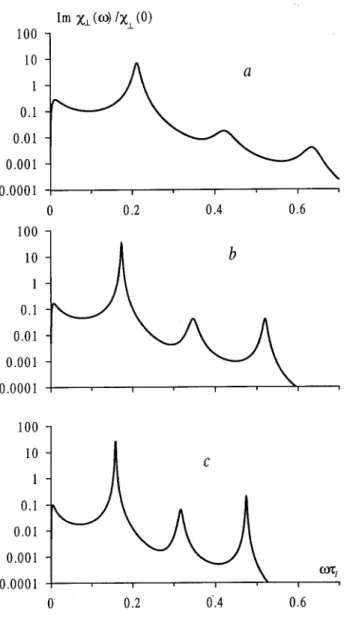
ThisbehaviorisillustratedbyFigs. 1and2. Inthe
rstonethestressretardationtime
M
hanges(grows
toptobottom)whilstalltheotherreferenetimesare
xed. Therefore,theparameterm=
M =
K
growstop
to bottom, equalling2in Fig.1b, where A
2 = A
3 . It
orrespondingtom=0:8andtothatinFig.1,where
A
2 <A
3
at m=4. InFig.2, theMaxwelliantimeis
xedandwevarytheelastirestorationtime
K . From
toptobottomonehasm3(a), 2(b)and1(),and
the interplay of the seond and third peaks is in full
agreementwiththeestimates(65){(67).
Figure1.Imaginarypartofthetransversesuseptibility
un-derhangeof
M
;subgures(toptobottom)areplottedfor
TD=200andTK =50at: TM =40(a),100(b),200().
Low-temperaturebehavior(the high-rigiditylimit)
of the longitudinal suseptibility
k
is essentially
dif-ferent from
?
sine there is no athermi limit for
k
. Indeed,under diminutionofutuationsthe
mag-neti material saturates, and its suseptibility along
the diretion of its magnetization tends to zero as
k
(0) ' (=K)(n 2
=2K), see Eq. (46). For the
dy-nami suseptibility, in linearin =K approximation,
Figure2. Imaginarypartofthetransversesuseptibility
un-derhangeofK;subgures(toptobottom)areplottedfor
TM =100andTD=200at: TK=35(a),50(b),100().
k (!)
k (0)
' 1+ i!
(1+m) 2
1
2
r i!
+ 1
2 m
2
2
q i!
(68)
+
m
r +
q
i(!
q )
+
1
4 m
2
2
q
i(!2
q )
:
Thesameresultanbeobtainedmorediretlyfromthe
generalformula(47),iftosubstitutetherethe
longitu-dinalorrelationfuntionbytheleadingterm
G
k
(t)h#
t #i
2
=h# 2
i 2
; K (69)
ofitslow-temperatureexpansion.
From Eq. (68)itfollowsthatin arigid gel the
ab-sorption spetrum forthe probingeld direted along
thepartileorientationaxisomprisesalow-frequeny
ba-similar to that done for thetransverse ase, onends
that for the longitudinal spetra the ritial value of
the parameter m is m
= (
p
33 1)=4 1:19. At
m<m
theenergyisabsorbedmostlyatthebasi
fre-queny
q
,whereasatm>m
themain r^olepassesto
theseondharmoni. Inotherwords,inthe
longitudi-nalabsorptionspetrumsuppressionofoddharmonis
takesplae. Theauseofthiseet is,oneagain,the
preseneoftheosillatorymodeintheangular
orrela-tor (35). This time, however,thelongitudinal dipolar
orrelator is even with respet to h#
t
#i, so that the
evenharmonisare favored.
Figure3. Imaginarypart ofthe longitudinalsuseptibility
underhangeofM;subgures(toptobottom)areplotted
forTD=200andTK=50at: TM =40(a),60(b),70().
Figure4. Imaginarypartofthe longitudinalsuseptibility
underhangeofK;subgures(toptobottom)areplotted
forTM =50andTD=200at: TK =35(a),42(b),70().
Figs.3and4makethosequalitativeonsiderations
more vivid. In Fig. 3the stress retardation time
M
hanges(growstoptobottom)whilstalltheotherones
arexed. Thismeansthat theparameterm=
M =
K
growstoptobottom,equalling1:19inFig.3b,where
A
1 =A
2
. Onean learly see the dierene between
Fig. 3a, where m = 0:8 and A
1 > A
2
, and Fig. 3,
where m=1:4thus ensuringA
1 <A
2
. InFig.4, the
stress relaxationtimeis xed andwehange the
elas-ti restoration time
K
. From topto bottom one has
m1:4(a),1.2(b)and0.7(). ThedataofFig.2was
obtained numerially; they fall in full agreementwith
theestimatesofEq.(68).
VII Conlusions
Intheabove-presentedonsideration,whenonsidering
a ferrogel, we assume that the dissipativemehanism
visoelastitype. Thisassumptionseemstobemore
re-alisti thanformerlyused hypothesisthat presentsthe
saidinterationas justasimplevisousfrition.
Thevisoelastimehanismimpartsnovelessential
features to thedynami magneti response of a
ferro-gel. Unlikethepurelyvisousase,heretheosillatory
regime is possible that means that under appropriate
onditions the magneti spetrum of a ferrogel
om-prises anumberofequidistantresonanelines. Tothe
eigenfrequenybothelastifores|equilibriumand
dy-nami (Maxwell)|ontribute ontheequal basis. Due
totheinherentmesosopianisotropyofthegelsystem,
thespetraofresponsetotheprobingelddireted
ei-theralongorarosstheeasyaxisofthepartile
orien-tation,dieronsiderably. Therearetwomain aspets
ofthosedierenes. First,thetransversesuseptibility
hasanite zero-temperature(athermi)limitwhereas
the longitudinal one turns to zero with temperature.
Seond, due to the parity properties of the respetive
dipolar orrelators, in the spetrum of the linear
re-sponse signalthere may oura seletive suppression
of the amplitudes of the higher harmonis. This
ef-fettakesplaeundersuÆientlystrongvisoelastiity.
Dependingonthetypeofthesignalthat oneanalyzes,
either even(in thetransverseresponse) orodd(in the
longitudinalone) higherharmonisaresuppressed.
Aknowledgements
Support of thisworkby theInternational
Assoia-tionforthePromotion ofCo-operationwithSientists
fromtheNewIndependentStatesoftheFormerSoviet
Union GrantNo.INTAS 97-31311.
Referenes
[1℄ L.LiebertandA.Martinet,J.Phys.Lett.(Frane)40,
L363(1979).
[2℄ P.Fabre, C. Cassagrande, M. Veyssie, V. Cabuil, and
R.Massart,Phys.Rev.Lett.64,539(1990).
[3℄ V.V.Berejnov,J.-C.Bari,V.Cabuil,R.Perzynski,and
Yu.L.Raikher,Europhys.Lett.41,507(1998).
[4℄ J.Dumas and J.-C. Bari,J. Phys. Lett. (Frane)41,
L279(1980).
[5℄ M.Zrnyi,L. Barsi,and A.Buki,J.Chem. Phys.104,
8750 (1996); M. Zrnyi, L. Barsi, D. Szabo,and H.-G.
Kilian,ibid.106,5685(1997).
[6℄ Yu.L.RaikherandV.V.Rusakov,Phys.Rev.E54,3846
(1996).
[7℄ A.A.Potanin,R.J.Hirko,V.T.Peikov,andA.M.Lane,
J.Rheology42,1249(1998).
[8℄ V.T.PeikovandA.M.Lane,J.Colloid&InterfaeSi.
206,350(1998).
[9℄ V.T.Peikov,K.S.JeonandA.M.Lane,J.Magn.Magn.
Mater.193,307,311(1999).
[10℄ M.Benakli,P.B.Vissher,B.S.Chae,andA.M.Lane,
J.Appl.Phys.87,5657 (2000).
[11℄ J.-L.Dejardin,Phys.Rev.E58,2808 (1998).
[12℄ Yu.L.Raikher,V.V.Rusakov,W.T.Coey,andYu.P.
Kalmykov,Phys.Rev.E63,031402(2001).
[13℄ J.H. Calderwood, W.T. Coey, A. Morita, and S.
Walker,Pro.Roy.So.LondonA352,275(1976).
[14℄ W.T.Coey,M.W. EvansandP.Grigolini,Moleular
Diusion and Spetra, Wiley{Intersiene, New York,
1984.
[15℄ W.T.Coey,Yu.P.Kalmykov,andJ.T.Waldron,The
LangevinEquation.WorldSienti,Singapore,1996.
[16℄ R.ZwanzigandM.Bixon,Phys.Rev.A2,2005(1970).
[17℄ P.G.deGennes,SalingConepts inPolymerPhysis,
CornellUniv.Press,Itaka,1979.
[18℄ M.DoiandS.F.Edwards,TheTheoryofPolymer
Dy-namis,OxfordUniv.Press, Oxford,1986.
[19℄ V.S.Volkov,Sov.Phys.JETP71,93(1990).
[20℄ V.S.VolkovandA.I.Leonov,J.Chem.Phys.104,5922
(1996).
[21℄ L.D. Landau and E.M. Lifshitz, Eletrodynamis of
ContinuousMedia,PergamonPress,Oxford,1960.
[22℄ J.H.vanZantenand K.P.Rufener, Phys.Rev.E 62,
5389(2000).
[23℄ L. D. Landau and E. M. Lifshitz, Fluid Mehanis,
PergamonPress,Oxford,1959.
[24℄ Yu.L.RaikherandV.V. Rusakov,J. Mol.Liquids71,