Phase Separation in Disordered Exclusion Models
Joachim Krug
Fachbereich Physik, Universitat GH Essen, D-45117 Essen, Germany Received 15 October 1999
The eect of quenched disorder in the one-dimensional asymmetric exclusion process is reviewed. Both particlewise and sitewise disorder generically induce phase separation in a range of densities. In the particlewise case the existence of stationary product measures in the homogeneous phase implies that the critical density can be computed exactly, while for sitewise disorder only bounds are available. The coarsening of phase-separated domains starting from a homogeneous initial condition is addressed using scaling arguments and extremal statistics considerations. Some of these results have been obtained previously in the context of directed polymers subject to columnar disorder.
I Introduction
The one-dimensional asymmetric simple exclusion pro-cess (ASEP) was introduced by Spitzer in 1970 as an example of an interacting stochastic process [1, 2, 3]. In the probabilistic community it has been widely used for rigorous studies of the emergence of hydrodynamic be-havior from stochastic microscopic dynamics [4, 5]. Al-ready thirty years ago similar models were considered in the context of biopolymerization [6], while recent appli-cations have focused on the problem of vehicular trac ow [7]. The interest of statistical physicists has been further fueled by the discovery of boundary-induced phase transitions [8, 9, 10] as well as the relations to interface growth and directed polymers in random me-dia [11, 12]. In short, the ASEP is a generic model of driven single le transport which combines utmost simplicity with a remarkable richness of behaviors.
Fig. 1 illustrates the model. Particles occupy the sites of a one-dimensional lattice subject to the simple exclusion rule (at most one particle per site). In an in-nitesimal time intervaldtparticleiat sitex
iattempts a jump to the right (left) with probability pdt (q dt). The jump succeeds if the neighboring site is empty and is suppressed otherwise. In general the jump rates p and qmay depend on both the particle label iand the position x on the lattice. In much of the paper I will restrict myself to the totallyasymmetric caseq= 0.
In the present article I want to address the eects thatquencheddisorderin the jump rates has on the be-havior of the ASEP. Disorder eects can be quite dra-matic in one-dimensional single le systems, as is evi-denced by the everyday experience with platoons and
trac jams caused by slow vehicles, accidents or road construction on highways [13, 14, 15, 16, 17]. Also in the context of driven transport on biomolecules a cer-tain amount of disorder seems unavoidable [18].
Figure 1. Illustration of the asymmetric simple exclusion process.
It is natural to distinguish betweenparticlewise dis-order with p=p
i, q =q
i independent of
x, and site-wisedisorder withp =p(x), q = q(x) independent of i. Both particlewise and sitewise disorder generically induce phase separation in the sense that, for global particle densities in a certain interval [
, c
; + c], the system breaks up into regions of density
, c and
+ c separated by sharp density discontinuities (\shocks"). These shocks are typically associated with bottlenecks, i.e. slow particles or slow sites in the particlewise and sitewise cases, respectively. If the system is started from a homogeneous initial condition, the average size of phase separated regions grows as a power law
(t)t 1=z
; (1)
dening a dynamic exponentz; an example of the time evolution in the particlewise case is shown in Fig. 2. Two kinds of questions will therefore be asked in the following: First, how can the density interval [
, c
Figure 2. Space-time plot of trajectories of the ASEP with particlewise disorder. The gure shows 256 particles on a ring of 1024 sites. The initial distribution of particles was random with density = 1=4<c = 0:4. Courtesy of M.
Gerwinski.
For particlewise disorder a number of exact analytic results are available [19, 20, 21, 22, 23] which have been reviewed elsewhere [15]. This case will therefore only be briey summarized in Section II. The more dicult problem of sitewise disorder has been studied numeri-cally by Tripathy and Barma [24] and others [16, 25], but little is known analytically. In Section III some progress in this direction will be reported. Specically, I derive a rigorous bound on the critical densities based on the results for the particlewise case, and obtain pre-dictions for the coarsening behavior for various types of disorder distributions. The relation to directed poly-mers in random media is briey discussed in Section
III.4, and some conclusions and open questions are for-mulated in Section IV.
II Particlewise disorder
II.1 Steady state and critical density For particlewise disorder the congurations of the system are most naturally described in terms of the headways u
i = x
i+1 ,x
i
,1 in front of the particles. The key simplifying feature is that dierent headways become statistically independent in the steady state, with a geometric distribution [19, 21]
P i(
u) = (1, i)
u
i (2)
for the headway in front of particle i. In the totally asymmetric case the parameters
i are determined by the jump rates p
i through the simple relation [20, 21]
i= v =p
i (3)
where v is the (common) mean speed of the particles in the steady state. Eq.(3) expresses the plausible fact that the headways in front of slow particles are larger than in front of fast ones. The geometric distribution (2) remains valid in the case of partial asymmetry, but then (3) is replaced by a more complicated relation [19, 21]. The steady state distribution for the totally asymmetric model with parallel update has a similar form [22].
In the following we consider the totally asymmetric case and take the p
i to be independent random vari-ables with a probability densityf(p) supported on the interval [c;1], with a minimal speed c bounded away from zero. Since particles cannot pass each other, it is clear that the steady state speed v in an innite sys-tem cannot exceed c. To compute it, one determines the mean headway in front of particle i from (2) and performs the disorder average. In a system of density the resulting average headway must be (1,)=. This yields the implicit equation
=
1 +v Z
1 c
dpf(p) p,v
,1
(4) for the speed as a function of density. Two cases are to be distinguished. If the integral on the right hand side of (4) diverges in the limitv!c, thenv()<cfor all>0. In this case the
i in (2) are bounded away from unity for alli, the headway distributions are nor-malizable, and the system remains homogeneous. If, on the other hand, the integral remains nite in this limit, then the right hand side of (4) evaluated atv=c denes a critical density
csuch that
v()cin the en-tire interval [0;
c]. For the slowest particles with p
particles, and the faster particles form platoons behind them, a phenomenon familiar from vehicular trac on country roads [15, 13, 14]. The system phaseseparates into regions of density
,
c = 0 (the gaps) and regions of density
+ c =
c (the platoons).
It is evident from (4) that the condition for phase separation translates into a condition on the behavior of the disorder distributionf(p) near p=c. Introducing an exponentnthrough
f(p)(p,c) n
; p!c; (5)
phase separation occurs i n>0. At the critical point
=
c the disorder averaged headway distribution has a power law tail u
,(n+2) [20]. Evans [21, 22] has emphasized the close analogy to Bose-Einstein conden-sation, where f(p) plays the role of a density of states, and the slowest particle in the system corresponds to the quantum mechanical ground state.
II.2 Coarsening behavior
No exact results pertaining to the dynamics of phase separation are available, apart from the observation [23] that the existence of a well-dened hydrodynamic limit implies that inhomogeneities are restricted to scales smaller than t, and therefore
lim t!1
(t)=t= 0: (6) Considerable evidence has however accumulated in fa-vor of the idea [20] that the coarsening behavior for particlewise disorder can be described in terms of a simpler, deterministic model, in which particles move ballistically on the real line with xed random speeds and coalesce upon overtaking. Such a model was rst introduced by Newell [13], and later a detailed kinetic theory was worked out by Ben-Naim, Krapivsky and Redner [14].
Within the deterministic model, the dynamic expo-nent z can be determined through a simple extremal statistics argument. The key idea is that the parti-cles heading the platoons at timet are those with the smallest speeds among of the order of(t) particles. El-ementary probability theory suces to show that, for a probability density behaving as (5), these extremal speeds cluster in an interval of size
,1=(n+1)above the minimal speedc. Therefore the speed dierence v be-tween two platoons is of the order
,1=(n+1), and the faster platoon will merge with the slower one on a time scale t =v
(n+2)=(n+1). Inverting this relation one obtains the coarsening law (1) with
z= n+ 2 n+ 1
: (7)
Numerical results supporting (7) have been reported for models with parallel update [26], in simulations of jam dissolution [23] and in a simulation study of a system with open boundaries [27].
III Sitewise disorder
III.1 Disorder types
We distinguish three cases which will turn out to represent dierent classes of coarsening behavior. For type I disorder the dynamics is totally asymmetric, q(x) 0, and the forward rates p(x) are independent random variables in an interval [c;1], with a minimal ratec>0. The simplest (and typical) example is that of binary rates, with probability density
f(p) =(p,c) + (1,)(p,1) (8) where2(0;1) denotes the fraction of slow sites. Type IIdisorderis similar to type I except that the support of the probability density f(p) extends all the way to p= 0, i.e. the minimal ratec= 0. For type II disorder nontrivial dynamics occurs only for continuousf(p). As in the models with particlewise disorder (eq.(5)), the important feature of f(p) is the behavior near p = 0, which can be characterized by an exponent nthrough the relation
f(p)p n
; p!0: (9)
Finally, for typeIII disorder not only the strength, but also the direction of the bias is spatially random. A majority of sites has a bias to the right, say, with p(x)>q(x), while a minority has q(x)>p(x). If the one-dimensional lattice is viewed as a transport path in a higher-dimensional disordered structure, such as a percolation cluster, the stretches of minority sites can be interpreted as \backbends" where the path turns back against the direction of the driving eld [28]. Com-pared to the strong disorder eects induced by the back-bends, the randomness in the strength of the bias is irrelevant. Therefore a representative example of type III disorder is a model where the strength of the bias is constant, and only its direction varies. This corre-sponds to settingq(x) = 1,p(x) and choosing thep(x) from a binary distribution which is symmetric around p= 1=2,
f(p) = (1,)(p,b) +(p,(1,b)): (10) Here b2(1=2;1) denotes the strength of the bias and 2(0;1=2) the fraction of minority sites.
It is easy to see that for type II and III disor-der the stationary particle current vanishes in the in-nite system limit, due to the existence of arbitrar-ily large stretches of arbitrararbitrar-ily small jump rates (for type II) or arbitrarily long backbends (for type III). As a consequence phase separation occurs at any density 2(0;1), i.e.
,
c = 0 and
+
has been rigorously established, and it has been shown that J() is convex in the sense that J
00(
) 0 [29]. However, in contrast to the models with particlewise disorder the stationary state is not known, and there-fore an explicit computation ofJ() is not possible. In the next section some bounds on J() will be derived and used to bound the critical densities for type I dis-order. The coarsening dynamics for all three cases will be addressed in Section III.3.
III.2 Bounds on the critical density for type I disorder
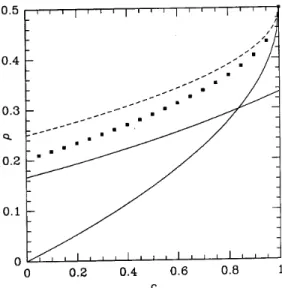
We rst collect some obvious properties of J(). Due to particle-hole symmetry we haveJ() =J(1,). The current is bounded from below by the current c(1,) of a pure system with all rates equal to the minimal ratec, and from above by the current(1,) of the system with all rates equal to unity. A more precise upper bound is obtained by observing that in the innite system there are arbitrarily large stretches with rates arbitrarily close toc. The maximum current that can be driven through such a stretch is c=4, the maximum value ofc(1,). We conclude that
c(1,)J()min[c=4;(1,)]: (11) Numerical simulations of site-disordered exclusion models [24, 16, 25] and related growth models [30, 31] indicate that the upper boundc=4 is attained in a nite density interval around= 1=2, which coincides with the phase separation interval [
, c
; +
c]; by particle-hole symmetry
, c = 1
, + c
c. In the following our strat-egy will be to derive optimal lower and upper bounds J
<(
) andJ >(
) on the stationary current, which are then translated into lower and upper bounds
< c, > c on
c through the relation J
>(
< c) =
J <(
> c) =
c=4: (12)
The lower current bound in (11) does not give rise to any nontrivial density bound, while the upper bound (1,) yields
c
(1, p
1,c)=2: (13) For the case of binary disorder (eq.(8)) an improved lower bound on the current was derived by Tripathy and Barma [24] by considering a nite ring of L sites, N =L particles andN
s=
Lslow sites. They start from the observation that the maximum current that can be driven through a stretch of slow sites is a de-creasing function of the length of the stretch (we will return to this point below in Section III.3). It is there-fore plausible (though not rigorously established) that for given L, N and N
s the stationary current will be minimalin the fully segregated limit where all slow sites form a single large stretch. ForL!1the fully segre-gated system can be treated as two connected homoge-neous systems with dierent densities, which are xed
through the constraints of equal currents and total par-ticle number. This yields the upper density bound
c
(1,(1,) p
1,c)=2: (14) In the dilute limit!0 the bounds (13) and (14) co-incide, and give
c= (1 ,
p
1,c)=2 exactly. It should however be noted that this limit doesnotcorrespond to the case of a single defect site, since the maximal cur-rent that can be driven through a single defect is larger thanc=4 [32] (see also Section III.3).
The lower bound (13) can be improved by compar-ing the disordered exclusion model to azerorange pro-cess(ZRP) with the same set of jump ratesfp(x)g. In the ZRP an arbitrary number of particles is allowed on any site [1, 15], and therefore any attempted jump suc-ceeds. As a consequence the stationary state of the ZRP is a product measure, with the occupation numbers at dierent sites being independent, for any choice of jump rates depending on the position xand on the number of particles at the site [19, 33]. Here we consider the case where the rate at which a particle is transferred from site x to x+ 1 is equal to p(x) independent of the number of particles atx, provided the latter is not zero. It is then obvious (and can be proved through waiting time considerations) that the particle current J
ZRP(
) of the ZRP provides an upper bound to the current J() of the ASEP.
In fact the disordered ZRP is equivalent to the ASEP withparticlewisedisorder, with the ZRP occupa-tion numbers representing the headways in the ASEP [19, 15]. The ZRP current is equal to the particle speed v of the ASEP, which is given by (4) for any disor-der distribution f(p). The ZRP density is equal to the mean headway of the ASEP, and is therefore related to the ASEP density through
ZRP= 1 =
ASEP
,1. Eval-uating the integral in (4) for the binary distribution (8) yields ZRP= J ZRP c,J
ZRP
+ 1,
1,J ZRP
; (15)
and setting J > =
J
ZRP in (12) we obtain the density bound
c
3 +c(1,) 4,c
; (16)
which improves (13) for smallc. In particular, forc!0 we have
c
=3, which proves, remarkably, that the homogeneous phase<
Figure 3. Bounds on the critical density for sitewise disorder with the binary distribution (8),= 1=2. The dashed line
is the upper bound (14), the two full curves show the lower bounds (13) and (16), and the full squares are simulation data obtained by G. Tripathy.
III.3 Coarsening behavior
At least for type I disorder the existence of a hydro-dynamic limit [29] implies that the relation (6) carries over to the sitewise case. To obtain a ner estimate of the coarsening scale (t) we rely on extremal statis-tics arguments similar to those used in Section II.2. A schematic phase separated density prole is shown in Fig. 4. Two \antischocks" at positions x1 and x2, where the density jumps from+
c = 1 ,
c to
, c =
c, markbottleneckregions of particularly slow rates, which support maximum currentsj1andj2. If the bottleneck in the downstream direction is slightly more restrictive, in the sense that j =j1,j2>0, then the low den-sity region between the bottlenecks will slowly ll in and disappear at a time
t(1,2 c)
=j: (17)
If the statistics of extremal bottlenecks is known, the typical current dierence jcan be estimated as a func-tion of and (17) yields a prediction for the coarsening law (t). In the following this will be carried out for the dierent disorder types.
Figure 4. Schematic of two bottlenecks at positionsx 1 and x2.
I I I.3.1 Typ e I disorder
Consider rst the conceptually simplest case of the binary disorder distribution (8). We expect long stretches of slow sites to constitute the most restric-tive bottlenecks. For a quantitarestric-tive analysis we would require the maximum current jmax(c;`) which can be driven through a stretch of`slow sites with jump rates c embedded in an innite system of sites with jump rates 1. Already for`= 1 the computation ofjmax(c;`) is a dicult unsolved problem [32]. However for large` we can make progress by replacing the stretch by a nite system of`sites with uniform jump ratescand periodic or open boundary conditions, for which the maximum current is known [9, 10]. For both kinds of boundary conditions the current approaches the`!1limitc=4 from above, with a leading correction [34] proportional to 1=`. Thus we expect, for large`,
jmax(c;`)(c=4)(1 +a=`) +O(1=`2); (18) whereais a positive constant of order unity.
Since the probability distribution of the lengths of slow stretches is
P(`) = (1,) `
; (19)
the longest stretch in a region of size is of the order of
`max ln ln(1=)
: (20)
Note that `max , which is consistent with the as-sumption of well-localized bottlenecks inherent in Fig-ure 4. Using (18) we see that the currents supported by the longest stretches exceed c=4 by an amount of the order ofc=`max, and therefore
j
cln(1=) ln
: (21)
Inserting this into (17) the leading order coarsening law is obtained as
(t) t=t0 ln(t=t0)
(22) with a characteristic time scalet0(1,2
c)
=cln(1=). This argument was formulated earlier in the context of phase-disordered growth models, where also numerical evidence in favor of the coarsening law (22) was pre-sented [30, 31].
For continuous disorder distributionsf(p) the iden-tication of the relevant bottlenecks is a little more sub-tle. Consider a region of size ` where all rates satisfy p(x) c+. The maximum current through such a region can then be estimated as
jmax c+
4
1 + a `
If f(p) behaves as in (5) for p! c the probability of the region is of the order of (
n+1)`. The probability distribution ofj can then be written as
P(j) Z
d` Z
d( n+1)`
(j,(+ca=`)=4) Z
dexp[,(n+ 1)caln(1=)=(4j,)]: (24) Evaluating the last integral at the saddle point yields
P(j)exp[,(n+ 1)caln
2(1
=j)=j]: (25) The current scale j of the most restrictive among bottlenecks is obtained by settingP(j)1=, which gives
j
[ln(ln)]2 ln
; (26)
and the corresponding coarsening law reads, to leading order int,
(t)
t[ln(lnt)]2 lnt
(27) which, for most purposes, is indistinguishable from (22).
I I I.3.2 Typ e I I andI I I disorder
For type II disorder with a continuous probability distributionf(p), characterized by (9), the expression (23) for the maximum current supported by a slow stretch of length ` applies with c = 0. The distribu-tion ofjmax then becomes
P(jmax) Z
d` Z
d
(n+1)`
(jmax,(1 +a=`)=4) Z
d`exp[,(n+ 1)`ln((1 +a=`)=4jmax)]: (28) Now the maximum of the exponent evidently occurs at `= 1, i.e. the dominant bottlenecks areindividualslow sites. The distribution of the currents supported by the bottlenecks is then simply given by the jump rate dis-tribution f(p) itself, and the situation reduces to that analyzed in the case of particlewise disorder, Section II.2. In particular, the coarsening exponentz for type II sitewise disorder is also given by (7).
For type III disorder with distribution (10) the dom-inant bottlenecks are long backbends, i.e. stretches of minority sites at which the local bias is directed against the mean ow direction. The maximum current that can be driven through a backbend of length` is expo-nentially small in`, and is given by [24, 28]
jmax(`)exp[,(1=2)`ln(b=(1,b))]: (29) Combining this with the probability distribution (19) of backbend lengths it follows thatjmax is distributed according to a power law,
P(jmax)(jmax)
2 ,1
,1 (30)
where
= ln[
b=(1,b)] ln[1=]
: (31)
Since the largest backbend in a region of size is of length ` ln , we can employ a coarse grained picture in which the backbends are shrunk to individ-ual sites with a jump rate distribution given by (30), thus eectively reducing the problem to type II disor-der with the exponent n in (9) given byn = 2=,1. The coarsening exponent for the disorder distribution (10) is then obtained from (7) as
z= 1 + =2: (32)
III.4 Relation to directed polymers
Using the waiting time approach [35] the site disor-dered ASEP can be mapped to a zero temperature di-rected polymer (DP) with point and columnar disorder [36]. In that context the coarsening law(t) describes the disorder-induced transverse wandering of the poly-mer, which can be estimated using variable range hop-ping arguments [36] and the analogy to Lifshitz tails for one-dimensional disordered Schrodinger operators [37]. To see that the results derived for the DP are con-sistent with those obtained above, it is important the recall [35] that the waiting time mapping transforms the timetof the ASEP into the energyof DP. For type I disorder the transverse wandering xof the DP was found to increase with its lengthL as [36]xL=(lnL)2; (33) while the ground state energy behaves as E L=lnL to leading order. Combining the two results and iden-tifyingE t the coarsening law (22) follows.
For type II disorder the power law (9) of the prob-ability distribution at smallp translates into a power law tail
P() ,(2+n)
; !1 (34)
in the distribution of waiting times or energies = 1=p. Directed polymers in the presence of columnar disor-der with a power law distribution were considisor-dered in Ref.[37], where it was shown that the wandering is typ-ically ballistic, xL, while the ground state energy scales with length as
E L(
IV Summary and open
ques-tions
In this paper I have described some recent progress in our understanding of disorder eects in asymmet-ric simple exclusion models. A common feature of both particlewise and sitewise disordered systems is the ap-pearance of phase separation in an interval of densities, which ismacroscopicallycharacterized by a linear por-tion in the current-density relapor-tion J(); in the parti-clewise case J() =c for<
c, while in the sitewise case J() c=4 for
c
1,
c. An interesting open question concerns the connection between phase separation and linearity of J(), which is reminiscent of the role that the convexity of thermodynamic po-tentials plays for the stability of equilibrium systems. While it is obvious that phase separation implies a lin-ear segment inJ(), the converse statement has, to my knowledge, not been established. To prove that it is false, it would be sucient to nd a (noisy!) exclusion type model with a homogeneous stationary state and a linear current-density relation (deterministic systems with linearJ() are well known [7, 38]).
The dynamics of phase separation has been explored in the framework of scaling arguments, which can be formulated in a similar way both for particlewise and sitewise disorder. In the particlewise case the relevant bottlenecks which determine the positions of domain boundaries are always individual slow particles, while in the sitewise case with type I and III disorder the bot-tlenecks are formed collectively by many defects. For type I disorder this implies a certain universalityof the coarsening law, in the sense that the exponent zin (1) is z= 1 independent of the underlying disorder distri-bution; the additional logarithmiccorrections in (22,27) ensure the consistency with the rigorous result (6). This is somewhat analogous to the case ofnite temperature
directed polymers with columnar defects, where univer-sal scaling laws arise from the thermal averaging over large spatial regions [37].
A numerical conrmation of the predictions for the coarsening dynamics in the case of sitewise disorder would be most welcome. For type II disorder this should be relatively straightforward, however in the cases of type I and III disorder the behavior is dom-inated by exponentially rare regions, which may make it hard to reach asymptopia.
Acknowledgements
The results on particlewise dis-order were obtained in collaboration with Pablo Fer-rari and Timo Seppalainen, while the material on site-wise disorder is joint work with Mustansir Barma and Goutam Tripathy. Support by DAAD within the PRO-BRAL programme and by DFG within SFB 237 is gratefully acknowledged.References
[1] F. Spitzer, Adv. in Math.5, 256 (1970).
[2] T.M. Liggett, Interacting Particle Systems(Springer, Berlin, 1985).
[3] T. Liggett, Stochastic Interacting Systems: Con-tact, Voter and Exclusion Processes (Springer, Berlin/Heidelberg, 1999).
[4] H. Spohn, Large Scale Dynamics of Interacting Parti-cles(Springer, Berlin/Heidelberg, 1991).
[5] C. Kipnis and C. Landim,Scaling Limits of Interacting Particle Systems(Springer, Berlin/Heidelberg, 1999). [6] G. Schutz, Int. J. Mod. Phys. B11, 197 (1997), and
references therein.
[7] K. Nagel, Phys. Rev. E53, 4655 (1996).
[8] J. Krug, Phys. Rev. Lett.67, 1882 (1991).
[9] G. Schutz and E. Domany, J. Stat. Phys. 72, 277
(1993).
[10] B. Derrida, M. R. Evans, V. Hakim, and V. Pasquier, J. Phys. A26, 1493 (1993).
[11] J. Krug and H. Spohn, inSolids Far From Equilibrium, edited by C. Godreche (Cambridge University Press, Cambridge, 1991), p. 479.
[12] T. Halpin-Healy and Y.C. Zhang, Phys. Rep.254, 215
(1995).
[13] G.F. Newell, Opns. Res.7, 589 (1959).
[14] E. Ben-Naim, P. Krapivsky, S. Redner, Phys. Rev. E
50, 822 (1994).
[15] J. Krug, in \Trac and Granular Flow '97' ", edited by M. Schreckenberg and D. E. Wolf (Springer, Singapore, 1998), p. 285.
[16] Z. Csahok and T. Vicsek, J. Phys. A27, L591 (1994).
[17] W. Knospe, L. Santen, A. Schadschneider and M. Schreckenberg, in \Trac and Granular Flow `97' ", ed. by M. Schreckenberg and D. E. Wolf (Springer, Sin-gapore, 1998), p. 349.
[18] T. Harms and R. Lipowsky, Phys. Rev. Lett.79, 2895
(1997).
[19] I. Benjamini, P.A. Ferrari and C. Landim, Stoch. Proc. Appl.61, 181 (1996).
[20] J. Krug and P.A. Ferrari, J. Phys. A29, L465 (1996).
[21] M.R. Evans, Europhys. Lett.36, 13 (1996).
[22] M.R. Evans, J. Phys. A30, 5669 (1997).
[23] T. Seppalainen and J. Krug, J. Stat. Phys. 95, 525
(1999).
[24] G. Tripathy and M. Barma, Phys. Rev. E 58, 1911
(1998).
[26] D. V. Ktitarev, D. Chowdhury and D. E. Wolf, J. Phys. A30, L221 (1997).
[27] M. Bengrine, A. Benyoussef, H. Ez-Zahraouy, J. Krug, M. Loulidi and F. Mhirech, J. Phys. A32, 2527 (1999).
[28] R. Ramaswamy and M. Barma, J. Phys. A20, 2973
(1987).
[29] T. Seppalainen, Ann. Probab.27, 361 (1999).
[30] J. Krug, in \Surface Disordering: Growth, Rough-ening and Phase Transitions", edited by R. Jullien, J. Kertesz, P. Meakin and D.E. Wolf (Nova Science, 1992), p. 177.
[31] J. Krug, Phys. Rev. Lett.75, 1795 (1995).
[32] S. A. Janowsky and J. L. Lebowitz, Phys. Rev. A 45,
618 (1992); S. A. Janowsky and J. L. Lebowitz, J. Stat. Phys.77, 35 (1994).
[33] E. D. Andjel, Ann. Probab.10, 525 (1982).
[34] J. Krug and P. Meakin, J. Phys. A23, L987 (1990).
[35] J. Krug and L.-H. Tang, Phys. Rev. E50, 104 (1994).
[36] I. Arsenin, T. Halpin-Healy and J. Krug, Phys. Rev. E
49, R3561 (1994).
[37] J. Krug and T. Halpin-Healy, J. Physique I France 3,
2179 (1993).
[38] K. Nagel and H.J. Herrmann, Physica A 199, 254