Study of Dynamial Dipole Moment in an
Asymmetri Double Quantum Well
J.Bohorquez and A. S. CamahoB.
Departamento deF
isiaUniversidaddelosAndes
Bogota,Colombia
Reeivedon23April,2001
Astudyofthedynamialbehaviorofthehargeinanasymmetridoublequantumwellispresented.
Inpartiular,thetimebehaviorofintrasub-banddipolemomentwhihisinduedbyintersub-band
optialexitationisanalyzedintwoaspets: rst,designofthequantumwellsinordertospatially
separate the hargeand store itand seond studythe dynami tunnelingeetbetween thetwo
wells. Sinebothondutionbandlevelsareoptiallypopulatedbytransitionsfromasingleband
level,theyare oherentlyoupled. Theintrasub-banddensitymatrixompletelyharaterizes the
dynamisoftheondutionbandeletrons.Thesedipolemomentosillationsareentirelyequivalent
tothetunnelingosillationsbetweenthetwowells. Thetimedependentdipolemomentproduedby
thesereal-spaehargeosillationsisobtainedasasoureofdipoleeletromagnetiradiationinTHz
region,whihhasbeendetetedexperimentally.Thealulationsshowthegeometrydependeneof
the emittedradiation. Basedonthereporteddeoherenetimefor thisproessaoherentontrol
mehanismoftheTHzradiation isintroduedbyvaryingthephaseofaseondlaser.
Semiondutor heterostruturesare aperfet
labo-ratory to study oherent optial eets in ondensed
matter systemsdueto their highqualityand the
pos-sibilitytoengineerthestrutureofenergylevels.
Tun-neling is a fundamental quantum mehanially
phe-nomenon of interest in manybranhesof physis
spe-ially in quantum wells. In order to study tunneling
withouttheinueneoftransport,oneshouldstudyan
isolatedstrutureinwhihtransporteetsarenot
im-portant: anasymmetridoublequantumwellstruture
(a-DQW) Coherent osillations of a wave paket in a
semiondutordoublequantumwellstruturewere
de-tetedusingtimeresolveddegeneratefourwavemixing
andpumpandprobespetrosopy[1℄. Theearly
obser-vationofTHzradiationfromanosillatingwavepaket
inasemiondutornanostruture,usinganasymmetri
quantum well struture (a-DQW) wasreported in [2℄.
Inthisworkasystematistudyofthedynami
behav-iorof the harge in an a-DQW is presented, in whih
partiularly the dynami tunneling eet betweenthe
twowellsisexaminedinthefollowingway: An
appropi-ated designofheterostruture anshowoherene
be-tweentwoondution bandlevels,oupledto oneand
the same ground state level (a valene band level or
anotherondution sub-band). Suh struturebehave
qualitativelylike a three levelsystem. In the present
alulationwehoosethethreelevelsintheondution
band. The intrasub-band density matrix ompletely
haraterizesthedynamisoftheondutionband
ele-trons,thetotaldipole momentof ondutioneletrons
distributedbetweenbothupperstatesanbeexpressed
throughtheir density matrix[3℄. Thetime dependent
dipolemomentproduedbythesereal-spaeharge
os-illations is obtainedand adetailed alulation of the
timeevolutionproessasfuntionofthebarrierwidth
ispresented. Suhtime dependentdipole momentisa
soureofdipoleeletromagnetiradiation,whihanbe
deteted[2℄andanbeoherentlyontrolledby
phase-shiftoftwopumppulsesasshownin[4℄. Thistehnique
hasalsobeensugestedforontrolingdeohereneeets
[5℄and[6℄.
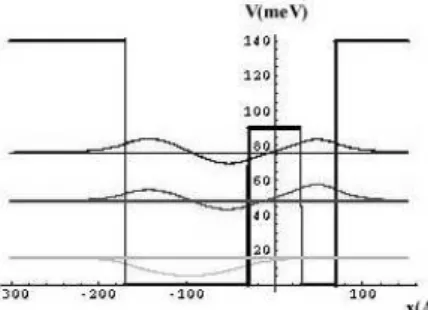
Figure 1. Transition diagram of a three level system
ex-ited from the lowerlevel to both upper levels
simultane-ouslywithapulsewhosespetrumoverlapsbothtransition
frequenies.
The harge dynami behavior of an a-DQW
row barrier whose width b is omparable to the
tun-neling deayexponent. Thewavefuntions ofthetwo
levelsarenowoupledandstrongmodiationofthem
isexpetediftheenergiesoftheonnedlevelsinboth
wellsarelosetoeahother,whihmeanstunneling
res-onane. The two resonanelevels hybridize and form
anewwavefuntionfortheasymmetriquantumwell.
The wavefuntions of the a-DQW are obtained from
alinearsuperpositionofthewavefuntionsofthetwo
wellsenteringin thestruture[7℄.
Theeletronidensityofthea-DQWexhibits
tem-poral osillations with the frequeny of the splitting
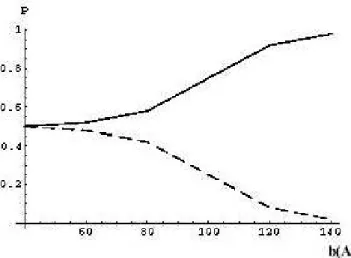
in the tunnel-oupled system. Fig.2 shows the harge
probabilityin bothwells withtheeletroninitially
lo-alizedinthewidewell(WW).Thetransferisomplete
only inexattunneling resonanease,asanbeseen
in Fig.2 for narrow barriers the harge is equally
dis-tributed in both wells, but as barrier width inreases
the harge will prefer to be in the WW. In this way
a hargestorage in the WWis reahed, whih an be
ontrolledvaryingthebarrierwidth.
Figure 2. Charge probability as funtion of time in both
wells. ThewellparametersareWWwidth140A,NWwidth
60AforseveralbarrierwidthswitheletronimassofGaAs
Coherentoupling
Intersub-band transitions in the wide well (WW)
ouratlowerenergythaninthenarrowwell(NW).A
short laser pulse an exite an eletroni wave paket
that is mostly loalized in the WW between thenal
states (1 and 2). The laserspetrumshould be wider
than the energy splitting of the upper states. Sine
both exited levels are optially populated by
transi-tionsfrom thesamegroundstate(0)of thewidewell,
they are oherently oupled. Moreover, the ground
state of thewide wellis optially oupled to both
ex-omponentsp
01 andp
02
isdesribedbytheBloh
equa-tions. Quantum beats our when the eletronsfrom
thelowerlevelaresimultaneouslyexitedintoboth
up-per levels. Assuming the exitation pulse to be a Æ
funtion in the timedomain E(t) =E
0
p
Æ(t), the
po-larizationsp
01 andp
02
forpositivetimesare:
p 01 (t)= i ~ (E 0 p d 01 exp( i ~ ( 1 0 )t) (1) p 02 (t)=(
i ~ (E 0 p d 02 exp( i ~ ( 2 0 )t) (2) where d 01 and d 02
are the orresponding dipole
tran-sitionmatrix elements and
1 and
2
are the energies
of the upper levels. These two polarizations interfere
giving a quantum beat and oupling the two upper
states through a new polarization obtained from the
equationofmotionoftheintrasub-banddensitymatrix
omponent.Theintrasub-bandnondiagonalelementof
thedensitymatrixf
ij is
f
12 (t)=d
01 d 02 ( E 0 p ~ ) 2 (t)e i ~ ((2 1)t) (3)
Thetwonalstatesareoherentlyoupledtothesame
initial state, it means, when both interband
transi-tion matrix elements d
01 and d
02
are nonzero,
ultra-fastintersub-bandoptialpolarizationreatesoherent
ouplingbetweenthetwonalstates,itmeansan
intra-band oupling. In partiularwean expressthe total
dipolemoment ofondution eletronsdistributed
be-tweenstates1and2throughtheirdensitymatrix.
De-notingD
i;j
thematrixelementsof thedipole moment
betweenondution band statesi and j, wean write
thetotaldipolemomentoftheondutioneletronsas
D(t)= X j=1;2 D ij f ij (4)
sothat theintrabandoherene ausesthedipole
mo-mentofthesystemtoosillatewiththequantumbeat
frequeny(
2
1
)t=~. IntheaseofaDQW system,
thesedipolemomentosillationsareentirelyequivalent
totunnelingosillationsbeauseaneletroninitially
lo-alizedinoneofthetwowellsofaDQWstruturewill
tunnelintotheotherwellandthenbakintotherstin
aperiodifashion. Thetimedependentdipolemoment
isproduedbytheserealspaehargeosillations. The
tunnelingtimeasfuntionofthebarrierwidthisshown
in Fig. 3, where it is observed that tunneling time is
anon-linear funtion of the barrier width. This time
Figure 3. Tunneling timeas funtionof barrierwidth. It
showsalinearregionfor widthsbetween80A 0
and120A 0
for thehosenWW widthof140 A 0
and NWwidthof60
A 0
.
Moreover these osillations are the soure of
ele-tromagneti radiation in the THz region. Coherent
harge osillations an be ontrolled by a sequene of
twopulses beausethedriventermin thematrix
den-sityequationistheprodutofthepolarizationreated
by the rst pulse with the eld of the seond pulse.
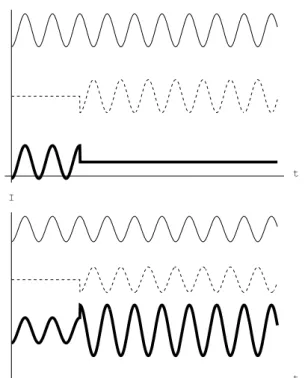
Whenbothexitationpulsesarepresent,theamplitude
andphaseofthehargeosillationsbeomedependent
on the relative phase-shift between the two pulses as
shown in gure 4. The driving term in the density
matrixequationforatwo-pulseexitationontainsthe
produt of optial polarization of the rst pulse and
theeletrield oftheseondpulse, whihisaseond
order eet in nonlinear suseptibility 2
of the three
level system. Thetimeseparationof thephaseloked
pulsepairmustbeshorterthanthetimeittakesforthe
THz signalto deayompletely This eet showsthe
oherentontrolofTHzwavesproduedbyana-DQW
by simplyhangingthephase between thepulses.The
timeseparationofthephaselokedpulsepairmustbe
shorter than the time it takes for the THz signal to
deayompletely.
Inthisworkthedynamidipole momentfora
spe-ial heterostruture, an asymmetri double quantum
well, asathreelevelsystemin theoherentregime,is
studied. Thehargewavefuntion paket isdesribed
asasuperpositionoftheeigenstatesofbothwells. The
time dependent harge probability shows the relevant
role playedbythe barrierwidth in this system,whih
anbeusedtoontrolthehargedistribution,for
exam-pletostoreit. Inordertodeeplyunderstandthis
pro-ess the polarizations (non diagonal matrix elements)
are studied in the simplease that theyare produed
by a Æ -like exitation pulse by alulating all dipole
momenttransitions d
01 ,d
02
and D(t)in this proess.
Inpartiular thetemporal variationof thedipole
mo-ment D(t) is the soure of the THz radiation. The
orresponding polarizations p
01 and p
02
give riseto a
quantum beat and to f whih is responsiblefor the
oherentouplingbetweenstates1and2.
t
I
t
I
Figure 4. Thesignals froma-DQWexitedbya sequene
oftwomutualoherentoptialpulseswithphasedierene
zeroand=2.
Aknowledgments
This work was partially supported by
COLCIEN-CIAS grant RC 428 -2000 and by Fundaion para la
PromoiondelaInvestigaionylaTenolog
iadelBano
delaRepublia,grant1189
Referenes
[1℄ Karl Leo, Jagdeep Shah, Ernst Goebel and Theodore
C.Damenand Stefan Shmitt-Rinkand Wilfrid
Shae-fer,Phys.Rev.Lett.66,201(1991).
[2℄ H.G.Roskos,M.C.Nuss,J.Shah,K.Leo,D.A.B.Miller,
A.M.Fox,S.Shmitt-Rink,andK.Koehler,Phys.Rev.
Lett.69,3800(1992).
[3℄ H. Haug, S.W.Koh, Quantum Theory of the Optial
andEletroniPropertiesofSemiondutors(World
Si-enti,Singapure,3edition,1994).
[4℄ M.S.C. Luo, S.L. Chuang, P.C.M. Planken, I. Brener,
andM.C.Nuss,Phys.Rev.B48,11043(1993).
[5℄ W.Poetz,Appl.Phys.Lett.71,(3),395(1997).
[6℄ Xuedong Huand W.Poetz, Phys.Rev.Lett. 82,3116
(1999).
[7℄ Fedor T. Vasko and Alex V. Kuznetsov, Eletroni
States and OptialTransitions inSemiondutors