Article
Printed in Brazil - ©2012 Sociedade Brasileira de Química0103 - 5053 $6.00+0.00
A
*e-mail: [email protected], [email protected]
Bioactive Phenylpropanoids from
Daphne feddei
Yanling Lu,a,b Xuesen Li,a,b Huaixue Mu,a Haitao Huang,b Gan-Peng Li*,a and Qiufen Hu*,a
aKey Laboratory of Ethnic Medicine Resource Chemistry (Yunnan University of Nationalities),
State Ethnic Affairs Commission & Ministry of Education, Kunming 650031, P. R. China.
bKey Laboratory of Tobacco Chemistry of Yunnan Province, Yunnan Academy of Tobacco Science,
Kunming 650106, P. R. China
A investigação de extrato acetônico de folhas e caules de Daphne feddei forneceu três novos fenilpropanóides, fedeicetonas A-C (1-3), juntamente com nove fenilpropanóides conhecidos (4-11). Suas estruturas foram elucidadas com base em métodos espectroscópicos. Os compostos 1-3 foram testados com relação as suas atividades anti-HIV-1 e citotoxidades frente a células cancerígenas. Os resultados mostraram que as atividades citotóxicas e anti-HIV-1 dos compostos 1-3 são modestas.
Investigation of acetone extract of the leaves and stems of Daphne feddei afforded three new phenylpropanoids, feddeiketones A-C (1-3), together with nine known phenylpropanoids (4-11). Their chemical structures were elucidated on the basis of spectroscopic methods. Compounds 1-3 were tested for their anti-HIV-1 activities and cytotoxicities against cancer cells. The results showed that compounds 1-3 have modest cytotoxic and anti-HIV-1 activities.
Keywords: Daphne feddei, phenylpropanoids, feddeiketones A-C, anti-HIV-1 activity, cytotoxic activity
Introduction
The genus Daphne (Thymelaeaceae) comprises about 70 species, 35 of which grow in China. Daphne feddeiLevl., which is known as “Dian Rui Xiang” (Chinese), is distributed in Yunnan, Sichuan and Guizhou Provinces of China. It is a kind of evergreen shrub. Its leaves and stems have been used as folk medicine to treat the injuries from falls and bruises.1 Previous chemical studies on D. feddeiLevl. led
to the identification of diterpenes, monomeric coumarins, dicoumarins, flavonoids, biflavonoids, phenylpropanoids and lignans.2-8 Among them, phenylpropanoids are important
plant secondary metabolites with various biological activities, including antioxidant, anti-inflammatory, healing, antiviral and antimicrobial.9-11
Our previous studies on Daphne feddei collected from Dali Prefecture of Yunnan Province resulted in the isolation of several lignans and phenylpropanoids including two new secolignans and one new neolignan.12 As a continuation of
investigation on chemical constituents of the same Daphne feddei plant, three new phenylpropanoids (1-3), together
with nine known phenylpropanoids (4-12), were isolated. In addition, the anti-HIV-1 and cytotoxic activities of compounds 1-3 were evaluated. This article deals with the isolation, structural elucidation and biological activities of the new compounds.
Results and Discussion
The 70% aq. acetone extract of D. feddei was suspended in H2O and partitioned with ethyl acetate.
The ethyl acetate partition was repeatedly subjected to column chromatography over Si gel and preparative HPLC (high performance liquid chromatography) to afford compounds 1-12, including three new phenylpropanoids, named feddeiketones A-C (1-3), together with nine known phenylpropanoids, p-coumaric acid (4),13
caffeic acid (5),14 ferulic acid (6),15 coniferoside (7),16
isoconiferin (8),17 turbinataphenol A (9),18 nervolan B (10),19
nervolan C (11)20 and 1,2-O
-dicaffeoylcyclopenta-3-ol (12).21 The structures of compounds 1-12 are shown in
Figure 1. In addition to three new compounds, compounds
Compound 1 was isolated as pale yellow gum. Its molecular formula was established as C13H16O6
by a pseudo-molecular-ion peak in the HRESIMS (high-resolution electron spray ionization mass spectrometry) (m/z 291.0852 [M + Na]+ , calc. 291.0845).
Its 1H and 13C NMR (nuclear magnetic resonance)
spectra (Table 1) showed signals to 16 hydrogens and 13 carbons, respectively, corresponding to one aromatic ring (dC 105.5, 111.6, 130.5, 138.6, 148.8, 152.8) with two
aromatic protons (dH 6.82 d, J 1.8 Hz; 7.06 d, J 1.8 Hz),
one methylene group (dC 42.0), one methylenedioxy group
(dC 60.0), one carbonyl group (dC 198.0), two methoxyl
groups (dC 55.7, 60.9), an acetoxy group (dC 169.7,
21.3) and a phenolic hydroxyl group (dH 10.98). Strong
absorption bands accounting for hydroxyl (3382 cm-1),
carbonyl (1715, 1705 cm-1) and aromatic group (1636,
1508, 1452 cm-1) could also be observed in its IR (infrared)
spectrum. The UV spectrum of 1 showed absorption
OR4
O
R2O
OR3
R1O
1 R1 = R2 = -Me; R3 = -H; R4 = -Ac
2 R1 = R2 = -Me; R3 = R4 = -H 3 R1 = -Me; R2 = R3 = -CH2-; R4 = -H
1
2 3 4 5
6 7
8 9
COOH R1O
R2
4 R1 = -H, R2 = -H 5 R1 = -H, R2 = -OH 6 R1 = -H, R2 = -OMe
R1O
MeO
7 R1 = -Glc; R2 = -H 8 R1 = -H; R2 = -Glc
OR2
O OH
OH MeO
O OH
O
HO
HO
9
OMe R1
AngO
R2
10 R1 = -OMe; R2 = -OH
11 R1 = -H; R2 = -OH
O O HO
HO HO
HO
OH
12
Figure 1. Chemical structures of compounds 1-12.
Table 1.1H and 13C NMR data (in C
5D5N) of compounds 1-3
Position 1 2 3
δC (m) δH (m, J / Hz) δC (m) δH (m, J / Hz) δC (m.) δH (m, J / Hz)
1 130.5 (s) 130.4 (s) 131.4 (s)
2 111.6 (d) 7.06 (d, J 1.8) 111.4 (d) 7.05 (d, J 1.9) 111.1 (d) 7.06 (d, J 1.8)
3 148.8 (s) 149.0 (s) 143.7 (s)
4 138.6 (s) 138.4 (s) 137.1 (s)
5 152.8 (s) 152.7 (s) 148.5 (s)
6 105.5 (d) 6.82 (d, J 1.8) 106.0 (d) 6.82 (d, J 1.9) 103.9 (d) 7.32 (d, J 1.8)
7 198.0 (s) 198.1 (s) 198.8 (s)
8 42.0 (t) 3.43 (t, J 6.2) 43.8 (t) 3.44 (t, J 6.2) 43.7 (t) 3.32 (t, J 6.2)
9 60.0 (t) 4.66 (t, J 6.2) 58.6 (t) 4.43 (t, J 6.2) 58.9 (t) 4.44 (t, J 6.2)
OMe-4 60.9 (q) 3.70 (s) 60.7 (q) 3.70 (s)
OMe-5 55.7 (q) 3.78 (s) 55.7 (q) 3.74 (s) 56.0 (q) 3.70 (s)
−OCH2O− 101.3 (t) 5.83, 5.89 (s)
Ar-OH 10.98 (brs) 10.85 (brs)
1' 169.7 (s)
maxima at289 nm confirming the existence of the aromatic function. The 1H-1H COSY (correlation spectroscopy) of
H-8/H-9, together with HMBC (heteronuclear multiple bond correlation) correlations (Figure 2) of aromatic protons, H-2 (dH 7.06), H-6 (dH 6.82) with C-7 (dC 198.0),
of H-8 (dH 3.43) with C-1 (dC 130.5) and of H-9 (dH 4.66)
with C-1' (dC 169.7) suggested that 1 is a
3-acetoxy-1-phenyl-1-propanone (Ar-CO-CH2-CH2OAc) and possess
two methoxyl groups and a phenolic hydroxyl group on the aromatic ring. The HMBC correlations of aromatic hydroxyl proton signal (dH 10.98) with C-2 (dC 111.6),
C-3 (dC 148.8), C-4 (dC 138.6) indicated that the hydroxyl
group should be located at C-3. The HMBC correlations of two methoxyl proton signals (dH 3.70, 3.78) with C-4
(dC 138.6) and C-5 (dC 152.8) indicated that two methoxyl
groups should be located at C-4 and C-5, respectively. Therefore, the structure of 1 waselucidated as that shown in Figure 1, and it has been trivially named as feddeiketoneA.
Compound 2, that was also obtained as pale yellow gum, has a molecular formula C11H14O, based on the HRESIMS
showing a sodiated molecular ion at m/z 249.0731 [M + Na]+ (calc. m/z 249.0739). The 1H and 13C NMR
spectra of 2 were very similar to those of 1. The IR and UV spectra were also similar to those of compound 1. The differences from 1 were the absence of the acetoxy group signal and the appearance of the hydroxyl proton signal (dH 4.99 brs) in 2. Therefore, the structure of 2 was
established and was named feddeiketone B.
Compound 3 was also obtained as pale yellow gum. The
1H and 13C NMR spectra of 3 were very similar to those
of 2. The obvious chemical shift differences resulted from the substituent group variations in the aromatic ring. For compound 3,the HMBC spectrum showed that a methoxyl group was located at C-3, and a methylenedioxy group at C-4 and C-5. Accordingly, the structure of 3 was determined as shown and named feddeiketone C.
In the anti-HIV-1 tests, the cytotoxicity assay against C8166 cell CC50 (cause 50% cells’ death) was assessed
using the MTT (1-(4,5-dimethylthiazol-2-yl)-3,5-diphenyl-formazan) method, and the anti-HIV-1 activity was evaluated by the inhibition assay for the cytopathic effects of HIV-1 (EC50).13 Compound 1 shows anti-HIV-1 activity with EC50
3.96 µg mL-1, CC
50 64.5 µg ml-1and TI (therapeutic index)
16.3. Compound 2 shows anti-HIV-1 activity with EC50
3.16 µg mL-1, CC
50 96.3 µg ml-1and TI 30.5. Compound
3 shows anti-HIV-1 activity with EC50 2.47 µg mL -1, CC
50
43.4 µg mL-1and TI 17.6. The results showed that compounds
1-3 have modest anti-HIV-1 bioactivities.
The cytotoxicity tests for the isolates were performed using a previously reported procedure.22 All treatments were
performed in triplicate. In the MTT assay, the IC50 was
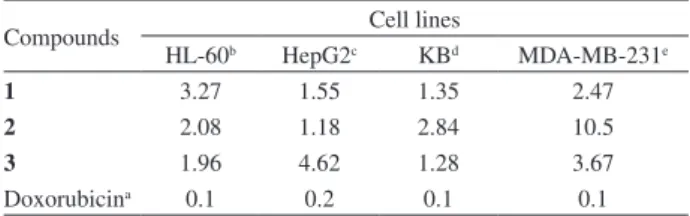
defined as the concentration of the test compound resulting in a 50% reduction of absorbance compared with untreated cells. The cytotoxic abilities of compound 1-3 against HL-60, Hep-G2, KB and MDA-MB-231 tumor cell lines were performed using the MTT-assay (with doxorubicin as the positive control). The results were shown in Table 2 and showed that compounds 1-3 have significant potential cytotoxic activities.
Conclusions
The spectroscopic analyses of compounds isolated from leaves and stems of Daphne feddei. revealed three new phenylpropanoids (named feddeiketones A-C (1-3)), together with nine known phenylpropanoids (4-11). These new compounds had their cytotoxic activities and anti-HIV-1 bioactivity studied, with modest activities.
Experimental
General procedures
IR spectra were measured on a Bruker Tensor 27 spectrometer with KBr pellets. UV spectra were measured on a Shimadzu UV-2401A spectrophotometer. Optical rotations were measured on a Horiba SEPA-300 polarimeter.
1H and 13C NMR and 2D NMR spectra were recorded on
Bruker DRX-500, with chemical shifts (d) in ppm relative to tetramethylsilane (TMS) as internal standard and coupling constants in Hz. HRESIMS data were measured
Figure 2. Selected HMBC ( ) and 1H-1H COSY (— ) correlations of compound 1.
O
O O
MeO
OMe HO
Table 2. Cytotoxicities of compounds 1-3
Compounds Cell lines
HL-60b HepG2c KBd MDA-MB-231e
1 3.27 1.55 1.35 2.47
2 2.08 1.18 2.84 10.5
3 1.96 4.62 1.28 3.67
Doxorubicina 0.1 0.2 0.1 0.1
aData of IC
using an API QSTAR time-of-flight spectrometer and a VG Autospec-3000 spectrometer. Preparative HPLC was performed on a Shimadzu LC-8A preparative liquid chromatograph system equipped with a ZORBAX PrepHT GF (21.2 mm × 25 cm, 7 µm) column or aVenusil MP C18
(20 mm × 25 cm, 5 µm) column. Silica gel (200-300 mesh, Qing-dao Marine Chemical, Inc., Qingdao, China) was used for column chromatography. Fractions were monitored by TLC (Qing-dao Marine Chemical, Inc., Qingdao, China), and spots were visualized by heating Si gel plates sprayed with 5% H2SO4 in EtOH and under UV light.
Plant material
The leaves and stems of D. feddei were collected from Dali Prefecture, Yunnan Province, People’s Republic of China, in September 2009, and authenticated by Professor Chen Y. J. (Yunnan University of Nationalities). A voucher specimen (YNNI 09-9-12) is deposited at the Herbarium of Key Laboratory of Ethnic Medicine Resource Chemistry, Yunnan University of Nationalities.
Extraction and isolation
Air-dried and powdered leaves and stems of D. feddei (2.5 kg) were extracted with 70% aqueous acetone (4 × 2.5 L) at room temperature. After evaporating the solvents in vacuum, a residue was obtained (153 g). This residue was dissolved in H2O and extracted with EtOAc
(3 × 1 L). The EtOAc (82.5 g) extract was chromatographed on a silica gel (200-300 mesh) column and eluted with gradient mixtures of chloroform-acetone (20:1, 9:1, 8:2, 7:3, 6:4, 5:5) to afford five fractions A-F. Fraction E (6:4, 38.4 g) was subjected to silica gel column chromatography, eluted with chloroform-methanol (9:1, 8:2, 7:3, 6:4, 1:1), yielded subfractions E1-E5. Subfraction E1 (9:1, 2.47 g) was further purified by preparative HPLC eluting with H2O-MeOH (50:50, flow rate 12 ml min
-1) to give 1
(21.2 mg), 3 (11.4 mg), 9 (22.6 mg) and 10 (8.62 mg). Subfraction E2 (8:2, 3.68 g) was subjected to preparative HPLC eluting with H2O-MeOH (58:42, flow rate
12 mL min-1) to afford 2 (18.5 mg), 11 (35.4 mg) and 12
(4.58 mg). Subfraction E3 (3:2, 9.2 g) was also further purified by preparative HPLC eluting with H2O-MeOH
(80:20, flow rate 12 mL min-1) to afford 4 (50.5 mg),
5 (36.5 mg), 6 (24.6 mg), 7 (63.5 mg) and 8 (41.2 mg).
Anti-HIV-1 assay
Cytophatic effect inhibitory assay using C8166 cells infected with HIV-1 was used to evaluate anti-HIV-1
activity (EC50). The cytotoxicities of compounds 1-3
against C8166 cells (CC50) were also evaluated using the
MTT method and allowed the determination of therapeutic index (TI).21
Cytotoxicity assay
Cytotoxic activities of compounds 1-3 against cancer cell lines HL-60, Hep-G2, KB and MDA-MB-231 were measured by the MTT method using doxorubicin as the positive control.22
Feddeiketone A (1)
Pale yellow gum; UV (MeOH) λmax/nm (log ε) 324
(dH 2.47), 289 (dH 4.18), 250 (dH 3.26), 210 (dH 4.82);
IR (KBr) νmax/cm-1 3382, 2923, 2852, 1715, 1705, 1636,
1508, 1452, 1432, 1360, 1280, 1172, 1138, 1089, 1043, 976, 825; 1H NMR (C
5D5N, 500 MHz) and 13C NMR data
(C5D5N, 125 MHz) see Table 1; positive-mode ESIMS
m/z 291 [M + Na]+; HRESIMS m/z 291.0852 [M + Na]+
(calc. for C13H16NaO6, 291.0845).
Feddeiketone B (2)
Pale yellow gum; UV (MeOH) λmax/nm (log ε) 325
(dH 2.44), 288 (dH 4.16), 250 (dH 3.18), 210 (dH 4.89);
IR (KBr) νmax/cm
-1 3408, 2924, 2857, 1718, 1632, 1516,
1458, 1362, 1276, 1160, 1085, 974, 820; 1H NMR
(C5D5N, 500 MHz) and
13C NMR data (C
5D5N, 125 MHz)
see Table 1; positive-mode ESIMS m/z 249 [M + Na]+;
HRESIMS m/z 249.0731 [M + Na]+ (calc. for C
11H14NaO5,
249.0739).
Feddeiketone C (3)
Pale yellow gum; UV (MeOH), λmax/nm (log ε), 325
(dH 2.57), 287 (dH 4.22), 250 (dH 3.26), 210 (dH 4.82);
IR (KBr) νmax/cm-1 3412, 2925, 2862, 1718, 1628, 1518,
1462, 1453, 1273, 1156, 1082, 951, 862; 1H NMR
(C5D5N, 500 MHz) and 13C NMR data (C5D5N, 125 MHz)
see Table 1; positive-mode ESIMS m/z 247 [M + Na]+;
HRESIMS m/z 247.0587 [M + Na]+ (calc. for C
11H12NaO5,
247.0582).
Supplementary Information
13C NMR, DEPT and 1H NMR spectra of feddeiketones
Acknowledgments
We wish to acknowledge financial support from the Excellent Scientific and Technological Team of Yunnan High School (2010CI08), the Young Academic and Technical Leader Rising Foundation of Yunnan Province & Yunnan University of Nationalities (2007PY01-27) and Open Research Fund Program of Key Laboratory of Ethnic Medicine Resource Chemistry, State Ethnic Affairs Commission & Ministry of Education, School of Chemistry and Biotechnology, Yunnan University of Nationalities (2010XY08).
References
1. Putian, L.; Jiang, Y.; Flora of China; Chinese Science Press: Beijing, 1977.
2. Liang, S.; Feng, Y.; Tian, J. M.; Lu, M.; Xiong, Z.; Zhang, W. D.; J. Asian Nat. Prod. Res. 2011, 13, 1074.
3. Li, S. H.; Wu, L. J.; Gao, Y. H.; J. Asian Nat. Prod. Res. 2005, 7, 838.
4. Liang, S.; Tang, J.; Shen, Y. H.; Jin, H. Z.; Tian, J. M.; Wu, Z. J.; Zhang, W. D.; Yan, S. K.; Chem. Pharm. Bull. 2008, 56, 1729. 5. Liu, X.; Ye, W. C.; Che, Z.T.; Zhao, S. X.; J. China Pharm.
Univ. 2003, 34, 116.
6. Liang, S.; Shen, Y. H.; Tian, J. M.; Wu, Z. J.; Jin, H. Z.; Zhang, W. D.; Yan, S. K.; J. Nat. Prod. 2008, 71, 1902.
7. Hu, X. J.; Jin, H. Z.; Su, J.; Zhang, W. X.; Wen, Z.; Yan, S. K.; Liu, R. H.; Li, J. Q.; Zhang, W. D.; Chin. J. Nat. Med. 2009, 7, 34.
8. Liao, S. G.; Zhang, B. L.; Wu, Y.; Helv. Chim. Acta 2005, 88, 2873.
9. Kim, W.; Seong, K. M.; Youn, B.; Exp. Mol. Med. 2011, 43, 323.
10. Kazufumi, Y.; Kanako, S.; Yusuke T.; Phytochemistry 2009, 70, 1739.
11. Gálvez, M.; Martín-Cordero, C.; Ayuso, M. J.; Stud. Nat. Prod. Chem. 2006, 33, 675.
12. Hu, Q. F.; Mu, H. X.; Huang, H. T.; Lv, H. Y.; Li, S. L.; Tu, P. F.; Li, G. P.; Chem. Pharm. Bull. 2011, 59, 1421.
13. Harris, P. J.; Hartley, R. D.; Biochem. Syst. Ecol. 1980, 8, 153. 14. Morozova, E. V.; Korableva, N. P.; Sukhova, L. S.; Chem. Nat.
Compd. 1975, 11, 92.
15. Kosmolak, F. G.; Rohringer, R.; Prep. Biochem. Biotechnol.
1974, 4, 499.
16. Tolonen, A.; Pakonen, M.; Hohtola, A.; Jalonen, J.; Chem. Pharm. Bull. 2003, 51, 467.
17. Nakanishi, T.; I ida, N.; Inatomi, Y.; Murata, H.; Inada, A.; Murata, J.; Lang, F. A.; Iinuma, M.; Tanaka, T.; Heterocycles
2004, 63, 2573.
18. Cardoso, C. L.; Hiroshiro, H.; Silva, D. H. S.; Bolzani, V. S.; Berova, N.; Nakanishi, K.; J. Nat. Prod. 2006, 69, 1046. 19. Yan, L.; Huang, Y.; Fu, J. J.; Qin, J. J.; Zeng, Q.; Zhu, Y.; Yan,
S. K.; Zhang, W. D.; Jin, H. Z.; Helv. Chim. Acta 2010, 93, 265. 20. Nhiem, N. X.; Kimc, K. C.; Kimd, A. D.; Hyunc, J. W.; J. Asian
Nat. Prod. Res. 2011, 13, 56.
21. Wang, J. H.; Tam, S. C.; Huang, H.; Yang, D. Y.; Wang, Y. Y.; Zheng, Y. T.; Biochem. Biophys. Res. Commun. 2004, 317, 965. 22. Mosmann, T.; J. Immunol. Methods 1983, 65, 55.
Submitted: August 17, 2011