Article
J. Braz. Chem. Soc., Vol. 23, No. 4, 648-655, 2012. Printed in Brazil - ©2012 Sociedade Brasileira de Química 0103 - 5053 $6.00+0.00
A
*e-mail: [email protected]
Ab Initio
, DFT and Semi-Empirical Studies on Interactions of Phosphoryl,
Carbonyl, Imino and Thiocarbonyl Ligands with the Li
+Cation:
Affinity and Associated Parameters
Leonardo M. da Costa,a Lílian W. C. Paesb and José Walkimar de M. Carneiro*,a
aInstituto de Química, Universidade Federal Fluminense, Outeiro de São João Batista, s/n,
24020-141 Niterói-RJ, Brazil
bDepartamento de Ciências Exatas, Escola de Engenharia Industrial e Metalurgia de Volta
Redonda, Universidade Federal Fluminense, Av. Dos Trabalhadores,420, Vila Santa Cecília, 27255-125 Volta Redonda-RJ, Brazil
A afinidade do cátion Li+ para uma série de ligantes fosforila, carbonila, imino e tiocarbonila
substituídos na posição para de um anel aromático foi calculada com os métodos ab initio MP2/6-311+G(d,p), DFT B3LYP/6-311+G(d,p) e semi-empírico PM6. Cada série de ligante é constituída pelos seguintes grupos substituídos na posição para: NH2, OCH3, CH3, H, Cl, CN
and NO2. A entalpia de interação foi calculada para quantificar a afinidade dos ligantes para o
cátion Li+. Parâmetros geométricos e eletrônicos foram correlacionados com a força da interação
metal-ligante. A natureza eletrônica dos grupos substituintes é o principal parâmetro que modula a intensidade da ligação metal-ligante. Grupos doadores de elétrons tornam a entalpia de interação mais exotérmica, enquanto grupos aceptores de elétrons tornam a entalpia de interação menos exotérmica. Análise da decomposição da energia mostra que os grupos substituintes modulam a intensidade da componente eletrostática da interação sem afetar a componente covalente.
The affinity of the Li+ cation for a set of para-substituted phosphoryl, carbonyl, imino and
thiocarbonyl ligands was calculated with the ab initio MP2/6-311+G(d,p), DFT B3LYP/6-311+G(d,p) and semi-empirical PM6 methods. Each set of ligand is constituted by the following para-substituted groups: NH2, OCH3, CH3, H, Cl, CN and NO2. The interaction enthalpy was calculated to quantify the affinity of the ligands for the Li+ cation. Geometric and electronic
parameters were correlated with the strength of the metal-ligand interaction. The electronic nature of the para-substituted group is the main parameter that modulates the intensity of the metal-ligand binding energy. Electron donor groups make the interaction enthalpy more exothermic, whereas electron acceptor groups make the interaction enthalpy less exothermic. The energy decomposition analysis shows that the para-substituted groups modulate the intensity of the electrostatic component of the interaction without affecting the covalent component.
Keywords: lithium cation, substituent effect, interaction enthalpy, EDA, ligand interaction
Introduction
The interaction between metal cations and neutral bases is a subject of continuous interest in biochemistry, because of their relevant functions in many biological
processes.1,2 Alkaline metal cations are indispensable
for the human body, playing an important role in DNA syntheses, hormonal regulation, muscle contraction and in the maintenance of blood pressure.3,4 More specifically,
the Li+ cation can also inhibit multiple enzymes, such as
cytochrome P450 and glutathione S-transferase, stabilize
the structure of nucleotides, stimulate glycogen synthesis and interact with various types of neurotransmitters.5 In all
these processes the Li+ cation interacts with a wide range
of biological molecules with several different organic functional groups. The most common types of interactions
are with oxygen atoms of alcohols,6 ketones,7 carboxylic
acids8,9 and phosphates,10 nitrogen atoms of amines,9,11
amides12 and imides13 and sulfur atoms of thiols.14 In the
types of atoms,5 forming either electrostatic or polar
interactions, due to its small size and high nuclear effective charge.15
The bond between the Li+ cation and ligands can
be described as an acid-base interaction. According to Pearson’s acid base theory the Li+ cation is classified as a
hard acid and forms stable compounds when interacting with hard bases.16 Interactions between the Li+ cation and
oxygen donor ligands (hard base) are stronger than those with ligands having nitrogen or sulfur atoms (less harder bases) due to its small van der Waals radius and strong polarization power. Nevertheless, the neighborhood of
the atom interacting with the Li+ cation is also important
to define the strength of the interaction. Inductive and resonance effects of neighbor pendant groups can modulate the electron releasing or withdrawing ability of the ligand
by rearranging the charges through the molecule.17,18
Computational studies have extensively contributed to the understanding of the strength of the interactions
between the Li+ cation and ligands by calculating the
lithium cation affinity (LCA) and basicity (LCB). The LCA
is defined as the negative of the enthalpy change (∆H) of
equation 1, whereas the LCB is the ∆G298 associated with
the corresponding thermodynamic equilibrium.19
Li+ + L [Li-L]+ (1)
The widest LCA and LCB series were proposed by Burk
et al.,19 based on Taft’s work,20 and consist of an experimental
and ab initio study of 205 neutral organic and inorganic
ligands with a 29.6 kcal mol-1 LCB range. This scale has been
widely used to convert relative basicities into absolute ones and to evaluate the strength of the binding energy between the Li+ cation and ligands.19 Monofunctional sulfuryl and
phosphoryl ligands were evaluated by Buncel et al.21 and
Borrajo et al.21 showing, as a general trend, that the Li+
cation interaction is stronger with harder (Pearson) bases. A detailed DFT study of the influence of electron donor
and electron acceptor groups in a set of para-substituted
acetophenones on the lithium affinity was reported by Senapati et al.22 It demonstrates that pendant aromatic groups
can modulate the strength of the lithium interaction and that some specific electronics and geometrical parameters are strongly correlated to the affinity. Similar correlations were
found by Palusiak23 in para-substituted Cr(CO)
5−pyridine
complexes, by Ma in silver complexes with carbonyl, nitrogenous, thio and aromatic ligands24 and by Gal et al.25
in lithium complexes with substituted phenyl rings. High level electronic structure calculations of lithium affinities
show high degree of correlation between ab initio and DFT
results.19,24,26
Continuing our previous investigations27 about the
effect of substituents on the interaction between oxo ligands and the alkaline earth cations, in the present work we quantify the intensity of the binding energy of several ligands, with different functional groups, to the Li+ cation.
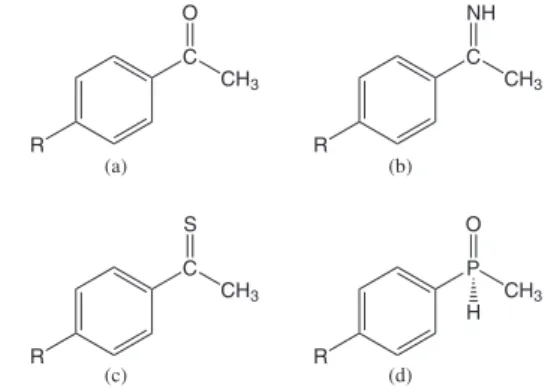
As model ligands we studied some constitutive blocks of organic compounds, with C=O (carbonyl), C=N (imino), C=S (thiocarbonyl) and P=O (phosphoryl) groups, as shown in Figure 1. To mimic electronic effects of natural biomolecules we choose a set of simple and common substituents, having different properties for resonance and inductive effects.28 The substituents H, Cl, OCH
3, CH3, CN,
NH2 and NO2 were selected. In previous works we showed
that aromatic compounds substituted in the para position
can modulate the strength of binding of phosphoryl and
carbonyl ligands to the calcium and magnesium cations.27
To rationalize the influence of the para-substituent on
the strength of the metal-ligand interaction the energy decomposition analysis (EDA), as proposed by Ziegler and
co-workers,29 was employed.
Computational Details
Geometry optimizations and energy calculations were
carried out with the Gaussian 03W software,30 using the
B3LYP31 functional and the MP2 frozen core32ab initio
method with the 6-311+G(d,p)33 basis set. After geometry
optimization the second order force constant matrix was calculated to confirm the optimized geometry as a genuine minimum on the potential energy surface. It has been shown that these combinations of methods and basis set are able to yield structures in reasonable agreement with those obtained at higher level of theory.34-37 To evaluate the ability
of a less time consuming method to reproduce the lithium
cation affinity, semi-empirical PM638 calculations were
also carried out with the MOPAC 2009 package.39 EDA
calculations29,40 were done using the B3LYP functional and
the DZP basis set of the ADF software.41
R
C O
CH3
R
C NH
CH3
R
C S
CH3
R
P O
CH3
H
(a) (b)
(c) (d)
Figure 1. Structures of the adducts used for interaction with the Li+ cation:
Results and Discussion
Geometry optimization
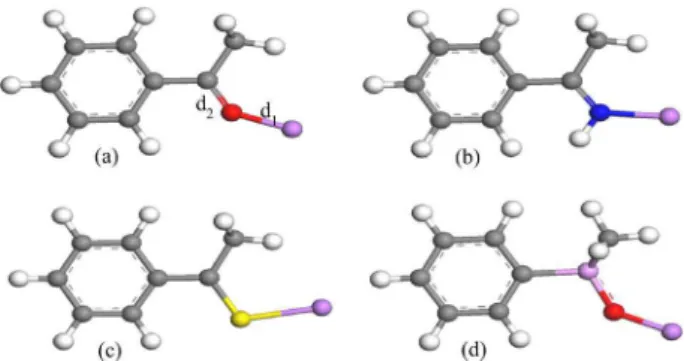
The geometries of the 28 substituted lithium complexes were fully optimized with the MP2 frozen core, DFT and semi-empirical methods, without any restriction. In Figure 2 we show the optimized geometries for the carbonyl, imino, thiocarbonyl and phosphoryl complexes with the hydrogen atom in the para position. The optimized geometries of these
complexes are similar, except for the point of interaction with the lithium cation. The optimized geometries for the several para-substituted derivatives are also similar, with
the exception of the d1 (bond length between the lithium
cation and the O, N or S atom of the ligand) and d2 (P=O,
C=O, C=N or C=S double bond of the complex) distances.
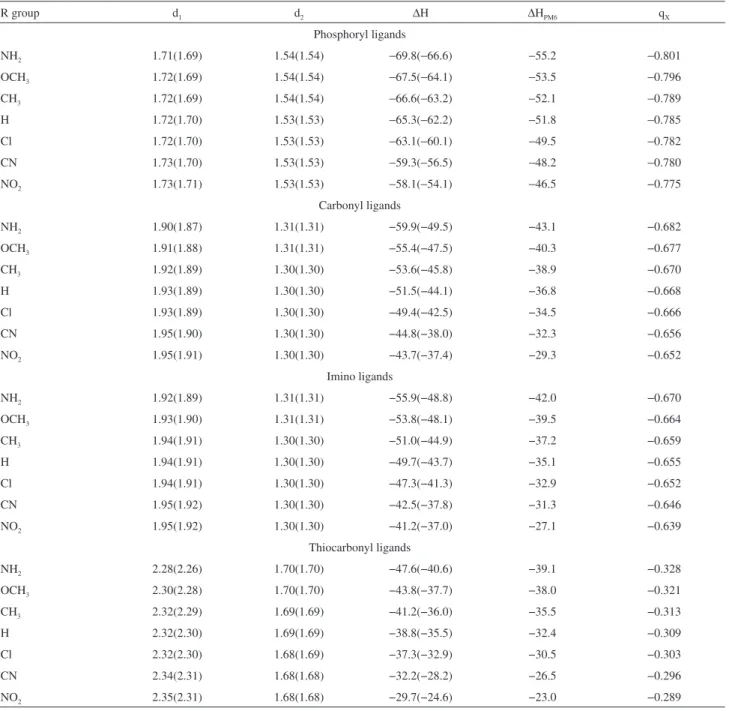
In Table 1 we list the MP2 and B3LYP d1 and d2
distances for each optimized structure. As the
lithium-ligand interaction is predominantly electrostatic,15 the
distance between the cation and the ligand (d1) must reflect
the strength of that interaction. The smallest d1 bond lengths
are found in the phosphoryl complexes, followed by the carbonyl, imino and thiocarbonyl complexes, in agreement with other theoretical studies.24,36,42 The d
1 bond lengths in
the phosphoryl compounds are about 0.19 Å smaller than in the carbonyl, 0.21 Å smaller than in the imino and 0.57 Å smaller than in the thiocarbonyl compounds. Following this order we can predict that the phosphoryl ligands lead to the stronger interaction with the lithium cation, whereas the thiocarbonyl ligands lead to the weaker interaction. When
seen within a given set of ligand, the d1 distance shows a
common trend, as previously reported.27 The d
1 distance in
complexes with electron donor groups in the para-position
is smaller than in complexes with electron withdrawing groups. This behavior shows that the resonance effect
inherent to the para-substituted group is also important to
determine the d1 distance. The resonance effect of electron
donor groups increase the negative charge on the atom (O, N or S) that interacts with the lithium cation, making the d1
distance smaller and the corresponding interaction stronger, whereas electron withdrawing substituents decreases the negative charge, weakening the interaction. The (MP2)
difference in the d1 distance between the amino (strongest
resonance donor effect) and the nitro (strongest resonance acceptor effect) derivatives is 0.02 Å for phosphoryl, 0.05 Å for carbonyl, 0.03 Å for imino and 0.07 Å for thiocarbonyl
compounds. The d1 bond lengths are longer with MP2
than with B3LYP, in agreement with Petrie’s work.43 The
d2 bond lengths depend mainly on the atomic radii of the
atoms that participate in the interaction and are not directly related to the strength of the interaction between the metal
and the ligand. The carbonyl and imino d2 bond lengths are
essentially the same, circa 0.23Å and 0.39Å smaller than the
d2 distance in the phosphoryl and thiocarbonyl compounds,
respectively. Analysis of the d2 bond lengths in a given class
of compound shows that the substituent has only marginal contribution to that distance, since they are almost constant in each set. In the complexation process the interaction
between the Li+ cation and the ligand is strengthened by
electron delocalization from the double bond of the ligand to the cation. Part of the electron density of the double bond is dislocated to the O, N or S atom and increases its negative charge, making the metal-ligand interaction stronger and
the d2 distance longer. The double bond (P=O, C=O, C=N
and C=S) lengths before complexation with the Li+ cation
are essentially constant for each set of ligands, being 1.30 Å for the carbonyl and imino, 1.50 Å for the phosphoryl and 1.64 Å for the tiocarbonyl ligands. After complexation they increase as a consequence of the electron delocalization. This effect is larger for the carbonyl (0.08Å), followed by the imino (0.05 Å), thiocarbonyl (0.05 Å) and phosphoryl
(0.04 Å) derivatives. The MP2 and B3LYP d2 bond lengths
are essentially the same.
Interaction enthalpy
The affinity of each ligand for the metal cation was
evaluatedin terms of the interaction enthalpy, obtained as
the heat of reaction of equation 1, corrected to 298K with the thermal contribution (using unscaled frequencies). The same approach has been used previously to determinate the interaction energy between metal cations and ligands.6-9,11,22-27
In Table 1 we list the interaction enthalpies for the phosphoryl, carbonyl, imino and thiocarbonyl complexes
using the ab initio, DFT and semi-empirical methods.
As a typical ionic bond,15 the strength of the Li+-ligand
Figure 2. Optimized structures of the Li+ complexes with the hydrogen
atom as the para-substituted group. The d1 (bond length between the
interaction is strictly correlated to the distance between
the interacting atoms (d1), where the smallest distances
lead to the strongest interaction enthalpy. The phosphoryl
compounds have the highest affinity for the Li+ cation,
with an (MP2) interaction enthalpy circa 12 kcal mol-1
more negative than for the carbonyl derivatives. The corresponding differences for the imino and thiocarbonyl compounds are 14 kcal mol-1 and 24 kcal mol-1, respectively.
This ligand affinity order was also found in previous studies with aminoacids8-10 and other biological adducts.6,7,24
Analysis of the interaction enthalpy in each set of ligands shows an interesting trend related to the nature
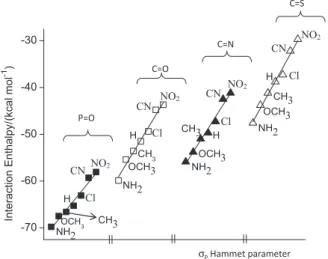
of the para-substituted group. Figure 3 shows the
correlation between the interaction enthalpy and the
values of the σp Hammet parameter of the substituents for
the para-substituted derivative in each set of phosphoryl,
carbonyl, imino and thiocarbonyl compounds. Ligands with electron releasing groups have more negative interaction enthalpies than the ones with electron withdrawing groups. This is due to the resonance structures inherent to each Table 1. Interatomic d1 and d2 distances (see Figure 2 for definition of the distances) in Å, MP2, B3LYP and PM6 interaction enthalpies (∆H) in kcal mol-1
and Merz Kollman charges on the atom (O, N or S) that interacts with the Li+ cation (q
X) in |e−| for the phosphoryl, carbonyl, imino and thiocarbonyl
derivatives. B3LYP values are given in parenthesis
R group d1 d2 ∆H ∆H
PM6 qX
Phosphoryl ligands
NH2 1.71(1.69) 1.54(1.54) −69.8(−66.6) −55.2 −0.801
OCH3 1.72(1.69) 1.54(1.54) −67.5(−64.1) −53.5 −0.796
CH3 1.72(1.69) 1.54(1.54) −66.6(−63.2) −52.1 −0.789
H 1.72(1.70) 1.53(1.53) −65.3(−62.2) −51.8 −0.785
Cl 1.72(1.70) 1.53(1.53) −63.1(−60.1) −49.5 −0.782
CN 1.73(1.70) 1.53(1.53) −59.3(−56.5) −48.2 −0.780
NO2 1.73(1.71) 1.53(1.53) −58.1(−54.1) −46.5 −0.775
Carbonyl ligands
NH2 1.90(1.87) 1.31(1.31) −59.9(−49.5) −43.1 −0.682
OCH3 1.91(1.88) 1.31(1.31) −55.4(−47.5) −40.3 −0.677
CH3 1.92(1.89) 1.30(1.30) −53.6(−45.8) −38.9 −0.670
H 1.93(1.89) 1.30(1.30) −51.5(−44.1) −36.8 −0.668
Cl 1.93(1.89) 1.30(1.30) −49.4(−42.5) −34.5 −0.666
CN 1.95(1.90) 1.30(1.30) −44.8(−38.0) −32.3 −0.656
NO2 1.95(1.91) 1.30(1.30) −43.7(−37.4) −29.3 −0.652
Imino ligands
NH2 1.92(1.89) 1.31(1.31) −55.9(−48.8) −42.0 −0.670
OCH3 1.93(1.90) 1.31(1.31) −53.8(−48.1) −39.5 −0.664
CH3 1.94(1.91) 1.30(1.30) −51.0(−44.9) −37.2 −0.659
H 1.94(1.91) 1.30(1.30) −49.7(−43.7) −35.1 −0.655
Cl 1.94(1.91) 1.30(1.30) −47.3(−41.3) −32.9 −0.652
CN 1.95(1.92) 1.30(1.30) −42.5(−37.8) −31.3 −0.646
NO2 1.95(1.92) 1.30(1.30) −41.2(−37.0) −27.1 −0.639
Thiocarbonyl ligands
NH2 2.28(2.26) 1.70(1.70) −47.6(−40.6) −39.1 −0.328
OCH3 2.30(2.28) 1.70(1.70) −43.8(−37.7) −38.0 −0.321
CH3 2.32(2.29) 1.69(1.69) −41.2(−36.0) −35.5 −0.313
H 2.32(2.30) 1.69(1.69) −38.8(−35.5) −32.4 −0.309
Cl 2.32(2.30) 1.68(1.69) −37.3(−32.9) −30.5 −0.303
CN 2.34(2.31) 1.68(1.68) −32.2(−28.2) −26.5 −0.296
group, which modulates the electronic charge on the atom that interacts with the metal cation. This behavior was previously seen for interactions of ligands with the lithium,22 chromium23 and calcium27 cations. In each set of
ligands the amino para-substituted group gives the most
negative interaction enthalpy, whereas the nitro group gives the less exothermic enthalpy. The difference of interaction enthalpies for compounds containing the amino and the nitro para-substituted groups is above 10 kcal mol-1 in all
the sets, showing that the resonance effect of the para
-substituted group indeed determines the intensity of the interaction. Table 2 gives the linear fitting parameters for the data shown in Figure 3. They confirm the interaction enthalpy order given above and, additionally, indicate that the substituents have the strongest effect on the thiocarbonyl derivatives while the weakest effect is observed for the phosphoryl case. The effect of the substituents on the interaction enthalpy of carbonyl and imino derivatives is essentially the same.
The qualitative effect of each para-substituted group
is well reproduced by the semi-empirical and DFT methods employed, although a quantitative analysis show that the MP2 interaction enthalpies are more negative than those obtained with either the B3LYP or the PM6
methods, in accordance with our previous studies.27 For
the phosphoryl complexes the MP2 enthalpies are about
3 and 14 kcal mol-1 more negative than the B3LYP and
PM6 values, respectively. For the carbonyl compounds
this difference is in the order of 10 and 16 kcal mol-1,
respectively. For the imino derivatives the corresponding
values are 6 and 13 kcal mol-1 and for the thiocarbonyl
derivatives they are 5 and 7 kcal mol-1, respectively.
The charge on the atom that interacts with the lithium cation is closely related to the strength of the interaction. Compounds with the most negative charge are also those that have the strongest interaction enthalpy. In Table 1 we list the MP2 Merz Kollman atomic charges on the atoms that interact with the Li+ cation for all the sets of ligands
(charges on the Li+ cation are given in Table S1 of the
Supplementary Information). The analysis of these charges shows that the charge on the oxygen atom of the phosphoryl
compounds are about 0.120 e− more negative than those on
the oxygen atom of the carbonyl derivatives, 0.132 e− more
negative than those on the nitrogen atom of the imino
derivatives and 0.479 e− more negative than those on the
sulfur atom of the thiocarbonyl derivatives. This order was also found in previous studies.6,7,22-24 The charge analysis in
each set of ligands shows that the para-substituted group
modulates the charges through its resonance effect. The
difference between the charge of the amino and nitro para
-substituted groups are 0.026e− for the phosphoryl, 0.030e−
for the carbonyl, 0.031e− for the imino and 0.039e− for the
thiocarbonyl derivatives. These results are in agreement with the interaction order found in this work.
Decomposition of the metal-ligand interaction
The nature of the interaction between the Li+ cation
and the ligands is predominantly electrostatic.15 The main
parameters that determine the strength of the interaction are the distance between the charged atoms and their charges, as shown before. However, some contribution of covalent interaction, due to charge polarization, may
also add to the electrostatic component.15 The covalent
component is derived from the overlap of atomic orbitals and the electron exchange between the two partners of the interaction. The electrostatic component includes, mainly, ion-dipole and ion-induced dipole interactions. The energy decomposition analysis (EDA) method was employed to evaluate the changes in each component according to each ligand and in each set of ligand. In this method the molecule is divided into fragments and a linear combination of the fragment’s orbitals is used to generate
the molecular orbitals of the complex.40 In the present
study the fragments are the Li+ cation and the ligand. The
EDA approach divides the interaction between fragments Table 2. Linear fitting analysis for the data shown in Figure 3
Complexes Intercept Slope R-Square
Phosphoryl −72.10 1.96 0.961
Carbonyl −85.54 2.64 0.976
Imino −104.09 2.51 0.975
Thiocarbonyl −128.11 2.88 0.983
Figure 3. MP2(FC)/6-311+G(d,p) interaction enthalpy, calculated
according to equation 1, for complexes of the Li+ cation with the
into three main terms: the Pauli repulsion, due to repulsion between electrons of the same spin; the orbital interaction, due to the overlap of the fragment’s orbitals (covalent component) and the electrostatic interaction, due to the attraction of the charge distribution of each fragment
(ionic component).40 The calculated Pauli repulsion term
is essentially constant and small for all compounds in the set and does not show significant variations for the different ligands. Figures 4 and 5 show the dependence of the covalent and electrostatic components of the metal-ligand interaction as a function of the class of metal-ligand
and the para-substituted group in each ligand (For the
numerical values of each component see Tables S2-S5 in the Supplementary Information). The covalent component of the Li+-ligand interaction is essentially constant for each
set of ligand, with a variation of no more than 2.3 kcal mol-1
in each set. The effect of the para-substituted group on the
covalent component is practically negligible in each set of ligand, showing that the substituent does not modify this component. In contrast, the ionic component undergoes significant decrease as the R group becomes stronger electron attractor. This behavior is in agreement with
our previous calculations for the interaction of the Mg2+
cation with phosphoryl ligands.27 The ionic component
for the phosphoryl compounds are 12.1 kcal mol-1
more negative than for the carbonyl, 15.9 kcal mol-1
more negative than for the imino and 27.3 kcal mol-1
more negative than for the thiocarbonyl compounds. This
difference was expected based on the d1 distance and the
charges on the interacting atom of the ligand (O, N, S) in the
complex. The phosphoryl compounds have the smallest d1
distance and the most negative charge on the atom interacting with the metal, followed by the analogous carbonyl, imino and thiocarbonyl complexes. The analysis of the electrostatic component in each set of ligand reinforces the modulation
of the interaction by the para-substituted group. The
differences in the ionic component between the compounds
with the amino and nitro groups are −13.82 kcal mol-1
for the phosphoryl, −15.16 kcal mol-1 for the carbonyl,
−16.48 kcal mol-1 for the imino and −21.79 kcal mol-1 for
the thiocarbonyl derivatives. Therefore, there is a decrease in the contribution of the ionic component as we go through the sequence phosphoryl, carbonyl, imino and thiocarbonyl. For the thiocarbonyl complexes the ionic component becomes smaller than the covalent component for compounds with strong electron acceptor groups.
Conclusions
The ability of 28 phosphoryl, carbonyl, imino and thiocarbonyl ligands to complex the Li+ cation was analyzed
in terms of the distance between the cation and the ligand (d1), charges on the O, N or S atom that interacts with the
cation and the interaction enthalpy. Electron-donating substituents strength the ligand-cation interaction by shortening the d1 distance, increasing the O, N or S atomic
charges and increasing the negative value of the interaction enthalpy, while electron withdrawing substituents have
the opposite effect. The Hammett σp parameter is strongly
correlated with the interaction enthalpy, in agreement with the behavior cited above. Decomposition of the interaction energy showed that the differences in the ability of the ligands to complex the cation are mainly due to the para-substituted modulation of the electrostatic
component of the interaction. Electron-donor substituents lead to higher charges on the interacting atom what results in stronger electrostatic interaction and, as a consequence, higher interaction enthalpy. The covalent component of the Li+ cation-ligand interaction is almost constant for all
ligands in the set. The Pauli repulsion component is also constant and small. The MP2, B3LYP and PM6 methods give qualitatively the same trends for the variation of
the interaction enthalpy, according to the Hammett σp
parameter. Quantitatively, the interaction enthalpies calculated with the MP2 method are more negative than those obtained with either the B3LYP or the PM6 methods. Figure 4. Covalent component of the metal-ligand interaction.
Supplementary Information
Supplementary data are available free of charge at http://jbcs.sbq.org.br as PDF file.
Acknowledgments
J. W. de M. Carneiro has a research grant from Conselho Nacional de Desenvolvimento Científico e Tecnológico (CNPq). L. M. da Costa has a graduate fellowship from CAPES (Coordenadoria de Aperfeiçoamento de Pessoal de Nível Superior). Financial support from FAPERJ (Fundação Carlos Chagas Filho de Amparo a Pesquisa do Estado do Rio de Janeiro) is also kindly acknowledged.
References
1. Poonia, N. S.; Bajaj, A. V.; Chem. Rev.1979, 79, 389.
2. Daniele, P. G.; Foti, C.; Gianguzza, A.; Prenesti, E.; Sammartano, S.; Coord. Chem. Rev.2008, 252, 1093.
3. Kaim, W.; Schwederski, B.; Bioinorganic Chemistry: Inorganic Elements in Chemistry of Life, 1st ed.; Wiley: Chichester,
1994.
4. Cowan, J. A.; Inorganic Biochemistry: An Introduction, 2nd ed.;
Wiley: New York, 1997.
5. Birch, N. J.; Chem. Rev.1999, 99, 2659.
6. Allen, R. N.; Shukla, M. K.; Leszczynski, J.; Int. J. Quantum Chem.2006, 106, 2366.
7. Allen, R. N.; Shukla, M. K.; Burda, J. V.; Leszczynski, J.;
J. Phys. Chem. A2006, 110, 6139.
8. Benzakour, M.; Cartier, A.; Mcharfi, M.; Daoudi, A.; Theochem
2004, 681, 99.
9. Marino, T.; Russo, N.; Toscano, M.; J. Phys. Chem. B2003,
107, 2588.
10. Majerus, P. W.; Annu. Rev. Biochem.1992, 61, 225.
11. Marino, T.; Russo, N.; Toscano, M.; Inorg. Chem.2001, 40,
6439.
12. Henderson, K. W.; Walther, D. S.; Williard, P. G.; J. Am. Chem. Soc.1995, 117, 8680.
13. Liao, S.; Collum, D. B.; J. Am. Chem. Soc.2003, 125, 15114.
14. Senior, P. A.; Thomas, T. H.; Marshall, S. M.; Clin. Sci.2000,
98, 673.
15. Huheey, J. E.; Keiter, E. A.; Keiter, R. L.; Inorganic Chemistry: Principles of Structure and Reactivity, 4th ed.; Harper Collins
College Publisher: New York, 1993.
16. Pearson, R. G.; J. Am. Chem. Soc.1963, 85, 3533; Pearson, R. G.; Science1966, 151, 172; Pearson, R. G.; Songstad, J.; J. Am. Chem. Soc. 1967, 89, 1827.
17. Rosamilia, A. E.; Arico, F.; Tundo, P.; J. Phys. Chem. B2008,
112, 14525.
18. Reed, J. L.; Inorg. Chem.2009, 48, 7151.
19. Burk, P.; Koppel, I. A.; Koppel, I.; Kurg, R.; Gal, J.; Maria, P.; Herreros, M.; Notario, R.; Abbound, J. M.; Anvia, F.; Taft, R. W.;
J. Phys. Chem. A2000, 104, 2824.
20. Taft, R. W.; Anvia, F.; Gal, J.; Walsh, S.; Capon, M.; Holmes, M. C.; Hosn, K.; Oloumi, G.; Vasanwala, R.; Yazdani, S.; Pure Appl. Chem. 1990, 62, 17.
21. Buncel, E.; Decouzon, M.; Formento, A.; Gal, J. -F.; Herreros, M.; Li, L.; Maria, P. -C.; Koppel, I. A.; Kurg, R.; J. Am. Soc. Mass Spectrom. 1997, 8, 262; Borrajo, A. M. P.; Gal, J. -F.; Maria, P. -C.; Decouzon, M.; Ripley, D. C.; Buncel, E.; Thatcher, G. R. J.; J. Org. Chem. 1997, 62, 9203; Buncel, E.; Chen, A.; Decouzon, M.; Fancy, S. A.; Gal, J. -F.; Herreros, M.; Maria, P. -C.; J. Mass Spectrom. 1998, 33, 757.
22. Senapati, U.; De, D.; De, B. R.; Theochem2007, 808, 157.
23. Palusiak, M.; J. Organomet. Chem. 2007, 692, 3866. 24. Ma, N. L.; Chem. Phys. Lett.1998, 297, 230.
25. Gal, J. -F.; Maria, P. -C.; Decouzon, M.; Mo, O.; Yanez, M.;
Int. J. Mass Spectrom.2002, 219, 445.
26. Cao, D. -L.; Ren, F. -D.; Feng, Y. -Q.; Liu, S. -N.; Chen, S. -S.;
J. Mol. Model.2010, 16, 589.
27. Costa, L. M.; Carneiro, J. W. M.; Paes, L. W. C.; Romeiro, G. A.;
Theochem2009, 911, 46; Costa, L. M.; Carneiro, J. W. M.;
Paes, L. W. C.; Romeiro, G. A.; J. Mol. Model. 2011, 17, 243; Costa, L. M.; Carneiro, J. W. M.; Paes, L. W. C.; Romeiro, G. A.;
J. Mol. Model. 2011, 17, 2061.
28. Krygowski, T. M.; Stepién, B. T.; Chem. Rev.2005, 195, 3482.
29. Velde, G. T.; Bickelhaupt, F. M.; Baerends, E. J.; Guerra, C. F.; van Gisbergen, S. J. A.; Snijders, J. G.; Ziegler, T.; J. Comput. Chem.2001, 22, 931.
30. Frisch, M. J.; Trucks, G. W.; Schlegel, H. B.; Scuseria, G. E.; Robb, M. A.; Cheeseman, J. R.; Montgomery, J. A.; Vreven, T.; Kudin, K. N.; Burant, J. C.; Millam, J. M.; Iyengar, S. S.; Tomasi, J.; Barone, V.; Mennucci, B.; Cossi, M.; Scalmani, G.; Rega, N.; Petersson, G. A.; Nakatsuji, H.; Hada, M.; Ehara, M.; Toyota, K.; Fukuda, R.; Hasegawa, J.; Ishida, M.; Nakajima, T.; Honda, Y.; Kitao, O.; Nakai, H.; Klene, M.; Li, X.; Knox, J. E.; Hratchian, H. P.; Cross, J. B.; Bakken, V.; Adamo, C.; Jaramillo, J.; Gomperts, R.; Stratmann, R. E.; Yazyev, O.; Austin, A. J.; Cammi, R.; Pomelli, C.; Ochterski, J. W.; Ayala, P. Y.; Morokuma, K.; Voth, G. A.; Salvador, P.; Dannenberg, J. J.; Zakrzewski, V. G.; Dapprich, S.; Daniels, A. D.; Strain, M. C.; Farkas, O.; Malick, D. K.; Rabuck, A. D.; Raghavachari, K.; Foresman, J. B.; Ortiz, J. V.; Cui, Q.; Baboul, A. G.; Clifford, S.; Cioslowski, J.; Stefanov, B. B.; Liu, G.; Liashenko, A.; Piskorz, P.; Komaromi, I.; Martin, R. L.; Fox, D. J.; Keith, T.; Al-Laham, M. A.; Peng, C. Y.; Nanayakkara, A.; Challacombe, M.; Gill, P. M. W.; Johnson, B.; Chen, W.; Wong, M. W.; Gonzalez, C.; Pople, J. A.; Gaussian 03, Revision C.02, Gaussian, Inc.,
Wallingford CT, 2004.
31. Becke, A. D.; J. Chem. Phys.1992, 96, 2155.
Lett.1988, 153, 503; Frisch, M. J.; Head-Gordon, M.; Pople, J. A.; Chem. Phys. Lett.1990, 166, 275; Frisch, M. J.;
Head-Gordon, M.; Pople, J. A.; Chem. Phys. Lett.1990, 166, 281; Head-Gordon, M.; Head-Gordon, T.; Chem. Phys. Lett.1994,
220, 122; Saebo, S.; Almlof, J.; Chem. Phys. Lett.1989, 154, 83.
33. Rassolov, V. A.; Ratner, M. A.; Pople, J. A.; Redfern, P. C.; Curtis, L. A.; J. Comput. Chem.2001, 22, 976.
34. Corral, I.; Mo, O.; Yanez, M.; Scott, A.; Radom, L.; J. Phys. Chem. A2003, 107, 10456.
35. Trujillo, C.; Lamshabi, A. M.; Mó, O.; Yánez, M.; Salpin, J.;
Org. Biomol. Chem.2008, 6, 3695.
36. Peschke, M.; Blades, A. T.; Kebarle, P.; J. Am. Chem. Soc.2000,
122, 10440.
37. Bene, J. E. D.; J. Phys. Chem.1996, 100, 6284. 38. Stewart, J. J. P.; J. Mol. Model.2007, 13, 1173.
39. Stewart, J. J. P.; MOPAC 2009, version 11.038 W, Stewart Computational Chemistry: Colorado Springs, CO, USA, 2009. 40. Guerra, C. F.; Snijders, J. G.; te Velde, G.; Baerends, E. J.;
Theor. Chem. Acc.1998, 99, 391.
41. Baerends, E. J.; Autschbach, J.; Bérces, A.; Boerrigter, C. B. P. M.; Cavallo, L.; Chong, D. P.; Deng, L.; Dickson, R. M.; Ellis, D. E.; van Faassen, M.; Fan, L.; Fischer, T. H.; Guerra, C. F.; van Gisbergen, S. J. A.; Groeneveld, J. A.; Gritsenko, O. V.; Gruning, M.; Harris, F. E.; van den Hoek, P.; Jacobsen, H.; Jensen, L.; van Kessel, G.; Kootstra, F.; van Lenthe, E.; McCormack, D. A.; Michalak, A.; Osinga, V. P.; Patchkovskii, S.; Philipsen, P. H. T.; Post, D.; Pye, C. C.; Ravenek, W.; Ros, P.; Schipper, P. R. T.; Schreckenbach, G.; Snijders, J. G.; Sola, M.; Swart, M.; Swerhone, D.; te Velde, G.; Vernooijs, P.; Versluis, L.; Visser, O.; Wang, F.; van Wezenbeek, E.; Wiesenekker, G.; Wolff, S. K.; Woo, T. K.; Yakovlev, A. L.; Ziegler, T.; ADF 2010.02,
Amsterdam, 2010.
42. Trujillo, C.; Lamsabhi, A. M.; Mo, O.; Yanez, M.; Phys. Chem. Chem. Phys.2008, 10, 3229.
43. Petrie, S.; J. Phys. Chem. A2002, 106, 7034.