Revista Brasileira de Ciências Farmacêuticas Brazilian Journal of Pharmaceutical Sciences vol. 38, n. 2, abr./jun., 2002
New triterpene and triterpenoid glycosides from
Ilex brevicuspis
Alexandre T. Cardoso Taketa
1, Manfred Gondorf
1, Eberhard Breitmaier
1, Eloir Paulo Schenkel
2*
1Kekulé-Institut für Organische Chemie und Biochemie der Universität Bonn – Germany, 2Departamento de Ciências
Farmacêuticas,Centro de Ciências da Saúde,Universidade Federal de Santa Catarina
From the leaves of Ilex brevicuspis were isolated a new triterpene, 20(S)-3β,19α-dihydroxyurs-12-en-23,28-dioic acid, named here brevicuspic acid, and two new triterpenoid glycosides, 3-O-α -L-arabinopyranosyl-20(S)-pomolic acid-28-O-β-D-glucopyranosyl ester, named brevicuspisaponin 3, and the 23-sodium salt of (20S)-3β,19α,24-trihydroxyurs-12-en-23,28-dioic acid-28β-O-β -D-glucopyranosyl ester, along with the known compound 3-O-α -L-arabinopyranosyl-20(S)-19α,24-dihydroxyursolic acid- 28-O-β -D-glucopyranosyl ester, already described for Ilex argentina. Their structures were established on the basis of chemical and spectroscopic methods.
*Correspondence:
E.P. Schenkel
Departamento de Ciências Farmacêuticas - Centro de Ciências da Saúde
Universidade Federal de Santa Catarina -Campus Universitário / Trindade
88.040-900 – Florianópolis-SC, Brasil E-mail: [email protected]
Uniterms: • Aquifoliaceae • Ilex brevicuspis • Triterpenes • Saponins • Brevicuspic acid
• Brevicuspisaponins 3 and 4
INTRODUCTION
As previously reported, the leaves of Ilex brevicuspis Reissek (Aquifoliaceae) afforded the triterpenes ursolic acid, 23-methylester of 20(S )-rotundioic acid, and the new glycosides brevicuspisaponin 1 and 2(Taketa et al., 2000). Continuing the investigation on the leaves of I. brevicuspis, as a part of our studies on the adulterants of the genuine maté, Ilex paraguariensis
(Taketa, Schenkel.,1994; Schenkel et al.,1995; Heinzmann, Schenkel,1995; Pires et al., 1997; Schenkel
et al.,1997; Athayde et al.,1999; Reginatto et al.,1999; Athayde et al., 2001), we report here further new triterpene and saponins from the title plant.
MATERIAL AND METHODS
Plant material
Leaves of Ilex brevicuspis Reissek were collected in Osório, State of Rio Grande do Sul, Brazil. A herbarium specimen (leg. Coelho 163) is on deposit in the Herbarium of the Botany Department of the Federal University of Rio
Grande do Sul (Herbarium ICN, Porto Alegre, Brazil).
General experimental procedures
Melting points were obtained in a Kofler melting point apparatus and are uncorrected. IR spectra were recorded in a Perkin-Elmer 881 spectrophotometer. Optical rotations were measured in a Perkin-Elmer 241 polarimeter. EIMS and HRMS spectra were performed in a MS50 spectrometer and FAB-MS spectra on a Concept 1H spectrometer. 1H and 13C NMR spectra were recorded
Extraction and isolation
Air-dried leaves (589 g) were crushed and extracted with ethanol (1.5 L) at room temperature (2 x 7 days). The ethanolic extract (2 L) was evaporated to dryness under reduced pressure and the residue (69 g) was then suspended in water (700 mL) and extracted with chloroform (5 x 500 mL). Between the water and chloroform phases an emulsified phase was formed. The emulsified phase was evaporated to dryness to give the fraction containing the saponins (19 g). Part of this residue was repeatedly chromatographed to give compounds 1 (17 mg), 2 (13 mg) and pure compounds 3 (26 mg) and 4 (17 mg).
Acid hydrolysis
Compounds 2,3 and 4 were hydrolyzed on TLC plates in order to identify their sugars, as described by Kartnig and Wegschaider (1972).
Acetylation of compounds 1, 2 and 4
Compounds 1 (3 mg), 2 (3 mg) and 4 (6 mg) were acetylated with acetic anhydride/pyridine (1:1) at room temperature overnight, affording peracetylated compounds 1a, 2a and 4a.
Acetylated derivative (1a):
Acetylated brevicuspic acid [20(S)-3β,19α -dihydroxyurs-12-en-23,28-dioic acid] (1)
White powder, mp 232-235 °C. [α]20
589 +33°, [α] 20
578
+80°, [α]20
546 +94° and [α] 20
436 +182° (MeOH, c 0.17). IR νKBr
max cm
-1: 3425, 2932, 1741, 1698, 1456, 1372, 1237,
1030. FAB-MS (positive-ion mode, mNBA) m/z: 567.3 [M + Na]+, 467.2, 421.3, 338.3. EIMS m/z: 544.4 [M]+,
426.4, 498.4, 482.4, 438.3, 426.4, 407.3. HRMS: 526.3291 [M-H2O]+. 1H NMR (Table I) and 13C NMR
(Table II).
Brevicuspisaponin 3(2):
[3-O-α-L-arabinopyranosyl-20(S)-pomolic acid-28-O-β -D-glucopyranosyl ester]
FAB-MS (positive-ion mode, mNBA) m/z: 789.4 [M+Na]+, 703.4, 687.4, 613.1, 599.1, 531.2.
Peracetylated derivative (2a):
White powder, mp 153-155 °C . [α]20
589 +17°,
[α]20
578 +21°, [α] 20
546 +23°, [α] 20
436 +39° and [α] 20
365 +61°
(CHCl3, c 0.21). IR νKBr max cm
-1: 3481, 2946, 1752, 1370,
1224, 1056. FAB-MS (positive-ion mode, mNBA) m/z: 1083.4 [M + Na]+, 904.4, 850.4, 783.3, 683.4, 667.2,
613.3. 1H NMR (Table I) and 13C NMR (Table II).
ILA-1(3):
[ 3β-O-α- L - a r a b i n o p y r a n o s y l - 2 0 (S) - 1 9α, 2 4 -dihydroxyursolic acid-28-O-β-D-glucopyranosyl ester]
White powder, mp 200-204 °C [α]20
589 +12°, [α] 20
578
+13°, [α]20
546 +14°, [α] 20
436 +24° and [α] 20
365 +37° (MeOH,
c 0.25). IR nKBr max cm
-1: 3437, 2932, 1734, 1637, 1382,
1074. FAB-MS (positive mode, mNBA) m/z: 805.3 [M+Na]+, 642, 482, 411. 1H NMR (Table I) and 13C NMR
New triterpene and triterpenoid glycosides from Ilex brevicuspis 157
Brevicuspisaponin 4 (4):
[23-sodium salt of (20S)-3β,19α ,24-trihydroxyurs-12-en-23,28-dioic acid-28β-O-β-D-glucopyranosyl ester]
FABMS (positive-ion mode, thioglycerol) m/z:
725.3 [M+Na]+, 703.3 [M+H]+ , 539.2 [M-C
6H11O5]. IR νKBr
max cm
-1 : 3422, 2930, 1735, 1573, 1457, 1383, 1232,
1073.
Peracetylated derivative (4a):
White powder, mp 153-155 °C. FAB-MS (positive-ion mode, mNBA) m/z: 955.4 [M + H]+1H NMR (Table I)
and 13C NMR (Table II).
RESULTS AND DISCUSSION
Triterpene 1 and saponins 2, 3 and 4 were isolated from the emulsified phase obtained from the leaves of the title plant, using the procedure described in the experimen-tal section. Due to difficulty in purifications, compounds
1, 2 and 4 were acetylated in order to afford pure compounds 1a, 2a and 4a.
EIMS spectrum of 1a display a molecular peak at m/ z 544 [M+] as molecular ion, which together with the
HRMS from the fragment ion with m/z 526.3291 [M+
-H2O] suggested the molecular formula C32H48O7. The triterpenoid structure was confirmed by the 1H
broadband-decoupled 13C NMR experiment which exhibited the
presence of one acetyl group (δC 170.2 and 21.1) and thirty other carbon atoms. The DEPT subspectra revealed the presence of six methyl, nine methylene, six methane groups. It was possible to recognize the existence of two carboxy groups (δC 180.7 and 179.2), one double bond (δC 126.8 and 139.5), one acetylated sec alcohol group (δC 78.5) and one tert alcohol group (δC 73.3). The 1H NMR
spectrum showed the presence of five angular methyl groups (δH 0.94, 1.05, 1.42, 1.52 and 1.68) and one methyl group attached to CH (δH 1.10, d, 3J= 7.0 Hz), suggesting
an ursane or oleanane derivative. The multiplicities at δH 5.76 (3α-H, dd, 3J= 12.0 and 3.4 Hz) indicated a 3β
-hydroxy substitution on this skeleton. HMBC experiment allowed to locate 24-CH3 (δC 12.8) and 23-COOH (δC 179.2) at C-4. NOE enhancements were detected for 25β -CH3 (δH 0.94, s) and 24-CH3 (δH 1.52, s) in a ROESY experiment, indicating the 4a-configuration of the carboxy group.
In the 1H NMR spectrum, the deshielded methylene
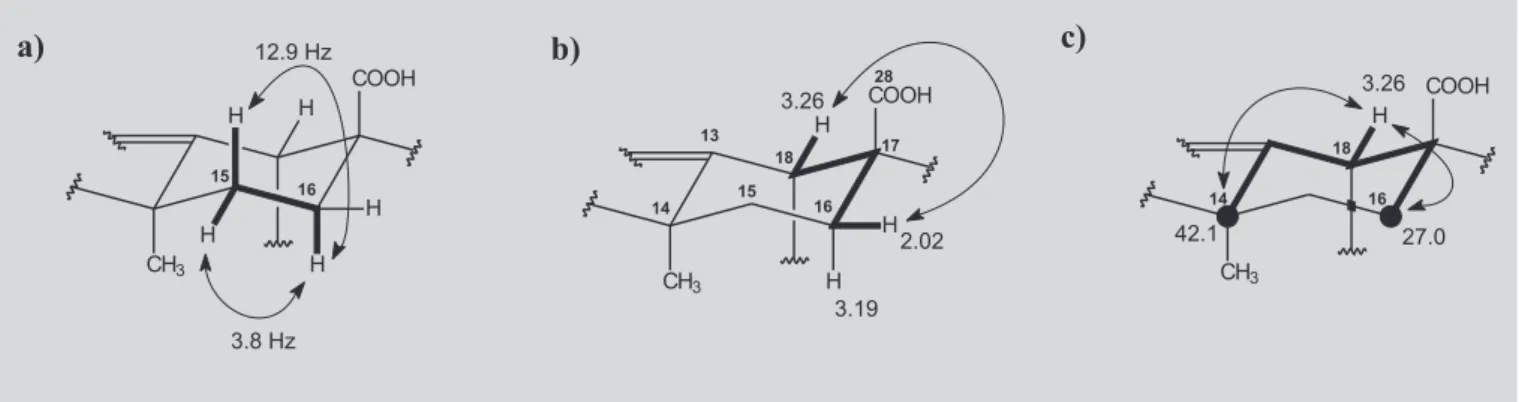
hydrogen proton at δH 3.19 showed characteristic multiplicities (td, J= 12.9 and 3.8 Hz) that established an axial relative stereochemistry for 16α-H. It was confirmed through the W-type correlation observed between proton signals at δH 2.02 (equatorial 16β-H) and δH 3.26
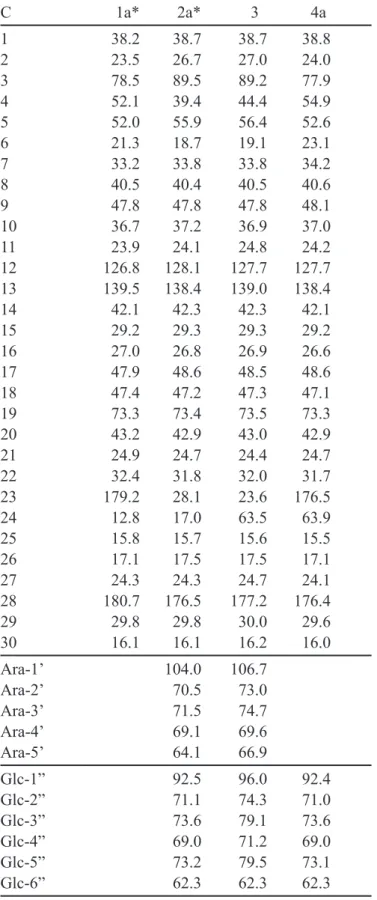
(equato-TABLE I - 13C-NMR data for the acetylated derivatives 1a,
2a and 4a, and compound 3 (pyridine-d5)
C 1a* 2a* 3 4a
1 38.2 38.7 38.7 38.8 2 23.5 26.7 27.0 24.0 3 78.5 89.5 89.2 77.9 4 52.1 39.4 44.4 54.9 5 52.0 55.9 56.4 52.6 6 21.3 18.7 19.1 23.1 7 33.2 33.8 33.8 34.2 8 40.5 40.4 40.5 40.6 9 47.8 47.8 47.8 48.1 10 36.7 37.2 36.9 37.0 11 23.9 24.1 24.8 24.2 12 126.8 128.1 127.7 127.7 13 139.5 138.4 139.0 138.4 14 42.1 42.3 42.3 42.1 15 29.2 29.3 29.3 29.2 16 27.0 26.8 26.9 26.6 17 47.9 48.6 48.5 48.6 18 47.4 47.2 47.3 47.1 19 73.3 73.4 73.5 73.3 20 43.2 42.9 43.0 42.9 21 24.9 24.7 24.4 24.7 22 32.4 31.8 32.0 31.7 23 179.2 28.1 23.6 176.5 24 12.8 17.0 63.5 63.9 25 15.8 15.7 15.6 15.5 26 17.1 17.5 17.5 17.1 27 24.3 24.3 24.7 24.1 28 180.7 176.5 177.2 176.4 29 29.8 29.8 30.0 29.6 30 16.1 16.1 16.2 16.0 Ara-1’ 104.0 106.7
Ara-2’ 70.5 73.0
Ara-3’ 71.5 74.7
Ara-4’ 69.1 69.6
Ara-5’ 64.1 66.9
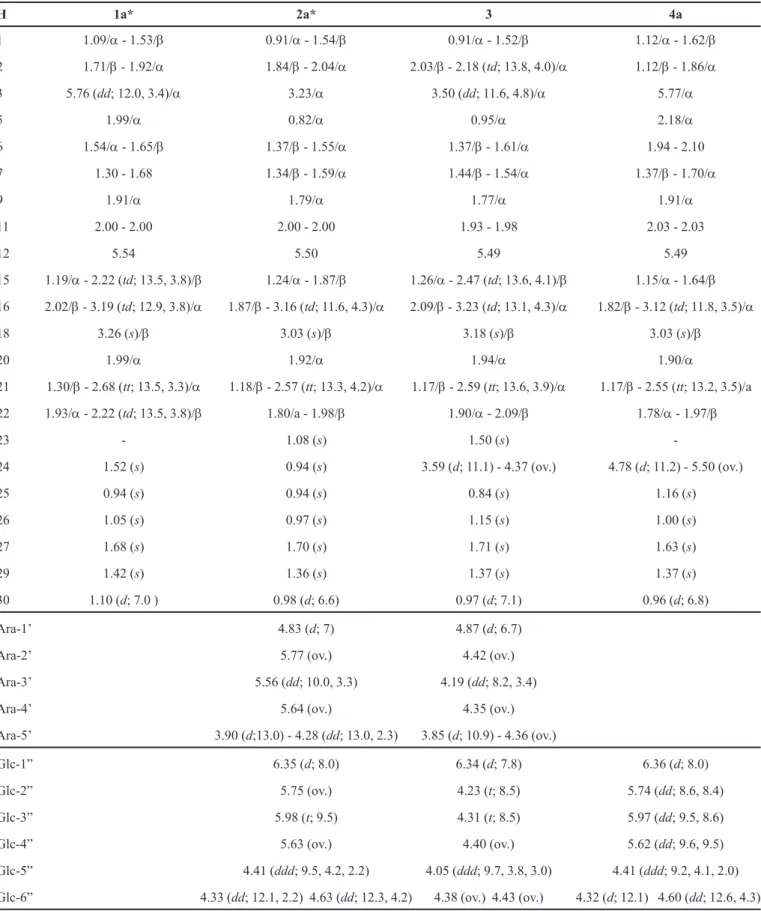
TABLE II - 1H-NMR data for the acetylated derivatives 1a, 2a and 4a, and compound 3 (pyridine-d
5) (multiplicities;
J= Hz)
H 1a* 2a* 3 4a
1 1.09/α - 1.53/β 0.91/α - 1.54/β 0.91/α - 1.52/β 1.12/α - 1.62/β
2 1.71/β - 1.92/α 1.84/β - 2.04/α 2.03/β - 2.18 (td; 13.8, 4.0)/α 1.12/β - 1.86/α
3 5.76 (dd; 12.0, 3.4)/α 3.23/α 3.50 (dd; 11.6, 4.8)/α 5.77/α
5 1.99/α 0.82/α 0.95/α 2.18/α
6 1.54/α - 1.65/β 1.37/β - 1.55/α 1.37/β - 1.61/α 1.94 - 2.10
7 1.30 - 1.68 1.34/β - 1.59/α 1.44/β - 1.54/α 1.37/β - 1.70/α
9 1.91/α 1.79/α 1.77/α 1.91/α
11 2.00 - 2.00 2.00 - 2.00 1.93 - 1.98 2.03 - 2.03
12 5.54 5.50 5.49 5.49
15 1.19/α - 2.22 (td; 13.5, 3.8)/β 1.24/α - 1.87/β 1.26/α - 2.47 (td; 13.6, 4.1)/β 1.15/α - 1.64/β
16 2.02/β - 3.19 (td; 12.9, 3.8)/α 1.87/β - 3.16 (td; 11.6, 4.3)/α 2.09/β - 3.23 (td; 13.1, 4.3)/α 1.82/β - 3.12 (td; 11.8, 3.5)/α
18 3.26 (s)/β 3.03 (s)/β 3.18 (s)/β 3.03 (s)/β
20 1.99/α 1.92/α 1.94/α 1.90/α
21 1.30/β - 2.68 (tt; 13.5, 3.3)/α 1.18/β - 2.57 (tt; 13.3, 4.2)/α 1.17/β - 2.59 (tt; 13.6, 3.9)/α 1.17/β - 2.55 (tt; 13.2, 3.5)/a
22 1.93/α - 2.22 (td; 13.5, 3.8)/β 1.80/a - 1.98/β 1.90/α - 2.09/β 1.78/α - 1.97/β
23 - 1.08 (s) 1.50 (s)
-24 1.52 (s) 0.94 (s) 3.59 (d; 11.1) - 4.37 (ov.) 4.78 (d; 11.2) - 5.50 (ov.)
25 0.94 (s) 0.94 (s) 0.84 (s) 1.16 (s)
26 1.05 (s) 0.97 (s) 1.15 (s) 1.00 (s)
27 1.68 (s) 1.70 (s) 1.71 (s) 1.63 (s)
29 1.42 (s) 1.36 (s) 1.37 (s) 1.37 (s)
30 1.10 (d; 7.0 ) 0.98 (d; 6.6) 0.97 (d; 7.1) 0.96 (d; 6.8)
Ara-1’ 4.83 (d; 7) 4.87 (d; 6.7)
Ara-2’ 5.77 (ov.) 4.42 (ov.)
Ara-3’ 5.56 (dd; 10.0, 3.3) 4.19 (dd; 8.2, 3.4)
Ara-4’ 5.64 (ov.) 4.35 (ov.)
Ara-5’ 3.90 (d;13.0) - 4.28 (dd; 13.0, 2.3) 3.85 (d; 10.9) - 4.36 (ov.)
Glc-1” 6.35 (d; 8.0) 6.34 (d; 7.8) 6.36 (d; 8.0)
Glc-2” 5.75 (ov.) 4.23 (t; 8.5) 5.74 (dd; 8.6, 8.4)
Glc-3” 5.98 (t; 9.5) 4.31 (t; 8.5) 5.97 (dd; 9.5, 8.6)
Glc-4” 5.63 (ov.) 4.40 (ov.) 5.62 (dd; 9.6, 9.5)
Glc-5” 4.41 (ddd; 9.5, 4.2, 2.2) 4.05 (ddd; 9.7, 3.8, 3.0) 4.41 (ddd; 9.2, 4.1, 2.0)
Glc-6” 4.33 (dd; 12.1, 2.2) 4.63 (dd; 12.3, 4.2) 4.38 (ov.) 4.43 (ov.) 4.32 (d; 12.1) 4.60 (dd; 12.6, 4.3)
New triterpene and triterpenoid glycosides from Ilex brevicuspis 159
rial 18β-H) in the HH COSY experiment. Further, evidence for an equatorial 18β-H was provided by heteronuclear long-range correlation via three bonds couplings, 3J(13C, 1H),
detected by the HMBC experiment. This proton displayed cross-signals with carbons C-14 (δC 42.1) and C-16 (δC 27.0), revealing a dihedral angle close to 180°, providing evidence for the cis-fusion between the rings D/E.
A triplet of triplets (3J=13.3 and 3.3 Hz) observed
for 21α-H (δH 2.68, axial) revealed the β-configuration of the C-30 methyl group (δH 16.1), corresponding to an ursane derivative with the 20(S)-configuration that could be confirmed by means of the ROESY experiment, indicating spatial correlation between the 18β-H (δH 3.26) and hydrogens 29β-CH3 (δH 1.42) and 30β-CH3 (δH 1.10). Compared with ursolic acid (Tkachev et al., 1994), compound 1a presented two important γ-effects in the ring E. The first one was caused by the axial 30β-CH3,
shielding the carbons C-18 and C-22 by 5 and 4 ppm, respectively, in the 13C NMR. The second effect was
observed due to the presence of the axial 19α-hydroxy group, that shielded C-21 by about 6 ppm. Thus, 1a differs from the structure of rotundioic acid (Nakatni et al., 1989) by a different configuration of C-20 and turns out to be the peracetylated derivative of 20(S)-3β,19α -dihydroxyurs-12-en-23,28-dioic acid, named brevicuspic acid.
Fast atom bombardment mass spectroscopy (FAB-MS, positive mode) of 2a generated a fragment at m/z
1083 [M+Na]+ as a pseudo molecular ion, in accordance
with seven acetylated OH groups and with the spectrum obtained for the non-peracetylated compound 2, showing a pseudo molecular ion at m/z = 789 [M+Na]+. 13C NMR
of 2a data revealed the occurrence of signals from one carboxy carbon (δC 176.5), seven acetate groups (δC 169 - 170 and δC 20.7 - 21.1), one double bond (δC 128.1 and
FIGURE 1 - Ring D from 1a: additional evidence for the relative configuration by the 1H NMR coupling constants (a),
W-type correlation deduced from the HH COSY diagram (b) and long-range correlation 3J(13C,1H) in the HMBC
experiments (c).
138.4), two anomeric carbons (δC 104.0 and 92.5), one glycosylated sec alcohol (δC 89.5) and one tert alcohol (δC 73.4). 1H NMR confirmed the presence of six angular
methyl groups (δH 2x 0.94, 0.97, 1.08, 1.36 and 1.70), one methyl group attached to CH (δH 0.98, d, 3J= 6.6 Hz), one
olefinic proton (δH 5.50) and two anomeric sugar protons (δH 4.83, d, 3J= 8.0 Hz and δ
H 6.35, d,
3J= 8.0 Hz). Both
sugars presented antiperiplanar configuration of 1’-H and 2’-H (3J= 8.0 Hz), reflecting the α-configuration of the
L-arabinopyranose and the β-configuration of the D-glucopyranose. The glycosidic linkages were established using the HMBC techniques. It was possible to observe correlation between the anomeric proton of α-L-arabinose (δH 4.83) and C-3 (δC 89.5), and also between the anomeric proton of β-D-glucose (δH 6.35) and C-28 (δC 176.5).
ROESY experiments were used to establish the α -configuration for 1’-H (δH 4.83), 3-H (δH 3.23) and 23-CH3 (δH 1.08, s). Moreover, the β-configuration of 29-CH3 (δH 1.36, s) attached to C-19 (dC 73.4) indicated the presence of a 19α-tert alcohol group. In the same way, the α -configuration of 20-H (δH 1.92) defined the configuration 30β-CH3 (δH 0.98, d, 3J = 6.6 Hz) at C-20. These data
indicated the aglycone to be the 20(S)-isomer of pomolic acid (Brieskorn et al., 1967) and compound 2a was elucidated as the peracetylated derivative obtained from the 3-O-α-L-arabinopyranosyl-20(S)-pomolic acid-28-O
-β-D-glucopyranosyl ester, named brevicuspisaponin 3. Examination of compound 3 allowed its characte-rization as ILA-1, a saponin already isolated from the leaves of Ilex argentina(Schenkel et al.,1995). One- and two-dimensional NMR spectroscopic data confirmed 3 as 3-O
-α-L-arabinopyranosyl-20(S)-19α,24-dihydroxyursolic acid-28-O-β-D-glucopyranosyl ester.
Compound 4 was characterized as a sodium salt by IR that shows a symmetric stretching band at 1573 cm-1,
a diagnostic frequency for a carboxylic acid salt. The presence of the sodium was determined by the flame ionization, employing a polarized filter for the D-sodium line, and compounds 3 as negative control. Acidic hydrolysis on TLC plates (Kartning, Wegschaider, 1972) indicated the presence of glucose. The FABMS of this genuine saponin (positive-ion mode) displayed peaks at
m/z= 725.3 [M+Na]+and 703.3 [M+H]+. Compound 4a
showed the pseudo-molecular ion by FABMS (positive-ion mode) at m/z= 955.4 [M + H]+.
13C NMR spectra of compound 4a revealed the
presence of signals of two carboxy carbons (δC 176.4 and 176.5), one double bond (δC 127.7 and 138.4), one anomeric sugar carbon (δC 92.4), one sec-hydroxyl (δC 77.9), one tert-hydroxyl functions (δC 73.3) and two
hydroxymethyl groups (δC 62.3 and 63.9). The 1H NMR
spectrum showed the presence of four angular methyl groups (δH 1.00, 1.16, 1.37 and 1.63), one methyl group attached to CH (δH 0.96, d, 3J
HH= 6.8 Hz), one olefinic
proton (δH 5.49) and one anomeric sugar proton (δH 6.36,
d, 3J
HH= 8.0 Hz). Its NMR data comparison with
compound 2a (table 2) indicated that the sugar β -D-glucose was esterified with the C-28 carboxy function in the aglycone.
The location of the carboxylate group at C-4 was derived from the HMBC correlation signals δC 176.5 ↔δH 4.78 (24A-H) and 5.50 (24B-H). Moreover, the carbon resonance of this hydroxymethyl group presented long-ran-ge correlation with the signals at δH 5.77 (3α-H) and 2.18 (5α-H). The occurrence of a triplet of triplets at δH 2.55 (JHH= 13.2 and 3.5 Hz) indicated an axial hydrogen 21α-H and thus, the (20S)-configuration. It was corroborated through spatial correlation observed between 18β-H (δH 3.03) and hydrogens 29β-CH3 (δH 1.37) and 30β-CH3 (δH 0.96; d, 3J
HH= 6.8 Hz) in the ROESY diagram (Figure 2).
Furthermore, ROESY correlation between signals at δH 4.78 (24Aβ-H) and δH 1.16 (25β-CH3) also established the configuration on C-4 and located the sodium carboxylate group at C-23 (4α-configuration). This experiment also showed the correlation between 3α-H (δH 5.77) and 5α-H (δH 2.18). Thus, compound 4a is a new saponin and was elucidated as the peracetylated derivative from of the 23-sodium salt of (20S)- 3β,19α ,24-trihydroxyurs-12-en-23,28-dioic acid-28β-O-β-D-glucopyranosyl ester, named brevicuspisaponin 4.
Considering these and the previous published results (Taketa et al., 2000), the saponin profile of I. Brevicuspis
leaves is markedly different from those found in I. paraguariensis leaves. The latter presents saponins derived from the oleanolicand ursolic acid without oxygenated functions at C-19, C-23 or C-24, as demonstrated to I. brevicuspis. These are important features that may be useful to develop methodologies for the quality control of maté products based on the characterization of the free triterpenes or the saponins.
ACKNOWLEDGMENTS
New triterpene and triterpenoid glycosides from Ilex brevicuspis 161
RESUMO
Novos triterpenos e glicosídeos triterpenóides de Ilex brevicuspis
Das folhas de Ilex brevicuspis foram isolados e identifi-cados um novo triterpeno, ácido 20(S)-3β,19α -diidroxiurs-12-en-23,28-dióico, denominado ácido brevicúspico, e dois novos glicosídeos, éster 28-O-β -D-glicopiranosil do ácido 3β-O-α -L-arabinopiranosil-20(S)-pomólico e o sal sódico em C-23 do ester 28β-O-β -D-glicopiranosil do ácido (20S)- 3β,19α ,24-triidroxiurs-12-en-23,28-dióico. Foi isolado ainda o éster 28-O-β -D-glicopiranosil do ácido 3β-O-α -L-arabinopiranosil-20(S)-19α,24-diidroxiursólico, já descrito anteriormen-te para a espécie Ilex argentina. As estruturas foram estabelecidas por métodos espectroscópicos e químicos.
UNITERMOS: Aquifoliaceae. Ilex brevicuspis. Triterpenos. Saponinas. Ácido brevicúspico. Brevicuspisaponinas 3 e 4.
REFERENCES
ATHAYDE, M. L., SCHENKEL, E. P., GOSMANN, G., GUILLAUME, D. Triterpenoids from the leaves of Ilex theezans Martius ex Reiss. Acta Farm. Bonaerense, v. 18, p. 49-52, 1999.
ATHAYDE, M. L., SCHENKEL, E.P., GNOATO, S., GOSMANN, G., GIBERTI, G.C., GUILLAUME D. Triterpenes and saponins from Ilex argentina leaves. Acta Farm. Bonaerense, v. 20, p.13-16, 2001.
BRIESKORN, C. H., WUNDERER, H. Pomol- und Pomolsäure. Chem. Ber., v. 100, p. 1252-1253, 1967.
HEINZMANN, B.M., SCHENKEL, E. P. Saponins from Ilex dumosa. J. Nat. Prod., v. 58, p. 1419-1422, 1995.
KARTING, T., WEGSCHAIDER, O. Zur Kenntnis der Saponine aus Herniaria glabra.Planta Med., v. 21,
p.144-150, 1972.
NAKATANI, M., MIYAZAKI, Y., IWASHITA, T., NAOKI, H., HASE, T. Triterpenes from Ilex rotunda fruits.
Phytochemistry, v. 28, p.1479-1482, 1989.
PIRES, V. S., GUILLAUME, D., GOSMANN, G., SCHENKEL, E. P. “Erva-Mate” adulterating plants: saponins from Ilex dumosa.J. Agric. Food Chem., v. 45,
p.1027-1031, 1997.
REGINATTO, F. H., ATHAYDE, M. L., GOSMANN, G., SCHENKEL, E. P. Methylxanthines accumulation in
Ilex Species - Caffeine and theobromine in erva-mate (Ilex paraguariensis) and other Ilex species. J. Braz. Chem. Soc. v. 10, p.443-446, 1999.
SCHENKEL, E. P., ATHAYDE, M. L., GIBERTI, G. C., GUILLAUME, D. A new saponin from Ilexargentina.
Acta Farm. Bonaerense, v.14, p.5-10, 1995.
SCHENKEL, E.P., GOSMANN, G., MONTANHA, J.A., HEINZMANN, B.M., ATHAYDE, M.L., TAKETA, A.T.C., PIRES, V., GUILLAUME, D. Saponins from maté Ilex paraguariensis and other South American Ilex
species: Ten years research on Ilex saponins. Ciênc. Cult.,
v. 49, p.315-320, 1997.
TAKETA, A. T. C., SCHENKEL, E. P. Saponins from Ilex pseudobuxus. Acta Farm. Bonaerense, v.13, p.159-164, 1994.
TAKETA, A. T. C., SCHMITTMANN-SCHLAGER, T., GUILLAUME, D., GOSMANN, G., SCHENKEL, E.P. Triterpenoid glycosides and a triterpene from Ilex brevicuspis. Phytochemistry, v. 53, p. 901-904, 2000.
TKACHEV, A. V., DENISOV, A. Y., GATILOV, Y. V., BAGRYANSKAYA, I. Y., SHEVTSOV, S. A., RYBALOVA, T. V. Stereochemistry of hydrogen peroxide-acetic acid oxidation of ursolic acid and related compounds. Tetrahedron, v. 50, p.11459-11462, 1994.