Extratympanic
electrocochleography in
the diagnosis of auditory
neuropathy/auditory
dyssynchrony
Summary
Adriana Ribeiro Tavares Anastasio 1, Kátia deFreitas Alvarenga 2, Orozimbo Alves Costa Filho 3
1 Doctor, Speech Therapist, Adjunct Professor, Speech Therapy Course, FMRP-USP.
2 Speech Therapist, Habilitation Degree (Livre-Docente) Associate Professor, Speech Therapy Course, FOB-USP. 3 Physician, Otologist, Full Professor, USP Bauru Campus.
Address for correspondence: Adriana Ribeiro Tavares Anastasio - Travessa dois número 70 Jardim Recreio Ribeirao Preto SP 14040-160.
Paper submitted to the ABORL-CCF SGP (Management Publications System) on June 15th, 2006 and accepted for publication on November 2nd, 2006. cod. 2132.
T
he brainstem auditory evoked potential (BAEP) is being extensively used as a method for the evaluation of cochlear function in individuals with diagnosis of auditory neuropathy/auditory dyssynchrony (AN/AD). In the absence of otoacoustic emissions, many cases of AN/AD have been diagnosed by the presence of CM identified in the BAEP. Aim: to demonstrate the clinical applicability of extratympanic electrocochleography (ET-Ecochg) in the differential diagnosis of AN/AD compared to the BAEP. Method: a 4-year-old child with a diagnosis of AN/AD seen at the Audiological Research Center was submitted to ET-Ecochg with a 2000 Hz tone burst in rarefaction and condensation polarities. Results: the ET-Ecochg exam was illustrated. Using an appropriate protocol, it was possible to demonstrate CM and to confirm it in the Ecochg, with a recording quality superior to that obtained in the BAEP. Conclusion: ET-Ecochg permitted a more detailed analysis of CM compared to the BAEP, thus showing clinical applicability for the investigation of cochlear function in AN/AD.Keywords: audiometry evoked response, child, hearing loss, cochlear microphonic potentials.
REVIEW ARTICLE
INTRODUCTION
In the past 20 years, scientists have described pa-tients with similar clinical findings, but with a wide variety of terms to name those symptoms, such as brainstem processing syndrome, central auditory dysfunction, neural synchrony disorder, auditory neuropathy, and recently
auditory dyssynchrony.1,2
The term auditory neuropathy was first used in a
paper published in 19963 that attempted to classify patients
that had a variety of auditory symptoms, a normal-functio-ning cochlea, and altered cochlear nerve function.
In 2001, some authors1 suggested the term audi-tory dyssynchrony instead of audiaudi-tory neuropathy, as the cochlear nerve was not always injured, and therefore the old term would be semantically incorrect. Even with this recommendation, however, both terms are still used in papers that describe these patients. As a result, auditory neuropathy/dyssynchrony (AN/AD) has emerged as a
third term.3-10
AN/AD patients are subjects that may have normal tone thresholds or profound hearing loss. The condition is usually bilateral, but there are reports of unilateral cases in the literature. The disorder may be diagnosed at any age. Otoacoustic emissions (OAEs) and/or cochlear micropho-nics (CMs) are present regardless of the degree of hearing loss. Auditory brainstem evoked potentials (ABEPs), mi-ddle ear muscle reflexes and olivocochlear reflexes are absent. Audiograms, when they can be applied, may be flat or show an upward or downward-sloping curve or be completely irregular; findings usually do not match speech
understanding difficulties.1,11-15
It may be difficult to locate the injury site in AN/ AD, although the presence of OAEs and/or CMs suggests that outer hair cells (OHC) are intact. The ABEP wave I, however, which is generated by the myelin-sheathed peripheral portion of the cochlear nerve, is absent in this auditory condition. Symptoms suggest a disorder involving inner hair cells (IHC), the synapses between IHC and the auditory nerve, and peripheral portions of the cochlear
nerve.16-18
Although the risk factors for AN/AD are unclear, some of the children with this disorder have a history of neonatal events such as premature birth, low birth weight,
anoxia and hyperbilirubinemia.19
The presence of OAEs associated with absent ABEPs is pathognomonic of AN/AD, although in some cases OAE recordings may be absent. Consequently, depending on when the initial diagnosis is made, OAEs and absent ABEPs will not provide a final definition and diagnosis of AN/AD. In such cases, the presence of CMs becomes the determinant finding in the differential diagnosis of this
condition.1,20,21 Some authors have proposed that AN/AD
be defined as a condition with absent or abnormal ABEPs
including wave I, associated with present OAEs and/or
CMs.20
In the past 10 years, many papers on auditory neu-ropathy have underlined the role of CMs, which are now analyzed with greater care in AN/AD patients. Reports in the literature have shown that CMs in these patients are more prominent, having an abnormally increased
amplitude,23-26 and persist for up to 4 to 6 milliseconds
after click stimulation,22 contrary to what is found in
nor-mal subjects.
Electrocochleography (ECoG), which had a sig-nificant clinical impact in the diagnosis and monitoring
of Ménière’s disease,27-29 and which objectively assesses
cochlear potentials, is the indicated clinical procedure
to analyze CMs.30,31 The recent development of various
non-invasive electrodes have reawakened interest in the
clinical use of ECoG.27,32 Although transtympanic
electro-cochleography (TT-ECoG) yields recordings with higher amplitudes and lower test-retest variability, it has the di-sadvantage of being an invasive procedure. Extratympanic electrocochleography (ET-ECoG), therefore, is clinically more useful in this context, supporting an audiological diagnosis and increasing knowledge about cochlear func-tion in AN/AD.
Even though ECoG is the most appropriate proce-dure for assessing cochlear function, and therefore helping identify CMs and diagnosing AN/AD, there is little
infor-mation in the literature on its use in this disorder.4,5,33
ABEP testing has also been widely used in identi-fying CMs, the rationale being that insertion phones avoid the extensive magnetic field caused by supra-aural phones, which obscure cochlear potentials and, at times, the nerve action potential. Furthermore, CMs may be identified by recording auditory evoked potentials using negative and positive polarity acoustic stimuli in which results may be compared, given that CMs are affected by the stimulus
polarity, contrary to ABEPs.1,20,25,34
To confirm the presence of CMs, some researchers block the insertion phone plastic tube to guarantee that recordings are auditory neurophysiological responses that truly reflect acoustic stimulation, rather than electrical artifacts.3,20,24
Although the literature has suggested that cochlear
function is normal in AN/AD,3,13,34 it is important to analyze
CMs in these cases; a number of findings about this specific cochlear potential in AN/AD patients appear to show that
the cochlea may be dysfunctional.23-26
The use of ABEP testing of CMs seems inadequate, as CMs cannot be carefully analyzed by this method. A better analysis of CM amplitude and morphology would be obtained with tone bursts, rather than the clicks usually
used in ABEP testing.28,35,36
in the differential diagnosis of AN/AD, compared to ABEP testing.
MATERIAL AND METHOD
A case description is made of a four-year-old child diagnosed with AN/AD. Following a term birth and the presentation of apnea and cyanosis three days later, the child was admitted into hospital and given gentamycin for 14 days. Hyperbilirubinemia ensued, requiring blood transfusion. Free-field audiological testing found a decrea-sed auditory threshold that suggested a downward-sloping configuration moderate to severe hearing loss. Responses to intense speech were inconsistent. Immitance testing sho-wed normal tympanometric curves and absent contralateral and ipsilateral acoustic reflexes. Transient and distortion product OAEs were present in both ears.
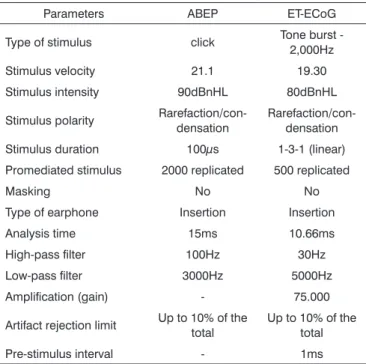
ABEP testing and ET-ECoG were done to aid in the differential diagnosis of AN/AD. The test protocol is des-cribed in Table 1. Both ABEP testing and ET-ECoG were done in an acoustically and electromagnetically treated room, using a Bio-logic Systems Corp.® Navigator Pro device, version 4.2.0. The skin was cleaned with abrasive paste; a small amount of electrolytic paste was placed on disposable electrodes. After electrode placement, the ca-bles were connected. An Ear Tone 3A earphone was used. The following electrode arrangement was used for ABEP testing: active-frontal; reference-mastoid, and ground on the contralateral mastoid to the stimulated side. The active and ground ET-ECoG electrodes were placed frontally, and the reference electrode (TIPtrode model) was introduced
into the acoustic canal.
Etymotic Research laboratories, based on insertion phone structure, developed the TIPtrode. It contains a plastic tube that conveys sound and that connects to the insertion phone tube. It is coated by a thin gold layer that conducts the auditory evoked potential electrical activity to
the preamplifier.37 The TIPtrode not only initiates
acous-tic stimuli, but is also the receptor for electrical activity. Following the registration protocol, the procedure for both ABEP testing and ET-ECoG was repeated in rarefac-tion polarity by blocking the inserrarefac-tion phone plastic tube with appropriate forceps that had two rubber olives on its extremity to avoid damage to the plastic tube and to stop the acoustic stimulus from reaching the auditory canal. In these circumstances, the cochlear potential disappears,
and only any signal electrical artifacts remain.20,24,38 This
sequence aimed to assure the reliability of recordings and to confirm the biological response.
RESULTS
Figure 1 shows ABEP recordings in both ears in a four-year-old child diagnosed with AN/AD. CMs may be seen in the two upper recordings (R-rarefaction, and C-condensation) as well as absence of neural components. Cochlear CMs were not completely cancelled in the intermediate recording (A-alternated). The lower recor-ding (Bloq-blocked) shows the absence of a biological response.
Table 1. Protocol for ABEP testing and ET-ECoG recording.
Parameters ABEP ET-ECoG Type of stimulus click Tone burst - 2,000Hz
Stimulus velocity 21.1 19.30 Stimulus intensity 90dBnHL 80dBnHL
Stimulus polarity Rarefaction/con-densation Rarefaction/con-densation Stimulus duration 100µs 1-3-1 (linear) Promediated stimulus 2000 replicated 500 replicated
Masking No No
Type of earphone Insertion Insertion Analysis time 15ms 10.66ms High-pass filter 100Hz 30Hz Low-pass filter 3000Hz 5000Hz Amplification (gain) - 75.000
Artifact rejection limit Up to 10% of the total Up to 10% of the total Pre-stimulus interval - 1ms
Figure 1 - Extratympanic electrocochleography in auditory neuropa-thy/dyssynchrony - ABEP recordings in AN/AD
Figure 3 shows inversion of CM tracings at 180° on the upper ET-ECoG recording when using rarefaction (R) e condensation (C) polarities. CM authenticity is shown on the lower recording, where the cochlear potential di-sappears when blocking the insertion phone tube (Bloq-blocked).
in which blocking the plastic tube to confirm a biological response is not possible.
ET-ECoG is a non-invasive technique that may be used in young children, without sedation; the diagnosis of AN/AD, therefore, may be expedited. The recording amplitude is increased, compared to ABEP testing, by locating the electrodes closer to the site of origin of co-chlear potentials, which is extremely relevant in AN/AD, as published papers have shown that CMs are ampler in
such testing conditions.22-26 Higher quality recordings make
it possible to evaluate not only the amplitude but also the duration of CMs; the literature suggests that CMs are more prolonged in AN/AD, compared to normal subjects.
A further points is that ET-ECoG also evaluates cochlear function, thereby providing an audiological as-sessment if OAEs are absent.
It is important to note that even when using ET-ECoG to evaluate CMs in AN/AD patients, an appropriate protocol using strategies to assure recording reliability should be applied. Tone burst stimulation should be used, and rarefaction and condensation polarities should be used to confirm inversion of recordings, and therefore, confirmation of CMs. We also recommend using insertion phones to provide confirmation of a biological response, where the plastic tube may be blocked to discard possible signal electrical artifacts.
CONCLUSION
Our findings show that ET-ECoG may be applied clinically in the differential diagnosis of AN/AD, making it possible to analyze cochlear function in greater detail com-pared to ABEP testing, particularly in identifying CMs.
We aimed to provide additional data in support of a more effective diagnosis of AN/AD, especially in small children in whom electrophysiological methods frequen-tly are the only available tools for evaluating auditory function.
REFERENCES
1. Berlin CI, Hood LJ, Rose K. On renaming auditory neuropathy as auditory dys-syncrony: implications for a clearer understanding me-chanisms and management options. Audiol Today 2001;13(6):15-7. 2. Kraus N. Auditory neuropathy: an historical and current perspective.
In: Sininger, YS, Starr A, editores. Auditory neuropathy: a new pers-pective on hearing disorders. San Diego: Singular; 2001. p. 1-14. 3. Starr A, Picton TW, Sininger YS, Hood LJ, Berlin CI. Auditory
neuro-pathy. Brain 1996;119:741-53.
4. Kaga M, Kon K, Uno A, Horiguchi T, Yoneyama H, Inagaki M. Auditory perception in auditory neuropathy: clinical similarity with auditory verbal agnosia. Brain 2002;24:197-202.
5. Santarelli R, Arslan E. Electrocochleography in auditory neuropathy. Hear Res 2002;170:32-47.
6. Berlin CI, Morlet T, Hood LJ. Auditory neuropathy/dyssinchrony. Its diagnosis and management. Pediatr Clin N Am 2003;50:331-40. 7. Rapin I, Gravel J. “Auditory neuropathy”: physiologic and pathologic
evidence calls for more diagnostic specificity. Int J Pediatric
Otorhi-Figure 2 - Extratympanic electrocochleography in auditory neuropa-thy/dyssynchrony - ET-ECoG recordings in AN/AD
Figure 3 - Extratympanic electrocochleography in auditory neuropa-thy/dyssynchrony - Inversion of CM tracings in ET-ECoG
DISCUSSION
Auditory neuropathy/dyssynchrony (AN/AD) is a relatively new condition in audiology that has been inves-tigated in many recent papers. OAEs and ABEP testings are the methods used in diagnosing this disorder. When OAEs are absent in these patients, however, the differential
diagnosis depends on CM recordings.1-18,20,21
It seems inappropriate to analyze CMs by using ABEP testing for the following reasons: the stimulus (click) that is used to initiate neural potentials limits the
conditions for recording CMs;1,20,25,34 and secondly, many
nolaryngol. 2003;67:707-28.
8. Tang TPY, McPherson B, Yuen KCP, Wong LLN, Lee JSM. Auditory neuropathy/auditory dys-synchrony in school children with hearing loss; frequency of occurrence. Int J Ped Otorhinolaryngol 2004;68:175-83.
9. Loundon N, Marcolla A, Roux I, Rouillon I, Denoyelle F, Feldmann D, Marlin S, Garabedian EN. Auditory neuropathy or endocochlear hearing loss? Otol Neurotol 2005;26 (4):748-54.
10. Ngo RYS, Tan HKK, Balakrishnan A, Lim SB, Lazaroo DT. Auditory neuropathy/auditory dys-synchrony detected by universal newborn hearing screening. Int J Ped Otorhinolaryngol (In press); 2006. 11. Zeng F, Oba S, Garde S, Sininger YS, StarrA. Temporal and speech
pro-cessing deficits in auditory neuropathy. Neuro Report 1999;10:3429-35.
12. Hood LJ, Berlin CI. Auditory neuropathy (auditory dys-syncrony) disables efferent suppression of otoacoustic emissions. In: Sininger, YS, Starr A, editores. Auditory neuropathy:a new perspective on hearing disorders. San Diego: Singular; 2001. p. 183-202.
13. Sininger YS, Oba S. Patients with auditory neuropathy: who are they and what can they hear? In: Sininger YS, Starr A, editores. Auditory Neuropathy: a new perspective on hearing disorders. San Diego: Singular; 2001. p. 15-35.
14. Zeng F, Oba S, Garde S, Sininger YS, Starr A. Psychoacoustics and speech perception in auditory neuropathy. In: Sininger YS, Starr A, editores. Auditory Neuropathy: a new perspective on hearing disor-ders. San Diego: Singular; 2001. p. 141-64.
15. Sininger YS, Trautwein PG. Electrical stimulation of the auditory nerve via cochlear implants in patients with auditory neuropathy. Ann Otol Rhinol Laryngol 2002;111:29-31.
16. Nadol Jr JB. Primary cochlear neuronal degeneration. In: Sininger, YS, Starr A, editores. Auditory neuropathy: a new perspective on hearing disorders. San Diego: Singular; 2001. p. 99-140.
17. Starr A. The neurology of auditory neuropathy. In: Sininger YS, Starr A, editores. Auditory Neuropathy: a new perspective on hearing disorders. San Diego: Singular; 2001. p. 37-50.
18. Starr A, Picton T, Kim R. Pathophysiology of auditory neuropathy. In: Sininger YS, Starr A, editores. Auditory Neuropathy: a new perspective on hearing disorders. San Diego: Singular; 2001. p. 67-82.
19. Madden C, Rutter M, Hilbert L, Greinwald JH, Choo DI. Clinical and audiological features in auditory neuropathy. Arch Otolaryngol Head Neck Surg 2002;128:1026-30.
20. Deltenre P, Mansbach AL, Bozet C, Barthelemy P, Paulissen D, Renglet T. Auditory neuropathy with preserved cochlear microphonics and secondary loss of otoacoustic emissions. Audiology 1999;38:187-95.
21. Withnell RH. Brief report: the cochlear microphonic as an indication of outer hair cell function. Ear Hear 2001;22:75-7.
22. Berlin C.I, Hood LJ, Goforth-Barter L, Bordelon J. Clinical Applica-tion of Auditory Efferent Studies. In: Berlin CI, editor. The Efferent Auditory System. Basic Science and Clinical Applications. San Diego: Singular; 1999. p.105-25.
23. Starr A, McPherson D, Patterson J, Don M, Luxford W, Shannon R, Sininger YS, Tonakawa L, Waring M. Absence of both auditory evoked potentials an auditory percepts dependent on timing cues. Brain 1991;114:1157-80.
24. Deltenre P, Mansbach AL, Bozet C, Clercx A, Hecox KE. Auditory neu-ropathy: a report on three cases with early onsets and major neonatal illnesses. Electroencephalogr Clin Neurophysiol. 1997;104:17-22. 25. Berlin CI, Bordelon J, St John P, Wilensky D, Hurley A, Kluka E,
Hood LJ. Reversing click polarity may uncover auditory neuropathy in infants. Ear Hear 1998;19:37-47.
26. Starr A, Sininger YS;Nguyen T, Michalewski HJ, Oba S, Abdala C. Cochlear receptor (microphonic and summating potentials, otoacous-tic emissions) and auditory pathway (auditory brain stem potentials) activity in auditory neuropathy. Ear Hear 2001;22:91-9.
27. Ferraro JA, Krishnan G. Cochlear potentials in clinical audiology. Audiol Neurootol 1997;2:241-56.
28. Margolis RH. Electrocochleography. Seminars in hearing 1999;20(1):46-61.
29. Pappas Jr DG, Pappas DG, Carmichael L, Hyatt DP, Toohey LM. Ex-tratympanic electrocochleography: diagnostic and predictive value. Am J Otol 2000;21(1):81-7.
30. Hall JW. Handbook of auditory evoked response. Needham Heights: Allyn and Bacon; 1992.
31. Noguchi Y, Nishida H, Komatsuzaki A. A comparison of extratym-panic versus transtymextratym-panic recordings in electrocochleography. Audiology 1999;38 (3):135-40.
32. Sheykholeslami K, Kaga K, Murofushi T, Hughes DW. Vestibular function in auditory neuropathy. Acta Otolaryngol 2000;120:849-54. 33. Hood LJ. Auditory neuropathy: what is it and what can we do about
it? Hear J 1998;51(8):10-8.
34. Elberling C, Salomon G. Cochlear microphonics recorded from the ear canal in man. Acta Otolaryng 1973;75:489-95.
35. Winzenburg SM, Margolis RH, Levine SC, Haines SJ, Fournier EM. Tympanic and transtympanic electrocochleography in acoustic neu-roma and vestibular nerve section surgery. Am J Otol 1993;14(1):63-9.
36. Roland PS, Yellin MW, Meyerhoff WL, Frank T. Simultaneous compari-son between transtympanic and extratympanic electrocochleography. Am J Otol 1995;16(4):444-50.