Introduction
Studies on algal flora in our country began as early as 1890 and they continue to present day. The general impression is that researchers limit their interests in the major groups of algae, as well as in types of water ponds and biotopes (Temniskova et al., 2005). Data about many of the rivers are insufficient. A number of regions can be considered unexplored – Sredna Gora Mountain, West Frontier Mountains, partially the Balkan Mountains.
Summaries of the research carried out on algal flora of Bulgaria were made by Temniskova et al.(2005). A review of the phytoplankton in the dams was conducted by Stoyneva & Michev (2007), followed by Beshkova et al. (2007).
There are no many literature sources describing hydrophilic blue-green algae spread in our country so far. In the recent years studies were carried out by Tsanev & Belkinova(2009),Teneva et al. (2010a, 2010b, 2011, 2014), Belkinova et al. (2012), Stoyanov et al. (2013, 2016).
Currently, the algal diversity in Bulgaria is represented by about 3063 species (Temniskova et al., 2005). Strict compliance with the status of the existing protected areas, in which there are water bodies, including those of the Bulgarka Nature Park, is needed for protecting the algal diversity.
Bulgarka Nature Park was proclaimed in 2002 by the Ministry of Environment and Waters. It covers a total area of 21772.2 ha. It is located on the ridges and the northern slopes of Shipka and Tryavna parts of Central Balkan Mountains. The park includes the springs of Yantra River and its major tributaries at the upper reaches of the river and the areas on 9 settlements located within the municipalities of Gabrovo,
Tryavna and Muglizh. ‘Hristo Smirnenski’ dam also belongs
to the Natural Park area. The average altitude of the park is 940 m and the displacement is 1120 m.
Materials and Methods
The inventory of freshwater algal flora in the Bulgarka Nature Park was conducted during May-October 2012 and in the spring of 2013 (Figure 1). Samples from 37 water sources
Plamen Stoyanov
1,2Rumen Mladenov
1,2Ivanka Teneva
2Detelina Belkinova
2,3Study on freshwater algal flora on the
territory of the Bulgarka Nature Park
Authors’ addresses:
1
Department of Pharmacognosy and Pharmaceutical Chemistry, Faculty of Pharmacy, Medical University of Plovdiv, 120 Bratya Bukston Blvd. Plovdiv 4000, Bulgaria.
2
Department of Botany and Methods of Biology Teaching, Faculty of Biology, University of Plovdiv “Paisii
Hilendarski”, 24 Tzar Assen Str.,
Plovdiv 4000, Bulgaria. 3
Institute of Biodiversity and Ecosystem Research, Bulgarian Academy of Sciences, 2 Gagarin Str., Sofia 1113, Bulgaria.
Correspondence:
Plamen Stoyanov
Department of Pharmacognosy and Pharmaceutical Chemistry, Faculty of Pharmacy, Medical University of Plovdiv, 120 Bratya Bukston Blvd. Plovdiv 4000, Bulgaria
Tel.: +359 32 261568
e-mail: [email protected]
Article info:
Received: 30 June 2016
Accepted: 10 July 2016
ABSTRACT
The study presents data on the diversity of freshwater algal flora on the territory of the Bulgarka Nature Park. One hundred ninety-four species, belonging to 11 divisions were identified. The conservation value of the identified species was assessed.
130
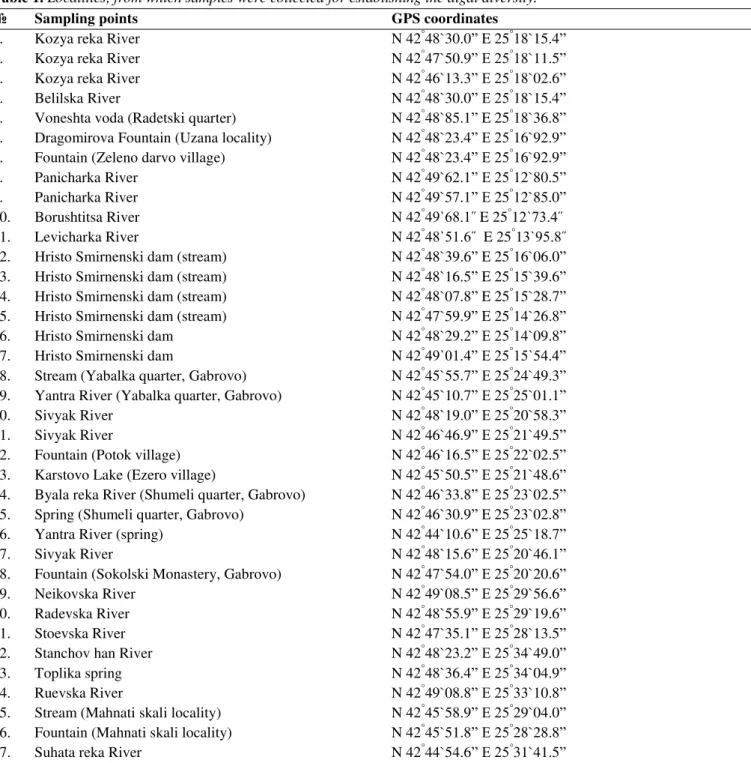
(dams, rivers, streams and fountains) were collected (Table 1). GARMIN 530 portable GPS receiver was used during the inventory visits.
Initially the sampling location and its depth were determined. The collected sample was stored in formalin. For the periphyton study, the algae were collected together with the substrate, and then fixed with formalin (Belkinova et al., 2013).
The taxonomic composition was determined by using a light microscope MAGNUM-T, with 10х40 magnification, equipped with 3 Mpx digital camera and the guide of John et al. (2003), Komárek & Fott (1983), Komárek & Anagnostidis (1999, 2005), Krammer & Lange-Bertalot (1986-1991),
Hasler et al. (2014), Komárek et al. (2011), Komárková et al. (2010), Anagnostidis (2001), Komárek et al. (2013), Strunecky et al. (2013).
Results and Discussion
One hundred ninety-four species that belong to 11 divisions were described during the inventory, carried out on the territory of the Bulgarka Nature Park (Figure 2).
A full list of the freshwater algal species found on the territory of the Bulgarka Nature Park is presented in Table 2.
Table 2 shows that Cyanoprokaryota division is represented by 29 genera, including 49 taxa, out of them 46 species and 3 unidentified taxa (sp.). Bacillariophyta
division is represented by 58 taxa, out of them 50 species and 8 unidentified taxa (sp.), belonging to 24 genera.
Chlorophyta is the second largest division. It includes 31 genera with 50 taxa, out of which 49 species and one unidentified taxa (sp.). From Charophyta division, only the species Chara vulgaris was established. Zygnemophyta
division includes 8 genera with 15 species and one unidentified taxon (sp.). Rhodophyta division is represented by the species Bangia atropurpurea. The divisions
Xanthophyta, Cryptophyta and Pyrrhophyta are represented
Figure 1.Map of the study area.
Table 1.Localities, from which samples were collected for establishing the algal diversity.
№ Sampling points GPS coordinates
1. Kozya reka River N 42°48`30.0” E 25°18`15.4”
2. Kozya reka River N 42°47`50.9” E 25°18`11.5”
3. Kozya reka River N 42°46`13.3” E 25°18`02.6”
4. Belilska River N 42°48`30.0” E 25°18`15.4”
5. Voneshta voda (Radetski quarter) N 42°48`85.1” E 25°18`36.8” 6. Dragomirova Fountain (Uzana locality) N 42°48`23.4” E 25°16`92.9” 7. Fountain (Zeleno darvo village) N 42°48`23.4” E 25°16`92.9”
8. Panicharka River N 42°49`62.1” E 25°12`80.5”
9. Panicharka River N 42°49`57.1” E 25°12`85.0”
10. Borushtitsa River N 42°49`68.1˝ E 25°12`73.4˝
11. Levicharka River N 42°48`51.6˝ E 25°13`95.8˝
12. Hristo Smirnenski dam (stream) N 42°48`39.6” E 25°16`06.0” 13. Hristo Smirnenski dam (stream) N 42°48`16.5” E 25°15`39.6” 14. Hristo Smirnenski dam (stream) N 42°48`07.8” E 25°15`28.7” 15. Hristo Smirnenski dam (stream) N 42°47`59.9” E 25°14`26.8”
16. Hristo Smirnenski dam N 42°48`29.2” E 25°14`09.8”
17. Hristo Smirnenski dam N 42°49`01.4” E 25°15`54.4”
18. Stream (Yabalka quarter, Gabrovo) N 42°45`55.7” E 25°24`49.3” 19. Yantra River (Yabalka quarter, Gabrovo) N 42°45`10.7” E 25°25`01.1”
20. Sivyak River N 42°48`19.0” E 25°20`58.3”
21. Sivyak River N 42°46`46.9” E 25°21`49.5”
22. Fountain (Potok village) N 42°46`16.5” E 25°22`02.5”
23. Karstovo Lake (Ezero village) N 42°45`50.5” E 25°21`48.6” 24. Byala reka River (Shumeli quarter, Gabrovo) N 42°46`33.8” E 25°23`02.5” 25. Spring (Shumeli quarter, Gabrovo) N 42°46`30.9” E 25°23`02.8”
26. Yantra River (spring) N 42°44`10.6” E 25°25`18.7”
27. Sivyak River N 42°48`15.6” E 25°20`46.1”
28. Fountain (Sokolski Monastery, Gabrovo) N 42°47`54.0” E 25°20`20.6”
29. Neikovska River N 42°49`08.5” E 25°29`56.6”
30. Radevska River N 42°48`55.9” E 25°29`19.6”
31. Stoevska River N 42°47`35.1” E 25°28`13.5”
32. Stanchov han River N 42°48`23.2” E 25°34`49.0”
33. Toplika spring N 42°48`36.4” E 25°34`04.9”
34. Ruevska River N 42°49`08.8” E 25°33`10.8”
35. Stream (Mahnati skali locality) N 42°45`58.9” E 25°29`04.0” 36. Fountain (Mahnati skali locality) N 42°45`51.8” E 25°28`28.8”
37. Suhata reka River N 42°44`54.6” E 25°31`41.5”
Table 2.List of algal species found on the territory of the Bulgarka Nature Park.
№ Divisio Cyanoprokaryota
1. Anathece minutissima (West) Komárek, Kastovsky & Jezberová [Syn.: Aphanothece minutissima (W. West)
Komárková-Legnerová et Cronberg 2. Aphanothece sp.
3. Borzia trilocularis Cohn ex Gomont 4. Calothrixbraunii Born. et Flah. 5. Calothrix elenkinii Kossnsk. 6. Calothrix parietina(Näg.) Thuret
132
10. Chroococcus turgidus(Kützing) Nägeli
11. Cylindrospermum muscicola Kütz.
12. Geitlerinema amphibium (Agardh ex Gomont) Anagnostidis
13. Gloeothece fuscolutea (Nägeli ex Kützing) Nägeli [Syn.: Gloeocapsafuscolutea(Näg.) Kützing]
14. Heteroleibleinia rigidula(Kütz. ex Hansgirg) Hoffmann
15. Jaaginema gracile(Böcher) Anagnostidis et Komárek
16. Johanseninema constrictum (Szafer) Hasler, Dvorák & Poulícková [Syn.: Anabaena constricta (Szaf.) Geitl.] 17. Leptolyngbya foveolarum(Rabenhorst ex Gomont) Anagnostidis ex Komárek
18. Leptolyngbya perelegans (Lemmermann) Anagnostidis et Komárek
19. Limnococcus limneticus (Lemmermann) Komárková, Jezberová, O.Komárek & Zapomelová[Syn.: Chroococcus limneticus Lemmermann]
20. Limnoraphis hieronymusii (Lemmermann) J.Komárek, E.Zapomelová, J.Smarda, J.Kopecky, E.Rejmánková,
J.Woodhouse, B.A.Neilan & J.Komárková [Syn.: Lyngbya hieronymusii Lemm.] 21. Lyngbya rigidula (Kutz.) Hansg.]
22. Lyngbya stagnina Kützing ex Gomont
23. Merismopedia sp.
24. Merismopedia tenuissima Lemm.
25. Microcoleus amoenus (Gomont) Strunecky, Komárek & J.R.Johansen [Syn.: Phormidium amoenumKütz. ex Anagn. et
Komárek]
26. Microcoleus autumnalis (Gomont) Strunecky, Komárek & J.R.Johansen [Syn.: Phormidium autumnale (Agardh) Trevisan ex Gomont]
27. Oscillatoria curviceps Agardh ex Gomont 28. Oscillatoria limosa Agardh ex Gomont
29. Phormidium breve(Kützing ex Gomont) Anagnostidis et Komárek
30. Phormidium kuetzingianum(Kirchner) Anagnostidis et Komárek
31. Phormidium stagninum Anagnostidis [Syn.: Lyngbya stagninaKützing ex Gomont]
32. Phormidium terebriforme(Agardh ex Gomont) Anagnostidis et Komárek
33. Phormidium uncinatum Gomontex Gomont 34. Pseudanabaena catenata Lauterborn 35. Pseudanabaena galeata Böcher
36. Pseudanabaena minima (G.S. An) Anagnostidis
37. Pseudanabaena mucicola (Naumann et Huber-Pestalozzi) Schwale
38. Romeria elegans(WoŁoszyńska in Koczwara) WoŁoszyńska et Koczwara ex Geitler
39. Schizothrix sp.
40. Scytonema mirabile (Dillw.) Bornet 41. Scytonema ocellatum Lyngb.
42. Snowella arachnoideaKomárek et Hindák
43. Snowella atomusKomárek & Hindák
44. Spirulina majorKützing ex Gomont
45. Symploca muscorum Gomont ex Gomont
46. Synechococcus capitatus Bailey-Watts et Komárek 47. Synechococcus elongatus(Nägeli) Nägeli
48. Synechocystis minuscula Voronichin
49. Xenotholos kerneri (Hansgirg) Gold-Morgan et al.
Divisio Bacillariophyta
50. Achnanthes brevipes Ag.
51. Achnanthes f. lanceolata (Bréb.) Grun. 52. Achnanthes exigua Grun.
53. Achnanthes lanceolata (Bréb.) Grun. 54. Amphora ovalisKütz.
57. Cocconeis pediculus Ehrengerg 58. Cocconeis placentula Ehr.
59. Craticula ambigua (Ehrenberg) D.G.Mann 60. Cyclotella meneghiniana Kütz.
61. Cyclotella ocellata Pant.
62. Cymbella aspera (Ehr.) Cl. 63. Cymbella cf. cuspidata Kütz. 64. Cymbella cuspidata Kütz.
65. Cymbella cymbiformis ( Kütz. ) V. H. 66. Cymbella sp.
67. Cymbella tumida Bréb.
68. Cymbella turgida (Greg.) Cl. 69. Diatoma anceps (Ehr.) Kirch. 70. Diatoma hiemale (Lyngb.) Heib. 71. Diatoma hiemalis (Roth) Heiberg 72. Diatoma mesodon(Ehr.) Kütz.
73. Diatoma vulgaris Bory 74. Eunotia arcus Ehr. 75. Eunotia cf. praerupta Ehr. 76. Eunotia faba (Ehr.) Grun 77. Fragilaria capucina Desmaz.
78. Fragilaria cf. berolinensis (Lemmermann) Lange-Bertalot 79. Fragilaria construens (Ehr.) Grun.
80. Fragilaria ulna (Nitzsch) Lange-Bertalot
81. Fragilarioforma virescens (Ralfs) D.M.Williams & Round 82. Gomphonema acuminatum Ehr.
83. Gomphonema constrictum Ehr. 84. Gomphonema gracile Ehr.
85. Gomphonemaparvulum (Kütz.) Grun. 86. Gomphonema sp.
87. Gyrosigmaangulatum (Quekett) Griffith & Henfrey 88. Luticola sp.
89. Melosira varians C.Agardh
90. Meridion circulare (Grev.) De Toni 91. Meridion circulare Ag.
92. Navicula cf. radiosaKütz.
93. Navicula sp.
94. Nitzschia acicularis(Kütz.) W. Smith
95. Nitzschia cf. linearis (C.Agardh) W.Smith 96. Nitzschia palea (Kütz.) W. Sm.
97. Nitzschia sp.
98. Pinnularia gibba Ehr. 99. Pinnularia major Kütz. 100. Pinnularia sp.
101. Pinnularia viridis (Nitzsch.) Ehr. 102. Rhoicosphaenia curvata (Kütz.) Grun.
103. Rhoicosphenia abbreviata (Agardh) Lange-Bert. 104. Rhopalodia gibba(Ehr.) O.Müll.
105. Stauroneis anceps Ehr. 106. Stauroneis sp.
107. Stephanodiscus hantzschii Grun.
134
108. Actinastrum hantchii Lagerh.
109. Ankistrodesmus gracilis(Reinsch) Korš.
110. Chlamydomonas lapponica Skuja 111. Chlamydomonasplanctogloea Skuja 112. Cladophoraglomerata(Linnaeus) Kützing
113. Cladоphora fracta(Dillw.) Kütz.
114. Closteriopsis longissima (Lemm.) Lemm. 115. Coelastrum polychordum(Korš.) Hind.
116. Crucigeniellacrucifera (Wolle) Kom. 117. Elakatothrix genevensis (Reverd.) Hind. 118. Gonium pectoraleO.F. Müller
119. Kirchneriella dianae (Bohl.) Comas 120. Koliella stagnalis Hindák
121. Lagerheimia wratislaviensisSchröd.
122. Micractinium pusillum Fresenius 123. Microspora stagnorum (Kütz.) Lagerh.
124. Microspora tumidula Hazen
125. Microthamnion kuetzingianumNägeli ex Kützing
126. Microthamnion strictissimum Rabenh. 127. Monoraphidium arcuatum(Korš.) Hind.
128. Monoraphidium contortum (Thur.) Kom.-Legn. 129. Monoraphidium convolutum (Corda) Kom.-Legn. 130. Monoraphidium griffithii (Berk.) Kom.-Legn. 131. Monoraphidium minutum(Näg.) Kom.-Legn. 132. Oedogonium pusillum Kirchn.
133. Oedogonium sp. 134. Oocystis lacustris Snow.
135. Pandorina morum(O.F. Müller) Bory
136. Pediastrum duplex Meyen
137. Pediastrum duplex var. gracillimum W. & G.S. West 138. Phacotus pallidus Korschikoff
139. Polyedriopsis spinulosa (Schmidle) Schmidle 140. Protoderma frequens (Butsher) Printz 141. Protoderma virideKütz.
142. Scenedesmus bernardii G.M. Smith 143. Scenedesmus communis Hegew. 144. Scenedesmus obliquus (Turp.) Kütz.
145. Scenedesmus opoliensis P.G. Richter var. mononensis Chodat 146. Scenedesmus pectinatus Meyen
147. Scenedesmus semipulcherHortobágyi
148. Scenedesmus suspicatus Chodat 149. Sphaerocystis schroeteri Chod.
150. Stichococcus variabilis W. et G. S. West 151. Stigeoclonim lubricum(Dillw.) Kütz.
152. Stigeoclonium tenue (Ag.) Kütz.
153. Tetraedron minimum (A. Braun) Hansgirg 154. Tetrastrum komarekii Hind.
155. Ulothrix subtilisKütz.
156. Ulothrix subtilissima Rabenh. 157. Ulothrix tenuissima Kütz.
Divisio Charophyta
Divisio Zygnemophyta
159. Closterium acerosum (Schrank.) Ehr. 160. Cosmarium bioculatum Bréb.
161. Cosmarium reniforme (Ralfs) W.Archer 162. Cosmarium speciosum P.Lundell 163. Desmidium swartzii (Ag.) Ralfs 164. Gonatozygon brebissonii De Bary
165. Gonatozygon kinahanii (W.Archer) Rabenhorst 166. Gonatozygon monotaenium De Bary
167. Mougeotia scalaris Hass. 168. Mougeotia sp.
169. Mougeotia viridis(Kützing) Wittrock
170. Penium spinospermum Josh. 171. Spirogyra crassa (Kütz.) Petit
172. Spirogyra inflata (Vaucher) Kützing
173. Zygnema cruciatum (Vaucher) C.Agardh 174. Zygnema pectinatum (Wauch.) Ag.
Divisio Rhodophyta
175. Bangia atropurpurea (Roth) C.Agardh
Divisio Xanthophyta
176. Tribonema utriculosum (Kütz.) Hanzen
177. Tribonema vulgare Pasch.
Divisio Cryptophyta
178. Chroomonas acuta Uterm. 179. Cryptomonaserosa Ehr.
Divisio Chrysophyta
180. Chromulina sp.
181. Chrysococcuscordiformis Naumann 182. Chrysococcus punctiformis Pasch. 183. Chrysococcus rufescens Klebs 184. Dinobryon divergens Imh.
185. Dinobryon divergens Imh. var. angulatum (Sel.) Brunnth. 186. Kephyrion francevi Gus.
Divisio Pyrrhophyta
187. Ceratium furcoides (Levander) Langhans 188. Peridiniuminconspicuum Lemmermann
Divisio Euglenophyta
189. Trachelomonas bacillifera Playfair
190. Trachelomonas hispida (Perty) F. Stein emend. 191. Trachelomonas planctonica Swir. var. longicolis Skv. 192. Trachelomonas similis Stokes
193. Trachelomonas volvocina Ehr. 194. Trachelomonas volvocinosis Swir.
by two species each. Chrysophyta division includes 4 genera with 7 taxa, out of which 6 species and 1 unidentified taxon (sp.). Six species belonging to one genus are identified from
Euglenophyta divison.
Bacillariophyta division is represented by the largest species diversity. They are a dominant group of organisms in biomass and in number of species in lakes, springs, upper and middle river reaches in Europe, being the major primary
136
partially been influenced by anthropogenic activities, serving
as ‘refuges’ and‘habitat islands’ for many species.
Conclusion
As a result of the study, 194 species, belonging to 104 genera of 11 divisions were identified. Among them there are no algal species of conservation importance included in the Red List of macroalgae according to Temniskova et al. (2008). Nevertheless, some macroalgal species as Bangia atropurpurea (Roth) C. Agardh, Chara vulgaris L. and microalgae (Chrysococcus rufescens Klebs, Calothrix parietina [Näg.] Thuret, Chroococcus limneticus Lemm.) are described as indicators of olygosaprobe, clean waters (Wasser et al., 1989).
References
Anagnostidis K. 2001. Nomenclatural changes in cyanoprokaryotic order Oscillatoriales. Preslia, Praha,73: 359-375.
Belkinova D, Mladenov R, Cheshmedjiev S. 2013. Phytoplankton. – In: Belkinova D, Gecheva G, Cheshmedjiev S, Dimitrova-Dyulgerova I, Mladenov R, Marinov M, Teneva I. Stoyanov P, Ivanov P, Michov S, Pehlivanov L, Varadinova E, Karagyozova T, Vasilev M, Apostolu A, Velkov B, Pavlova M. Biological analysis and ecological status assessment of Bulgarian surface water ecosystems. Plovdiv University Press, Plovdiv, p. 55-95. Belkinova D, Mladenov R, Dimitrova-Dyulgerova I, Teneva I,
Stoyanov P, Cheshmedjiev S. 2012. Phytoplankton of the Stouden Kladenets Reservoir (Eastern Rhodope Mountains, Bulgaria). University of Plovdiv “Paisii Hilendarski”, 42-61. Beshkova B, Kalchev R, Botev I. 2007. Bulgarian water reservoirs:
Phytoplankton and related physical and chemical factors. Journal of Balkan Ecology, 10: 13-28.
Brittain J, Milner A. 2001. Ecology of glacier-fed rivers: current status and concepts.Freshwater Biol., 46(12): 1571-1578.
Hasler P, Dvorák P, Poulícková A. 2014. Johanseninema, a corrected name for a recently described genus of filamentous epipelic cyanobacteria. Preslia (Prague)86: 293-294.
John D, Whitton B, Brook A. 2003. The freshwater algal flora of the British Isles. An identification guide to freshwater and terrestrial algae. – Cambridge University Press, Cambridge, United Kingdom.
Komárek J, Anagnostidis K. 1999. Cyanoprokaryota, 1: Chroococcales. In Ettl, H., G. Gärtner, H. Heynig & D.
Möllenhauer (eds), Süßwasserflora von Mitteleuropa, 19(1). Gustav Fischer Verlag, Stuttgart, p. 1-548.
Komárek J, Anagnostidis K. 2005. Cyanoprokaryota. 2.
Oscillatoriales. –In: Büdel B, Krienitz L, Gärtner G. & Schagerl
M. (eds), Süsswasserflora von Mitteleuropa, 19/2,
Elsevier/Spektrum, Heidelberg, p. 1-759.
Komárek J, Fott B. 1983. Chlorophyta (Grünalgen) Ordnung: Chlorococcales. – In: Huber-Pestalozzi, G. (ed), Das
Phytoplankton des Süßwassers: Die Binnengewässer, 16, 7/1. E. Schweizerbart'sche Verlagsbuchhandlung (Nägele u. Obermiller), Stuttgart, p. 1-1004.
Komárek J, Kastovsky J, Jezberová J. 2011. Phylogenetic and taxonomic delimitation of the cyanobacterial genus
Aphanothece and description of Anathece gen. Nov. Eur. J. Phycol., 46(3): 315-326.
Komárek J, Zapomelová E, Smarda J, Kopecký J, Rejmanková E, Woodhaouse J, Neilan B, Komárková J. 2013. Polyphasic
evaluation of Limnoraphis robusta a water-bloom forming
cyanobacterium from Lake Atitlán, Guatemala, with a
description of Limnoraphis gen. Nov. Fottea,13(1): 39-52.
Komárková J, Jezberová J, Komárek O, Zapomelová E. 2010. Variability of Chroococcus (Cyanobacteria) morphospecies with regard to phylogenetic relationships. Hydrobiologia, 639(1): 69-83.
Krammer K, Lange-Bertalot H. 1986-1991. Süßwasserflora von Mitteleuropa. Bacillariophyceae. 2/1: Naviculaceae, 1986; 2/2 Bacillariaceae, Epithemiaceae, Surirellaceae, 1988; 2/3: Centrales, Fragilariaceae, Eunotiaceae, 1991; 2/4 Achnantaceae, 1991. Gustav Fisher Verlag, Stuttgard.
Stoyanov P, Teneva I, Mladenov R, Belkinova D. 2013. Diversity and еcology of the phytoplankton of filamentous blue-green algae (Cyanoprokaryota, Nostocales) in Bulgarian standing waters. Ecologia Balkanica, 5(2): 1-6.
Stoyanov P, Teneva I, Mladenov R, Belkinova D. 2016. Filamentous cyanoprokaryotes (Cyanoprokaryota /Cyanobacteria) in standing waters of Bulgaria: diversity and ecology. J. BioSci. Biotech., 5(1): 19-28.
Stoyneva M, Temniskova-Topalova D. 2007. Cyanoprokaryotes and algae of non-lotic Bulgarian wetlands. - In: Michev T. & Stoyneva M. (eds.), Inventory of Bulgarian wetlands and their biodiversity. Part 1: Non-Lotic Wetlands. Publ. House Elsi-M, Sofia, p. 155-167.
Strunecky O, Komárek J, Johansen J, Lukesová A, Elster J. 2013. Molecular and morphological criteria for revision of the genus
Microcoleus (Oscillatoriales, cyanobacteria). J. Phycol., 49(6): 1167-1180.
Temniskova D, Kirjakov I, Moncheva S, Stoyneva M, Mladenov R, Belkinova D, Stancheva R, Ivanov P. 2005. Biodiversity of the algae in Bulgaria – In: Petrova A. (ed). Current State of Bulgarian Biodiversity, Sofia, 11-36 (in Bulgarian).
Temniskova D, Stoyneva M, Kirijakov I. 2008. Red list of the Bulgarian algae. Macroalgae. Phytologia Balcanica, 14(2): 193-206.
Teneva I, Basheva D, Belkinova D, Dimitrova-Dyulgerova I, Mladenov R, Dzhambazov B. 2011. Study of the qualitative and quantitative composition of the blue-green algae (Cyanoprokaryota), presence of cyanotoxins and heavy metals in Studen kladenets Reservoir. Trav. Sci. Univ. Plovdiv, Plantarum, 41(6): 89-124.
Teneva I, Belkinova D, Dimitrova-Dyulgerova, I, Vlaknova M, Mladenov R. 2010a. Composition and toxic potential of Cyanoprokaryota in Vacha Dam (Bulgaria). Biotechnol. Biotec. Eq., 24(2SE): 26-32.
Teneva I, Gecheva G, Cheshmedjiev S, Stoyanov P, Mladenov R, Belkinova D. 2014. Ecological status assessment of Skalenski Lakes (Bulgaria). Biotechnol. Biotec. Eq., 28(1): 82-95. Teneva I, Mladenov R, Belkinova D, Dimitrova-Dyulgerova I,
Dzhambazov B. 2010b. Phytoplankton community of the drinking water supply reservoir Borovitsa (South Bulgaria) with an emphasis on cyanotoxins and water quality. Cent. Eur. J. Biol., 5(2): 231-239.
Tsanev A, Belkinova D. 2009. Research on the phytoplankton of Ivaylovgrad Reservoir (Eastern Rhodopes Mts., Bulgaria). – In: Velcheva, I. et al. (eds). Proceedings of the Anniversary Scientific Conference of Ecology, November 1st 2008, Plovdiv: 485-493.
Wasser S, Kondrateva N, Masyuk N, Palamar-Mordvintzeva G, Vetrova Z, Kordyum E, Moshkova N, Prihodkova L, Kovalenko O, Stupina V, Tzarenko P, Yunger V, Radchenko M, Vinogradova O, Buhtiyarova L, Razumna L. 1989. Algae. Reference book. Naukova dumka Press, Kiev, 608 (in Russian). Werum M. 2001. Die Kieselalgengesellschaften in Quellen.