Diaphragmatic Eventration in a Term Pregnant
A Rare Cause of Dyspnea in Pregnancy:
Diaphragmatic Eventration
Gebelikte Nadir Görülen Bir Dispne Nedeni:
Diyafragma Evantrasyonu
DOI: 10.4328/JCAM.4577 Received: 23.04.2016 Accepted: 01.06.2016 Printed: 01.09.2016 J Clin Anal Med 2016;7(5): 727-9 Corresponding Author: Mehmet Ferdi Kıncı, Department of Obstetrics and Gynecology, Gülhane Military Medical Academy, Ankara, Turkey.
T.: +90 3123045810 F.: +90 3123045800 E-Mail: [email protected] Özet
Diyafragma evantrasyonu; diyafragma yaprağının bir kısmı veya tamamının, kalıcı olarak yükselmesidir. Gebeliğinin 35. hatasında, ilerleyen nefes darlığı ve dispep
-tik yakınmalar şikayeti olan hastaya Akciğer grafisi çek-tik. Diyafragma evantras
-yonu tanısı koyduktan sonra takip ettik. Gebeliğinin 38. hatasında şikayetlerinin artması üzerine sezaryen ile doğumu gerçekleşen vakaya yaklaşımı sunuyoruz. Ge
-belik hatası ne olursa olsun spesifik olmayan semptomlar ile başvuran hastalar
-da obstetrik nedenler ekarte edildikten sonra diyafragma evantrasyonu düşünül
-melidir. Tedavi yaklaşımı jinekologları, obstetrisyenleri, çocuk doktorları ve göğüs hastalıkları uzmanlarını kapsayacak şekilde multidisipliner yaklaşım ile olmalıdır.
Anahtar Kelimeler
Diyafragma Evantrasyonu; Term Gebelik; Dispne; Solunum Fonksiyon Testi
Abstract
Diaphragmatic eventration is a permanent elevation of part or all of the dia-phragmatic leaf. The patient had progressive dyspnea and dyspeptic complaints
at gestational week 35. She was followed up with a presumed diagnosis of dia -phragmatic eventration. We present here our intervention in a case where
cesar-ean section was performed at gestational week 38 due to progressive dyspnea. Diaphragmatic eventration should be considered ater obstetric causes are ruled out in patients who present with non-speciic symptoms regardless of their gesta
-tional week. The treatment approach should be multidisciplinary, involving gyne
-cologists, obstetricians, pediatricians, and pulmonologists, as well as specialists
from other branches when necessary.
Keywords
Diaphragmatic Eventration; Term Pregnancy; Dyspnea; Respiratory Function Test
İbrahim Alanbay¹, Mustafa Öztürk2, Mehmet Ferdi Kıncı¹, Ulaş Fidan¹, Mustafa Ulubay¹
¹Department of Obstetrics and Gynecology, Gülhane Military Medical Academy,
²Department of Obstetrics and Gynecology, Etimesgut Military Hospital, Ankara, Turkey
Introduction
Diaphragmatic eventration is a permanent elevation of part or all of the diaphragmatic leaf with no impairments in organ con-nections or costal region concon-nections [1]. Paralysis and
eventra-tion of the diaphragm is seen quite rarely (<0.05%). However, the incidence rate during pregnancy is unknown because there are few previously described cases. As a result, the treatment
approach for diaphragmatic eventration in pregnancy is
un-speciied. Being mostly asymptomatic, diaphragmatic eventra
-tion is oten diagnosed incidentally. In addi-tion to respiratory
complaints such as dyspnea that can be progressive or can be
aggravated with efort, it can also involve gastrointestinal com
-plaints including epigastric pain and swelling, and even exhibit
symptoms such as palpitation. We present here our intervention
with a patient who applied to our clinic at gestational week 35 with progressive dyspnea and dyspeptic complaints, and who
was diagnosed with diaphragmatic eventration and adminis-tered a cesarean delivery.
Case Report
A 33-year-old G2P1 female at her gestational week 35 present -ed to our outpatient clinic complaining about severe dyspnea that had started at the third trimester of her pregnancy and
progressed with increasing severity. She stated in her medical history that she had experienced dyspeptic complaints persist
-ing for years, but her irst pregnancy had been totally normal.
No pathology was encountered in her systemic and obstetric
examinations. She was recommended outpatient monitoring with check-ups if her complaints continued. However, she pre
-sented again approximately one week later because her respi
-ratory diiculties worsened. Her physical examination showed
subcostal retractions during inspiration. The biochemical analy-sis were within normal limits with total white blood cell count
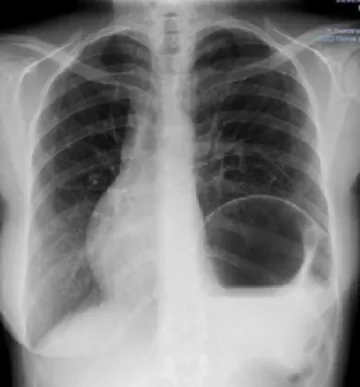
of 8,800/µl, hemoglobin 13.8 g/dl, platelet 204 *10.e3/mikroL, urea 8.7 mg/dl, creatinine 0.47 mg/dl, AST 24 U/L, and ALT 11 U/L. Ater the patient was given necessary information and her consent was obtained, a posteroanterior chest x-ray was taken in her gestational week 36 with a lead vest to protect the baby. An elevation of approximately 4 cm in the let diaphragm, a rightward shit in the trachea, and a right-sided deviation in the
heart were seen in her radiography (Figure 1).
This caused us to consider a diaphragmatic eventration. The
patient was asked to bring in a previously taken chest x-ray, but she said that she had never had a chest x-ray taken before. Since her gestation was at full term and her complaints increased,
we thought that a spontaneous vaginal delivery would worsen her condition. We decided to administer a cesarean delivery. A
female infant was delivered weighing 3,410 grams with 1 and
5 minute APGAR scores of 7 and 9 respectively. The patient’s
respiration complaints receded partially ater birth, but her dys
-peptic complaints remained. On her follow-up x-ray, which was performed 2 days ater the cesarean section, the cardiac shit
had retreated but the diaphragmatic elevation remained
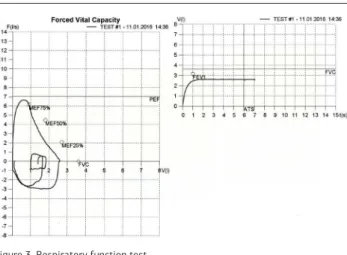
(Fig-ure 2). Her respiratory function test, performed 3 months ater cesarean section, showed a restrictive disorder (Figure 3).
It was recommended that the patient have a surgical restora-tion of her diaphragm.
Discussion
Paralysis and eventration of the diaphragm is seen quite
rare-ly (<0.05%). Besides being a congenital condition, it can also develop due to phrenic nerve damage secondary to a trauma, tumoral iniltrations, iatrogenic reasons, or conditions that
increase the intra-abdominal pressure. It is generally
asymp-tomatic and is incidentally encountered during an examination for another reason. It is a clinical condition oten localized on the let, in which case it can be diagnosed easily. Dyspnea and orthopnea are its most frequent symptoms. Epigastric pain, burns, regurgitation, constipation, and weight loss are among
its most common gastrointestinal symptoms. In advanced
cas-Figure 1. Diaphragmatic eventration of 35 week pregnancy
Figure 2. The cardiac shit was observed to retreat, but the diaphragmatic eleva
-tion remained ater birth.
| Journal of Clinical and Analytical Medicine
728
es, a paradoxical inward movement of the lower costal margin
occurs during inspiration (Hoover’s sign). It can result in
ven-tilation-perfusion defect, respiratory alkalosis, or hypoxia. The
easiest method for diagnosing it is the PA X-Ray. In a healthy
person, the right hemidiaphragm is 1-2 cm higher than the let
one at full inspiration. Disturbance of this situation may
sug-gest the presence of diaphragmatic eventration. Low forced vital capacity and forced expiratory volume are observed in the irst second during a respiratory function test [2]. Fluoroscopy, ultrasound, computed tomography, and magnetic resonance imaging may be utilized for diagnosis. Its treatment is surgi -cal. Diaphragmatic repair can be performed by un-opened or opened operation techniques [3].
Nausea and vomiting in the irst trimester of pregnancy and enlargement of the uterus in the second trimester, and maneu -vers such as Valsalva and crystals during birth increase intra-abdominal pressure. It should be noted that these may not only
lead to diaphragmatic eventration but may also worsen the ex
-isting condition and increase complaints dramatically. Since the
symptoms of diaphragmatic eventration that develop during pregnancy are among the very frequently seen obstetric
symp-toms, it may become more diicult to make a diagnosis (4). Visceral perforation, respiratory distress, pneumothorax, and obstructive shock can be seen in advanced cases. For this rea
-son, we should consider gastrointestinal and respiratory sys
-tem pathologies ater ruling out the obstetric causes in patients
presenting with similar complaints. There are cases in the lit-erature that culminate in gastric and diaphragmatic ruptures [5]. The mortality rate in such cases is quite high. In
asymptom-atic cases with diaphragmasymptom-atic eventration during pregnancy, repair is recommended under elective conditions in the irst and
second trimester. At the time of elective cesarean section in
the third trimester diaphragm repair is recommended, but if a normal delivery is chosen, Valsalva and crystals maneuvers
should be avoided. In symptomatic cases delivery and primary diaphragm repair is recommended regardless of fetal maturity [6].
In conclusion, diaphragmatic eventration in pregnancy is a con
-dition that is diicult to diagnose with its non-speciic symp -toms. It should be addressed promptly due to its potential com-plications. Diaphragmatic eventration should be considered
ater obstetric causes are ruled out in patients who present with non-speciic symptoms regardless of their gestational week. The treatment approach should be multidisciplinary, involving
gynecologists, obstetricians, pediatricians and pulmonologists,
as well as specialists from other branches when necessary.
Under optimum conditions, medicolegal responsibility calls for
providing the family with proper information on possible
mater-nal and fetal complications, obtaining their consent, and then
deciding on a delivery method and diaphragmatic repair.
Competing interests
The authors declare that they have no competing interests.
References
1. Groth SS, Andrade RS. Diaphragm Plication for Eventration or Paralysis: A Re
-view of the Literature. Ann Thorac Surg 2010;89(6):S2146-50.
2. Pilsczek FH, George L. Unilateral paralysis of the diaphragm during pregnancy: Case report and literature review. Heart Lung 2005;34(4):282-7.
3. Evman S, Tezel C, Vayvada M, Kanbur S, Urek S, Baysungur V, et al. Comparison of Mid-Term Clinical Outcomes of Diferent Surgical Approaches in Symptomatic Diaphragmatic Eventration. Ann Thorac Cardiovasc Surg 2016. doi: 10.5761/atcs.
oa.16-00018.
4. Kaloo PD, Studd R, Child A. Postpartum diagnosis of a maternal diaphragmatic
hernia. Aust N Z J Obstet Gynaecol 2001;41(4):461-3.
5. Morcillo-López I, Hidalgo-Mora JJ, Baamonde A, Díaz-García C. Gastric and dia
-phragmatic rupture in early pregnancy. Interact Cardiovasc Thorac Surg. 2010
Nov;11(5):713-4.
6. Servais EL, Stiles BM, Finnerty BM, Paul S. Ruptured Diaphragmatic Eventration: A Rare Cause of Acute Postpartum Dyspne. Ann Thorac Surg 2012;93(6):e143-4
How to cite this article:
Alanbay İ, Öztürk M, Kıncı MF, Fidan U, Ulubay M. A Rare Cause of Dyspnea in
Pregnancy: Diaphragmatic Eventration. J Clin Anal Med 2016;7(5): 727-9. Figure 3. Respiratory function test