Individual Variability and Test-Retest
Reliability Revealed by Ten Repeated
Resting-State Brain Scans over One Month
Bing Chen1,2☯, Ting Xu3☯, Changle Zhou1, Luoyu Wang2, Ning Yang3,4,5, Ze Wang2,
Hao-Ming Dong3,4,5, Zhi Yang3,5, Yu-Feng Zang2, Xi-Nian Zuo3,5,6,7*, Xu-Chu Weng1,2*
1Fujian Provincial Key Lab of the Brain-like Intelligent systems, Xiamen University School of Information Science and Engineering, Xiamen, Fujian 361005, China,2Zhejiang Key Laboratory for Research in Assessment of Cognitive Impairments, Center for Cognition and Brain Disorders, Hangzhou Normal University, Hangzhou, Zhejiang 311121, China,3Key Laboratory of Behavioural Sciences and Magnetic Resonance Imaging Research Center, Institute of Psychology, Chinese Academy of Sciences, Beijing 100101, China,4University of Chinese Academy of Sciences, Beijing 100049, China,5Laboratory for Functional Connectome and Development, Institute of Psychology, Chinese Academy of Sciences, Beijing 100101, China,6Faculty of Psychology, Southwest University, Beibei, Chongqing 400715, China, 7Department of Psychology, School of Education Science, Guangxi Teachers Education University, Nanning, Guangxi 530001, China
☯These authors contributed equally to this work. *[email protected](XNZ);[email protected](XW)
Abstract
Individual differences in mind and behavior are believed to reflect the functional variability of the human brain. Due to the lack of a large-scale longitudinal dataset, the full landscape of variability within and between individual functional connectomes is largely unknown. We collected 300 resting-state functional magnetic resonance imaging (rfMRI) datasets from 30 healthy participants who were scanned every three days for one month. With these data, both intra- and inter-individual variability of six common rfMRI metrics, as well as their test-retest reliability, were estimated across multiple spatial scales. Global metrics were more dynamic than local regional metrics. Cognitive components involving working memory, inhi-bition, attention, language and related neural networks exhibited high intra-individual vari-ability. In contrast, inter-individual variability demonstrated a more complex picture across the multiple scales of metrics. Limbic, default, frontoparietal and visual networks and their related cognitive components were more differentiable than somatomotor and attention net-works across the participants. Analyzing both intra- and inter-individual variability revealed a set of high-resolution maps on test-retest reliability of the multi-scale connectomic metrics. These findings represent the first collection of individual differences in scale and multi-metric characterization of the human functional connectomes in-vivo, serving as normal ref-erences for the field to guide the use of common functional metrics in rfMRI-based
applications. a11111
OPEN ACCESS
Citation:Chen B, Xu T, Zhou C, Wang L, Yang N, Wang Z, et al. (2015) Individual Variability and Test-Retest Reliability Revealed by Ten Repeated Resting-State Brain Scans over One Month. PLoS ONE 10(12): e0144963. doi:10.1371/journal. pone.0144963
Editor:Gaolang Gong, Beijing Normal University, CHINA
Received:September 11, 2015
Accepted:November 27, 2015
Published:December 29, 2015
Copyright:© 2015 Chen et al. This is an open access article distributed under the terms of the
Creative Commons Attribution License, which permits
unrestricted use, distribution, and reproduction in any medium, provided the original author and source are credited.
Data Availability Statement:All neuroimaging image files are available from FigShare (https://
figshare.com/s/7dac285e153e176d90e8) with a
digital object identifier (10.6084/m9.figshare.
2007483).
Funding:This work was partially supported by the National Key Basic Research and Development (973) Program (2015CB351702, X-NZ), the Major Joint Fund for International Cooperation and Exchange of the National Natural Science Foundation
Introduction
Functional connectomics with resting-state functional magnetic resonance imaging (rfMRI) is a widely used tool to map the intrinsic architecture in the human brain [1–4]. Different computational methods have been developed to examine the functional changes associated with development and disease processes [5,6]. The rfMRI-derived metrics can be categorized into three different types according to the spatial scale at which they characterize human brain function, namely the local scale (brain areas/regions), meso-scale (subnetworks or modules), and global brain. At each scale these metrics aim to characterize information seg-regation and integration in functional connectomics. Functional connectivity between brain areas can be defined in a relatively straightforward manner with temporal correlations [7,8]; other measures of connectivity can be used, but may be difficult hard to interpret, partly because there are many confounds [9] that can affect these metrics [10–13]. Fortunately, sev-eral recent studies have made efforts on explore the potential neurobiological significance of these metrics [14–16].
High test-retest reliability is a necessary requirement for developing a biomarker of func-tional connectomics for clinical application [17]. The existing rfMRI-derived metrics have demonstrated moderate to high test-retest reliabilities and are widely used to study different aspects of the human brain’s intrinsic functional architecture or functional connectomics [18], and systematically reviewed in [19]. Specifically, at local scales, the amplitude measures exhibit moderate to substantial reliability [20] whereas the local functional homogeneity metrics are highly reliable (substantial to almost perfect) [21]. At the scale of networks, com-mon intrinsic connectivity networks show relatively high reliability while the seed-based methods [22] are relatively less reliable than independent component analysis [23]. At scales of the entire connectome, various centrality metrics exhibit only fair to moderate test-retest reliability [2], although this can be affected by sampling rates, preprocessing and computa-tional strategies [24–27]. Test-retest reliability of these metrics have been partly examined in typically [28,29] or atypically developing children [29] as well as normal [30–32] and abnor-mal aging people [33].
Test-retest reliability is an integrative statistical measure of both intra-individual variability (intraVar) and inter-individual variability (interVar) [34,35], composing so-called individual differences. Previous studies have presented significant individual differences in human brain intrinsic function at both the group and individual level [1,15,36–38], although most focused on seed-based functional connectivity. The distribution of individual differences to within- and between-subject variability determines the degree of test-retest reliability of the functional mea-sures. However, very few studies have explored details of both intraVar and interVar of com-mon functional measurements due to lacking a richly-sampled datasets within and between individuals. One representative work on interVar was recently conducted by Mueller and col-leagues [39], shedding light on the role of intrinsic functional connectivity in brain evolution and development by relating individual differences to interVar of cortical morphology, ana-tomical distance and cognition. This dataset has been employed as normal reference in guiding individual-level network parcellation of the human cortex [40]. Another seminal work investi-gated the spatial structure of intraVar of whole-brain intrinsic connectivity within one-hour rfMRI scans from 10 participants and concluded that this intraVar also reflected functionally specialized and flexible configuration across the human brain cerebral cortex [41]. A recent work on the MyConnectome project [42] by Poldrack and colleagues has yielded the most detailed depiction of an individual brain’s function across one year (almost daily scanned) [43], together with the work from Choe and colleagues on rfMRI-derived networks of an individual
X-NZ) of the Chinese Academy of Sciences, the Natural Science Foundation of China (31070905, 31371134, 81171409 and 81471740) and the National Social Science Foundation of China (11AZD119).
across a period of 3.5 years (weekly scanned) [44], further highlighting the value of mapping intra-individual variability more accurately to probe the intrinsic function.
While the mapping of the individual differences are fundamentally important to understand how the human brain organizes, changes dynamically, as well as how it is altered by disease conditions [45,46], a comprehensive study of both intraVar and interVar of the rfMRI mea-sures in a single sample is still missing. The major challenge is to obtain a longitudinal dataset with enough samples at both the group and individual levels. In the present research, we scanned 30 healthy adults using rfMRI with a one-month longitudinal experiment design. This allowed each participant to undergo an rfMRI scanning session every 2–3 days, resulting in ten repeated measurements for each participant. This test-retest sample has been released (http:// dx.doi.org/10.15387/fcp_indi.corr.hnu1) as part of the Consortium for Reliability and Repro-ducibility (CoRR) [47], which shares the data via the Neuroimaging Informatics Tools and Resources Clearinghouse (NITRC). It is also available at FigShare (https://figshare.com/s/ 7dac285e153e176d90e8) with a digital object identifier (10.6084/m9.figshare.2007483). Using this dataset, we 1) implement surface-based computation of the common rfMRI metrics at scales of local areas, subnetwork/module and global connectome; 2) delineate both intraVar and interVar of the common rfMRI metrics at the three different spatial scales; 3) examine test-retest reliability of these common brain connectomics metrics and generate their cortical surfaces; 4) related these individual differences and the test-retest reliability to the brain net-works and the cognitive components in the intrinsic functional architecture.
Methods and Analysis
Participants
Thirty participants aged 20 to 30 years old (15 females, mean age = 24, SD = 2.41) were recruited and scanned ten times over approximately one month. None of participants had a history of neurological or psychiatric disorders, substance abuse, or head injury with loss of consciousness. The ethics committee of the Center for Cognition and Brain Disorders (CCBD) at Hangzhou Normal University approved this study. Written informed consent was obtained from each participant prior to data collection.
MRI Data Acquisition
MRI Imaging sessions were performed using a GE MR750 3.0 Tesla scanner (GE Medical Sys-tems, Waukesha, WI) at CCBD, Hangzhou Normal University. Each participant underwent ten imaging scans over one month with one scan every three days, during which two imaging sequences were completed to measure individual brain structure and function. Specifically, a T2-weighted echo-planar imaging (EPI: TR = 2000 ms, TE = 30 ms, flip angle = 90°, field of view = 220 × 220 mm, matrix = 64 × 64, voxel size = 3.4 × 3.4 × 3.4 mm, 43 slices) sequence was performed to obtain resting state fMRI images for 10 minutes. A T1-weighted Fast Spoiled Gradient echo (FSPGR: TR = 8.1 ms, TE = 3.1 ms, TI = 450 ms, flip angle = 8°, field of
MRI Data Preprocessing
The Connectome Computation System (CCS:https://github.com/zuoxinian/CCS) was
devel-oped to provide a multimodal image analysis platform for the discovery science of human brain function by integrating three main MRI data processing packages [48–50] with our MATLAB implementations of various computational modules for image quality control, sur-face-based rfMRI metrics, data mining algorithms, reliability and reproducibility assessments and visualization. The primary CCS pipeline consists of both anatomical and functional pro-cessing, which are documented in the CCS paper in details [51]. Here, we only provide an over-all description of these steps.
The CCS anatomical pipeline first removed noise from individual MR T1 images by adopting a spatially adaptive non-local means filter [52,53]. For each participant, regarding that the focus of the present analysis is changes of rfMRI metrics, we aligned and averaged the ten de-noised T1 images to produce a robust, high-resolution anatomical image with high contrast between gray matter (GM) and white matter (WM) for generation of an individual cortical surface model as anatomical reference. Using this image, the skull was then stripped and manually edited for a bet-ter brain extraction, and the 3D extracted brain volume was segmented into different tissues such as cerebrospinal fluid (CSF), WM, GM and further parcellation of the GM tissue. With such information, individual pial (GM/CSF boundary) and white (GM/WM boundary) surfaces were reconstructed and spatially normalized to match a group-level standard template surface in the Montreal Neurological Institute (MNI) space via a sphere registration [49,54,55].
The subsequent CCS functional pipeline discarded the first 5 EPI volumes (10 seconds), removed and interpolated temporal spikes (see instructions in [56,57] regarding in-scanner head motion), corrected acquisition timing among image slices and head motion among image volumes and normalized the 4D global mean intensity to 10,000. White surfaces were then employed by a boundary-based registration (BBR) algorithm to match spatial correspondences between individual functional images to anatomical images [58]. To further eliminate the effect of head motion and physiological noises during the rfMRI scanning session, we regressed out the estimated Friston’s 24-parameter motion curves [37] and nuisance signals measured as WM and CSF mean time series [59] from individual rfMRI time series. Linear and quadratic trends were also regressed out from the rfMRI data by multiple linear regressions. Finally, the data were projected onto thefsaveragesurface grid (average inter-vertex distance = 1 mm) and down-sampled to thefsaverge5surface grid (average inter-vertex distance = 4 mm) for subse-quent rfMRI computation.
Participant-level rfMRI Metrics Derivation
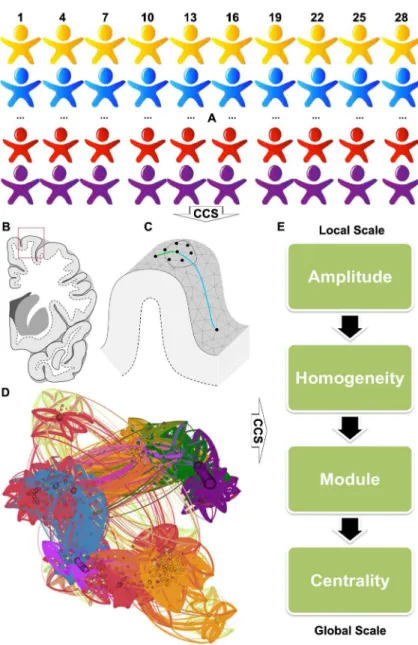
The overall analytic strategy is presented inFig 1. The above CCS pipeline preprocessed all individual rfMRI images (Fig 1A) and projected individual rfMRI time series onto a uniform cortical surface grid (fsaverge5) based upon the brain tissue classification (Fig 1B and 1C). As a proof of concept, an individual-level functional connectome can be modeled as a graph or net-work with vertices as nodes and pair-nodes dependency as edges (Fig 1D). To achieve a system-atic and comprehensive characterization of the brain graph, we proposed a set of metrics at three different scales from a single vertex to the whole cortex (Fig 1E). Given an arbitrary vertex
vi(i= 1, ,V) on the surface whereVis the number of all vertices of thefsaverge5surface grid,
its time series measured with rfMRI isvi(tj)(j= 1, ,T) whereTis the number of time points
of the rfMRI scan (assume an even number). All these metrics are summarized in this section with computational details.
Fig 1. The overall analytic strategy implemented in the Connectome Computation System (CCS).All individual rfMRI images (A) are first preprocessed through the CCS pipeline and then CCS projected individual rfMRI time series onto a uniform cortical surface grid based upon the brain tissue classification (B/ C). As a proof of concept, an individual-level functional connectome can be modelled as a graph or network with vertices as nodes and pair-nodes dependency as edges (D). To achieve a systematic and
comprehensive characterization of the brain graph, we proposed a set of metrics at three different scales from a single vertex to the whole cortex for measuring the amplitude and homogeneity at local scales, subnetworks or modules at meso-scales, and connectome centrality at the global scale (E). The connectome graph is reproduced and modified from [15].
(ALFF) [10] and its fractional version (fALFF) [11]. Both ALFF and fALFF were derived from spatially smoothed rfMRI data (6 mm full-width at half-maximum isotropic Gaussian kernel) via the Fourier decomposition [20]. ALFF measures the strength or intensity of the low-fre-quencyO= [0.01,0.1] (Hz) oscillations whereas fALFF is the relative amplitude contribution of the specific frequency to the whole detectable frequency rangeO0= (0,1/(2Δt)] (Hz) whereΔt is the sampling rateEq (1).
viðtÞ ¼ X
T=2
l¼1
falcosðoltÞ þblsinðoltÞg;ol¼2pl=T
ALFFðvi;OÞ ¼
ffiffiffiffiffiffiffiffiffiffiffiffiffiffiffiffiffiffiffiffiffiffiffiffiffiffiffiffiffiffiffiffiffiffiffiffiffiffiffiffi X
l:ol2O
aðolÞ2
l þbðolÞ
2
l
T=2 s
; fALFFðviÞ ¼
ALFFðvi;OÞ
ALFFðvi;O0Þ
ð1Þ
With a relatively larger scale than the two amplitude measures, to measure local connectivity, regional homogeneity (ReHo) was also employed to characterise the local functional homoge-neity of each vertex across the cortical mantle [12,14,15,21]. This surface-based ReHo was derived from the non-smoothed but temporally band-passfiltered (the passing frequency band
O) rfMRI data. The Kendall’s coefficient of concordance of time series within a set of neighbor-ing vertices quantifies the ReHo. Denotegjias the rank time series ofvi(tj), and theEq (2)
for-mulates ReHo computation where K is the number of neighbors of the vertexvi,N(vi). The
mean rank across its neighbors at thej-th time point isgj
i, and its overall mean rank across all
neighboring voxels and time points isg
i. Here, two neighbor-sizes used for computation of
homogeneity metrics, namely ReHo1 (K = 7) and ReHo2 (K = 20).
ReHoðvi;NðviÞÞ ¼
XT
j¼1
ðgjiÞ
2
Tðg
iÞ 2 1 12K 2 ðT3 TÞ ¼12 XT
j¼1
ðgjiÞ2
ðT3
TÞ 3
Tþ1
T 1:
ð2Þ
Scales of Subnetwork. Seed-based method can construct a subnetwork of the seed region. Denote the representative time series of the seed as a vectors¼ ðsjÞT
j¼1, and the full brain
rfMRI time series as a matrixV¼ ðvjiÞ ¼ ðviÞ
V
i¼1. Pearson’s correlation coefficient betweens
andviis defined asρin theEq (3)and further converted into Fisher-z value to quantify the
seed-based functional connectivity (SFC) between the seed and the vertex. This method can be sensitive to the seed selection, and here we choose a small default network region from a highly reproducible functional parcellation of the human brain [60], namely ‘17Networks_LH_De-faultA_PCC’. Its representative time series was obtained by averaging all time series within the seed area. Of note, this surface-based SFC was estimated using the same preprocessed rfMRI data as ReHo but normalized (0 mean and 1 variance).
SFCðvi;sÞ ¼
1
2ln
1þrðv
i;sÞ
1 rðv
i;sÞ
where rðvi;sÞ ¼sv
0
i: ð3Þ
A fast MATLAB implementation can be achieved for the entire cortex correlation with the seed region as in theEq (4)[2,51].
SFCðV;sÞ ¼Vs0¼ ðv1s0; ;v Vs
0Þ ð4Þ
To extract multiple networks simultaneously from individual rfMRI time series (not normal-ized), a dual regression (DR) procedure was employed [23]. Specifically, spatial confidence maps
Superstruct Project [61] were employed in thefirst regression on individual rfMRI images to con-struct the characteristic time seriesxði¼1Þ1;;7of the seven networks at individual level inEq (5).
These characteristic time series were further entered into the second regression on the individual rfMRI time series to extract individual spatial maps of the seven networksyði¼2Þ1;;7inEq (6).
DRð1ÞðV;yð1Þ
i¼1;;7Þ: V 0¼ ðyð1Þ
1 ; ;y ð1Þ 7 Þðx
ð1Þ 1 ; ;x
ð1Þ 7 Þ
0
þEð1Þ ð5Þ
DRð2Þ
ðV;xði¼1Þ1;;7Þ: V¼ ðx ð1Þ 1 ; ;x
ð1Þ 7 Þðy
ð2Þ 1 ; ;y
ð2Þ 7 Þ
0
þEð2Þ ð6Þ
Scales of Global Connectome. At this scale, an individual functional connectome was reconstructed by computing the full cortical correlation matrixV V0. This surface-based com-putation constructed weighted graphs for individual brains by quantifying the inter-vertex con-nection as the Pearson’s correlation between their preprocessed rfMRI signals (not smoothed but temporally band-pass filtered) [2]. All these cortical graphs were set to have the same edge density (0.05) to make them comparable across participants and time. Denote the adjacency matrix as inEq (7).
A¼ ðaijÞ ¼1 2ln
1þrðv
i;vjÞ
1 rðv
i;vjÞ !
;i;j¼1; ;V ð7Þ
We applied degree centrality (DCw)[2,62] and eigenvector centrality (ECw) [2,63,64] to capture the feature of the information processing in the weighted functional connectomes. DCw is the degree of the functional connectivity by measuring the sum of weighted connec-tions for each node vertexEq (8). ECw is the eigenvector corresponding to the maximal eigen-valueλ1of the adjacency matrixEq (8)and captures an aspect of centrality that extends to global features of the weighted brain graph.
DCwðviÞ ¼
XV
j¼1
aij; ECwðviÞ ¼
1
l1
XV
j¼1
aijECwðvjÞ ð8Þ
Group-level Statistical Assessments
To examine the dynamic changes of human brain function for individual subjects and among different subjects over one month, we applied the Linear Mixed Effects (LME) models to 300 samples of each functional metric. We also included various potential confounding factors in LMMs such as the age, sex, mean frame-wise displacement (meanFD) of head motion, and BBR minimum cost (mcBBR) at the participant-level.
At the whole-brain level, for each specific functional metric M2{ALFF, fALFF, ReHo1,
ReHo2, SFC, DR, DCw, ECw}, we employed the model as inEq (9)to estimate both intraVar
and interVar. We denote gMijas the global mean metric of thei-th measurement of thej-th
participant (fori= 1 10 andj= 1 30).
gMij¼m00þg0jþagejþsexjþmotionijþij ð9Þ
Interplays between each pair of the DR-derived networks were estimated as the temporal correlation between each pair of their characteristic time series. This interplay correlational matrix was converted to Fisher’s z-values. An LME modelEq (9)was then applied to each of the interplay metric for estimation of their variance components.
Such a strategy of post-hoc standardization in functional connectomics has been proposed recently and is more efficient and reliable to detect individual differences [38]. Specifically, the regression model, as shown inEq (10), was applied to each vertex on thefsaverage5surface and yielded vertex-wise statistical assessments. To account for heterogeneous changes in regional volume, the amount of regional volume change required to warp a subject into the standard surface,fsaverage, is measured using the vertex-wise covariate derived from the Jacobian deter-minant of the spherical transform in FreeSurfer.
MijðvÞ ¼ m00ðvÞ þgMijþg0jðvÞ þagejþsexj
þmotionijþmcBBRijþJacobianjðvÞ þijðvÞ
ð10Þ
LME models (9) and (10) contain parameters of both fixed and random effects, and the ran-dom error term. The basic assumption of an LME is that the observed variable and error term are normally distributed with mean 0 and variances. Here, the variances2
bis the
inter-individ-ual or between-subject variance (interVar); in other words, the variation between participants whiles2
wis the intra-individual or within-subject variance representing the variation within
single subjects across one month (intraVar). In order to evaluate the test-retest reliability of the functional metrics, the intra-class correlation (ICC) was calculated by according to its defi ni-tion as ICC¼s2
w=ðs
2
bþs
2
wÞ. All the estimation of the variances was implemented by CCS. To
avoid negative estimation of the ICC, the variance components in the LMMs were estimated with the restricted maximum likelihood (ReML) approach with the covariance structure of compound symmetrical matrix. From this reliability definition, it is clear that the test-retest reliability integrates both intra-individual and inter-individual variability. Low intra-individual variability or high inter-individual variability will lead to high test-retest reliability. The reli-ability bounds the validity of various metrics used in clinical diagnoses and thus becomes an essential requirement on developing a biomarker in applications [17].
Results
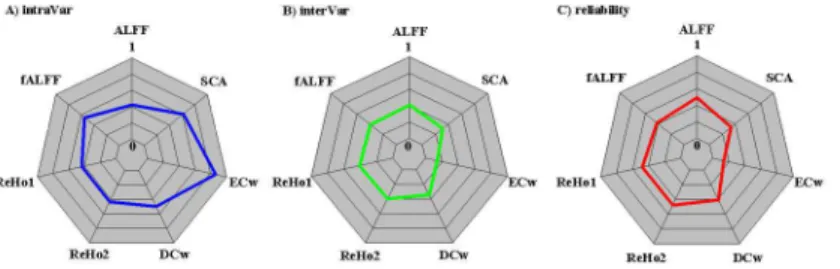
Our analyses produced a set of maps of the individual differences in intrinsic functional archi-tecture by delineating intra-individual, inter-individual variability and test-retest reliability across multiple metrics and multiple spatial scales of the human connectome. Specifically, we computed eight different functional metrics to characterize the human brain connectome at local, meso and global scales: ALFF, fALFF, ReHo1, ReHo2, SFC, DR, DCw and ECw to cap-ture the feacap-ture of the information processing in the weighted functional connectomes [2]. Ver-tex-wise maps of the individual variability and test-retest reliability depicted high-resolution distributions of variability and stability of these functional connectomics. In reporting these findings, we categorized the ICC into five common intervals [65]: 0<ICC0.2 (slight); 0.2< ICC0.4 (fair); 0.4<ICC0.6 (moderate); 0.6<ICC0.8 (substantial); and 0.8< ICC1.0 (almost perfect). Global mean measures of all these metrics (for DR, no global mean calculated regarding its methodological consideration) only exhibited fair to moderate test-retest reliability (Fig 2C), indicating their dynamic nature within subjects (Fig 2A) or limited between-subject variability (Fig 2B).
experiments (N = 10,449) that contains twelve (C1-Hand, C2-Mouth, C3-Auditory, C4-Visual, C5-Language, C6-Attention, C7-Autonomic, C8-Inhibition, C9-Working Memory,
C10-Default, C11-Basal and C12-Reward) components of cognition [66]. Percentages of high values (>= 0.4) and mean values are computed for all the networks and components. This strategy helps to shape the following reports of these large amount findings into a hierarchically organized framework.
Local Scales: Amplitude and Homogeneity
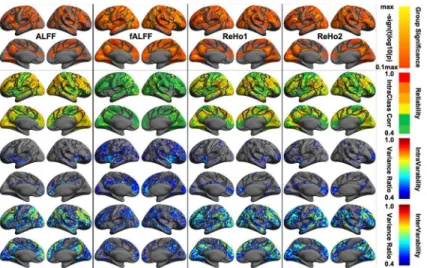
These four local metrics demonstrated moderate to almost perfect reliability across the cortex (Fig 4). ALFF and ReHo1, ReHo2 were very similar regarding their spatial patterns of individ-ual differences and reliability whereas fALFF was pretty different from them, showing largely
Fig 2. Quantification of variability of seven common rfMRI metrics across the whole cortical mantle. A) Auantification measures of intra-individual variability strength are plotted in polar form for amplitude of low-frequency fluctuations (ALFF), fractional ALFF (fALFF), regional homogeneity with length-one (ReHo1) and length-two (ReHo2) neighbors, seed-based connectivity analysis (SCA), weighted degree centrality (DCw) and eigenvector centrality (ECw). B) Auantification measures of inter-individual variability strength are plotted in polar form for the rfMRI metrics. C) Auantification measures of test-retest reliability strength are plotted in polar form for the rfMRI metrics. Note that for the purpose of visualization, all the strengths are normalized into a standard value between 0 and 1 by dividing the specific variance with the overall variance.
doi:10.1371/journal.pone.0144963.g002
Fig 3. Renders of canonical large-scale networks and cognitive components.A) The seven large-scale networks derived from a large sample (N = 1,000) of healthy resting-state brains [60] including Visual (Purple), Somatomotor (Blue), Dorsal Attention (Green), Ventral Attention (Violet), Limbic (Cream), Frontoparietal Control (Orange), Default (Red). This render projects these networks onto thefsaverage
surface grid with its dorsal, ventral, lateral, medial, anterior and posterior views of the left hemisphere (LH) and the right hemisphere (RH). Dark gray curves indicate the boundaries between the seven networks. B) A surface render of the cognitive ontology of the brain derived from a large data set of neuroimaging
experiments (N = 10,449) that contains twelve (C1-Hand, C2-Mouth, C3-Auditory, C4-Visual, C5-Language, C6-Attention, C7-Autonomic, C8-Inhibition, C9-Working Memory, C10-Default, C11-Basal and C12-Reward) components of cognition [66]. This image is reproduced and modified from [66].
reduced reliability and inter-individual variability. Specifically, regions with the highest reli-abilities were primarily located in Visual, DorsAttn, Control and Default networks where intra-individual variability were small, and inter-individual variability were high (S1 Table). An interesting observation is, across all the local metrics, the medial prefrontal cortex node of the default network were the most temporally dynamic region, especially for fALFF. This met-ric represents the most dynamic one among the four local measures with a focal site in the insular cortex. These highly reliable regions were linked to multiple cognitive components including working memory, attention, default, language, inhibition and visual processes (S2 Table). These high-level cognition processes exhibited low intra-individual variability and high inter-individual variability regarding their local functional characteristics.
Meso Scales: Networks and Modules
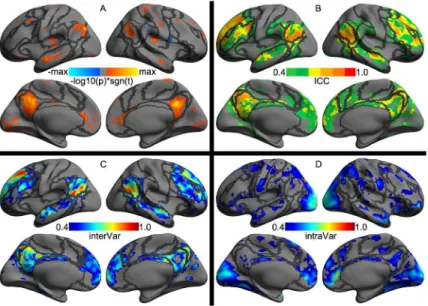
The left PCC region showed substantial test-retest reliability of its seed-based functional con-nectivity (Fig 5A) with a set of brain areas from both the Default network and Control network (Fig 5B). These two networks covered more than 60% of the reliable PCC’s SFC (S3 Table). Regarding the intra-individual variability, most dynamic SFC of the left PCC mainly connected with the Limbic and the Visual network (Fig 5D). Most test-retest reliable SFC of the PCC were associated with Default, Inhibition, Working Memory and Basal components of the human cognition, indicating low-level within-subject and high-level between-subject variability (S4 Table).
Spatial patterns of the seven cortical functional modules and their temporal interplays as well as their reliability and variability are presented inFig 6. DR-derived visual network con-nectivity reliably detectable within the Visual network and DorsAttn network while its inter-plays with the SomMot network and the Limbic network were reliable (S3 Table). These
Fig 4. Vertex-wise statistical maps of four common rfMRI metrics at local scales.Maps of group-level statistical significance strength (the first row), test-retest reliability (the second row), intra-individual variability (the third row) and inter-individual variability (the forth row) are rendered onto thefsaveragesurface grid with its lateral and medial views for amplitude and homogeneity metrics including amplitude of low-frequency fluctuations (ALFF, the first column), fractional ALFF (fALFF, the second column), regional homogeneity with length-one neighbors (ReHo1, the third column) and regional homogeneity with length-two neighbors (ReHo2, the forth column). Dark gray curves indicate the boundaries between the seven canonical neural networks.
Fig 5. Vertex-wise statistical maps of the seed-based rfMRI connectivity.Maps of group-level statistical significance strength (A), test-retest reliability (B), inter-individual variability (C) and inter-individual variability (D) are rendered onto thefsaveragesurface grid with its lateral and medial views. Dark gray curves indicate the boundaries between the seven canonical neural networks.
doi:10.1371/journal.pone.0144963.g005
Fig 6. Vertex-wise statistical maps of large-scale common modular metrics at meso scales of subnetworks.Maps of group-level significance strength (A), test-retest reliability (B), intra-individual variability (C) and inter-individual variability (D) are rendered onto thefsaveragesurface grid with its lateral and medial views for within-network functional specialization (spatial patterns) and between-network functional integration (temporal interactions or interplays) of the seven common large-scale neural networks: Visual, SomMot, DorsAttn, VentAttn, Limbic, Control, Default. Dark gray curves indicate the boundaries between the seven canonical neural networks. Each connection line is plotted with mixed colors of the two networks it connects.
functional connectivity spatially distributed to Visual and Attention cognitive components (S4 Table). The reliable SomMot network connectivity existed within itself and the two attention (DorsAttn and VentAttn) networks, and were involved in Hand and Mouth cognitive process. Beyond with the Visual network, its interplays with both the DorsAttn and the Limbic net-works were reliable. DR-derived connectivity of the Limbic network were not reliable in general while it had reliable interplays with other networks including Visual, SomMot, DorsAttn, Ven-tAttn and Default networks. No cognitive component contained test-retest reliable DR-derived Limbic connectivity.
DR-derived connectivity of the DorsAttn network were reliably presented with itself and the Control network while its temporal interactions with the VentAttn, Default, SomMot and Limbic networks were reliable. Regarding the related cognition processes, these DR-derived
connectivity profiles were linked to Attention, Working Memory and Visual components (S4
Table). The within-network DR connectivity of the VentAttn network and its connectivity with Control, DorsAttn, Default and SomMot networks were test-retest reliable. Dynamic interactions between the VentAttn network and Default, Limbic and DorsAttn networks were also reliably observed. Interestingly, this salience-related network showed reliable connectivity across all the 12 cognitive components, among which Inhibition, Working Memory and Atten-tion were the highest three. Beyond within-network connectivity, the Control network exhib-ited highly reliable connectivity with the two attention and default networks while no reliable between-network interplays were observed for such a highly flexible network. Working Mem-ory, Inhibition, Language and Attention components all had reliable connectivity with this net-work. Finally, the Default network DR connectivity were reliably distributed within Default, Control and Attention networks whereas its interplays with the two attention networks and the Limbic network were also test-retest reliable. This kind of reliable connectivity were reflected in cognitive components of Working Memory, Inhibition, Default, Language, Basal and Auditory.
Global Scales: Connectome
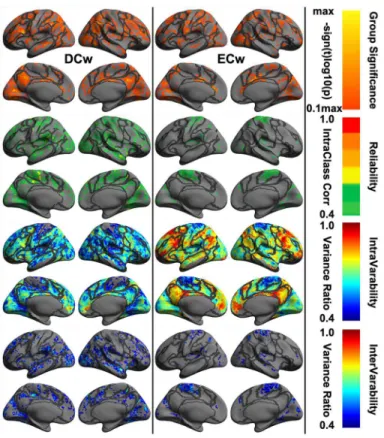
As a metric to measure the functionally local connection, DCw characterized the global-scale feature of the human brain connectome. This metric, at vertex-wise level, were only moderately test-retest reliable with very few nodes in parietal and temporal cortex, belonging to Control, Visual and SomMot networks (Fig 7). In contrast, ECw is a functionally global metric and failed in detecting test-retest reliable profiles across the whole cortex although there was a small set of nodes with moderate reliability assignment within parietal areas of the SomMot network (S5 Table). Low test-retest reliability was an indication of the high dynamics across time or intra-individual variability. This high-level instability of the network centrality demon-strated obvious regional specificity, e.g., the highest changes within the Default network. No reliable assignment of the network centrality metrics to the 12 cognitive components was detected (S6 Table).
Discussion
on large-scale longitudinal neuroimaging data (N = 300) via linear mixed models. For the first time, we delineate a landscape of the individual variability by examining changes of these met-rics within and across participants, as well as their test-retest reliability, over a one-month duration. We detected remarkable changes in the variability landscape across different metrics at multiple spatial scales (region, network and connectome). This landscape reveals that more global metrics exhibited larger intra-individual variability across all scales, reflecting the poten-tial inverse relationship between metric complexity and intra-individual variability. In contrast, inter-individual variability demonstrated much more diverse profiles across different metrics, echoing regional differences in functional connectomics at different scales and indicating orga-nizational topology underlying the intrinsic functional architecture in the human brain. Our findings not only depicted this variability landscape but also mapped test-retest reliability of the common functional metrics across one month by integrating both intra-individual and inter-individual variability, providing a resource as references on tests of these variability pro-files in brain development and disease conditions.
Resting-state fMRI (rfMRI) represents the most popular tool to investigate functional con-nectomics currently with a spatial scale of 2–4 millimeters and a temporal scale of 0.5–3 sec-onds [67,68]. Temporal dynamics is a hallmark of the human brain functional architecture measured with rfMRI and have been demonstrated as a major contributor to the
intra-Fig 7. Vertex-wise statistical maps of two common rfMRI metrics at connectome scales.Maps of group-level statistical significance strength (the first row), test-retest reliability (the second row), intra-individual variability (the third row) and inter-intra-individual variability (the forth row) are rendered onto the
fsaveragesurface grid with its lateral and medial views for weighted degree centrality (DCw) and weighted eigenvector centrality (ECw). Dark gray curves indicate the boundaries between the seven canonical neural networks.
individual variability across different temporal scales [69–71]. Previous studies have demon-strated that these intra-individual differences could be primarily dominated by the non-sta-tionary components in the rfMRI signals [72]. The time-varying degrees of functional
connectivity were commonly thought of as a reflection of flexibility in the functional coordina-tion between different neural systems [45,73,74]. Specifically, at the scale of minutes, high intra-individual variability was mainly presented in homotopic functional connectivity as well as non-homotopic between-network connectivity [41]. However, the spatial distribution of the most variable functional connectivity has been a controversy [45,75,76]. Our results provide evidence that local features or short-range metrics were more temporally stable than remote features or long-range metrics at scales of days. These parallel to those recent observations at scales of years (development or aging) [77,78].
Regarding spatial locations, the somatomotor network was the most temporally stable net-work, and this observation echoed the low intra-individual variability of sensory motor-related cognitive components including hand, mouth and auditory. The limbic network seemed to be most dynamic over the one month, although this might be an indication of the low signal-to-noise ratio during the rfMRI scan within this network. Beyond the two networks, the default network and dorsal attention network were also highly variable over a single month. These findings enriched previous observations of the dynamic functional connectivity at single scales by providing a full picture of its multi-scale spatial distribution (whole brain, networks and voxels). One significant and novel addition from the present work to the existing literature is the one-month temporal stability of 12 components of human cognition. Notably, working memory, inhibition, attention, language and visual process are the five most variable cognitive components in terms of their changes of the rfMRI metrics across different scales, whereas hand, auditory, mouth, autonomic, reward, basal and default components remain relatively stable over one month. Mapping intra-individual variability of various functional metrics derived from rfMRI voxel-wise further offered a high-resolution landscape of temporal dynam-ics in functional connectomes. This presents a resource for understanding how individual sta-ble structural connectomes generate their vast functional repertoire [79,80] and related dynamics [81–83] in enabling action, perception and cognition [73], as well as their alterations, under disease conditions [84].
Driving forces behind the inter-individual variability of brain structure and function are related to both genetic and environmental factors [85]. Such variability of the high-order asso-ciation cortex is less influenced by genetic factors with their neuroanatomical properties during development, preserving room for environmental factors to exert impacts on the functional variability [86]. With rfMRI, recent studies have increasingly shown inter-individual variability in functional connectivity. One consistent finding is that the variability in the heteromodal association cortex was significantly higher than that in unimodal cortex [39,87]. Inter-individ-ual variability in connectivity was significantly correlated with the degree of evolutionary corti-cal expansion [39]. Of note, all previous studies employed seed-based correlation or
components are more variable across participants. Together with vertex-wise high-resolution maps of this variability, the present work delineates a more completed picture of inter-individ-ual variability in functional connectomes, indicating the complexity of different aspects of information processing through connectomes and their individual differences reflected in the human brain intrinsic architecture [1,89].
By employing a set of canonical templates of the large-scale cortical functional networks [60], the dual regression method offers us the opportunity of examining the brain dynamics in func-tional connectomics across the one month. This depicts a relatively full picture of the funcfunc-tional connectome regarding its temporal variability and individual differences. One interesting obser-vation is that long-distance functional connectivity between networks or interplays/integrations seem more temporally dynamic than their changes across subjects (Fig 6C). In contrast, short-distance connectivity within the networks or functional specialization remained temporally stable than their between-subject variability (Fig 6D). These findings are consistent with the previous reports at scales of years (brain development and aging across the lifespan) [90–96], which recently have been linked to lifespan changes of behaviors across individuals [97].
Intra-individual and inter-individual variability are two important contributing factors to the reliability of metrics in functional connectomics. Applications, especially in clinical diagno-sis, favor metrics with high test-retest reliability, which optimizes a trade-off between the two variability components with low intra-individual variability (more stable across different mea-suring occasions) and high inter-individual variability (more differentiable across participants), and serves as a necessary condition for high validity of a biomarker [17]. Previous studies have demonstrated moderate to high test-retest reliability of common functional connectome met-rics [19], although the sample sizes in these test-retest studies were limited. A recent Consor-tium for Reliability and Reproducibility (CoRR) released more than 5,000 test-retest multi-modal imaging datasets to the connectomics field [47], providing an open resource for large-scale test-retest reliability exploration in functional connectomics. The present datasets are part of the CoRR datasets. All the preprocessed data and CCS scripts in the present work will be made public to the field soon after the final acceptance of the current work via a data-shar-ing platform in the Institute of Psychology, Chinese Academy of Sciences. These finddata-shar-ings rep-resent the first collection of test-retest reliability for multi-scale and multi-metric
characterization of functional human connectomes. As demonstrated in a recent study on reli-ability-based correction for functional connectivity [98], these test-retest reliability maps gen-erated by the current work can serve as the essential resources for attenuation correction for functional connectomics (i.e., these rfMRI-based metrics) [19] and thus are crucial for the field to guide the use and correction of common functional metrics, as well as their explanation, in applications.
Regional differences in signal-to-noise ratio [60,61] have been reported, and their influ-ences on test-retest reliability need further investigation in future. Methodological issues such as smoothing, filtering and global signal regression could disturb individual variability [99,
Supporting Information
S1 Table. Network summary on individual differences and test-retest reliability of common rfMRI metrics at local scales.
(PDF)
S2 Table. Cognition summary on individual differences and test-retest reliability of com-mon rfMRI metrics at local scales.
(PDF)
S3 Table. Network summary on individual differences and test-retest reliability of common rfMRI metrics at meso scales.
(PDF)
S4 Table. Cognition summary on individual differences and test-retest reliability of com-mon rfMRI metrics at meso scales.
(PDF)
S5 Table. Network summary on individual differences and test-retest reliability of common rfMRI metrics at global scales.
(PDF)
S6 Table. Cognition summary on individual differences and test-retest reliability of com-mon rfMRI metrics at global scales.
(PDF)
Acknowledgments
This work was partially supported by the National Key Basic Research and Development (973) Program (2015CB351702, X-NZ), the Major Joint Fund for International Cooperation and Exchange of the National Natural Science Foundation (81220108014, X-NZ), the Hundred Talents Program and the Key Research Program (KSZD-EW-TZ-002, X-NZ) of the Chinese Academy of Sciences, the Natural Science Foundation of China (31070905, 31371134, 81171409 and 81471740) and the National Social Science Foundation of China (11AZD119). The computations were performed on the Dell Blade Cluster System at the Institute of Psychol-ogy, Chinese Academy of Sciences. We thank Dr. B.T. Thomas Yeo for discussions about the use of the cognitive ontology and Dr. Richard F. Betzel for proof-reading of the final version of the manuscript.
Author Contributions
Conceived and designed the experiments: XNZ XW. Performed the experiments: BC. Analyzed the data: BC TX XNZ. Contributed reagents/materials/analysis tools: BC TX NY HMD ZY XNZ. Wrote the paper: BC TX CZ LW ZW NY HMD ZY YFZ XNZ XW.
References
1. Biswal BB, Mennes M, Zuo XN, Gohel S, Kelly C, Smith SM, et al. Toward discovery science of human brain function. Proc Natl Acad Sci U S A. 2010; 107(10):4734–9. doi:10.1073/pnas. 0911855107PMID:20176931
3. Smith SM, Vidaurre D, Beckmann CF, Glasser MF, Jenkinson M, Miller KL, et al. Functional connec-tomics from resting-state fMRI. Trends Cogn Sci. 2013; 17(12):666–82. doi:10.1016/j.tics.2013.09. 016PMID:24238796
4. Buckner RL, Krienen FM, Yeo BT. Opportunities and limitations of intrinsic functional connectivity MRI. Nat Neurosci. 2013; 16(7):832–7. doi:10.1038/nn.3423PMID:23799476
5. Zhang D, Raichle ME. Disease and the brain’s dark energy. Nat Rev Neurol. 2010; 6(1):15–28. doi: 10.1038/nrneurol.2009.198PMID:20057496
6. Di Martino A, Yan CG, Li Q, Denio E, Castellanos FX, Alaerts K, et al. The autism brain imaging data exchange: towards a large-scale evaluation of the intrinsic brain architecture in autism. Mol Psychia-try. 2014; 19(6):659–67. doi:10.1038/mp.2013.78PMID:23774715
7. Biswal B, Yetkin FZ, Haughton VM, Hyde JS. Functional connectivity in the motor cortex of resting human brain using echo-planar MRI. Magn Reson Med. 1995; 34(4):537–41. doi:10.1002/mrm. 1910340409PMID:8524021
8. Greicius MD, Krasnow B, Reiss AL, Menon V. Functional connectivity in the resting brain: a network analysis of the default mode hypothesis. Proc Natl Acad Sci U S A. 2003; 100(1):253–8. doi:10.1073/ pnas.0135058100PMID:12506194
9. Murphy K, Birn RM, Bandettini PA. Resting-state fMRI confounds and cleanup. Neuroimage. 2013; 80:349–59. doi:10.1016/j.neuroimage.2013.04.001PMID:23571418
10. Zang YF, He Y, Zhu CZ, Cao QJ, Sui MQ, Liang M, et al. Altered baseline brain activity in children with ADHD revealed by resting-state functional MRI. Brain Dev. 2007; 29(2):83–91. doi:10.1016/j. braindev.2006.07.002PMID:16919409
11. Zou QH, Zhu CZ, Yang Y, Zuo XN, Long XY, Cao QJ, et al. An improved approach to detection of amplitude of low-frequency fluctuation (ALFF) for resting-state fMRI: fractional ALFF. J Neurosci Methods. 2008; 172(1):137–41. doi:10.1016/j.jneumeth.2008.04.012PMID:18501969
12. Zang Y, Jiang T, Lu Y, He Y, Tian L. Regional homogeneity approach to fMRI data analysis. Neuro-image. 2004; 22(1):394–400. doi:10.1016/j.neuroimage.2003.12.030PMID:15110032
13. He Y, Wang J, Wang L, Chen ZJ, Yan C, Yang H, et al. Uncovering intrinsic modular organization of spontaneous brain activity in humans. PLoS One. 2009; 4(4):e5226. doi:10.1371/journal.pone. 0005226PMID:19381298
14. Jiang L, Xu T, He Y, Hou XH, Wang J, Cao XY, et al. Functional homogeneity in the human cortex: Regional variation, morphological association and functional covariance network. Brain Struct Funct. 2015; 220(5):2485–507. doi:10.1007/s00429-014-0795-8PMID:24903825
15. Jiang L, Zuo XN. Regional homogeneity: A multi-modal, multi-scale neuroimaging marker of the human brain connectome. Neuroscentist. 2015; Epub ahead of print: In press.
16. Anderson JS, Zielinski BA, Nielsen JA, Ferguson MA. Complexity of low-frequency blood oxygen level-dependent fluctuations covaries with local connectivity. Hum Brain Mapp. 2014; 35(4):1273–83. doi:10.1002/hbm.22251PMID:23417795
17. Kraemer HC. The reliability of clinical diagnoses: state of the art. Annu Rev Clin Psychol. 2014; 10:111–30. doi:10.1146/annurev-clinpsy-032813-153739PMID:24387235
18. Li Z, Kadivar A, Pluta J, Dunlop J, Wang Z. Test-retest stability analysis of resting brain activity revealed by blood oxygen level-dependent functional MRI. J Magn Reson Imaging. 2002; 36(2):344–
54. doi:10.1002/jmri.23670
19. Zuo XN, Xing XX. Test-retest reliabilities of resting-state FMRI measurements in human brain func-tional connectomics: a systems neuroscience perspective. Neurosci Biobehav Rev. 2014; 45:100–
18. doi:10.1016/j.neubiorev.2014.05.009PMID:24875392
20. Zuo XN, Di Martino A, Kelly C, Shehzad ZE, Gee DG, Klein DF, et al. The oscillating brain: complex and reliable. Neuroimage. 2010; 49(2):1432–45. doi:10.1016/j.neuroimage.2009.09.037PMID: 19782143
21. Zuo XN, Xu T, Jiang L, Yang Z, Cao XY, He Y, et al. Toward reliable characterization of functional homogeneity in the human brain: preprocessing, scan duration, imaging resolution and computational space. Neuroimage. 2013; 65:374–86. doi:10.1016/j.neuroimage.2012.10.017PMID:23085497 22. Shehzad Z, Kelly AM, Reiss PT, Gee DG, Gotimer K, Uddin LQ, et al. The resting brain: unconstrained
yet reliable. Cereb Cortex. 2009; 19(10):2209–29. doi:10.1093/cercor/bhn256PMID:19221144 23. Zuo XN, Kelly C, Adelstein JS, Klein DF, Castellanos FX, Milham MP. Reliable intrinsic connectivity
networks: test-retest evaluation using ICA and dual regression approach. Neuroimage. 2010; 49 (3):2163–77. doi:10.1016/j.neuroimage.2009.10.080PMID:19896537
25. Wang J, Zuo X, Dai Z, Xia M, Zhao Z, Zhao X, et al. Disrupted functional brain connectome in individu-als at risk for Alzheimer’s disease. Biol Psychiatry. 2013; 73(5):472–81. doi:10.1016/j.biopsych.2012. 03.026PMID:22537793
26. Liao XH, Xia MR, Xu T, Dai ZJ, Cao XY, Niu HJ, et al. Functional brain hubs and their test-retest reli-ability: A multiband resting-state functional MRI study. Neuroimage. 2013; 83:969–82. doi:10.1016/j. neuroimage.2013.07.058PMID:23899725
27. Du HX, Liao XH, Lin QX, Li GS, Chi YZ, Liu X, et al. Test-Retest reliability of graph metrics in high-res-olution functional connectomics: A resting-state functional MRI study. CNS Neurosci Ther. 2015; 21 (10):802–16. doi:10.1111/cns.12431PMID:26212146
28. Thomason ME, Dennis EL, Joshi AA, Joshi SH, Dinov ID, Chang C, et al. Resting-state fMRI can reli-ably map neural networks in children. Neuroimage. 2011; 55(1):165–75. doi:10.1016/j.neuroimage. 2010.11.080PMID:21134471
29. Somandepalli K, Kelly C, Reiss PT, Zuo XN, Craddock RC, Yan CG, et al. Short-term test-retest reli-ability and repeatreli-ability of resting state fMRI metrics in children with and without attention-deficit/ hyperactivity disorder. Dev Cogn Neurosci. 2015; 15:83–93. doi:10.1016/j.dcn.2015.08.003PMID: 26365788
30. Guo CC, Kurth F, Zhou J, Mayer EA, Eickhoff SB, Kramer JH, et al. One-year test-retest reliability of intrinsic connectivity network fMRI in older adults. Neuroimage. 2012; 61(4):1471–83. doi:10.1016/j. neuroimage.2012.03.027PMID:22446491
31. Song J, Desphande AS, Meier TB, Tudorascu DL, Vergun S, Nair VA, et al. Age-related differences in test-retest reliability in resting-state brain functional connectivity. PLoS One. 2012; 7(12):e49847. doi: 10.1371/journal.pone.0049847PMID:23227153
32. Orban P, Madjar C, Savard M, Dansereau C, Tam A, Das S, et al. Test-retest resting-state fMRI in healthy elderly persons with a family history of Alzheimer’s disease. Sci Data. 2015; 2:150043. doi: 10.1038/sdata.2015.43PMID:26504522
33. Blautzik J, Keeser D, Berman A, Paolini M, Kirsch V, Mueller S, et al. Long-term test-retest reliability of resting-state networks in healthy elderly subjects and with amnestic mild cognitive impairment patients. J Alzheimers Dis. 2013; 34(3):741–54. PMID:23271315
34. Shrout PE, Fleiss JL. Intraclass correlations: uses in assessing rater reliability. Psychol Bull. 1979; 86 (2):420–8. doi:10.1037/0033-2909.86.2.420PMID:18839484
35. Weir JP. Quantifying test-retest reliability using the intraclass correlation coefficient and the SEM. J Strength Cond Res. 2005; 19(1):231–40. doi:10.1519/00124278-200502000-00038PMID: 15705040
36. Yan C, Liu D, He Y, Zou Q, Zhu C, Zuo X, et al. Spontaneous brain activity in the default mode network is sensitive to different resting-state conditions with limited cognitive load. PLoS One. 2009; 4(5): e5743. doi:10.1371/journal.pone.0005743PMID:19492040
37. Yan CG, Cheung B, Kelly C, Colcombe S, Craddock RC, Di Martino A, et al. A comprehensive assessment of regional variation in the impact of head micromovements on functional connectomics. Neuroimage. 2013; 76:183–201. doi:10.1016/j.neuroimage.2013.03.004PMID:23499792
38. Yan CG, Craddock RC, Zuo XN, Zang YF, Milham MP. Standardizing the intrinsic brain: towards robust measurement of inter-individual variation in 1000 functional connectomes. Neuroimage. 2013; 80:246–62. doi:10.1016/j.neuroimage.2013.04.081PMID:23631983
39. Mueller S, Wang DH, Fox MD, Yeo BTT, Sepulcre J, Sabuncu MR, et al. Individual variability in func-tional connectivity architecture of the human brain. Neuron. 2013; 77(3):586–95. doi:10.1016/j. neuron.2012.12.028PMID:23395382
40. Wang D, Buckner RL, Fox MD, Holt DJ, Holmes AJ, Stoecklein S, et al. Parcellating cortical functional networks in individuals. Nat Neurosci. 2015; 18(2):1853–60. doi:10.1038/nn.4164PMID:26551545 41. Gonzalez-Castillo J, Handwerker DA, Robinson ME, Hoy CW, Buchanan LC, Saad ZS, et al. The
spa-tial structure of resting state connectivity stability on the scale of minutes. Front Neurosci. 2014; 8:138. doi:10.3389/fnins.2014.00138PMID:24999315
42. Poldrack RA, Laumann T, Koyejo O, Gregory R, Hover A, Chen MY, et al. Long-term neural and phys-iological phenotyping of a single human. Nat Commun. 2015; 6:8885. doi:10.1038/ncomms9885 PMID:26648521
43. Laumann TO, Gordon EM, Adeyemo B, Snyder AZ, Joo SJ, Chen MY, et al. Functional system and areal organization of a highly sampled individual human brain. Neuron. 2015; 87(3):657–70. doi:10. 1016/j.neuron.2015.06.037PMID:26212711
45. Allen EA, Damaraju E, Plis SM, Erhardt EB, Eichele T, Calhoun VD. Tracking whole-brain connectivity dynamics in the resting state. Cereb Cortex. 2014; 24:663–76. doi:10.1093/cercor/bhs352PMID: 23146964
46. Kelly C, Biswal BB, Craddock RC, Castellanos FX, Milham MP. Characterizing variation in the func-tional connectome: promise and pitfalls. Trends Cogn Sci. 2012; 16(3):181–8. doi:10.1016/j.tics. 2012.02.001PMID:22341211
47. Zuo XN, Anderson JS, Bellec P, Birn RM, Biswal BB, Blautzik J, et al. An open science resource for establishing reliability and reproducibility in functional connectomics. Sci Data. 2014; 1:140049. doi: 10.1038/sdata.2014.49PMID:25977800
48. Cox RW. AFNI: what a long strange trip it’s been. Neuroimage. 2012; 62(2):743–7. doi:10.1016/j. neuroimage.2011.08.056PMID:21889996
49. Fischl B, Sereno MI, Dale AM. Cortical based analysis. II: Inflation, flattening, and a surface-based coordinate system. Neuroimage. 1999; 9(2):195–207. doi:10.1006/nimg.1998.0396PMID: 9931269
50. Jenkinson M, Beckmann CF, Behrens TE, Woolrich MW, Smith SM. FSL. Neuroimage. 2012; 62 (2):782–90. doi:10.1016/j.neuroimage.2011.09.015PMID:21979382
51. Xu T, Yang Z, Jiang L, Xing XX, Zuo XN. A Connectome Computation System for discovery science of brain. Sci Bull. 2015; 60(1):86–95. doi:10.1007/s11434-014-0698-3
52. Xing XX, Zhou YL, Adelstein JS, Zuo XN. PDE-based spatial smoothing: a practical demonstration of impacts on MRI brain extraction, tissue segmentation and registration. Magn Reson Imaging. 2011; 29(5):731–8. doi:10.1016/j.mri.2011.02.007PMID:21531104
53. Zuo XN, Xing XX. Effects of non-local diffusion on structural MRI preprocessing and default network mapping: statistical comparisons with isotropic/anisotropic diffusion. PLoS One. 2011; 6(10):e26703. doi:10.1371/journal.pone.0026703PMID:22066005
54. Dale AM, Fischl B, Sereno MI. Cortical surface-based analysis. I. Segmentation and surface recon-struction. Neuroimage. 1999; 9(2):179–94. doi:10.1006/nimg.1998.0395PMID:9931268 55. Segonne F, Pacheco J, Fischl B. Geometrically accurate topology-correction of cortical surfaces
using nonseparating loops. IEEE Trans Med Imaging. 2007; 26(4):518–29. doi:10.1109/TMI.2006. 887364PMID:17427739
56. Power JD, Barnes KA, Snyder AZ, Schlaggar BL, Petersen SE. Spurious but systematic correlations in functional connectivity MRI networks arise from subject motion. Neuroimage. 2012; 59(3):2142–54. doi:10.1016/j.neuroimage.2011.10.018PMID:22019881
57. Carp J. Optimizing the order of operations for movement scrubbing: Comment on Power et al. Neuro-image. 2013; 76:436–8. doi:10.1016/j.neuroimage.2011.12.061PMID:22227884
58. Greve DN, Fischl B. Accurate and robust brain image alignment using boundary-based registration. Neuroimage. 2009; 48(1):63–72. doi:10.1016/j.neuroimage.2009.06.060PMID:19573611 59. Jo HJ, Saad ZS, Simmons WK, Milbury LA, Cox RW. Mapping sources of correlation in resting state
FMRI, with artifact detection and removal. Neuroimage. 2010; 52(2):571–82. doi:10.1016/j. neuroimage.2010.04.246PMID:20420926
60. Yeo BT, Krienen FM, Sepulcre J, Sabuncu MR, Lashkari D, Hollinshead M, et al. The organization of the human cerebral cortex estimated by intrinsic functional connectivity. J Neurophysiol. 2011; 106 (3):1125–65. doi:10.1152/jn.00338.2011PMID:21653723
61. Holmes AJ, Hollinshead MO, OKeefe TM, Petrov VI, Fariello GR, Wald LL, et al. Brain Genomics Superstruct Project initial data release with structural, functional, and behavioral measures. Sci Data. 2015; 2:150031. doi:10.1038/sdata.2015.31PMID:26175908
62. Buckner RL, Sepulcre J, Talukdar T, Krienen FM, Liu H, Hedden T, et al. Cortical hubs revealed by intrinsic functional connectivity: mapping, assessment of stability, and relation to Alzheimer’s disease. J Neurosci. 2009; 29(6):1860–73. doi:10.1523/JNEUROSCI.5062-08.2009PMID:19211893 63. Lohmann G, Margulies DS, Horstmann A, Pleger B, Lepsien J, Goldhahn D, et al. Eigenvector
central-ity mapping for analyzing connectivcentral-ity patterns in fMRI data of the human brain. PLoS One. 2010; 5 (4):e10232. doi:10.1371/journal.pone.0010232PMID:20436911
64. Wink AM, de Munck JC, van der Werf YD, van den Heuvel OA, Barkhof F. Fast eigenvector centrality mapping of voxel-wise connectivity in functional magnetic resonance imaging: implementation, valida-tion, and interpretation. Brain Connect. 2012; 2(5):265–74. doi:10.1089/brain.2012.0087PMID: 23016836
66. Yeo BT, Krienen FM, Sepulcre J, Sabuncu MR, Lashkari D, Hollinshead M, et al. Functional speciali-zation and flexibility in human association cortex. Cereb Cortex. 2015; 25(10):3654–72. doi:10.1093/ cercor/bhu217PMID:25249407
67. Biswal BB. Resting state fMRI: a personal history. Neuroimage. 2012; 62(2):938–44. doi:10.1016/j. neuroimage.2012.01.090PMID:22326802
68. Smith SM, Beckmann CF, Andersson J, Auerbach EJ, Bijsterbosch J, Douaud G, et al. Resting-state fMRI in the Human Connectome Project. Neuroimage. 2013; 80:144–68. doi:10.1016/j.neuroimage. 2013.05.039PMID:23702415
69. Hutchison RM, Womelsdorf T, Allen EA, Bandettini PA, Calhoun VD, Corbetta M, et al. Dynamic func-tional connectivity: promise, issues, and interpretations. Neuroimage. 2013; 80:360–78. doi:10.1016/ j.neuroimage.2013.05.079PMID:23707587
70. Calhoun VD, Miller R, Pearlson G, Adali T. The chronnectome: time-varying connectivity networks as the next frontier in fMRI data discovery. Neuron. 2014; 84(2):262–74. doi:10.1016/j.neuron.2014.10. 015PMID:25374354
71. Keilholz SD. The neural basis of time-varying resting-state functional connectivity. Brain Connect. 2014; 4(10):769–79. doi:10.1089/brain.2014.0250PMID:24975024
72. Messe A, Rudrauf D, Benali H, Marrelec G. Relating structure and function in the human brain: relative contributions of anatomy, stationary dynamics, and non-stationarities. PLoS Comput Biol. 2014; 10 (3):e1003530. doi:10.1371/journal.pcbi.1003530PMID:24651524
73. Park HJ, Friston K. Structural and functional brain networks: from connections to cognition. Science. 2013; 342(6158):1238411. doi:10.1126/science.1238411PMID:24179229
74. Baker AP, Brookes MJ, Rezek IA, Smith SM, Behrens T, Probert Smith PJ, et al. Fast transient net-works in spontaneous human brain activity. Elife. 2014; 3:e01867. doi:10.7554/eLife.01867PMID: 24668169
75. Zalesky A, Fornito A, Cocchi L, Gollo LL, Breakspear M. Time-resolved resting-state brain networks. Proc Natl Acad Sci U S A. 2014; 111(28):10341–6. doi:10.1073/pnas.1400181111PMID:24982140 76. Schaefer A, Margulies DS, Lohmann G, Gorgolewski KJ, Smallwood J, Kiebel SJ, et al. Dynamic
net-work participation of functional connectivity hubs assessed by resting-state fMRI. Front Hum Neu-rosci. 2014; 8:195. doi:10.3389/fnhum.2014.00195PMID:24860458
77. Betzel RF, Fukushima M, He Y, Zuo XN, Sporns O. Dynamic fluctuations coincide with periods of high and low modularity in resting-state functional brain networks. arXiv.org. 2015;arXiv:1511.06352v1. 78. Fukushima M, Betzel RF, He Y, Zuo XN, Sporns O. Characterizing spatial patterns and flow dynamics
in functional connectivity states and their changes across the human lifespan. arXiv.org. 2015; arXiv:1511.06427v1.
79. Honey CJ, Kotter R, Breakspear M, Sporns O. Network structure of cerebral cortex shapes functional connectivity on multiple time scales. Proc Natl Acad Sci U S A. 2007; 104(24):10240–5. doi:10.1073/ pnas.0701519104PMID:17548818
80. Deco G, Ponce-Alvarez A, Mantini D, Romani GL, Hagmann P, Corbetta M. Resting-state functional connectivity emerges from structurally and dynamically shaped slow linear fluctuations. J Neurosci. 2013; 33(27):11239–52. doi:10.1523/JNEUROSCI.1091-13.2013PMID:23825427
81. Deco G, McIntosh AR, Shen K, Hutchison RM, Menon RS, Everling S, et al. Identification of optimal structural connectivity using functional connectivity and neural modeling. J Neurosci. 2014; 34 (23):7910–6. doi:10.1523/JNEUROSCI.4423-13.2014PMID:24899713
82. Barttfeld P, Uhrig L, Sitt JD, Sigman M, Jarraya B, Dehaene S. Signature of consciousness in the dynamics of resting-state brain activity. Proc Natl Acad Sci U S A. 2015; 112(3):887–92. doi:10.1073/ pnas.1418031112PMID:25561541
83. Shen K, Hutchison RM, Bezgin G, Everling S, McIntosh AR. Network structure shapes spontaneous functional connectivity dynamics. J Neurosci. 2015; 35(14):5579–88. doi:10.1523/JNEUROSCI. 4903-14.2015PMID:25855174
84. Hellyer PJ, Scott G, Shanahan M, Sharp DJ, Leech R. Cognitive Flexibility through Metastable Neural Dynamics Is Disrupted by Damage to the Structural Connectome. J Neurosci. 2015; 35(24):9050–63. doi:10.1523/JNEUROSCI.4648-14.2015PMID:26085630
85. Anderson ML, Finlay BL. Allocating structure to function: the strong links between neuroplasticity and natural selection. Front Hum Neurosci. 2014; 7(3):918. doi:10.3389/fnhum.2013.00918PMID: 24431995
87. Gao W, Elton A, Zhu H, Alcauter S, Smith JK, Gilmore JH, et al. Intersubject variability of and genetic effects on the brain’s functional connectivity during infancy. J Neurosci. 2014; 34(34):11288–96. doi: 10.1523/JNEUROSCI.5072-13.2014PMID:25143609
88. Smith DV, Utevsky AV, Bland AR, Clement N, Clithero JA, Harsch AE, et al. Characterizing individual differences in functional connectivity using dual-regression and seed-based approaches. Neuro-image. 2014; 95:1–12. doi:10.1016/j.neuroimage.2014.03.042PMID:24662574
89. Bassett DS, Gazzaniga MS. Understanding complexity in the human brain. Trends Cogn Sci. 2011; 15(5):200–9. doi:10.1016/j.tics.2011.03.006PMID:21497128
90. Cao M, Wang JH, Dai ZJ, Cao XY, Jiang LL, Fan FM, et al. Topological organization of the human brain functional connectome across the lifespan. Dev Cogn Neurosci. 2014; 7:76–93. doi:10.1016/j. dcn.2013.11.004PMID:24333927
91. Yang Z, Chang C, Xu T, Jiang L, Handwerker DA, Castellanos FX, et al. Connectivity trajectory across lifespan differentiates the precuneus from the default network. Neuroimage. 2014; 89C:45–56. doi: 10.1016/j.neuroimage.2013.10.039
92. Betzel RF, Byrge L, He Y, Goni J, Zuo XN, Sporns O. Changes in structural and functional connectivity among resting-state networks across the human lifespan. Neuroimage. 2014; 102 Pt 2:345–57. doi: 10.1016/j.neuroimage.2014.07.067PMID:25109530
93. Betzel RF, Avena-Koenigsberger A, Goni J, He Y, de Reus MA, Griffa A, et al. Generative models of the human connectome. Neuroimage. 2016; 124(Pt A):1054–1064. doi:10.1016/j.neuroimage.2015. 09.041
94. Chan MY, Park DC, Savalia NK, Petersen SE, Wig GS. Decreased segregation of brain systems across the healthy adult lifespan. Proc Natl Acad Sci U S A. 2014; 111(46):E4997–5006. doi:10. 1073/pnas.1415122111PMID:25368199
95. Zhao T, Cao M, Niu H, Zuo XN, Evans A, He Y, et al. Age-related changes in the topological organiza-tion of the white matter structural connectome across the human lifespan. Hum Brain Mapp. 2015; 36 (10):3777–92. doi:10.1002/hbm.22877PMID:26173024
96. Gu S, Satterthwaite TD, Medaglia JD, Yang M, Gur RE, Gur RC, et al. Emergence of system roles in normative neurodevelopment. Proc Natl Acad Sci U S A. 2015; 112(44):13681–6. doi:10.1073/pnas. 1502829112PMID:26483477
97. He Y, Xu T, Wei Zhang, Zuo XN. Lifespan anxiety is reflected in intrinsic amygdala cortical connectiv-ity. Hum Brain Mapp. 2016; Epub ahead of print: In press.
98. Mueller S, Wang DH, Fox MD, Pan R, Lu J, Li K, et al. Reliability correction for functional connectivity: Theory and implementation. Hum Brain Mapp. 2015; 36(11):4664–80. doi:10.1002/hbm.22947 PMID:26493163
99. Saad ZS, Gotts SJ, Murphy K, Chen G, Jo HJ, Martin A, et al. Trouble at rest: how correlation patterns and group differences become distorted after global signal regression. Brain Connect. 2012; 2(1):25–
32. doi:10.1089/brain.2012.0080PMID:22432927