Integrating field surveys and remote sensing data to
study distribution, habitat use and conservation status
of the herpetofauna of the Comoro Islands
Oliver Hawlitschek1, Boris Brückmann1, Johannes Berger1, Katie Green2,
Frank Glaw1
1 Zoologische Staatssammlung München (Bavarian State Collection of Zoology), Münchhausenstr. 21, 81247 München, Germany 2 Bristol Conservation and Science Foundation, Comoros Project Oice, Anjouan, Union des Comores
Corresponding author:Oliver Hawlitschek ([email protected])
Academic editor:F. Andreone | Received 1 June 2011 | Accepted 12 October 2011 | Published 3 November 2011
Citation: Hawlitschek O, Brückmann B, Berger J, Green K, Glaw F (2011) Integrating ield surveys and remote sensing data to study distribution, habitat use and conservation status of the herpetofauna of the Comoro Islands. ZooKeys 144: 21–79 doi: 10.3897/zookeys.144.1648
Abstract
We studied the non-marine reptile and amphibian species of the volcanic Comoro archipelago in the Western Indian Ocean, a poorly known island herpetofauna comprising numerous microendemic species of potentially high extinction risk and widespread, non-endemic and often invasive taxa. According to our data, the Comoro islands are inhabited by two amphibian species and at least 28 species of reptiles although ongoing genetic studies and unconirmed historical records suggest an even higher species di-versity. 14 of the 28 currently recognized species of terrestrial reptiles (50%) and the two amphibians are endemic to a single island or to the Comoro archipelago. he majority of species are most abundant at low elevation. However, a few endemic species, like the gekkonid lizards Paroedura sanctijohannis and
Phelsuma nigristriata, are more common in or even conined to higher altitudes. We created habitat maps from remotely sensed data in combination with detailed species distribution maps produced using com-prehensive data from ield surveys between 2000 and 2010, literature, and historical locality records based on specimens in zoological collections. Using these data, we assessed the conservation status of the endemic terrestrial reptiles and amphibians according to the IUCN Red List criteria. Our results show that although little area of natural forest remains on the Comoros, many species are abundant in degraded forest or plantations. Competition and predation by invasive species appears to be the most important threat factor for the endemic herpetofauna, together with habitat degradation and destruction, which further favours invasive species. We propose the status Endangered for three species, Vulnerable for one species, Near hreatened for six species, Least Concern for four and Data Deicient for two species. he
www.zookeys.org
Copyright Oliver Hawlitschek et al. This is an open access article distributed under the terms of the Creative Commons Attribution License, which permits unrestricted use, distribution, and reproduction in any medium, provided the original author and source are credited.
Oliver Hawlitschek et al. / ZooKeys 144: 21–79 (2011) 22
endemic subspecies Oplurus cuvieri comorensis is proposed for the status Critically Endangered. Based on the results of this study, seven areas of importance for reptile and amphibian conservation on the Comoros are identiied. his study shows how remote sensing data can contribute to increasing accuracy and objec-tiveness of conservation assessments.
Résumé:
Nous avons étudié les reptiles et amphibiens non marinsde l´archipel volcanique des Comores, Océan Indien occidental, une herpétofaune insulaire peu connue et comprenante à la fois de nombreuses es-pèces microendémiques à risque d´extinction potentiellement élevé, et des eses-pèces non endémiques à grande aire de distribution, souvent invasives. D´après nos données, l´archipel des Comores est habité par 2 espèces d´amphibiens et au moins 28 espèces de reptiles, bien que des études génétiques en cours et des données historiques non conirmées suggèrent une diversité spéciique plus élevée. 14 des 28 es-pèces de reptiles terrestres actuellement référencés (50%) et les 2 eses-pèces d´amphibiens sont endémiques d´une seule île ou de l´archipel. La majorité des espèces sont plus abondantes à basse altitude. Cependant quelques espèces endémiques comme les lezards Gekkonidae Paroedura sanctijohannis et Phelsuma ni-gristriata sontplus communs ouconinés à l'altitude élevée. Nous avons réalisé des cartes des habitats à partir de données de télédétection ainsi que des cartes détaillées de distribution des espèces en combinant des données obtenues au cours de mission de terrain entre 2000 et 2010, des données de la littérature et des données de distribution historiques basées sur des spécimens de collections zoologiques. A partir de ces données, nous avons évalué le statut de conservation des espèces endémiques de reptiles terrestres et d´amphibiens d´après les critères de la liste rouge de l´UICN. Nos resultats montrent que bien qu´il reste de petites zones de forêt naturelle aux Comores, beaucoup d´espèces sont abondantes dans les forêts de-gradés et les plantations. La competition et la prédation par les espèces invasives apparaît comme la plus grosse menace pesant sur l´herpétofaune endémique, aux quelles il convient d´ajouter les dégradations et la destruction des habitats, qui en outré favorise les espèces invasives. Nous proposons le statut En-dangered (en danger) pour 3 espèces, Vulnerable (vulnérable) pour une espèce, Near hreatened (quasi menacée) pour 6 espèces, Least Concern (preoccupation mineure) pour 4 et Data Deicient (données insuisantes) pour 2 espèces. Le statut Critically Endangered (danger critique d’extinction) est proposé pour la sous-espèce Oplurus cuvieri comorensis. Sur la base de ces résultats, 7 régions d´importance pour la conservation des reptiles et amphibiens des Comores sont identiiées. Cette étude montre comment les données de télédétection peuvent contribuer à accroître la précision et l’objectivité des estimations de conservation.
Keywords
amphibians; area of occupancy; conservation planning; IUCN Red List; Landsat; protected areas; reptiles; satellite imagery; Western Indian Ocean
Introduction
been documented for birds (Temple 1985) and reptiles (Case et al. 1992, Cheke and Hume 2008).
In order to predict and prevent future extinctions, it is necessary to detect threat-ened species and assess the degree of threat they are facing. he IUCN Red List has become the reference to the status of threatened species worldwide and an important tool in biodiversity monitoring and conservation planning (Stuart et al. 2004, Rodri-gues et al. 2006, Vié et al. 2008, Hofmann et al. 2010). Initially, Red List status as-sessments were based solely on the experience and opinion of the assessors; no formal criteria were available (Burton 2003). he irst set of objective criteria was released in IUCN (1994), and revised in IUCN (2001a), to be henceforth applied in Red List assessments. hese criteria are either based on known numbers of individuals or areas inhabited by the species in question. While numbers of individuals may be reliably es-timated or counted in large, conspicuous and well-known species, this is often diicult if species are small, elusive or occur in remote areas. In such cases, the criteria based on area are more useful. Buchanan et al. (2008) used remote sensing data to estimate deforestation and its impact on the conservation status of birds in New Britain. To date we know of no other attempts to directly link remote sensing information with IUCN Red List assessments. We suggest that, in cases where suicient distributional data are available, remote sensing may provide an important contribution towards the objectiication of Red List assessments.
For a case study, we chose the Comoro archipelago in the Western Indian Ocean (WIO). he WIO is a region in which particularly many extinction events of reptiles have occurred. Half of the 20 reptile species listed as extinct in the IUCN Red List were endemic to this area (IUCN Red List of hreatened Species, Version 2010.4, http://www.iucnredlist.org; downloaded on 27 October 2010). Due to the relative scarcity of historical records and the absence of identiiable fossil and subfossil material (but see Gerlach and Canning 2004 for a note on possible fragments of giant tortois-es), no reliable hypotheses on possible past extinctions on the Comoros can be made. Similarly, no information on possible threats to their endemic extant herpetofauna has been available so far.
he Comoro archipelago consists of four major islands: Grand Comoro (1010 sqkm), Anjouan (424 sqkm), Mohéli (217 sqkm) and Mayotte (377 sqkm). hey are a result of hot-spot volcanism (Emerick and Duncan 1982) and were not connected to each other or any other landmasses at any point in their geological history (Colonna et al. 1996, Battistini and Verin 1984). Distances between the islands are from 50 to 90 kilometres and roughly 300 kilometres both to the East African coast and to Madagas-car. According to various authors the archipelago’s oldest island, Mayotte, has an esti-mated age of between 15 and 3.65 ma (million years) (Hajash and Armstrong 1972, Montaggioni and Nougier 1981, Emerick and Duncan 1982, Nougier et al. 1986, Bachélery and Coudray 1993). Climate on the Comoros is tropical and dominated by monsoon and trade winds.
fol-Oliver Hawlitschek et al. / ZooKeys 144: 21–79 (2011) 24
lowed by skinks (4 species), lamprophiid (3 species) and typhlopid snakes (3 species), chameleons (2 species), one species of iguana (Oplurus cuvieri comorensis), and one spe-cies of agamid lizard (Agama agama). Two species of amphibians are endemic, but still await description (Vences et al. 2003). Sea turtles commonly use Comorian beaches for reproduction but are not included in this study as we focus on the terrestrial herpeto-fauna. he Nile Crocodile (Crocodylus niloticus) was reported to occur on the Comoros by Benson (1960), but has not been observed since. Benson’s report probably refers to an erratic specimen (Meirte 2004).
he iguana Oplurus cuvieri comorensis is endemic to Grand Comoro at subspecies level, the nominate form inhabiting Madagascar (Münchenberg et al. 2008). Each of the four subspecies of Cryptoblepharus boutonii (Scincidae) is endemic to one of the four islands, while some other subspecies of the same species are distributed over a vast area in the Indian and Paciic oceans (Rocha et al. 2006). Phelsuma v-nigra (Gekkoni-dae) is endemic to the Comoros as a species, but Grand Comoro, Mohéli and Anjouan each have one endemic subspecies (Rocha et al. 2009a).
As in many regions worldwide, natural habitats on the Comoros are threatened by the impact of man. he archipelago was irst colonized by man over a thousand years ago (Allibert and Verin 1996, Cheke 2010, Msaidie et al. 2011). Today, the Comoros are densely populated islands; calculated from numbers of various sources (Central Intelligence Agency 2010, INSEE 2007), densities are about 325 inhabitants per sqkm for Grand Comoro, 595 for Anjouan, 167 for Moheli and 533 for Mayotte. In comparison, the numbers are 117 inhabitats per sqkm for metropolitan France and 404 for the Netherlands, Europe’s most densely populated country. An estimated growth rate of 2.7% makes the Comorian population one of the fastest growing on earth. Due to requirements for construction, ylang ylang distillation, and agriculture, most forests in easily accessible areas are lost, and the remaining forests are already modiied by activities of logging and agroforestry (Anonymus 2000, Kothari 2003). Jolly and Fukuda-Parr (2000) calculated an average deforestation rate of 5.8% per year for the period from 1990 to 1995, which is the fourth highest rate worldwide.
In this paper, we present distribution maps for all terrestrial species of Comorian reptiles and amphibians. Furthermore, we present the irst complete terrestrial habi-tat survey based on satellite imagery for the Comoros archipelago, which we utilised to evaluate which habitats are of importance for the herpetological species. We also present a key to the reptiles and amphibians of the Comoro Islands to facilitate future identiication. Based on these results, we use IUCN Red List criteria to assess the conservation status of the Comorian reptiles and amphibians and propose areas of particular conservational importance.
Methods
Locality data and species identiication
Locality data on reptiles and amphibians was obtained from zoological collections, ield surveys, and literature. We surveyed all preserved Comorian specimens of terres-trial reptiles and amphibians from the following collections: Natural History Museum, London, United Kingdom (BMNH); Muséum National d’Histoire Naturélle, Paris, France (MNHN); Senckenberg Forschungsinstitut und Naturkundemuseum Frank-furt, Germany (SMF); Zoologisches Forschungsmuseum Alexander Koenig, Bonn, Germany (ZFMK); Museum für Naturkunde Berlin, Germany (ZMB); Zoologische Staatssammlung München, Germany (ZSM). In addition we discuss further records of special interest fom the California Academy of Sciences, San Francisco (CAS) and the Field Museum, Chicago (FMNH) which were traced by searches in the HerpNET database (http://herpnet.org). Material from ield surveys and museums were also used for creation of the identiication key.
Only reliable localities of safely identiied specimens have been included in this study. All recent locality data was collected in repeated ield surveys in the Comoros in 2000, 2002, 2008 and 2010, with a total of 24 weeks of ield work or obtained from Carretero et al. (2005). We also visited historical localities in an attempt to conirm the presence of the species historically recorded. To verify species identiications, voucher specimens (deposited in ZSM) and / or tissue samples were collected and photographs were taken. In the ield, coordinates were stored with a Garmin (R) ETREX Venture GPS.
Habitat classes
Oliver Hawlitschek et al. / ZooKeys 144: 21–79 (2011) 26
this ile are given in brackets. Basic information on Comorian vegetation was obtained from Anonymus (2000), Pascal (2002) and Louette et al. (2004).
Closed Forest: Forest with little or no traces of human impact and a closed canopy.
he remote sensing classiication does not allow the discrimination between areas of undisturbed pristine forest and forest which has a closed canopy but is modiied by low intensity human activities such as limited agro-foresty, selective logging, and irewood collecting. However, the methods applied here have already been used to discriminate areas of forest under heavier human inluence (Hayes and Sader 2001, Sader et al. 2001, Wilson and Sader 2002). Corresponsing classes in IUCN (2001b) are Tropical Moist Lowland (1.6) and Tropical Moist Montane Forests (1.9)
Mangrove: TropicalMangrove Forests (1.7), dominated by Rhizophora and
Avi-cennia trees, growing in estuaries and coastal areas.
Montane Dry Vegetation: Tropical High Altitude Shrubland (3.7), dominated by
Philippia (Erica) comorensis. Restricted to Mt. Karthala on Grand Comoro, at altitudes of above 1400 meters.
Volcanic Rock: Areas covered by recent lava outlow. Vegetation is absent or very
scarce. Also includes large clif and shore areas of volcanic rock.
Inland Water: Water bodies within the terrestrial surface of the islands that have
no connection to the sea. his includes freshwater (e.g. Lac Dziani Dzaha) as well as other types of water (e.g. Lac Salé).
Degraded Forest: Tropical Heavily Degraded Former Forest (11.6) in forest areas
where logging, intensive agroforestry, and clearing for small plantations are present. It also includes regenerating secondary forests. his habitat is distinguished from natural forest types by a more open canopy and thus less relectance in the near-IR bands in relation to relectance in the visible spectrum. Patches of crop plants are present, either under the original canopy or in clearings. Neophyte stands are common.
Plantation: Areas widely dominated by plantations of arboreal and arbusteal crops
(11.3). Only isolated stands, single trees or nothing is left of the primary forest. In relation to forest and degraded forest, near-IR relectance is lower. his class does not include pure open crop plantations (manioc, potato etc.). On the Comoros, however, such crops are rarely planted in suiciently large pure plantations to justify a separate class. Patches of open crop plantations may be included in the classes “Plantation” or “Dry / Low Vegetation”.
Dry / Low Vegetation: Characterized by complete or near complete vegetation
cover in dry areas. It is dominated by shrubby or herbaceous plants (Tropical Dry Shrubland: 3.5), but may also contain stands of short trees or single larger trees, often forming savanna-like structures (Dry Savanna: 2.1). Baobabs (Adansonia digitata) often occur in this class. his class also includes plantations in dry areas, which are often to a high degree mixed with natural vegetation (11.3). Near-IR relectance is lower than in other vegetation classes because of relatively low photosynthetic activity due to drought.
Openly Populated Area: Urban areas (11.5) with gardens (Rural Gardens: 11.4),
Densely Populated Area: Denser urban areas (11.5), dominated by buildings and infrastructure, with less than 50% vegetation cover.
Habitat and distribution maps
We created habitat maps of all four Comoro islands based on Landsat ETM+ im-ages of 30 m resolution, purchased from Landsat.org, Global Observatory for Eco-system Services, Michigan State University (http://landsat.org, 2007-09-20; images et1610690228032, et1620680814032, et1620690520012, and et1630681114052, years 2001 to 2007). Elevation data was obtained from SRTM-DEM images of 90 m resolution from the information technology center at the University of Tokyo (http://itc.u-tokyo.ac.jp/GIS, 2007-10-10; images S13E044, S12E043, S13E043, and S13E045).
Habitat mapping was conducted using the maximum likelihood supervised clas-siication in ENVI 4.3 to 4.7, ITT Industries, Inc., followed by manual processing in ESRI ArcGIS 9.2 and 9.3. We based our supervised classiication on ground veriica-tion points collected in the ield, using 10% to 25% of the available ield points as test points instead of training points. Further accuracy assessment of the classiication was conducted by visual comparison of habitat classes between the classiied map, topographic maps (1:25,000 for Mayotte and 1:50,000 for all other islands, © Insti-tut Géographique National, France, 1993 and 1995) and GoogleEarth scenes (http:// earth.google.com/). We then used ArcGIS 9.2 to 10.0 to measure the areas covered by the diferent habitat classes and to create distribution maps for all species.
Conservation assessments
Oliver Hawlitschek et al. / ZooKeys 144: 21–79 (2011) 28
been observed there because they were considered unsuitable for maintaining a viable population, as explained for each of these species in the discussion. Conservation as-sessments and proposals of IUCN Red List status are presented under Discussion: Conservation assessments.
Results
Distribution maps and species composition
We examined 680 historical specimens in herpetological collections which are known to harbour signiicant material from the Comoro islands (BMNH, MNHN, SMF, ZFMK and ZMB), representing 306 localities recorded between 1845 and 1991. Of all historical localities, 56 had very imprecise locality data (e.g., “Comoros”). 205 were referable to one particular island of the archipelago. Only 45 had locality data precise enough to be used for our distribution maps, and all but two of these could be con-irmed in our ield surveys. hus, these rather precise historical records provided very valuable support in our surveys. In our ield surveys from 2000 to 2010, we collected 311 specimens and recorded 952 localities. We obtained another 133 locality records collected in 2003 from Carretero et al. (2005). After exclusion of overlapping records, a total of 1038 localities were used in our analyses and for the creation of the distribu-tion maps (Appendix 1, 2).
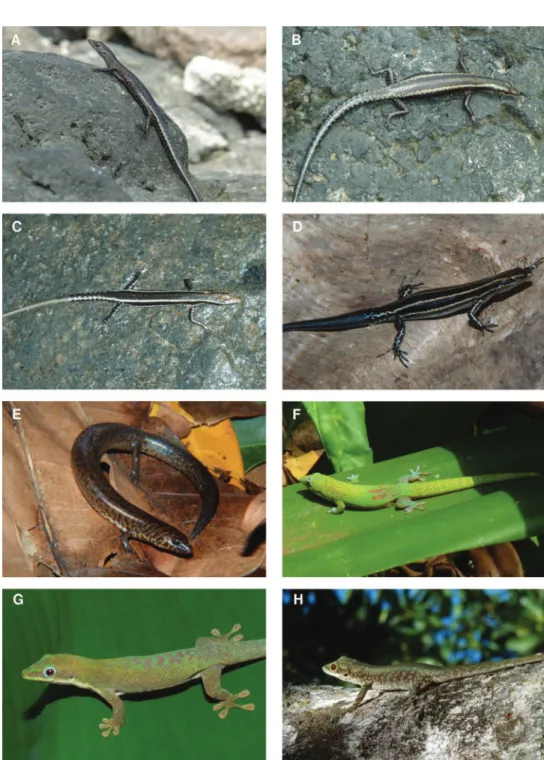
Our data (Table 1) show that seven families of reptiles are present on the Co-moros. 14 of the 28 recognized species of terrestrial reptiles (50%) and both amphib-ian species (100%) are endemic to a single island or to the Comoros. Of the 36 taxa of both groups recognized at species or subspecies level, 22 (66.7%) are endemic. Within the Comoro archipelago amphibians have only been recorded on Mayotte, where the two species are endemic, but to date undescribed. One species of blind-snake (Typhlops sp.) is probably undescribed. Photographs of the species and subspe-cies are shown in Figs 5–9.
Habitat classiication
Anj-table 1. An overview of species and subspecies of Comorian reptiles and amphibians. EI = Endemic to this island, EC = Endemic to the Comoros, P = Present on this island, but not endemic.
Gd. Comoro Anjouan Mohéli Mayotte
Typhlopidae:
Ramphotyphlops braminus P P P P
Typhlops comorensis EC EC -
-Typhlops sp. EI - -
-Lamprophiidae:
Leioheterodon madagascariensis P - -
-Liophidium mayottensis - - - EI
Lycodryas sanctijohannis EC EC EC EC
Chamaeleonidae:
Furcifer cephalolepis EI - -
-Furcifer polleni - EC - EC
Gekkonidae:
Ebenavia inunguis P P P P
Geckolepis maculata P P P P
Hemidactylus frenatus P P P P
Hemidactylus mercatorius P P P P
Hemidactylus parvimaculatus - P P
-Hemidactylus platycephalus P P P P
Paroedura sanctijohannis EC EC EC EC
Phelsuma comorensis EI - -
-Phelsuma dubia P P P P
Phelsuma laticauda - P - P
Phelsuma nigristriata - - - EI
Phelsuma pasteuri - - - EI
Phelsuma robertmertensi - - - EI
Phelsuma v-nigra anjouanensis - EI -
-Phelsuma v-nigra comoraegrandensis EI - -
-Phelsuma v-nigra v-nigra - - EI
-Iguanidae:
Oplurus cuvieri comorensis EI - -
-Scincidae:
Amphiglossus johannae EC EC EC EC
Cryptoblepharus boutonii ater EI - -
-Cryptoblepharus boutonii degrijsii - EI -
-Cryptoblepharus boutonii mayottensis - - - EI
Cryptoblepharus boutonii mohelicus - - EI
-Trachylepis comorensis P P P P
Trachylepis striata - P -
-Agamidae:
Agama agama P - -
-Mantellidae:
Blommersia sp. - - - EI
Oliver Hawlitschek et al. / ZooKeys 144: 21–79 (2011) 30
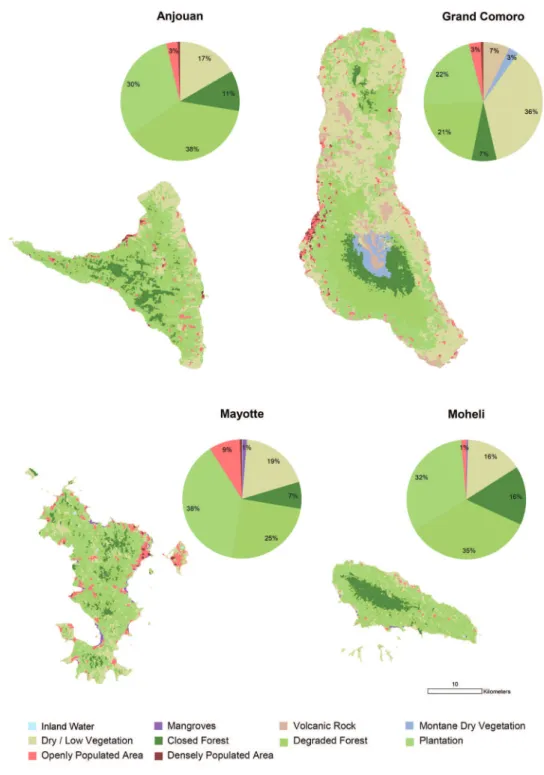
ouan with 11% (46.6 sqkm). Mayotte displays the smallest remaining area of forest (27.5 sqkm, 7%).
Habitat use
Most specimens (27%) and species (25 species) out of the total number of 30 species of reptiles and amphibians were recorded in the habitat class plantation (Figure 2). A similarly high percentage of specimens was recorded in dry / low vegetation (24%), fol-lowed by degraded forest (18%). Of specimen records, 14% were made in forest and table 2. Land cover by habitat classes. he areas of each habitat class per island and as total are given in square kilometres.
Anjouan Grand Comoro Mayotte Mohéli Total Inland Water 0.00 0.04 0.06 0.02 0.12 Mangroves 0.01 0.07 4.44 0.08 4.60 Volcanic Rock 0.00 73.23 0.00 0.00 73.23 Montane Dry Vegetation 0.00 27.00 0.00 0.00 27.00 Dry / Low Vegetation 70.24 367.95 71.64 33.53 543.37 Closed Forest 46.60 68.48 27.47 34.47 177.02 Degraded Forest 161.27 212.64 95.06 74.84 543.81 Plantation 129.41 220.69 143.50 69.68 563.28 Openly Populated Area 13.22 32.91 31.52 3.03 80.68 Densely Populated Area 2.79 6.85 2.27 0.00 11.91
423.54 1009.85 375.96 216.65 2025.01
Oliver Hawlitschek et al. / ZooKeys 144: 21–79 (2011) 32
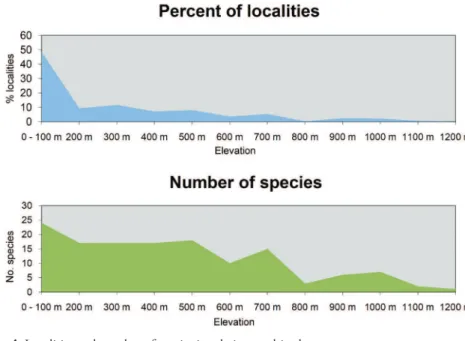
13% in openly populated areas. he second highest numbers of species were recorded in degraded forest (22) and in openly populated areas (21), followed by dry and low vegeta-tion (19), forest (18), densely populated areas (11), mangroves (6) and volcanic rock (3). Regarding altitude, almost half of all localities (48.9%) and 25 species (out of 30) were recorded in altitudes below 100 m asl (Figure 4). he number of species recorded then drops to 18 up to 200 m altitude and still 16 at elevations of up to 700 m. he relative number of records decreases to around 10% up to 200 m and further to a single specimen of Furcifer cephalolepis on the slope of Mt. Karthala, Grand Comoro, at 1135 m asl.
Distribution maps and distribution over habitats and altitude levels for all species are given in Figs 10–19.
Figure 4. Localities and number of species in relation to altitude.
table 3. Proposed Red List status, extent of occurrence (EOO) and area of occupancy (AOO) of reptile and amphibian species endemic to the Comoros. EOO and AOO are given in sqkm. Endemic subspecies that are not endemic at species level are marked with an asterisk (*).
Species Status EOO AOO
Typhlops comorensis DD 1433.5 ?
Typhlops sp. DD 1009.9 ?
Liophidium mayottensis EN B1abiii + B2abiii 376.0 65.2
Lycodryas sanctijohannis NT 2025.0 1737.4
Furcifer cephalolepis LC 1009.9 718.1
Furcifer polleni LC 376.0 371.5
Paroedura sanctijohannis EN B1abiii + B2abiii 2025.0 60.8
Phelsuma comorensis NT 250.1 183.5
Phelsuma nigristriata VU D2 376.0 24.8
Phelsuma pasteuri NT 376.0 127.0
Phelsuma robertmertensi EN B1abiii + B2abiii 376.0 98.9
Phelsuma v-nigra NT 1650.1 1368.2
Oplurus cuvieri comorensis * CR B1abv + B2abv 7.6 <7.6
Amphiglossus johannae LC 2025.0 1737.4
Cryptoblepharus boutonii ater * LC ? ?
Cryptoblepharus boutonii degrijsii * LC ? ?
Cryptoblepharus boutonii mayottensis * NT ? ?
Cryptoblepharus boutonii mohelicus * LC ? ?
Trachylepis comorensis LC >2025.0 >1811.0
Blommersia sp. NT 376.0 297.6
Oliver Hawlitschek et al. / ZooKeys 144: 21–79 (2011) 34
Identiication key
We created an identiication key including all non-marine species and subspecies of amphibians and reptiles on the Comoros. We also included species whose occurrence on the Comoros could not be conirmed. For every species, the islands of its occur-rence are indicated in round brackets (AN = Anjouan, GC = Grand Comoro, MA = Mayotte, MO = Mohéli). he key is based on data published in Meirte (2004), Vences et al. (2004), Glaw and Vences (2007) and unpublished data in Hawlitschek (2008) and by F. Glaw and V. Wallach.
1 Skin moist, no scales present; tail absent ...Amphibians / Anurans (frogs), 2
– Skin dry, covered with scales; tail present ...Reptiles, 3
2 Small species (adult snout-vent length 25-35 mm); tympanal region blackish; hind limbs with distinct dark bands; relatively small eyes; iris silvery; adult males with distinct femoral glands on ventral surface of thighs; only on May-otte ...Blommersia sp. (MA)
– Medium-sized species (adult snout-vent length 35-56 mm); tympanal region beige to brown; hind limbs without or with indistinct dark bands; relatively large eyes; iris reddish; adult males without femoral glands on ventral surface of thighs; only on Mayotte ...Boophis sp. (MA)
3 Limbs and external ear opening absent ...Serpentes (snakes), 4
– Limbs and external ear opening present ...Lacertilia (lizards), 11
4 Worm–like snakes with burrowing habits; very small, total length ca. 100-250 mm; scalation and coloration uniform all over body; eyes absent or only visible as small black spots covered by scales ...Typhlopidae, 5
– Typical snakes, ground- or tree-dwelling; medium-sized to large, adult total length > 50 cm; one distinctly enlarged row of ventral shields and 17–23 dorsal scale rows at midbody; pupil of eyes clearly visible ...other families, 7
5 Maximum total length 181 mm; 20 midbody scale rows; 261-364 total mid-dorsal scales; superior nasal suture visible mid-dorsally ... ...Ramphotyphlops braminus (AN, GC, MA, MO)
– Not as above ...Typhlops, 6
6 Maximum total length 245 mm; 22 midbody scale rows; 414-485 total mid-dorsal scales ...Typhlops comorensis (AN, GC) – Extremely small, known total length 68-70 mm; 18 midbody scale rows;
384-408 total middorsal scales; species poorly known ...Typhlops sp. (GC)
7 Dorsal coloration with dark and bright crossbands, dark bands at least twice as broad as bright bands; less than 100 ventral scales; only on Grande Co-moro, occurrence in need of conirmation ... ...Lycodon aulicus (Natricidae,GC – UNCONFIRMED)
Oliver Hawlitschek et al. / ZooKeys 144: 21–79 (2011) 36
Figure 6. Species photographs. ALycodryas sanctijohannis, male, ZSM 38/2010, Anjouan BLycodryas sanctijohannis, female, ZSM 40/2010, Anjouan CFurcifer cephalolepis, male, Grand Comoro DFurcifer polleni, male, Anjouan eFurcifer cephalolepis, female, Grand Comoro FFurcifer polleni, female, Mayotte
8 Robust, ground-dwelling and digging snake; rostral scale directed upwards; total length of adults up to 150 cm; 23 dorsal scale rows ... ...Leioheterodon madagascariensis (GC)
– Slender, terrestrial or arboreal, non-digging snakes; rostral scale not directed upwards; total length of adults up to 100 cm; 17-19 dorsal scale rows ...9
9 Pupil round; head not broader than neck; coloration dorsally grayish, ven-trally bright with small dark spots on each ventral scale; ground-dwelling ... ... Liophidium mayottensis (MA)
– Pupil vertical; head distinctly broader than neck; ground- or tree-dwelling ... ...Lycodryas, 10
10 Mostly 19 dorsal scale rows (sometimes 17) at midbody; coloration sexually dimorphic, males grayish, sometimes with dark spots or blotches, iris gray, females uniformly orange or brown, iris brownish... ...Lycodryas sanctijohannis (AN, GC, MA, MO)
– 17 dorsal scale rows at midbody, coloration brown with dark crossband ... ...Lycodryas gaimardii(MA – UNCONFIRMED)
11 Eyes largely covered with skin and moving independently; prehensile tail; tong-like hands and feet with two or three lateral ingers opposing inner in-gers ...Chamaeleonidae, 12
– Eyes not covered with skin; no prehensile tail; ingers and toes not fused ... ...other families, 13
12 Snout-vent length maximum 77 mm in males, 54 mm in females; rostral crests with very distinctly enlarged scales, fusing anteriorly and reaching or exceeding snout tip; distinctly elevated parietal crest; gular crest with dis-tinctly enlarged cones ...Furcifer cephalolepis (GC)
– Snout-vent length maximum 104 mm in males, 63 mm in females; rostral crests with weakly enlarged scales, poorly elevated, diminishing posterior to snout tip; parietal crest visible, but not elevated; gular crest poorly devel-oped ... Furcifer polleni (AN, MA)
13 Head dorsally with enlarged, symmetrical scales distinct from scales following posteriorly ...Scincidae / Lacertidae, 14
– Head dorsally with scales similar to those following posteriorly ... ...other families, 21
14 Dorsal scales granular, ventral scales cycloid and overlapping, forming a dis-tinct collar of enlarged scales in the throat region ... ...Meroles knoxii (Lacertidae, AN – UNCONFIRMED)
– Scales uniformly cycloid and overlapping ...Scincidae, 15
15 Body cylindrical, head and tail not clearly distinct from body; limbs small; coloration light brown with dark brown spots ... ...Amphiglossus johannae (AN, GC, MA, MO)
Oliver Hawlitschek et al. / ZooKeys 144: 21–79 (2011) 38
16 Medium-sized, often robust lizards, total length up to more than 200 mm; scale rows around midbody 28 to 39 ...Trachylepis, 17
– Small lizards, less than 100 mm total length; dorsoventrally depressed; colora-tion blackish, often with white stripes; scale rows around midbody 21 to 29; only in rocky intertidal regions ...Cryptoblepharus boutonii, 18
17 Common lizard; coloration dark with patterns of brighter spots; never with white stripes ...Trachylepis comorensis (AN, GC, MA, MO)
– Coloration blackish with two white lateral stripes ..Trachylepis striata (AN)
18 Coloration uniformly black ...Cryptoblepharus boutonii ater (GC)
– White stripes present ...19
19 Black with two white lines along the body ... ...Cryptoblepharus boutonii mohelicus (MO)
– More than two white lines present ...20
20 Black with four white lines along the body, tail sometimes bluish ... ...Cryptoblepharus boutonii mayottensis (MA)
– Black with ive white or yellowish lines along the body, tail often blue ... ...Cryptoblepharus boutonii degrijsiii (MO)
21 Ventral surface of ingers and toes with adhesive lamellae, allowing move-ment on vertical surfaces; total length never exceeding 160 mm; usually not ground-dwelling ...Gekkonidae, 22
– Adhesive lamellae absent; total length up to 500 mm; ground-dwelling, climbing only on rough surfaces; robust lizards ...other families, 38
22 Dorsal ground color green, sometimes in shades of olive or brownish, often with pattern in red; pupil round; diurnal ...Phelsuma, 23
– Dorsal ground color brown or grey, green and red colors absent; pupil verti-cal; nocturnal ...31
23 Dark lateral stripe along body present ...24
– No dark lateral stripe present ...25
24 Neck dorsally without dark stripes, limbs dorsally marbled with bright spots, tail dorsally with dark spots ...Phelsuma comorensis (GC)
– Neck dorsally with three dark stripes, limbs dorsally not marbled, tail with narrow dark crossbands ...Phelsuma nigristriata (MA)
25 Dorsal ground color rather green with olive, brown or turquoise shades than deep green ...26
– Dorsal ground color deep green ...27
26 Flanks with brighter spots, dorsum dark green or brown, with orange median line (sometimes interrupted), sometimes with blue blotch on neck ... ...Phelsuma robertmertensi (MA)
– No bright spots on lanks, often red dots on dorsum, no median line, tail often bluish ...Phelsuma dubia (AN, GC, MA, MO)
Oliver Hawlitschek et al. / ZooKeys 144: 21–79 (2011) 40
Figure 8. Species photographs. A. Phelsuma nigristriata, Mayotte BPhelsuma comorensis, Grand Comoro
CPhelsuma pasteuri, Mayotte DPhelsuma v-nigra anjouanensis, Anjouan ePhelsuma v-nigra comoraegran-densis, Grand Comoro FPhelsuma v-nigra v-nigra, Mohéli GEbenavia inunguis, ZSM 68/2010, Anjouan
– Neck and tail not yellowish or golden, dorsum with numerous smaller red dots and spots ...28
28 Blue spot on neck; gular region uniformly bright ..Phelsuma pasteuri (MA)
– No blue color elements dorsally; gular region with more or less visible pattern in the form of a “V” ...Phelsuma v-nigra, 29
29 Ventral side yellow, dorsal side green with relatively large red dots ... ...Phelsuma v-nigra v-nigra (MO)
– Ventral side whitish, dorsal red dots smaller ...30
30 Dorsal side green to bluish, small red dots, sometimes with red median line . ...Phelsuma v-nigra comoraegrandensis (GC)
– Dorsal side green, red dots very small, sometimes forming a reticulated pat-tern or absent ...Phelsuma v-nigra anjouanensis (AN)
31 Scales rather large, cycloid, overlapping, can be shed when touched; tubercles and striped color patterns absent ...Geckolepis maculata (AN, GC, MA, MO)
– Scales small, granular, in part tubercular; sometimes with striped color pattern ...32
32 Adhesive lamellae covering entire ventral side of digits, in double rows of several pads each; when resting, ventral side of body usually in contact with substrate; colors brown during day, grayish, whitish or pinkish at night ... ...Hemidactylus / Gehyra, 33
– Adhesive lamellae only in two pads near tips of the toes; when resting, ventral side of body usually lifted from substrate; colors always brownish other genera ...37
33 Body and tail smooth, no tubercles present; coloration grey, sometimes pink-ish ...Gehyra mutilata (UNCONFIRMED)
– Body and tail covered with tubercles; coloration grey to brownish; very common in urban areas and plantations, rare in natural habitats ...Hemidactylus, 34
34 Maximum snout-vent length of adults 55 mm; 2 to 8 rows of tubercles along the back, with 7 to 24 tubercles per row; dorsal side of body mostly uniformly white, beige or yellowish at night, pattern of dark stripes and spots visible during the day ...Hemidactylus frenatus (AN, GC, MA, MO)
– Pattern of dark stripes and spots mostly also visible at night; 8 or more rows of tubercles along the back, with 21 or more tubercles per row ...35
35 Maximum snout-vent length of adults 51 mm; dorsal side covered with rela-tively prominent brown and whitish tubercles; 3 to 5 dorsal rows of brown spots often visible; 14 to 17 rows of tubercles along the back, with 23 to 30 tubercles per row ...Hemidactylus parvimaculatus (AN, MO)
– Snout-vent length of adults up to more than 51 mm; dorsal side usually with pattern of brighter and darker colors, but no whitish tubercles present ...36
Oliver Hawlitschek et al. / ZooKeys 144: 21–79 (2011) 42
the eyes less distinct than in 36 B) ... ...Hemidactylus mercatorius (AN, GC, MA, MO)
– Maximum snout-vent length 85 mm; original tail with whorls of spiny, en-larged scales largely restricted to the proximal part of the tail; males with 41 to 59 femoral pores; 8 to 14 rows of tubercles along the back, with 21 to 31 tubercles per row; cranial depression extending anteriorly from between the eyes more distinct than in 36 ... ...Hemidactylus platycephalus (AN, GC, MA, MO)
37 Small, slender geckos, maximum snout-vent length 40.8 mm; lanks darker than dorsum, with sharpest contrast in head region; never with crossbands on body ...Ebenavia inunguis (AN, GC, MA, MO)
– Medium-sized geckos with robust heads, maximum snout-vent length 66.9 mm; four bright crossbands on dorsum, best visible at night; coloration of lanks not clearly distinguished from that of dorsum ... ...Paroedura sanctijohannis (AN, GC, MA, MO)
38 Neck with crest of spiny scales; scales on tail similar to those on body; males with contrasting black and orange color pattern ...Agama agama (GC)
– Crest of spiny scales on neck absent; tail with enlarged scales, spiny ... ...Oplurus cuvieri comorensis (GC)
Discussion
Unconirmed records and taxonomic comments
For all the species records given in Table 1 at least one voucher specimen for each island was either collected during our surveys or traced in natural history collections. he only exception is Hemidactylus mercatorius on Mohéli, of which we do not know of any voucher specimen. he following species of terrestrial reptiles were previously recorded in the Comoros, but were not conirmed during our study.
Lycodon aulicus
Oliver Hawlitschek et al. / ZooKeys 144: 21–79 (2011) 44
of L. aulicus is known to exist. Lycodon aulicus capucinus, now often considered as distinct species L. capucinus, is an invasive species on the Mascarene islands (Cheke and Hume 2008).
Lycodryas gaimardii and Lycodryas maculatus
No unambiguous records of these species on the Comoros exist. Historical records and their possible taxonomic implications will be discussed in an upcoming paper on Lycodryas sanctijohannis (Hawlitschek et al., unpublished data, see also Hawlitschek 2008).
Gehyra mutilata
his nocturnal gecko, similar in appearance to the genus Hemidactylus, is widespread in the Indian Ocean area and considered an invasive species in many regions (Denny et al. 2005, Witmer et al. 2007, Rocha et al. 2009b). Its existence on the Comoros was apparently irst suspected by Blanc (1971), without indicating any speciic island, and subsequently by Cole (1992) and Paris (1999), but was never conirmed. During our ield surveys in the Comoros, we did not detect any signs of the presence of this species, and did not ind any voucher specimens in the studied collections.
Meroles knoxii
Oliver Hawlitschek et al. / ZooKeys 144: 21–79 (2011) 46
Hemidactylus mabouia and H. brooki
he Comorian populations of Hemidactylus which were formerly assigned to H. ma-bouia (Blanc 1971, 1972, Meirte 2004) are now assigned to H. mercatorius and H. platycephalus (Vences et al. 2004, Carretero et al. 2005, Rocha et al. 2010b). he Co-morian populations formerly assigned to H. brooki (Carretero et al. 2005) are now assigned to H. parvimaculatus (Bauer et al. 2010, Rösler and Glaw 2010).
Land cover changes and state of the natural vegetation
Similar to other tropical oceanic islands, the Comoros were likely covered by large areas of forest before the arrival of man (Pascal 2002, Louette et al. 2004). Today, as shown by the present results, land cover of natural or near natural forest on the Co-moros is classiied at less than 7%. As the remote sensing classiication relies mainly on photosynthetic activity and canopy closure, minor modiications from selective logging or agro-forestry may be undetected. his means that the less than 7% coverage of this class of forest contains pristine undisturbed forest but may also comprise areas where signiicant human impact is present.
Opening of the forest canopy is one of the prime factors inducing changes in forest microclimate and understory vegetation and thus afecting the species composition of the fauna (Chen et al. 1999, Jennings et al. 1999). Large areas still covered with forest vegetation are heavily degraded and their canopy has been opened. Areas where in-tensive logging has taken place are often cultivated with arborescent crops, small-scale plantations of other crops and neophyte stands. In lowland areas, forests have been replaced by extensive crop plantations. On Anjouan, Mayotte and Mohéli, the largest forest areas remain in the highest altitude ranges. Only on Grand Comoro, they are replaced by montane dry vegetation in altitudes too high for tropical forest (Figure 3).
Nearly a third of the area of the Comoros is covered by dry and low vegetation. his deinition includes natural types of non-forest vegetation as well as crop stands and areas in which erosion and devegetation has led to soil fatigue to such an extent that crops cannot be grown (called “Padzas”). It can be assumed that even before the arrival of man, dry and low vegetation already made up a certain proportion of the Co-morian vegetation. However, large areas which are now covered by dry / low vegetation were originally covered by dry forests, of which today only fragments are left (Pascal 2002, Louette et al. 2004).
Habitat use and the impact of altitude
Oliver Hawlitschek et al. / ZooKeys 144: 21–79 (2011) 48
Figure 12. Distribution maps, and distribution over habitat and altitude classes, for Furcifer cephalolepis,
forest are the results of human impact of the last millennium. However, relatively low numbers of species were recorded in closed forest. his may be attributed to the relatively small area occupied by this habitat, but this alone cannot easily explain why fewer species were recorded in natural forests than in plantations, degraded forests, dry and low vegetation and even in urban areas.
Several reasons for this pattern can be discussed. (1) Introduced species, mainly among the genera Hemidactylus and Phelsuma, are adapted to anthropogenic habitats, abundant, and easy to observe, and therefore make up a large part of the total records. (2) As several studies have shown (Fredericksen and Fredericksen 2002, Bell and Donnelly 2006), degraded habitats generally seem to show a higher diversity especially of reptiles than undisturbed forest in similar areas. his is explained with the higher diversity in microhabitats, as patches of original forest remain very close to a system of clearings and secondary vegetation, and the higher proportion of insolated sites, which is important for ectothermic animals. (3) For similar reasons, many reptile species are less abundant in closed forest areas and prefer perch sites higher above the ground, where insolation is higher. his makes observation more diicult. (4) he possibility of extinction should be considered. Lowland forest areas have probably been deforested over a long period of time, and species restricted to these habitats may have already gone extinct. (5) At least on Grand Comoro, regular volcanic eruptions of the Mt. Karthala might have disturbed the evolution of reptile communities specialized on undisturbed forest.
Of the endemic species recorded, most are more abundant in secondary habitats than in pristine forest (Figure 5). he endemic reptiles Amphiglossus johannae, Furcifer cephalolepis, Lycodryas sanctijohannis, and Phelsuma v-nigra were all most commonly re-corded in plantations or degraded forests. his is also true for both endemic amphibian species in Mayotte. here are only two endemic reptile species whose preference for pris-tine forest habitats can be supported by a signiicantly large number of records. hese are the geckos Paroedura sanctijohannis and Phelsuma nigristriata. Nearly all P. sanctijohannis on Anjouan, Grand Comoro and Mohéli were observed in undisturbed forests, while on Mayotte this species was also commonly found in degraded habitats. P. nigristriata is known almost exclusively from pristine forests on Mayotte and largely depends on Pandanus plants as microhabitat which are restricted to relatively undisturbed forest. Only few, mainly juvenile, specimens were observed in neighbouring degraded habitats.
Oliver Hawlitschek et al. / ZooKeys 144: 21–79 (2011) 50
Potential factors of threat for endemic Comorian reptiles and amphibians
he majority of endemics among the Comorian herpetofauna appear to have adapted to the habitat changes imposed by man. Paroedura sanctijohannis and Phelsuma ni-gristriata are the only species for which a true dependency on pristine forests can be postulated. Even these two species can also be found in degraded habitats, albeit in lower densities.
A much more potent threat for Comorian endemics may be competition by in-vasive species. In 1998, according to Meirte (2004), the agamid lizard Agama agama was introduced to Grand Comoro. It has since established a dense population in the capital Moroni, but has not yet been observed outside urban areas. While it may be a competitor to or even predator on other local species, the species most afected may be the Comoro iguana Oplurus cuvieri comorensis, which resembles the agama in habitus and ecology. he Comoro iguana inhabits only a narrow strip of rocky clifs along the northeast coast of Grand Comoro. If the agama expands its range and reaches that of the Comoro iguana, there would be no areas of refuge for the latter species. If both species prove to be direct competitors, this might lead to the extinction of O. cuvieri comorensis.
An even more evident situation of direct competition is that of the diurnal Phelsuma geckos, which are present on the Comoros with ive endemic and two introduced spe-cies. While P. comorensis on Grand Comoro, as well as the Mayottean species, seem to prefer habitats where invasive Phelsuma species are rare or absent, P. v-nigra resembles the invasive species in terms of distribution and preferences. Focused studies are necessary to address the situation of competition between the various Comorian Phelsuma species.
he overwhelming majority of nocturnal geckos that can be observed on the Co-moros belong to introduced species. hese are the four species of Hemidactylus, all of which cover more or less extensive distribution ranges in the tropics. hree of these species are rarely seen outside urban and plantation areas of low altitudes, but H. platycephalus has colonized all available types of habitats including undisturbed forests and has been observed in altitudes of over 600 m. On Anjouan, Grand Comoro and Mohéli, the endemic and nocturnal Paroedura sanctijohannis inhabits almost exclusive-ly areas above this altitude. his could be explained by possible exclusion from lower altitudes through competition from H. platycephalus. Only on Mayotte, P. sanctijohan-nis regularly occurs in syntopy with H. platycephalus.
Oliver Hawlitschek et al. / ZooKeys 144: 21–79 (2011) 52
No studies have yet been undertaken concerning the impact of predatory mammals on the Comorian herpetofauna. Tenrecs (Tenrec ecaudatus) inhabit all islands of the Comoro archipelago and were probably introduced in historical times (Louette et al. 2004), although this is unclear. his species mainly feeds on invertebrates but to some extent also on small, ground-dwelling vertebrates. On the Comoros, typhlopid snakes, skinks and frogs might form part of its nurriture. Two introduced species of viverroid carnivores may be stronger predators on reptiles: the Small Indian Civet (Viverricula indica) on Mayotte and the abundant Small Asian Mongoose (Herpestes javanicus auro-punctatus) on Grand Comoro. hey prey on a variety of small animals; in both species, insects and other invertebrates make up the largest part of the diet, but they also feed on amphibians and reptiles, including snakes (see Chuang and Lee 1997 for Viverricula and summary in Hays and Conant 2007 for Herpestes). hus, both species, although this has not yet been proven, may also prey on reptiles, especially snakes, on the Comoros and therefore reduce the populations of these reptile species. he species most strongly afected might be the terrestrial Mayotte endemic snake Liophidium mayottensis.
hese observations suggest that competition and predation by invasive species pose a more serious threat to Comorian endemic reptiles than destruction of the remaining natural habitats. However, habitat degradation and destruction, extension of settle-ments and intensiication of land use also create more suitable conditions for invasive species and should therefore also be considered an important threat factor.
Several endemic Comorian reptile species have been subject to international trade as pets. Data are available only for species listed on the CITES appendices (UNEP-WCMC 2011). According to this database, a considerable number of animals was exported from the three islands of the Union of the Comoros. 22004 specimens of the day gecko Phelsuma comorensis and 23850 specimens of P. v-nigra are listed for the period of 2000 to 2010. he numbers for Mayotte endemics are much lower at 2000 specimens for P. nigristriata, 100 for P. pasteuri and 280 for P. robertmertensi. he situation of the chameleons of the genus Furcifer is similar: 14420 specimens of F. cephalolepis from Grand Comoro were listed as exported since 2000, but only 1560 specimens of F. polleni from Mayotte.
Oliver Hawlitschek et al. / ZooKeys 144: 21–79 (2011) 54
It is diicult to assess the impact of the export of specimens for pet trade on the wild populations of the species concerned. Our results show that the relatively heav-ily exploited species Phelsuma comorensis and P. v-nigra are more abundant in their natural habitats than the less heavily exploited species from Mayotte. his suggests that the collection of specimens so far did not have a signiicantly negative efect on their populations. he chameleon Furcifer cephalolepis from Grand Comoro, which has been much more intensely exploited than its relative from Mayotte, F. polleni, is also less often observed in the wild than its congener. his could indicate that collection of specimens for pet trade in high numbers may negatively inluence the populations of F. cephalolepis. Since no reliable data on the abundance of this species before its exploita-tion is available, we have no means of investigating this speculaexploita-tion.
Amphibians are globally threatened by the chytrid fungus Batrachochytrium den-drobatidis (Daszak et al. 2003, Weldon et al. 2004, Mendelson et al. 2006, Skerratt et al. 2007, Wake and Vredenburg 2008, Rödder et al. 2009), which has led to mas-sive reductions and even extinctions of amphibian populations. So far, no amphibian population declines have been noticed on Mayotte and surveys for this fungus have not been conducted. It is unknown how strongly it might afect the endemic anuran species, but reviewing its impact on other amphibian species worldwide, it must be as-sumed to cause severe losses among Mayotte’s amphibians if introduced.
Conservation assessments
We evaluate all species of reptiles and amphibians endemic to the Comoros against the criteria for Red List categories in IUCN (2001a). hese assessments are proposals for national conservation status and are also currently under review at the CI-IUCN Bio-diversity Assessment Unit for inclusion in the IUCN Red List (P. Bowles, pers. comm. 2011-05-17 to 2011-09-06). Some endemic reptile species from the Comoros were previously evaluated by other authors and were all given the status “Least Concern”. Our results do not always conirm these assessments, and we propose changing the Red List entries to better relect the threat situations of these species.
We also present an assessment of Trachylepis comorensis although a population of this species is known on the islet of Nosy Tanikely, Madagascar (Köhler et al 1997). Ad-ditionally, genetic studies by Mausfeld-Lafdhiya et al. (2004) and Rocha et al. (2010a) show that the subspecies T. maculilabris casuarinae from Casuarina Island of the coast of North Mozambique is nested within T. comorensis. According to these studies, how-ever, the two non-Comorian areas were probably colonized with human aid, and the Comoros are the centre as well as the original distribution range of T. comorensis.
Oliver Hawlitschek et al. / ZooKeys 144: 21–79 (2011) 56
Figure 16. Distribution maps, and distribution over habitat and altitude classes, for Phelsuma comorensis,
Malagasy O. cuvieri and it is now considered a subspecies. We agree with this view but still evaluate the Red List status of O. cuvieri comorensis because we recognize the difer-ences in morphology and behaviour to the nominate form (Meirte 1992) and because, according to our evaluation, it is the most threatened reptile taxon on the Comoros. Several subspecies of Cryptoblepharus boutonii, including those from the Comoros, have been treated as species (Horner 2007). We follow Rocha et al. (2006) in consider-ing all WIO forms as subspecies.
Although IUCN does not support Red List assessments for undescribed species, we here provide an evaluation of their national conservation status applying the Red List Cri-teria, in order to help inform assessment of these species once they are formally described. A summary of the assessments is given in Table 3. Future taxonomic studies may reveal further endemic species on the Comoros, possibly in the genera Ebenavia, Geck-olepis, Lycodryas and Paroedura.
Oplurus cuvieri comorensis
his iguana inhabits only rocky shores in a very small area on Grand Comoro. We measured the length of coastline potentially inhabitable for O. cuvieri comorensis as 38 km. Assuming that the iguana inhabits areas as far away as 200 m from the coast, which is probably not true for most of its range, this would mean an extent of occur-rence of roughly 7.6 sqkm. he actually inhabited area (area of occupancy) is even smaller, as not all coastal areas are colonized. he two foremost threatening factors are competition with invasive species and collection of individuals by locals for food and entertainment (Meirte 2004 and pers. obs.), which cause a continuing decline in number of mature individuals (CR B1bv + B2bv). If the invasive Agama agama extends its range to the North of Grand Comoro, the entire range of O. cuvieri comorensis will be afected.
According to IUCN (2001a), “locations” are areas where “a single threatening event can rapidly afect all individuals of the taxon present”. hus, all known localities of O. cuvieri comorensis can be considered a single location (CR B1a+B2a) because of the uniformity of the habitat and the short distances in between. According to the facts presented, the status of Critically Endangered (CR B1abv + B2abv) is proposed for O. cuvieri comorensis.
Typhlops comorensis and Typhlops sp.
Oliver Hawlitschek et al. / ZooKeys 144: 21–79 (2011) 58
Comoro. It is likely to represent a new, undescribed species (Wallach pers. comm.) but current knowledge does not exclude the possibility that this species has been acciden-tally introduced from somewhere else. here are no indications that these two species are restricted to the remaining undisturbed forest areas or that R. braminus or any other possibly introduced species impose high pressure on them. With regards to the poor knowledge available the status Data Deicient appears appropriate for both species.
Liophidium mayottensis
Only two localities of this terrestrial and diurnal snake endemic to Mayotte were available for this analysis and therefore no speciic statements about its biology, distribution and population size can be made. As no speciic data on the distribution of this snake is available and one of the two specimens was caught in forest, it should be assumed that L. mayottensis will be afected by a further degradation and fragmentation of its habitat and probably also by the introduced carnivorous Small Indian Civet (Viverricula indica). While the total area of Mayotte (376.0 sqkm) is recognized as extent of occurrence, we conservatively assume that L. mayottensis is restricted to an area in central Mayotte forming a single location, where both observations were made. Assuming that plantation and closed forest, where specimens have been observed, and degraded forest as “intermediate” are suitable habitat classes, we calculate an area of occupancy of 65.2 sqkm. herefore, the status Endangered (EN B1abiii + B2abiii) is applied for this very rarely encountered and poorly known species that should become a focal species for future studies and monitoring programs.
Lycodryas sanctijohannis
Oliver Hawlitschek et al. / ZooKeys 144: 21–79 (2011) 60
Figure 18. Distribution maps, and distribution over habitat and altitude classes, for Phelsuma v-nigra,
to be strongly afected by the introduced species (carnivores, rats, tenrecs, other reptiles or birds) at present, the status Near hreatened is proposed.
Furcifer cephalolepis
Current listing:Least Concern (Carpenter 2009)
his chameleon inhabits various habitats on Grand Comoro, in an area of oc-cupancy of 718.1 sqkm. It is most common at the mountain of La Grille. Since F. cephalolepis is also abundant in plantation and degraded forest, deforestation cannot be considered an imminent threat. However, relatively high export numbers from 2000 to 2010 could have had a negative impact on this species, although this cannot be proven at present. We therefore propose to maintain the status Least Concern, but note that future monitoring programs, if implemented, should also regard this species.
Furcifer polleni
Although limited to a much smaller extent of occurrence and thus also area of occu-pancy (371.5 sqkm) than F. cephalolepis, F. polleni from Mayotte island is more com-monly observed and inhabits a variety of habitats from pristine forest to gardens in densely populated areas. Blanc (1971, 1972, and cited in Raxworthy et al. 2002) re-ports F. polleni for Mohéli, but not for Mayotte. We have found no indications of a presence of this species on Mohéli and consider this record erroneous, in accordance with Meirte (2004). An allochthonous population on Anjouan, which is not consid-ered for the calculation of area of occurrency, is so far only known from gardens in the town of Hombo (Meirte 2004 and pers. obs.). Export numbers from 2000 to 2010 were relatively low (1562 specimens) and signiicant threats were not observed. We propose to assign the status Least Concern to F. polleni.
Paroedura sanctijohannis
Oliver Hawlitschek et al. / ZooKeys 144: 21–79 (2011) 62
Figure 19. Distribution maps, and distribution over habitat and altitude classes, for Trachylepis striata,
P. sanctijohannis on these three islands is already reduced to a narrow range just below the summits of the mountains concerned, there is little bufer zone for displacement left. While the extent of occurrence is calculated to be 2025.0 sqkm, the area of occu-pancy is much smaller. Since mostly erratic juvenile specimens were observed outside closed forest, we assume that this habitat is not suitable for maintaining viable and reproducing populations. We calculate the area of occupancy as the sum of all areas of closed forest in which P. sanctijohannis was observed, plus the dry vegetation on Saziley peninsula of Mayotte, resulting in a severly fragmented area of 60.8 sqkm. his quali-ies for the category Endangered, although it is much closer to Critically Endangered (below 10 sqkm) than to Vulnerable (500 sqkm). he status Endangered (EN B1abiii + B2abiii) is proposed for P. sanctijohannis.
Phelsuma comorensis
Current listing:Least Concern (Ineich 2009b)
his day gecko is restricted to a relatively small area on Grand Comoro, the mountain of La Grille, where it can be found in considerable abundance in degraded forests as well as in areas which are subject to heavy human inluence, including banana plantations and open urban areas. An erratic individual was also observed near the capital Moroni, but no populations outside the La Grille area are known. herefore, an extent of occurrence of 250.1 sqkm and an area of occupancy of 183.5 sqkm are calculated (EN B1biii+B2biii), and La Grille can be considered a single location (EN B1a+B2a). Phelsuma comoren-sis lives syntopically with the invasive species P. dubia throughout most of its range, al-though strong competition has not been observed so far. Further human development and population growth may lead to intensiication of agriculture and horticulture, and to unpredictable general changes in land use including intensiied use of pesticides which could lead to strong degradation of its area of occupancy. his would qualify the species for the status Endangered (EN B1abiii + B2abiii). We therefore propose the status Near hreatened.
Phelsuma nigristriata
Oliver Hawlitschek et al. / ZooKeys 144: 21–79 (2011) 64
Figure 20. Proposed areas of conservational importance for the herpetofauna on the Comoro islands.
population growth on Mayotte, there is a high risk that increased degradation of pristine forests will lead to a continuing decline in the extent and quality of this habitat. his might drive the population of P. nigristriata to Critically Endangered in a very short time (criterion VU D2). We therefore propose the status Vulnerable (VU D2) for this species.
Phelsuma pasteuri
Phelsuma robertmertensi
As discussed above, P. robertmertensi is found mainly in mangroves and coastal tree stands, but also in the forest at Choungui on Mayotte. Despite the formal protection of mangroves and forests on Mayotte, these preferred habitats should still be consid-ered threatened by human activities and fragmentation. An area of occupancy of 98.9 sqkm is calculated for P. robertmertensi. Almost the entire population of this species inhabits areas where individuals are exposed to competition by the introduced P. lati-cauda. As deined by this threat, the species is considered to occur at a single location. he status Endangered (EN B1abiii + B2abiii) should be assigned.
Phelsuma v-nigra
Current listing:Least Concern (Ineich 2009c)
On all the islands where P. v-nigra subspecies occur, they inhabit a variety of habitats in a total area of occupancy of 1368.2 sqkm and live in sympatry with at least one in-troduced species of Phelsuma. hough partially more abundant in higher altitude zones than the competitor P. dubia (and probably also P. laticauda on Anjouan), as shown by the results discussed above, no evidence clearly points to a decline of this species (EN B1bv). Elucidating this situation by long-term observations would be desirable. Moreo-ver, many localities of P. v-nigra are situated in plantations and urban areas, so currently the area suitable for this species does not appear to be subjected to fragmentation and degradation (EN B1abiii). herefore, the status Near hreatened (EN B1abiii + B1bv) appears appropriate for this species and should also be applied to all subspecies.
Amphiglossus johannae
Current listing:Least Concern (Ineich and Meirte 2009)
Amphiglossus johannae was observed on all islands in many diferent habitat classes, including habitats under human inluence, and altitudes. Given the cryptic and fos-sorial habits of this skink a relatively high abundance cannot be excluded. No threat factors are currently visible. he status Least Concern should be maintained.
Cryptoblepharus boutonii subspecies
Current listing: Cryptoblepharus ater: Least Concern (Ineich 2009a)
Oliver Hawlitschek et al. / ZooKeys 144: 21–79 (2011) 66
using our methodology, since rocky tidal zones are patchy and hard to detect using Landsat imagery. he subspecies C. b. ater (Grand Comoro), C. b. degrijsii (Anj-ouan) and C. b. mohelicus (Mohéli) are regularly observed in suitable habitats, also inhabit harbours and shores near settlements and are common in syntopy with potentially competitive Trachylepis comorensis and – on Grand Comoro – Agama agama. We propose the status Least Concern for these subspecies. In contrast, C. b. mayottensis in Mayotte could often not be detected in seemingly suitable habitats and was never recorded in harbours, which raises the suspicion of a past decline in area, extent or quality of its habitat (EN B1biii). We propose the status Near hreatened for this subspecies.
Trachylepis comorensis
On all islands, T. comorensis is widespread and occurs in primary forest as well as in areas under heavy human inluence. In addition to the Comoros, it inhabits only small islets. No signs of reduction or fragmentation of the area of occupancy or population decline can be detected. he status Least Concern is applied to this species.
Blommersia sp.andBoophis sp.
Both anuran species treated here were recorded from various habitat classes, mainly classes under heavy human inluence. Areas of occupancy of 297.6 sqkm were cal-culated for both species. hreats by habitat degradation or population declines can neither be observed nor inferred. However, the populations of both species might rapidly break down in the case of the introduction of the amphibian chytrid fungus, which is considered one of the prime factors of the global amphibian decline as has already been introduced to many previously unafected areas (Daszak et al. 2003, Weldon et al. 2004, Mendelson et al. 2006, Skerratt et al. 2007, Wake and Vreden-burg 2008, Rödder et al. 2009). his might lead to a classiication of Endangered (EN B1bv + B2bv). At present, the status Near hreatened should be applied for both species.
Areas of conservational importance and future measures