resins obtained by chemical recycling of poly(ethylene terephthalate)
Aleksandar D. Marinković1, Tijana Radoman2, Enis S. Džunuzović1, Jasna V. Džunuzović3, Pavle Spasojević1, Bojana Isailović1, Branko Bugarski1
1Faculty of Technology and Metallurgy, University of Belgrade, Belgrade, Serbia
2Innovation center, Faculty of Technology and Metallurgy, University of Belgrade, Belgrade, Serbia
3Institute of Chemistry, Technology and Metallurgy (ICTM) – Center of Chemistry, University of Belgrade, Belgrade, Serbia
Abstract
Composites based on unsaturated polyester (UPe) resinsand fumed silica AEROSIL® RY 50, NY 50, RX 50 and NAX 50, as well as graphite, TiO2 or organically modified clay CLOISITE
30B were prepared in order to investigate the influence of reinforcing agents on the mechanical properties of composites. Unsaturated polyester resins were synthesized from maleic anhydride and products of glycolysis, obtained by depolymerization of poly(ethyl-ene terephthalate) with dipropylpoly(ethyl-ene glycol (UPe1 resin) and triethylpoly(ethyl-ene glycol (UPe2 resin) in the presence of tetrabutyl titanate catalyst. The obtained unsaturated polyesters were characterized by FTIR spectroscopy, acid and hydroxyl values, and their mechanical pro-perties were also examined. Significant increase of the tensile modulus, tensile strength and decrease of the elongation at break was observed for composites prepared after addi-tion of 10 wt.% of graphite or 10 wt.% of TiO2 to the UPe resins, indicating strong
inter-action between matrix and filler particles. On the other hand, nanocomposites prepared using UPe2 and hydrophobically modified silica nanoparticles showed lower tensile strength and tensile modulus than polymer matrix. The presence of CLOISITE 30B had no significant influence on the mechanical properties of UPe1, while tensile strength and tensile modu-lus of UPe2 increased after adding 10 wt.% of clay.
Keywords: poly(ethylene terephthalate), chemical recycling; composites, mechanical pro-perties.
Polymers
SCIENTIFIC PAPER
UDC 678.7–19:66.095.26:620.1/.2
Hem. Ind. 67 (6) 913–922 (2013)
doi: 10.2298/HEMIND130930077M
Available online at the Journal website: http://www.ache.org.rs/HI/
Poly(ethylene terephthalate) (PET) is a semi-crys-talline, thermoplastic polyester that exhibits very good mechanical properties, good barrier properties and high transparency. Because of this, it is used for the production of packaging materials for soft drinks, food and pharmaceuticals, synthetic textile, photo-paper and for engineering plastics (usually reinforced with glass fibers). The production and consumption of PET products recorded the fastest growth rate in the global plastics market, but the current consumption of plastic containers is generating a huge amount of polymer waste. PET accounts for more than 8 wt.% and 12 vol.% of the orld’s solid aste ge eratio [ ].
The wide application and permanent increase in consumption of PET based products caused unavoid-able generation of large volume of PET waste (rapid growing), which created a major environmental prob-lem because PET is very resistant to biodegradation. Increased environmental awareness, legislative
Correspondence: A.D. Mari ko ić, Fa ulty of Te h ology a d Metal -lurgy, University of Belgrade, Karnegijeva 4, 11120 Belgrade, Serbia. E-mail: [email protected]
Paper received: 30 September, 2013 Paper accepted: 14 October, 2013
sures and public need for the sustainable development, increased interest in recycling of plastics. Plastic recyc-ling is important from several aspects, such as energy conservation, reduced oil consumption, saving space in landfills, reduced greenhouse gas emissions and the benefits of reuse [1]. Recycling of plastic materials is divided into four categories: primary (re-extrusion), secondary (mechanical), tertiary (chemical) and quater-nary (energy recovery – incineration) [2]. Chemical pro-cessing of PET and reuse of the obtained products are the most important strategy for PET recycling. PET has ester groups that can degrade using a variety of reagents such as acids, bases or water (hydrolysis of PET) [3,4], alcohols (PET alcoholysis) [5], amines (PET aminolysis) [6], glycols (PET glycolysis) [7–9], etc. In the PET glycolysis process, oligomeric products with termi-nal hydroxyl groups were obtained by PET depolymeri-zation reaction with different glycol. The resulting oli-gomers can be used for the synthesis of various poly-mers, such as alkyd resins [10,11], polyurethanes [12,13] or unsaturated polyester (UPe) resins [14–16].
easy of processing, good compatibility with a variety of fillers, as well as large selection of various types. How-ever, compared with other engineering polymers, unsa-turated polyesters have lower mechanical and thermal properties, which limit their use for some applications. These imperfections can be removed by adding various modified fillers [20–23]. Conventional fillers are used to improve the mechanical properties and to reduce the production costs, but their use is limited since they may lead to the phase separation and agglomeration of the filler particles, leading to a drastic deterioration of the material properties [24].
The incorporation of clay into UPe resin can result in improvements of mechanical, thermal, barrier and chemical properties, wear resistance and flame retard-ancy [25–29]. This can be done with less clay content than what is usually used in most conventional com-posites.
The most commonly used clay for polymeric com-posites is montmorillonite (MMT), which belongs to the general family of 2:1 layered silicates [30], and it is con-sisted of two fused silicate tetrahedral sheets sand-wiching an edge-shared octahedral sheet of either alu-minum or magnesium hydroxide. Only few works have been reported based on MMT-UPe resin derived from PET waste. Jo et al. [31] investigated mechanical pro-perties and thermal stability of MMT-UPe nanocompo-sites and polymer concrete prepared using the MMT-UPe nanocomposite, and found that the compressive strength, elastic modulus, and splitting tensile strength of the polymer concrete based on MMT-UPe nanocom-posites exceeded those of polymer concrete obtained using pure UPe resin. Also, the polymer concrete made with MMT-UPe nanocomposite showed better thermal performance than that made of pure UPe resin. Water sorption and diffusion of the MMT-UPe system was investigated by Katoch et al. [32]. The authors con-cluded that nanocomposite samples show lower diffu-sion coefficient than pure UPe and it decreases with increasing nanofiller content up to 4% by weight.
In this work, hybrid materials based on UPe matrix and graphite powder (GP), TiO2, chemically modified clay CLOISITE 30B or chemically modified silica nano-particles were prepared in order to study the influence of reinforcing agents on the mechanical properties of the obtained composite materials. Unsaturated poly-esters were synthesized from di-hydroxyl functional product obtained by different methods of catalytic glycolysis of PET waste, using dipropylene glycol (DPG) and triethylene glycol (TEG), and maleic anhydride. EXPERIMENTAL PART
Chemicals
Hydroquinone (HQ), dipropylene glycol (DPG) and triethylene glycol (TEG) were obtained from Fluka.
Maleic anhydride (MA) was obtained from Sigma Aldrich. Tetrabutyl titanate (titanium (IV) butoxide; TBT) was obtained from Sigma-Aldrich. As fillers, gra-phite powder (GP; Dragon) and TiO2 (Qingdao David Chemical Co., Ltd.) in the rutile crystal form (particle diameter of 0.25 μ a d de sity of .9 kg d –3) were used. Four different hydrophobic nanosilica were obtained from Evonik. Aerosil® RY 50 (specific surface area of 30±15 m2 g–1) and Aerosil® NY 50 (specific sur-face area of 30±10 m2 g–1) are hydrophobic fumed silica based on Aerosil® OX 50 and Aerosil® 50, respectively, treated with silicone oil. Aerosil® RX 50 (specific surface area of 35±10 m2 g–1) and Aerosil® NAX 50 (specific surface area of 40±10 m2 g–1) are Aerosil® 50 nano-particles surface modified with hexamethyldisilazan.
Organically modified clay CLOISITE 30B was obtained from Rockwood Clay Additives. CLOISITE 30B is a natu-ral montmorillonite modified with alkyl quaternary ammonium salts, with 65% of molecules containing alkyl residue with 18 carbon atoms, 30% of the alkyl group with 16 carbon atoms and 5% of molecules con-taining alkyl groups with 14 carbon atoms. In the dry state, 9 % of the lay parti les ha e size elo μ . All chemicals were used as received without further purification.
Synthesis of UPe resins
Synthesis of UPe1
1
H- and 13C-NMR data of UPe1resin 1H-NMR (CDCl
3): 1.24 (m, 12H, O-CH2-CH(CH3)-O), 3.58 (m, 6H, O-CH2-CH(CH3)-O-CH2-CH(CH3)-O), 4.50 (m, 6H, O-CH2-CH(CH3)-O-CH2-CH(CH3)-O), 5.22 (d, 1H, sty-rene), 5.74 (d, 1H, stysty-rene), 6.68 (q, 1H, stysty-rene), 6.77 (m, 2H, O-(O)C-CH=CH-C(O)-O), 7.31 (m, 5H, styrene), 8.08 (m, 4H, HAr).
13C-NMR (CDCl
3): 16.5 (O-CH2-CH(CH3)-O-CH2- -CH(CH3)-O), 18.4 (O-CH2-CH(CH3)-O-CH2-CH(CH3)-O), 70.3 (O-CH2-CH(CH3)-O-CH2-CH(CH3)-O), 70.7(O-CH2- -CH(CH3)-O-CH2-CH(CH3)-O), 73.4 (O-CH2-CH(CH3)-O- -CH2-CH(CH3)-O), 76.3 (O-CH2-CH(CH3)-O-CH2-CH(CH3)- -O), 113.7; 126.1; 127.8; 128.3 (styrene), 128.4 (O=C- -HC=CH-C=O), 129.6 (CHAr), 133.6 (CAr), 136.7; 137.4 (C, styrene), 165.4 (O-C(O)-CH=CH-C(O)-C), 174.1 (O-C(O)- -Ar-C(O)-O).
Synthesis of UPe2
Depolymerization of PET waste was performed by glycolysis with TEG. In a 250 ml four-necked flask, equipped with a mechanical stirrer, thermometer, con-denser and inlet for nitrogen, 61.2 g of PET, 68.8 g of TEG and 0.2 g of TBT were placed (Table 1). The reac-tion of glycolysis lasted for 5 hours at 210 C, after which the reaction mixture was cooled to 90 C. The hydroxyl value of the resulting glycolyzate was 292 mg KOH g–1. Then, a Dean-Stark water separator was assembled on the flask and maleic anhydride (40.4 g) and HQ (0.02 g) were added (Table 1). The synthesis of UPe2 was performed in the same manner as synthesis of UPe1.
1H- and 13C-NMR data for UPe2resin (Ar is terephtaloyl
moiety): 1
H-NMR (CDCl3): 1.24 (m, 12H, O-CH2-CH(CH3)-O), 2.43 (m, 4H, H-6, H-3, THP), 3.04 (m, 2H, H-1, H-2, THP), 3.58 (m, 6H, O-CH2-CH(CH3)-O-CH2-CH(CH3)-O), 4.50 (m, 6H, O-CH2-CH(CH3)-O-CH2-CH(CH3)-O), 5.22 (d, 1H, sty-rene), 5.74 (d, 1H, stysty-rene), 6.68 (q, 1H, stysty-rene), 6.77 (m, 2H, O-(O)C-CH=CH-C(O)-O), 7.31 (m, 5H, styrene), 8.08 (m, 4H, HAr).
13
C-NMR (CDCl3): 16.5 (O-CH2-CH(CH3)-O-CH2- -CH(CH3)-O), 18.4 (O-CH2-CH(CH3)-O-CH2-CH(CH3)-O), 70.3 (O-CH2-CH(CH3)-O-CH2-CH(CH3)-O), 70.7(O-CH2- -CH(CH3)-O-CH2-CH(CH3)-O), 73.4 (O-CH2-CH(CH3)-O- -CH2-CH(CH3)-O), 76.3(O-CH2-CH(CH3)-O-CH2-CH(CH3 )-O), 113.7; 126.1; 127.8; 128.3 (styrene), 128.4 (O=C- -HC=CH-C=O), 129.6 (CHAr), 133.6 (CAr), 136.7; 137.4 (C, styrene), 165.4 (O-C(O)-CH=CH-C(O)-C), 174.1 (O-C(O)- -Ar-C(O)-O).
Production of composites based on UPe1 and UPe2 resins
Unsaturated polyester samples, UPe1 and UPe2, were used as the polymer matrix for the production of composite materials with addition of the following fillers: various commercial organically modified SiO2 nanoparticles (RX50, NAX50, RY50 and NY50), organi-cally modified clay CLOISITE 30B, rutile TiO2 or GP. The composites (UPeN/filler) based on UPeN (where index N designates UPe resin – Upe1 and UPe2) and selected filler were obtained by mixing (grinding) appropriate amount of filler with UPeN (60 wt.% in styrene), using both modified laboratory homogenizer and ultrasonic bath. The pure UPeN and composites, (UPeN/filler), based on UPeN (60 wt.% in styrene) were cured using benzoyl peroxide (1.0 wt.%) as initiator and N,N-dime-thylaniline (0.5 wt.%) as an accelerator.
All experiments used for the preparation of com-posites were conducted in three steps: weighted UPeN and filler components were carefully blended (homoge-nized) for 30 min using a modified laboratory homo-genizer. In the second step, the sticky paste was trans-ferred to an ultrasonic bath and treated under ultra-sound for 15 min at 30 C. The ultrasonic bath (Ban-delin electronic, Berlin, Germany, power 120 W, fre-quency 35 kHz) was thermostated by circulating cold water through the jacket. After the addition of the accelerator and blending in a modified laboratory homogenizer at high speed (800º/min) for 1 min, the initiator was added, and the obtained uncured com-posite was then blended at 800 C/min for 1 min and used for loading in PTFE mould. In this manner, UPeN/ /filler(n) were obtained, where index (n) designates percent of added filler (clay CLOISITE 30B: 0.25, 0.5, 1.0, 2.5, 5 and 10 wt.% and the amount of other fillers was 10 wt.%).
Characterization
The composition of the obtained product of glyco-lysis and the obtained unsaturated polyesters was determined using NMR and FTIR spectroscopy. 1H and 13
C-NMR spectra were recorded on Varian Gemini 200 instrument Spectra at room temperature in deuterated chloroform (CDCl3). Chemical shifts were expressed in pp δ alues relative to TMS (tetramethylsilane) in the 1H-NMR spectra, and the residual solvent signal in 13
C-NMR spectra. FTIR spectra were recorded in the transmission mode, using a Bomem MB, series Hart-mann & Braun, spectrometer and samples in the form of film or KBr tablet.
Table 1. Experimental conditions for UPe1 and UPe2 synthesis
Sample PET, g Glycol, g Catalyst, g Anhydride, g Molar ratio OH/COOH HQ, g Styrene, g
UPe1 57.2 DPG (61.8) TBT (0.2) MA (38.0) 1.1 0.04 104.83
The gel time of the samples was determined from the cure exotherm, measured according to ASTM D2471-99. The acid (AV) and hydroxyl (HV) values were determined according to ASTM D3644 and ASTM D2849 methods, respectively. The number average molecular weight, Mn, of the synthesized UPe was cal-culated as: n 2 56100 M AV HV (1)
Stress-strain curves of cross-linked polyester samp-les and composite materials were obtained from uni-axial tensile experiments, which were carried out at room temperature by the standard method (ASTM D882). Specimens of the materials were prepared in a standard size, and subjected to testing by the use of Testing Machine, AG-Xplus HS, Shimadzu, Japan. Ten-sile strength, elongation at break and Young's modulus (tensile modulus) for all samples were determined as the mean of five measurements.
RESULTS AND DISCUSSION
As a starting material for unsaturated polyester resins synthesis, intermediate products obtained by depolymerization of PET waste bottles were used. Gly-colysis of PET waste with dipropylene glycol or triethyl-ene glycol in the presence of catalysts tetrabutyl tita-nate was performed. Hydroxyl value of the products obtained by glycolysis in the presence of DPG was 315 mg KOH g–1, and 292 mg KOH g–1 when TEG was used. Based on the determined hydroxyl values of interme-diary products, the number average molecular weight obtained by calculation according to Eq. (1) was 356 g mol–1 in the case of DPG and 384 g mol–1 when TEG was used. AV, HV and values of Mn of the synthesized UPe1 and UPe2 are given in Table 2.
Table 2. HV, AV and Mn of the synthesized UPe1 and UPe2
Sample AV / mg KOH g-1 HV / mg KOH g-1 Mn / g mol -1
UPe1 6.55 62.8 1620
UPe2 17.5 51.5 1630
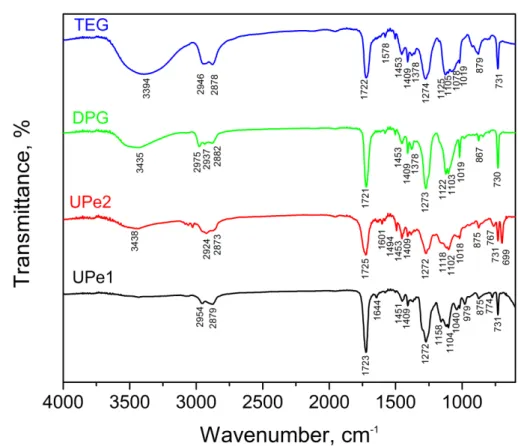
FTIR spectra of the products of PET glycolysis with DPG and TEG are shown in Figure 1. The broad band at ≈3400 cm–1 originates from the stretching vibration of OH valence bond present in terminal hydroxyl groups. In the FTIR spectrum of the product of glycolysis based on TEG, the band at 2975 cm–1, corresponding to the asymmetric deformation of C–H stretching vibration in the methyl group, was not observed due to the lack of methyl groups in TEG. This band is visible in the spec-trum of the product of glycolysis based on DPG. Also, for the same reason there is no band at 1377 cm–1, which originates from the bending vibration of C–H
bonds present in the methyl group. The intense band, observed at ≈1720 cm–1, originates from valence vib-ration of C=O present in ester group. The absorption bands between 1300 and 1100 cm–1 originate from C–O stretching vibrations, asymmetric and symmetric, res-pectively, present in ester group of terephthalic acid. The band at 879 cm–1 originates from the deformation vibrations of aromatic C–H out of plane connections. It is characteristic of 1,4-disubstituted benzene ring, which in this case comes from the terephthalic acid moiety.
After the reactions of glycolysis, maleic anhydride at the molar ratio of hydroxyl and carboxyl groups of 1.1, was added in the flask. Figure 1 shows also FTIR spectra of the synthesized unsaturated polyesters UPe1 and UPe2. Comparison with spectra of starting product indi-ates significant reduction in the intensity of band at 3400 cm–1, which originates from the stretching vib-ration of OH groups. Also, band at 1078 cm–1, which is derived from the alcoholic C–O stretching deformation vibration, is reduced. At the same time, the appearance of new bands at 1644 and 979 cm–1 can be observed in the FTIR spectrum of UPe1 resin, which correspond to the C=C stretching (skeletal) vibration of benzene ring and out of plane bending vibrations of 1,2-trans disub-stituted C=CH group, present in maleic acid fragment, respectively. Aromatic C–H stretching vibration, over-lapped with vinyl group, appeared in the region 3076– –3010 cm–1 in the spectra of the synthesized UPe.
The cure exotherms of UPe1 and UPe2, cross-linked with 1.0 wt.% benzoyl peroxide and 0.5 wt.% N,N- -dimethylaniline, are presented in Figure 2. According to these results, the maximum curing temperature of UPe1 (88 C) was quite higher and reached earlier (13 min) than for UPe2 (41 C after 21 min). Curing reaction of UPe1 is faster than curing reaction of UPe2, due to the better miscibility of polyester resin containing DPG with styrene than the resin containing TEG.
Figure 1. FTIR Spectra of UPe1, UPe2, and glycolyzed products (obtained using DPG and TEG).
Figure 2. The cure exotherms of UPe1 and UPe2 cross-linked with 1.0 wt.% benzoyl peroxide and 0.5 wt.% N,N-dimethylaniline.
change is less than 10% compared to the pure polyester (Figure 4, Table 3).
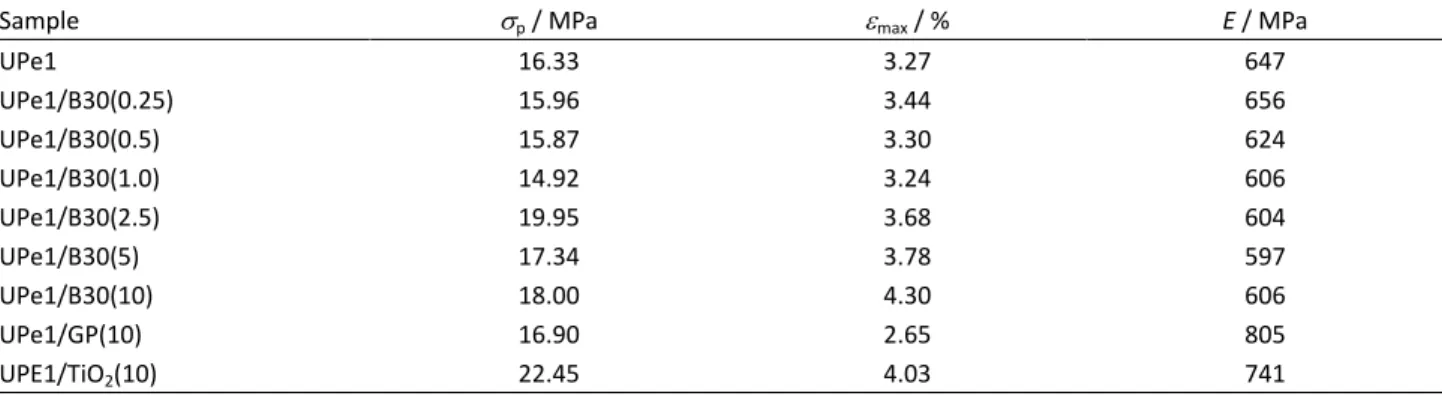
The greatest influence on the mechanical properties of the composites was found when graphite and TiO2 (10 wt.%) were added as fillers, which is reflected as significant increase of the tensile modulus, tensile strength and decrease of the elongation at break com-pared to the corresponding UPe resins (Figure 5, Table 3). In the case of nanocomposites prepared from UPe2
Figure 3. The stress-strain curves of the cured samples UPe1 and UPe2.
Figure 4. The stress-strain curves of the nanocomposites based on UPe1 and CLOISITE 30B.
Figure 6. The stress-strain curves of the nanocomposites based on UPe2 and AEROSIL® nanofillers.
Figure 7. The stress-strain curves of the composites based on UPe2 and graphite, clay and titanium dioxide.
Table 3. Results of the mechanical testing of cured UPe1 and corresponding composites
Sample p / MPa max / % E / MPa
UPe1 16.33 3.27 647
UPe1/B30(0.25) 15.96 3.44 656
UPe1/B30(0.5) 15.87 3.30 624
UPe1/B30(1.0) 14.92 3.24 606
UPe1/B30(2.5) 19.95 3.68 604
UPe1/B30(5) 17.34 3.78 597
UPe1/B30(10) 18.00 4.30 606
UPe1/GP(10) 16.90 2.65 805
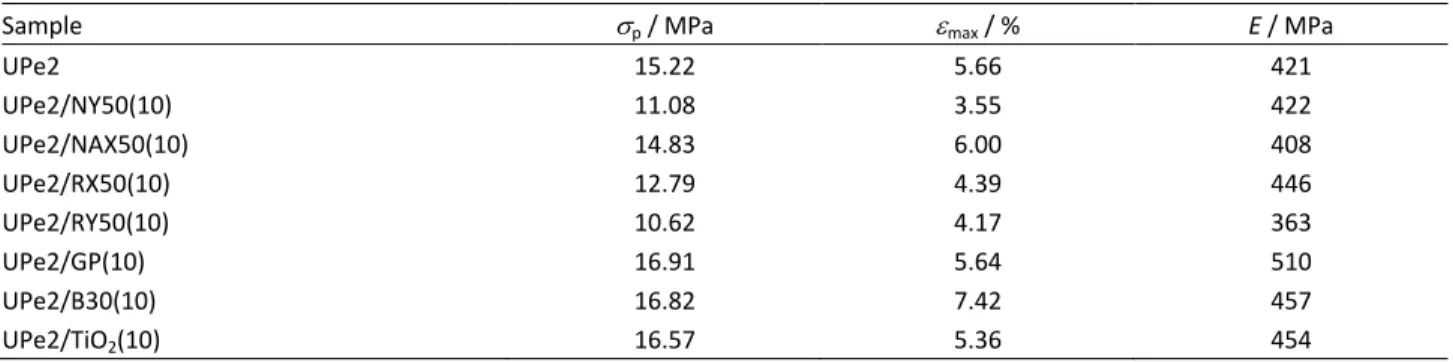
Table 4. Results of mechanical testing of cured UPe2 and corresponding composites
Sample p / MPa max / % E / MPa
UPe2 15.22 5.66 421
UPe2/NY50(10) 11.08 3.55 422
UPe2/NAX50(10) 14.83 6.00 408
UPe2/RX50(10) 12.79 4.39 446
UPe2/RY50(10) 10.62 4.17 363
UPe2/GP(10) 16.91 5.64 510
UPe2/B30(10) 16.82 7.42 457
UPe2/TiO2(10) 16.57 5.36 454
and cross-linked UPe2 resin. The presence of 10 wt.% clay, graphite or TiO2 in UPe2 resin increased tensile strength and tensile modulus, which indicates stronger interaction between filler particles themselves and matrix and filler particles (Figure 7, Table 4).
CONCLUSION
Maleic anhydride and di-hydroxyl functional pro-ducts obtained after catalytic glycolysis of PET waste, using dipropylene glycol or triethylene glycol, were used for the synthesis of unsaturated polyesters. The glycolyzed products and UPe resins were characterized by FTIR spectroscopy, acid and hydroxyl value. Curing reaction of UPe1 was faster than curing reaction of UPe2 due to the better miscibility of styrene with poly-ester resin based on glycolyzed product which contains DPG. Due to the higher polymer chain rigidity, UPe1 showed higher tensile strength and modulus, and lower elongation at break than UPe2.
The obtained UPe resins were further used as mat-rix for the synthesis of composites using chemically modified silica nanoparticles or clay CLOISITE 30B, as well as graphite powder or TiO2 as fillers. The influence of reinforcing agents on the mechanical properties of the prepared composites was investigated. It was shown that the addition of CLOISITE 30B to the UPe1 had no significant influence on the mechanical proper-ties, while tensile strength and tensile modulus of UPe2 increased after adding 10 wt.% of clay. The greatest influence on the mechanical properties of the compo-sites was found when graphite and TiO2 (10 wt.%) were added as fillers to the synthesized UPe, which is ref-lected as significant increase of tensile modulus, tensile strength and decrease of the elongation at break, indi-cating strong interaction between matrix and filler par-ticles. On the other hand, tensile strength and tensile modulus of nanocomposites prepared from UPe2 resin and hydrophobically modified silica nanoparticles decreased, while the composite prepared with AEROSIL® RY50 had the lowest mechanical properties.
Acknowledgement
The authors acknowledge financial support from Ministry of Education, Science and Technological deve-lopment of Serbia, Project No. 172013.
REFERENCES
[1] S.M. Al-Salem, P. Lettieri, J. Baeyens, Recycling and recovery routes of plastic solid waste (PSW): a review, Waste Manag. 29 (2009) 2625–2643.
[2] R. López-Fonseca, I. Duque-Ingunza, B. de Rivas, L. Flo-res-Giraldo, J.I. Gutiérrez-Ortiz, Kinetics of catalytic gly-colysis of PET wastes with sodium carbonate, Chem. Eng. J. 168 (2011) 312–320.
[3] K. Li, X. Song, D. Zhang, Depolymerization of poly-(ethylene terephthalate) with catalyst under microwave radiation, J. Appl. Polym. Sci. 109 (2008) 1298–1301. [4] R. López-Fonseca, M.P. Velasco, J.R.
González-Velasco, J.I. Gutiérrez-Ortiz, A kinetic study of the depolymerisation of poly(ethylene terephthalate) by phase transfer catalysed alkaline hydrolysis, J. Chem. Technol. Biotechnol. 84 (2009) 92–99.
[5] M. Goto, H. Koyamoto, A. Kodama, T. Hirose, S. Naga-oka, B.J. McCoy, Degradation kinetics of polyethylene terephthalate in supercritical methanol, AIChE J. 48
(2002) 136–144.
[6] M.E. Tawfik, S.B. Eskander, Chemical recycling of poly-(ethylene terephthalate) waste using ethanolamine, Sorting of the end products, Polym. Degrad. Stab. 95 (2010) 187–194.
[7] F. Pardal, G. Tersac, Kinetics of poly(terephthalate) glycolysis by diethylene glycol. I. Evolution of liquid and solid phases, Polym. Degrad. Stab. 91 (2006) 2840–
–2847.
[8] C.-H. Chen, C.-Y. Chen, Y.-W. Lo, C.-F. Mao, W.-T. Liao, Studies of glycolysis of poly(ethylene terephthalate) recycled from postconsumer soft-drink bottles. I. Influ-ences of glycolysis conditions, J. Appl. Polym. Sci. 80
(2001) 943–948.
[9] R. López-Fonseca, I. Duque-Ingunza, B. de Rivas, S. Arnaiz, J.I. Gutiérrez-Ortiz, Chemical recycling of post-consumer PET wastes by glycolysis in the presence of metal salts, Polym. Degrad. Stab. 95 (2010) 1022–1028. [10] G.P. Karayannidis, D.S. Achilias, I.D. Sideridou, D.N.
poly-(ethylene terephthalate), Eur. Polym. J. 41 (2005) 201–
–210.
[11] A. Torlakoğlu, G. Güçlü, Alkyd–amino resins based on
waste PET for coating applications, Waste Manag. 29
(2009) 350–354.
[12] M. Kathalewar, N. Dhopatkar, B. Pacharane, A. Sabnis, P. Raut, V. Bhave, Chemical recycling of PET using neo-pentyl glycol: Reaction kinetics and preparation of poly-urethane coatings, Prog. Org. Coat. 76 (2013) 147–156. [13] G. Güçlü, M. Orba, Alkyd resins synthesized from
post-consumer PET bottles, Prog. Org. Coat. 65 (2009) 362–
–365.
[14] D.J Suh, O.O Park, K.H Yoon, The properties of unsat-urated polyester based on the glycolyzed poly(ethylene terephthalate) with various glycol compositions, Poly-mer 41 (2000) 461–466.
[15] J.M.L. Reis, Effect of aging on the fracture mechanics of unsaturated polyester based on recycled PET polymer concrete, Mat. Sci. Eng., A 528 (2011) 3007–3009. [16] A.M. Atta, M.E. Abdel-Raouf, S.M. Elsaeed, A.-A.A.
Abdel-Azim, Curable resins based on recycled poly-(ethylene terephthalate) for coating applications, Prog. Org. Coat. 55 (2006) 50–59.
[17] Cs. Varga, N. Miskolczi, L. Bartha, G. Lipóczi, Improving the mechanical properties of glass-fibre-reinforced poly-ester composites by modification of fibre surface, Mater. Design 31 (2010) 185–193.
[18] R. Sengupta, M. Bhattacharya, S. Bandyopadhyay, A.K. Bhowmick, A review on the mechanical and electrical properties of graphite and modified graphite reinforced polymer composites, Prog. Polym. Sci. 36 (2011) 638–
–670.
[19] S.S. Ray, M. Okamoto, Polymer/layered silicate nano-composites: a review from preparation to processing, Prog. Polym. Sci. 28 (2003) 1539–1641.
[20] M. Zhang, R.P. Singh, Mechanical reinforcement of unsaturated polyester by Al2O3 nanoparticles, Mat. Lett.
58 (2004) 408–412 .
[21] L. Tibiletti, C. Longuet, L. Ferry, P. Coutelen, A. Mas, J.-J. Robin, J.-M. Lopez-Cuesta, Thermal degradation and fire behaviour of unsaturated polyesters filled with metallic oxides, Polym. Degrad. Stab. 96 (2011) 67–75.
[22] Y.-F. Shih, Y.-T. Wang, R.-J. Jeng, K.-M. Wei, Expandable graphite systems for phosphorus-containing unsat-urated polyesters. I. Enhanced thermal properties and flame retardancy, Polym. Degrad. Stab. 86 (2004) 339–
–348.
[23] L.B. Manfredi, E.S. Rodríguez, M. Wladyka-Przybylak, A. Vázquez, Thermal degradation and fire resistance of unsaturated polyester, modified acrylic resins and their composites with natural fibres, Polym. Degrad. Stab. 91
(2006) 255–261.
[24] K.A. Carrado, in G.A. Shonaike, S.G. Advani, (Eds.), Advanced Polymeric Materials: Structure Property Rela-tionships, CRC Press, Boca Raton, FL, 2003, Ch. 10. [25] X. Kornmann, L.A. Berglund, J. Sterte, E.P. Giannelis,
Nanocomposites based on montmorillonite and unsat-urated polyester, Polym. Eng. Sci. 38 (1998) 1351–1358. [26] R.K. Bharadwaj, A.R. Mehrabi, C. Hamilton, C. Trujillo,
M. Murga, R. Fan, A. Chavira, A.K. Thompson, Structure– property relationships in cross-linked polyester–clay nanocomposites,Polymer 43 (2002) 3699–3705. [27] M. Chieruzzi, A. Miliozzi, J.M. Kenny, Effects of the
nano-particles on the thermal expansion and mechanical pro-perties of unsaturated polyester/clay nanocomposites, Composites, A 45 (2013) 44–48.
[28] P. Jawahar, R. Gnanamoorthy, M. Balasubramanian, Tribological bahaviour of the clay-thermoset nanocom-posites, Wear 261 (2006) 835–840.
[29] P. Kiliaris, C.D. Papaspyrides, Polymer/layered silicate (clay) nanocomposites: An overview of flame retard-ancy, Prog. Polym. Sci. 35 (2010) 902–958.
[30] J.C. Huang, Zk Zhu, J. Yin, X.f. Qian, Y.Y. Sun, Poly-(etherimide)/montmorillonite nanocomposites pre-pared by melt intercalation: morphology, solvent resis-tance properties and thermal properties, Polymer 42
(2001) 873–877.
[31] B.-W. Jo, S.-K. Park, D.-K. Kim, Mechanical properties of nano-MMT reinforced polymer composite and polymer concrete, Constr. Build. Mater. 22 (2008) 14–20. [32] S. Katoch, V. Sharma, P.P. Kundu, Water sorption and
diffusion through saturated polyester and their nano-composites synthesized from glycolyzed PET waste with varied composition, Chem. Eng. Sci. 65 (2010) 4378–
IZVOD
MEHANIČKA SVOJSTVA KOMPOZITA NA BAZI NEZASIĆENIH POLIESTARSKIH SMOLA DOBIJENIH HEMIJSKOM
RECIKLAŽOM POLI(ETILEN-TEREFTALATA)
Aleksa dar D. Mari ko ić1
, Tijana Radoman2, E is S. Džu uzo ić1, Jas a V. Džu uzo ić3, Pa le Spasoje ić1, Boja a Isailo ić1
, Branko Bugarski1
1Teh ološko– etalurški fakultet, U iverzitet u Beogradu, B
eograd, Srbija 2
Inovacioni centar, Teh ološko- etalurški fakultet, U iverzitet u Beogradu, Beograd, Srbija 3
IHTM – Centar za Hemiju, Univerzitet u Beogradu, Beograd, Srbija
(Nauč i rad)
U o o radu si tetisa i su ko poziti a azi ezasiće ih poliestarskih (UPe)
smola i SiO2 (AEROSIL®:RY 50, NY 50, RX 50 i NAX 50), grafita, TiO2 ili organski odifiko a e gli e CLOISITE B u ilju ispiti a ja uti aja pu io a a eha ička s ojst a ko pozita. Nezasiće e poliestarske s ole su si tetisa e polazeći od
anhidrida maleinske kiseline i proizvoda glikolize dobijenih depolimerizacijom poli(etilen-tereftalata) sa dipropilen glikolom (UPe1 smola) ili trietilen glikolom
UPe s ola u prisust u katalizatora tetra util tita ata. Si tetisa e ezasiće e
poliestarske smole su ispita e pri e o FTIR spektroskopije, određe i je
kiseli ski i hidroksil i roj i ispita a su jiho a eha ička s ojst a. Molar a asa sred ja po roj oj red osti si tetisa ih ezasiće ih poliestarskih s ola je
iz eđu 6 –1630 g mol–1. Moduli istezanja i zatez a č rstoća ko pozita pri
-premljenih dodavanjem 10 mas.% grafita ili TiO2 ezasiće i poliestarski s o -la a su z ačaj o porasli u od osu a čiste poliestre, dok se izduže je pri kida ju s a jilo, što ukazuje a postoja je jakih i terak ija iz eđu atri e i česti a
pu io a. Sa druge stra e, a oko poziti si tetisa i korišće je UPe i odifiko
-a ih -a očesti -a SiO2su i ali a ju zatez u č rstoću i odule isteza ja ego
čista ezasiće a poliestarska s ola. Pokaza o je da prisust o gli e CLOISITE 30B
e a z ačaja uti aj a eha ička s ojst a s ole UPe , dok su red osti odula isteza ja i zatez e č rstoće UPe porasle ako doda a ja as.% gli e.
Klјuč e reči: Poli(etilen-tereftalat)
He-ijska re iklaža Kompoziti