MAS-SCM
ASfor Auto Sector:The Framework
Ritu Sindhu1, Abdul Wahid2,G.N.Purohit3
1(Research Scholar, Banasthali University, Rajasthan) 2(A.Prof.Gautam Buddha University, Greater Noida)
3(Dean, Banasthali University,Rajasthan)
Abstract:
The purpose of this study is to describe in de tail the development s tatus of t he innovative Multi -Agent based supply chain management (MAS-SCMAS )for auto sector.
This study was undertaken in view of the significance of improvement in efficiency of automobile sector and the development of a good multi-agent system framework to achieve that. The factors affecting the efficiency or OEE of the industry and t he efficiency properties were identified. It was clearly revealed that the available model do not fulfill the needs in the supply chain management of automobile industry and there is a s cope for evolving new model resulting in better efficiency.
Keywords: MAS-SCMAS, Multi-Agent systems, Supply Chain Management.
1.
IntroductionThe backbone of any company is its model. It is the skeleton, which governs the overall working of the plant. Because the model plays the major role hence the model for the
comprises of introduction of multi agents in the working of the company. The SCM multi agents perform the SCM tasks which were earlier done manually [4]. Automation acts as an additional feature as they decrease the number of errors and increase in the efficiency because of better planning, co-ordination and negotiation that comes into action because of these agents.
The framework acts as a series of steps that tell us about the pattern in which all the phases were executed to build the whole MAS-SCMAS Thus our framework allows review and revision at any sphere of time and innumerous number of times. The whole MAS-SCMAS model as the name suggests is MAS based SCM in automobile sector, and is built to perform the SCM with help of multi agents which are the intelligent systems which analyze the situation of the SCM and act accordingly to take essential decisions in the system.
2. Multi-Agent Systems
Agent-based systems technology has generated lots of excitement in recent years because of its promise as a n ew paradigm for conceptualizing, designing, and implementing software systems. In this article, I present some of the critical notions in MASs and the research work that has addressed them. Multi agent systems refer to
present existing scenario in the industry and hence makes essential decisions as required. MAS are a group of multi agents which consist of various agents which have divided the whole work of SCM into their respective individual tasks which whole together sum up to form the complete task of SCM. These problem solvers, often called agents, are autonomous and can be heterogeneous in nature. The multi agent systems must have the following features:
• It should be able to reduce the testing and maintenance cost.
• It should be able to ensure that quality work is being done.
• The agents must be able to take timely actions according to the current situations.
• It should reflect the level of maintainability.
• The agents should be able to make better use of resources.
• Different companies should be able to mould the agents according to their needs.
• The agents must be fault free.
• They should be easily implementable.
• The agents should be easily to install.
• They should be used to enhance the performance of the company. 3. Supply Chain Management
and/or specific departments are mere supply chain elements in integrated value networks. To satisfy customers' demand supply chain processes need to be aligned and coordinated. Agile supply chain management has become an effective and significant measure to enhance competitive advantage of modem enterprises [1],[2]. So, the effectiveness of a s upply chain management is an important factor of determining enterprise's success or failure. In the fierce market competition, supply chain management will determine its vicissitudes. For supply chain management is a very complex systems engineering, we need high efficiency information system to support it. But there are various kinds of enterprises in the supply chain.
4. MAS-SCMAS: The Framework
Taking into account the need and significance of a roadmap or framework for developing a MAS-SCMAS and ‘essentials and desirable features’, an integrated and prescriptive framework MAS-SCMAS is hereby proposed. MAS-SCMAS has been attempted to be highly implementable and prescriptive in nature. It has been structured into a hierarchical description including provinces, generic guideline, MAS-SCMAS development process etc. to be followed in order as follows.
4.1 Premises
The following premises have been considered when the proposed framework is being used to design the MAS-SCMAS:
• Four basic factors used to measure the influence of MAS-SCMAS in a company i.e. rate of production, rate of availability and rate of quality which cover all the factors that affect the efficiency of a company.
• An integrated approach to measurement of overall efficiency is feasible and would prove to be optimal.
• A common set of features for the desired model may be used to form the basis for its development.
• Determining the effect of the MAS-SCMAS on the major phases of the working i.e. planning, coordination and negotiation.
4.2 Generic Guidelines
The guidelines before following the process to develop the multi agents may be listed as follows:
• Assure compliance/adherence to collect a common set of essential and desirable features.
common set of essential and desirable features.
• Identify and persist preferably with all the attributes of good agent.
• Correlate the identified attributes with desired features and accordingly design the agents.
• Assure to control all the extraneous and intervening factors that may affect the efficient working of multi agent system.
4.3 MAS-SCMAU Development Process
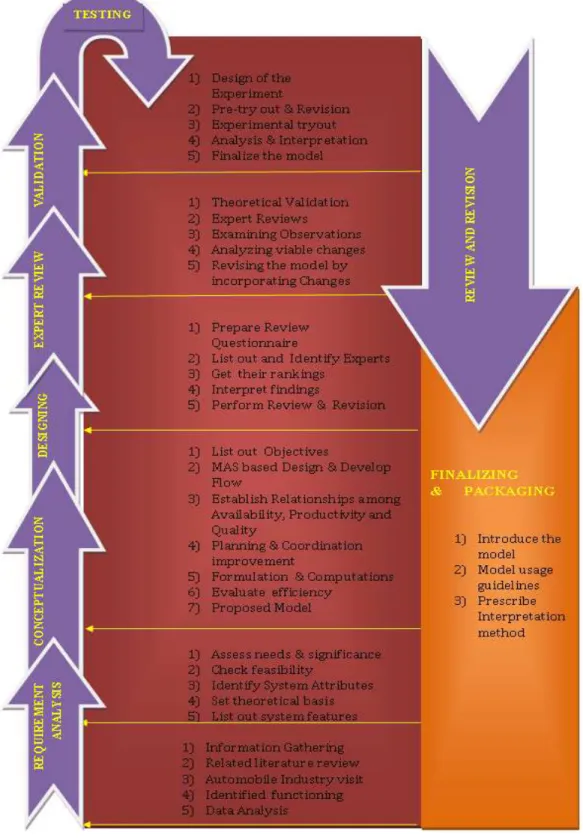
The development process of the MAS-SCMAS is comprised of eight phases together with prescriptive steps for each and has been depicted pictorially in MAS-SCMAS process model in the figure below. Such a framework has been proposed on the basis of integral and basic components for designing good quality MAS-SCMAS. The first phase starts up with the requirement analysis phase. The second phase Conceptualization of D esign a nd development for the desired s ystem is treated as an important task. Design and Development has been put forth as a third, followed by the phases termed as validation, Expert Review ,testing, review and revision and Finalizing and Packaging. An attempt has been made to symbolically represent the spirit of designing and to make the
framework prescriptive in nature followed by a brief description of each of the phases and steps.
4.3.1 Requirement Analysis
In this phase we gathered all the requirements of the project. This is a very crucial phase as in this all the requirements required throughout the project are to be analyzed first and then arranged accordingly. The requirements are analyzed with the help of industry visit. Industry visit plays a very important role throughout the process of MAS-SCMAS development. In this phase it helps us know about the various requirements that we will have in the development of our proposed framework and all what sources of information are required. A lot of data is also required for the study of the research topic; this is also laid down as a requirement and hence is fulfilled in this phase as well.
4.3.2 Conceptualization
A set of five steps has been prescribed, in the special context of development of
MAS-SCMAS, to implement the foremost phase. The first step ‘Assess Needs and
Significance’, refers to understanding the requirement of the framework that is supposed to be developed followed the contributions of such a development, apart from the fulfilling of the requirements. The second step ‘Check feasibility’ refers to counterchecking that the framework to be designed with all the above stated features is actually feasible or not. The third step ‘Identify System Attributes’ deals with the identification of the features with which the framework has to be bombarded with. The fourth step ‘Set Theoretical Basis’ deals with the specification of the theoretical viability for model development. The final step ‘List out System Features’ refers to listing the system features i.e. laying down the features of the system for which model is being developed.
4.3.3 Design and Development
Framework plays a cr ucial role for a company’s optimum efficiency. Designing is the most important and critical step towards the development of desired quality design model. This phase is based on f ive steps described as follows. The first step ‘List out Objectives’ refers to the exploration and to keep in mind the objectives to be achieved, throughout the development process. The objectives of the desired framework may be formally defined in terms
the formulation of the multi agent system that accomplishes the desired task. T his involves processes such as evolving a mathematical expression that on use will produce a quantitative value. The next part is computations; in this the efficiency is calculated with the effect of MAS. The sixth step ‘Evaluate efficiency’ refers to the efficiency calculation after the MAS has been successfully installed. The next part comes out to be Pre-try out and Post-try out in which the efficiency is calculated. Then the efficiency improvement is evaluated. This efficiency is that efficiency which is improved because of the applying of the multi agent system into the company. The final step ‘Proposed Model’ refers to the implementation of the proposed model which is developed by us. This model helps the companies to efficiently perform their SCM with the help of MAS.
4.3.4 Expert Reviews
The next phase in the MAS-SCMAS development was expert reviews. In this phase the expert of the domain area are consulted to provide their reviews about our model for improvements. Following are the activity incorporate in this phase
• Prepare a review Questionnaire • List out and Identify experts • Get their rankings
• Interpret findings (statistical analysis) • Perform review and revision.
4.3.5 Validation
The next phase in the development of the MAS-SCMAS is the validation. Theoretical validation of proposed framework provides the supporting evidence as to whether a measure really captures the internal attributes that purports to measure. Work on theoretical validation has followed two paths referred in literature as follows:
• Measurement-theory based approaches such as those proposed by Whitmire, Zuse, and Poels and Dedene.
• Property-based approaches (also called axiomatic approaches), such as those proposed by Weyuker and Briand et al.
4.3.6 Testing
third ‘Experimental try out’ refers to the step in which the experimental i.e. actual implementation is made of the MAS-SCMAS by installing the multi agents. The fourth ‘Analysis and i nterpretation’ refers to the step in which analysis is made by the whole testing phase i.e. both pre try out and experimental try out phase. The final ‘Finalize the Model’ refers to the step in which we finalize the model by making all the necessary things available in the model. 4.3.7 Finalizing and Packaging Document
The final phase of the development of the MAS-SCMAS is the documentation phase. In this phase all the documentation is done i.e. all the steps right from the start of the project. This all is done through the following steps:
• Introduce the model
• Define the usage guidelines
• Specific Application area
5. Conclusion and scope for further research:
The present research found many complimentary jobs to be achieved with regard to desirable features of MAS-SCMAU and its constitution. A similar situation was seen with respect to scope of evaluation. The researcher s ees co nsiderable s cope f or
further exploratory works so that a clear picture may emerge.
References:
[1]AbdulWahid1,K.Mustaffa,R.A.Khan”W BIS for Computer Programming”
[2] L aurillard, D., Rethinking University Teaching, 2nd Edition, Routledge/Falmer, London, 2002
[3] K Mustafa , pr esented e xpert keynote address on E -Learning, A N ational Conference on E -Learning perspective, India, January 19, 2008.
[4] Burkle, M. & Sayed, Y. ‘Integrating ICT i n Higher Education: T he C ase of ITESM’, Mexico, International
Journal of Education, 2001.
[5] Colllis, B. & Moonen, J., Flexible learning in a digital world: experiences and expectations, Kogan Page, London, 2001. [6] Dapeng Sun, Xiaoping Zhang, Ming Yu, Applications of Workflow in Supply Chain Management: A Case Study” 1-4244-0318-9/06/$20.00 ©2006 IEEE.
[7] Jiang Tian, , Huaglory Tainfield , “Literature Review upon Multi =Agent Supply Chain Management” , 1-4244-0060-0/06/$20.00 ©2006 IEEE.
Authors Profile:
Ritu Sindhu: Ph.D Scholar, Banasthali
University,Rajasthan.Completed her B.Tech (CSE) from U.P.T.U, Lukhnow, M.Tech
(CSE) from Banasthali University,
Rajasthan.
Abdul Wahid: Presently working as a
A.Professor in Gautam Buddha
University,Greater Noida He completed his Ph.D. in Computer Science from Jamia Millia Islamia (Central University), Delhi.
G.N.Purohit: Dean, Banasthali University,