International Journal of Engineering and Technology Volume 2 No. 11, November, 2012
ISSN: 2049-3444 © 2012 – IJET Publications UK. All rights reserved.
1881
The Utilization of Bili-
bili Dam’s Dredging Sediment Stabilized with Cement
for
Construction Material
Hamzah Yusuf
1, M.S.Pallu
2, L.Samang
3, and M.W.Tjaronge
4.
1Department of Civil Engineering, Hasanuddin University
2,3,4
University of Hasanuddin, Faculty of Technology,
Jl.Perintis Kemerdekaan Km 10 Makassar, South Sulawesi, Indonesia
ABSTRACT
This study aimed to determine (1) the base characteristics of Bili-Bili Dam’s dredging sediment soil (2) the change of strength capacity of dredging sediment soil stabilized with cement for construction material use such as paving block, blocks(batako), ceramic roof tile and concrete roof tile. This study was conducted in laboratory by using dredging sediment samples from Bili-bili dam’s intake and taken from 12 dredging points and located around 100 – 200 m from sluice gate of the dam. Testing and data analysis used are standard methods such as ASTM, AASTHO, and SNI. The Result of study showed that the base characteristics of dredging sediment as fined grain soil (silt-clay) with PI 17,205 % by various percentage of cement addition 5%, 10%, and 20% (cement stabilized), unconfined compressive strength test with soaking time 3, 7, 14, 28 days, showed the increase of compressive strength capacity of sediment and met the condition as construction material.
Keywords: Stabilization, Sediment, Dredging, Unconfine Compressive Strength
I.
INTRODUCTION
The multipurpose dam of bili-bili is located around 30 km in the downstream from caldera. It is about 80 million m3 of soft sediment has silted on the base of the dam and almost reaches the intake channel (Haeruddin 2011). This situation can induce the failure of Bili-bili Dam.
The high rate of sedimentation that occurs at this time should be anticipated by dredging the sediment in the intake and the surrounding area. the volume of sediment which has planned to dredge is 100000-200000 m ᶟ annually (samang, 2010). The constraint faced by this program is the limited storage capacity of the area, while the current location that used is only temporary because the area will be developed.
Based on this explanation that there will be a sedimentation
around dam’s intake which will affect the function of the dam,
so dredging can be an alternative solution. Generally, sediment dredging material was dumped to the sea but several researches have shown that the dredging sediment can be worth economically after analyzed and regarded environmental friendly rather than dumping it to the sea (Sheenan, 2010).
Stabilization is an effort to modify the quality of pavement material (sub base) or to boost the strength of the material so that it can work better than the existing base soil (depkimraswil 2003). Soil stabilization has been widely used to increase the
strength of sub base on pavement structure. In this case, there is an increase of strength, rigidity, and bearing capacity with various stabilization materials (Solanki, 2009; Naji, 2010; Piratheepan, 2010; Ghosh, 2010; Hossein, 2010; Inoue, 2004; Gnanendran, 2010; Kodikara ,2005)
There is a need to examine in the form of research to analyze the potency of the dredging sediment material. In this case, the application of local and appropriate multipurpose technology which can be used effectively and efficiently is hoped to reduce the risk of continuing disaster. The result of this research, later on, based on academic considerations can be used as construction material such as bricks, paving blocks, ceramics, and so forth by applying stabilization technology (mixing with cement material like PC and lime).
Sedimentation problem can induce silting and dam’s failing.
International Journal of Engineering and Technology (IJET) – Volume 2 No. 11, November, 2012
ISSN: 2049-3444 © 2012 – IJET Publications UK. All rights reserved.
1882
0 20 40 60 80 1000.001 0.01 0.1 1 10 100
Pa
ss
in
g
Fi
n
er
,
(%
)
Diameter, mm
Point 03 Point 05 Point 09
0.000 0.050 0.100 0.150 0.200 0.250 0.300 0.350 0.400
0.00 5.00 10.00 15.00 20.00 25.00
Ax
ia
l
S
tr
ess
,
(K
g
/cm
²)
Axial Strain, (%)
Curing Time 28 day
Curing Time 14 day
II. RESEARCH METHODOLOGY
The method used in this research is experimental method which conducted in laboratory of soil mechanic. The research methods used are : a. The Laboratory testing performed prior is the basic testing for original soil such as soil properties of dredging soil by use of standard test (ASTM and AASHTO) . b. strength capacity test of sediment stabilized with cement, this the second stage after base characteristic of of the soil is known. The addition material used in this study is Portland cement type 1. The method used is by adding the percentage of cement about 5%, 10% and 20%. To determine the compressive strength, soaking was conducted about 3 days, 7 days, 14 days, and 28 days. Result of the research can show the base characteristic of sediment and the strength increase after stabilization
.
III.
DISCUSSION OF RESULT
a. Index Properties of Natural Soil Sediment
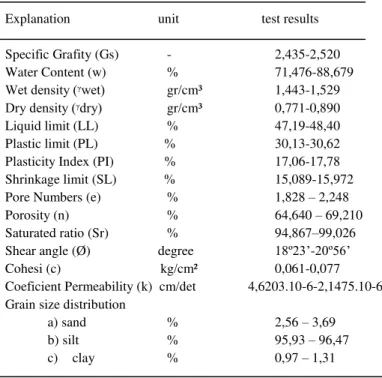
Index propertie testing program were concerned with; specific gravity, water content, density, atterberg limit, and grain size analysis .The Laboratory testing performed prior is the basic testing for original soil such as soil properties of dredging soil by use of standard test (Table 1). Soil samples taken consisted of 12 samples (12 intake points). Testing was conducted for a few sample points and taken randomly (5 points).
Tabel 1: Results of Dredging Sediment Index
Property Test
Explanation unit test results
Specific Grafity (Gs) - 2,435-2,520
Water Content (w) % 71,476-88,679
Wet density (ᵞwet) gr/cm³ 1,443-1,529
Dry density (ᵞdry) gr/cm³ 0,771-0,890
Liquid limit (LL) % 47,19-48,40
Plastic limit (PL) % 30,13-30,62
Plasticity Index (PI) % 17,06-17,78
Shrinkage limit (SL) % 15,089-15,972
Pore Numbers (e) % 1,828 – 2,248
Porosity (n) % 64,640 – 69,210
Saturated ratio (Sr) % 94,867–99,026
Shear angle (Ø) degree 18º23’-20º56’
Cohesi (c) kg/cm² 0,061-0,077
Coeficient Permeability (k) cm/det 4,6203.10-6-2,1475.10-6 Grain size distribution
a) sand % 2,56 – 3,69
b) silt % 95,93 – 96,47
c) clay % 0,97 – 1,31
Figure 1:Grain size distribution curve
Results of unconfined compressive strength analysis of dredging sediment Bili-bili Dam
Figure 2: Summary of unconfined compressive test of sediment with time of soaking 3,7,14, and 28 days.
b. Characteristics of dredging soil stabilized by portland cement
The characteristics test of the dredging soil stabilized by cement based on SNI 03-6791-2002, which the method for unconfined compressive strength test refers to JIS A1108, SNI 03-1974-1990, 14-1989-F SKSNIM and CBR testing refers to the ASTM D 1833, AASHTO T-180 & T-183, in this case, brief results were obtained by use of percentages of mixing cement, 5%, 10%, and 20% of the weight of sediment sample. The curing time for unconfined compressive strength are 3 days, 7 days, 14 days, and 28 days.
International Journal of Engineering and Technology (IJET) – Volume 2 No. 11, November, 2012
ISSN: 2049-3444 © 2012 – IJET Publications UK. All rights reserved.
1883
0 2.5 5 7.5 10 12.5 15 17.5
0.00 0.50 1.00 1.50 2.00 2.50 3.00 3.50
Ax
ia
l
S
tr
ess
,
(K
g
/cm
²
)
Axial Strain, (%)
Curing Time 28 days
Curing Time 14 days
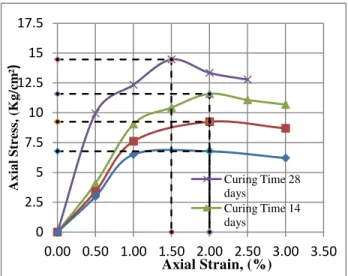
Unconfined compressive stress-strain test for some curing times and mortar variety, for instances the curve shape of the mixing of 5% cement and 20% cement and the curing times of 3,7,14, and 28 days can be seen in figure 3 below:
Figure 3 Summary of unconfined compressive test of sediment stabilized with cement 20 % with time of soaking 3,7,14, and 28
days
Results of unconfined compressive strength analysis of dredging sediment Bili-bili Dam, results were obtained by use of percentages of mixing cement, 0%, 5%, 10%, and 20% of the weight of sediment sample. The curing time for unconfined compressive strength are 3 days, 7 days, 14 days, and 28 days can be seen in table 2 below:
Table 2: Unconfined Compressive Strength with
Varied of Cement Addition and Time of Soaking.
% cem ent
Lab. tests Unit
Time of soaking (day)
3 7 14 28
0
stress (qu) strain (Ԑ)
Kg/cm² %
0,315 18,00
0,339 18,00
0,346 18,00
0,352 15,00
5
stress (qu) strain (Ԑ)
Kg/cm² %
1,300 6,00
1,843 4,00
2,359 3,00
3,387 2,00 10 stress (qu)
strain (Ԑ)
Kg/cm² %
2,551 2,00
3,555 2,00
4,517 2,00
5,464 1,50 20 stress (qu)
strain (Ԑ)
Kg/cm² %
6,775 2,00
9,242 2,00
11,576 2,00
14,451 1,50 Based on Table 1, it can be seen that, the plasticity index is about 17.06 to 17.88, gradation / grain size test results showed that Silt + clay dominated the type of samples is about 95.90 to 97.44% and about 2.56 to 4.10% for sand with water content about 71.476 to 88.679 %, while the specific gravity is 2.437 to
2.516.
The results of the test shows that the type of sediment is illite clay mineral in the form of muddy clay, property index refers to fine silt clay.
Bearing capacity test shows that there is an increase of bearing capacity on dredging sediment stabilized with cement.
Unconfined compressive strength which done with stabilization method cement in this research is to know the value of unconfined compressive strength ( qu) of sediment. Basest and analysis of unconfined compressive strength of dredging sediment, it is obtained for the real dredging sediment soil that qu number is 0,315 kg/cm2, this is showed that this value refers to soil with soft consistency.
While from the graph of stress-strain , the value of unconfined compressive strength for 5% of cement for stabilization resulting the strength increase between 1,300 kg/cm and 6,775 kg/cm2/ (20% cement) for 3 days time soaking, while for 28 days soaking, 3,387 kg/cm2, (5% cement) and 14,451 kg/cm2 (20% cement), these values tend to increase linearly with the percentage of cement and this value can be categorized as the increase of strength of bad soil to hard soil (Das, 1993).
IV
.CONCLUSION AND RECOMMENDATION
Conditions of site-deep sampling of sediment and briefly representation of test resuts, including its typical utilization potential, could be summarized as follows;
Conclusion
Based on the test and base soil characteristic analysis of Bili-bili dam’s dredging sediment, showed that the kind of soil is clay mineral in the form of muddy clay soil. By using stabilization method, there is a strength increase of soil with cement stabilized. It can be seen from the addition of cement in 5%, 10% and 20% and soaking time. Generally, there is an increase of soil bearing capacity on Bili-bil dam’s dredging sediment.
International Journal of Engineering and Technology (IJET) – Volume 2 No. 11, November, 2012
ISSN: 2049-3444 © 2012 – IJET Publications UK. All rights reserved.
1884
rice field, etc.) around the stock yard. The condition is
also relevant due to the existence of such industrial to
be widespread quite a lot in Gowa District.
Recommendation
By the increase of strength on dredging sediment stabilized with cement , it can be recommended to be used as construction material like brick, blocks, paving blocks, concrete tile, and others.
It is Required to do a further research about exploiting of sediment stabilized with cement besides cement, for example with lime, fly ash, other stabilization materials and bitumen.
ACKNOWLEDGMENT
We would like to thank all whom involved directly and indirectly in completing this paper. Special thanks to the Head of Soil Mechanic Laboratory ,Hasanuddin University and Politechnic for supporting, and provided opportunity to the writer to conduct research.
REFERENCES
[1]
American Society for Testing and Materials
(ASTM). 2005. Standard test methods for liquid
limit, plastic limit, and plasticity index of soils.
ASTM D4318-05
, West Conshohocken, Pa.
[2]
American Society for Testing and Materials
(ASTM). 2006a. Standard practice for classification
of soils for engineering purposes (Unified Soil
Classification System).
ASTM D854-06
, West
Conshohocken, PA.
[3]
American Society for Testing and Materials
(ASTM). 2006b. Standard test methods forspecific gravity of soil
solids by water pycnometer.
ASTM D854-06
, West
Conshohocken, Pa.
[4] Das, B. M., 1993, Principles of Geotechnical Engineering, PWS Publishing Comp., Boston, USA
[5]
Ghosh, A. 2010. Compaction Characteristics and
Bearing Ratio of Pond Ash Stabilized with Lime and
Phosphogypsum.
J. Mat. in Civ. Engrg.
22
, 343
[6] Gnanendran C., T., and Jegatheesan P.,2010., Determination of Fatigue Life of a Granular Base Material Lightly Stabilized with Slag Lime from Indirect Diametral Tensile Testing., Journal of Transportation Engineering, Vol. 136, No. 8, August 1, 736–745.
[7] Gouw, Tji-Liong. 2009. Soil Classification., Certification
Workshop (G-1) Engineers Association of Indonesia Land Vol.1
[8] Haeruddin, 2011. Budget Bili-bili Dam Dredging USD 40 M. Daily Fajar, June 8, 2011
[9] Hossein Moayedi, dkk. 2011. Effect of Sodium Silicate on Unconfined Compressive Strength of Soft Clay Electronic
Journal of Geotechnical EngineeringVol 16 tahun 2011
[10]Inoue,H., Kidera,S., Miura,N., 2004. Mechanical and Chemical Analyses of Improvement Effect on Stabilized Ariake Clay by Cement and Quick Lime. Proc. International Symposium on Lowland Technology
[11]Piratheepan, J., C. T. Gnanendran. 2010. Characterization of Cementitiously Stabilized Granular Materials for Pavement Design Using Unconfined Compression and IDT Testings with Internal Displacement Measurements.J.Mater.Civ.Eng.,22(5), 495-505
[12]Samang,L.,2010. Utilization Investigation Of Dredging Sediment Of Bili-Bili Reservoir for Urgent Disaster Reduction for Mt. Bawakaraeng, South Sulawesi., Draft Final Report, Soil Mechanic Laboratoy, Dept.of Civil Engineering, Hasanuddin University
[13]Sheehan,C. Harrington,J., & Murphy, J.D. 2010. An Environmental and Economic Assessment of Topsoil production from dredge Material. Journal Resources Concervation and Recycling. 55, 209-220