JSCS–4024 Original scientific paper
doi: 10.2298/JSC091009073L
A study on the microstructure of a nitrate ester plasticized
polyether propellant dissolved in HCl and KOH solutions
YONG LIU1,2*, LUOXIN WANG3, XINLIN TUO2, SONGNIAN LI1,2 and WEIMIN YANG1
1College of Mechanical and Electrical Engineering, Beijing University of Chemical
Technology, Beijing 100029, 2Department of Chemical Engineering, Tsinghua University,
Beijing 100084 and 3Wuhan University of Science and Engineering, Key Laboratory
of Green Processing and Functional Textiles of New Textile Materials, Ministry of Education, Wuhan 430073, China
(Received 9 October 2009, revised 19 January 2010)
Abstract: Understanding of how the properties and performance of nitrate ester plasticized polyether (NEPE) propellants relate to microstructure is compli-cated by numerous components that have different characteristics. One ap-proach to alleviating these complications is to observe a microstructure that has lost one or several components. This article examines the dissolution process, mass loss and change of the ion concentration of propellants in acid and alkali solutions. A scanning electron microscope was used to observe the dissolved residual of the propellants. The results revealed that the main constituents of NEPE propellant have different dissolving properties in solutions of HCl and KOH. By monitoring the dissolution process of NEPE propellant in HCl and KOH solutions, it was found that the microstructure of the propellant is gene-rally compact and the polymer binder not only binds all the other components, but also protects the inner part of the propellant in solution.
Keywords: NEPE propellants; microstructure; interfaces; scanning electron mic-roscope (SEM); swelling.
INTRODUCTION
Nitrate ester plasticized polyether (NEPE) propellants are high-energetic composite solid propellants that use a polyether, such as polyethylene glycol (PEG) or an ethylene oxide–tetrahydrofuran co-polyether, as a polymeric binder, and mixed nitrates (BG), usually 1,2,4-butanetriol trinitrate nitrate (BTTN) and nitroglycerin (NG), as plasticizer. Large amounts of solid particles, such as alu-minum powder (Al), octogen or cyclotetramethylene-tetranitramine (HMX) and ammonium perchlorate (AP) are contained in the propellants.1,2 This type of
pellant integrates the advantages of double-base propellants and composite
pellants, and adds excellent low temperature mechanical properties. Therefore, this type has been studied extensively and applied broadly in many countries since it was first developed in the USA in the 1970s.3,4 However, the
micro-structure of the propellant, which decisively affects its performance, has not been clearly studied.5–7 To obtain more energy or decrease the sensitivity of a NEPE
propellant, it is necessary to obtain detailed characteristics of the microstructure of the propellant in advance. An NEPE propellant is a kind of composite con-taining many components. Through the study of solution processes and the spe-cialty in different solvents, the state of different materials in the composite can be deduced. This is another way to obtain knowledge about the structural characters of a composite besides direct observation. Based on a former study concerning the microstructure and dissolution differences of a NEPE propellant in water and trichloromethane,8 the present article sequentially studies the dissolution
diffe-rences of the propellant in HCl and KOH solutions and examines the dissolution peculiarities of different components of the propellant. Through these studies, it was expected that the microstructures of the propellant could be understood more thoroughly.
EXPERIMENTAL
The main constituents of the studied solid propellant, which was taken from a rocket, were PEG, BG, Al, HMX and AP in the approximate mass percentages 6–9, 15–21, 19, 43 and 8, respectively. The content of the other auxiliary agents, such as the crosslinking agent, was about 1–2 %.
The HCl and KOH employed in the dissolution experiments were analytically pure re-agents. All the water used in the present study was distilled water.
The concentrations of NH4+, Al3+ and AlO
2- in the HCl and KOH solutions were
mea-sured using a Metrohm 761 Compact Ion Chromatograph (IC) (Switzerland) and Varion Vis-ta-MPX inductively coupled plasma-atomic emission spectrometer (ICPES) (USA).
The microstructure of the NEPE was observed using a Hitachi S-4500 scanning electron microscope (SEM) (Japan). The samples were sprayed with gold for 5 min before observation.
RESULTS AND DISCUSSION
Solubility of the NEPE propellant in HCl
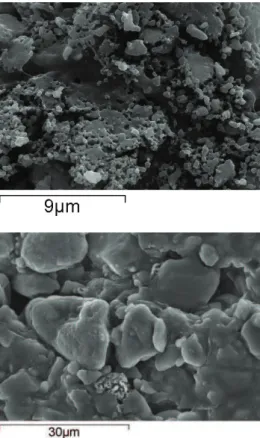
Concentrated HCl (36.5 %) (10 ml) was diluted with water (40 ml) in a bea-ker; five NEPE propellant samples, each about 2 mm×2 mm×1 mm, were put into the diluted HCl. Five days later, the samples had broken up into a powder. A translucent film had appeared on the bottoms of the beakers. Some small bubbles were observed in the film and small dust-like particles floated on the surface of the solutions. The powders were observed with the SEM; the morphology is shown in Fig. 1. For comparison, the SEM microphotograph of original NEPE propellant is presented in Fig. 2.8
phe-nomenon can be attributed to the fact that the polymer binder in the NEPE pro-pellants broke down into small molecules, such as ethylene glycol, in the HCl so-lution. After the polymer chains had decomposed into fragments, the solid par-ticles, such as AP, HMX and Al, which had been bonded by the chains, fell to pieces and then became powder. The dust particles on the solution surface may be very small solid particles that had a relatively large specific surface area. These small particles collected together and floated on the liquid surface because they were subjected to strong surface tension. To confirm this deduction, some Al powder was put into dilute HCl. A little Al powder floated on the surface even after vigorous shaking, which validates the above supposition. The solid com-ponent HMX is a chemically stable material that generally does not react with dilute HCl or KOH at normal temperatures.9 The AP and Al particles can react with dilute HCl and dissolve into the solution:10,11
NH4ClO4 + HCl → NH4Cl + HClO4 (1)
Al2O3 + HCl → AlCl3 + H2O (2)
Al + HCl → AlCl3 + H2 (3)
Fig. 1. SEM Image of the NEPE propellant powder treated with HCl solution.
However, the quantity of these two reagents was large and the reactions are slow. As a result, at the end of the experiment, some of the AP and Al particles remained. For this reason, Fig. 1 shows small balls (Al), particles with a scraggy surface (AP) and numerous middle-size particles (HMX).8 The densities of the liquid plasticizers NG and BTTN are both greater than water. In addition, the plasticizers both are barely dissolved in water and HCl, hence they formed a translucent film at the bottom of the beakers. As some components react with HCl and produce gases such as H2, some mini bubbles appeared in the film.
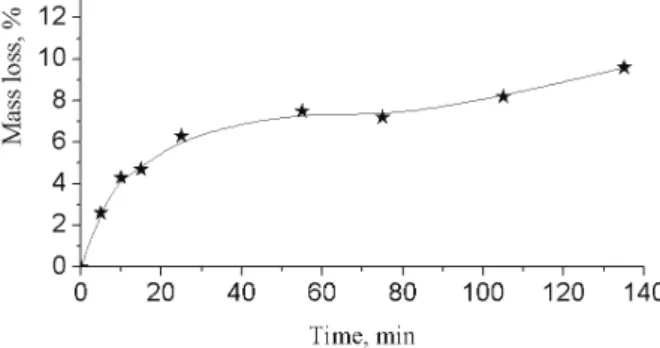
Information about the mass loss of a composite material in solution will re-flect to some extent the microstructure of the composite, especially when the components have specific solubility in different solutions. The mass loss experi-ment with NEPE propellants in dilute HCl was performed as follows:
1. The propellant was cut into samples about 2 mm×1.5 mm×1 mm, weighed, and put into 5 weighing bottles.
2. Five ml 0.042 mol L–1 HCl was put into each bottle.
3. The solution was poured out from each bottle after a certain interval. 4. The bottles with their remaining solution were dried at 30 °C for 24 h. 5. The residues were weighed and the mass losses were calculated and the results are shown in Fig. 3.
Fig. 3. Mass loss curve of the NEPE propellant soaked in dilute HCl.
inner AP and Al with the HCl; hence the mass loss became slower and slower. By the end of the process, the dissolution reached a balance.
To examine the solubility of large NEPE propellant samples in dilute HCl, a 9.7 mm×10 mm×10.5 mm propellant cube was put into 500 ml 0.042 mol L–1 HCl solution. The solution was stirred continuously and 1 ml aliquots were taken at intervals to measure, using the IC and ICPES, the concentration of NH4+ and
Al3+ in the solution. The results are shown in Fig. 4.
Fig. 4. Curves of the change in the concentrations of NH4+ and Al3+ in dilute HCl with time.
From Fig. 4, it is apparent that the curve of NH4+ concentration increased
rapidly because the AP readily dissolved in the HCl solution. After the outer AP had dissolved, the rate of increase of the NH4+ concentration slowed, illustrating
that the polymer binder in the outer part blocked the HCl solution from entering the propellant. In contrast, the curve of the Al3+ concentration in Fig. 4 can be di-vided into three stages. During the first stage (about 0–20 h), the increase of the Al3+ concentration was slow. The reason may be that there was an oxide film on the Al surface, which reacted with HCl slowly and protected the inner Al. Thus, after the oxide film had been dissolved, the inner Al reacted rapidly with the HCl. As a result, the concentration of Al3+ increased very rapidly in the second stage
(about 20–50 h). After the AP and Al in the surface layer of the propellants had dissolved, the polymer binder reacted with the dilute HCl very slowly and be-came a protective cover to the inner contents. The binder cover blocked the pene-tration of HCl into the propellant; for this reason, at the third stage (after about 50 h), the concentration of both Al3+ and NH4+ increased slower and slower.
Solubility of the NEPE propellant in KOH solution
later, a corner of the sample appeared to swell, and some mini blobs appeared on the sample. Four days later, the outer layer of the sample became translucent, like a gel. The color of the solution became yellowish. Six days later, the whole sample had swelled, and some mini pores could be observed on the surface of the sample. Some particles were suspended in the solution and the yellowish color deepened. After fourteen days, the sample was taken out, dried, and observed by SEM. The results are shown in Fig. 5.
(a)
(b)
Fig. 5. SEM images of the NEPE propellant soaked in KOH solution, a) surface of the sample; b) interior of the sample.
The propellant sample may have a relatively strong surface tension in alka-line solutions, hence the sample floated in the solution near the surface. Initially, the polymer binder absorbed water and swelled, and then it reacted slowly with the KOH. This was the cause of the swell. A few polymer binders appeared on the surface, as shown in the SEM image (Fig. 5a). Both Al and its oxide film Al2O3 can react with KOH and then dissolve in the solution:
Al2O3 + KOH → KAlO2 + H2O (4)
Finally, the reactions created a flock of Al(OH)3 sedimentation. These
sus-pensions in solution caused the slight amount of ball-like Al that can be seen in Fig. 5a. HMX and AP are crystals and perhaps react with KOH very slowly; hen-ce, after the grey Al had disappeared, the outer sample became translucent. It can be seen from Fig. 5a that many big scraggy particles (AP) and small, smooth par-ticles (HMX) appeared on the image.8 Due to the swell and the dissolution of some components, mini pores became visible on the surface of the sample. The plasticizers BTTN and NG are yellow oil-like liquids. They hardly dissolve in a dilute alkali solution at normal temperature, hence the solution did not immedia-tely become yellowish. However, over a long time period, the plasticizer dissol-ved a little and then the solution became yellow. Comparing Figs. 5a and 5b, the difference is apparent in that there are more polymer binders and ball-like Al in Fig. 5b, although the sample plumped. Thus, it can be concluded that the Al components reacted with difficulty with KOH under these conditions.
The mass loss experiment of the NEPE propellant in KOH was performed in exactly the same manner as that in HCl. The results are shown in Fig. 6.
Fig. 6. Mass loss curve of the NEPE propellant soaked in KOH solution.
The solubility of a cube of NEPE propellant (10 mm×10 mm×10 mm) in KOH solution was also examined in the same manner as in HCl. The change of the concentrations of NH4+ and AlO2– are shown in Fig. 7.
Fig. 7. Curve of the changes in the concentration of NH4+ and
AlO2- in KOH solution with time.
Comparing Fig. 4 and Fig. 7, the change of the NH4+ concentration was
different. The curve of the concentration of NH4+ in Fig. 7 is smooth and shows
almost no major changes, while in Fig. 4, the curve changes abruptly during the initial stage, which illustrates that AP is a little difficult to dissolve in KOH. Ano-ther reason may be related to the swell of the sample, which allowed relatively greater contact between AP and the KOH solution. Thus, the amount of AP reacting with KOH changed little. The curve of AlO2– concentration in Fig. 7 is
not like that of Al3+ in Fig. 4; it is rather like that of NH4+ in Fig. 4. This may be
attributed to the fact that the oxide film on the surface of the Al particles reacted more easily than the inner Al with KOH. For this reason, the concentration of AlO2– increased faster during the initial 20 h than it did later.
CONCLUSIONS
From the results obtained in this study, the following conclusions can be drawn.
i) The NEPE propellant disaggregates in concentrated HCl. In contrast, it swells in a KOH environment, which leads to a loosening of the microstructure.
ii) The polymer binder does not react easily with HCl or KOH, and it forms a protective layer around the inner AP and Al particles. Hence the binder in the outer layer results in the interior of the propellant retaining an intact structure.
may be that the oxide film on the Al surface is easier to remove in KOH solution than in HCl. The dissolution of the two materials would destroy the structure of the propellant.
iv) The dissolution mechanism of AP is different for big cubes of propellants in HCl and KOH. The swell of the propellant in KOH may be the main reason. More knowledge about the microstructure of the propellants may be obtained by comparing the solubilities of NEPE propellants in HCl and KOH.
Acknowledgements. This work was supported by the China Post-doctor Science Foun-dation (No. 20060390431).
HCl KOH
YONG LIU1,2, LUOXIN WANG3, XINLIN TUO2, SONGNIAN LI1,2 WEIMIN YANG1
1
College of Mechanical and Electrical Engineering, Beijing University of Chemical Technology, Beijing 100029 2Department of Chemical Engineering, Tsinghua University, Beijing 100084 и 3Wuhan University of
Science and Engineering, Key Laboratory of Green Processing and Funcitional Textiles of New Textile Materials, Ministry of Education, Wuhan 430073, China
(NEPE)
. Ј
. NEPE ,
. (SEM) -a.
.
NEPE HCl KOH
.
( 9. 2009, 19. 2010)
REFERENCES
1. T. H. Zhang, Y. L. Bai, S. Y. Wang, P. D. Liu, Propellants Explos. Pyrotech.28 (2003) 37 2. G. A. Butcher, AIAA 90-2524, AIAA/SAE/ASME/ASEE 26th Joint Propulsion
Con-ference, Florida, CA, USA, 1990, p. 125
3. S. W. Beckwith, H. B. Carroll, J. Spacecr. Rockets22 (1985) 156
4. F. T. Chen, Y. Q. Duo, S. G. Luo, Y. J. Luo, H. M. Tan, Propellants Explos. Pyrotech.28 (2003) 7
5. F. Xu, N. Aravas, P. Sofronis, J. Mech. Phys. Solids56
(
2008) 2050 6. A. H. Lepie, A. Adicoff, J. Appl. Polym. Sci.18(1974) 21657. R. Manjari, L. P. Pandureng, U. I. Somasundaran, T. Sriram, J. Appl. Polym. Sci. 51 (1994) 435
9. T. S. Ren, Chemistry and industry technology of nitramines and nitric acid ester explosive, Weapon Industry Press, Beijing, 1994, p. 1
10. L. Meda, G. Marra, L. Galfetti, S. Inchingalo, F. Severini, L. D. Luca, Compos. Sci. Technol.65 (2005) 769