Ricardo Arraes Alencar XimenesI
Maria Eugênia Novinsk GalloII Maria de Fátima de Medeiros BritoIII
I Departamento de Medicina Tropical. Centro de Ciências da Saúde. Universidade Federal de Pernambuco (UFPE). Recife, PE, Brasil II Laboratório de Hanseníase. Instituto
Oswaldo Cruz. Fundação Oswaldo Cruz. Rio de Janeiro, RJ, Brasil
III Hospital das Clínicas. UFPE. Recife, PE, Brasil
Correspondence:
Maria de Fátima de Medeiros Brito Pós-graduação em Medicina Tropical Bloco A – Hospital das Clínicas – UFPE Av. Prof. Morais Rego, s/nº
Cidade Universitária 50670-420 Recife, PE, Brasil E-mail: [email protected] Received: 10/14/2005
Reviewed: 11/1/2006 Approved: 12/8/2006
Retreatment in leprosy: a
case-control study
Retratamento de hanseníase: estudo
de caso-controle
ABSTRACT
OBJECTIVE: To assess risk factors for retreatment of leprosy patients.
METHODS: A case-control study with patients from two reference care units in Recife, northeastern Brazil, in 2003. The case group included retreated patients (N=155) and the control group comprised those patients who were not retreated (N=155) matched by year of diagnosis and health care unit. Univariate and multivariate analyses were conducted to test the associations and odds ratios and related 95% confi dence intervals were estimated.
RESULTS: The following factors were found to be signifi cantly associated (p<0.05) with retreatment: occurrence of adverse immunological reactions after treatment completion (OR=2.3; 95% CI=1.18;4.83), fi nal bacterial index
> 1 (OR=6.43; 95% CI=1.67;24.74), therapeutic regimen consisting of sulfone
monotherapy (OR=10; 95% CI=0.01;0.78) and reports of household contacts (OR=2.2; 95% CI=0.24;0.85).
CONCLUSIONS: The study fi ndings reinforce that the use of dapsone monotherapy should be discontinued, and highlight the need for epidemiological monitoring of specifi c groups of leprosy patients after treatment completion through periodical clinical and laboratory evaluation. Further studies to explore the association between fi nal bacterial index and retreatment are strongly recommended.
KEY WORDS: Leprosy, epidemiology. Leprosy, therapy. Leprostatic
RESUMO
OBJETIVO: Analisar os fatores de risco para retratamento da hanseníase.
MÉTODOS: Estudo de caso-controle com pacientes de duas unidades de referência para tratamento da hanseníase, em Recife, Pernambuco, no de 2003. O grupo de casos incluiu pacientes retratados (N=155) e foi comparado com o grupo controle (N=155), pacientes não retratados pareados por ano-diagnóstico e unidade de saúde. Para testar as associações foram realizadas análises uni e multivariadas, e calculados odds ratios com respectivos intervalos de confi ança de 95%.
RESULTADOS: Os seguintes fatores apresentaram associação estatisti-camente signifi cante (p<0,05) com retratamento: reação hansênica após tratamento (OR=2,3; IC 95%:1,18;4,83); índice baciloscópico fi nal > 1 (OR=6,43; IC 95%:1,67;24,74); tratamento com a monoterapia sulfônica (OR=10; IC 95%: 0,01;0,78); relato de contato intradomiciliar com porta-dores de hanseníase (OR=2,2; IC 95%:0,24;0,85).
CONCLUSÕES: Os resultados reforçam o desuso da monoterapia sulfônica e apontam a necessidade de se monitorizar grupos específi cos de pacientes após alta terapêutica, através do acompanhamento clínico e laboratorial periódico. Recomenda-se a realização de novos estudos para explorar a associação entre o índice baciloscópico fi nal e retratamento.
DESCRITORES: Hanseníase, epidemiologia. Hanseníase, terapia. Hansenostáticos, administração e dosagem. Resultado de tratamento. Recidiva, prevenção e controle. Estudos de casos e controles.
The major indicator of treatment effectiveness in leprosy cases is low relapse rate after its completion. Offi cial Brazilian data from Sistema Nacional de Agra-vos de Notifi cação (Disease Reporting National System – SINAN, 2002)* show that from 1994 to 2000 nearly 4,500 patients were reintroduced into the multidrug therapy (MTD)/World Health Organization (WHO) regimens, thus once again becoming part of the active record and showing increasing prevalence. Of these, 2,221 cases were diagnosed as relapses. In 2002 only, 1,394 cases of relapse were reported.
Relapse rates may be overestimated. Several authors have pointed out the occurrence of adverse immu-nological reactions after completion of therapeutic treatment.1,5,9,10 These events are quite frequent in the fi rst years after treatment, but they need to be differen-tiated from relapses, requiring clinical and laboratory resources.
It is diffi cult to apply the criteria proposed for diag-nosing relapse or differentiating it from a leprosy reaction, especially in primary care settings. This is due to the lack of information and standardization in
medical records of patients treated in different health units and Brazilian regions, as well as non-performance or lack of reliability of slit-skin smear and histological examinations.
The objective of the present study was to investigate risk factors for leprosy retreatment since there is little reference to these factors in the literature.
METHODS
The study was carried out at two reference care units for the treatment of leprosy in the city of Recife, nor-theastern Brazil, in 2003. Patients were diagnosed and treated in accordance with the Brazilian Ministry of Health guidelines.
This investigation was designed as a retrospective case-control study with 310 patients. A total of 155 patients undergoing leprosy retreatment after considered cured were included in the case group. The same number of patients who received specifi c treatment during the same period (with a margin of ± two years) in the same care units and who were considered cured and
INTRODUCTION
had not undergone leprosy retreatment were included in the control group. Controls were matched to cases on the basis of year of leprosy diagnosis and care unit attended to minimize or eliminate the confounding effect of these two factors. Patients who were retreated after treatment abandonment and those retreated due to incorrect allocation of the therapeutic regimen were excluded from the study. The decision to provide re-treatment was made by experienced leprosy clinicians working under routine conditions, after careful clinical and slit-skin smear examinations and, in few cases, skin biopsies.
Data were obtained from a secondary database and validated with the medical records from the reference units. The following risk factors potentially associated with retreatment were studied: therapeutic regimen; classifi cation (based on clinical criteria and slit-skin smear examination); initial and fi nal bacterial index; presence of reactions after treatment; type of reaction; therapeutic regimen for the reaction; and reports of household contacts with leprosy.
The sample size was estimated based on the desired values for the probabilities of type I (α) and type II (β) error, respectively, 0.05 and 0.20, and assuming a frequency of exposure (post-treatment reaction) of 50% and an odds ratio (OR) of 2.0 (based on a pilot study as no previously published reports were found in the literature). Based on these parameters, the sample size estimated was 148 individuals for each group. The associations between the dependent variable and each of the independent variables were investigated using calculations of matched OR, 95% confi dence intervals and p-values (p<0.05). Multivariate analysis was carried out with conditional logistic regression. The model was initially saturated with all variables that, in a preceding univariate model, had a p-value <0.10 for its association with the outcome, and the statistical signifi cance of dropping each variable out was tested. Data analysis was conducted using Epi Info version 6.04, SPSS-PC version 8.0, and the Stata 8 packages. The study was approved by the Ethics Committee of the Universidade de Pernambuco (CISAM/UPE – Protocol No. 046/2002).
RESULTS
The time elapsed from the beginning of leprosy treat-ment was similar in both groups due to the matching,
≤ 1 year for 68.5% of the patients, > 1 and ≤ 2 years for 16.5% and ≥ 3 for 15.0%.
Univariate analysis showed no statistically signifi cant associations between retreatment and sex, age group, operational classifi cation and initial bacterial index. Reports of household contacts with leprosy and fi nal
bacterial index were associated with retreatment. Patients who had reactions after treatment were about twice as likely to require retreatment as those who did not have any reactions after treatment completion. Type of reaction and the therapeutic regimen used for treating reactions were not associated with retreatment. Patients who received dapsone monotherapy were ten times more likely to undergo retreatment (Table 1).
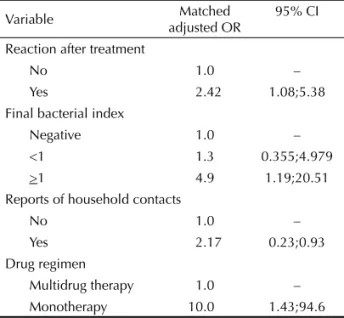
Using a step-down procedure, the conditional multiple logistic regression analysis indicated that the following variables were independently associated with the outco-me (retreatoutco-ment): reaction after treatoutco-ment, fi nal bacterial index, reports of household contacts and therapeutic regimen remained in the fi nal model (Table 2). The adjusted odds ratios (OR) were very similar to those obtained in the univariate analysis, thereby suggesting that confounding effects of each variable on other variables were small or nonexistent.
DISCUSSION
The present study indicates that the multiple factors for leprosy retreatment are presence of a reaction after treatment completion, reports of household leprosy contacts, dapsone monotherapy and a fi nal bacterial index ≥ 1.
A broad approach was taken to identify risk factors for retreatment among patients with history of previous leprosy treatment. This approach differs from that of most previous studies that focused either on relapse or leprosy reactions. This knowledge may contribute to the development of potential preventive measures for avoiding unnecessary retreatment. In addition to further studies, this knowledge may help achieving reduced retreatment rates and benefi t patients at an individual level, and contributes towards better organizing health care provision.
These patients were presumably relapsed patients fol-lowing the criteria proposed by the Brazilian Ministry of Health. Nonetheless, there may have been a propor-tion of false positives, i.e., patients with immunological reactions who were diagnosed as relapse cases. Fur-thermore, even if immunological reactions are ruled out, active disease may have been due to bacterial persistence or to reinfection caused by the irreversible immunological defi ciency specifi c to Mycobacterium leprae.
Relapse among paucibacillary patients nearly always requires differential diagnosis with delayed reversal reaction1,7,11 and there is no gold standardfor
compari-son, since M. leprae cannot be isolated in these cases.8
attend health units, and greater frequency of attendance may increase the likelihood that a subject will receive retreatment.
Patients who had reactions after treatment were about twice as likely to require retreatment as those who did not have any reactions after treatment completion. Brito et al2 (2005) described the case series of the 155 patients
who were being retreated for relapse. These authors examination, bacillus detection, histology, and
inocula-tion in mouse footpads. These resources, however, may not be available under routine conditions.
Although the diagnosis of adverse immunological reactions was made by experienced leprosy clinicians, misdiagnosis may nevertheless have occurred. In addi-tion, patients treated for leprosy with new skin lesions (including immunological reactions) are more likely to
Table 1. Univariate analysis of risk factors associated with leprosy retreatment. Recife, northeastern Brazil, 2003. N=310
Risk factor category Retreatment
Yes No Matched OR 95% CI p-value
Age 0.0537
<14 years 23 28 1
14–60 years 121 104 1.47 0.79;2.75
>60 years 13 24 0.64 0.27;1.51
Sex 0.4610
Male 74 80 1
Female 81 75 1.2 0.73;1.94
Operational classifi cation 0.7220
Paucibacillary 79 76 1
Multibacillary 72 79 0.91 0.57;1.46
Initial bacterial index 0.0985
0.0 84 95 1
0.1 to 3.0 15 21 0.71 0.34;1.49
>3 20 11 2.07 0.94;4.52
Therapy regimen 0.0009
Multidrug therapy 124 139 1
Monotherapy 23 15 10 1.28;78.11
Reaction after treatment 0.0157
No 52 22 1
Yes 101 132 2.3 1.18;4.83
Type of reaction 0.2749
No reaction 80 91 1
Type 1 16 16 1.37 0.71;2.66
Type 2 32 23 2.82 1.06;7.47
Type 1 and 2 15 06 0.78 0.33;1.81
Unknown 10 18 1.01 0.41;2.49
Management of reaction 0.5303
Corticoid + thalidomide 17 18 1
Corticoid 48 38 1.40 0.64;3.09
Thalidomide 07 06 1.26 0.34;4.62
Final bacterial index 0.0241
Negative 26 37 1
<1 06 06 1.33 0.35;4.97
>1 14 03 6.43 1.67;24.74
Not performed
Reports of household contact with leprosy 0.0130
No 78 104 1
Yes 40 28 2.2 1.17;4.03
showed that 65% were classifi ed as multibacillary and the most common manifestations were macular erup-tion and infi ltration. It was highly remarkable that the most common lesions in multibacillary patients with relapse were nodules and papules. According to Gebre et al5 (2000), the diagnosis of relapse in leprosy cases
are somewhat diffi cult to establish, thus paucibacillary patients should use corticosteroids for a six-month pe-riod while multibacillary patients should use them for a one-year period, with or without specifi c therapeutic treatment, in an attempt to protect patients against neural damage. If lesions recede, it may be assumed that a reaction has occurred. If lesions remain, relapse needs to be further investigated.
Leprosy patients reporting household contacts were twice as likely to require retreatment. No investigation regarding whether or not households contacts had active disease was undertaken. Nevertheless, it is reasonable to assume that this fi nding indicates the possibility of rein-fection given the irreversible immunological defi ciency specifi c to M. leprae as suggested by Reddy & Cherian8
(1991)and Gallo & Oliveira3 (1997).No studies were
found in the literature addressing the importance of con-tacts with regard to retreated patients. More complex studies using a cohort design may contribute towards elucidating these issues.
The study fi nding that patients who received dapsone monotherapy were ten times more likely to require retreatment support the fact that monotherapy regimens have limited effectiveness, as well-documented in the literature.
A slit-skin smear examination at the end of treatment was carried out only on 26.6% of the patients studied (92/310), and patients with a fi nal bacterial index ≥ 1 were six times more likely to require retreatment. These
results, however, should be interpreted with caution due to the small number of patients studied. Sampling variability and selection bias cannot be excluded as alternative explanations. These results could also be due to misclassifi cation, depending on the extent to which adverse immunological reactions may have been misdiagnosed as relapses. In studying relapse among multibacillary patients, Girdhar et al6 (2000)
suggested there was an increase in the bacterial index before the onset of lesions. Jamet & Baohong7 (1995)
recommended thatpatients with initial bacterial index
≥ 4 and fi nal bacterial index ≥ 3 should be monitored and that examinations should be carried out in higher-quality reference laboratories.
These findings cause some concern regarding the follow-up procedures needed for these patients. The Brazilian Ministry of Health assumes that cure is achieved based on the number of doses and regularity of treatment only. The study results indicate that efforts should be made to improve the quality of laboratory tests and to make them available at the primary care level. Further investigations using a cohort design and larger sample size are needed to evaluate the associa-tion between the bacterial index, especially at the end of treatment, and retreatment.
The statistically signifi cant association between post-treatment reactions and repost-treatment found in the present study are consistent with two hypotheses that should be further investigated. First, the presence of reaction after treatment completion increases the risk of relapse. Second, patients are being retreated not because they have relapses but because of reactions misdiagnosed in the clinical evaluation.
The present study on leprosy retreatment has raised questions that require additional approaches from a public health and clinical perspective. How many patients have adverse immunological reactions? How many are cases of bacterial persistence? Is the fi nal bacterial index no longer needed at the end of treatment of multibacillary patients? How many patients are rein-fected through household contacts? Further studies are needed to address these questions, particularly by using a cohort design and incorporating molecular biology techniques. Also, special monitoring procedures must be implemented after ascertaining cure of patients who are more likely to require retreatment.
In conclusion, the study fi ndings reinforce that the use of dapsone monotherapy should be discontinued and there is need for special monitoring of specifi c groups of leprosy patients, i.e., those who have household contacts with leprosy, those showing reactions after the completion of treatment and those with a fi nal bacterial index ≥ 1, through periodical clinical and laboratory evaluations.
Table 2. Logistic regression model of risk factors associated
with leprosy retreatment. Recife, northeastern Brazil, 2003.
Variable Matched
adjusted OR
95% CI
Reaction after treatment
No 1.0 –
Yes 2.42 1.08;5.38
Final bacterial index
Negative 1.0 –
<1 1.3 0.355;4.979
>1 4.9 1.19;20.51
Reports of household contacts
No 1.0 –
Yes 2.17 0.23;0.93
Drug regimen
Multidrug therapy 1.0 –
1. Becx-Bleumink M. Relapses among leprosy patients treated with multidrug therapy: experience in the leprosy control program of the All Africa Leprosy and Rehabilitation Training Center (ALERT) in Ethiopia; practical diffi culties with diagnosing relapses; operational procedures and criteria for
diagnosing relapses. Int J Lepr Other Mycobact Dis.
1992;60(3):421-35.
2. Brito MFM, Ximenes RAA, Gallo MEN. Retreatment of
leprosy relapse. An Bras Dermatol. 2005;
80(3):255-60.
3. Gallo MEN, Oliveira MLW. Recidivas e Reinfecção
em Hanseníase. Medicina (Ribeirão Preto).
1997;30(3):351-7.
4. Gallo MEN, Nery JAC, Albuquerque ECA, Signorelli M, Silva Filho VF. Multivacillar leprosy: bacilloscopic index and viability of M. leprae after 24 doses of Multidrug Therapy: World Health Organization (MDT/
WHO). An Bras Dermatol. 2000;75(3):291-7.
5. Gebre S, Saunderson P, Byass P. Relapses after fi xed
duration multiple drug therapy: the AMFES cohort. Lepr
Rev. 2000;71(3):325-31.
6. Girdhar BK, Girdhar A, Kumar A. Relapses in multibacillary leprosy patients: effect of length of
therapy. Lepr Rev. 2000;71(2):144-53.
7. Jamet P, Ji B. Relapse after long-term follow up of multibacillary patients treated by WHO
multidrug regimen. Int J Lepr Other Mycobact Dis.
1994;62(4):622.
8. Reddy PK, Cherian, A. Relapse in Hansen’s Disease after multidrug therapy and its differencial diagnosis
with reversal reaction. The Star. 1991:8-12.
9. Scollard DM, Smith T, Bhoopat L, Theetranont C, Rangdaeng S, Morens DM. Epidemiologic
characteristics of leprosy reactions. Int J Lepr Other
Mycobact Dis. 1994;62(4):559-67.
10. Waters MFR. Distinguishing between relapse and late reversal reaction in multidrug (MDT) treated BT
leprosy. Lepr Rev. 2001;72(3):250-3.
11. WHO Study Group. Chemotherapy of leprosy. Geneva: World Health Organization; 1994. (WHO Technical Report Series, 847).
REFERENCES