Mariana Santos de Campos
I, Bruna Andrade de Oliveira
I, Marcia Galan Perroca
II Faculdade de Medicina de São José do Rio Preto, Graduate in Nursing. São José do Rio Preto, São Paulo, Brazil.
How to cite this article:
Campos MS, Oliveira BA, Perroca MG. Workload of nurses: observational study of indirect care activities/interventions. Rev Bras Enferm [Internet]. 2018;71(2):297-305. DOI: http://dx.doi.org/10.1590/0034-7167-2016-0561
Submission: 10-20-2016 Approval: 04-11-2017
ABSTRACT
Objective: Observe the workfl ow of nurses in hospitalization units identifying indirect care activities/interventions; measure the frequency and average time spent in performing them; and to verify the associations between average time of the activities
interventions grouped into categories and per hospitalization unit. Method: Observational exploratory study using the timed
technique. It was conducted in medical, surgical and specialized clinic units of a teaching hospital in the northwest of São Paulo
Brazil, with 16 attending nurses as participants. Results: 90 hours of observation were performed, of which 58% (52 hours and 10
minutes) were related to indirect care activities of the patients. The most frequent activities/interventions were: “Communication” - 1,852 (44.1%), mean 34.6 (SD = 54); “Walking” - 1,023 (24.3%), mean 22 (SD = 49.2); and “Documentation” - 663 (15.8%),
mean 82.7 (SD = 144.4). Conclusion: These fi ndings favor a redesign of the work process and foster the need to update and
refi ne the current workload measurement instruments.
Descriptors: Workload; Nursing care; Nursing; Time Management; Nursing Human Resources in Hospitals.
RESUMO
Objetivos: Observar o fl uxo de trabalho de enfermeiros em unidades de internação identifi cando atividades/intervenções de cuidado indireto; mensurar a frequência e o tempo médio despendido na realização das mesmas; e verifi car as associações
entre o tempo médio das atividades/intervenções agrupadas em categorias e por unidade de internação. Método: Estudo
exploratório observacional utilizando a técnica de tempos cronometrados. Foi conduzido em unidades de clínica médica, cirúrgica e especializada de um hospital de ensino do noroeste paulista, tendo como participantes 16 enfermeiros assistenciais.
Resultados: Foram realizadas 90 horas de observação, sendo 58% (52 horas e 10 minutos) referentes às atividades de cuidado
indireto ao paciente. As atividades/intervenções mais executadas constituíram-se em: “Comunicação” – 1.852 (44,1%),
média 34,6 (DP=54); “Deslocamento” – 1.023 (24,3%), média 22 (DP=49,2); e “Documentação” – 663 (15,8%), média
82,7 (DP=144,4). Conclusão: Esses achados favorecem o redesenho do processo de trabalho e fomentam a necessidade de
atualização e refi namento dos instrumentos de mensuração de carga de trabalho atuais.
Descritores: Carga de Trabalho; Cuidados de Enfermagem; Enfermagem; Gerenciamento do Tempo; Recursos Humanos de Enfermagem no Hospital.
RESUMEN
Objetivo: Observar el fl ujo de trabajo de enfermeros en unidades de internación identifi cando actividades/intervenciones de cuidado indirecto; medir frecuencia y tiempo promedio empleado en realizar dichas tareas; y verifi car las asociaciones
entre tiempo promedio de actividades/intervenciones agrupadas en categorías y por unidad de internación. Método: Estudio
exploratorio, observacional, utilizando técnica de tiempos cronometrados. Realizada en unidades de clínica médica, quirúrgica
y especializada de hospital de enseñanza del noroeste paulista, habiendo participado 16 enfermeros asistenciales. Resultados:
Totalizadas 90 horas de observación, siendo 58% (52 horas 10 minutos) referentes a las actividades de cuidado indirecto al paciente. Las actividades/intervenciones más ejecutadas resultaron: “Comunicación” – 1.852 (44,1%), media 34,6 (SD=54);
“Traslado” – 1.023 (24,3%), media 22 (SD=49,2) y “Documentación” – 663 (15,8%), media 82,7 (SD=144,4). Conclusión:
Workload of nurses: observational study of indirect
care activities/interventions
INTRODUCTION
Workload can be understood as all activities performed in a given period by the nursing team in the care process and the
time spent to perform these actions(1). However, the activities
it encompasses have been understood in various forms(2).
For many years, it was considered to be related only to di-rect care (performed in the presence of the patient) and indi-rect activities (occurring outside the nurse-patient interaction)
(2). More recently, the concept of indirect care activities has
been expanded to include management of an environment of
interdisciplinary care and collaboration(3).
The Patient Classification Instrument (PCI), an integral part of the Patient Classification System (SCP), identifies the patients’ individual needs and groups them into categories, allowing them to determine their degree of complexity and
define the care profile(4). These instruments have been
devel-oped in several specialties to assist in the management of care. In this concept, it is possible to calculate the workload and time required for the care process, by considering the actual
needs of the client/user’s care(4). Thus, the PCI has been used
to measure the workload of the nursing team.
Studies measuring the time spent by nurses in performing their activities in different practice scenarios indicate a pre-dominance of time consumed in indirect care activities,
rang-ing from 43.2%(5) to 55.7%(6). However, most PCIs address
direct care activities. The planning and coordination of the caring process, which includes communication with nursing professionals and other areas, as well as documentation, were
included only in a Brazilian classification instrument(4).
Dissatisfaction among the professionals related to the
over-load of work in the units(7-9) and the recognition by
research-ers(7,10-11) that the work involved in nursing is not confined to
some activities of the caring process (medications, etc.), but also to a series of indirect activities (collaboration with staff, other professionals and students, among others) has generated reflection and the need to build instruments that can capture more faithfully the work of nurses, notably PCIs. It is impor-tant to point out, however, the impossibility of an instrument that contains all the activities carried out, because at all times the nursing staff faces numerous unforeseeable situations. Thus, they address those that present greater relevance in daily practice(7,11).
Few studies have been conducted to identify activities that directly influence the workload. Some factors were considered influential, however, difficult to measure (7-8,10-11). Thus, this study
was based around the following questions: Which activities/
interventions related to the indirect care of the patient are car-ried out by the care providing nurses in hospitalization units?; What is the mean time spent on each of these?; and Are there
associations between the mean time of activities/interventions grouped into categories and per hospitalization unit?
OBJECTIVE
To observe the workflow of nurses in hospitalization units, identifying indirect care activities/interventions and measure the frequency and average time spent in performing these;
Verify the associations between mean time of activities/inter-ventions grouped into categories and per hospitalization unit.
METHOD
Ethical aspects
The professionals received orientation about the purpose of the study and the voluntary nature of their participation and signed the Term of Free and Informed Consent. The study was approved by the Research Ethics Committee of the institution where the study took place.
Design, place of study and period
This study was observational exploratory with structured method. Structured observational methods are data collection techniques in which observational events or behaviors are se-lected in advance with the preparation of forms and types of
activities that the observer should consider(12).
Two hospitalization units of a medical clinic, two surgical clinics and one specialized (Infectious Diseases) clinic of a teaching hospital located in the northwest of São Paulo consti-tuted the study scenario. The study was carried out in March and April 2015.
Study population
All nurses (n = 16) were observed in the units investigated. The measurement of the time totaled 90 hours, excluding the time dedicated to the pre-test. It is important to emphasize that nursing activities are characterized by their short duration (30
seconds to one minute) and successive alternation(8). Direct
observation studies are considered exhaustive and therefore in-clude less sampling. International investigations have reported
observation time varying from 85.2 hours(7) to 98.2 hours(8) as
significant to identify the wide range of nursing activities.
Study Protocol
The research was conducted in the following steps:
Mapping of activities/indirect care interventions – Initially, direct observation was performed with nurses working day and night shifts during their activities for a period of three days. This preliminary observation generated a preliminary listing that was later complemented with indirect care activities/ Mariana Santos de Campos E-mail: [email protected]
CORRESPONDING AUTHOR
Los hallazgos favorecen el rediseño del proceso de trabajo y promueven la necesidad de actualización y redefinición de los instrumentos de medición de carga de trabajo actuales.
interventions described in the Nursing Intervention Classifica-tion (NIC)(3) and also by results of various studies(7-8,10-11,13). The
NIC taxonomy has been used since 1992 to standardize lan-guage in nursing. It groups 554 interventions and more than 12 thousand related activities based on clinical practice and
research results(3). Because the work of the nursing team is
standardized, researchers have used this taxonomy to conduct
studies on workload measurement(14-15). Subsequently, a final
listing was constructed, triangulating the three different forms of data collection with the interventions and their respective activities described in the NIC and non-NIC activities.
Pre-test – The final list constructed was entered into software and tested by one of the researchers after orientation and training in the investigated units, in order to evaluate the representative-ness and relevance of the mapped activities. At that time, a need was identified for the addition or exclusion of any activities.
Measurement of Time Spent – The time and movement
tech-nique(16) was used by means of specific time tracking software(17)
called Toggl(18). The mapped interventions and their respective
activities described in the NIC and the activities not described in this taxonomy were inserted in the software using a portable computer. With each intervention observed, the listing expand-ed with relatexpand-ed activities. After the selection corresponding to the moment, the “start” button was pressed and the stopwatch was activated, it was then returned to zero (“stop” button) at its end. In case of interruption of work continuity, the timer was interrupted and triggered again when the nurse resumed the activity being measured. The stop watch was chosen because it presents advantages in relation to the work sample, since it provides details of the workflow and its sequence, avoiding loss
of information regarding activities with a short duration(8).
The direct observation was carried out by two research-ers from Monday to Sunday, including the various work shifts (morning, afternoon and night). Each field observer accompa-nied a professional, for a minimum of three times, in sessions lasting from three to four hours. Inter-rater reliability test was conducted to verify compatibility in the activities/interven-tions recorded, obtaining a 95% agreement index.
Analysis of results and statistics
Descriptive statistics were used with calculation of frequen-cies, percentages, means, standard deviation, medians and in-terquartile range (IQR = Q3-Q1). We chose to present the data in seconds due to the short time of most activities. To evalu-ate the difference between mean times, we used the Analysis of Variance (ANOVA) and Tukey’s post-test. The analysis was performed using the Statsdirect program version1,9,15. The level of significance was set at 0.05.
RESULTS
Sixteen nurses participated in the study (six in the medi-cal clinic, seven in the surgimedi-cal and three in the specialized clinic) with a predominance of females (n = 13), mean age 37.2 years (SD = 10.6, range 25-59 years) and mean time of professional performance 6.1 years (SD = 7.6, variation 2 months to 25 years).
A total of 90 hours of observation were performed, with 58% (52 hours and 10 minutes) referring to the activities/interventions of indirect care to the patient, distributed between the medical clinic units (18 hours and 39 minutes), surgical (23 hours and 22 minutes) and infectious and parasitic diseases (IPD) (10 hours and eight minutes). The remaining hours, 42% (37 hours and 49 minutes), were related to direct, associated and personal care ac-tivities – the detailing of which was not the objective of this study. The previous listing consisted of 16 interventions and 46 indi-rect care activities. After the pre-test, we excluded technological control, verification of controlled substances and interpretation of laboratory data, since such interventions were not observed in the daily practice of nurses. The final listing included 13 NIC inter-ventions and their unfolding into 43 activities plus an additional three activities not described in the NIC, namely – Communica-tion, Walking, and Waiting Time. Communication was added to include verbal contacts with the nursing team, other members of the health team, support services and telephone calls, among oth-ers, not included in the intervention “Support to the doctor” and “Exchange of health information”. Walking (going from one place to another inside and/or outside the unit) and waiting time (time waiting for materials, medicines and others for performing proce-dures). It is underscored that these constitute activities mentioned
in international time measurement studies(7-8).
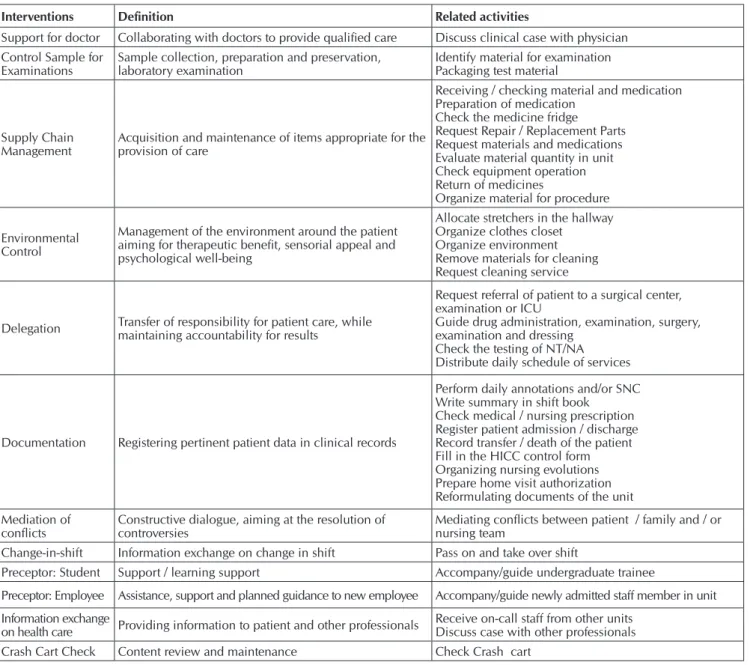
We identified 4,202 observations of the activities performed by the nurse. The description of the interventions and activities investigated described in the NIC are presented in Chart 1.
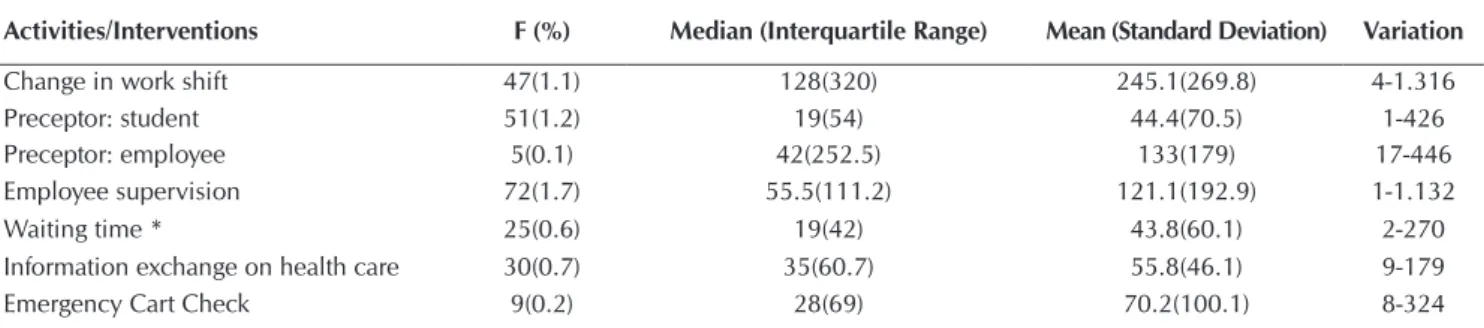
The frequency of interventions/activity ranged from 5 (0.1%) for preceptor employee to 1,852 (44.1%) for commu-nication, and the mean time spent was 22 seconds (SD = 49.2) for staff transference within and out of the unit at 245.1 seconds (SD = 269.8) for change in work shift (see Table 1).
For statistical analysis, non-NIC interventions and activities were grouped into five categories in order to verify their asso-ciations. They were: 1. COMMUNICATION: communication, shift, exchange information care Health; 2. DOCUMENTATION; 3. SUPERVISION: of employees, preceptor: student, preceptor: staff member, delegation, mediation of conflicts; 4. CONTROLS: sample for exams, supplies, environment, check crash cart, sup-port the doctor; and 5. WALKING; and waiting time.
Table 2 shows that the frequency of categories ranged from 185 (Supervision) to 1,929 (Communication). Statistical differences were observed by ANOVA (p≤0.05) between the mean time spent in the different categories, except for Communication × Controls (p = 0.66) and Documentation × Supervision (p = 0.91) (Table 2).
The differences between the mean time spent on each of the five categories per hospitalization unit investigated are shown in Table 4. The frequency ranged from 51 for Supervision in the medical clinic to 871 for Communication in the surgical clinic, and the p value ranged from 0.14 to 0.67 (ANOVA).
Chart 1 – Description of interventions and activities investigated as described in the Nursing Intervention Classification (NIC), São José do Rio Preto, São Paulo, Brazil, 2015
Interventions Definition Related activities
Support for doctor Collaborating with doctors to provide qualified care Discuss clinical case with physician Control Sample for
Examinations
Sample collection, preparation and preservation, laboratory examination
Identify material for examination Packaging test material
Supply Chain
Management Acquisition and maintenance of items appropriate for the provision of care
Receiving / checking material and medication Preparation of medication
Check the medicine fridge Request Repair / Replacement Parts Request materials and medications Evaluate material quantity in unit Check equipment operation Return of medicines
Organize material for procedure
Environmental Control
Management of the environment around the patient aiming for therapeutic benefit, sensorial appeal and psychological well-being
Allocate stretchers in the hallway Organize clothes closet
Organize environment Remove materials for cleaning Request cleaning service
Delegation Transfer of responsibility for patient care, while maintaining accountability for results
Request referral of patient to a surgical center, examination or ICU
Guide drug administration, examination, surgery, examination and dressing
Check the testing of NT/NA Distribute daily schedule of services
Documentation Registering pertinent patient data in clinical records
Perform daily annotations and/or SNC Write summary in shift book
Check medical / nursing prescription Register patient admission / discharge Record transfer / death of the patient Fill in the HICC control form Organizing nursing evolutions Prepare home visit authorization Reformulating documents of the unit
Mediation of conflicts
Constructive dialogue, aiming at the resolution of controversies
Mediating conflicts between patient / family and / or nursing team
Change-in-shift Information exchange on change in shift Pass on and take over shift
Preceptor: Student Support / learning support Accompany/guide undergraduate trainee
Preceptor: Employee Assistance, support and planned guidance to new employee Accompany/guide newly admitted staff member in unit
Information exchange
on health care Providing information to patient and other professionals
Receive on-call staff from other units Discuss case with other professionals Crash Cart Check Content review and maintenance Check Crash cart
Note: ICU Intensive Care Unit; Nursing Technician/Nursing Assistant - NT NA; Systematization of Nursing Care - SNC; Hospital Infection Control Committee - HICC
Table 1 – Relative frequency and mean time spent (in seconds) on the interventions / activities of indirect care to the patient, São José do Rio Preto, São Paulo, Brazil, 2015
Activities/Interventions F (%) Median (Interquartile Range) Mean (Standard Deviation) Variation
Support for doctor 44(1.0) 48(74.5) 72.9(90.8) 2-512
Communication* 1.852(44.1) 20(30) 34.6(54) 27-1.355
Control Sample for Examinations 41(1.0) 24(31) 31.7(32.4) 2-186 Supply Chain Management 141(3.4) 37(40) 50.1(61.7) 1-456 Environmental Control 142(3.4) 19.5(23.2) 38.4(82.7) 1-684
Delegation 49(1.2) 28(32) 34.1(22.6) 4-106
Walking* 1.023(24.3) 12(17) 22(49.2) 1-789
Documentation 663(15.8) 41(73) 82.7(144.4) 1-1.383
Mediation of conflicts 8(0.2) 54(75.2) 102(140.8) 17-442
Table 2 – Descriptive and Variance Analysis (ANOVA) among the categories Communication, Documentation, Supervision, Controls and Walking, São José do Rio Preto, São Paulo, Brazil, 2015
Categories Communication Documentation Supervision Controls Walking
Communication
Frequency Variation M(SD) Md(IQR)
-1.929 27-1.355
40.1(75) 22(33)
p< 0.01 p< 0.01 p=0.66 p< 0.01
Documentation
Frequency Variation M(SD) Md(IQR)
p<0.01 -663 1-1.383 82.7(144.4)
41(73)
p=0.91 p<0.01 p<0.01
Supervision
Frequency Variation M(SD) Md(IQR)
p<0.01 p=0.91
-185 1-1.132 76.4(137.7)
33(65)
p<0.01 p<0.01
Controls
Frequency Variation M(SD) Md(IQR)
p=0.66 p<0.01 p<0.01 -377 1-684 46.8(73.5)
28(39)
p<0.01
Walking
Frequency Variation M(SD) Md(IQR)
p<0.01 p<0.01 p<0.01 p<0.01 -1.048 1-789 22.5(49.5)
12(17.7)
Note: M(SD) – Mean (Standard Deviation); Md(IQR) – Median (Inter Quartile Range)
Activities/Interventions F (%) Median (Interquartile Range) Mean (Standard Deviation) Variation
Change in work shift 47(1.1) 128(320) 245.1(269.8) 4-1.316
Preceptor: student 51(1.2) 19(54) 44.4(70.5) 1-426
Preceptor: employee 5(0.1) 42(252.5) 133(179) 17-446
Employee supervision 72(1.7) 55.5(111.2) 121.1(192.9) 1-1.132
Waiting time * 25(0.6) 19(42) 43.8(60.1) 2-270
Information exchange on health care 30(0.7) 35(60.7) 55.8(46.1) 9-179
Emergency Cart Check 9(0.2) 28(69) 70.2(100.1) 8-324
Note: * Activities described in time measurement studies(8,11-13,15)
Table 1 (concluded)
Table 3 – Relative frequency and mean time spent (in seconds) in the five categories analyzed, according to the hospitaliza-tion unit (ANOVA), São José do Rio Preto, São Paulo, Brazil, 2015
Categories Medical clinic Surgical Clinic IDP p
F M(SD) Md(IQR) F M(DP) Md(AIQ) F M(SD) Md(IQR)
Communication 727 39(73.5) 19(32) 871 39.8(69.6) 22(32) 330 43.3(90.7) 25(34.2) 0.67 Documentation 242 88.3(153.9) 41.5(78.5) 345 83.8(149.8) 42(69.7) 75 60.8(65.2) 37(61) 0.34 Supervision 51 72.1(106.7) 28(85) 77 60.3(112.2) 32(43) 57 102(184.3) 40(82) 0.21 Controls 162 40.1(59.7) 21(38) 97 47.4(65.7) 32(35.5) 117 56(93.9) 31(37.5) 0.19 Walking 340 21.6(57.1) 10(11) 512 20.8(42.4) 12.5(18) 196 28.7(52.2) 18(18) 0.14
DISCUSSION
The findings of this study showed that 58% of the 90 hours observed were spent by nurses performing activities/interven-tions of indirect care. Previous studies have shown that nurses spend less time in these activities in units with similar
character-istics to this study: medical clinic, 47.3%(19); medical-surgical,
50%(20); and surgical 55.7%(6). Also, in others with divergent
care profile and work dynamics: joint housing, 31%(21);
emer-gency unit, 35%(22); and oncology outpatient clinic, 43.2%(5).
It was verified that 13 (81.3%) of the interventions catego-rized in the NIC consumed 27 hours and 44 minutes of the time spent by the nurse, while the other three activities (18.7%) not described in this taxonomy consumed 24 hours and 26 minutes. It was observed that the latter are related to communication, walk-ing and waitwalk-ing time and represented 46.2% of the total time.
In the various NIC interventions and non-NIC activities, the ones that most occupied the nurses’ working time were: Com-munication (44%, 17 hours and 51 minutes), Walking (24.3%, 6 hours and 16 minutes) and Documentation 15.8%, 15 hours and 14 minutes), totaling 84.2% and 39 hours and 19 minutes of the time spent. The remaining non-NIC interventions and ac-tivities accounted for 15.8% of the total, corresponding to 12 hours and 51 minutes. The lower percentiles and time spent on such interventions and activities may erroneously be attributed to a low degree of importance, however it is possible that this a
list of shorter and more targeted activities(8).
Within the Communication activity, the aspects consid-ered were “Communication with the nursing team”, “Medical team”, “Other professionals of the health team”, “Support ser-vices” and “Telephone communication”. Two international in-vestigations carried out in medical and surgical units showed
the time spent by nurses with this activity (12%(8) and 17.8%(7))
was lower than that found in the present study (44.1%). This
can be explained by the fact that the study site is a teaching hospital where there is a great flow of personnel and, conse-quently, intense communication with the multi-professional team. In addition, differences could arise because telephone
communication was included, whereas in other studies(7-8) this
was considered separately or not at all.
The communication process favors effective and safe prac-tice for the patient. However, the time spent in its accomplish-ment can be reduced so that the exchange of information within the team and between nursing and multi-professional teams is carried out in a way that avoids noise, interruptions and interference. Noise interferes with the concentration of those involved, favoring a loss of information or even
forget-fulness(23-24). Interruptions and interferences fragment or even
render impossible the finalization of information
transmis-sion, thereby generating repetition(8,23) and duplication of
mes-sages. Parallel conversations among professionals during the
shift can also increase the time spent on this activity(24).
After communication, “Walking” occupied the most time of the nurses, especially those in the hospitalization unit. This activ-ity, although not listed in the NIC, has been reported in
interna-tional studies with values of 17.1%(7) and 20.1%(8). Measurements
showed that nurses cover 1.6 to 8 km per day shift of 10 hours(25),
i.e. from 160 to 800m/hour. In this investigation, no statistically significant and consistent relationship was found between the various types of unit architecture and the time spent caring for patients. The authors suggest that the adaptability of nurses may have offset the limitations imposed by the unit’s physical layout.
Clearly, the real need for Walking and the location of the materials and equipment used to perform the care should be
further examined. An Australian study(26) showed that the time
spent in transit by nurses (time between activities and patient care), over a three-year investigation, showed a reduction from 7.4% to 4.6%, after optimization strategies.
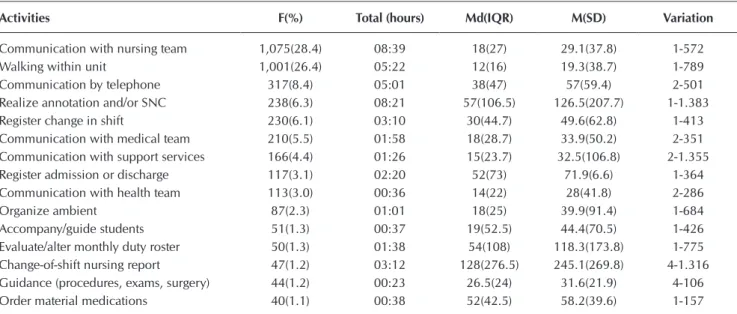
Table 4 – Indirect patient care activities performed most by nurses and average time spent (in seconds), São José do Rio Preto, São Paulo, Brazil, 2015
Activities F(%) Total (hours) Md(IQR) M(SD) Variation
Communication with nursing team 1,075(28.4) 08:39 18(27) 29.1(37.8) 1-572 Walking within unit 1,001(26.4) 05:22 12(16) 19.3(38.7) 1-789 Communication by telephone 317(8.4) 05:01 38(47) 57(59.4) 2-501 Realize annotation and/or SNC 238(6.3) 08:21 57(106.5) 126.5(207.7) 1-1.383 Register change in shift 230(6.1) 03:10 30(44.7) 49.6(62.8) 1-413 Communication with medical team 210(5.5) 01:58 18(28.7) 33.9(50.2) 2-351 Communication with support services 166(4.4) 01:26 15(23.7) 32.5(106.8) 2-1.355 Register admission or discharge 117(3.1) 02:20 52(73) 71.9(6.6) 1-364 Communication with health team 113(3.0) 00:36 14(22) 28(41.8) 2-286
Organize ambient 87(2.3) 01:01 18(25) 39.9(91.4) 1-684
Accompany/guide students 51(1.3) 00:37 19(52.5) 44.4(70.5) 1-426 Evaluate/alter monthly duty roster 50(1.3) 01:38 54(108) 118.3(173.8) 1-775 Change-of-shift nursing report 47(1.2) 03:12 128(276.5) 245.1(269.8) 4-1.316 Guidance (procedures, exams, surgery) 44(1.2) 00:23 26.5(24) 31.6(21.9) 4-106 Order material medications 40(1.1) 00:38 52(42.5) 58.2(39.6) 1-157
Documentation ranked in third place in terms of interventions occupying nurses’ time. Research on the subject presented values of 6.7%(22), 11.3%(8), 11.5%(5) and 18.4%(20). It is important to note
that most of the mentioned studies(5,20,22) used the method of work
sampling rather than time tracking to measure the time.
It is known that documentation is extremely important for the professional practice of nurses, since it is used as a tool to search for information and also to exchange knowledge. However, the time consumed is significantly high, making it necessary to implement some strategies for its reduction,
such as the implementation of electronic record keeping(27).
In the institutions that already use it, such as seen in the pres-ent study, it is possible to improve the use of computerized systems, by increasing the number of computers available for
access(28), employing more investment to avoid system failures
(inoperative system) and in order to train and continue educa-tion, given that some health professionals still show resistance
and difficulty to handle this type of documentation(27).
The mapping of 502 Nursing activities in North American
hospitals(29) identified 21 of these as commonly being
consid-ered by 90% of nursing managers for daily decision making on Nursing staff. These included four indirect care activities (docu-mentation, health care information exchange, case management and change-in-shift). The high time taken to attend these inter-ventions refers to the reflection on the variables that have been considered in the composition of the available PCIs.
The findings showed that the average time spent on the ac-tivities/interventions when grouped (communication, documen-tation, supervision, controls and walking) were different, except between Communication × Controls and Documentation × Su-pervision. Still, they pointed out that the mean times did not differ
among investigated units (range from p = 0.14 to p = 0.67).
It was observed that some activities, although they occupy more time, occur less frequently and vice versa. Others reg-istered higher frequency and more time, such as “Communi-cation with the nursing team” – 1,073 (28.7%, 8 hours and 39 minutes); “Walking in the hospitalization unit” – 1,001 (26.7%, 5 hours and 22 minutes) and “Telephone communi-cation” – 317 (8.5%, 5 hours and 1 minute). There were also other activities that occupied significant time, but presented a lower frequency, such as: “Change-in-shift” – 47 (1.2%, 3 hours and 12 minutes) and “Register admission and discharge of the patient” – 117 (3.1%, 2 hours and 20 minutes).
The time spent conducting each activity was often short, last-ing merely seconds. It was noted that, frequently, there was no effective termination of the task, since another activity had to be initiated or interrupted. This situation was also reported in other
studies(7-8) in which nurses spent less than 30 seconds on some
ac-tivities; in addition, these professionals spent 34% of their time on
multitasking(30), which clearly demonstrates the intense routine of
these professionals. Also, the constant interruptions experienced by nurses during their workflow can explain the high variability in
the recorded times as revealed in the standard deviations(8).
It is worth noting that the variations in time spent to carry out the interventions is significantly lower than the times estimated
by the NIC taxonomy(3), with the exception of “Documentation”,
which presented a variation from 1 second to 23 minutes (1,383 seconds), i.e. values higher than those described as 15 minutes. It should be noted that the time estimated by this taxonomy was also higher than that found in national(22) and international units(7-8).
Limitations of the study
The indirect care activities and the average times found in this study reflect the workflow of nurses in a specific care set-ting and are limited to the time of observation.
Contributions to the area of Nursing, health or public policy
Investigations into how health professionals occupy their time make it possible to redesign the work process in the units, thereby eliminating or minimizing activities/time that do not add value, in turn generating greater efficiency in the nurses’ work. Furthermore, they contribute to a better understanding of the components of the nursing workload and to planning the personnel needed to meet the demand for patient care. It is also worth noting that the mapping of activities/interventions carried out by the nursing team provides greater visibility of the profes-sional work by identifying activities that are not valorized, but are fundamental for the continuity of care, thus enabling nego-tiations for changes in the nursing practice scenario.
CONCLUSION
The identification of activities/interventions of indirect care verified, sequentially, “Communication”, “Walking” and “Docu-mentation” as those that most consume nurses’ working time. These findings foster the need for organizational changes and optimizing the work process, introduction of new technologi-cal strategies, and updating and refinement of current workload measurement instruments, particularly the PCIs.
FUNDING
Study financed by the Fundação de Amparo à Pesquisa do Estado de São Paulo (FAPESP).
REFERENCES
1. Berry L, Curry P. The nursing workload and patient care. Canadian Federation of Nurses Unions (CFNU) Report [Internet]. 2012 [cited 2016 Oct 15]. Available from: https://nursesunions.ca/sites/default/files/cfnu_workload_paper_pdf.pdf
2. Alghamdi MG. Nursing workload: a concept analysis. J Nurs Manag [Internet]. 2016[cited 2016 Oct 10];24(4):449-57. Available from: http://onlinelibrary.wiley.com/doi/10.1111/jonm.12354/abstract
4. Perroca MG. The new version of a patient classification instrument: assessment of psychometric properties. J Adv Nurs [Internet]. 2013[cited 2016 Oct 15];69(8):1862–68. Available from: http://onlinelibrary.wiley.com/doi/10.1111/jan.12038/full
5. Sousa CA, Jerico MC, Perroca MG. Measurement of nurses’ workload in an oncology outpatient clinic. Rev Esc Enferm USP [Internet]. 2014[cited 2016 Oct 10];48(1):97-103. Available from: http://www.scielo.br/pdf/reeusp/v48n1/0080-6234-reeusp-48-01-97.pdf
6. Desjardins F, Cardinal L, Belzile E, McCusker J. Reorganizing nursing work on surgical units: a time-and-motion study. Nurs Leadersh [Internet]. 2008[cited 2016 Oct 15];21(3):26-38. Available from: http://www.longwoods.com/content/20057
7. Cornell P, Riordan M, Townsend-Gervis M, Mobley R. Barriers to critical thinking: workflow interruptions and task switching among nurses. J Nurs Adm [Internet]. 2011[cited 2016 Oct 15];41(10):407-14. Available from: https://www.ncbi.nlm.nih.gov/ pubmed/21934427
8. Cornell P, Herrin-Griffith D, Keim C, Petschonek S, Sanders AM, D´Mello S, et al. Transforming nursing workflow, Part 1: the chaotic nature of nurse activities. J Nurs Adm [Internet]. 2010[cited 2016 Oct 15];40(9):366-73. Available from: http://journals. lww.com/jonajournal/Abstract/2010/09000/Transforming_Nursing_Workflow,_Part_1__The_Chaotic.6.aspx
9. Jeong DJY, Kurcgant P. Fatores de insatisfação no trabalho segundo a percepção de enfermeiros de um hospital universitário. Rev Gaúcha Enferm [Internet]. 2010[cited 2016 Oct 15];31(4):655-61. Available from: http://www.scielo.br/pdf/rgenf/v31n4/ a07v31n4.pdf
10. Rauhala A, Fagerstrom L. Are nurses’ assessments of their workload affected by non-patient factors? an analysis of the RAFAELA system. J Nurs Manag [Internet]. 2007[cited 2016 Oct 17];15:490–99. Available from: http://onlinelibrary.wiley.com/ doi/10.1111/j.1365-2834.2007.00645.x/abstract
11. Myny D, Hecke A, Bacquer D, Verhaegue S, Gobert M, Deflorr T, et al. Determining a set of measurable and relevant factors affecting nursing workload in the acute care hospital setting: a cross-sectional study. Int J Nurs Stud[Internet]. 2012[cited 2016 Oct 15];49(4):427-36. Available from: http://www.journalofnursingstudies.com/article/S0020-7489%2811%2900402-0/abstract
12. Polit DF, Beck CT. Fundamentos de pesquisa em enfermagem: avaliação de evidencias para a prática de enfermagem. 7.ed. Porto Alegre: Artmed, 2011.
13. Myny D, Van Goubergen D, Gobert M, Vanderwee K, Van Hecke A, Defloor T. Non-direct patient care factors influencing nursing workload in acute care hospitals: an integrative review of the literature. J Adv Nurs [Internet]. 2011[cited 2016 Oct 17];67(10):2109–29. Available from: http://onlinelibrary.wiley.com/doi/10.1111/j.1365-2648.2011.05689.x/abstract
14. Cordova PB, Lucero RJ, Hyun S, Quinlan P, Price K, Stone PW. Using the Nursing Interventions Classification as a potential measure of nurse workload. J Nurs Care Qual [Internet]. 2010[cited 2016 Oct 17];25(1):39–45. Available from: https://www.ncbi. nlm.nih.gov/pmc/articles/PMC2869293/
15. Cruz CWM, Bonfim D, Gaidzisnki RR, Fugulin FMT, Laus AM. The Use of Nursing Interventions Classification (NIC) in identifying the workload of nursing: an integrative review. Int J Nurs Knowl [Internet]. 2014[cited 2016 Oct 17];25(3):154-60. Available from: http://onlinelibrary.wiley.com/doi/10.1111/2047-3095.12031/abstract
16. Barnes RM. Estudo de tempos e movimentos: projeto e medida de trabalho. São Paulo: Edgard Blucher, 2001.
17. Catipon JB, Infante EJT. Time tracking technology [Internet]. 2012 [cited 2016 Oct 15]. Available from: http://www.google.com/ patents/US20120065932
18. Toggl. Insanely simple time tracking [Internet]. 2016[cited 2016 Oct 15]. Available from: https://www.toggl.com/
19. Chaboyer W, Wallis M, Duffield C, Courtney M, Seaton P, Holzhauser K, et al. A comparison of activities undertaken by enrolled and registered nurses on medical wards in Australia: an observational study. Int J Nurs Stud [Internet]. 2008[cited 2016 Nov 20];45(9):1274-84. Available from: http://www.journalofnursingstudies.com/article/S0020-7489(07)00250-7/abstract
20. Bordin LC, Fugulin FMT. Nurses’ time distribution: identification and analysis in a medical-surgical unit. Unidade Médico-Cirúrgica. Rev Esc Enferm USP [Internet]. 2009[cited 2016 Nov 20];43(4):833-40. Available from: http://www.scielo.br/pdf/ reeusp/v43n4/en_a14v43n4.pdf
21. Soares AVN, Gaidzinski RP, Cirico MOV. Nursing intervention identification in rooming-in. Rev Esc Enferm USP [Internet]. 2010[cited 2016 Nov 20];44(2):307-16. Available from: http://www.scielo.br/pdf/reeusp/v44n2/en_10.pdf
22. Garcia EA, Fugulin FMT. Nurses’ work time distribution at the emergency service. Rev Esc Enferm USP [Internet]. 2010[cited 2016 Nov 20];44(4):1027-36. Available from: http://www.scielo.br/pdf/reeusp/v44n4/en_25.pdf
23. Broca PV, Ferreira MA. Characteristics of communication process in nursing team. Rev Enferm UFPE [Internet]. 2015[cited 2016 Nov 20];9(5):8428-36. Available from: http://www.revista.ufpe.br/revistaenfermagem/index.php/revista/article/view/6432/ pdf_8104
24. Gonçalves MI, Rocha PK, Anders JC, Kusahara DM, Tomazoni A. Communication and patient safety in the change-of-shift nursing report in neonatal intensive care units. Texto Contexto Enferm [Internet]. 2016[cited 2016 Nov 20];25(1):1-8. Available from: http://www.scielo.br/pdf/tce/v25n1/en_0104-0707-tce-25-01-2310014.pdf
26. Westbrook JI, Duffield C, Lil L, Creswick NJ. How much time do nurses have for patients? a longitudinal study quantifying hospital nurses’ patterns of task time distribution and interactions with health professionals. BMC Health Serv Res [Internet]. 2011[cited 2016 Dec 15];11:319. Available from: http://bmchealthservres.biomedcentral.com/articles/10.1186/1472-6963-11-319
27. Rondina JM, Canêo PK, Campos MS. Conhecendo a experiência de implantação do prontuário eletrônico do paciente no hospital de base de São José do Rio Preto. Rev Adm Hosp Inov Saúde [Internet]. 2016[cited 2016 Dec 15];13(1):43-52. Available from: http://revistas.face.ufmg.br/index.php/rahis/article/view/43-52
28. Matsuda LM, Evora YDM, Higarashi IH, Gabriel CS, Inoue KC. Nursing informatics: unveiling the computer use by nurses. Texto Contexto Enferm[Internet]. 2015[cited 2016 Dec 22];24(1):178-86. Available from: http://www.scielo.br/pdf/tce/v24n1/0104-0707-tce-24-01-00178.pdf
29. Young J, Lee M, Sands LP, McComb S. Nursing activities and factors influential to nurse staffing decision-making. J Hosp Adm [Internet]. 2015[cited 2016 Dec 15];4(4):24-31. Available from: http://www.sciedu.ca/journal/index.php/jha/article/ view/6803/4197