Rev Odontol UNESP. 2015 Sept-Oct; 44(5): 262-267 © 2015 - ISSN 1807-2577
ORIGINAL ARTICLE
Doi: http://dx.doi.org/10.1590/1807-2577.0017
Evaluation of color stability of diferent
temporary restorative materials
Avaliação da estabilidade de cor de diferentes materiais restauradores provisórios
José Vitor Quinelli MAZARO
a*, Luiz Miguel MINANI
a, Adriana Cristina ZAVANELLI
a,
Caroline Cantieri de MELLO
a, Cleidiel Aparecido Araújo LEMOS
aaFaculdade de Odontologia, UNESP - Universidade Estadual Paulista, Araçatuba, SP, Brasil
Resumo
Introdução: Os materiais restauradores provisórios são amplamente utilizados, porém pouco se sabe a respeito de sua estabilidade de cor. Objetivo: Avaliar a estabilidade de cor de materiais restauradores provisórios: resina acrílica e resinas bisacrílicas, após a imersão em soluções pigmentantes, durante diferentes períodos de armazenamento.
Material e método: Quatro materiais foram testados (Dêncor/Clássico, Protemp 4/3M ESPE; Structur 2 SC/Voco; Luxatemp AM Plus/DMG) sendo confeccionadas 30 amostras (15 mm de diâmetro e 2 mm de espessura) por material. Estes foram divididos de acordo com o meio de imersão (saliva artificial, saliva + refrigerante tipo cola e saliva + café) e período de armazenamento (2, 5, 7 e 15 dias). As mensurações de cor foram realizadas antes e após as imersões, com auxílio de um espectrofotômetro, através do sistema CIE L*a*b*. Os dados foram analisados com análise de variância (ANOVA) e Tukey, com nível de significância à 5%. Resultado: A resina acrílica apresentou maior estabilidade de cor quando comparada às resinas bisacrílicas (p<0,001). Comparando as resinas bisacrílicas, não foi observado diferença significativa entre as resinas Structur e Luxatemp (p=0,767). Em relação as soluções testadas, o café apresentou os maiores valores de alteração de cor (p<0,001), sendo que quanto maior o período de armazenamento, maior foi a alteração de cor de todos os materiais provisórios analisados (p<0,001). Conclusão: A resina acrílica apresentou maior estabilidade de cor, quando comparada às bisacrílicas. O café causou a maior alteração de cor, e o tempo de imersão foi determinante na estabilidade de cor dos materiais provisórios analisados.
Descritores: Restauração dentária temporária; cor; prótese dentária.
Abstract
Introduction: Temporary restorative materials are widely used, however, little is know about their color stability.
Objective: to evaluate the color stability of the following temporary restorative materials: acrylic and bis-acrylic resins after immersion in pigmenting solutions for different periods of storage. Material and method: Four materials were tested (Dêncor/Clássico, Protemp 4/3M ESPE; Structur 2 SC/Voco; Luxatemp AM Plus/DMG) and 30 test specimens (15 mm in diameter and 2 mm thick) per material were fabricated. They were divided according to the storage medium (artificial saliva, saliva + cola type soda, and saliva + coffee) and storage time intervals (2, 5, 7 and 15 days). Color measurements were made before and after immersions, with use of a spectrophotometer, by means of the CIE L*a*b* system. The data were analyzed by the analysis of variance and the Tukey Test, at a level of significance of 5%. Result: Acrylic resin presented greater color stability in comparison with bis-acrylic resins (p<0.001). When bis-acrylic resins were compared no significant difference was observed between the resins Structur and Luxatemp (p=0.767). As regards solutions tested, coffee showed the highest color change values (p<0.001), and the longer the storage time interval, the greater was the color change in all the temporary restorative materials analyzed (p<0.001). Conclusion: Acrylic resin presented greater color stability in comparison with bis-acrylic resins (p<0.001). Coffee caused the greatest color change, and immersion time was determinant in color stability of the temporary materials analyzed.
Descriptors: Dental restoration temporary; color; dental prosthesis.
INTRODUCTION
he principle of using temporary restorations is to meet requisites such as pulp protection, marginal integrity, wear resistance, esthetics1
and to reestablish masticatory function for a limited period, until it is possible to insert the deinitive dental prosthesis2.
Among the various materials available, are polymethyl methacrylate (PMMA), methyl methacrylate, polyvinyl siloxane, bis-acrylic resins and resin composites, polymerized by means of chemical processes, light, or even dual polymerization4.
Heat polymerizable acrylic resins deserve to be pointed out due to their high resistance capable of guaranteeing signiicant longevity of the restorations5. However, bis-acrylic resins have been
increasingly widely used because of their practicality, in addition to showing minimal polymerization shrinkage, low exothermic reaction, and a highly satisfactory esthetic appearance6.
However, no exactness has been observed in the literature as regards the most appropriate material for fabricating temporary restorations, due to the innumerable materials available for this prosthetic purpose. Some authors have related that PMMA-based resins undergo less color change over time, when compared with the other resins2,7, while other studies have observed similarity in
the color stability of diferent temporary materials8,9.
In view of the foregoing, the aim of this study was to evaluate the color stability of diferent temporary prosthetic restorative materials (acrylic and bis-acrylic resins) immersed in diferent solutions for diferent time intervals. he hypotheses formulated for the study were as follows: (1) there is no diference in color stability of acrylic and bis-acrylic resins; (2) bis-acrylic resins present similar color stability; (3) the type of solution and time would have no inluence on the color stability of temporary materials.
MATERIAL AND METHOD
Experimental Design
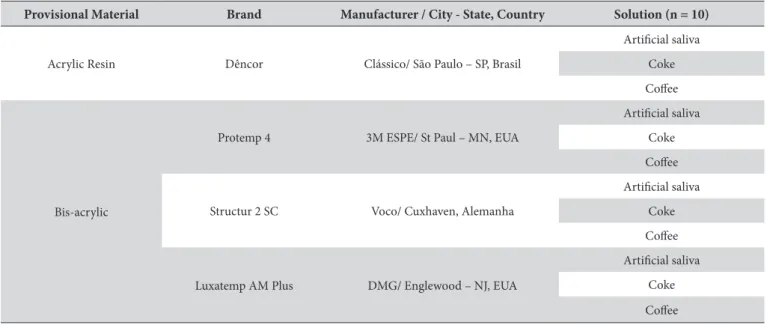
For each temporary material analyzed, 30 test specimens were fabricated, which were divided into three subgroups (n=10) according to the immersion medium in which they were stored, as shown in Table 1.
Sample Fabrication Method
he samples were fabricated with the use of a circular metal matrix, 15 mm in diameter and 2 mm thick, in accordance with Speciication No.27 of the American Dental Association (ADA)10,
in shade A2. he acrylic resin was manipulated in accordance with the manufacturer’s instructions, and bis-acrylic resins were taken to the metal matrix in a dispenser, with corresponding mixer tips for each material. Ater this, the period of polymerization of each material was awaited, in accordance with the manufacturers’ recommendations, with polymerization also being controlled according to the consistency of the material surface.
he next step was to perform polishing of the samples, in accordance with previously performed methodologies11,12, by using
silicon carbide abrasive papers (3M ESPE, St. Paul, MN, USA), in decreasing order of grits #320, #600, #800 and #1200 in an automatic polishing machine (EcoMet Pro Grinder/Polisher (Buehler – USA). Polishing was performed for 60 seconds at each abrasive paper grit, under water cooling. In the interval of each abrasive paper, the samples were washed in an ultrasonic bath (Cristófoli, Campo Mourão, Brazil) for 2 minutes, in order to remove possible residues present on the surface.
Ater polishing, the samples were immersed in artiicial saliva (2.2 g/L of gastric mucine, 0.381 g/L sodium chloride, 0.231 g/L calcium chloride, 0.738 g/L potassium phosphate, 1.114 g/L potassium chloride, 0.02% sodium azide, sodium hydroxide until a pH 7.0 was obtained)13. Aterwards the samples were kept in an
oven at 37° ± 1 °C for 24 hours. Ater this, initial readouts (baseline) were performed by means of ultraviolet-visible spectrophotometry (Model UV-2450, Shimadzu, Kyoto, Kyoto, Japan).
Color Stability Evaluation
he immersion solutions tested were as follows: artiicial saliva; saliva + cola type soda (Coca-Cola©, he Coca-Cola Company,
Brazil) and saliva + cofee solution - 90g of powder to 1 liter of
Table 1. Experimental design
Provisional Material Brand Manufacturer / City - State, Country Solution (n = 10)
Acrylic Resin Dêncor Clássico/ São Paulo – SP, Brasil
Artiicial saliva
Coke
Cofee
Bis-acrylic
Protemp 4 3M ESPE/ St Paul – MN, EUA
Artiicial saliva
Coke
Cofee
Structur 2 SC Voco/ Cuxhaven, Alemanha
Artiicial saliva
Coke
Cofee
Luxatemp AM Plus DMG/ Englewood – NJ, EUA
Artiicial saliva
Coke
Cofee
water at 90 °C (Pilão Tradicional, São Paulo, Brazil). he cofee solution was prepared in accordance with the manufacturer’s recommendations.
All the test specimens were immersed in their respective solutions at 37 °C, and all the solutions were diluted with artiicial saliva with the main purpose of simulating the oral conditions as faithfully as possible4,14,15.
Before performing the analysis, according to the methodology used by Haselton et al.4, each test specimen was manually cleaned
with a sot bristled brush P-40 (ORAL-B) for 30 seconds, and was then washed in distilled water to remove the remaining sediments of immersion solutions.
Color stability (ΔE) was veriied by means of an ultraviolet-visible spectrophotometer (Model UV-2450, Shimadzu, Kyoto, Kyoto, Japan) ater a storage time interval of 2, 5, 7 and 15 days, in each of the previously mentioned solutions.
he color change calculations (ΔE) were made by means of the CIE L*a*b* system, established by the “Commission Internacionale de l’Eclairage” (International Commission of Illumination) CIE. he “L” axial is known as luminosity and it extends from 0 (black) to 100 (perfect white). he “a” coordinate represents the quantity of red (positive values) and green (negative values) while the “b” coordinate represents the quantity of yellow (positive values) and blue (negative values). his system allows the value of ΔE (color variation) between two readings to be calculated by means of the formula: ΔE = [(ΔL)2 + (Δa)2 + (Δb)2]1/2, in which the variables were: ΔL = Linitial – Linal; Δa = ainitial – ainal; Δb = binitial – binal.
Data Analysis Method
For data analysis, three study factors were considered: temporary restorative material at two levels (acrylic and bis-acrylic resin); immersion solution at three levels (artiicial saliva, saliva + cola
type soda, and saliva + cofee); and immersion time at four levels (2, 5, 7 and 15 days).
On conclusion of the calculations, the ΔE values were submitted to statistical analysis. By using the program SigmaPlot 12.0 (Systat Sotware, San Jose, CA, USA), three-way analysis of variance (ANOVA) was performed (Factor 1: Temporary material, Factor 2: Immersion solution; Factor 3: Storage time) and a complementary one-way analysis of variance, seeking to speciically compare the bis-acrylic resins studied, by using the Tukey post-test for multiple comparisons, at a level of signiicance of 5%.
RESULT
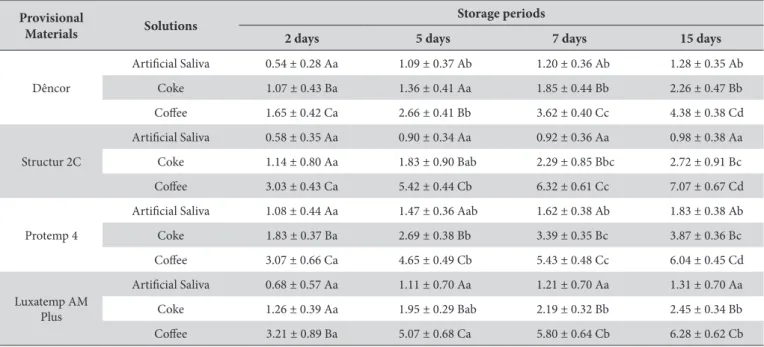
In a comparative analysis of color change between acrylic resin and bis-acrylic resins, a statistically signiicant and favorable diference was observed for the acrylic resins (p<0.001). Aterwards, when speciically analyzing the bis-acrylic resins tested, a statistically signiicant diference was observed in the comparative analysis among all the resins, showing higher ΔE values for Protemp 4 resin (p<0.001). However, there was no statistically signiicant diference between the resins Structur 2 SC and Luxatemp AM Plus (p=0.767). Ater this, when seeking to analyze the inluence of the diferent pigmenting solutions tested, on the color change in the temporary materials selected, cofee was found to present the highest color change values of all the materials, followed by cola type soda solution and artiicial saliva, irrespective of the storage time intervals of the test specimens (p<0.001). Moreover, it should be pointed out that the storage time interval was shown to be directly proportional to the change in color, in which the longer the storage period, the greater was the color change of the temporary material (Table 2).
Table 2. Color changes (Mean ± Standard deviation) of temporary materials analyzed, in diferent immersion mediums and storage time intervals.
Provisional
Materials Solutions
Storage periods
2 days 5 days 7 days 15 days
Dêncor
Artiicial Saliva 0.54 ± 0.28 Aa 1.09 ± 0.37 Ab 1.20 ± 0.36 Ab 1.28 ± 0.35 Ab
Coke 1.07 ± 0.43 Ba 1.36 ± 0.41 Aa 1.85 ± 0.44 Bb 2.26 ± 0.47 Bb
Cofee 1.65 ± 0.42 Ca 2.66 ± 0.41 Bb 3.62 ± 0.40 Cc 4.38 ± 0.38 Cd
Structur 2C
Artiicial Saliva 0.58 ± 0.35 Aa 0.90 ± 0.34 Aa 0.92 ± 0.36 Aa 0.98 ± 0.38 Aa
Coke 1.14 ± 0.80 Aa 1.83 ± 0.90 Bab 2.29 ± 0.85 Bbc 2.72 ± 0.91 Bc
Cofee 3.03 ± 0.43 Ca 5.42 ± 0.44 Cb 6.32 ± 0.61 Cc 7.07 ± 0.67 Cd
Protemp 4
Artiicial Saliva 1.08 ± 0.44 Aa 1.47 ± 0.36 Aab 1.62 ± 0.38 Ab 1.83 ± 0.38 Ab
Coke 1.83 ± 0.37 Ba 2.69 ± 0.38 Bb 3.39 ± 0.35 Bc 3.87 ± 0.36 Bc
Cofee 3.07 ± 0.66 Ca 4.65 ± 0.49 Cb 5.43 ± 0.48 Cc 6.04 ± 0.45 Cd
Luxatemp AM Plus
Artiicial Saliva 0.68 ± 0.57 Aa 1.11 ± 0.70 Aa 1.21 ± 0.70 Aa 1.31 ± 0.70 Aa
Coke 1.26 ± 0.39 Aa 1.95 ± 0.29 Bab 2.19 ± 0.32 Bb 2.45 ± 0.34 Bb
Cofee 3.21 ± 0.89 Ba 5.07 ± 0.68 Ca 5.80 ± 0.64 Cb 6.28 ± 0.62 Cb
DISCUSSION
Guaranteeing the color stability of temporary restorative materials is an essential factor with great inluence on the success of prosthetic rehabilitations, considering that during the stage of temporary restorations, patients concentrate their concern on the function and esthetics of the restorations16.
In view of the study hypotheses initially formulated, the irst hypothesis that color stability of acrylic resins is similar to that of bis-acrylic resins was rejected, since self-polymerizing acrylic resin presented greater color stability.
Similar results have been found in previous studies that also observed greater susceptibility to color change of bis-acrylic resins when in contact with pigmenting solutions2,7. Moreover, studies
conducted by Haselton et al.4 and Turgut et al.17 pointed out the
capacity of absorption and adsorption of pigmenting solutions to inluence the color stability of acrylic resins. his occurs because the PMMA-based materials have a more homogeneous composition, and consequently the capacity to absorb and adsorb solutions may have a direct inluence on color stability. Due to the heterogeneity of bis-acrylic resins, the pigmenting solution is capable of iniltrating into the midst of the small particles of material, thus causing a greater level of pigmentation4,17.
In a complementary analysis, evaluating only the bis-acrylic resins selected for this study, statistically signiicant diference was observed between the resins Structur 2 SC and Luxatemp AM Plus in comparison with Protemp 4, which presented the highest color change values, thus denying the second hypothesis formulated. hese results corroborate the indings of previous studies that evaluated the color stability of diferent materials and observed that Protemp resin also presented high color change values2,16.
It should be pointed out that the bis-acrylic resins have an organic matrix, inorganic iller particles, in addition to monomers such as bisphenol A-diglycidyl dimethacrylate (Bis-GMA) and triethylene glycol dimethacrylate (TEGDMA). Monomers and their derivatives tend to provide better mechanical properties, low changes in temperature, reduction in polymerization shrinkage, and excellent polishing, thereby increase the practicality of fabricating temporary dental prostheses4,16.
However, as pointed out by Haselton et al.4, the mixture of
monomers may be harmful to color stability, considering the majority of bis-acrylic resin polymers are more polar than the acrylic resin polymers. hese chemical characteristics increase the ainity of bis-acrylic resins for polar liquid molecules, and consequently, greater absorption of substances that interfere in the color stability of the materials may be observed4.
Moreover, the oral cavity and temporary restorations are known to be subject to diferent pigmenting mediums4,14,18, therefore, in
this study it was also sought to evaluate the color alteration of temporary materials when submitted to immersion mediums such as saliva, cola type sodas and cofee, commonly consumed by the population. From the results obtained, the third hypothesis formulated was also rejected, since a signiicant diference was
observed in the color change of test specimens for each immersion medium, which increased progressively according to the longer time the test specimens remained in each solution.
he solution containing artiicial saliva only, presented the lowest color change values, contributing to low ΔE values. herefore, as in the case of distilled water used in some studies19,20, since artiicial
saliva artiicial was a solution that contained no pigmenting agents, it was expected to present the lowest color change values4.
However, it should be pointed out that one of the limitations of this study is the fact that the intraoral environment has saliva with the presence of proteins and enzymes, in addition to being associated with innumerable temperature variations, factors not present in an in vitro study2.
Among the solutions tested, cofee was the medium that led to the greatest color change in all the materials and time intervals evaluated. his greater alteration may be related to the degree of compatibility of the polymeric phase of resin with the yellow coloring present in cofee, increasing the trend towards positive values with reference to the coordinate b*, responsible for detecting the shades of yellow and blue, which promoted staining of the test specimens21, since the cola type soda has no yellow coloring agents
in its composition22. Furthermore, the cofee solution was observed
to cause a signiicant change in color in a short period of immersion, corroborating the indings of previous studies that veriied color change in test specimens in the irst 24 hours of immersion23.
As regards the storage time interval, an inluence on color change in the materials tested directly proportional to the period of immersion was observed. he longer the period of test specimen immersion, the greater the color change presented, particularly in cofee solution.
However, it should be pointed out that only ΔE values higher than 3.724 are considered clinically unacceptable. herefore, resins
immersed in artiicial saliva solution and cola type soda, with the exception of Protemp 4 for the cola type soda in the period of 15 days, were observed to present color changes below the clinically perceptible level. Furthermore, cofee exceeded the acceptable limits as from the 5th day of immersion.
Gupta et al.15, estimated the maximum time for use of temporary
restorations should be up to 15 days, however, the deinitive treatment plan for extensive rehabilitations may be subject to alterations, due to clinical and laboratory delays, intercurrent diseases, or even inancial considerations25. In this case, according to the results
found in this study, and those of Doray et al.9, the shortest possible
time of temporary restoration use is recommended, in addition to a shorter period of exposure of these materials to pigmenting solutions, in order to seek the least amount of color change, and thereby avoid the patient’s dissatisfaction.
new restorations should be made in clinical situations in which it is necessary for temporary restorations to remain in use for longer periods, or alternatively, a material with greater color stability should be chosen. Furthermore, it should also be pointed out that the use of the association of pigmenting solution with artiicial saliva, in spite of approximating the simulated conditions of the intraoral environment, could inluence the degradation and color change of the material. herefore caution is required during interpretation of the data, and further studies that adequately simulate the oral conditions are necessary, in order to prove the indings shown in the results of studies available in the literature.
CONCLUSION
Acrylic resin presented greater color stability when compared with bis-acrylic resins. he bis-acrylic resins tested did not present the same color stability, since the resin Protemp 4 presented greater color changes in the mediums tested. Cofee was the solution responsible for the greatest color change in the temporary resins tested during the diferent immersion time intervals. he increase in immersion time of the test specimens had a signiicant inluence on the reduction in color stability of the temporary materials.
REFERENCES
1. Strassler HE. Fixed prosthodontics provisional materials: making the right selection. Compend Contin Educ Dent. 2013 Jan;34(1):22-4. PMid: 23550328.
2. Rutkunas V, Sabaliauskas V, Mizutani H. Effects of different food colorants and polishing techniques on color stability of provisional prosthetic materials. Dent Mater J. 2010 Mar;29(2):167-76. http://dx.doi.org/10.4012/dmj.2009-075. PMid:20379027.
3. Jalali H, Dorriz H, Hoseinkhezri F, Emadian Razavi SF. In vitro color stability of provisional restorative materials. Indian J Dent Res. 2012 May-June;23(3):388-92. http://dx.doi.org/10.4103/0970-9290.102238. PMid:23059579.
4. Haselton DR, Diaz-Arnold AM, Dawson DV. Color stability of provisional crown and fixed partial denture resins. J Prosthet Dent. 2005 Jan;93(1):70-5. http://dx.doi.org/10.1016/j.prosdent.2004.09.025. PMid:15624001.
5. Takamizawa T, Barkmeier W, Tsujimoto A, Scheidel D, Erickson R, Latta M, et al. Mechanical properties and simulated wear of provisional resin materials. Oper Dent. 2014 Nov 18. [Epub ahead of print]. PMID: 25405905.
6. Caldas IP, Alto RVM, Gallito MA, Santos GO, Bon SF. A utilização de resinas bisacrílicas no planejamento estético: relato de caso clínico. Rev Dental Press Estét. 2013 January-March;10(1):79-88.
7. Nejatidanesh F, Lotfi HR, Savabi O. Marginal accuracy of interim restorations fabricated from four interim autopolymerizing resins. J Prosthet Dent. 2006 May;95(5):364-7. http://dx.doi.org/10.1016/j.prosdent.2006.02.030. PMid:16679131.
8. Bayindir F, Kürklü D, Yanikoğlu ND. The effect of staining solutions on the color stability of provisional prosthodontic materials. J Dent. 2012 Dec;40(Suppl 2):e41-6. http://dx.doi.org/10.1016/j.jdent.2012.07.014. PMid:22842201.
9. Doray PG, Wang X, Powers JM, Burgess JO. Accelerated aging affects color stability of provisional restorative materials. J Prosthodont. 1997 September;6(3):183-8. http://dx.doi.org/10.1111/j.1532-849X.1997.tb00088.x. PMid:9497773.
10. American National Standards Institute. ANSI/ADA Specification no. 27: direct filling resins. American Dental Association; 1993.
11. Lefever D, Krejci I, Ardu S. Laboratory evaluation of the effect of toothbrushing on surface gloss of resin composites. Am J Dent. 2014 Feb;27(1):42-6. PMid:24902404.
12. Ardu S, Braut V, Uhac I, Benbachir N, Feilzer AJ, Krejci I. Influence of mechanical and chemical degradation on surface gloss of resin composite materials. Am J Dent. 2009 Oct;22(5):264-8. PMid:20225467.
13. Wongkhantee S, Patanapiradej V, Maneenut C, Tantbirojn D. Effect of acidic food and drinks on surface hardness of enamel, dentine, and tooth-coloured filling materials. J Dent. 2006 Mar;34(3):214-20. http://dx.doi.org/10.1016/j.jdent.2005.06.003. PMid:16087287.
14. Scotti R, Mascellani SC, Forniti F. The in vitro color stability of acrylic resins for provisional restorations. Int J Prosthodont. 1997 Mar-Apr;10(2):164-8. PMid:9206457.
15. Gupta G, Gupta T. Evaluation of the effect of various beverages and food material on the color stability of provisional materials: an in vitro study. J Conserv Dent. 2011 July;14(3):287-92. http://dx.doi.org/10.4103/0972-0707.85818. PMid:22025835.
16. Givens EJ Jr, Neiva G, Yaman P, Dennison JB. Marginal adaptation and color stability of four provisional materials. J Prosthodont. 2008 Feb;17(2):97-101. http://dx.doi.org/10.1111/j.1532-849X.2007.00256.x. PMid:17971123.
17. Turgut S, Bagis B, Ayaz EA, Ulusoy KU, Altintas SH, Korkmaz FM, et al. Discoloration of provisional restorations after oral rinses. Int J Med Sci. 2013 Aug;10(11):1503-9.
18. Khokhar ZA, Razzoog ME, Yaman P. Color stability of restorative resins. Quintessence Int. 1991 Sept;22(9):733-7. PMid:1946950.
19. Moszner N, Fischer UK, Angermann J, Rheinberger V. Bis-(acrylamide)s as new cross-linkers for resin-based composite restoratives. Dent Mater. 2006 Dec;22(12):1157-62. http://dx.doi.org/10.1016/j.dental.2005.11.032. PMid:16386292.
20. Sham AS, Chu FC, Chai J, Chow TW. Color stability of provisional prosthodontic materials. J Prosthet Dent. 2004 May;91(5):447-52. http:// dx.doi.org/10.1016/j.prosdent.2004.03.005. PMid:15153852.
22. Reddy PS, Tejaswi KL, Shetty S, Annapoorna BM, Pujari SC, Thippeswamy HM. Effects of commonly consumed beverages on surface roughness and color stability of the nano, microhybrid and hybrid composite resins: an in vitro study. J Contemp Dent Pract. 2013 July-Aug;14(4):718-23. http://dx.doi.org/10.5005/jp-journals-10024-1390. PMid:24309354.
23. Soares LE, Cesar IC, Santos CG, De Cardoso AL, Liporoni PC, Munin E, et al. Influence of coffee on reflectance and chemistry of resin composite protected by surface sealant. Am J Dent. 2007 Oct;20(5):299-304. PMid:17993026.
24. Khashayar G, Bain PA, Salari S, Dozic A, Kleverlaan CJ, Feilzer AJ. Perceptibility and acceptability thresholds for colour differences in dentistry. J Dent. 2014 June;42(6):637-44. http://dx.doi.org/10.1016/j.jdent.2013.11.017. PMid:24334221.
25. Prasad DK, Alva H, Shetty M. Evaluation of colour stability of provisional restorative materials exposed to different mouth rinses at varying time intervals: an in vitro study. J Indian Prosthodont Soc. 2014 Mar;14(1):85-92. http://dx.doi.org/10.1007/s13191-013-0276-4. PMid:24605003.
CONFLICTS OF INTERESTS
he authors declare no conlicts of interest.
*CORRESPONDING AUTHOR
José Vitor Quinelli Mazaro, Departamento de Materiais Odontológicos e Prótese Dentária, Faculdade de Odontologia de Araçatuba, UNESP – Univ Estadual Paulista, Rua José Bonifácio, 1193, 16015-050 Araçatuba - SP, Brasil,
e-mail: [email protected]