Larissa Rangel NascimentoI Anna Paula CoelliII
Nágela Valadão CadeIII José Geraldo MillIV
Maria del Carmen Bisi MolinaV
I Secretaria Municipal de Saúde. Vitória, ES, Brasil
II Secretaria Municipal de Saúde. Juiz de Fora, MG, Brasil
III Departamento de Enfermagem. Universidade Federal do Espírito Santo (UFES). Vitória, ES, Brasil
IV Departamento de Ciências Fisiológicas. UFES. Vitória, ES, Brasil
V Departamento de Nutrição. UFES. Vitória, ES, Brasil
Correspondence:
Maria del Carmen Bisi Molina Av. Marechal Campos, 1468 – Maruípe 29040-090 Vitória, ES, Brasil E-mail: [email protected] Received: 8/16/2010 Approved: 4/16/2011
Article available from: www.scielo.br/rsp
Sensitivity and specifi city in the
diagnosis of hypertension with
different methods
ABSTRACT
OBJECTIVE: To evaluate sensitivity and specifi city of different protocols for blood pressure measurement for the diagnosis of hypertension in adults.
METHODS: Cross-sectional study conducted in a non-probabilistic sample of 250 public servants of both sexes aged 35 to 74 years in Vitória, southeastern Brazil, between 2008 and 2010. The participants had their blood pressure measured using three different methods: clinic measurement, self-measured and 24-hour ambulatory measurement. They were all interviewed to obtain sociodemographic information and had their anthropometric data (weight, height, waist circumference) collected. Clinic measurement and self-measured were analyzed against the gold standard ambulatory measurement. Measures of diagnostic performance (sensitivity, specifi city, accuracy and positive and negative predictive values) were calculated. The Bland & Altman method was used to evaluate agreement between ambulatory measurement (standard deviation for daytime measurements) and self-measured (standard deviation of four measurements). A 5% signifi cance level was used for all analyses.
RESULTS: Self-measured blood pressure showed higher sensitivity (S=84%, 95%CI 75;93) and overall accuracy (0.817, p<0.001) in the diagnosis of hypertension than clinic measurement (S=79%, 95%CI 73;86, and overall accuracy=0.815, p<0.001). Despite the strong correlation with daytime ambulatory measurement values (r=0.843, p<0.001), self-measured values did not show good agreement with daytime systolic ambulatory values (bias=5.82, 95%CI 4.49;7.15). Seven (2.8%) cases of white coat hypertension, 26 (10.4%) of masked hypertension and 46 (18.4%) of white-coat effect were identifi ed.
CONCLUSIONS: The study shows that self-measured blood pressure has higher sensitivity than clinic measurement to identify true hypertension. The negative predictive values found confi rm the superiority of self-measured when compared to clinic in identifying truly normotensive individuals. However, clinic measurement cannot be replaced with self-measured, as it is still the most reliable method for the diagnosis of hypertension.
INTRODUCTION
The present study aimed to evaluate sensitivity and specifi city of different protocols for blood pressure measurement for the diagnosis of hypertension in adults.
METHODS
This cross-sectional study was developed as part of the Longitudinal Study of Adult Health (ELSA Brazil). The ELSA Brasil study was designed to investigate chronic disease determinants in the Brazilian population with main focus on cardiovascular diseases and diabetes.b
The study participants were active or retired public servants of the Universidade Federal do Espírito Santo aged 35 to 74 years. The sample size was estimated to detect a 3-mmHg difference in mean blood pressure using different measurement methods, an alpha error of 5% and a statistical power of 90%. Assuming a loss of 20%, the estimated sample size was 248 indi-viduals. ELSA Brasil participants who had completed all previous stages of the study project were invited to participate in this substudy. Those participants whose anthropometric characteristics (left arm circumference greater than 50 cm or lower than 17 cm) were not suitable for AMBP and SMBP were excluded from the study. Data was collected at the ELSA-ES Research Center. The study sample comprised 255 individuals but four were excluded from the analysis because they did not complete the set number of AMBP (16 valid measurements during daytime and eight during sleep).15 Another participant
was excluded for not having taken SMBP as established by the protocol. The fi nal sample consisted of data from 250 individuals studied between 2008 and 2010. The body mass index (BMI) was calculated as the ratio between weight (kg) and height (m2) and the
recom-mended World Health Organization (WHO)20 cutoffs
were used. Anthropometric measurements were made according to international recommendations.20 Weight
was measured using an electronic scale (Toledo®) with capacity of 200 kg and height was measured with a stadiometer (Seca®) with precision of 0.1 cm and bulb level.
Measures of waist circumference (WC), hip circumfer-ence (HC) and mid-upper arm circumfercircumfer-ence (MUAC) were obtained using an inelastic, fl exible tape placed in contact with the skin but without compressing tissues. WC was taken at the midpoint between the lower Hypertension is a major public health concern
world-wide due to its high prevalence in the adult population and strong impact on cardiovascular morbidity and mortality.4,15 Although there is no cure for this
condi-tion, blood pressure control can be achieved in most cases with general management associated or not with drug therapy.a An almost normal survival can be
achieved in hypertensive patients18,19 when
manage-ment is based on an accurate diagnosis as antihyper-tensive drugs produce major side effects, especially when chronically used.16 Epidemiologically speaking,
reducing false-positive and false-negative rates should be a priority goal while approaching hypertension as it can optimize management, prevents the effects of unnecessary drug use and thus reduce health care costs and improve quality of life.7,10,11
Although the diagnosis of hypertension is apparently straightforward, it may be affected by factors related to the examiner, instrument used, environment and the very patient.7 Some patients may experience stress
that is strongly infl uenced by the presence of a medical examiner and have unintentionally elevated blood pres-sure (BP) levels during assessment resulting in false positive (white coat hypertension)17 or false negative
(white-coat effect) diagnosis.16
More recently the use of oscillometric devices has improved blood pressure assessment and allowed standardizing home monitoring of blood pressure and self-measured blood pressure (SMBP).8 SMBP allows
patients to measuring their BP in an environment where they spend most of their time, for example, at work.1
The appropriate use of these devices could reduce false positives as elevated blood pressure due to stress would be minimized with blood pressure assessment in environments other than hospitals and medical offi ces (clinic measurement of blood pressure, CMBP).1,9
However, ambulatory measurement of blood pressure (AMBP) is still superior to SMBP and CMBP because it provides an automated measurement and allows prolonged (e.g., 24-h) monitoring as well.12
Although SMBP is a more affordable method than AMBP6 and can provide a larger number of measures
compared to CMBP,1 few studies have compared blood
pressure measurements obtained with these different methods.14,17 There are numerous issues related to
blood pressure assessment and it is therefore critical to establish the actual effectiveness of the currently used methods.
a National Heart, Lung and Blood Institute. Joint National Committee: The seventh report f the joint National Committee on Prevention, Detection, Evaluation and Treatment of High Blood Pressure. Bethesda; 2003[cited 2008 Nov 05]. Available from: http://www.nhlbi.nih.gov/ guidelines/hypertension.html
b Ministério da Saúde. Secretaria de Ciência, Tecnologia e Insumos Estratégicos, Departamento de Ciência e Tecnologia. ELSA Brasil. Estudo Longitudinal de Saúde do Adulto. Brasília; 2008[cited 2010 Jan 20]. Available from: http://www.elsa.org.br/
margin of the rib and the iliac crest in the midaxil-lary line; HC was taken by positioning the tape at the greatest protuberance of the buttocks. MUAC was measured as follows: the participant was in a standing position and his/her arm was positioned with the elbow
fl exed at 90° and palm facing up. The measure was taken from the lateral aspect of the acromion (bony edge of the shoulder) to the olecranon (elbow tip).c
All participants were interviewed using a questionnaire on sociodemographic and health-related information. The variable race/skin color was self-reported. The CMBP was taken using a validated oscillo-metric device (Onrom, model 705CP-Intelissense®). Participants were asked to empty their bladder and do not eat, drink (including coffee) and smoke 30 minutes before the assessment. With the participant in a sitting position after resting for at least fi ve minutes, three readings were made concomitantly in each arm according to the Brazilian Society of Hypertension criteria.16 BP in each arm was calculated as the
arith-metic average of the two last readings and classifi ed according to the readings obtained in the arm with the highest BP.16
Following CMBP an ambulatory blood pressure moni-toring device (Spacelabs 2000®) was placed on left arm and programmed to perform automatic measurements every 15 minutes during daytime and every 30 minutes during sleep (10 p.m. to 6 a.m.). Mean systolic and diastolic blood pressure and heart rate were automati-cally recorded for each participant for a 24-hour period, during daytime and nighttime. Each participant was then given a validated oscillometric device (Omron 705CP-Intelissense®) for home measurement of blood pressure. They were instructed on measurement proce-dures and to keep a “monitoring log.” Four BP readings were programmed to be made between 11 a.m. and 12 p.m., 5 p.m. and 6 p.m., 9 p.m. and 10 p.m. and 7 a.m. and 8 a.m. the next morning. The readings on the instrument’s display were to be recorded in the partici-pant’s log, but they were automatically saved on the instrument as well. Each participant was instructed to perform one reading at each time point and only repeat it fi ve minutes later if there was an error. They were also advised to make the reading in a quiet environment, comfortably sitting and resting their arm and feet. All instructions for SMBP were given by the same nurse during a 45-minute session. Participants were asked to perform the entire procedure to show they felt comfortable with it. This was intended to reduce the participant’s anxiety related to the instrument’s use1 —a
determinant factor to prevent false-positive results. It should be noted that the study sample included indi-viduals with all levels of schooling. Only one set of readings was not validated due to inconsistent proce-dure and was excluded from the study.
SMBP was considered adequate when four valid readings were recorded in the instrument’s memory at the preset time points. The participant’s SMBP was calculated as the average of these four read-ings. Hypertension was diagnosed based on each BP measurement method used according to the VI Brazilian Guideline on Hypertension.18 For daytime
SMBP and AMBP hypertension was defi ned as systolic blood pressure (SBP) ≥135 or diastolic blood pressure (DBP) ≥85. For 24-h AMBP and AMBP hypertension was defi ned as SBP ≥130 or DBP ≥ 80 and SBP ≥140 or DBP ≥90, respectively.
For identifying white coat hypertension (false posi-tives), masked hypertension and white-coat effect (false negatives), the following combinations of methods were used: SMBP and CMBP as the method tested; AMBP and CMBP as the gold standard for the three conditions described above.
In the statistical analysis categorical variables were described as percentages. The chi-square test (χ²) was used to test the hypothesis of homogeneity of propor-tions. The Kolmogorov-Smirnov test was used to assess the normality of continuous variables. Measures of diagnostic performance (sensitivity, specifi city, posi-tive and negaposi-tive predicposi-tive values, and accuracy) were calculated using 24-h AMBP as the gold standard. The Bland & Altman methodology3,5 was used to assess the
agreement between AMBP (daytime standard devia-tion) and SMBP (standard deviation of four measures). The level of signifi cance for all tests was set at 5%. All statistical analyses were performed with SPSS for Windows (version 17.0) and Epidat 3.0.
The study was approved by the Research Ethics Committee of the Center for Health Sciences at Universidade Federal do Espírito Santo (protocol no. 140/08). All participants signed an informed consent form.
RESULTS
Sociodemographic characteristics of participants according to BP classifi cation determined by 24-h AMBP are shown in Table 1. There were signifi cant differences in gender, race/skin color, age, height, weight and diagnosis of hypertension (p<0.05). Hypertensive participants showed higher mean age (55.9, SD = 8.7) compared to normotensive (53.2, SD = 9.7). There were no signifi cant differences in WC (p = 0.891) and HC (p = 0.425) among hypertensive women and BMI in hypertensive men (p = 0.099).
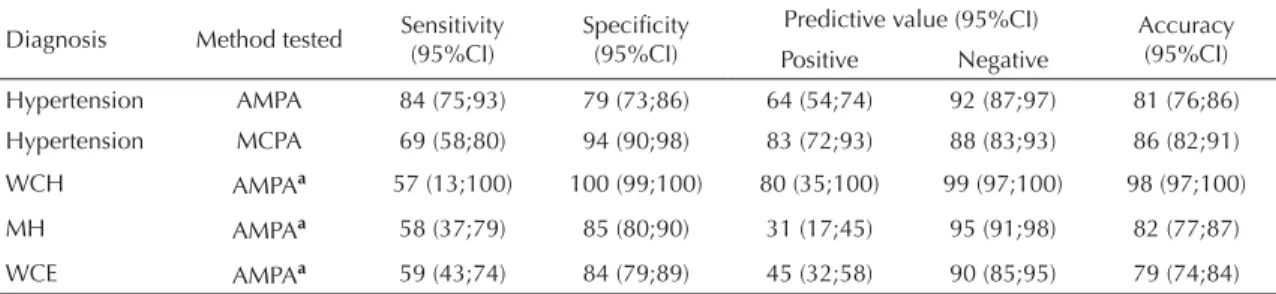
Table 2 shows that SMBP and CMBP showed similar sensitivity whereas CMBP had higher specifi city. Also, both methods showed similar accuracy.
effect were high (>80%) but their sensitivity was rela-tively low (55% to 59%). Of all 250 participants, 77 (30.8%) were classifi ed as hypertensive using AMBP, 63 (25.2%) using CMBP and 99 (36.9%) using SMBP. The negative predictive value (NPV) of SMBP was greater than CMBP (92% vs. 88%) and the positive predictive values (PPV) of SMBP and CMBP were 64% and 83%, respectively. On the other hand, CMBP showed higher accuracy (86%) than SMBP (81%). Table 2 shows a comparison of the performance of two BP measurement methods to identify white coat hypertension, masked hypertension and white-coat
effect. There were identifi ed seven (2.8%) partici-pants with white coat hypertension, 26 (10.4%) with masked hypertension and 46 (18.4%) with white-coat effect. The sensitivity, specifi city, positive and nega-tive predicnega-tive values and accuracy for identifying a white-coat effect were 59%, 84%, 45%, 90% and 79%, respectively.
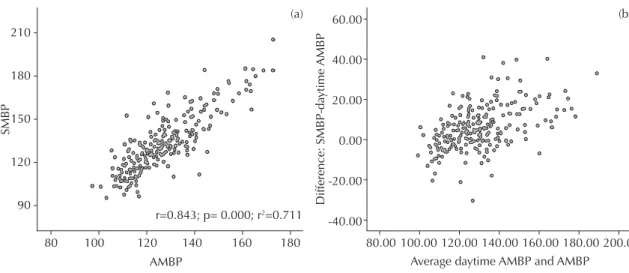
Figure 1 presents a comparison of mean BP obtained using SMBP and daytime AMBP. Figure 1a shows that BP measures had a strong correlation (r = 0.843, p<0.001) but they did not show good agreement as the Bland & Altman plot (Figure 1b) indicates statistically signifi cant bias (d) (d = 5.82, 95%CI: 4.49, 7.15).
Table 1. Sociodemographic and anthropometric characteristics of the sample studied according to the diagnosis of hypertension
using 24-hour ambulatory measure of blood pressure. Vitória, Southeastern Brazil, 2008–2010.
Variable All participants (n=250)
Hypertension (BP >130/80 mmHg) No
(n = 173)
Yes
(n = 77) p-value* Gender
Male 46.4 116 60.3 73 39.7 46
0.005
Female 53.6 134 76.9 103 23.1 31
Race/Skin color
White 41.6 104 78.8 82 21.2 22
0.005 Non-white 58.4 146 62.3 91 37.7 55
Age (years) 54.1 9.5 53.2 9.7 55.9 8.7 0.041 Weight (kg) 71.8 13.9 70.1 13.0 75.7 15.3 0.003 Height (m) 1.64 0.09 1.63 0.09 1.66 0.09 0.018
BMI (kg/m²) 26.8 4.6 26.5 4.5 27.5 5.0 0.099 WC (cm)
Male 95.0 12.4 92.7 12.4 98.6 11.8 0.012 Female 87.6 11.6 87.7 12.2 87.3 9.4 0.891 WHR (cm/cm)
Male 0.95 0.08 0.94 0.09 0.97 0.7 0.038 Female 0.86 0.86 0.86 0.07 0.87 0.06 0.425 BMI: Body mass index; WC: waist circumference, WHR: waist-to-hip ratio.
* Refer to χ2 statistics for gender and race/skin color (% and N) and Student’s t-test for the other variables presented (mean and
standard deviation).
Table 2. Estimated sensitivity, specifi city, positive and negative predictive values and accuracy of measures of diagnostic
performance and agreement among the methods studied to predict hypertension. Vitória, Southeastern Brazil, 2008–2010.
Diagnosis Method tested Sensitivity (95%CI)
Specifi city (95%CI)
Predictive value (95%CI) Accuracy (95%CI) Positive Negative
Hypertension AMPA 84 (75;93) 79 (73;86) 64 (54;74) 92 (87;97) 81 (76;86) Hypertension MCPA 69 (58;80) 94 (90;98) 83 (72;93) 88 (83;93) 86 (82;91)
WCH AMPAa 57 (13;100) 100 (99;100) 80 (35;100) 99 (97;100) 98 (97;100)
MH AMPAa 58 (37;79) 85 (80;90) 31 (17;45) 95 (91;98) 82 (77;87)
WCE AMPAa 59 (43;74) 84 (79;89) 45 (32;58) 90 (85;95) 79 (74;84)
a Diagnosis defi ned using a combination of self-measured blood pressure and method and clinic measurement of blood pressure.
Figure 2 shows that mean DBP measured using daytime AMBP and SMBP were also correlated (r = 0.821, p<0.001, Figure 2a). However, the means in Figure 2b showed good agreement as bias is almost zero and not statistically signifi cant (d = 0.41, 95%CI: –0.38;1.21).
DISCUSSION
The study results suggest that SMBP has higher sensi-tivity than CMBP to identify true hypertension in the general population as this is a highly prevalent condi-tion. The NPVs found support the fi nding that SMBP is superior to CMBP to identify truly normotensive individuals.
The method tested for identifying white coat hyper-tension showed greater specifi city than sensitivity, and good diagnostic ability evidences through high accuracy and agreement, and a NPV indicating low false-negative rates. The results with the same combination (SMBP and CMBP) used for identifying masked hypertension and white coat effect suggest that a similar performance to that seen for white coat hypertension.
Since SMBP do not follow a standard protocol time points of BP measures and number of steps required to establish the most accurate diagnosis are set at the physician’s and patient’s discretion.1,15 Thus, a
wide range of methodological approaches have been
Figure 1. Dispersion measures of correlation and agreement of systolic blood pressure measures between self-measured blood
pressure and daytime ambulatory measurement of blood pressure. Vitória, Southeastern Brazil, 2008–2010. 210
180
150
120
90
80 100 120 140 160 180
r=0.843; p= 0.000; r2=0.711
80.00 100.00 120.00 140.00
Average daytime AMBP and AMBP
Difference: SMBP-da
ytime
AMBP
SMBP
AMBP
160.00 180.00 200.00 60.00
40.00
20.00
0.00
-20.00
-40.00
(a) (b)
SMBP: Self-measured blood pressure; AMBP: ambulatory measurement of blood pressure
120
100
80
60
80
60 100 120 60.00 70.00 80.00 90.00
Average daytime AMBP and AMBP
Difference: SMBP-da
ytime
AMBP
SMBP
Daytime AMBP
r = 0.821; p = 0.000; R2 = 0.675
100.00 110.00 120.00 30.00
20.00
10.00
0.00
-10.00
-20.00
(a) (b)
Figure 2. Dispersion measures of correlation and agreement of diastolic blood pressure measures between self-measured blood
investigated, making it difficult comparison with other studies. However, the present study allows a comparison of performance of the three methods studied. One limitation of this study is the high number of participants taking antihypertensive drugs, which makes it diffi cult to know their actual BP but does not preclude a comparison of methods for the diagnosis of hypertension.
The superior results found refers only to aspects related to a method’s sensitivity and accuracy and should not be interpreted as an option to replace one method for another as they are described in the literature as being complementary for diagnosing hypertension.13 It is not
intended here to conclude that one method is superior to another, but rather to point to different methods available that can be used to prevent misdiagnosis. This is supported by the Bland & Altman method results3
showing that SMBP and AMBP while having a strong correlation did not show good agreement as to suggest that one method should replace the other.3,5
While there have been efforts to reduce the patient’s anxiety regarding blood pressure measurement, our study found signifi cant BP differences between the methods tested compared to the gold standard, espe-cially for SBP. SMBP measures were higher than those obtained by the nurse at the medical offi ce (CMBP) and AMBP, showing that although CMBP is less sensitive it remains crucial for the clinical diagnosis of hypertension.
Since white coat hypertension, masked hypertension and white coat effect have low prevalence, a test’s specifi city is the best marker of diagnostic quality. We did not compare a test’s superiority because a single test was used to identify different conditions. We found that combining SMBP and CMBP was more effective for the diagnosis of white coat hypertension than masked hypertension and white coat effect.
The study results suggest that the anxiety experienced during SMBP can be as important as that due to CMBP. It also showed that when appropriately performed SMBP is a feasible, safe and low-cost approach that can help the clinical diagnosis of hypertension. In conclusion, SMBP can be used to help the diagnosis when hypertension is suspected but it cannot replace CMBP, which is still the most reliable method. The indiscriminate use of SMBP should be discouraged in the general population because it is only helpful when the protocol is followed consistently but most people do not know the correct procedure. Also, some people may carry out a BP measure at times when they feel their “BP is high,” increasing their anxiety. Therefore, the management of hypertension based solely on SMBP is not recommended.
ACKNOWLEDGEMENTS
1. Alessi A. Automedida da pressão arterial – Opinião do agonista. Rev Bras Hipertens. 2008;15(4):196-8.
2. Appel LJ, Stason WB. Ambulatory blood pressure monitoring and blood pressure self-measurement in the diagnosis and management of hypertension. Ann Intern Med. 1993;118(11):867-82.
3. Bland JM, Altman DG. Statistical Methods for assessing agreement between two methods of clinical measurements. Lancet. 1986;1(8476)307-10. DOI:10.1016/S0140-6736(86)90837-8
4. Cooper RS, Wolf-Maier K, Luke A, Adeyemo A, Banegas JR, Forrester T, et al. An international comparative study of blood pressure in populations of European vs. African descent. BMC Med. 2005;3:1-8. DOI:10.1186/1741-7015-3-2
5. Hirakata VN, Camey AS. Análise de concordância entre métodos Bland-Altman. Rev HCPA. 2009;29(3):261-8
6. Mallick S, Kanthety R, Rahman M. Home blood pressure monitoring in clinical practice: a review.
Am J Med. 2009;122(9):803-10. DOI:10.1016/j. amjmed.2009.02.028
7. O’Brien E, Petrie J, Littler W, Swiet M, Padfi eld Pl, O’Malley K, et al. The British Hypertension society protocol for the evaluation of automated and semi-automated blood pressure measuring devices with special reference to ambulatory systems. J Hypertens.
1990;8(7):607-19. DOI:10.1097/00004872-199007000-00004
8. O’Brien E, Waeber B, Parati G, Staessen J, Myers MG. Blood pressure measuring devices: recommendations of the European Society of Hypertension.
BMJ. 2001;322(7285):531-6. DOI:10.1136/ bmj.322.7285.531
9. Parati G, Krakoff LR, Verdecchia P. Methods of measurements: home and ambulatory blood pressure monitoring. Blood Press Monit. 2010;15(2):100-5. DOI:10.1097/MBP.0b013e328338c63b
10. Park MK, Menard SW, Yuan C. Comparison of auscultatory and oscillometric blood pressures. Arch Pediatr Adolesc Med. 2001;155(1):50-3.
11. Pickering TG, Hall JE, Appel LJ, Falkner BE, Graves J, Hill MN, et al. Subcommittee of Professional and Public Education of the American Heart Association Council on High Blood Pressure Research. Recommendations for blood pressure measurement in humans and experimental animals: Part 1: blood pressure measurement in humans: a statement for professionals from the Subcommittee of Professional and Public Education of the American Heart
Association Council on High Blood Pressure Research.
Hypertension. 2005;45(5):142-61.
12. Pickering TG, Shimbo D, Haas D. Ambulatory blood-pressure monitoring. N Engl J Med.
2006;354(22):2368-74. DOI:10.1056/NEJMra060433
13. Pickering TG, White WB, Giles TD, Black HR, Izzo JL, Materson BJ, Oparil S, Weber MA. When and how to use self (home) and ambulatory blood pressure monitoring. J Am Soc Hypertens. 2010;4(2):56-61. DOI:10.1016/j.jash.2010.03.003
14. Sega R, Facchetti R, Bombelli M, Cesana G, Corrao G, Grassi G, Mancia G. Prognostic value of ambulatory and home blood pressures compared with offi ce blood pressure in the general population: follow-up results from the Pressioni Arteriose Monitorate e Loro Associazioni (PAMELA) study.
Circulation. 2005;111(14):1777-83. DOI:10.1161/01. CIR.0000160923.04524.5B
15. Sociedade Brasileira de Cardiologia. Sociedade Brasileira de Hipertensão. Sociedade Brasileira de Nefrologia. IV Diretriz para Uso da Monitorização Ambulatorial da Pressão Arterial. II Diretriz para Uso da Monitorização Residencial da Pressão Arterial. Arq Bras Cardiol. 2005; 85(Suppl II):1-20. DOI:10.1590/ S0066-782X2005002300002
16. Sociedade Brasileira de Cardiologia. VI Diretriz brasileira de hipertensão arterial. Rev Bras Hipertens.
2010;17(1):4.
17. Stergiou GS, Skeva II, Baibas NM, Kalkana CB, Roussias LG, Mountokalakis TD. Diagnosis of
hypertension using home or ambulatory blood pressure monitoring: comparison with the conventional strategy based on repeated clinic blood pressure measurements. J Hypertens. 2000;18(12):1745-51. DOI:10.1097/00004872-200018120-00007
18. Turnbull F, Blood Pressure Lowering Treatment Trialists’ Collaboration. Effects of different blood-pressure-lowering regimens on major cardiovascular events: results of prospectively-designed overviews of randomised trials. Lancet. 2003;362(9395):1527-35. DOI:10.1016/S0140-6736(03)14739-3
19. Wolf-Mayer K, Cooper RS, Kramer HB, Banegas JR, Giampaoli S, Joffres MR, et al. European hypertension treatment and control in fi ve countries, Canada and United States. Hypertension. 2004;43(1):10-7. DOI:10.1161/01.HYP.0000103630.72812.10
20. World Health Organization. Defi ning the problem of overweight and obesity. In: Obesity: preventing and managing the global epidemic: report of a Who Consultation.Geneva; 2000. p. 241-3. (WHO Technical Report Series, 894).
REFERENCES
Article based on LR Nascimento’s master’s dissertation presented to the Graduate Program in Collective Health at Universidade Federal do Espírito Santo in 2010.
LR Nascimento was supported by Fundação de Amparo à Pesquisa do Espírito Santo (FAPES) (protocol nr. 020/2008; master’s grant).