ON SYLLABLE STRUCTURE AND PHONOLOGICAL VARIATION:
THE CASE OF I-EPENTHESIS BY BRAZILIAN PORTUGUESE LEARNERS OF ENGLISH
Paul John*
Universite du Quebec a Trois-Rivieres, CAN
Walcir Cardoso**
Concordia University, CAN
Abstract
Our study employs nonword-learning tasks to examine i-epenthesis in the speech output of 53 Brazilian Portuguese learners of English. One aim is to investigate conlicting views on the syllabiication of consonants in various word-medial and inal contexts, where they can be parsed as either codas or onsets of empty nuclei. Another aim is to test a proposal (John & Cardoso, 2017) concerning the source of L2 phonological variation: we suggest that L2 variation is lexical rather than derivational, stemming from individual items having dual underlying representations which compete for selection at the moment of speaking. he results of a multivariate statistical analysis indicate: i) a hierarchy of diiculty in the acquisition of the stops /p k/ in diferent lexical locations; and ii) simultaneous development of dual representations for single lexical items.
Keywords: Second language acquisition; Syllable structure; Phonological variation; Vowel epenthesis; Nonword learning
* Assistant professor in the Department of Modern Languages at Université du Québec à Trois-Rivières, having obtained his PhD from the Department of
Linguistics at Université du Québec à Montréal. His areas of specialty include acquisition of L2 phonology, phonological variation, and pronunciation teaching. He is currently working on a project using neuro-imaging to investigate L2 segmental representation. His e-mail address is [email protected]
** Professor of Applied Linguistics at Concordia University (PhD in Linguistics, McGill University). He conducts research on the L2 acquisition of phonology,
morphosyntax and vocabulary, and the efects of computer technology (e.g., clickers, text-to-speech synthesizers, automatic speech recognition) on L2 learning. His e-mail address is [email protected]
Esta obra tem licença Creative Commons
Introduction
he study reported on here uses nonword-learning tasks to investigate variable i-epenthesis by Brazilian Portuguese (BP) learners of English. he purpose is to gather empirical evidence from second language (L2) acquisition to elucidate questions of syllable structure on the one hand and of phonological variation on the other. First, depending on the theoretical framework, competing syllabic parses apply to consonants in word-inal and in certain word-medial positions: these can be analyzed either as codas or as onsets of empty nuclei. To what extent do L2 learners’ realization of consonants in the various contexts support one or the other analysis? With regard to BP learners of English, the relevant information comes from the diferent rates of epenthetic
[i], according to the word-inal or word-medial context the target consonant appears in. Next, in previous work (John & Cardoso, 2017), we suggested that phonological variation in L2 speech is typically lexical rather than derivational. Using variable i-epenthesis as a test case, can we uncover further evidence for such a view?
Speciically, we focus on i-epenthesis ater the stops /p k/ in three contexts: 1) in word-inal position (bishop → bisho[pi], magic → magi[ki]); 2) in word-medial position before /t/ (chapter → cha[pi]ter,
Interestingly, the problem for learners of English is not with the stops per se, since /p k/ are part of the BP phoneme inventory. Rather, the problem concerns the contexts of occurrence: BP allows only a limited set of segments in these locations (i.e., /s l r N/, where /N/ indicates an underspeciied nasal consonant), and even then, they are subject to variable processes of lenition (e.g., paga/r/ → paga[h]) and deletion (e.g.,
paga/r/ → paga[Ø]). Where stops potentially occur in these contexts in native Portuguese words or in loanwords to BP, the same strategy of vowel insertion is found: laptop → la[pi]to[pi], link → lin[ki], captar
→ ca[pi]tar ‘to win’, pacto → pa[ki]to ‘pact’, apnéa →
a[pi]néa ‘apnea’, aracnídeo → ara[ki]nídeo ‘arachnid’ (Cantoni & Cristófaro-Silva, 2008; Cristófaro-Silva & Almeida, 2008; Nevins, 2008). he phenomenon in L2 English is thus a irst language (L1) transfer process. Interestingly, while the interlanguage process is variable, the L1 process is categorical.1
Clearly, i-epenthesis permits /p/ or /k/ to be syllabiied as an onset, which is precisely the syllabic position the stops can occupy in BP (see [p]agar ‘to pay’,
lu[p]a ‘magnifying glass’, [k]ara ‘face’, di[k]a ‘hint’). he syllabic ailiation of /p k/ before epenthesis, on the other hand, is open to debate, with phonological theory instantiating three competing views. he orthodox view (Blevins, 1995; Selkirk, 1982) treats the stops as codas in all three contexts. From the perspective of Government Phonology (Harris & Gussmann, 1998; Kaye, 1990), however, /p k/ are codas only word-medially before /t/, being analyzed as onsets of empty nuclei in the other two contexts. Finally, according to the CVCV approach (Lowenstamm, 1996; Scheer, 2004), phonological representations are composed exclusively of CV strings, amounting to a series of non-branching onsets and nuclei. In this case, /p k/ are Cs (or onsets) followed by empty Vs (or nuclei) in all three cases.2
One aim of our study is to contribute to the debate on syllabiication by gathering empirical evidence concerning BP English learners’ realization of /p k/ in the various contexts. In essence, equivalent epenthesis rates across the three contexts would point to a common syllabic parse (i.e., consistent with either the orthodox coda or the CVCV analysis), whereas diferential rates
of epenthesis would favour distinct syllabic parses (i.e., consistent with the Government Phonology view).
A further aim is to investigate a proposal we articulated previously regarding L2 phonological variation (John & Cardoso, 2017). Our impression is that variation in L2 speech is particularly common, more so than in L1 speech. Why is this the case? Is L2 variation the same as L1 variation? Our previous indings led us to propose that L2 phonological variation is typically lexical, due to competition between dual underlying representations (URs) associated with individual lexical items. he idea is that, at the moment of lexical access, either UR can be selected as a base for speech output. hus, BP learner variation in the realization of an item such as magic as magi[ki] ~ magi[k] would be due to variable selection of the URs magi/ki/ and magi/k/, not to a variable synchronic process of vowel insertion. he derivational approach is typically adopted to explain L1 variation, whether in the form of variable rules (e.g., Cedergren & Sankof, 1974; Labov, 1969) or crucially unranked or overlapping constraints (e.g., Anttila, 1997; Boersma, 1997; Boersma & Hayes, 2001; Kiparsky, 1993; Reynolds, 1994). he notion of lexical variation has a decidedly marginal status in the variationist literature (e.g., Anttila, 2002; Guy, 2007), but we suggest it should be foregrounded in the case of L2 variation.
he next section provides more extensive information on the background to our current investigation. We review the indings of previous studies of BP i-epenthesis and discuss at greater depth the issues of both the syllabiication of consonants in the various contexts and the source of phonological variation in L2 speech. he subsequent sections present our methodology for investigating these issues via nonword learning tasks and the results of a Goldvarb X (Sankof, Tagliamonte & Smith, 2005) analysis of the data. Finally, we discuss our indings, including the implications of some unexpected patterns in the BP speakers’ treatment of the nonwords.
Background
word-inal position. One aspect of the indings concerns the inluence of the segment itself on the phenomenon: on the one hand, voiced stops trigger higher rates of epenthesis (b d g >> p t k, with ‘>>’ indicating greater epenthesis – Baptista & Silva Filho, 1997, 2007); on the other, non-coronal stops trigger higher rates of epenthesis (p b k g >> t d – Cardoso, 2007). he former inding is consistent with the universal markedness of voiced obstruents in inal position, as evidenced by the common tendency for these to devoice (for an overview of the phenomenon in interlanguage, see Yavaş, 1994; see also Broselow, Chen & Wang, 1998). Likewise, the inluence of place of articulation follows the unmarked status of coronals crosslinguistically (Paradis & Prunet, 1991). he two sets of indings are revealing because voiced /b g/ and coronal /t d/ are precisely the stops that, according to Government Phonology, do not occur in medial codas in English; only the voiceless non-coronals /p k/ do (for a comprehensive explanation, see Harris, 1994; Harris & Gussmann, 1998). his view, incidentally, motivated our decision to limit the focus in the current study to the acquisition of /p k/.3
A further inding concerns the efect of word length on epenthesis: higher rates were found in monosyllabic as opposed to di- or polysyllabic words (thus pack →
pa[ki] >> attack → atta[ki] – Cardoso, 2007). his pattern points to the inluence in the phonological system of a Word Minimality constraint (McCarthy & Prince, 1993). Interestingly, this constraint is not observed in the BP L1 system, as the language contains a large amount of monosyllabic words such as pó ‘powder’ and fé ‘faith’. he phenomenon thus constitutes a case of the Emergence of the Unmarked in interlanguage (Broselow, Chen & Wang, 1998; McCarthy & Prince, 1994). Importantly for our study design, we decided to avoid the inluence of Word Minimality by comparing inal and word-medial epenthesis rates in disyllabic forms only. Because of the limited number of high-frequency disyllabic words with /p k/ in the three contexts, however, we could not use real-word elicitation tasks with our learners. Instead, to test epenthesis rates across the three contexts, we developed a set of nonword-learning tasks (see the methodology section for more detail).
Finally, in a rare exception to the exclusive focus on inal consonants, Huf and Alves (2010) found higher rates of epenthesis ater absolute-inal (e.g., attack
→ atta[ki]) as opposed to penultimate stops (tact →
ta[ki]t). he authors interpret the inding as indicating higher rates of epenthesis in absolute-inal rather than penultimate codas. From a Government Phonology perspective, however, only penultimate consonants such as the /k/ in tact are codas; inal consonants such as the /k/ in attack are onsets of empty nuclei. he diference in behaviour could be seen as supporting this distinct syllabic parse.
he fact that previous studies have focused on consonants in inal (or, exceptionally, penultimate) position to the exclusion of word-medial position suggests that researchers tacitly assume an orthodox coda analysis for the stops in all these contexts. If stops are codas in inal and in word-medial position before /t/ and /n/, we would expect learners to treat them similarly in all three contexts. In each case, BP learners of English would need to acquire a uniform coda representation for stops such as /p k/. While this is the prevalent view in phonology (Blevins, 1995; Selkirk, 1982), it is not the only one. In Government Phonology (Harris & Gussmann, 1998; Kaye, 1990), it is argued that inal consonants are onsets of empty nuclei; only an initial consonant in a medial cluster of falling or level sonority constitutes a coda. Hence, while level-sonority /pt/-/kt/ clusters are coda-onset sequences, rising-sonority clusters that do not form branching onsets, such as /pn/-/kn/, are onset-onset sequences with an intervening empty nucleus. Finally, proponents of CVCV (Lowenstamm, 1996; Scheer, 2004) argue that phonological representations are strictly comprised of sequences of C and V slots, which amount to a series of non-branching onsets and nuclei. All and any consonant is thus in an onset position, and adjacent consonants are necessarily separated by an empty nucleus.
Table 1 – Competing views of syllabiication
Orthodox phonology
Government
Phonology CVCV Medial /pt/-/kt p.t - k.t p.t - k.t pØt - kØt Medial /pn/-/kn p.n - k.n pØn - kØn pØn - kØn Final /p#/-/k#/ p. - k. pØ - kØ pØ - kØ
In a recent study, we established diferent epenthesis rates ater /p k/ in word-inal versus word-medial position before /t/ (John & Cardoso, 2017, to appear). his inding is consistent with, and tentatively supports, the Government Phonology view that the stops are parsed diferently in the two locations. heir diferential acquisition implies the presence of a dual learning challenge: arguably, learners need to enlarge the set of both onsets of inal empty nuclei and of medial codas to include /p k/. Nonetheless, diferential acquisition does not necessarily rule out a common syllabic parse (i.e., as codas or as onsets in both locations): it could be argued that diferential acquisition derives simply from the stops being determined by separate parameters or constraints in the two contexts. hat is, despite identical syllabic ailiation in the two contexts, diferent aspects of the phonological system might need adjusting to allow the stops to surface in both locations.
For the current and a previous pilot study (John & Cardoso, 2016), we thus expanded the scope of investigation to include /p k/ in word-medial position before /n/. In this context, Government Phonology considers the stops to constitute onsets of empty nuclei, that is, just like inal consonants. If, in terms of i-epenthesis, word-medial /p k/ before /n/ patterns with word-inal /p k/ rather than with word-medial /p k/ before /t/, this would be consistent with the Government Phonology view. hat is, onsets of empty nuclei should pattern together, not with true codas. his is precisely what we found in a pilot study involving BP learners of English in the L2 context of Montreal. here were, however, certain problems in the pilot study with how the word-learning tasks were designed and presented to the participants. As a result, participants had great diiculty retaining the nonwords. For the current study, we thus reined the methodology to favour higher levels
of vocabulary retention, seeking to conirm the previous inding among a population of English learners in the foreign language context of Belém, Brazil.
We also adapted the data analysis in order to verify predictions generated by our proposal that L2 phonological variation is typically lexical rather than derivational. L1 variation is usually attributed to a variable synchronic process, which can be modeled via variable rules (Cedergren & Sankof, 1974; Labov, 1969) or via crucially unranked or overlapping constraints (Anttila, 1997; Boersma, 1997; Boersma & Hayes, 2001; Kiparsky, 1993; Reynolds, 1994).5 For example, the
non-categorical deletion of inal /t d/ in North American English is attributed to a variable process that is sensitive to internal (linguistic) and external (extralinguistic) factors such as the nature of the surrounding segmental environment and level of formality (e.g., Guy, 1980; Neu, 1980). he notion that surface variation could in some cases be due to the presence in the lexicon of more than one UR for individual items is rarely entertained in the variationist literature (cf. Anttila, 2000; Guy, 2007). We suspect, however, that much variation in L2 speech is due to precisely this scenario: the idea is that, when individual lexical items are associated with two URs, these compete for selection, with either one being potentially accessed at the moment of speaking (John & Cardoso, 2017).
found in their speech output presumably correspond to vowels recorded in lexical entries. Relatedly, it has been argued that the epenthetic vowels observed in the L1, in native BP words and loanwords alike, are also part of the UR (Cantoni & Silva 2008; Cristófaro-Silva & Almeida, 2008). he upshot is that, in both the L1 and the L2 contexts, the term i-epenthesis is really a misnomer.
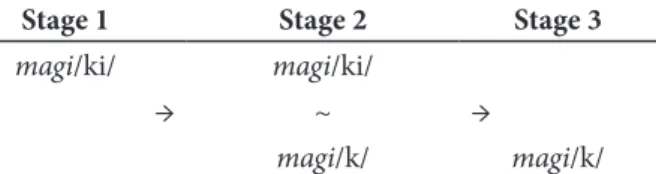
Apparently, then, the irst step for BP learners of English involves constructing URs that contain the illusory vowel (e.g., magic = magi/ki/). Over time, however, with increased exposure to English and improved proiciency, learners develop the ability to perceive and represent problematic consonants without the vowel (i.e., as codas or as onsets of empty nuclei). At this point, they revise the URs for individual words (e.g., magi/ki/ → magi/k/). However, the revised UR does not overwrite or otherwise eradicate the original one; instead, the two continue to be present in the lexicon, with both being available for selection at the moment of speaking. Over time, learners get better at accessing the revised (accurate) UR over the original (inaccurate) UR, with rates of magi/ki/ steadily declining and rates of magi/k/ increasing. Potentially, in speech production, learners reach a stage where only the revised UR is accessed, at which point the original UR functionally ceases to play a role. he three stages are illustrated in Figure 1.
Stage 1 Stage 2 Stage 3 magi/ki/ magi/ki/
→ ~ →
magi/k/ magi/k/
Figure 1 – Hypothetical stages in L2 phonological develop-ment
Variation is thus limited to stage 2 in development. At this point, where contextual factors are found to inluence the phenomenon probabilistically, these would not be afecting rates of application of a variable process; rather they would be inluencing the process of UR selection during lexical access, with some factors favouring selection of the original, and others the revised UR.
Crucially, our model of L2 phonological development makes certain predictions. First, learners at stages 1 and 3 of acquisition should exhibit (near) categorically inaccurate and (near) categorically accurate behaviour respectively. Next, variation at stage 2 should be restricted to words that are acquired at the previous initial stage of illusory vowel perception. Variation should not be found among new words acquired later on once the learner has entered stage 2. If stage 2 is characterized by accurate perception, representations for new words should generally not contain illusory vowels, although some residual ghost-vowel perception may still lead learners astray. hat is, newly acquired items (such as the nonwords galip, toktel and sepna) should generally be subject to accurate perception and UR development (e.g., gali/p/, to/k/tel), with only occasional misperceptions (e.g., se/pi/na). Consequently, learners at stage 2 should show categorical behaviour for recently acquired words: categorical accuracy for most items, with the possibility of categorical inaccuracy for others. Newly acquired items should thus only be subject to between-word variation; within-word variation should be limited to words acquired at stage 1 (or to those items acquired inaccurately at stage 2, once these undergo UR revision). Our predictions for newly acquired words according to the three stages of development are illustrated in Table 2.
Table 2 – Newly acquired (non)words (e.g., galip, toktel,
sepna)
Stage 1 (categorically
inaccurate)
Stage 2 (categorically
accurate OR inaccurate)
Stage 3 (categorically
accurate)
gali/pi/ gali/p/ gali/p/
to/ki/tel to/k/tel to/k/tel
se/pi/na se/pi/na se/p/na
and hypotheses based on this issue and on the issue of the syllabiication of stops in the three contexts are as follows:
1. Do word-medial /p k/ preceding /n/ pattern with inal /p k/ rather than word-medial /p k/ preceding /t/?
Hypothesis: If Government Phonology is correct in analyzing /p k/ as occupying an onset of an empty nucleus in both these positions, the hypothesis is that they should pattern together.
2. Do BP learners of English show only between-word variation in the realization of newly acquired items?
Hypothesis: Our model of L2 phonological development makes the prediction that learners at stage 2 should show precisely this behaviour; within-word variation is not consistent with our model.
he following section provides information on the methodology employed to investigate these questions.
Methodology
Participants
53 BP adult and teenage learners of English (30 F, 23 M; 15-56 years old, mean 28) in Belém, Brazil, participated in the study. hey were students at the
Centro de Educação de Jovens e Adultos (CEEJA) Prof. Luiz Octávio Pereira, a remedial program for people who were dropouts or who, for various reasons, had slipped through gaps in the educational system, ending up with little or no previous schooling. Interestingly, while most ESL studies employ university students (and hence, much of what we know about L2 acquisition comes from this elite population – see Collins & Muñoz, 2016, for an extensive review), our participants were at the opposite end of the academic spectrum. Indeed, only 7 reported previous instruction in English, and even this was only at the beginner level. In terms of
English proiciency, then, they were all early beginners, and given the emphasis on pen-and-paper exercises seen in the public school system in Brazil (which focus mostly on grammar and vocabulary), their previous exposure to and production of spoken English was limited or non-existent. Consequently, their awareness of English phonology would be quite basic. his was of some concern to us at irst, since we wondered whether they would not simply all be at the initial stage of total L1 transfer and hence categorical i-epenthesis in the three contexts. Fortunately, the concern proved not to be well founded.
Data collection
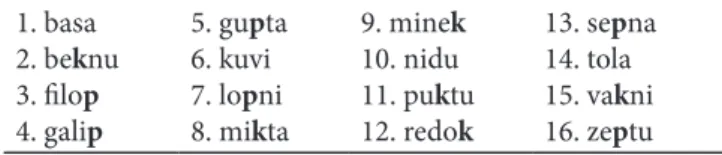
Participants performed a series of tasks presented via PowerPoint on a laptop computer and intended either to get them to learn a set of 12 nonwords or to collect data on their oral production of these same nonwords. For each of the tasks, including reading-aloud, repetition, identiication, and elicitation components, we created three versions in which the nonwords were presented in randomized orders. For the irst task, participants were instructed to use “English pronunciation” to read aloud the nonwords, being told these were invented rather than actual words of English. he set of nonwords is reproduced in Table 3, including the 12 target items and 4 distractors (for ease of identiication, the target segments are in bold here, though they were not in the version presented to participants).
Table 3 – List of nonwords for the reading-aloud task
1. basa 2. beknu 3. ilop 4. galip
5. gupta 6. kuvi 7. lopni 8. mikta
9. minek 10. nidu 11. puktu 12. redok
13. sepna 14. tola 15. vakni 16. zeptu
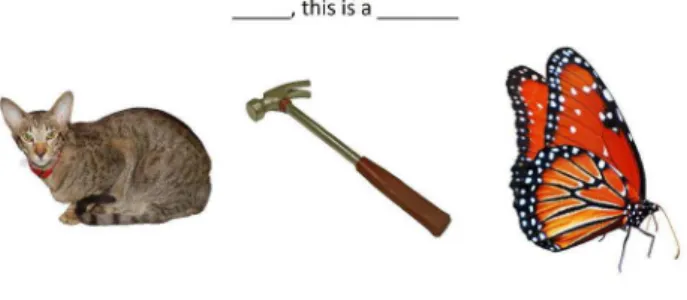
of 44.1 kHz) was Audacity 2.1. On each of a series of four PowerPoint slides, they saw three images taken from the Bank of Standardized Stimuli (Brodeur, Dionne-Dostie, Montreuil & Lepage, 2010). Upon clicking on each image, they heard a recording of the word in isolation and at the end of a carrier phrase: for example, the participant would hear ‘Minek, this is a minek’, ater clicking on the image of an elephant. he recordings were made by three adult speakers of standard Canadian English (2 M, 1 F), with recordings from diferent speakers being used both in diferent versions of the tasks and across diferent tasks within a given version. he aim was to expose the participants to various voices for the nonwords so as to ensure development of richer phonological representations. his decision was based on research indings suggesting that increasing the variability in the oral input results in greater learning (Bradlow, 2008; Lively, Logan, & Pisoni, 1993; homson, 2011). he screen shot in Figure 2 reproduces one of the slides from the repetition task.
Figure 2 – Repetition task: sample slide
he participants would repeat what they heard and try to memorize the word associated with the image. In our previous pilot study (John & Cardoso, 2016), the participants were oten unsuccessful at recalling the words later on, during post-tests. Consequently, for this study, we removed the four distractors from the word-learning tasks, efectively reducing the retention load from 16 to 12 words. We also encouraged the participants to listen and repeat as many times as they
wished, and they could also return to earlier slides to review before moving on to the next task. he intention was to maximize their learning by providing as much practice time as they deemed necessary. For the purposes of data collection, however, only the initial two repetitions of each nonword (i.e., in isolation and at the end of the carrier phrase) were retained.
Tasks 3 and 4 were identification tasks intended to ensure, check and reinforce the learning that took place in the preceding repetition task. For Task 3, the participants saw an image and listened to two recordings (e.g., Mikta, this is a mikta and Zeptu, this is a zeptu), having to decide which recording correctly identified the image. Afterwards, they were provided with feedback on their responses in order to give them a chance to learn any nonwords they were unsure of. Figure 3 provides an example of a slide from Task 3.
Figure 3 – Identiication Task 3: sample slide
Figure 4 – Slide from identiication Task 4
Tasks 5 and 6 were elicitation tasks, the irst being a practice test with feedback on error and the second being an actual test of their retention and production of the nonwords. Only the recordings from Task 6 were retained for the data analysis. In Task 5, the participants were asked to identify the nonword associated with the image, saying it aloud in isolation and at the end of the carrier phrase. hey would then click on the sound ile to verify their responses (see Figure 5). his constituted a last opportunity to learn the nonwords before being tested on them. In order to guide lexical access, the irst two sounds in the target word were provided.
Figure 5 – Elicitation Task 5: sample slide
Task 6 had the identical set-up, except that the participants could not verify their responses aterwards. his constituted the inal, immediate post-test phase of the data collection, checking production of the nonwords retained from the preceding learning tasks. As with the repetition task, two tokens of each nonword were collected: the item in isolation and then
at the end of the carrier phrase. he purpose was not to test vocabulary retention per se, but rather to verify pronunciation of the just-acquired forms. Figure 6 illustrates Task 6.
Figure 6 – Elicitation Task 6: sample slide
Finally, in Task 7, participants performed the same reading-aloud task as initially, producing each of the nonwords in isolation. he diferent stages in the data collection and nonword-learning tasks are reproduced in Table 4. To reiterate, for the purposes of the analysis, only the data collected in Tasks 1, 2, 6, and 7 were retained (indicated by an asterisk).
Table 4 – Data collection and nonword-learning tasks
Task Content
1. Pre-reading aloud task* 2. Repetition task*
3. Identiication task
4. Identiication task
5. Elicitation (practice) task 6. Elicitation (test) task* 7. Post-reading aloud*
List of 16 nonwords, including 4 distractors
12 target nonwords, in isolation and in carrier phrase
1 image and 2 recordings
2 images and 1 recording
Nonword in isolation and in carrier phrase
Nonword in isolation and in carrier phrase
Data coding
he data were then coded both for the dependent variable of i-epenthesis and for the following independent variables:
Position in word: (1) inal; (2) medial before /t/; (3)
medial before /t/
Consonant: (1) /p/; (2) /k/
Task: (1) pre-reading aloud; (2) repetition (tokens 1 vs.
2); (3) elicitation (tokens 1 vs. 2); (4) post-reading aloud
he presence of i-epenthesis was determined by the irst researcher listening to the recordings over a headset; the second researcher was consulted whenever presence or absence was diicult to determine.6
Results
We adopted a variationist methodology for collecting and analyzing linguistic data due to the nature of the study – it is essentially variationist in the sense that the variation that we report is (inherently) subject to the inluence of not one but multiple contextual inluences or multiple causes (Young & Bayley, 1996). As such, the data were analyzed via Goldvarb X (Sankof et al., 2005), a multiple regression statistical program speciically designed to handle linguistic variation. he program assigns to individual factors a weight ranging from 0 to 1 to indicate the relative contribution of the factor to the application of a variable phenomenon such
as i-epenthesis. Anything in excess of 0.5 indicates that a factor favours the phenomenon. Since Goldvarb only handles variation, the data from one participant with categorical epenthesis were eliminated ater the irst run; in order to reine the analysis, limiting it to factors that contribute signiicantly to the phenomenon under study, the factor group ‘participant’ was then eliminated ater the second run, since our main interest, within the realm of typical variationist research, is on the speech community, not individuals (Bayley, 2005).
he results presented in Table 5 are from the third and inal Goldvarb run, showing both the factors weights and the percentage of i-epenthesis when the given factor is present. According to these results, i-epenthesis is more likely to occur when the target /p/ and /k/ appear before /n/ (.729; Position), when the target consonant is a /p/ (.553; Consonant), and when the participants are engaged in reading aloud tasks (.752 and .558 on pretest and posttest respectively; Task).7
Focusing on the most relevant variables, the position in which the target /p/ and /k/ occur, we observe a developmental sequence that ranks medial /p k/ before /n/ at the hardest end of a hierarchy based on diiculty (0.729), followed by inal /p k/ (0.400) and medial /p k/ before /t/ (0.361). Finally, tokens 1 and 2 in both the repetition and elicitation tasks were assigned diferent factor weights (0.378 vs. 0.404 and 0.448 vs. 0.428), indicating that epenthesis rates were not identical for the two tokens.
Table 5 – Factor weights/ % assigned by the Goldvarb X
Aside from the results of the Goldvarb analysis, a few other observations can be made about the data. First, the participants occasionally realized the vowels /u/ or /a/ rather than /i/ ater /p k/. No other vowels were inserted instead of /i/. We coded such instances as applications of epenthesis, but because they were so infrequent, we maintained the designation of the dependent variable as i-epenthesis rather than the more generic vowel epenthesis.
Various transformations of the target items other than vowel epenthesis were also observed. For example, at times, the participants deleted /p k/ (e.g., gupta
→ guta, redok → redo). At others, they substituted the consonant following /p k/, with both n → t and t → n substitutions being observed (e.g., sepna → sepita, mikta
→ mikina). Interestingly, while p → k substitutions (e.g.,
lopni → lokini) were fairly common (25 in all), there were no instances of the reverse k → p substitution. he following section considers the implications of the indings for our hypotheses.
Discussion
One motivation for our exploring i-epenthesis in medial and inal contexts was to investigate the diferent syllabic parses that have been proposed for consonants in these locations. Depending on the theoretical framework, /p k/ in inal position and in word-medial position before /t/ or /n/ are analyzed either as all codas (orthodox phonology) or all Cs/onsets followed by empty Vs/nuclei (CVCV) or else as codas before /t/ and as onsets of empty nuclei in the two other contexts (Government Phonology). If BP learners of English treat /p k/ in the three contexts similarly, hence acquiring them simultaneously, this would suggest a uniied learning challenge and would be consistent with a common syllabic ailiation. If learners treat and acquire /p k/ diferentially in the three contexts, this would suggest that learners face a dual challenge of permitting /p k/ in both a coda and an onset of an empty nucleus. Speciically, we anticipated that medial /p k/ before /n/ should behave similarly to inal /p k/ if these consonants are parsed as onsets in the two locations; being parsed as a coda, medial /p k/ before
/t/, on the other hand, should behave diferently. hat is, the two onset locations should show similar rates of i-epenthesis, whereas the coda location should have a diferent rate.
Our results show that /p k/ are treated diferently in the three contexts, a inding which is not consistent with a common syllabic parse as a coda or onset. On the other hand, the results are inconclusive in terms of supporting the Government Phonology view. What we ind is a hierarchy of diiculty across the three locations, going from hardest to easiest: medial /p k/ before /n/ >> inal /p k/ >> medial /p k/ before /t/ (compare the factor weights: 0.729 >> 0.400 >> 0.361 respectively). Apparently, acquisition proceeds independently according to context, suggesting a developmental process that follows linguistic universals, not L1 transfer, as the observed patterns are not triggered by BP phonology (Major, 1986). In addition, as the factor weights indicate, the rates of epenthesis ater inal /p k/ (0.400) and medial /p k/ before /t/ (0.361), which supposedly require diferent syllabic parses, are much closer than the rates ater inal /p k/ (0.400) and medial /p k/ before /n/ (0.729), which supposedly both involve onsets of empty nuclei. he indings contrast somewhat with what we observed in our previous pilot study (John & Cardoso, 2016). Although the same hierarchy of diiculty emerged, the factor weights showed inal /p k/ (0.556) to pattern closely with medial /p k/ before /n/ (0.648), not with medial /p k/ before /t/ (0.299). In brief, the indings from the pilot study appear to conirm the Government Phonology view, whereas the indings from the current study fail to support it.
categorical behaviour for new items: BP learners at stage 1 in acquisition, who are subject to illusory vowel perception, should show categorical i-epenthesis ater newly acquired nonwords; learners at stage 2, however, having largely overcome illusory vowel perception, should show categorically accurate production, although occasional misperceptions could lead to categorically inaccurate production for certain items. Importantly, according to our model, we would not expect to ind variation in the realization of one and the same lexical item. In brief, while between-word variation for just-acquired forms is consistent with the model, within-word variation is not.
Variation in i-epenthesis was found across the tasks. his inding, however, is not necessarily evidence of true within-word variation. he highest rates of epenthesis were found in the pre-reading aloud task, followed by the post-reading aloud task. It could be argued that this is a task efect: in reading aloud, particularly before having any experience with how the nonwords are pronounced by speakers of English, arguably the participants tend to access their L1 phonological system to determine how to articulate the forms. Indeed, we should emphasize that, in reading aloud words in BP, the participants would be used to producing vowels that do not appear in the orthography, but that allow the output to conform to L1 syllabiication patterns.
For our purposes, then, the more crucial information comes from the repetition and elicitation tasks. First, there were some diferences between the tasks, with the repetition task showing slightly lower rates of epenthesis (token 1: 0.378; token 2: 0.404) than the elicitation task (token 1: 0.448; token 2: 0.428). Note that these diferences are not statistically diferent; they are presented as such for the sake of argumentation. Next, more importantly, there was frequent variation in the realization of the irst and second tokens in each target production in the carrier phrase adopted, as evidenced by the diferent factor weights accorded to the two tokens. What this means is that in the tasks, at times, the participants realized the irst token accurately and the second inaccurately (e.g., Gu[p]ta, this is a gu[pi]
ta) or vice versa (e.g., Mi[ki]ta, this is a mi[k]ta). What this means is that both as they are constructing a lexical
entry (the repetition task) and as they are accessing an entry (the elicitation task), competing accurate and inaccurate URs are in play. he implication is that dual URs do not arise in the L2 lexicon sequentially, as we posited; rather, they emerge simultaneously as new words are acquired. Learners show uncertainty when positing a UR for a new item, developing competing URs at the moment of acquisition. Interestingly, this behaviour seems to start quite early on: our participants were generally low in proiciency, with little previous experience with spoken English. Nonetheless, as indicated in the previous section, only one participant (whose data were discarded from further statistical analysis because of categorical i-epenthesis) actually occupied the initial stage of phonological acquisition, with total transfer of L1 phantom vowel perception and hence categorical epenthesis.
Another possibility that we might entertain is that i-epenthesis is not lexical at all, but derivational, due to a variable process of vowel insertion. hat is, perhaps L2 phonological variation is not special, but closely parallels what is found in L1s. We think that this view is misguided. First, the evidence for ghost vowel perception (e.g., Dupoux et al., 1999; Cardoso, 2011) points inevitably to the conclusion that apparent epenthetic vowels are in fact underlying. Likewise, further arguments have been mounted to demonstrate the underlying status of these vowels in L1 BP (Cantoni & Cristófaro-Silva 2008; Cristófaro-Silva & Almeida, 2008). Finally, /i/ was not the only vowel that was inserted ater /p k/ in the nonwords. Occasionally, /u/ or /a/ were added instead (e.g., ilop → ilo[pu];
gupta → gu[pa]ta; beknu → be[ka]nu), with nothing in the context to predict when one or the other (or instead [i]) would appear. In order for these patterns to be derivational, we would need to posit three phonological processes of variable vowel epenthesis that apply arbitrarily and at random. Instead, we stand by the claim that so-called epenthetic [i] is underlying and is the default illusory vowel, with /u/ or /a/ occasionally being heard in place of /i/.
conirms the observation that, alongside coronal (Paradis & Prunet, 1991), velar place has special unmarked status cross-linguistically (Rice, 1996). In languages such as Selayarese (Mithun & Basri, 1986), nasals that do not receive a place speciication via spreading from an adjacent consonant are assigned velar place by default (John, 2014). Interestingly, the unmarked status of velar /k/ over labial /p/ also found an echo in a substitution pattern we observed in the data. To reiterate, other transformations of the target forms than only vowel epenthesis occurred. At times, for example, the consonant following /p/ or /k/ was switched, with both n → t (e.g., sepna → sepita) and t → n (e.g., mikta → mikina) being instantiated. In terms of substitutions targeting /p k/, however, while we found 25 instances of the pattern p → k (e.g., lopni → lokini), there were no instances of the reverse k → p pattern. In brief, this unexpected inding provides further evidence for the default unmarked status of velars.
Conclusion
In sum, we set out irst to investigate rates of i-epenthesis ater the stops /p k/ by BP learners of English in diferent lexical contexts: in word-inal position and in word-medial position before either /t/ or /n/. Based on the Government Phonology view that both inal consonants and medial /p k/ before /n/ constitute onsets of empty nuclei, we predicted that they should trigger similar rates of i-epenthesis; medial /p k/ before /t/, on the other hand, should behave diferently, since these are in coda position. However, syllabiication appears not to hold the full explanation for contextual variation in epenthesis: we found a hierarchy of diiculty across the three contexts (/pn/-/ kn/ >> /p#/-#k#/ >> /pt/-/kt/). his is more consistent with the notion of a developmental sequence than with the notion of consonants associated with the same syllabic constituents patterning together. Especially, our indings contradict both the orthodox phonology and CVCV views, whereby /p k/ are either codas or onsets across the three contexts, in which case they should be acquired (evidenced by similar epenthesis rates) more or less simultaneously.
Next, we wished to test a proposal articulated in previous work (John & Cardoso, 2017) whereby the source of L2 phonological variation is lexical rather than derivational: we proposed that dual URs are associated with single lexical items, either of which may be accessed as a base for speech output. Hypothetically, dual URs arise sequentially in the learner lexicon as inaccurate forms, which develop due to perceptual illusions, are gradually replaced with revised accurate forms. hese latter forms develop once learners are able to perceive and represent /p k/ correctly. In this case, at the later stage of accurate perception, newly acquired items should generally be produced accurately. Certainly, learners should not exhibit within-word variation. However, this is precisely what we found: learners showed variation for newly acquired items from the start. hat is, dual URs for individual items seem to be acquired simultaneously at this stage in acquisition. Our model of phonological development thus proves to be overly simplistic.
Acknowledgements
We would like to thank the people and institutions that helped us with this project. First and foremost, we would like to thank our Brazilian collaborator, Léa Cardoso, for opening the doors of her school and for her active involvement in many aspects of this research, including her assistance in recruiting participants for the study, administering some of the experiments and tests, and liaising with the Centro de Estudos de Jovens e Adultos prof. Luiz Otávio Pereira, where the study took place. Accordingly, we thank the school’s director, Sra. Miriam Augusta de Oliveira e Silva, and its vice-directors, Sra. Bianora Coêlho dos Santos and Sra. Terezinha da Silva for, among other things, allowing us to use their facilities to conduct the study. We would also like to recognize Michel Monier’s and Lorena Danta’s invaluable help as research assistants in the development of the research tools and in the data collection respectively, and we thank the 53 participants who enthusiastically devoted their time to learn a set of nonsensical words in a non-existing language. Finally, we recognize partial inancial support from the Fonds institutionnel de recherche (FIR, Université du Québec à Trois-Rivières) and from the Social Sciences and Humanities Research Council (SSHRC).
Notes
1. his distinction between the L1 and L2 manifestations of the phenomenon may appear to be a simpliication since, as a reviewer pointed out to us, some variation has been observed in the phonetic realization of epenthetic [i] in BP, such that the vowel is phonetically gradient and hence variable (e.g., Cristófaro-Silva & Almeida, 2008). Indeed, it even seems that at times neither epenthetic nor regular [i] is realized, at least in the speech of the undergraduate students from Belo Horizonte used in Cristófaro-Silva and Almeida’s study. It is unclear, however, to what extent this variation holds for other L1 regional variants. In addition, apparent L1 variation (even absence of [i]) may simply derive from phonetic implementation, including the BP process of variable devoicing of the vowel ater a voiceless obstruent. We would thus argue that the distinction between categorical presence of the vowel in the L1 and non-categorical in the L2 holds at the abstract phonological level.
2. Further complicating matters, some have argued (Piggott, 1999; Rice, 2003) that word-inal consonants may be parsed as codas in some languages but as onsets of empty nuclei in others. For more on this issue, see John and Cardoso (2017), where we argue that, while English appears to employ an onset parse for inal consonants, BP is consistent with a coda parse.
3. Some may dispute the Government Phonology view that only /p k/ occur in medial codas, pointing to heterosyllabic medial clusters with initial voiced stops such as /b/ in ob.solete and /g/ in ig.nite, in addition to the coronal stops /t/ in at.las and /d/ in kid.ney. Nonetheless, such exceptions oten contain a morpheme boundary (in which case the stops are morpheme-inal) or else they fail to exhibit the level or falling sonority cline displayed by bona ide coda-onset sequences such as /k.t/ in actor and /n.d/ in tinder. As a consequence, Government Phonology analyzes these as word-internal onsets of empty nuclei.
4. One possibility that we overlook here is that inal consonants may be extrasyllabic (e.g., Ito, 1988). We do so because, in most accounts, inal consonants are extrasyllabic only in the initial stages, being incorporated into a coda constituent in the course of the derivation.
5. Another possibility is that variation stems from multiple grammars (Kroch, 1989), with the speaker switching back and forth between more than one categorical variant of the language. Furthermore, it has been proposed that between-word variation may derive from lexically indexed constraints (Coetzee, 2009).
6. he decision not to employ an acoustic analysis using a spectrograph (e.g., via Praat) was based on the observation that, even with this kind of ine-grained phonetic analysis, tokens can fall into a grey (gradient) area within which a researcher still has to ultimately determine an arbitrary cut-of point for what constitutes epenthesis or not. We preferred the cut-of point to be determined by how targetlike (i.e., without i-epenthesis) something sounded to a native-speaker’s ears.
7. To return to the issue of data coding, it would strictly speaking be more accurate to state that the results indicate which factors favour perception of the presence of i-epenthesis by experienced listeners.
References
Phonological heory (pp. 35–68). Amsterdam: John Benjamins.
Anttila, A. (2002). Variation and phonological theory. In J. Chambers, P. Trudgill and N. Schilling-Estes (Eds.), Handbook of Language Variation and Change (pp. 206–43). Oxford: Blackwell.
Baptista, B., & Silva Filho, J. (1997). he inluence of markedness and syllable contact on the production of English consonants by EFL learners. In J. Leather and A. James (Eds.), New Sounds 1997: Proceedings of the hird International Symposium on the Acquisition of Second Language Speech (pp. 26–34). Klagenfurt: University of Klagenfurt.
Baptista, B., & Silva Filho, J. da (2007). he inluence of voicing and sonority relationships on the production of English inal consonants. In B. Baptista and M. Watkins (Eds.), English with a Latin Beat: Studies in Portuguese/Spanish-English Interphonology (pp. 73– 89). Amsterdam: John Benjamins.
Bayley, R. (2005). Second language acquisition and sociolinguistic variation. Intercultural Communication Studies, 14(2), 1-13
Best, C. T. (1994). he emergence of native-language phonological inluences in infants: A perceptual assimilation model. In J. C. Goodman & H. C. Nusbaum (Eds.), he development of speech perception: he transition from speech sounds to spoken words (pp. 233-277). Cambridge, MA: he MIT Press.
Blevins, J. (1995). he syllable in phonological theory. In J.A. Goldsmith (Ed.), he Handbook of Phonological heory (pp. 206–44). Oxford: Blackwell.
Boersma, P. (1997). How we learn variation, optionality, and probability. In Proceedings of the Institute of Phonetic Sciences 21 (pp. 43–58). Amsterdam: University of Amsterdam.
Boersma, P., & Hayes, B. (2001). Empirical tests of the gradual learning algorithm. Linguistic Inquiry, 32(1), 45–86.
Bradlow, A. R. (2008) Training non-native language sound patterns: Lessons from training Japanese adults on the English /r/-/l/ contrast. In J. G. Hansen Edwards & M. L. Zampini (Eds.), State-of-the-art issues in second language phonology (pp. 287-308). Amsterdam: John Benjamins.
Brodeur, M., Dionne-Dostie, E., Montreuil, T., & Lepage, M. (2010). he Bank of Standardized Stimuli (BOSS), a new set of 480 normative photos of objects to be used as visual stimuli in cognitive research. PLoS ONE, 5(5), e10773.
Broselow, E., Chen, S.-I., & Wang, C. (1998). he emergence of the unmarked in second language phonology. Studies in Second Language Acquisition, 20, 261–80.
Cantoni, M., & Cristófaro-Silva, T. (2008). Verbal stress assignment in Brazilian Portuguese and the prosodic interpretation of segmental sequences. In Proceedings of the Speech Prosody Conference, Campinas 2008 (pp. 587–90). São Paulo: Universidade de Campinas.
Cardoso, W. (2007). he variable development of English word-inal stops by Brazilian Portuguese speakers: A stochastic optimality theoretic account. Language Variation and Change, 19, 219–48.
Cardoso, W. (2011). he development of coda perception in second language phonology: A variationist perspective. Second Language Research, 27(4), 433–65.
Cedergren, H. J., & Sankof, D. (1974). Variable rules: Performance as a statistical relection of competence. Language, 50(2), 333–55.
Cristófaro-Silva, T., & Almeida, L. (2008). On the nature of epenthetic vowels. In L. Bisol and C. R. Brescancini (Eds.), Contemporary Phonology in Brazil (pp. 193– 212). Cambridge: Cambridge Scholars Publishing.
Coetzee, A. (2009). Phonological variation and lexical frequency. In A. Schardl, M. Walkow and M. Abdurrahman (Eds.), NELS 38: Proceedings of the North East Linguistic Society, Volume 1 (pp. 189–202). Amherst: GLSA.
Collins, L., & Muñoz, C. (2016). he foreign language classroom: Current perspectives and future considerations. he Modern Language Journal, 100(1), 133-147.
Dupoux, E., K. Kakehi, Y. Hirose, C. Pallier, & J. Mehler. 1999. Epenthetic vowels in Japanese: A perceptual illusion? Journal of Experimental Psychology: Human Perception and Performance, 25, 1568-1578.
Flege, J. E. (1995). Second-language speech learning: heory, indings, and problems. In W. Strange (Ed.), Speech perception and linguistic experience: Issues in cross-language research (pp. 229-273). Timonium, MD: York Press.
Guy, G. (1980). Variation in the group and the individual: the case of inal stop deletion. In W. Labov (Ed.), Locating Language in Time and Space (pp. 1-36). New York: Academic Press.
_______. (2007). Lexical exceptions in variable phonology. University of Pennsylvania Working Paper in Linguistics, 13(2), 109-119.
Harris, J., & Gussmann, E. (1998). Final codas: Why the west was wrong. In E. Cyran (Ed.), Structure and Interpretation in Phonology: Studies in Phonology (pp. 139–62). Lublin: Folia.
Huf, J. C. C., & Alves, U. K. (2010). A produção de /p/ et /k/ em codas simples e complexas do inglès (L2) por aprendizes gaúchos. Verba Volant, 1(1), 1–27.
Ito, J. (1988) Syllable heory in Prosodic Phonology. New York: Garland Publishing.
John, P. (2014). he Phonology of Empty Categories. Unpublished doctoral dissertation, Université du Québec à Montréal.
John, P. & Cardoso, W. (2016). A question of syllable structure: contextual acquisition of /p/ and /k/ by Brazilian Portuguese learners of English. Gradus, 1(1), 126-144.
John, P., & Cardoso, W. (2017). Medial coda and inal stops in Brazilian Portuguese-English contact. In M. Yavaş, M. Kehoe and W. Cardoso (Eds.), Romance-Germanic Bilingual Phonology. Sheield: Equinox Publishing.
John, P., & Cardoso, W. (to appear). Are word-inal consonants codas? Evidence form Brazilian Portuguese ESL/EFL learners. In J. Volin and R. Skarnitzl (Eds.), Pronunciation of English by Speakers of Other Languages. Newcastle upon Tyne: Cambridge Scholars Publishing.
Kaye, J. (1990). ‘Coda’ licensing. Phonology, 7, 301–30.
Kiparsky, P. (1993). Variable rules. Paper presented at the Rutgers Optimality Workshop. New Brunswick, NJ.
Kroch, A. (1989). Relexes of grammar in patterns of language change. Language Variation and Change, 1, 199–244.
Kuhl, P. K., & Iverson, P. (1995). Linguistic experience and the “perceptual magnet efect”. In W. Strange (Ed.), Speech perception and linguistic experience: Issues in cross-language research (pp. 121-154). Baltimore, MD: York Press.
Labov, W. (1969). he logic of nonstandard English. Georgetown Monographs on Language and Linguistics, 22, 1–31.
______. (2001). Principles of Linguistic Change: Social Factors. Malden, MA: Blackwell.
Lively, S. E., Logan, J. S., & Pisoni, D. B. (1993). Training Japanese listeners to identify English /r/ and /l/ II: he role of phonetic environment and talker variability in learning new perceptual categories. Journal of the Acoustical Society of America, 94, 1242-1255.
Lowenstamm, J. (1996). CV as the only syllable type. In J. Durand and B. Laks (Eds.), Current Trends in
Phonology: Models and Methods (pp. 419–41). Salford, Manchester: ESRI.
Major, R. (1986). Paragoge and degree of foreign accent in Brazilian English. Second Language Research, 2, 53–71.
McCarthy, J. J, & Prince, A. (1993). Prosodic Morphology I: Constraint Interaction and Satisfaction. Unpublished manuscript, University of Massachusetts, Amherst, MA and Rutgers University, New Brunswick NJ.
______. (1994). he emergence of the unmarked: Optimality in prosodic morphology. In Papers from the Annual Meeting of the North East Linguistic Society 24, 333–79.
Mithun, M., & Basri, H. (1986) he phonology of Selayarese. Oceanic Linguistics, 25, 210-254.
Nevins, A. (2008). Review of A Lateral heory of Phonology: What is CVCV and Why Should it be? by Tobias Scheer. Lingua, 118(3), 425–34.
Neu, H. (1980). Ranking of constraints on /t,d/ deletion in American English; A statistical analysis. In W. Labov (Ed.), Locating Language in Time and Space (pp. 37-54). New York: Academic Press.
Paradis, C., & Prunet, J.-F. (Eds.). (1991). Phonetics and Phonology: he Special Status of Coronals. San Diego: Academic Press.
Piggott, G. (1999). At the right edge of words. he Linguistic Review, 16(2), 143–85.
Reynolds, W. (1994). Variation and Phonological heory. PhD Dissertation, University of Pennsylvania, Philadelphia, PA.
Rice, K. (1996). Default variability: the coronal-velar relationship. Natural Language & Linguistic heory, 14(3), 493-543.
Sankof, D., Tagliamonte, S., & Smith, E. (2005). GoldVarb X: a variable rule application for Macintosh and Windows. http://individual.utoronto.ca/tagliamonte/ goldvarb.html
Scheer, T. (2004). A Lateral heory of Phonology. What Is CVCV and Why Should It Be? Berlin: Mouton de Gruyter.
Selkirk, E. (1982). he syllable. In H. van der Hulst and N. Smith (Eds.), he Structure of Phonological Representations, Part 2, (pp. 337–83). Dordrecht: Foris.
homson, R. (2011). Computer Assisted Pronunciation Training: Targeting Second Language Vowel Perception Improves Pronunciation. CALICO Journal, 28(3), 744-765.
Young, R. & Bayley, R. (1996). VARBRUL analysis for second language acquisition research. In R. Bayley & D. Preston (Eds.), Second language acquisition and linguistic variation (pp, 253-306). Amsterdam: John Benjamins.