REEXAMINING FOREIGN ACCENT: HOW MUCH CAN PERSONALITY EXPLAIN?
Germán Zárate-Sández* Western Michigan University, USA
Abstract
Previous studies have shown that learners’ individual diferences (e.g., motivation, age) can impact second language learners’ pronunciation. his study focused on one individual diference that has received relatively little attention—namely, personality. It sought to determine to what extent subcomponents of personality (as deined in the Big-Five model of personality) account for learners’ foreign accent during quasispontaneous and unplanned speech. Fity-one English-speaking learners of Spanish performed a speaking task that was scored for degree of accentedness. Results revealed that personality explained a considerable portion of the variance, and that extraversion and neuroticism were signiicant predictors of foreign accent. he discussion addresses the interplay between personality and foreign accent and examines implications for the acquisition of pronunciation in the classroom.
Keywords: Classroom instruction; Extraversion; Foreign accent; Pronunciation; Neuroticism; Personality.
* Assistant professor of Linguistics, teacher trainer, and coordinator of Spanish instruction at Western Michigan University, USA. His ields of expertise and
research cover the learning and teaching of second language pronunciation, with emphasis on the role of learners’ individual diferences and the link between perception and production of second language intonation. His email: [email protected]
Esta obra tem licença Creative Commons
Introduction
It is well-known that second language (L2) learners’ pronunciation usually falls short of native standards, especially among adult learners. his type of speech is normally referred to as accented, that is, marked by a
foreign accent. he ield of L2 phonology has shown that this accented speech can be attributed to an array of interrelated factors, both internal (e.g., L2 proiciency, transfer from the irst language (L1), age, motivation, aptitude, and personality) and external (e.g., register, speaking style, and relationship with the interlocutor) to the language learner (Ellis, 1985; Major, 2001; Suter, 1976; Tarone, 1979, 1983). Within the group of internal factors, research on L2 accent1 has focused on how— and if—learners’ individual diferences (IDs) correlate with their L2 accent. Age of arrival (AoA) in the L2 community has been arguably the single most studied variable as a predictor of foreign accent (Flege, 1981; Flege, Munro, & MacKay, 1995). Other IDs that have
attracted researchers’ attention have been motivation (e.g., Moyer, 1999), length of residence (LoR) in the L2 community (e.g., Riney & Flege, 1998), and L2 use (e.g., Piske & MacKay, 1999).
and complexity (e.g., Carrell, Prince, & Astika, 1996), none of which easily provides essential information about the degree of perceived L2 accent.
Finally, most research on L2 accent has studied populations of speakers who have acquired the L2 primarily as a result of immersion where the L2 is spoken (e.g., MacKay, Flege, & Imai, 2006; Munro & Derwing, 1995; hompson, 1991). his is probably due to the widespread interest in AoA and LoR as predictor variables. Much less attention has been given to instructional settings, where pronunciation learning can be expected to difer from naturalistic acquisition. In the classroom, learners tend to receive less but more comprehensible input (Loewen, 2015), linguistic exposure comes from native as well as non-native speakers (other classmates and some instructors), and learners may receive explicit pronunciation instruction as well as feedback on their production (Lee, Jang, & Plonsky, 2015), all of which afect learners’ L2 accent in ways that are not normally found in a naturalistic setting. In terms of the L2s investigated, English has been the most popular language examined (Piske, MacKay, & Flege, 2001). As a result, we know comparatively little about L2 accent among populations of learners who acquire languages other than English in an instructed setting. In an attempt to contribute to this area, the goal of this study was to investigate the extent to which personality may afect foreign accent among learners of Spanish as a second language.
Literature review
L2 Accent
For decades, research on L2 accent has attracted the attention of many second language acquisition (SLA) researchers as the ield has tried to explain why learners’ pronunciation oten deviates from native standards. Munro (1998), for example, investigated and deined foreign-accented speech as “nonpathological speech produced by L2 learners that difers in partially systematic ways from the speech characteristic of native speakers of a given dialect” (p. 139). Regarding the components that make up a foreign accent, studies
have looked at segmental phonology, prosody, voice quality, and speed of delivery, among other factors, and concluded that aspects beyond the individual segment (e.g., syllable structure, stress, and intonation) seem to have a relatively large impact on L2 accent (e.g.,
Anderson-Hsieh, Johnson, & Koehler, 1992; Flege & Hammond, 1981; Jilka, 2000; Munro, 1995; however, see Lee, 2014, for alternative indings). Park (2013), for example, found that non-target like segments in the syllable coda had a bigger weight than onset segments in the perception of a foreign accent in English among speakers of Korean. Beyond phonology, there has also been some interest in the efects of syntactic and lexical factors on foreign accent. Ioup (1984), for instance, found that L2 accent is more readily detectable at the level of phonology than at the level of syntax: a group of native speakers of English could notice a foreign accent and match this accent to a particular native group based on phonological cues, while they were unable to do so based on syntactic information alone. As for lexis, there seems to be an inverse relationship between lexical frequency and foreign accent: L2 speech is perceived as more accented when low-frequency words are used (Levi, Winters, & Pisoni, 2007), though the same efect could not be replicated by Porretta, Kyröläinen, and Tucker (2015). In a related study by Incera, Shah, McLennan, and Wetzel (2017), predictability of sentence-inal words in English correlated with listeners’ perception of a foreign accent: the more unpredictable the word from the hearer’s perspective, the more accented native speakers perceived the sentence to be.
(1976; Purcell & Suter, 1980), for example, explored both internal (such as age of exposure to the L2, attitude, and L1) and external factors (such as contact with native L2 speakers and amount of formal instruction in the L2) that afected the foreign accent in English of 61 college students (four diferent L1s). He found that the speaker’s L1, the concern for pronunciation accuracy, and the amount of conversation carried out in English yielded the strongest correlations with L2 accent, as rated by English native speakers.
Ater Suter, other researchers followed suit. Out of the many variables examined, AoA has generally shown a strong association with degree of foreign accent (MacKay, Flege, & Imai, 2006; Moyer, 1999; Piske et al., 2001; hompson, 1991). Experience with the L2, oten operationalized as LoR, may predict foreign accent with less accuracy: some studies have claimed the existence of a relationship (Purcell & Suter, 1980; Riney & Flege, 1998) while others have not found such link (Elliot, 1995; Moyer, 1999; Piske et al., 2001). According to Flege and Liu (2001), this discrepancy might be due to a sampling error: some studies have investigated groups with a short LoR (one or two years) or with relatively little L2 use. he authors underscored that “[i]t appears that adults’ performance in an L2 will improve measurably over time, but only if they receive a substantial amount of native speaker input” (p. 527). From a methodological point of view, therefore, indings from studies on LoR are diicult to compare.
Flege and associates have been among the leading igures in the study of the factors afecting L2 accent, especially age. In his early work, Flege reviewed a number of studies that analyzed the diferences in L2 accent between child and adult learners (Flege, 1981). Although the author accepted that there is an obvious advantage in attainment for the former group, he did not attribute such diferences to maturational constraints, especially of the sort proposed by the critical period hypothesis. Instead, he suggested that the non-native like accent in adult L2 learners is due to the inluence of the already developed L1, an idea that he captured in the phonological translation hypothesis, which holds that “a tendency by mature speakers to interpret sounds occurring in a foreign language in terms of sounds
found in their native language may be a more important cause of foreign accent than any limitation on phonetic learning imposed by neurophysiological maturation” (pp. 448-449). Motivation has also been an ID investigated in relation to foreign accent. Moyer (1999), for instance, reported that “professional motivation” correlated negatively with degree of foreign accent (the higher the motivation, the less noticeable the accent) among English learners of German. Another popular targeted factor has been gender, which has produced mixed outcomes: a few indings suggest females are perceived to have less of a foreign accent than males (e.g., hompson, 1991) while others found no correlations between gender and L2 accent (Elliot, 1995; Piske et al., 2001; Suter, 1976). Combined, these studies have answered some questions regarding the factors that afect a foreign accent, but many issues remain unresolved. he ield needs both replication studies and novel research in order to address unanswered questions.
In conclusion, research continues to ind a good amount of variability in L2 learners’ accent that cannot be explained. As MacKay et al. (2006) discuss, “previous work has established that divergences from L2 phonetic norms […] contribute to the perception of L2 accent […]. It is less certain, however, why certain individuals diverge more from L2 phonetic norm, and thus have stronger foreign accents, than others do” (p. 158). By examining learners’ personality—a relatively underinvestigated ID in SLA research—this current study expects to shed additional light on the complex ield of foreign accent.
Personality
review of IDs because they believed “progress in this area has been slow, in terms of both methodology and systematic patterns of results” (p. 590). More than a decade ater these assertions, research on personality in SLA is still scarce, but the sum of indings to date reveals interesting trends as well as lingering issues (e.g., Busch, 1982; Dewaele & McCloskey, 2014; Hinton, 2014).
On the one hand, a number of studies have shown no relationship between personality (oten restricted to the extraversion subcomponent) and oral proiciency. Suter (1976; Purcell & Suter, 1980), for example, found no correlation between foreign accent in English and extraversion among college-level learners of English of various L1s. Van Daele, Housen, Pierrard, and Debruyn (2006) studied Dutch-speaking secondary school students of English and French and found that extraversion afected lexical complexity but did not afect accuracy, syntactic complexity or oral luency measures in either language. On the other hand, some research has found a signiicant relationship between personality and oral achievement. Busch (1982) looked at the relationship between extraversion and several measures of English proiciency among Japanese students of English as a foreign language (EFL). Apart from some secondary correlations, results did not support the hypothesis that extraverts are more proicient in English. In fact, introverts had signiicantly better pronunciation in English than extraverts. Robson (1994) looked at various personality traits in relation to class participation and L2 English proiciency among Japanese junior college women. No relationships were found between personality traits and overall proiciency, but, interestingly, some signiicant correlations emerged between personality and oral proiciency. he study by Oya et al. (2004) produced mixed results. It investigated personality and anxiety for four measures of oral proiciency among EFL speakers of Japanese in Auckland, New Zealand. hey found a signiicant correlation between extraversion and the global impression measure of oral proiciency, but there were no signiicant correlations with the other three measures: luency, accuracy, or complexity. In sum, a modest body of research has found a link between personality and oral proiciency,
though the direction and strength of this relationship remains unclear.
An explanation for these conlicting results could come from the kind of association between personality and linguistic tasks established in previous research, especially early ones. Dewaele and Furnham (1999), for example, claimed that a signiicant efect for extraversion should emerge when a demanding oral task is used as opposed to a written task or test. Similarly, Carrell et al. (1996) wondered if the associations with personality found in their study would have been diferent “had we employed other types of language achievement measures: more oral, social interactive, open-ended, less structured measures” (p. 97). Strong (1983) summarized the results of previous studies on personality and L2 acquisition and concluded that clearer efects of personality would be found when “natural communicative language” was examined, instead of tasks that employed “formal tested language” (p. 241). his methodological issue needs to be taken into account in future studies of L2 accent and personality.
he present study adheres to the Big Five taxonomy of personality, which began in the 1970s and developed progressively in psychology as various research groups studied the areas in which personality traits can be subsumed (see John, Naumann, and Soto, 2008, for review). As John et al. (2008) argued, it has become one the dominant models of personality. he taxonomy is comprised of the ive personality dimensions listed below.
1. Openness to experience: High scorers tend to be original, creative, curious, complex; Low scorers tend to be conventional, down to earth, narrow interests, uncreative.
2. Conscientiousness: High scorers tend to be reliable, well-organized, self-disciplined, careful; Low scorers tend to be disorganized, undependable, negligent.
4. Agreeableness: High scorers tend to be good natured, sympathetic, forgiving, courteous; Low scorers tend to be critical, rude, harsh, callous.
5. Neuroticism: High scorers tend to be nervous, high-strung, insecure, worrying; Low scorers tend to be calm, relaxed, secure, hardy.
Given the scarcity of research on personality and L2 accent, the analysis in this study included all ive components of the model. Also, conlicting results in this body of literature suggest we still need to explore the ield widely before focusing on the personality traits that emerge as signiicant predictors of foreign accent.
Summary of review and general motivation
he few studies that have addressed the speciic relationship between personality and L2 accent have yielded contradictory results. In addition, these studies have favored naturalistic settings of learning and have overwhelmingly focused on English as a second language. With this in mind, the main goal of this study is to determine if personality traits can explain the level of foreign accent among Spanish learners who have acquired the L2 in an instructed setting. he following overall research question was thus posited: To what extent do subcomponents of personality (namely, openness to experience, conscientiousness, extraversion, agreeableness, and neuroticism) account for learners’ foreign accent in Spanish?
Method
Participants
A total of 51 students enrolled in Advanced Spanish I (ith semester) at a university on the east coast of the United States participated in the study. he age range was between 18 and 22. here were 29 females and 22 males. In order to participate, students needed to meet the following criteria: be native speakers of American English, have no signiicant knowledge of another language beyond a level equivalent to two semesters of
instruction, and have not spent more than one month in a Spanish-speaking country.
In order to determine proiciency with a more reliable and valid tool than mere classroom enrolment, participants completed an Elicited Imitation Task (EIT) test for Spanish (Ortega, 2000; Ortega, Iwashita, Rabie, & Norris, 1999). he EIT belongs to a family of imitation tests that measure L2 proiciency. It is quick to administer and relies exclusively on aural stimuli and oral production, which is particularly appealing for studies dealing with production of spoken language only, such as the present study. It has been shown to be a reliable and valid measure of L2 oral proiciency (see Bowden, 2016, for discussion). For the sake of space, details about the administration and scoring are omitted here, but they followed the same procedure described by Bowden (2016) and Ortega (2000). he test produces a score between 0 and 120. Results yielded a mean of 91.33 for the group in this study (n
= 69, SD = 9.89, range: 55–114). It is worth mentioning that this igure is close to the 96.5 mean reported by Bowden (2016) for a comparable group (sixth-semester college Spanish). he inal sample of 51 participants resulted ater seven outliers (whose scores were two standard deviations above or below the group mean) were eliminated from the study.
Four early Spanish-English bilinguals (three females and one male) also participated for comparison purposes. hese heritage speakers (early bilinguals who were raised in families that speak a minority language, Kondo-Brown, 2006) were chosen instead of Spanish monolinguals in order to do justice to participants’ bilingualism: L2 speakers difer from monolingual speakers in both language use and cognitive processing, and they appear to resemble early bilinguals as their proiciency increases (Cook, 1999; Ortega, 2009). hese four participants scored between 115 and 119 on the EIT.
Materials
1. Background questionnaire
accent in Spanish, such as extended periods in a Spanish-speaking country and unusual amounts of Spanish use outside the classroom. Answers to questionnaire items were used to eliminate subjects that did not meet the criteria for participation, though data were still collected from them.
2. he Big-Five personality test
he Big-Five personality test—derived from the Big Five taxonomy—was used to examine participants’ personality in each of its ive subcomponents. he test has been extensively used in the ield of psychology (see John, Naumann, & Soto, 2008, for review) and increasingly in SLA research (e.g., MacIntyre & Charos, 1996; Verhoeven & Vermeer, 2002), and it is considered a valid and reliable measure of L2 learners’ personality, as it “captures a considerable proportion of the variance” among diferent personality factors (Dörnyei, 2005: p. 14). he test contains 45 items on a 7-point Likert scale. his study used the online version of the test (http://www.outofservice.com/bigive), which is available for free and has been shown to be as reliable as the paper-and-pencil version (Gosling, Vazire, Srivastava, & John, 2004). At the end of the test, the system generates a percentile (0-100) for each of the ive personality dimensions.
3. Elicitation task
he elicitation task prompted the use of a quasispontaneous and unplanned speech style since previous work suggests that it is during this type of discourse that personality may play a more crucial role in shaping L2 pronunciation outcomes (Bialystok, 1982; Dewaele & Furnham, 1999; Strong, 1983). A set of two pictures was used in the speaking task (also employed in a similar study by Elliot, 1995). One picture portrayed students in a classroom and the other one showed people at a party; both groups were being rowdy and annoying their teacher and a neighbor, respectively. Participants had to describe them in Spanish. Directions were given in English and emphasized that participants could go beyond mere description of the pictures and relate the topics to their own experiences (See Appendix I).
4. Exit questionnaire
his questionnaire elicited participants’ reactions to the test. Speciically, it asked them to assess the accuracy of the scores for each of the Big Five personality components. he questionnaire also asked participants how they felt about participating and speaking in their Spanish class. Finally, there were two open-ended questions regarding participants’ beliefs on how their personality afected their learning in general, as well as their Spanish pronunciation in particular (see Appendix II).
Procedure
Interviews were conducted in the researcher’s oice. he data collection session with each participant lasted between 35 and 45 minutes. he researcher was the only person with whom participants interacted. Ater receiving a general description of the interview session and consenting to participate, participants completed the background questionnaire. hen they proceeded to complete the elicitation task, which was recorded with Audacity 2.1.2 at a sampling rate of 32 kHz, using an external Logitech USB microphone attached to a personal computer. Instructions for the task were written (see Appendix I), but the researcher provided further assistance in English if participants required it. Since one central goal of this task was to elicit the most casual and spontaneous speech possible, the researcher adopted a friendly attitude and tried to create a relaxing atmosphere.
here were no time constraints set for the task, but two participants were asked to stop ater speaking for ive minutes. Other participants averaged three minutes. he researcher had to elicit more speech from three participants who spoke for less than 70 seconds. hey were asked to relate the events in the pictures to their own experiences, which in every case resulted in contributions of at least two minutes in length.
were asked to read their results and the interpretation line given for them. he researcher copied the scores on a pre-printed form. Participants were given a printed copy of the results. he personality test was conducted ater the speech elicitation task, so that knowing that their personality was being measured would not afect participants’ performance on the oral task.
Next, participants were given a ive-minute break, ater which they came back to the room to complete the EIT, which lasted 10 minutes. Finally, participants answered the exit questionnaire (paper and pencil) and were debriefed on the goals of the study.
Data coding and analysis
he degree of foreign accent was assessed by three native speakers. For this purpose, the researcher prepared a digital recording for each participant. Each recording lasted 90 seconds (considered suicient time for raters to provide their judgements), beginning at second 30, when participants felt more comfortable with the task and fewer hesitations occurred. Any interventions or prompts from the researcher were clipped out of the recording.
Resulting speech samples were given an overall rating produced by three expert raters, all native speakers of Spanish. An “expert rater” in this study refers to someone with a conscious knowledge of the linguistic L2 system and how learners’ L2 might be afected by the L1. he researcher selected three advanced Ph.D. students in Spanish Linguistics from the same institution where participants were recruited. Even though previous studies on L2 accent are divided between the use of expert and naïve raters (see Piske et al., 2001, for discussion and review), experienced raters are usually considered more reliable. Huang and Jun (2015), for example, compared ratings given by non-native speakers of the L2, unexperienced native speakers, and experienced native speakers, and concluded that experienced raters (comprised mostly of foreign language teachers) were better at detecting and rating non-native features in L2 speech. Expert raters in this current study were expected to focus on pronunciation2 while ignoring other areas of participants’ production, such as non-target uses
of lexical, morphosyntactic, or pragmatic features. As discussed above, a foreign accent appears to be primarily
but not exclusively made up of phonological factors. herefore, expert raters can more easily tease apart the diferent components that make up a foreign accent and focus only on those relevant for the study.
he speech samples were presented to raters in a randomized order, and a diferent order for each rater, through noise-canceling headphones attached to a personal computer. No speciic training was given beyond the instructions (see Appendix III), which emphasized that raters needed to: 1) base the rating on an overall impression of participants’ pronunciation, 2) be prepared to ind a variety of levels in luency, accuracy, complexity (both lexical and morphosyntactic), and even engagement with the task, 3) ignore the aforementioned factors when giving a score, 4) try not to lump scores in the middle range, 5) listen to the entire recording before giving a score. hree recordings from participants who were eliminated from the study were used as practice.
Answers were marked on a 6-point Likert scale, 1 being “a very strong foreign accent” and 6 “no foreign accent.” Inter-rater reliability was calculated using individual Pearson correlation scores and an overall Cronbach’s Alpha score. For the former test, all three pair-wise comparisons reached signiicant positive correlations (raters 1 and 2: r = .715, p < .01; raters 1 and 3: r = .805, p < .01; raters 2 and 3: r = .675, p < .01), while for the latter, the score was .891 (on a possible range from 0 to 1). hese two measures can be interpreted as a high level of inter-rater reliability (Larson-Hall, 2010). he inal holistic score for each participant was calculated by averaging the scores from the three raters.
Results
were signiicantly diferent from the comparison group in their L2 accent scores (t = 6.12, p = .02, df = 53). Since no personality data were collected for the heritage learners, no further analysis was done for this group.
Table 1: Descriptive statistics for holistic L2 accent scores and subcomponents of personality
N Mean SD Range
Max. Min.
L2 accent score 51 3.59 1.10 1.67 6.00
Openness 51 47.84 26.29 0 98
Conscientiousness 51 57.27 24.69 3 92
Extraversion 51 54.96 24.11 7 97
Agreeableness 51 63.69 18.29 30 97
Neuroticism 51 47.12 24.79 5 96
In order to answer the research question, scores from the ive personality dimensions were entered into a standard multiple regression analysis, in which the ive personality scores represented the explanatory variables and the holistic L2 accent score represented the predicted variable. As can be seen in the correlation matrix on Table 2, extraversion and neuroticism yielded signiicant correlations with L2 accent; a positive one for the former and a negative one for the latter. here was also a signiicant negative correlation between neuroticism and agreeableness. No other intercorrelations among explanatory variables were found. he results of these correlations show a desirable level of multicollinearity, a prerequisite to enter predictor variables into a multiple regression.
Table 2. Pearson correlation matrix for predictor and predicted variables
Personality subcomponents
L2 accent 1 2 3 4 5
L2 accent 1.000
Subcomponents
1. Openness .006 1.000
2. Conscientiousness -.129 -.163 1.000
3. Extraversion .364** -.053 -.163 1.000
4. Agreeableness .109 -.144 -.053 -.163 1.000
5. Neuroticism -.589** .224 -.144 -.053 -.320* 1.000
Note. Correlations signiicant at * p < .05, ** p < .01
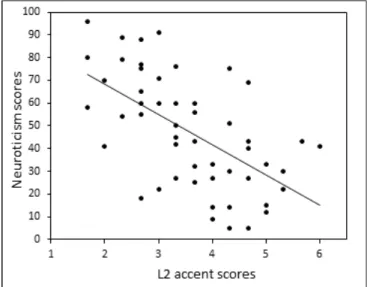
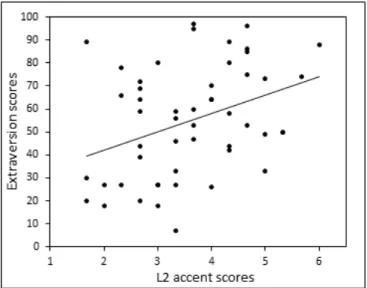
he regression analysis proved signiicant and showed that the predictor variables in the model account for 47% of the variance in L2 accent (r2 = .47, F(5, 45) = 8.10, p < .001). However, only neuroticism signiicantly predicted L2 accent (β = -.63, p < .001), as did extraversion (β = .24, p = .035). Scatterplots for the relationship between these two variables and L2 accent scores are presented in Figures 1 and 2.
Figure 2. Scatterplot for L2 accent scores (X axis) and extra-version (Y axis), with regression line
hese results indicate that participants’ personality can account for their L2 accent in Spanish. he model of personality encompassed in the Big-Five Personality Test captured 47% of the variance in foreign accent scores. he only dimensions that were signiicantly correlated with the predicted variable, however, were neuroticism and extraversion. he negative correlation for neuroticism implies that higher levels of this personality trait are associated with a stronger foreign accent. Higher extraversion, in turn, correlates with lower levels of perceived foreign accent in Spanish.
Discussion and conclusion
his study investigated whether subcomponents of personality (deined in the Big Five model) account for foreign accent among learners of Spanish as a second language, as perceived by Spanish native speakers. Results suggest that this understudied individual diference should be added to the list of IDs that potentially predict and explain accent in a second language.
Neuroticism was the strongest predictor of L2 accent. Nervous, anxious, and worrying individuals may have more accented L2 speech compared to learners who are conident and relaxed. Even though this is apparently the irst study that inds such relationship, neuroticism has been discussed in the ield of SLA under
the construct anxiety. In particular, foreign language anxiety and foreign language classroom anxiety have been related to learners’ traits (e.g., perfectionism and unwillingness to communicate) as well as to outcomes in linguistic performance (see Dewaele, 2017, for a recent review). he dynamic approach to anxiety by MacIntyre and Serroul (2015) proposed that learners will tend to go through a series of stages to cope with communication diiculties. he interplay of motivation, anxiety, perception of competence, and willingness to communicate (what the authors call “the four horsemen of communication diiculties” p. 130) will eventually determine how each learner handles these situations. Although the discussion in MacIntyre and Serroul (2015) focused only on lexical and syntactic elements of communication, their indings suggest that anxiety can also impact L2 accent, not necessarily by itself but working in tandem with other factors in communication.
In order to probe deeper into how learners’ neuroticism impacts their L2 pronunciation, a few excerpts from the exit questionnaire (questions 3.1 and 3.2) are now presented and analyzed. he following three, for instance, are from students who scored between 60 and 80 on neuroticism, and between 2 and 4 on foreign accent.
Excerpt, participant 5
“I am very insecure and that negatively afects my learning of Spanish. I am oten afraid to ask questions or give my answers because I don’t want to look stupid. My classmates have much better pronunciation than me and I feel I will be judged if I make pronunciation mistakes.”
Excerpt, participant 14
Excerpt, participant 35
“It’s tough for me to improve my speaking and pronunciation when I’ve had people make me feel dumb about not speaking Spanish well.”
Even though these extracts describe subjects’ classroom participation and opportunities for interaction, they might be good illustrations of learners whose neuroticism impacts their L2 accent negatively not only in this study (as shown in their scores) but also in the classroom. hese participants also demonstrate that neuroticism may correlate with other personality traits such as perfectionism. Participants admitted they did not want to look “stupid” or “dumb” or be judged for making pronunciation mistakes, which prompted them to remain silent or participate only if they knew they were correct. hese trends, though not systematically examined for all participants, are in line with previous research that obtained a positive correlation between foreign language (classroom) anxiety and perfectionism (Taguchi, Magid, & Papi, 2009).
Other participants, on the other hand, obtained high neuroticism values but were perceived as having relatively little foreign accent. Participant 33, for instance, received a 69 for neuroticism and a 4.67 for her L2 accent score. his is what she said:
Excerpt, participant 33
“I am hoping to go abroad. […] I am not sure if I want to go alone because I am very scared to go alone, in case I get lost or something, which has to do with my anxiety. In class, I feel comfortable answering though, and am loving my Spanish classes at [name of the university], so I am not afraid to speak if I have a good idea.”
his particular participant acknowledged her neuroticism, but also believed that it did not afect her pronunciation in the classes she was taking. We could argue that her motivation to be in class compensated for her general anxiety and perhaps gave her the courage to speak in class and practice her pronunciation. his participant points to the dynamic nature of anxiety
(subsumed in neuroticism) and how it interacts with other personality traits.
Extraversion, in turn, correlated positively with degree of foreign accent; learners who are more sociable, talkative, and outgoing tended to be perceived as having less foreign accent. his inding is in line with previous studies that obtained a similar relationship (e.g., Oya et al., 2004). he relatively unstructured format of the current task seems to have captured a relationship between extraversion and oral skills that some previous studies overlooked. As predicted by Dewaele and Furnham (1999), extraversion should emerge as a signiicant predictor of L2 accent when the linguistic task is unplanned and spontaneous—that is, when it poses some level of complexity. his type of task contrasts with a low-complexity task, such as reading a paragraph or a list of isolated sentences (e.g., Moyer, 1999; hompson, 1991). hough the current study did not set out to compare task types, it conirms Dewaele and Furnham’s predictions.
As was the case for neuroticism, learners’ accounts of their experiences further illuminate the relationship between extraversion and pronunciation. he following excerpts are from learners who followed the trends for the group as a whole; that is, the higher their extraversion score, the more native-like their accents in Spanish.
Excerpt, participant 40
“Being a little bit on the shyer side makes it more nerve-wracking for me to speak in front of the whole class in a language I already barely feel comfortable speaking. Of course, if I don’t speak the language, my teachers cannot hear me talk and then they can’t really correct my pronunciation.”
Excerpt, participant 10
Excerpt, participant 22
“If you are shy like me, you won’t speak as much and therefore you end up practicing less Spanish. I would never go out and ind native speakers to interact with. I can have some long conversations with my own classmates, and I do enjoy that, of course. I love Spanish, but I ind some situations and people more intimidating than others.”
Some learners who did not follow this pattern also provided interesting insight into their learning and use of Spanish pronunciation. Participant 27, for instance, scored 89 on the extraversion scale but received only 1.67 for his perceived foreign accent. He commented:
Excerpt, participant 27
“Most of the time I just say whatever comes to my mind without thinking about how I say it, the pronunciation, or the correct Spanish grammar. I have a sociable personality and I am always eager to interact with others in order to learn more from them. Some people would say I’m impulsive, but I feel the more you think about something, the more you change the original idea you wanted to say.”
It could be argued that this participant did not worry about his L2 accent because his extroverted personality allowed him to get the message across efectively without being bothered by the accuracy of formal linguistic features. Similar results were obtained by Dewaele and McCloskey (2015), although in this study it was the interlocutor’s foreign accent (rather than their own) that did not appear to bother extraverts.
Results from the quantitative analysis along with answers from the exit survey show an intricate relationship between personality and pronunciation. In many cases this relationship is not necessarily stable or present across the board, as for participants who claim to be talkative inside the Spanish classroom but shy outside. As is the case with all correlational research, this study does not claim to establish causality: it has not shown that personality traits “cause” a foreign
accent. Some data, in fact, suggest that the direction of the relationship may be the opposite, as for participants who get anxious when they do not pronounce words as well as they think they should. All in all, the survey data from this study call for cautious analysis of individual diferences, where every “individual” potentially has something to say, and where exceptional behaviors add to the richness of the description.
In terms of learners’ achievement, it is noteworthy that at least two participants obtained scores within the range of early bilingual speakers (5.67-6.00). hese speakers also showed high levels of extraversion and low levels of neuroticism. Even though they constituted only two cases, they may provide evidence that some speakers actually achieve L2 proiciency with an undetectable or at least negligible level of perceived foreign accent. Bongaerts, Summeren, Planken, and Schils (1997) obtained similar indings for highly motivated learners. Results from this current study suggest that personality is another variable that explains exceptionally low levels of L2 accent for some L2 learners who were irst exposed to the L2 during adulthood.
A word of caution is necessary regarding the role of foreign accent in L2 pronunciation. Decades ago, the interest in foreign accent was mostly rooted in a desire to gain understanding about something that needed to be eradicated. Foreign accent was perceived as an undesirable feature of L2 speech, a deviation from L1 norms. Today, models of L2 pronunciation recognize that L2 accent is a problem only to the extent that it interferes with intelligibility and comprehensibility (see Derwing & Munro, 2015, for discussion). his is the stance adopted in the current study, though these dimensions were not included given the exploratory nature of the project.
Finally, the current study is in the minority when it comes to the context of learning analyzed. he vast majority of studies on L2 accent have been conducted in the area of naturalistic SLA (e.g., MacKay et al., 2006;
interesting implications for instructed learning of pronunciation. First, the data showed that a native-like accent is attainable in an instructed setting. Of course, this does not amount to saying that instruction alone will result in a native-like accent. It is reasonable to assume, for example, that motivation and other personal traits will make some students seek opportunities to communicate outside the classroom or be proactive about improving their pronunciation. What we can conclude is that contact with the L2 community is not an essential condition for attaining native-like pronunciation, even if this is true only for very few learners. Second, some participants in this study described the classroom as a sort of safe haven where they could use the language in a relaxing atmosphere. Some introverts confessed that they felt shy or nervous about talking with native speakers in the community or studying abroad, yet found themselves more relaxed in the classroom and thus able to engage in meaningful communication that perhaps would not have occurred in diferent contexts. his highlights the importance of seeing the L2 classroom as a welcoming place where most personality types can thrive.
In sum, this study contributes to the body of knowledge on L2 learners’ personality traits. he Big Five model accounted for a signiicant portion of learners’ foreign accent in Spanish. Given previous research in the ield, it was perhaps unexpected to ind that neuroticism was a stronger predictor of foreign accent than extraversion. Quantitative data along with answers to open-ended questions showed an intricate but revealing interplay between L2 accent and these two personality dimensions. Findings like these suggest that we may be closer to incorporating personality into a model of individual diferences that can better explain and predict achievement in second language pronunciation.
Notes
1. A note on terminology: “foreign accent” and “L2 accent” are used interchangeably in this article.
2. he researcher did not give raters a deinition of “pronunciation” since the goal was to obtain a holistic (global), unbiased score of foreign accent, based on the raters’ knowledge as native speakers and background
in Spanish linguistics. he written instructions ofered what were considered the basic guidelines for all raters to follow (see Appendix III).
References
Anderson-Hsieh, J., Johnson, R., & Koehler, K. (1992). he relationship between native speaker judgments of nonnative pronunciation and deviance in segmentals, prosody, and syllable structure. Language Learning, 42, 529–555.
Bialystok, E. (1982). On the relationship between knowing and using forms. Applied Linguistics, 3, 181–206.
Bongaerts, T., Summeren, C., Planken, B., & Schils, E. (1997). Age and ultimate attainment in the pronunciation of a foreign language. Studies in Second Language Acquisition, 19, 447–466.
Bowden, H. (2016). Assessing second-language oral proiciency for research: he Spanish Elicited Imitation Task. Studies in Second Language Acquisition, 38(4), 647–675.
Brennan, E. M., & Brennan J. S. (1981). Accent scaling and language attitudes: Reactions to Mexican American English speech. Language and Speech, 24, 207–221.
Busch, D. (1982). Introversion-extraversion and the EFL proiciency of Japanese students. Language Learning, 32(1), 109–132.
Carrell, P. L., Prince, M. S., & Astika, G. G. (1996). Personality types and language learning in an EFL context. Language Learning, 46(1), 75–99.
Cook, V. (1999). Going beyond the native speaker in language teaching. TESOL Quarterly, 33, 185–209.
Derwing, T. M., & Munro, M. J. (1997). Accent, intelligibility, and comprehensibility: Evidence from four L1s. Studies in Second Language Acquisition, 19, 1–16.
______. (2015). Pronunciation fundamentals: Evidence-based perspectives for L2 teaching and research. Amsterdam: Benjamins.
Dewaele, J.-M. (2017). Psychological dimensions and foreign language anxiety. In S. Loewen & M. Sato (Eds.), he Routledge handbook of instructed second language acquisition (pp. 433–450). New York: Routledge
Dewaele, J.-M., & Furnham, A. (1999). Extraversion: he unloved variable in applied linguistic research.
Language Learning, 49, 509–544.
Dewaele, J.-M., & McCloskey, J. (2015). Attitudes towards foreign accents among adult multilingual language users. Journal of Multilingual and Multicultural Development, 36(3), 221–238.
Dörnyei, Z. (2005). he psychology of the language learner: Individual diferences in second language acquisition. Mahwah, NJ: Lawrence Erlbaum Associates.
Dörnyei, Z., & Skehan, P. (2003). Individual diferences in second language learning. In C. Doughty & M. H. Long (Eds.), he handbook of second language acquisition
(pp. 589–630). Malden: Blackwell Publishing.
Elliot, A. R. (1995). Field dependence/independence, hemispheric specialization, and attitude in relation to pronunciation accuracy in Spanish as a foreign language. he Modern Language Journal, 79, 356–371.
Ellis, R. (1985). Sources of variability in interlanguage.
Applied Linguistics, 6, 118–131.
Flege, J. E. (1981). he phonological basis of foreign accent: A hypothesis. TESOL Quarterly, 15, 443–455.
Flege, J., & Liu, S. (2001). he efect of experience on adults’ acquisition of a second language. Studies in Second Language Acquisition, 23, 527–552.
Flege, J., & Hammond R. (1981). Speakers’ awareness of some non-segmental aspects of foreign accent. In
M. Henderson (Ed.), 1980 Mid-America linguistics
conference papers, (pp. 145–163). Lawrence:
Department of Linguistics, University of Kansas.
Flege, J. E., Munro, M. J., & MacKay, I. R. (1995). Factors afecting strength of perceived foreign accent in a second language. he Journal of the Acoustical Society of America, 97, 3125–3134.
Gosling, S. D., Vazire, S., Srivastava, S., & John, O. P. (2004). Should we trust web-based studies? A comparative analysis of six preconceptions about internet questionnaires. American Psychologist, 59(2), 93–104.
Hinton, M. (2014). he bold and the beautiful: How aspects of personality afect foreign language pronunciation. Research in Language, 12(3), 217–232.
Huang, B., & Jun, S. (2015). Age matters, and so may raters: Rater diferences in the assessment of foreign accents. Studies in Second Language Acquisition, 37(4), 623–650.
Incera, S., Shah, A. P., McLennan, C. T., & Wetzel, M. T. (2017). Sentence context inluences the subjective perception of foreign accents. Acta Psychologica, 172, 71–76.
Ioup, G. (1984). Is there a structural foreign accent? A comparison of syntactic and phonological errors in
second language acquisition. Language Learning, 34(2), 1–17.
Jilka, M. (2000). he contribution of intonation to the perception of foreign accent (Unpublished doctoral dissertation). University of Stuttgart.
John, O. P., Naumann, L. P., & Soto, C. J. (2008). Paradigm shit to the integrative Big-Five trait taxonomy: History, measurement, and conceptual Issues. In O. P. John, R. W. Robins, & L. A. Pervin (Eds.), Handbook of personality: heory and research (pp. 114–158). New York, NY: Guilford Press.
Kondo-Brown , K. (Ed.). (2006). Heritage language development: Focus on East Asian immigrants. Amsterdam: Benjamins.
Larson-Hall, J. (2010). A guide to doing statistics in second language research using SPSS. New York: Routledge.
Lee, J.-K. (2014). he role of prosody in the perception of foreign accent and comprehensibility: Prosody-corrected-L2 speech vs. prosody-distorted-L1 speech.
Korean Journal of Linguistics, 39(1), 155–179.
Lee J., Jang, J, & Plonsky, L. (2015). he efectiveness of second language pronunciation instruction: A meta-analysis. Applied Linguistics,36(3), 345–366.
Levi, S. V., Winters, S. J., & Pisoni, D. B. (2007). Speaker-independent factors afecting the perception of foreign accent in a second language. he Journal of the Acoustical Society of America, 121,2327–2338.
Loewen, S. (2015). Introduction to instructed second language acquisition. New York: Routledge.
MacIntyre, P. D., & Charos, C. (1996). Personality, attitudes, and afect as predictors of second language communication. Journal of Language and Social Psychology, 15, 3–26.
MacIntyre, P. D., & Serroul, A. (2015). Motivation on a per-second timescale: Examining approach-avoidance motivation during L2 task performance. In Z. Dörnyei, P. D. MacIntyre, & A. Henry (Eds.), Motivational dynamics in language learning (pp. 109–138). Tonawanda, NY: Multilingual Matters.
MacKay, I. R. A., Flege, J. E., & Imai, S. (2006). Evaluating the efects of chronological age and sentence duration on degree of perceived foreign accent. Applied Psycholinguistics, 27, 157–183.
Major, R. (2001). Foreign accent: he ontogeny and phylogeny of second language phonology. Mahwah, NJ: Lawrence Erlbaum Associates, Inc.
Moyer, A. (1999). Ultimate attainment in L2 phonology: he critical factors of age, motivation, and instruction.
Munro, M. (1995). Nonsegmental factors in foreign accent: Ratings of iltered speech. Studies in Second Language Acquisition, 17(1), 17–34.
______. (1998). he efects of noise on the intelligibility of foreign-accented speech. Studies in Second Language Acquisition, 20, 139–154.
Munro, M. J., & Derwing, T. M. (1995). Foreign accent, comprehensibility and intelligibility in the speech of second language learners. Language Learning, 45,73– 97.
______. (2001). Modeling perceptions of the accentedness and comprehensibility of L2 speech: he role of speaking rate. Studies in Second Language Acquisition, 23, 451–468.
Munro, M. J., Derwing, T. M., & Morton, S. L. (2006). he mutual intelligibility of L2 speech. Studies in Second Language Acquisition, 28, 111–131.
Ortega, L. (2000). Understanding syntactic complexity: he measurement of change in the syntax of instructed L2 Spanish learners (Unpublished doctoral dissertation). University of Hawaii at Manoa.
______. (2009). Understanding second language acquisition. London: Routledge.
Ortega, L., Iwashita, N., Rabie, S., & Norris, J. (1999, August). A multilanguage comparison of L2 syntactic complexity measures. Paper presented at the 12th AILA (World Congress of International Association of Applied Linguistics) Conference, Tokyo.
Oya, T., Manalo, E., & Greenwood, J. (2004). he inluence of personality and anxiety on the oral performance of Japanese speakers of English. Applied Cognitive Psychology, 18, 841–855.
Park, H. (2013). Detecting foreign accent in monosyllables: he role of L1 phonotactics. Journal of Phonetics, 41(2), 78–87.
Piske, T., & MacKay, I. R. A. (1999). Age and L1 use efects on degree of foreign accent in English. In J. J. Ohala, Y. Hasegawa, M. Ohala, D. Granville, & A. C. Bailey (Eds.), Proceedings of the 14th International Congress of
Phonetics Sciences (pp. 1433–1436). Berkeley: Dept. of Linguistics, University of California Berkeley.
Piske, T., MacKay, I. R. A., & Flege, J. (2001). Factors afecting degree of foreign accent in an L2: A review.
Journal of Phonetics, 29, 191–215.
Porretta, V., Kyröläinen, A., & Tucker, B. V. (2015). Perceived foreign accentedness: Acoustic distances and lexical properties. Attention, Perception and Psychophysics, 77(7), 2438–2451.
Purcell, E. T., & Suter, R. W. (1980). Predictors of pronunciation accuracy: A reexamination. Language Learning, 30, 271–287.
Riney, T. J., & Flege, J. E. (1998). Changes over time in global foreign accent and liquid identiiability and accuracy. Studies in Second Language Acquisition, 20, 213–243.
Ritchie, W. C., & Bhatia, T. K. (2009). he new handbook of second language acquisition. Leiden: Brill.
Robson, G. L. (1994). Relationships between personality, anxiety, proiciency and participation (Unpublished doctoral dissertation). Temple University.
Strong, M. (1983). Social styles and second language acquisition of Spanish-speaking kindergarteners. TESOL Quarterly, 17, 241–258.
Suter, R. W. (1976). Predictors of pronunciation accuracy in second language learning. Language Learning, 26, 233–253.
Taguchi, T., Magid, M., & Papi, M. (2009). he L2 motivational self system among Japanese, Chinese, and Iranian learners of English: A comparative study. In Z. Dörnyei & E. Ushioda (Eds.), Motivation, language identity and the L2 self (pp. 66–97). Bristol: Multilingual Matters.
Tarone, E. (1979). Interlanguage as chameleon. Language Learning, 29, 181–191.
______. (1983). On the variability of interlanguage systems. Applied Linguistics, 4, 143–163.
hompson, I. (1991). Foreign accents revisited: he English pronunciation of Russian immigrants.
Language Learning, 41, 177–204.
van Daele, S., Housen, A., Pierrard, M., & Debruyn, L. (2006). he efect of extraversion on oral L2 proiciency.
EUROSLA Yearbook, 6, 213–236.
Verhoeven, L., & Vermeer, A. (2002). Communicative competence and personality dimensions in irst and second language learners. Applied Psycholinguistics, 23, 361–374.
APPENDIX I:
Elicitation Task
Directions
APPENDIX II:
Exist questionnaire
EXIT QUESTIONNAIRE
Name: ________________________________________
Please read the following questions and answer them to the best of your knowledge. his information will
be kept conidential, and your name or individual answers shall never appear in any part of this project.
(1) Look at the results of your personality test. Do you think they are true for you? Please discuss each
item separately.
Openness ______________________________________________________
Conscientiousness _______________________________________________
Extraversion____________________________________________________
Agreeableness __________________________________________________
Neuroticism ____________________________________________________
(2) How do you usually feel about participating and speaking in Spanish
in class
? Please check all that
apply.
_____ Most class participation occurs when the teacher requests it.
_____ I tend to participate without the teacher’s request.
_____ I like speaking activities in groups.
_____ I like speaking activities in pairs.
_____ I prefer to work alone rather than in pairs or groups.
_____ I tend to participate more than my classmates (ask more questions, make more
comments, etc.)
_____ I prefer written over oral activities in the classroom.
_____ I usually seek opportunities to speak Spanish in the classroom
(3) 1. Do you feel that any aspects of your personality afect (either positively or negatively) your
learn-ing of Spanish? If so, please explain how.
2. Now consider your pronunciation in Spanish. Do you feel that any aspects of your personality
af-fect (either positively or negatively) your learning and use of Spanish pronunciation?
Please provide an overall impression of the participants’ pronunciation as compared to that of a native speaker. Please do not try to detect speciic sounds or intonational patterns to judge participants’ L2 accent. Rather, your evaluation is expected to be a global score, based on a composite of features that you may have detected consciously or unconsciously.
Since the speaking task is likely to yield diferent responses given its open-ended nature, speakers may vary in the level of luency, accuracy, and complexity in terms of syntax, vocabulary, storytelling ability, etc. However, you are expected to base your judgment on pronunciation alone.
Use the scale below, from 1 (very strong foreign accent) to 6 (no foreign accent). Try not to lump scores into the middle range. Circle your choice.
he recording you will listen to lasts 90 seconds. Please listen to each recording once only and wait until the end of each recording before you give your score.
Please do not discuss your answers with anyone else.
1 ---2 ---3 ---4 --- 5 --- --6
Very strong foreign accent No foreign accent