Materials Research, Vol. 9, No. 1, 21-24, 2006 © 2006
*e-mail: [email protected]
Blue Cooperative Emission in Yb
3+- Doped GeO
2
- PbO Glasses
Vanessa Duarte Del Cachoa, Luciana Reyes Pires Kassaba,b*,Samuel Leite de Oliveirac, Nilton Itiro Morimotoc
a
LSI, Departamento de Engenharia de Sistemas Eletrônicos, EPUSP, São Paulo - SP, Brazil
b
Laboratório de Vidros e Datações, Faculdade de Tecnologia de São Paulo, São Paulo - SP, Brazil
cInstituto de Física de São Carlos, USP, São Carlos - SP, Brazil
Received: December 2, 2004; Revised: July 13, 2005
Investigation of the blue cooperative luminescence in a binary composition of GeO2-PbO glasses with different
Yb3+ concentrations is reported. High refractive index (1.96) and large transmission window (0.4 up to 5.0 µm) are
characteristics of this vitreous system. Luminescence and lifetime measurements in the visible and near infrared regions were performed to investigate the spectroscopic characteristics of the glasses. Visible emission around
507 nm was detected in all samples. The visible emission intensity increases with the Yb2O3 content at least up to
2.0 wt. (%), that represents the maximum Yb2O3 concentration possible for this glass system. The visible lifetimes
are about half of their respective near infrared ones, and the blue luminescence comes from a cooperative process.
A rate equation was used to describe the behavior of the cooperative emission intensity as a function of Yb2O3
concentration; a good agreement with the calculated and measured cooperative luminescence was achieved.
Keywords: glasses, ytterbium, cooperative luminescence
1. Introduction
The heavy metal oxide glasses1,2, in which the usual vitrifying
elements3 are oxides of germanium, gallium and tellurium, have
attracted interest for photonics applications because of their optical properties such as high refractive index, optical non-linearity and infrared transmittance providing the possibility to develop efficient lasers and amplifiers at longer wavelengths than available from other
oxide glasses4,5.
Regarding the Yb-doped materials, several investigations have revealed the technological potentiality of these systems since they may generate tunable lasers in the infrared region from 920 to 1060 nm
and visible emission at about 500 nm6,7, by means of a cooperative
effect. There are only two manifolds in the Yb3+ energy level scheme
in the 4fn configuration, the 2F
7/2 ground state and the
2F
5/2 excited
state. The lack of intermediate levels and the large separation between the excited state and the ground state manifolds reduces nonradiative decay. The cooperative luminescence is an upconversion process in which two interacting ions in the excited state decay simultane-ously to the ground state, emitting one photon at twice the energy of
single-ion-transitions. 3-D displays8, intrinsic bistability for optical
switching9,10 and planar lasers for optical devices in
telecommunica-tions11 are some applications for cooperative emission in systems
doped with Yb ions.
In this work we present a study of the cooperative luminescence in
a binary composition of Yb3+ - doped GeO
2 - PbO glasses prepared at
the Laboratory of Glasses and Datation at FATEC-SP. The measured emission spectra and lifetimes in the visible region as a function of
Yb3+ concentration are presented. From the luminescence spectra and
lifetime measurements in the near infrared region, the mechanism re-sponsible by the visible emission in this glass system was identified.
2. Experimental
Different concentrations of Yb2O3varying from 0.1 to 2.0 wt. (%),
were added to the binary composition 59GeO2 - 41 PbO (mol%),
henceforth named GP12. The powders were melted in an alumina
crucible (with impurities of 0.01%) at 1323 K during 1 hour in air
and poured into a brass mold previously heated. During the melting the powders were stirred by a mechanical system, developed in our laboratory, to enhance the optical quality. The stirring is performed during the last 10 minutes of the melting. Annealing treatments were performed on each sample for 3 hours at 693 K (considering the glass transition temperature) and then cooled to room temperature inside the furnace. The samples produced are transparent, homogeneous and stable against crystallization. For concentrations greater than
2.0 wt. (%) of Yb2O3 we observe a loss of transparency. Therefore, the
solubility limit of Yb2O3 in this heavy metal oxide glass, considering
the current melting scheme employed, is approximately 2.0 wt. (%)
of Yb2O3. The density of (6.21 ± 0.1) g/cm3 was measured using the
Archimedes method. The samples were polished for refractive index, absorption, luminescence and lifetime measurements. The refractive index of (1.96 ± 0.05) was determined by means of the "apparent depth method” that relates the physical thickness of the samples to their opti-cal thickness (apparent thickness). The optiopti-cal thickness was measured
with a 10 x objective lens of a microscope (Carl Zeiss). The
absorp-tion spectra were obtained using a spectrophotometer (Carry 500). Infrared luminescence measurements were performed by optically pumping the samples with laser diode operating at 808 nm. The signal was dispersed by a monochromator (Jarrel-Ash) and detected by an InGaAs detector connected to a lock-in amplifier. The excitation was
performed close to the sample edge13 to minimize re-absorption due
to radiation trapping effect. The radiation trapping effect14 arises from
the spectral overlap of the emission and absorption bands of Yb3+. This
effect normally deforms the Yb3+ emission band and increases with
sample size, refractive index and Yb3+ concentration.
The lifetimes of the 4F
5/2→ 4F
7/2 transition were measured using a
22 Cacho et al. Materials Research
connected to a digital oscilloscope. As will be shown Yb3+ ions have a
strong absorption at 980 nm. So this is the most adequate wavelength for the measurement of the cooperative luminescence: more ions are excited favoring the cooperative luminescence. All measurements were performed at room temperature; errors of luminescence and lifetime measurements are estimated to be of ± 5%.
3. Results and Discussion
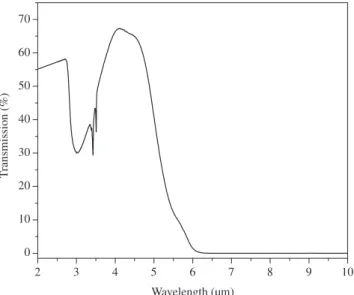
The transmission in the infrared region is presented in Figure 1 for
the undoped sample. The band positioned around 3.4 µm is related to the
presence of OH– radicals into the glass. The broad infrared transmission
(up to 5.0 µm) observed is a consequence of the small field strengths
and relatively large masses of the components of these glasses that
present more than 50% of heavy metal oxides, such as PbO4.
Figure 2 shows the absorption spectrum of the sample doped with
1.0 wt. (%) of Yb2O3. The transition observed is related to the 2F
7/2→
2 3 4 5 6 7 8 9 10
Wavelength (µm) 70
60
50
40
30
20
10
0
T
ransmission (%)
Figure 1. Infrared transmission spectrum of the GP glass with 2 mm thick-ness.
250 500 750 1000 1250 1500 1750 2000
0.0 0.5 1.0 1.5 2.0
0 1 2 3 4 5
A
(cm
-1)
Yb2O3 (wt. (%)) 2F
7/2 2F
5/2
A
(cm
-1)
Wavelength (nm) 6
5
4
3
2
1
0
Figure 2. Absorption spectrum of the GP glass doped with 1.0 wt. (%) of Yb2O3. The inset shows the absorption coefficient as a function of Yb2O3 concentration.
2F 5/2 Yb
3+ transition. The inset shows that the absorption coefficient
increases linearly with Yb3+ concentration, indicating a systematic
incorporation of Yb ions by the vitreous matrix. So the relative
concen-trations of Yb3+ are in agreement with the nominal values. In addition,
we also can observe that the absorption edge starts at 400 nm in the GP glass; no absorption related to impurities was observed.
Yb3+ ions absorb and emit in the near infrared spectral range
when excited by radiation of the near infrared region. However, some
materials containing Yb3+ can exhibit visible luminescence at twice
the energy of the 2F
5/2 levels. The upconverted emission involves Yb
3+ ion pairs excited by radiation in the near infrared spectral region; so a
simultaneous de-excitation of two excited Yb3+ ions, in the 2F
5/2 level,
results in the emission of one visible photon around 500 nm. Yb3+
ions not only emit in the near infrared from their 2F
5/2 excited-state
multiplet, but can also undergo visible emission at the blue-green
spectral region from the doubly excited 2F
5/2, 2F
5/2 pair state: this is
known as cooperative process. The cooperative luminescence depends on the inter-ionic distances, phonon energy, edge of the transmis-sion window in the visible region and laser power employed for the
excitation of Yb3+. The investigations reported in the literature show
that the visible lifetime value related to the cooperative mechanism
is half of its respective near infrared one6,7.
The near-infrared luminescence from the 2F
5/2 excited level of the
sample doped with 2.0 wt. (%) Yb2O3 is displayed in the Figure 3.
The emission around 1000 nm is attributed to 2F
5/2→ 2F
7/2 transition.
It is interesting to mention that the near infrared emission intensity
increases with Yb2O3 concentration; this indicates that no fluorescence
quenching related to nonradiative transitions is observed for this range of concentration.
The visible luminescence spectrum of the samples is shown in Figure 4. The band at 507 nm may be ascribed to the combination of
electronic energies associated to the Stark components of the 2F
5/2 level
of isolated Yb3+ ions. A strong blue emission can be easily observed
by naked eyes focusing the laser beam in the glasses. Then the broad and strong visible emission observed around 507 nm from GP glasses under near infrared excitation is attributed to the cooperative process
involving Yb3+ ions and, as predicted by the literature, the peak value
corresponds approximately to half of the near infrared one (around 1000 nm). In the inset of the same figure the intensity of the
lumi-900 950 1000 1050 1100 1150
Wavelength (nm) 500
400
300
200
100
0
Intensity (arb
. units)
Vol. 9, No 1, 2006 Blue Cooperative Emission in Yb3+ - Doped GeO
2 - PbO Glasses 23
nescence in the visible region (~ 507 nm) is plotted as a function of
Yb2O3 concentration. The blue emission intensity increases with the
Yb2O3 concentration indicating that no quenching of the luminescence
is observed at least up to 2.0 wt. (%). Therefore, unfavorable non-radiative de-excitation mechanisms such as multiphonon relaxation and quenching due to OH- radicals can be neglected. A continuous line was achieved from a rate equation explained below; the points in Figure 4 represent the experimental values.
The dependence of the cooperative and near-infrared intensities
on Yb2O3 concentration can be determinedby means of a rate
equa-tion that considers the nonradiative and radiative decays as done in
references15,16.
(1)
where Ni (i = 1,2) represents the populations of the 2F
7/2 and
2F 5/2 Yb
3+
levels, respectively. Nyb = N1 = N1 + N2 gives the total concentration
of Yb3+ ions, W
rad is the radiative rate from the
2F
5/2 level. Equation 1
means that the population of the 2F
5/2 level is increased by a
pump-ing term RN1 that depends on the laser intensity (I) according to
R = σabsI/hv, where R is the pumping rate, σabs is the absorption cross
section at the pumping energy hv. All other terms are responsible for
losses from the 2F
5/2 level; WradN2 represents the radiative decay, WnrN2
accounts for nonradiative losses, such as multiphonon relaxation and energy transfer from Yb ions to OH groups. The cooperative effect was neglected in the equation because it contributes very little for
the emptying of the state 2F
5/2 when compared to term (Wrad + Wnr)N2.
Considering the sample under low excitation density (N1 can be
ap-proximated to the total concentration NYb) and in the stationary
condi-tion (N.2 = 0), N2 is given by N2 = RNYbτIR, where τIR = (Wrad + Wnr)-1 is
the experimental lifetime of the 2F
5/2 level. Starting from that, the near
infrared and cooperative luminescence intensity can be determined
from this expression because they are proportional to N2 and (N2)2,
respectively16. The square dependence of the cooperative
lumines-cence intensity with respect to Yb3+ concentration is expected for an
upconversion process due to pair interaction. The inset of Figure 4 indicates a good agreement between the normalized cooperative lu-minescence intensity predicted by the above rate equation (continuous line) and the normalized experimental results (points).
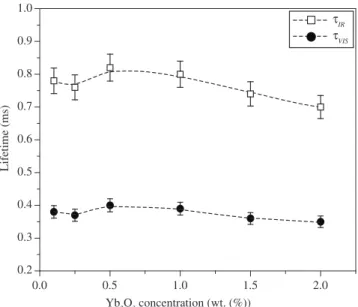
Figure 5 exhibits the near infrared and the cooperative lifetimes
as a function of Yb2O3 concentration in GP glasses. The alterations
of the fluorescence lifetime as a function of Yb content in both near infrared and visible regions are of the order of the experimental er-rors. The slight decrease of the fluorescence lifetime corroborates that the nonradiative decay is not serious in this system. The other aspect that has to be added is that cooperative lifetimes are about half
of their respective near infrared ones, as predicted in the literature6,7
for systems in which the visible emission is caused by the coopera-tive process.
The studies presented in this work will be used in the future to produce glass fibers and thin films viewing applications with waveguides.
4. Conclusion
An investigationof cooperative luminescence in Yb3+-doped
GeO2 - PbO glasses is presented. Emission in the visible region, at
about 507 nm was measured and no quenching luminescence was observed. The near infrared fluorescence lifetimes slightly change
with Yb2O3 concentration indicating that the nonradiative decay is not
serious in this vitreous system. The visible lifetimes are about half of their respective near infrared ones, corroborating the hypothesis that the blue luminescence comes from a cooperative effect involving Yb ions. The behavior of the cooperative luminescence as a function
of Yb2O3 concentration was determinedusing a rate equation that
considers the experimental near infrared lifetimes; a good agree-ment with the measured cooperative luminescence experiagree-mental was observed. The achieved results suggest the Yb-doped GP glasses as an interesting material to be used in the development of photonic devices operating in the visible region.
Acknowledgments
We would thank the support from CNPQ and FAPESP.
References
1 Dumbaugh W. Heavy metal oxides glasses containing Bi2O3. Physics and
Chemistry of Glasses. 1986; 27(3):119-123.
2. Dumbaugh W. Lead bismuthate glasses. Physics and Chemistry of
Glasses. 1978; 19(6):121-125.
450 475 500 525 550 575 600 625
0.0 0.5 1.0 1.5 2.0
Experimental intensity
Intensity (arb
. units)
Yb2O3 concentration (wt. (%))
0.0 0.5 1.0 1.5 2.0
Rate equation description Yb2O3 (wt. (%))
0.10 0.25 0.50 1.00 1.50 2.00 90
80
70
60
50
40
30
20
10
0
Intensity (arb
.units)
Wavelength (nm) 1.0
0.8
0.6
0.4
0.2
0.0
Figure 4. The cooperative luminescence for GP glass doped with different concentrations of Yb2O3. The inset shows the experimental (points) and calculated (continuous line) cooperative emission intensity as a function of Yb2O3 concentration.
0.0 0.5 1.0 1.5 2.0
Lifetime (ms)
Yb2O3 concentration (wt. (%))
1.0
0.9
0.8
0.7
0.6
0.5
0.4
0.3
0.2
TIR
TVIS
Figure 5. Cooperative (τVIS) and near infrared lifetime (τIR) in Yb 3+ doped
24 Cacho et al. Materials Research
3. Lezal D, Pedlikova J, Kostka P, Bludska J, Poulain M, Zavadil J. Heavy metal oxide glasses: preparation and physical properties. Journal of Non
Crystalline Solids. 2001; 284:288-295.
4. Coleman D, Jackson S, Golding P, King T. Spectroscopic and energy transfer measurements for Er3+ doped and Er3+, Pr3+ codoped PbO-Bi2O3-GaO glasses. Journal of the Optical Society of America B. 2002; 19:2927-2937.
5. Shin Y, Lim H, Choi Y, KimY, Heo J. 2.0 µm emission properties and energy transfer between Ho3+ and Tm3+ in PbO-Bi
2O3-Ga2O3 glasses.
Journal of American Ceramic Society. 2000; 83(4):787-791.
6. Nakazawa E, Shionoya S. Cooperative luminescence in YbPO4. Physics
Review Letters. 1970; 25:1710-1712.
7. Kushida T. Energy transfer and cooperative optical transitions in rare-earth doped inorganic materials. Journal of Physics Society of Japan. 1973; 34:1318-1326.
8. Maciel G, Biswas A, Kapoor R, Prasad N. Blue cooperative upconversion in Yb doped multicomponent sol-gel-processed silica glass for three-dimensional display. Applied Physics Letters. 2000; 76:1978-1980.
9. Lüthi S, Hehlen M, Riedener T, Güdel H. Excited state dymanics and optical bistability in the dimmer system Cs3Lu2Br9:Yb
3+. Journal of
Luminescence. 1998; 76:447-450.
10. Hehlen M, Güdel H, Shu Q, Rai J, Rai S, Rand S. Cooperative bist-ability in dense excited atomic systems. Physics Review Letters. 1994; 73:1103-1106.
11. Malinowski M, Kaczkan M, Piramidowicz R, Frukacz Z, Sarnecki J. Cooperative emission in Yb3+:YAG planar epitaxial waveguide. Journal
of Luminescence. 2001; 94:29-33.
12. Balda R, Fernández J, Sanz M, de Pablos A, Navarro J, Mugnier J. Laser spectroscopy of Nd3+ ions in GeO
2-PbO-Bi2O3 glasses. Physical Review
B. 2000; 61:3384-3390.
13. Sumida D, Fan T. Effect of radiation trapping on fluorescence lifetime and emission cross-section measurements in solid state laser media. Optics
Letters. 1994; 19:1343-1345.
14. Zhang L, Hu H. Evaluation of spectroscopic properties of Yb3+ in tetraphos-phate glass. Journal of Non-Crystalline Solids. 2001; 292:108-114. 15. Goldner Ph, Pellé F, Meichenin D, Auzel F. Cooperative
lumines-cence in ytterbium-doped CsCdBr3. Journal of Luminescence. 1997; 71(2):137-150.
16. Bell M, Quirino W, Oliveira S, Souza D, Nunes L. Cooperative lumines-cence in Yb3+ doped phosphate glasses. Journal of Physics Condensed