Drug interactions resulting from scheduling and errors in the
preparation of antibacterials
Interações medicamentosas induzidas pelo aprazamento e os erros no preparo de
antibacterianos
Francisco Gilberto Fernandes Pereira1, Geórgia Alcântara Alencar Melo2, Nelson Miguel Galindo Neto2, Rhanna
Emanuela Fontenele Lima Carvalho3, Eugenié Desirré Rabelo Néri4, Joselany Áfio Caetano2
Objective: to identify drug interactions resulting from scheduling and errors in the preparation of antibacterials.
Methods: observational and cross-sectional study carried out in medical clinics of a sentinel hospital. Data were collected through the observation of prescriptions and the preparation of 265 doses of antibacterials with the use of a check list. Results: the administration of Piperaciclina and Tazobactan prevailed, with 51 doses. The scheduling of antibacterials with another drug occurred predominantly in the morning. Interactions with injectable anticoagulants and between antimicrobials of different classes stood out. The scheduling was associated with the lack of availability of printed guidelines on medication administration (p=0.003). The main error was the dose (32.5%). Conclusion: the scheduling of antibacterials in the medical clinic may potentiate possible drug interactions and dose errors have been identified in the administration of drugs.
Descriptors: Anti-Bacterial Agents; Medication Errors; Hospital Units; Drug Interactions; Medical-Surgical Nursing.
Objetivo: identificar as interações medicamentosas induzidas pelo aprazamento e os erros no preparo de
antibacterianos administrados. Métodos: estudo observacional e transversal, realizado em clínicas médicas de hospital da rede sentinela. A coleta de dados ocorreu por meio da observação das prescrições e do preparo de 265 doses de antibacterianos com a utilização de um check-list. Resultados: prevaleceu a administração da Piperaciclina e Tazobactan, com 51 doses. O aprazamento de horário dos antibacterianos com outro medicamento ocorreu prevalentemente no período matutino, destacando-se interações com anticoagulantes injetáveis e entre antimicrobianos de classes diferentes, e se associou com a não disponibilização no setor de orientações impressas acerca dos cuidados com a administração do medicamento (p=0,003). O principal erro encontrado foi o de dose (32,5%). Conclusão: o aprazamento de antibacterianos em setor de clínica médica pode potencializar possíveis interações medicamentosas e os erros de dose são identificados na administração dos medicamentos.
Descritores: Antibacterianos; Erros de Medicação; Unidades Hospitalares; Interações de Medicamentos; Enfermagem Médico-Cirúrgica.
1Universidade Federal do Piauí. Picos, PI, Brazil. 2Universidade Federal do Ceará. Fortaleza, CE, Brazil. 3Universidade Estadual do Ceará. Fortaleza, CE, Brazil. 4Maternidade Escola Assis Chateaubriand. Fortaleza, CE, Brazil.
Corresponding author: Francisco Gilberto Fernandes Pereira
Introduction
The use of antibacterial agents occurs on a lar-ge scale, corresponding to about 30.0% of drug costs in health institutions. This high utilization has been associated with increased health care costs and the emerging bacterial resistance to these drugs(1-3).
Antibacterials are the most prescribed class of medication in hospitals due to the destruction of bacteria, and the administration errors of these dru-gs have reached 27.4%. When considering that 20 to 50.0% of antimicrobials are used inappropriately in the hospital environment due to incorrect administra-tion, among other causes, the importance of monito-ring the use of these drugs is highlighted(4). In this
con-text, in order to improve the quality of antibacterial treatment and reduce the costs related to its adverse events, initiatives investigating the stages of prescrip-tion, preparation and administration are pertinent to the health environments(5).
Prescriptions present, simultaneously, several medicines that may have drug interaction and even contraindication of simultaneous administration. Po-tential drug interactions may have positive results (increased effectiveness), however, most of the time, effects are negative (decreased effectiveness and toxi-city). A study carried out in Intensive Care Units poin-ted out this phenomenon can occur in up to 71.0% of patients and that, among other factors, it can be cau-sed by the scheduling of administrations(6).
Safe and precise scheduling is the nurse’ res-ponsibility who, from fixed hours of routine, records the times in which the medicines should be adminis-tered. However, the distribution of schedules in stan-dardized and fixed moments contributes to the simul -taneous administration of several drugs in the same patient, which increases the chances of accidental drug interaction(7).
Another important step for safe administration of medication is the preparation. Although this step is often neglected, errors made during it may compromi-se the safety and efficacy of the drug therapy. Studies
found in national databases, carried out in the last decade, have addressed the administration of medi-cations and the post-administration effects, but the scheduling (focusing on the drug interaction induced by the determination of schedules for drug adminis-tration) and the preparation of antibacterials have been little explored in the literature.
The stages of scheduling and preparation of an-tibacterials are predominantly attributed to nursing. It is relevant to investigate the errors related to the-se stages in view of the need for scientific evidence to corroborate the reduction of the probability of error and to support the planning of continuing education and training of nursing professionals.
In view of the above, the present study aimed to identify drug interactions resulting from schedu-ling and errors in the preparation of administered an-tibacterials.
Methods
This is an observational and cross-sectional study conducted between August and December 2014 in the medical clinics of a teaching hospital belonging to the Sentinel Network of the National Sanitary Sur-veillance Agency, located in Fortaleza, Ceará, Brazil. In the period of data collection, the medical clinics of the referred hospital were divided into two nursing posts, A and B, which included assistance to 114 beds of the following specialties: Dermatology, Cardiology, Medi-cal Clinic, Endocrinology, Gastroenterology, Pneumo-logy, NeuroPneumo-logy, NephroPneumo-logy, Hematology and Rheu-matology.
For the sample calculation from the definition of the total doses to be observed, we requested from the hospital pharmacy service of the Institution the amount of doses of antibacterials, divided by shifts, dispensed for Clinics A and B in a period of 30 days before the beginning of data collection, which was 270 and 420 doses for Clinics A and B, respectively, tota-ling 690.
resear-ch was composed of 40.0% of the doses reported by the pharmacy service, that is, 276. This sample per-centage was calculated based on the average errors of preparation and administration of antimicrobial medication present in another Brazilian study(8),
con-sidering a sample error of 5% and a 95% confidence level. Thus, 157 observations were made at Medical Clinic B: 67 in the morning; 30 in the afternoon; and 60 in the night shift. In Clinic A, 108 doses were obser-ved: 44 in the morning; 22 in the afternoon; and 42 in the night shift. It should be noted that the final sample was 265 doses, since the first 11 doses observed were discarded due to the Hawthorne effect.
Data collection was conducted in randomly sor-ted days by the researchers. On these specific days, the three shifts were contemplated by the observation of errors, regardless of weekends or holidays. The num-ber of doses observed at each shift varied according to the availability of antibacterials due for each period.
At first, researchers read the medical prescrip -tion to identify the medica-tion used and the schedu-ling. Pharmacological classification and verification of possible drug interactions were performed according to the Anatomical Therapeutic Chemical System of the Collaborating Center for Drug Statistics Methodology, used by the Collaborating Center for the International Monitoring of Medicines(9).
Data collection was performed by two inde-pendent researchers who, after previous training to standardize their conducts, observed the same prepa-ration situations. The information collected by them was compared by double checking the instrument and by discussing the observed situation in order to avoid discrepancy in the data collection. To avoid the Hawthorne effect, common in observational studies, which comprises drastic changes in the performance of certain tasks by the subjects when they know they are being observed by people who are not part of the routine of the workplace, the observations made in the first month of data collection were not considered for analysis.
A check-list type instrument was used, with the following variables: drug classification, time used for preparation, availability of printed instructions on medication administration and preparation error in the sector. In addition, the errors were categorized according to the taxonomy used for international re-search in dose errors, time errors (preparation time) and wrong choice of medication, characterized by in-correct selection of the prescribed medication at the time of preparation(10).
The data were grouped into the database using the Statistical Package for Social Science 19.0 software for statistical judgment. The chi-square test was per-formed to identify the associations between the varia-bles raised and the medication errors. A significance level of 5% was used.
The study complied with the formal require-ments contained in the national and international regulatory standards for research involving human beings.
Results
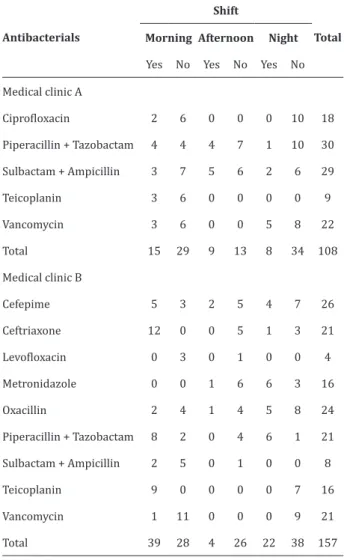
Of the 265 observations, the classes of antibac-terials most used in the Clinics were: penicillins 112 (42.3%), glycopeptides 68 (25.7%), cephalosporins 47 (17.7%), quinolones 22 (8.3%) and imidazole 16 (6.0%). Levofloxacin was the least used antibacterial, at a frequency of four times, as Table 1.
Table 1 – Distribution of antibacterial types and amount of drug interactions (n=265)
Antibacterials
Shift
Total Morning Afternoon Night
Yes No Yes No Yes No
Medical clinic A
Ciprofloxacin 2 6 0 0 0 10 18
Piperacillin + Tazobactam 4 4 4 7 1 10 30
Sulbactam + Ampicillin 3 7 5 6 2 6 29
Teicoplanin 3 6 0 0 0 0 9
Vancomycin 3 6 0 0 5 8 22
Total 15 29 9 13 8 34 108
Medical clinic B
Cefepime 5 3 2 5 4 7 26
Ceftriaxone 12 0 0 5 1 3 21
Levofloxacin 0 3 0 1 0 0 4
Metronidazole 0 0 1 6 6 3 16
Oxacillin 2 4 1 4 5 8 24
Piperacillin + Tazobactam 8 2 0 4 6 1 21
Sulbactam + Ampicillin 2 5 0 1 0 0 8
Teicoplanin 9 0 0 0 0 7 16
Vancomycin 1 11 0 0 0 9 21
Total 39 28 4 26 22 38 157
It is important to note that 23 doses of Pipera-cillin + Tazobactam were administered combined with other medications, such as Lithium and Furosemide. Metronidazole and Teicoplanin also stood out in this aspect, with approximately half of the doses admin-istered under potential drug interaction. The drug-drug interaction was the most frequent; concomitant administration with injectable anticoagulants, such as low molecular weight Sodium Heparin, and the asso-ciation between cephalosporins with penicillins (oxa-cillin) were frequent.
Some drugs had printed guidelines about the administration available in the sector: in Clinic B, the
guidelines for Piperacillin and Tazobactam were pres-ent, while in Clinic A, information was available about Teicoplanin, Sulbactam and Ampicillin.
Table 2 presents the data related to the drug in-teraction induced by scheduling associated with the existence of printed guidelines about administration in the sector. It is noteworthy that in Clinic B there was less availability of printed information and statistical association with greater number of scheduling that in-duced interactions (p=0,003).
Table 2 – Association between drug interaction indu-ced by scheduling and availability of printed guideli-nes on antibacterial administration (n=265)
Drug interac-tion induced by scheduling
Availability of printed guidelines on antibacterial administration
Total p*
Yes No
Medical clinic A
Yes 20 12 32
No 39 37 76 0.286
Total 59 49 108
Medical clinic B
Yes 16 49 65
No 7 85 92 0.003
Total 23 134 157
*Chi-square test
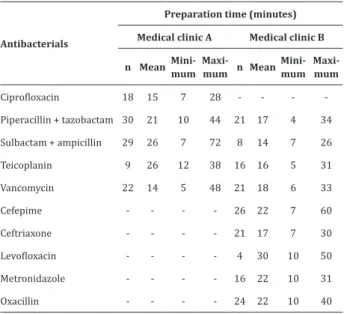
Regarding the types of errors observed, the wrong choice of medication occurred in 29 (11.6%) preparations and dose errors occurred in 81 (32.5%), with a tendency to subdose. Regarding the time, the preparation time was prolonged in some situations, which may influence the pharmacological stability of the medicines and, therefore, configure an error.
Among the erroneously chosen drugs, the si-milarity in the names of the antibacterials may have generated some confusion or mistake in the selection of the drug to be prepared, such as those of the class of cephalosporins (Ceftriaxone, Cefemipe and Cefazolin).
to 30 minutes. It was observed that Sulbactam, Ampi-cillin and Cefepime were the drugs with the highest preparation time, 60 and 72 minutes, respectively. While the highest mean, 30 minutes, was seen in Le-vofloxacin. On the other hand, a finding that requires attention was the minimum time of 4 minutes for the preparation of Piperacillin and Tazobactam in Clinic B.
Table 3 – Distribution of preparation time of antibac-terials in Clinics A and B (n=265)
Antibacterials
Preparation time (minutes)
Medical clinic A Medical clinic B
n Mean Mini-mum
Maxi-mum n Mean
Mini-mum
Maxi-mum
Ciprofloxacin 18 15 7 28 - - -
-Piperacillin + tazobactam 30 21 10 44 21 17 4 34
Sulbactam + ampicillin 29 26 7 72 8 14 7 26
Teicoplanin 9 26 12 38 16 16 5 31
Vancomycin 22 14 5 48 21 18 6 33
Cefepime - - - - 26 22 7 60
Ceftriaxone - - - - 21 17 7 30
Levofloxacin - - - - 4 30 10 50
Metronidazole - - - - 16 22 10 31
Oxacillin - - - - 24 22 10 40
In situations where the preparation time was more than 30 minutes, the cause of the delay was the interruption to perform other activities.
Discussion
The present study presents as a limitation the investigation in a specific scenario, which may differ from the reality of other medical clinics. In addition, the data obtained refer to the scheduling and prepa-ration of antibacterials, so that other pharmacological classes may have different results.
Antibiotics are often used to treat diseases re-lated to bacterial infection due to the efficient action and clinical urgency of solubility. Drug interaction as a result of drug antagonism may weaken the
antibio-tic action, and ineffective treatment of infections may lead to worse prognosis and death of the patient(1,11).
In view of the use of multiple drugs in the hospital context, interactions may occur and impaired antibio-tic efficacy may contribute to the development of bac -terial resistance to antibiotics(12-13).
According to a study that analyzed 53 cultures for antibiogram of patients with hospital infection ad-mitted in the Intensive Care Unit, the major bacterial resistances were related to cephalosporins and glyco-peptides(5). These classes corresponded to 43.4% of
the antibacterials administered in the Medical Clinics investigated in this study. The wide use in the medical clinic, added with the bacterial resistance detected in another study, alerts the nursing staff to pay extra at-tention with the scheduling of such drugs.
International study results on errors in drug administration in an emergency unit confirm that in -congruities in scheduling are the most common errors in this stage(14). When considering that the
adminis-tration schedule depends on the time invested in the drug preparation, the relevance of the results of this study, which point out the duration of 72 minutes in the preparation of some antibacterials, is highlighted.
Delay in the preparation can cause delay of the infusion, which is an error with serious consequences, since the prescription and the delay meet the need of maintaining the plasma levels for action of the medici-ne that consider its half-life and elimination. So, when these levels are not maintained by a new infusion, the microorganism can develop mechanisms of adapta-tion and become resistant to that active principle(2).
In addition, long-term preparation may promote en-vironmental exposure of the drug and promote con-tamination of the devices used in the preparation and administration(15).
bacte-rium, otherwise there may be considerable difficulty for penetration of the active principle into the micro-organism. Thus, when there is wrong selection of the drug in the preparation or administration, the patient may be exposed to an ineffective and pharmacodyna-mically incompatible substance to that bacterium(13).
The frequency of dose errors found in this stu-dy coincides with that shown in a national assessment of 3,500 records of medication errors, of which 11.4% were dose errors(4). In this case, the wrong dose of
antimicrobial may compromise the bioavailability, efficacy and therapeutic effect of the active principle, culminating, in some cases, with potentiated toxicity and/or increased bacterial resistance.
It was observed that the unavailability of gui-delines on the administration of medications was sta-tistically related to the scheduling of drugs with drug interaction to be administered at the same time. Such a finding suggests that nurses responsible for schedu -ling tend not to make mistakes if written instructions are available, which raises awareness on the relevance of the availability of printed instructions on the sub-ject for consultation of professionals.
In this context, it is relevant that such instruc-tions have enough information to support safe use by nurses, which must include: name of the drug, route, indication, contraindication, presentation, dosage, di-lution/reconstitution technique, stability, adverse re-actions, infusion and potential drug interactions(16). In
addition, it is important to provide training and raise awareness of the professionals so that the use of the materials occurs correctly and they feel stimulated to adhere to the available resource(17).
The administrative and organizational struc-ture of health institutions motivates the nursing staff to follow institutionally standardized schedules, and such standardization requires a lot of attention from the nurses responsible for the scheduling so that the possibility of potential drug interaction is considered in the drug scheduling of each patient(18). In order to
avoid drug interaction resulting from scheduling, we highlight the computerization of the medical
prescrip-tion and nursing scheduling associated to some tool in the computerized system that prevents the scheduling of medicines with drug interaction for the same time as a strategy that can be effective.
We expect that this study may contribute to alert nursing professionals to the need to organize me-dication administration schedules taking into account pharmacokinetic and pharmacodynamic principles in order to guarantee greater effectiveness regarding the active principle used and to avoid interactions. In addition, the findings lead to a reflection on the need for the rational use of antimicrobials and, finally, it is a set of indicators that can support the planning of trai-ning and improvement in nursing education.
Conclusion
The potential drug interactions resulting from the scheduling of antibacterials together with another drug occurred with a higher prevalence in the mor-ning shift (Piperacillin + Tazobactam administered in combination with Lithium and Furosemide, Metro-nidazole and Teicoplanin; and drug-drug interaction with injectable anticoagulants, and the association be-tween cephalosporins and penicillins (oxacillin)), and were associated with the lack of availability of printed guidelines on drug administration in the sector. This way, the scheduling of antibacterials in the medical cli-nic sector may potentiate possible drug interactions, and dose errors are identified in the administration of drugs.
Collaborations
References
1. Holloway KA, Rosella L, Henry D. The impact of WHO Essential Medicines Policies on inappropriate use of antibiotics. PLoS One. 2016; 11(3):e0152020. doi: doi.org/10.1371/journal. pone.0152020
2. Guillaudin M, Griveaux A, Te Bonle F, Jandard V, Paillet M, Camus G, et al. Preparation and administration of injectable antibiotics: a tool for nurses. Rev Infirm [Internet]. 2013 [cited 2017 nov. 15]; 196:38-40. Available from: https://www. ncbi.nlm.nih.gov/pubmed/24427920
3. Bozkurt F, Kaya S, Tekin R, Gulsun S, Deveci O, Dayan S, et al. Analysis of antimicrobial consumption and cost in a teaching hospital. J Infect Public Health. 2014; 7(2):161-9. doi: http:// dx.doi.org/10.1016/j.jiph.2013.09.007
4. Santos L, Winkler N, Dos Santos MA, Martinbiancho J. Description of medication erros detected at a drug information Centre in Southern Brazil. Pharm Pract [Internet]. 2015 [cited 2017 nov. 12]; 13(1):524-31. Available from: https://www.ncbi. nlm.nih.gov/pubmed/25883691
5. Paes ARM, Câmara JT, Santos DAS, Portela NLC. Estudo epidemiológico de infecção hospitalar em Unidade de Terapia Intensiva. Rev Enferm UFPI [Intertnet]. 2014 [citado 2017 dez 20]; 3(4):10-7. Disponível em: http://www.ojs.ufpi.br/index. php/reufpi/article/view/1858
6. Queiroz KCB, Nascimento MFS, Fernandes V, Miotto FA. Análise das interações medicamentosas identificadas em prescrições da UTI neonatal da ICU-HGU. UNOPAR Cient Ciênc Biol Saúde [Internet]. 2014 [citado 2017 dez 03]; 16(3):203-7. Disponível em: http://www.pgsskroton. com.br/seer/index.php/JHealthSci/article/ view/445/415
7. D’Aquino FFR, Juliani CMCM, Lima SAM, Spiri WC, Gabriel CS. Drug-related incidents in a hospital: input to improving management. Rev Enferm UERJ [Internet]. 2015 [cited 2017 Dec. 03]; 23(5):616-21. Available from: http://www.e-publicacoes.uerj.br/index.php/enfermagemuerj/ article/view/10637/18592
8. Silva AEBC, Cassiani SHB. Prospective risk analysis of the anti-infective medication administration process. Rev Latino-Am Enfermagem. 2013; 21(esp):233-41. doi: http://dx.doi.org/10.1590/ S0104-11692013000700029
9. World Health Organization. Collaborating Centre for Drug Statistics Methodology. Anatomical Therapeutic Chemical (ATC) index with Defined Daily Doses (DDDs). New York: WHO; 2013. 10. Saraiva DMRS. Erros de medicação: tipos,
taxono-mia impacto, causalidade e estratégia de gestão do risco. Egitnia Sci [Internet]. 2016 [citado 2017 dez. 20]; 9:7-22. Disponível em: https:// search.proquest.com/openview/b845556a2c- 537632760251693671c993/1?pq-origsite=g-scholar&cbl=1246356
11. Becker DE. Antimicrobial drugs. Anesth Prog. 2013; 60(3):111-23. doi: http://dx.doi. org/10.2344/0003-3006-60.3.111
12. Munck C, Gumpert HK, Wallin AIN, Wang HH, Sommer MO. Prediction of resistance develop-ment against drug combinations by collateral responses to component drugs. Sci Transl Med. 2014; 6(262):262ra156. doi: http://dx.doi. org/10.1126/scitranslmed.3009940
13. Rodriguez de Evgrafov M, Gumpert H, Munck C, Thomsen TT, Sommer MO. Collateral resistance and sensitivity modulate evolution of high-level resistance to drug combination treatment in Staphylococcus aureus. Mol Biol Evol. 2015; 32(5):1175-85. doi: http://dx.doi.org/10.1093/ molbev/msv006
14. Vazin A, Zamini Z, Hatam N. Frequency of medication erros in an emergency department of a large teaching hospital in Southern Iran. Drug Healthc Patient Saf. 2014; 6:179-84. doi: http:// dx.doi.org/10.2147/DHPS.S75223
15. Ministério da Saúde (BR). Agência Nacional de Vigilância Sanitária. Protocolo de segurança na prescrição, uso e administração de medicamentos. Brasília: Ministério da Saúde; 2013.
17. Ministério da Saúde (BR). Agência Nacional de Vigilância Sanitária. Gerência de Vigilância e Monitoramento em Serviços de Saúde (GVIMS). Gerência Geral de Tecnologia em Serviços de Saúde (GGTES). Investigação de Eventos Adversos em Serviços de Saúde. Brasília: Ministério da Saúde; 2013.