O
RIGINALA
RTICLE14
Authors
Carmen Tzanno Branco Martins1
Geison Stein Meirelles Ramos1
Simone Adriana Guaraldo1
Clarissa Baia Bargas Uezima1
João Paulo Lian Branco Martins1 Elzo Ribeiro Junior1
1Centro Integrado de
Nefrologia – CINE; Home Dialysis Center.
Submitted on: 01/27/2010 Approved on: 09/28/2010
Corresponding author:
Carmen Tzanno Branco Martins
Rua Poeta Castro Alves, 173, Vila das Palmeiras Guarulhos – SP – Brazil CEP: 07013-150 Phone: 55 11 2358-2067 E-mail:
The present study was conducted at the Centro Integrado de Nefrologia (CINE) and Home Dialysis Center.
Authors declare no conlict of interest.
A
BSTRACTPhysical inactivity is a determinant of clini-cal disorders and psychologiclini-cal problems in patients with chronic kidney disease. In two satellite clinics, a program of physi-cal activity (PA) was offered to 86 patients undergoing hemodialysis. Of those, 49 pa-tients entered the PA program spontane-ously and 37 remained inactive. After six months, a satisfaction self-reported ques-tionnaire and the Modified Mini-Mental State (3MS) Examination for assessment of cognitive function were applied. Cognition was compared between inactive patients and those participating in the PA program for at least three months. Regardless of age and duration of dialysis, patients showed a cognitive deficit greater than expected. In the general group, better cognitive function was observed in active patients as com-pared to the inactive ones (p < 0.05). When separated by age groups, active patients over the age of 60 years had better results than the inactive ones (p < 0.05). We con-cluded that patients with better cognitive responses are more physically active and/ or physical activity contributes to better cognitive function.
Keywords: cognition, physical educational and training, chronic kidney failure, renal dialysis.
[J Bras Nefrol 2011;33(1): 14-16]©Elsevier Editora Ltda.
Comparison of cognitive function between patients on
chronic hemodialysis who carry out assisted physical
activity and inactive ones
I
NTRODUCTIONPhysical inactivity is one of the factors contributing to the increase in clinical dis-orders1 and psychological problems2 in
pa-tients witn chronic kidney disease. Aiming at raising the consciousness of patients about the importance of physical activity and its benefits, a joint work of psycholo-gists and physical trainers was implemented
at two satellite clinics, the CINE (Centro Integrado de Nefrologia) and the Home Dialysis Center, in the city of São Paulo, São Paulo state. A physical activity (PA) program with spontaneous patients’ entry was elaborated for individuals undergoing hemodialysis (HD) treatment.
P
ATIENTS ANDM
ETHODSThe PA program consists of two weekly 20- to 30-minute sessions of combined strengthening and peripheral muscle re-sistance exercises and stretching, always preceding the HD sessions. The PA pro-gram aims at improving muscle strength and stretching to make patients’ daily chores easier. The patients’ entry into the PA program is spontaneous.
The PA program was offered to 86 pa-tients who had been in a HD program for at least six months. Forty-nine patients en-tered the PA program, while 37 remained inactive. To be considered active, patients had to participate in the supervised PA program for at least three months with 100% attendance.
After six months, the modified mini-mental state (3MS)3 examination was
J Bras Nefrol 2011;33(1):14-16 15
Comparison of cognitive function between patients on chronic HD who carry out assisted physical activity and inactive ones
patients were divided into groups according to their ages as follows: Group I, patients under the age of 35 years (n = 11); Group II, patients aged from 35 to 60 years (n = 47); and Group III, patients over the age of 60 years (n = 28). As there were two categori-cal variables (physicategori-cal activity and result of the 3MS examination), the Chi-square test and the Fisher exact test were performed.
When comparing the score obtained in the 3MS ex-amination (numerical data), inactive individuals scored lower than active individuals in the general group and in Group III. No difference was observed in the other groups. Mann-Whitney nonparametric test was used.
After the period of six months of the PA inter-vention, a self-reported questionnaire was applied to assess the patient’s satisfaction with the program. It consisted of the following one open and six multiple-choice questions related to body pain, physical and psychic changes, and participation:
1) Have you experienced body pain?
a) Yes b) No
2) Have you noticed any change after beginning to exercise?
a) Yes b) No
3) How do you assess the duration of the exercise sessions?
a) Insufficient b) Fair c) Too long 4) How do you rate the exercises?
a) Light b) Good c) Heavy 5) What do you aim at by exercising?
a) Improvement in life quality and/or physical fitness b) Pain reduction c) Other
6) What do you think about exercising before the HD session?
a) Good b) Bad c) No answer 7) Suggestions:
_________________________________________ _________________________________________
R
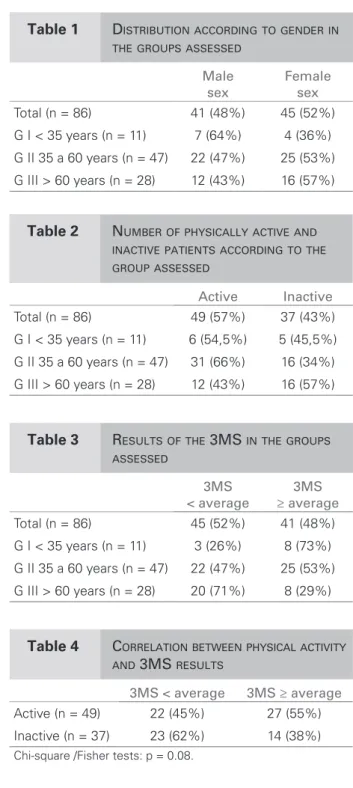
ESULTSGender distribution was similar in the three groups assessed (Tables 1 and 2).
A progressive deficiency in cognitive function re-lated to age was observed (Table 3). When comparing cognitive function and physical activity as categori-cal variables, patients with average results or results above average showed a tendency towards being the most physically active. This suggests that the number of patients assessed should be increased (Table 4).
The patients’ scores obtained in the general group (n = 86) and according to the age bracket were com-pared. A significant difference was observed in Group III. Physically active patients scored highest in 3MS. A score reduction was observed as age increased both in the active and inactive groups. However, the physi-cally inactive group showed the greatest loss (80 ± 13; 75 ± 19; and 62 ± 15) (Table 5).
The physical activity practice in that population resulted in positive responses in the self-reported ques-tionnaire. In the physically active group, 52% of the patients showed a reduction in pain complaints and Table 1 DISTRIBUTION ACCORDING TO GENDER IN
THE GROUPS ASSESSED
Male sex
Female sex
Total (n = 86) 41 (48%) 45 (52%)
G I < 35 years (n = 11) 7 (64%) 4 (36%)
G II 35 a 60 years (n = 47) 22 (47%) 25 (53%)
G III > 60 years (n = 28) 12 (43%) 16 (57%)
Table 2 NUMBER OF PHYSICALLY ACTIVE AND INACTIVE PATIENTS ACCORDING TO THE GROUP ASSESSED
Active Inactive
Total (n = 86) 49 (57%) 37 (43%)
G I < 35 years (n = 11) 6 (54,5%) 5 (45,5%)
G II 35 a 60 years (n = 47) 31 (66%) 16 (34%)
G III > 60 years (n = 28) 12 (43%) 16 (57%)
Table 3 RESULTS OF THE 3MS IN THE GROUPS ASSESSED
3MS < average
3MS ≥ average
Total (n = 86) 45 (52%) 41 (48%)
G I < 35 years (n = 11) 3 (26%) 8 (73%)
G II 35 a 60 years (n = 47) 22 (47%) 25 (53%)
G III > 60 years (n = 28) 20 (71%) 8 (29%)
Table 4 CORRELATION BETWEEN PHYSICAL ACTIVITY AND 3MS RESULTS
3MS < average 3MS ≥ average
Active (n = 49) 22 (45%) 27 (55%)
Inactive (n = 37) 23 (62%) 14 (38%)
J Bras Nefrol 2011;33(1):14-16
16
Comparison of cognitive function between patients on chronic HD who carry out assisted physical activity and inactive ones
25% of them provided a positive response regarding an increase in one’s perception of health, expressed as well-being and mood enhancement.
The results have been interpreted as satisfactory, and the PA program maintained and encouraged.
D
ISCUSSIONOn average, the prevalence of cognitive deficit in the Brazilian population over the age of 60 years ranges from 5.9% to 29.7%.4,5 In a meta-analysis assessing
27 studies, Jorm et al6 have reported that the
preva-lence of dementia doubles every 5.1 years from the age of 60 years. In the sample studied, patients with chronic kidney disease undergoing a HD program showed, regardless of gender and duration of the di-alysis treatment, a cognitive impairment above that expected for their respective age bracket (26%, 47%, and 71%). Such findings are corroborated by the study by Yaffe K et al7 demonstrating a reduction in
the cognitive response of patients with chronic kidney disease in the pre-dialysis phase.
Cognition is an important factor for determining the therapeutic approach and for assessing adherence to treatment.
Recently, a study conducted by the Group of Cognitive Neurology and Behavior of the Neurology Clinic of the Hospital das Clinicas of the Medical School of the University of São Paulo has shown that more than half of the population has difficulty in understanding information about administration of medication, results of tests, and scheduling of medi-cal visits. The study assessed 312 individuals, 32.4% of whom showed difficulty in understanding phrases and simple texts. Among the elderly, that rate reached 51.6%. Although the study focused on functional il-Although the study focused on functional il-literacy, the cognitive impairment in the elderly popu-lation cannot be excluded as a limiting factor to ad-herence to treatment.8
Considering that 39% of the patients on a chronic HD program in Brazil9 are over the age of 60 years,
and that in the sample studied 71% of the patients had cognitive impairment at that age, we believe that
the multiprofessional team should be encouraged to adopt a simpler and more direct approach. In ad-dition, instruction sessions should be provided to caregivers.
C
ONCLUSIONWe concluded that patients with better cognitive re-sponses are more physically active and/or that physi-cal activity contributes to improve cognitive function.
R
EFERENCES1. Medeiros RH, Pinent CEC. Aptidão física do indivi-duo com doença renal crônica. J Bras Nefrol 2002; 24:81-7.
2. Velloso RLM. Efeitos da hemodiálise no campo sub-jetivo dos pacientes renais crônicos.Cogito. [Epub] 2001; 3:73-82.
3. Moura SM. Contribuições de quatro instrumentos de triagem para o diagnóstico de déficits cognitivos no envelhecimento no Brasil: validade de critério e nor-mas de desempenho, FAFICH-UFMG, Belo Horizonte 2008.
4. Almeida Filho N, Santana VS, Pinho AR. Estudo epi-demiológico dos transtornos mentais em uma popu-lação de idosos: área urbana de Salvador - BA. J Bras Psiquiatr 1984; 33:114-20.
5. Veras RP, Coutinho E. Prevalência da síndrome ce-rebral orgânica em população de idosos de área me-tropolitana da região sudeste do Brasil. Rev Saúde Pública1994; 28: 26-37.
6. Jorm AF, Korten AE, Henderson AS. The prevalence of dementia: A quantitative integration of the litera-ture. Acta Psychiatr Scand 1987; 76:465-79.
7. Yaffe K, Ackerson L, Tamura MK et al. Chronic
Kidney Disease and Cognitive Function in Older Adults: Findings from the Chronic Renal Insufficiency Cohort Cognitive Study. J Am Geriatric Soc [Epub] 2010; 58:33845.
8. Carthery-Goulart MT, Anghinah R, Areza-Fegyveres R et al. Performance of a Brazilian population on the test of functional health literacy in adults. Rev Saúde Pública [Epub] 2009; 43:631-8.
9. Sociedade Brasileira de Nefrologia. Censo SBN 2009. Disponível em: [http://www.sbn.org.br/pdf/censo_SBN _2009_final.pdf].
Total < 35 years 35 – 60 years > 60 years
N 3MS n 3MS n 3MS N 3MS
Inactive 37 70 ± 17a 5 80 ± 13 16 75 ±19 16 62 ± 15 c
Active 49 80 ±13 b 6 90 ± 7 31 80 ±12 12 75 ± 15 d
a x b: p = 0.004; c x d: p = 0.02; a x d p < 0.05.