ORIGINAL ARTICLE
552
Do Foley Catheters Adequately Drain the Bladder? Evidence
from CT Imaging Studies
_______________________________________________
Svetlana Avulova
1, Valery J. Li
1, Johnathan A. Khusid
1, Woo S. Choi
2, Jeffrey P. Weiss
1,31 Department of Urology, SUNY Downstate College of Medicine, Brooklyn, NY, USA; 2 Radiology, SUNY Downstate College of Medicine, Brooklyn, NY, USA; 3 Department of Urology, Weill Cornell Medical College, New York, NY, USA
ABSTRACT
ARTICLE
INFO
______________________________________________________________ ______________________
Introduction: The Foley catheter has been widely assumed to be an effective means of draining the bladder. However, recent studies have brought into question its efficacy. The objective of our study is to further assess the adequacy of Foley catheter for com-plete drainage of the bladder.
Materials and Methods: Consecutive catheterized patients were identified from a re-trospective review of contrast enhanced and non-contrast enhanced computed tomo-graphic (CT) abdomen and pelvis studies completed from 7/1/2011-6/30/2012. Residual urine volume (RUV) was measured using 5mm axial CT sections as follows: The length (L) and width (W) of the bladder in the section with the greatest cross sectional area was combined with bladder height (H) as determined by multiplanar reformatted ima-ges in order to calculate RUV by applying the formula for the volume (V) of a sphere in a cube:V=(π/6)*(L*W*H).
Results: RUVs of 167 (mean age 67) consecutively catheterized men (n=72) and women (n=95) identified by CT abdomen and pelvis studies were calculated. The mean RUV was 13.2 mL (range: 0.0 mL-859.1 mL, standard deviation: 75.9 mL, margin of error at 95% confidence:11.6 mL). Four (2.4%) catheterized patients had RUVs of >50 mL, two of whom had an improperly placed catheter tip noted on their CT-reports.
Conclusions: Previous studies have shown that up to 43% of catheterized patients had a RUV greater than 50 mL, suggesting inadequacy of bladder drainage via the Foley catheter. Our study indicated that the vast majority of patients with Foley catheters (97.6%), had adequately drained bladders with volumes of <50 mL.
Key words:
Urinary Catheterization; Tomography, X-Ray Computed; Urinary Bladder
Int Braz J Urol. 2015; 41: 552-5
_____________________
Submitted for publication: August 02, 2014
_____________________
Accepted after revision: December 10, 2014
INTRODUCTION
The Foley catheter has been a staple of me-dical care since its inception in 1935 by American urologist Frederic Foley (1). Though there have been modifications in the 80 years since its cre-ation, the Foley catheter has withstood the test of time and is considered an acceptable means for bladder drainage in the appropriate setting. One
of the main complications of its use is catheter--associated urinary tract infection (CAUTI).
The prevalence of CAUTI is high, as up to 40% of catheterized patients in the acute hospital care setting develop CAUTI (2). This, in conjunc-tion with the fact that up to 25% of patients ad-mitted to hospitals have a urinary catheter placed at some point during their stay highlights the he-althcare burden generated by CAUTI (3). Although
IBJU| EFFICACY OF FOLEY CATHETER AS MEASURED BY CT-SCAN
553
the cost of each CAUTI is estimated to be less than $600, the additive cost to hospitals for lack of Me-dicare and Medicaid reimbursement of a “preven-table complication” is considerable (4, 5).For each day that a catheter is in place, 3-7% of patients may develop a CAUTI (6). By the 30th day of catheterization, the incidence of CAU-TI or catheter-associated asymptomatic bacteriu-ria (CAASB) is almost 100% (7). Failure to keep the urinary collection bag in a gravity dependent position is the most commonly violated catheter care-related recommendation, and can double the relative risk of developing CAUTI or CAASB (8).
One potentially modifiable factor to im-pact the incidence of CAUTI is inadequate drai-nage of the bladder. Stoller et al. suggested that Foley catheters do not consistently and constantly drain urine from the bladder, with 43% of patients found to have a residual urine volume >50 mL (8). A previous study found that clinically asymp tomatic men with a post-void residual volume (PVR) of >180 mL are at high risk for developing bacteriuria (9). Further, PVR >150 mL in a non--catheterized patient is associated with an incre-ased risk of developing a urinary tract infection (10). Taking these findings together, it would seem logical that we can reduce the incidence of CAUTI by addressing the problem of inadequate bladder drainage by Foley catheters. As such, the purpose of our study was to evaluate the efficacy of the Foley catheter in bladder drainage.
MATERIALS AND METHODS
After obtaining approval from our Institu-tional Review Board (approved protocol #330937-1), we retrospectively identified 167 consecutively catheterized patients via contrast enhanced and non-enhanced abdominal and pelvic CT studies from 7/1/2011-6/30/2012. Patients with suprapu-bic bladder drainage catheters were excluded.
We assessed residual urine volume (RUV) by utilizing the 5mm axial section demonstrating the greatest bladder cross sectional area. Using co-ronal multiplanar reformatted images to determi-ne maximum bladder height, RUV was calculated by means of the formula for the volume (V) of a sphere in a cube with a given length (L), width (W), and height (H): V=(π/6)*(W*L*H).
RESULTS
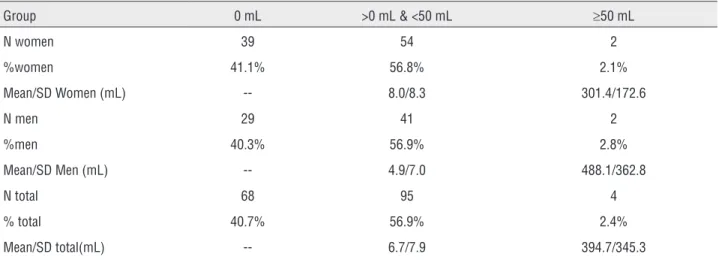
Patients were stratified into three groups: RUV =0 (n=68, 40.7%), RUV >0 and <50 mL (n=95, 56.9%, mean=6.7 mL, standard deviation (st dev) =7.9 mL), and RUV ≥50 mL (n=4, 2.4%, mean=394.7 mL, st dev=345.3 mL). Two of the four patients with RUV ≥50 mL were found to have improperly placed catheters by CT. The ove-rall mean RUV was 13.2 mL with a st dev of 75.9 mL and margin of error of 11.6 mL for a 95% con-fidence interval.
We further stratified patients by gender. Thirty nine women (41%) had RUV =0 mL, 54 (57%) had a RUV >0 mL and <50 mL (mean=8.0 mL, st dev=8.3 mL), and 2 (2%) had RUV ≥50 mL, (mean=301.4 mL, st dev=172.6 mL). The overall mean RUV for women was 10.9 mL with a st dev of 50.0 mL. Twenty nine men (40.3%) had RUV=0 mL, 41 (57%) had a residual urine volume of >0 mL and <50 mL, (mean=4.9 mL, st dev =7.0 mL), and 2 (2.8%) had RUV >50 mL (mean=488.1 mL, st dev=362.8 mL). The overall mean RUV for men was 16.2 mL, with a st dev of 100.2 mL. A summa-ry of our data analysis is provided in Table-1.
DISCUSSION
IBJU| EFFICACY OF FOLEY CATHETER AS MEASURED BY CT-SCAN
554
In the present study, while only 2% of pa-tients had a RUV of >50 mL, 59% of papa-tients a RUV of >0 mL, indicating that for most patients the Foley catheter does not completely drain the bladder. Though some of the smaller volumes may be considered negligible, 16% of our patients (n=26) had a RUV of >10 mL.We found that half (2/4) of the patients with a RUV >50 mL had an improperly placed catheter, emphasizing the importance of catheter placement technique and urine output monitoring. Hence, the vast majority of properly placed cathe-ters appear to drain the bladder at least moderate-ly well with an arbitrary “cut point” of 50 mL. The importance of finite RUV <50 mL in catheterized patients has yet to be determined.
CONCLUSIONS
In summary, our retrospective study pro-vides three principal findings:
1) For the vast majority of patients the Foley ca-theter adequately drained the bladder;
2) There were no gender differences in the efficacy of the Foley catheter in bladder drainage;
3) Improper placement of a Foley catheter can lead to significant urinary retention.
ABBREVIATIONS
CAUTI = catheter-associated urinary tract in-fection
CAASB = catheter-associated asymptomatic bac-teriuria
PVR = post-void residual volume
RUV = residual urine volume
L = length
W = width
H = height
V = volume
St dev = standard deviation
CONFLICT OF INTEREST
None declared.
REFERENCES
1. Carr HA. A short history of the Foley catheter: from handmade instrument to infection-prevention device. J Endourol. 2000; 14:5-8.
2. National Nosocomial Infections Surveillance System. National Nosocomial Infections Surveillance (NNIS) System Report, data summary from January 1992 through June 2004, issued October 2004. Am J Infect Control. 2004; 32:470-85.
3. Weinstein JW, Mazon D, Pantelick E, Reagan-Cirincione P, Dembry LM, Hierholzer WJ Jr. A decade of prevalence surveys in a tertiary-care center: trends in nosocomial infection rates, device utilization, and patient acuity. Infect Control Hosp Epidemiol. 1999; 20:543-8.
4. Tambyah PA, Knasinski V, Maki DG. The direct costs of nosocomial catheter-associated urinary tract infection in the era of managed care. Infect Control Hosp Epidemiol. 2002; 23:27-31.
Table 1 - Summary of Data.
Group 0 mL >0 mL & <50 mL ≥50 mL
N women 39 54 2
%women 41.1% 56.8% 2.1%
Mean/SD Women (mL) -- 8.0/8.3 301.4/172.6
N men 29 41 2
%men 40.3% 56.9% 2.8%
Mean/SD Men (mL) -- 4.9/7.0 488.1/362.8
N total 68 95 4
% total 40.7% 56.9% 2.4%
Mean/SD total(mL) -- 6.7/7.9 394.7/345.3
IBJU| EFFICACY OF FOLEY CATHETER AS MEASURED BY CT-SCAN
555
5. Saint S, Meddings JA, Calfee D, Kowalski CP, Krein SL.Catheter-associated urinary tract infection and the Medicare rule changes. Ann Intern Med. 2009; 150:877-84.
6. Nicolle LE. Catheter-related urinary tract infection. Drugs Aging. 2005; 22:627-39.
7. Maki DG, Tambyah PA. Engineering out the risk for infection with urinary catheters. Emerg Infect Dis. 2001; 7:342-7. 8. Garcia MM, Gulati S, Liepmann D, Stackhouse GB, Greene
K, Stoller ML. Traditional Foley drainage systems--do they drain the bladder? J Urol. 2007; 177:203-7; discussion 207. 9. Truzzi JC, Almeida FM, Nunes EC, Sadi MV. Residual urinary
volume and urinary tract infection--when are they linked? J Urol. 2008; 180:182-5.
10. Dromerick AW, Edwards DF. Relation of postvoid residual to urinary tract infection during stroke rehabilitation. Arch Phys Med Rehabil. 2003; 84:1369-72.
11. Hakenberg OW, Ryall RL, Langlois SL, Marshall VR. The estimation of bladder volume by sonocystography. J Urol. 1983; 130:249-51.
12. Simforoosh N, Dadkhah F, Hosseini SY, Asgari MA, Nasseri A, Safarinejad MR. Accuracy of residual urine measurement in men: comparison between real-time ultrasonography and catheterization. J Urol. 1997; 158:59-61.
_______________________ Correspondence address:
Johnathan Alexander Khusid, MD Department of Urology, SUNY Downstate